Post-traumatic stress disorder (PTSD) affects between 3% and 5% of community populations (Kessler et al., Reference Kessler, Berglund, Demler, Jin and Walters2005; McEvoy et al., Reference McEvoy, Grove and Slade2011). There is an overwhelming evidence for the efficacy of exposure-based cognitive behaviour therapy (CBT) as a treatment of PTSD, and this has been demonstrated in survivors of rape (Foa et al., Reference Foa, Rothbaum, Riggs and Murdock1991), assaults (Resick et al., Reference Resick, Galovski, O'Brien Uhlmansiek, Scher, Clum and Young-Xu2008), accidents (Bryant et al., Reference Bryant, Moulds, Guthrie, Dang, Mastrodomenico, Nixon, Felmingha, Hopwood and Creamer2008) and war (Schnurr et al., Reference Schnurr, Friedman, Engel, Foa, Shea, Chow, Resick, Thurston, Orsillo, Haug, Turner and Bernardy2007). Accordingly, international treatment guidelines recommend TF-CBT as the treatment of choice for PTSD (National Institute for Clinical Excellence, 2005; Institute of Medicine, 2008).
Despite the extensive evidence on treating PTSD across many populations, there are no properly controlled studies of treating PTSD in emergency service personnel. This is an outstanding gap in our knowledge because a meta-analysis of 28 studies indicates that 10% of first responders meet criteria for PTSD (Berger et al., Reference Berger, Coutinho, Figueira, Marques-Portella, Luz, Neylan, Marmar and Mendlowicz2012). This rate of PTSD is not surprising considering the repeated trauma exposure experienced by emergency service personnel. Two small studies of treating emergency service personnel have reported that programmes that contained elements of CBT resulted in greater PTSD reduction relative to wait-list (WL) (Gersons et al., Reference Gersons, Carlier, Lamberts and van der Kolk2000; Difede et al., Reference Difede, Malta, Best, Henn-Haase, Metzler, Bryant and Marmar2007). The absence of large, well-controlled trials of CBT for emergency service personnel impedes agencies from knowing the optimal procedures for managing PTSD in emergency service personnel. The need for evidence regarding the treatment of PTSD in emergency service personnel is indicated because emergency service personnel have complex clinical profiles, including high rates of comorbid depression, panic disorder and alcohol abuse (Pietrzak et al., Reference Pietrzak, Schechter, Bromet, Katz, Reissman, Ozbay, Sharma, Crane, Harrison, Herbert, Levin, Luft, Moline, Stellman, Udasin, Landrigan and Southwick2012); emotional numbing (Galatzer-Levy et al., Reference Galatzer-Levy, Madan, Neylan, Henn-Haase and Marmar2011); and marked relationship difficulties (Cone et al., Reference Cone, Li, Kornblith, Gocheva, Stellman, Shaikh, Schwarzer and Bowler2015). Although these profiles may be comparable to military and veteran populations, emergency response personnel may be different from these populations because they function within a civilian context and work within distinctive cultural contexts (Berger et al., Reference Berger, Coutinho, Figueira, Marques-Portella, Luz, Neylan, Marmar and Mendlowicz2012; Cone et al., Reference Cone, Li, Kornblith, Gocheva, Stellman, Shaikh, Schwarzer and Bowler2015).
A key component of treating PTSD is exposure to traumatic memories. This procedure is based on the premise that engagement of trauma memories overcomes avoidance of trauma reminders, facilitates mastery of memory-related distress and fosters habituation of anxiety (Foa, Reference Foa2011). Despite its efficacy, this intervention faces several challenges. First, it traditionally involves 40–60 min of imaginal exposure to the trauma memory (Foa and Rothbaum, Reference Foa and Rothbaum1998), resulting in lengthy treatment sessions. Second, many clinicians are reluctant to use the strategy, seemingly because of the distress associated with the prolonged focus on trauma memories (Becker et al., Reference Becker, Zayfert and Anderson2004; van Minnen et al., Reference van Minnen, Hendriks and Olff2010). Previous attempts to understand the efficacy of briefer durations of imaginal exposure suggest that 20- and 30-min exposure durations to trauma memories may be as efficacious as 60-min exposure (van Minnen and Foa, Reference van Minnen and Foa2006; Nacasch et al., Reference Nacasch, Huppert, Su, Kivity, Dinshtein, Yeh and Foa2015). This approach has not been tested, however, in emergency service personnel.
This study assessed the efficacy of a CBT programme for emergency service personnel with PTSD relative to WL. To determine the potential efficacy of brief exposure, this study also tested whether 10-min exposure would be as efficacious as 40-min exposure. It was hypothesised that both forms of CBT would be more efficacious than WL in reducing PTSD symptoms at post-treatment. Further, it was predicted that CBT-Brief (CBT-B) would not be less efficacious than CBT-Long (CBT-L) in reducing PTSD symptoms. Prior CBT treatment studies of PTSD have shown reduction in symptoms of depression and maladaptive appraisals, as well as improved quality of life (Foa and Rauch, Reference Foa and Rauch2004; Foa et al., Reference Foa, McLean, Capaldi and Rosenfield2013). Further, there is a strong comorbidity between PTSD and alcohol abuse in emergency service personnel. Accordingly, we also hypothesised that both formats of CBT would be more efficacious than WL in reducing depression, maladaptive appraisals, alcohol use and improved quality of life at post-treatment, and that CBT-B would not be less efficacious than CBT-L in altering these secondary outcomes at follow-up.
Method
Design
A randomised controlled trial was undertaken in which participants with PTSD received either CBT-L, CBT-B or were allocated to a WL condition. Relative gains were assessed at baseline and immediately following treatment. Following the post-treatment assessment, participants in the WL condition were randomised to either CBT-L or CBT-B, and all participants were assessed at baseline again (i.e. before commencing treatment), post-treatment and at 6-month follow-up. This design was adopted because of ethical concerns that an evidence-based intervention such as CBT would be withheld from participants for a period of 9 months from the point of initial assessment. Participants were recruited between 21 July 2011 and 5 October 2016 (with final follow-up assessments completed on 26 July 2017). The trial was approved by the UNSW Human Research Ethics Committee (HC10029). The protocol was prospectively registered on ANZCTR (12609000324213). Study protocol is provided in the online Supplementary material.
Participants
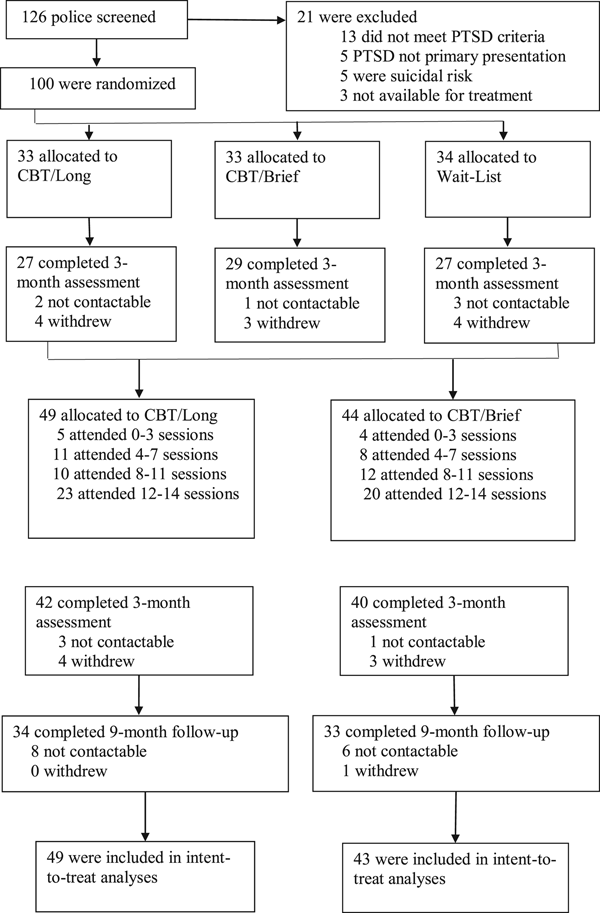
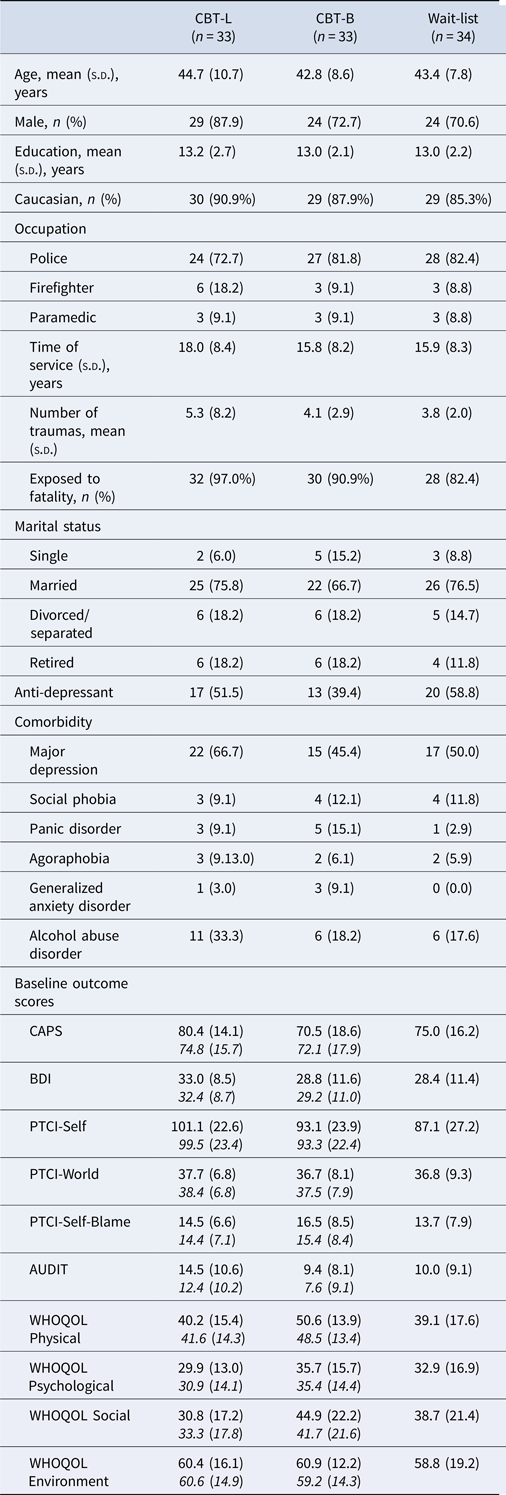
Participants were recruited from referrals to the UNSW Traumatic Stress Clinic (promoted in emergency service personnel publications). Following written informed consent, participants were administered the Clinician Administered PTSD Scale (CAPS; Blake et al., Reference Blake, Weathers, Nagy, Kaloupek, Gusman, Charney and Keane1995) to assess PTSD. Inclusion criteria were current or retired emergency service personnel, primary diagnosis was DSM-IV criterion for PTSD (defined as PTSD symptoms being the primary diagnosis for functional impairment), were aged between 18 and 70 years, and adequate English and ability to follow instructions. Exclusion criteria included (a) imminent plans of suicide, (b) psychotic disorders or (c) substance dependence. We allowed participants prescribed antidepressant medication into the trial if they were on a stable dose for 2 months prior to randomisation and remained on the dose for the duration of the trial. There were 100 emergency service personnel randomised to CBT-L (n = 33), CBT-B (n = 33) or WL (n = 34). Following the WL period, 16 participants were randomised to CBT-L and 11 were randomised to CBT-B. All participants were assessed at baseline, after 3 months (post-treatment assessment), and CBT-L and CBT-B conditions were also assessed after 9 months (6 months following treatment completion). The flowchart of participant recruitment and retention is reported in Fig. 1. Sample characteristics of randomised participants are presented in Table 1.
Flow diagram of progress through phases of a randomised trial comparing cognitive behaviour therapy-long exposure v. cognitive behaviour therapy-brief exposure v. wait-list in emergency service personnel.

Participant characteristics

Standard deviations appear in parentheses. Means for baseline values for follow-up sample (including those randomised after wait-list) are in italics.
Randomisation and masking
Participants were randomly allocated (on a 1:1:1 ratio) to either CBT-L, CBT-B or WL. Following the WL period, participants in WL were randomised to either CBT-L or CBT-B. All participants were informed that they would receive a variant of CBT but when they would commence treatment would be determined by chance. Due to naturally occurring waiting times at the Traumatic Stress Clinic, all participants experienced comparable waiting times between initial contact with the clinic and commencement of treatment; whereas WL participants were assessed soon after contacting the clinic and commenced active treatment 3 months later, CBT-L and CBT-B participants were assessed after several months but commenced treatment immediately after initial assessment. Randomisation was conducted at UNSW by staff who were independent of the trial using generated random number sequences. Assessors were blind to treatment condition but were aware of the possible treatment conditions, and blindness was optimised by having assessors trained and managed separately from treating clinicians. Fidelity of masking was measured by having assessors guess the condition of each participant at each assessment. Assessors correctly guessed the condition of participants at chance rate at both post-treatment (50.6%) and follow-up (47.5%), indicating that blindness was maintained.
Measures and outcomes
Demographic details
A clinical interview assessed for age, educational level, ethnicity, occupation (police, firefighter, paramedic), years of emergency service, current employment status (current service, retired), number of traumatic events exposed to, exposure to fatalities and prescription of antidepressant medication.
The Mini-International Neuropsychiatric Interview (version 5.5; MINI; Sheehan et al., Reference Sheehan, Lecrubier, Harnett-Sheehan, Amorim, Janavs, Weiller, Hergueta, Baker and Dunbar1998) was used to assess comorbid Axis I depression and anxiety disorders. The MINI possesses strong psychometric properties, including inter-rater reliability (κ 0.88–1.00), test–retest reliability (0.76–0.93) and strong specificity for diagnoses (0.72–0.97) (Lecrubier et al., Reference Lecrubier, Sheehan, Weiller, Amorim, Bonora, Harnett Sheehan, Janavas and Dunbar1997).
Primary outcome measure
Post-traumatic stress disorder: The CAPS is a structured clinical interview designed to measure DSM-IV PTSD symptom severity in ‘the last 4 weeks’. The CAPS comprises 17 questions scored on two five-point Likert scales that index frequency (0 = never, 4 = daily) and intensity (0 = none, 4 = extreme) to provide an overall severity score (range 19–136; higher scores indicate greater severity). The CAPS is a structured clinical interview that possesses good sensitivity (0.84) and specificity (0.95) relative to the SCID PTSD diagnosis, and also possesses sound test–retest reliability (0.90) (Blake et al., Reference Blake, Weathers, Nagy, Kaloupek, Gusman, Charney and Keane1995). There was a sound internal consistency of the CAPS in this sample (Cronbach's α = 0.68).
Secondary outcome measures
Depression: The Beck Depression Inventory-second edition (BDI; Beck et al., Reference Beck, Steer and Brown1996) is a 21-item self-report inventory designed to measure depressive symptoms ‘in the past 2 weeks’. Items are scored on a four-point Likert scale to provide an overall severity score (range 0–63; higher scores indicate greater severity). The BDI has excellent reliability (α = 0.92) and test–retest reliability (r = 0.90) (Beck et al., Reference Beck, Steer and Brown1996). Internal consistency in this sample was 0.61.
Alcohol use: The Alcohol Use Disorder Identification Test (AUDIT; Babor et al., Reference Babor, de la Fuente, Saunders and Grant1989) measures alcohol abuse with 10 items. Items 1–8 are scored on a five-point Likert scale, while the remaining items scored on a three-point Likert scale, to provide an overall severity score (range 0–40; higher scores indicate greater severity). The AUDIT possesses sound test–retest reliability (0.86) (Sinclair et al., Reference Sinclair, McRee and Babor1992), and in this sample the consistency was 0.79.
Quality of life: The World Health Organization Quality of Life – BREF (WHOQOL-BREF; WHOQOL Group, 1996) is a World Health Organization instrument that assesses quality of life across four domains of functioning. Each item is scored on a five-point Likert scale with higher scores indicating better quality of life. Subscales encompass physical health (seven items, range 7–35), psychological (six items, range 6–30), social relationships (three items, range 3–15) and environment (eight items, range 0–40). The WHOQOL-BREF demonstrates good discriminant validity, content validity, internal consistency and test–retest reliability. Internal consistency in this sample ranged from 0.70 to 0.81 for the four subscales.
Cognitions: Trauma-related appraisals were assessed using the Posttraumatic Cognitions Inventory (PTCI) (Foa et al., Reference Foa, Ehlers, Clark, Tolin and Orsillo1999). It is a 33-item measure rated on a seven-point Likert scale (1 = totally disagree, 7 = totally agree) and yields three subscales: negative cognition about oneself (21 items, range 21–147), negative cognitions about the world (seven items, range 7–49) and self-blame (five items, range 5–35). Higher scores reflect elevated levels of negative cognitions. The PTCI possesses good internal consistency (α = 0.97) and discriminant ability to differentiate people with and without PTSD (sensitivity = 0.78, specificity = 0.93) (Foa et al., Reference Foa, Ehlers, Clark, Tolin and Orsillo1999). Internal consistency in this sample ranged from 0.81 to 0.90 across the three subscales.
Procedures
CBT-L and CBT-B comprised 12 individual weekly sessions that comprised one session of psychoeducation, four sessions of CBT skills training, six sessions that comprised imaginal and in vivo exposure and one session of relapse prevention. Therapy commenced with skills training to address the comorbid problems commonly experienced by emergency responders. The skills training provided brief instruction in one or more of the following areas, depending on the participant's comorbid presentation: depression management, panic management, emotion regulation, substance abuse management, anger management or interpersonal relationships. Participants were provided with a workbook that included information about the abovementioned skills. Cognitive restructuring was incorporated into sessions 2–11 to restructure maladaptive cognitions. CBT-L sessions were 90 min in duration and comprised 40 min of imaginal exposure. CBT-B sessions were 60 min in duration and comprised 10 min of imaginal exposure, ensuring that non-exposure session time was restricted to 50 min in both conditions. Brief exposure focused on the most distressing features of the trauma memories. At the completion of each exposure session, there was a brief discussion of issues arising from the exposure to maximise processing of the exposure. In vivo exposure was commenced in session 7, and continued for each remaining session. Five Masters- or Doctoral-level clinical psychologists administered both forms of CBT.
Participants allocated to WL were assessed at baseline, and again three months later.
To assess protocol fidelity, all treatment sessions were recorded and 15% of these sessions were assessed by independent clinicians, who used a checklist based on guidelines for assessing treatment fidelity (Mowbray, Reference Mowbray, Holter, Teague and Bybee2003). Two independent raters assessed the presence each of 22 treatment components, without regard to treatment condition or treatment session (mean κ = 0.91). Raters also indicated the quality of the therapy provided on a seven-point scale (1 = ‘unacceptable, 7 = ‘very good’) (mean inter-rater reliability: r = 0.87). Fidelity checks indicated that all appropriate CBT interventions were provided, and the appropriate length of exposure was given in the CBT-L and CBT-B conditions, respectively. Any signs of psychiatric crisis (e.g. imminent suicidal risk) or need for acute protection were referred to the local advisory board, referral to appropriate services made and participants were removed from the study.
Statistical analyses
The sample size was powered to accommodate (a) the superiority hypothesis at post-treatment that CBT-L and CBT-B would have greater efficacy than WL, and (b) the non-inferiority hypothesis at follow-up that CBT-B would not be less efficacious than CBT-L. Non-inferiority analyses test the prediction that a new treatment (in this case, CBT-B) will not result in a worse outcome than an existing treatment (Walker, Reference Walker and Nowacki2010). Following previous PTSD non-inferiority trials (Morland et al., Reference Morland, Greene, Rosen, Foy, Reilly, Shore, He and Frueh2010), we calculated that non-inferiority between CBT-L and CBT-B would be defined as a difference of <10 points on CAPS scores. It was calculated that the non-inferiority hypotheses would be supported if the 95% confidence interval (CI) for the difference between conditions was less than the predefined non-inferiority margin (Sealed Envelope Power Calculator). Allowing for 70% attrition at the follow-up assessment, this resulted in a desired sample of 50 participants in each of the CBT-L and CBT-B conditions to provide power = 0.80 with α = 0.20 and β = 0.10 (consistent with non-inferiority analyses) (Ehlers et al., Reference Ehlers, Hackmann, Grey, Wild, Liness, Albert, Deale, Stott and Clark2014). This sample size was sufficient to test the superiority analysis at post-treatment because on the basis of prior trials of exposure-based CBT relative to WL (Powers et al., Reference Powers, Halpern, Ferenschak, Gillihan and Foa2010), adopting a moderate-to-large effect size (d = 0.70) to detect the difference between both CBT-L and CBT-B relative to WL at post-treatment (α = 0.05, two-sided) required 33 participants per cell (G*Power, 2009).
Analyses focused primarily on intent-to-treat analysis. Using SPSS version 24, hierarchical linear mixed models (HLM) were used to study differential effects of each treatment condition because this method effectively handles missing data by calculating estimates of trajectories. For the post-treatment analyses between the three conditions, analyses focus on linear time effects, treatment conditions and interactions. Fixed-effects parameters were tested with the Wald test (t test, p < 0.05, two-sided) and 95% CIs. Cohen's (d) effect size was calculated for all analyses. Analyses focus on the estimated mean differences relative to pre-treatment levels of primary (CAPS) and secondary (BDI, WHOQOL, AUDIT, PTCI) outcomes. The proportion of participants who no longer met criteria for PTSD (on treatment completers) was also calculated. In addition, we analyse the longer term effects of CBT-L and CBT-B by assessing the non-inferiority between these treatments at 6-month follow-up. Secondary analysis was conducted to determine if treatment response was predicted by a number of comorbid psychiatric disorders by repeating the analysis with a number of comorbid disorders as a random effect.
Results
Preliminary analyses
The majority of participants were police officers (79.0%), and the remainder were either firefighters (12.0%) or paramedics (9.0%). CBT-L, CBT-B and WL conditions did not differ on any pre-treatment factors, including age, marital status, time of service, number of traumatic events, exposure to fatalities, and comorbid disorders (see Table 1). Importantly, pre-treatment levels of PTSD severity did not differ between participants randomised to CBT-L or CBT-B after the WL period and those randomised immediately (t 91 = 1.6, P = 0.12). Comparable proportions of participants in both CBT-L and CBT-B attended 0–3 sessions (10.2% v. 9.1%), 4–7 sessions (22.4% v. 18.2%), 8–11 sessions (20.4% v. 27.3%) and 12–14 sessions (47.0% v. 45.4%). Eighty-one (86%) participants randomised to CBT-L or CBT-B completed the 6-month follow-up. Participants who were retained at follow-up did not differ from those who were lost to follow-up in terms of age, education level, years as an emergency service personnel officer, time since developing PTSD or baseline PTSD severity. In terms of adverse reactions, one participant in the CBT-L condition was referred for in-patient management of suicidal risk during therapy.
Participants who were randomised after the WL period did not differ from those randomised to immediate treatment in terms of time between initial contact with the clinic and commencement of treatment (F 92 = 1.5, P = 0.14) and pre-treatment PTSD severity (t 92 = 1.6, P = 0.12).
Post-treatment analyses: CBT-L v. CBT-B v. WL
Primary outcome
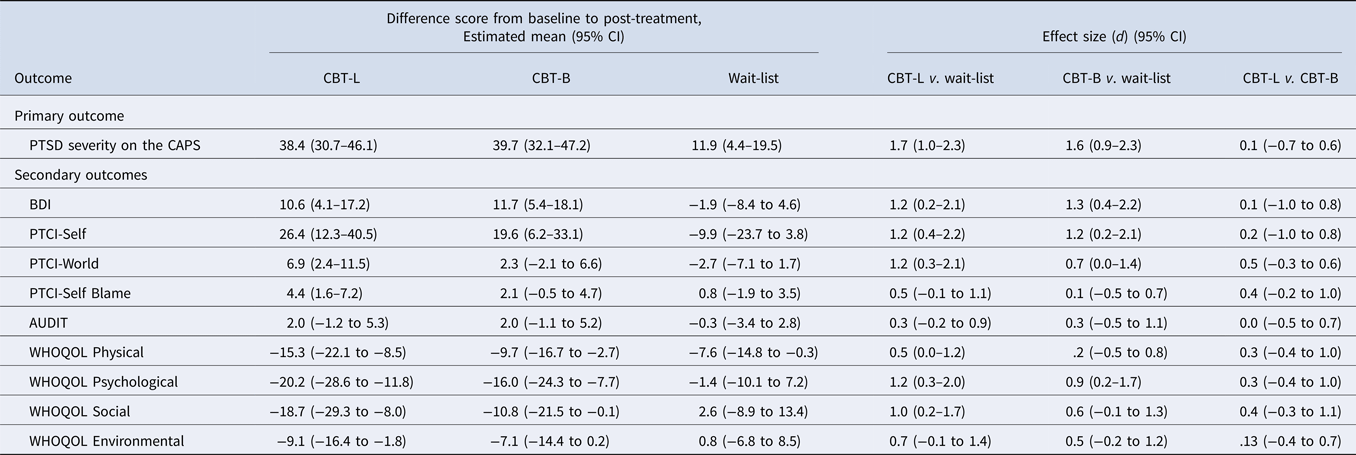
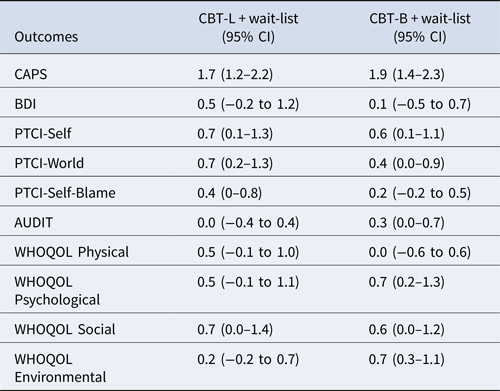
Table 2 provides the least-square mean scores for CAPS. In the model at post-treatment, there was a significant effect for time (F 63.06 = 176.03, P < 0.001), indicating that CAPS scores were reduced at post-treatment for all conditions. Moreover, there was a significant interaction effect (F 47.25 = 20.04, P < 0.001), indicating that both CBT conditions led to greater reductions than WL at post-treatment. There was a non-significant difference between CBT-L and CBT-B (F 49.00 = 0.20, P < 0.85). Fewer participants in CBT-L (n = 11, 40.7%) than WL (n = 25, 89.3%) met PTSD criteria (mean difference, 48.5%; 95% CI 23.7–66.2%; χ2 = 14.3, P < 0.001). Fewer participants in CBT-B (n = 7, 24.1%) than WL (n = 25, 89.3%) met PTSD criteria (mean difference 65.2%; 95% CI 24.1–89.3%; χ2 = 24.1, P < 0.001). There was a non-significant difference between CBT-L and CBT-B (mean difference 16.6%; 95% CI 24.1–89.3%; χ2 = 1.8, P = 0.18). Secondary analysis indicated that number of comorbid disorders did not predict treatment response at post-treatment (F 84.24 = 1.0, P = .42).
Estimated between condition mean scores for primary and secondary outcome measures at baseline and post-treatment for CBT-L, CBT-B and wait-list conditions

CAPS, Clinician Administered PTSD Scale (range: 0–136; higher scores indicate elevated PTSD); BDI, Beck Depression Inventory (total score range: 0–63; higher scores indicate more severe depression); PTCI, Posttraumatic Cognitions Inventory (subscale scores range, Self: 21–147; World: 7–49; Self-Blame: 5–35; higher scores indicate more maladaptive cognitions); AUDIT, Alcohol Use Disorder Identification Test (range: 0–40; higher scores indicate greater alcohol use); WHOQOL, WHO Quality of Life (each subscale score range: 0–100; higher scores indicate better quality of life).
Secondary outcomes
BDI, WHOQOL, AUDIT and PTCI scores are also displayed in Table 2. There were significant main effects for time, as well as significant group × time interactions for BDI (main: F 32.50 12.5, P = 0.001; interaction: F 19.61 5.7, P = 0.01), WHOQOL Psychological (main: F 53.57 25.2, P = 0.001; interaction: F 38.57 = 5.6, P = .008), WHOQOL Social (main: F 65.69 8.4, P = 0.005; interaction: F 41.99 = 3.7, P = .03), PTCI-Self (main: F 34.85 9.3, P = 0.004; interaction: F 18.76 = 7.2, P = .005), and a significant time × group interaction effect for PTCI-World (F 52.20 = 3.9, P = .02). That is, CBT conditions led to greater reductions in depressive symptoms, PTCI-Self and PTCI-World scores, as well as greater improvements in psychological and social quality of life than WL.
Follow-up analyses: CBT-L v. CBT-B
Primary outcome
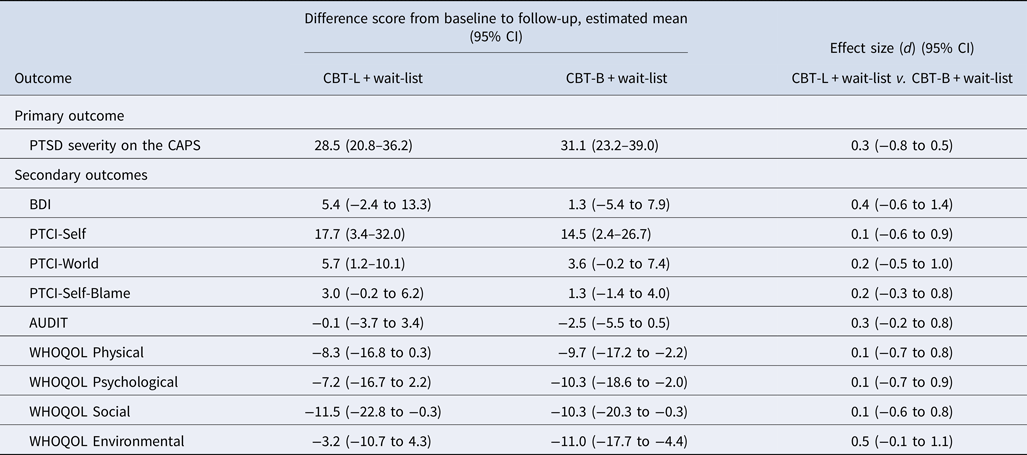
Table 3 provides the least-square mean scores for CAPS and secondary outcomes for CBT-L and CBT-B conditions at baseline and follow-up. There was a significant effect for time (F 159.15 = 108.6, P < 0.001), indicating that CAPS scores were reduced at follow-up. There was no significant group × time interaction (F 159.15 = 0.2, P = .85), indicating a non-significant difference between CBT-L and CBT-B (2.6; 95% CI = −7.75 to –12.87; P = 0.64; d = 0.16). Comparable proportions of participants in CBT-L (n = 17, 40.5%) and CBT-B (n = 15, 36.6%) met PTSD criteria at follow-up (mean difference 3.9%; 95% CI −1.2% to −3.7%; χ2 = 0.1, P = 0.72). Secondary analysis indicated that number of comorbid disorders did not predict treatment response at follow-up (F 80.97 = 1.1, P = .38). As a secondary analysis, we assessed the extent to which symptom reduction was impacted by comorbidity by repeating the mixed-model analysis entering the number of comorbid disorders as a factor. This analysis indicated that number of comorbid disorders did not moderate treatment response (F 105.26 = 0.6, P = .60). We also conducted a secondary analysis in which number of sessions attended was entered as a factor, which indicated that number of sessions attended did not influence outcome (F 59.28 = 0.7, P = .65).
Estimated between condition mean scores for primary and secondary outcome measures at baseline and follow-up for CBT-L and CBT-B conditions

CAPS, Clinician Administered PTSD Scale (range: 0–136; higher scores indicate elevated PTSD); BDI, Beck Depression Inventory (total score range: 0–63; higher scores indicate more severe depression); PTCI, Posttraumatic Cognitions Inventory (subscale scores range, Self: 21–147; World: 7–49; Self-Blame: 5–35; higher scores indicate more maladaptive cognitions); AUDIT, Alcohol Use Disorder Identification Test (range: 0–40; higher scores indicate greater alcohol use); WHOQOL, WHO Quality of Life (each subscale score range: 0–100; higher scores indicate better quality of life).
Secondary outcomes
There were no significant group × time interactions for any secondary outcomes (see Table 3). However, there were significant main effects for time for BDI (F 159.15 = 108.63, P < 0.001), AUDIT (F 90.99 = 3.9, P = .02), PTCI-Self (F 104.66 = 20.81, P < 0.001), PTCI-World (F 109.11 = 10.38, P < 0.001) and PTCI-Blame (F 92.20 = 5.18, P = 0.007) scales, as well as improvements in scores on the WHOQOL Physical (F 95.81 = 14.7, P < 0.001), WHOQOL Psychological (F 102.48 = 20.0, P < 0.001), WHOQOL Social (F 97.50 = 12.0, P < 0.001), WHOQOL Environmental (F 100.35 = 10.2, P < 0.001) scales. Table 4 indicates that for participants in both the CBT-L and CBT-B conditions, there were very large effect sizes in the reduction of PTSD severity from pre-treatment to follow-up.
Estimated baseline to follow-up effect sizes for CBT-L and CBT-B conditions

CAPS, Clinician Administered PTSD Scale; BDI, Beck Depression Inventory; PTCI, Posttraumatic Cognitions Inventory; AUDIT, Alcohol Use Disorder Identification Test; WHOQOL, WHO Quality of Life
Discussion
This trial provides robust evidence that an exposure-based CBT programme reduces PTSD severity in emergency service personnel. We emphasise that this conclusion is based on the post-treatment data relative to the WL condition and so it cannot be generalised to long-term gains. However, the 6-month follow-up data indicated large effect sizes in terms of reduction of PTSD severity for participants who received CBT. These data extend prior studies that have applied CBT to emergency service personnel, which reported effect sizes of 0.92 (Gersons et al., Reference Gersons, Carlier, Lamberts and van der Kolk2000) and 1.37 (Difede et al., Reference Difede, Malta, Best, Henn-Haase, Metzler, Bryant and Marmar2007), respectively. These effect sizes are comparable to the current post-treatment effect sizes relative to WL (CBT-L = 1.7; CBT-B = 1.6). We note that the current data represent significantly larger sample sizes than the previous studies, although these earlier studies reported follow-up effect sizes.
CBT was comparably efficacious when imaginal exposure to trauma memories occurred for 40 or 10 min. This accords with the studies that have trialled exposure for 30 min (van Minnen et al., Reference van Minnen, Hendriks and Olff2010) and 20 min (Nacasch et al., Reference Nacasch, Huppert, Su, Kivity, Dinshtein, Yeh and Foa2015). By showing that, when delivered with other CBT elements, 10 min of exposure that focuses on trauma hotspots can be as efficacious as 40 min, this study suggests potential cost-savings by reducing therapy time. It is worth noting that only one participant (in CBT-L) reported an adverse event, which was apparently due to events occurring in their domestic situation and that required hospital admission for suicidal intent. There is good evidence that exposure-based therapies do not precipitate adverse events more than other interventions (Taylor, Reference Taylor2003), and this study suggests that even brief periods of exposure to trauma memories do not elicit negative reactions. Further, we note that 67.3% of participants in CBT-L and 50.0% of participants in CBT-B attended at least eight sessions. It has been suggested that the distress elicited by exposure therapy for PTSD may prompt premature drop out from treatment because of the difficulty in tolerating the emotional memories. In contrast to this view, one analysis of 25 treatment studies found that exposure therapy resulted in comparable drop out rates to non-exposure therapy (Hembree et al., Reference Hembree, Foa, Dorfan, Street, Kowalski and Tu2003). The current data extend this knowledge by suggesting comparable retention rates across longer and short forms of imaginal exposure sessions. We note that we did not include a treatment arm that did not comprise exposure-based strategies, and so it is possible that the non-exposure-oriented strategies in the current protocols may have contributed strongly to the observed clinical gains.
The efficacy of trauma-focused CBT to reduce depression was markedly less than the reduction of PTSD. A robust finding in most exposure-based CBT is the secondary reduction of depression symptoms (Powers et al., Reference Powers, Halpern, Ferenschak, Gillihan and Foa2010; Sloan et al., Reference Sloan, Gallagher, Feinstein, Lee and Pruneau2011). It is possible that depression symptoms in the current trial did not respond to exposure-based CBT, even with the addition of a brief depression management training, because of the chronicity and nature of the psychological states of these participants. We note that the current protocol introduced in vivo exposure into treatment considerably later than other established treatment protocols (Foa et al., Reference Foa, Hembree, Cahill, Rauch, Riggs, Feeny and Yadin2005); it is possible that providing in vivo exposure earlier in treatment may have enhanced behavioural activation and mastery, which could contribute to reductions in depressive symptoms. These factors may have contributed to depression levels not reducing in the current study as much as they have in other CBT trials. The need to address ongoing depression in emergency service personnel remains a significant issue for further study.
We note several limitations to this trial. First, we did not retain our WL condition for the 6-month follow-up assessment. This decision was taken because of the evidence that exposure-based CBT is an efficacious treatment for PTSD and to delay offering treatment for 9 months after entry into the trial was deemed ethically unacceptable. Despite the lack of WL comparisons at follow-up, it is worth noting that large baseline to follow-up effect sizes for reduction in CAPS scores within both the CBT-L and CBT-B conditions (see Table 4) are comparable to within-participant effect sizes reported in prior prolonged exposure trials with civilians (Bryant et al., Reference Bryant, Moulds, Guthrie, Dang and Nixon2003). Second, we did not obtain sessional measures of PTSD severity, which precluded us from determining the relative speed of symptom reduction in the two forms of exposure therapy. Third, we did not accurately measure any self-initiated homework activities and so we cannot exclude the possibility that participants did not engage in exposure between sessions that was longer or shorter than prescribed in sessions. Fourth, not all 100 participants initially recruited to the study were retained for the randomisation to the non-inferiority phase; the randomisation of 93 participants resulted in marginally reduced power. Fifth, we note that it would be useful to conduct cost-effectiveness analysis of CBT involving brief duration of imaginal exposure, in association with non-exposure therapy strategies, to determine the economic advantages of providing shorter therapy sessions. Finally, advancing our knowledge about the utility of CBT for emergency service personnel would benefit from a dismantling design that considers the different components of the treatment that optimally reduce PTSD and its comorbid problems in this population. These limitations notwithstanding, this study provides initial evidence that among emergency service personnel with PTSD, adapted trauma-focused CBT efficaciously reduced PTSD symptoms relative to WL, and both long and brief exposure conditions resulted in comparably large reductions in PTSD 6 months after treatment.
Financial support
The study was funded by the National Health and Medical Research Council (1073041). The funder had no role in study design, data collection or analysis, or report preparation.
Conflict of interest
None.