INTRODUCTION
Lithistid sponges, also known as rock sponges, are an artificial group of species characterized by the shared possession of a hypersilified skeleton composed of articulated spicules—desmas. Although initially placed in the order Lithistida Schmidt Reference Schmidt1870, a substantial body of morphological and molecular evidence has revealed the polyphyletic nature of this group and the astrophorid, halichondrid and purportedly spirophorid affinities of several of its families (e.g. Kelly-Borges & Pomponi, Reference Kelly-Borges and Pomponi1994; McInerney et al., Reference McInerney, Adams and Kelly1999; Cárdenas et al., Reference Cárdenas, Xavier, Reveillaud, Schander and Rapp2011, Redmond et al., Reference Redmond, Morrow, Thacker, Diaz, Boury-Esnault, Cárdenas, Hajdu, Lôbo-Hajdu, Picton, Pomponi, Kayal and Collins2013). Globally, 13 families, 46 genera and 199 extant species are currently accepted (van Soest et al., Reference van Soest, Boury-Esnault, Hooper, Rützler, de Voogd, Alvarez de Glasby, Hajdu, Pisera, Manconi, Schoenberg, Janussen, Tabachnick, Klautau, Picton, Kelly, Vacelet, Dohrmann, Díaz and Cárdenas2014), many of which are thought to be relicts of a much more diverse and abundant fauna dating back to the Cambrian (Lévi, Reference Lévi, Reitner and Keupp1991; Pisera, Reference Pisera, Hooper and van Soest2002).
Most species are found at bathyal or bathyal-like environments (caves) in tropical and warm temperate regions (e.g. Pomponi et al., Reference Pomponi, Kelly, Reed and Wright2001; Pisera & Vacelet, Reference Pisera and Vacelet2011), although some species can be found in shallower waters (Kelly, Reference Kelly2007; Kelly et al., Reference Kelly, Ellwood, Tubbs, Buckeridge, Custódio, Lôbo-Hajdu, Hajdu and Muricy2007). Diversity and distribution patterns of the lithistid sponge fauna are most comprehensively studied for some regions such as: the continental shelf and slope of the tropical western Atlantic (e.g. Schmidt, Reference Schmidt1870, Reference Schmidt1880; van Soest & Stentoft, Reference van Soest and Stentoft1988; Pomponi et al., Reference Pomponi, Kelly, Reed and Wright2001); the south-west Pacific archipelagos of New Caledonia, New Zealand and the seamounts of the Norfolk Ridge (e.g. Lévi & Lévi, Reference Lévi and Lévi1983, Reference Lévi and Lévi1988; Lévi, Reference Lévi, Reitner and Keupp1991; Schlacher-Hoenlinger et al., Reference Schlacher-Hoenlinger, Pisera and Hooper2005; Kelly, Reference Kelly2007); and the Mediterranean Sea (e.g. Manconi & Serusi, Reference Manconi and Serusi2008; Pisera & Vacelet, Reference Pisera and Vacelet2011).
In the north-east Atlantic, knowledge about the lithistid sponge fauna is mostly restricted to the Azores archipelago, for which 10 species belonging to seven genera and seven families have been reported in the course of several expeditions (e.g. Topsent, Reference Topsent1892, Reference Topsent1904, Reference Topsent1928). In fact, previous to the present study, only five lithistid species—Neophrissospongia nolitangere (Schmidt, Reference Schmidt1870), Discodermia verrucosa Topsent, Reference Topsent1928, Leiodermatium lynceus (Schmidt, Reference Schmidt1870), Macandrewia azorica Gray, Reference Gray1859 and Exsuperantia sp.—were known to occur in the Canary Islands, and only three species—Corallistes masoni (Bowerbank, Reference Bowerbank1869), Neoschrammeniella bowerbankii (Johnson, Reference Johnson1863) and Leiodermatium pfeifferae (Carter, Reference Carter1876)—were reported from Madeira.
In this study we expand the current knowledge regarding the diversity and distribution of the lithistid fauna of bathyal areas of Madeira, Selvagens and the Canary Islands from the analyses of specimens collected in the course of a research expedition of the Harbor Branch Oceanographic Institute (HBOI) and compare our findings to what was reported in the literature for these and other nearby areas such as the Azores and the Mediterranean Sea.
MATERIALS AND METHODS
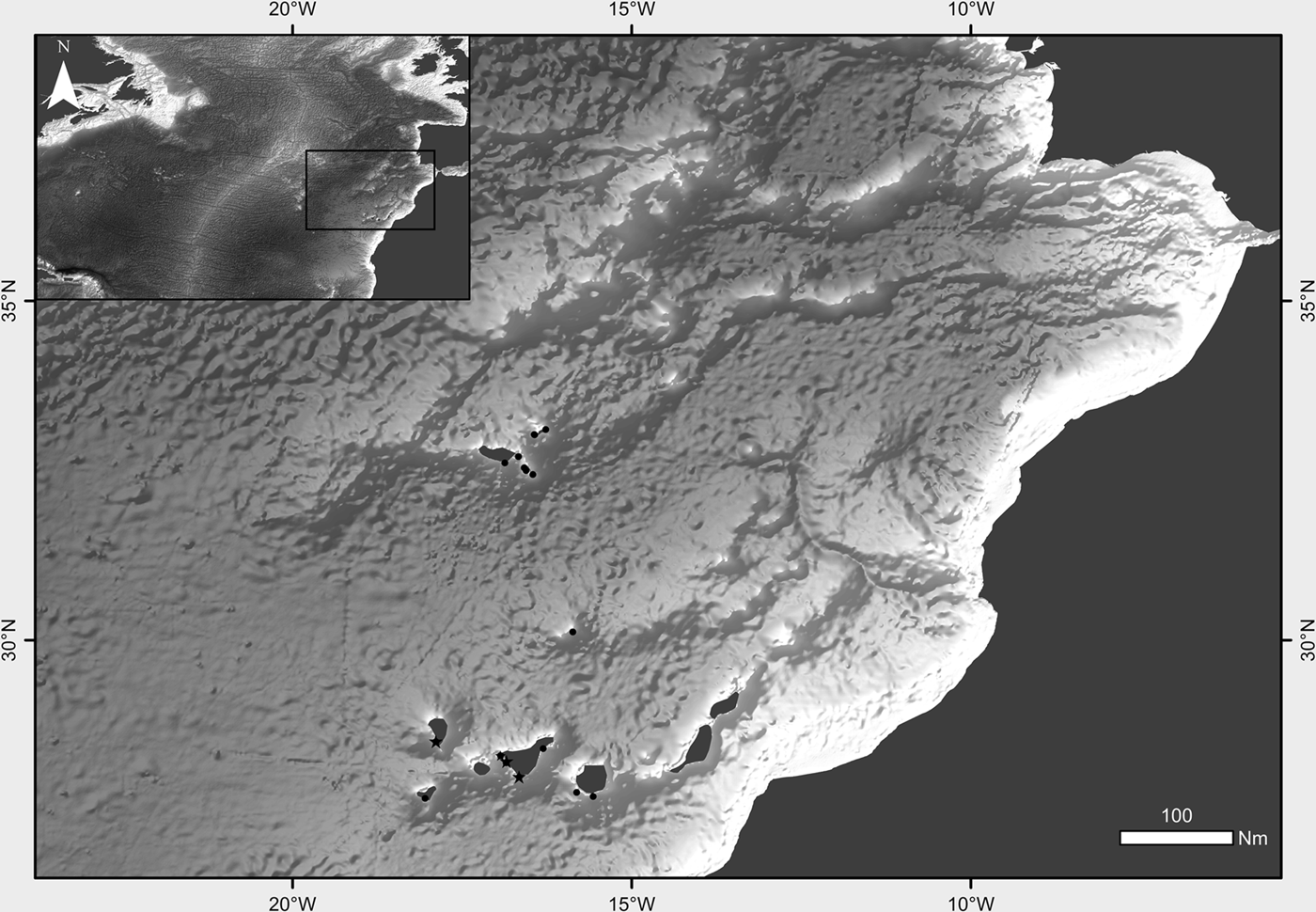
The circalittoral and bathyal areas of the Macaronesian islands of Madeira, Selvagens and Canaries were surveyed in the course of a research expedition conducted by the Division of Biomedical Marine Research and the Department of Marine Botany of the HBOI (Figure 1). Samples were collected between 50 and 1000 m depth using the ‘Johnson Sea Link I’ submersible.
Study area—the Macaronesian islands of Madeira, Selvagens and Canaries. Black circles represent deep-water stations where lithistids were collected; black stars represent stations where Isabella harborbranchi sp. nov. was collected. For detailed information see Supplementary Material.

Specimens were preserved in 70% ethanol or frozen and are deposited in the HBOM. The holotype is deposited in the US National Museum (USNM). Identifications were made from thick tissue sections mounted in Canada balsam and observed under light microscopy. Spicules were dissociated by nitric acid boiling, washed, and examined at high magnification using scanning electron microscopy (SEM).
Small fragments of the Isabella harborbranchi sp. nov. specimens were sub-sampled for barcoding purposes. Total DNA was extracted using DNeasy® blood and tissue kit (QIAGEN), and the mitochondrial cytochrome oxidase subunit I (COI) gene was amplified and sequenced using the primers LCO1490 and HCO2198 (Folmer et al., Reference Folmer, Black, Hoeh, Lutz and Vrijenhoek1994). Sequence data along with morphological information were deposited in the Sponge Barcoding Project website (SBP—http://www.spongebarcoding.org/) as well as in GenBank (http://www.ncbi.nlm.nih.gov/). Obtained sequences were compared with those of I. mirabilis available in the SBP (record nos. 814, 823, 824, 828).
Despite morphological and molecular evidence that desma-bearing sponges are polyphyletic, with families belonging to several orders within the Demospongiae (e.g. Kelly-Borges & Pomponi, Reference Kelly-Borges and Pomponi1994; McInerney et al., Reference McInerney, Adams and Kelly1999; Cárdenas et al., Reference Cárdenas, Xavier, Reveillaud, Schander and Rapp2012, Redmond et al., Reference Redmond, Morrow, Thacker, Diaz, Boury-Esnault, Cárdenas, Hajdu, Lôbo-Hajdu, Picton, Pomponi, Kayal and Collins2013), the present study follows the classification system proposed in Systema Porifera by Hooper & van Soest (Reference Hooper and Van Soest2002) until a comprehensive replacement classification is published.
RESULTS
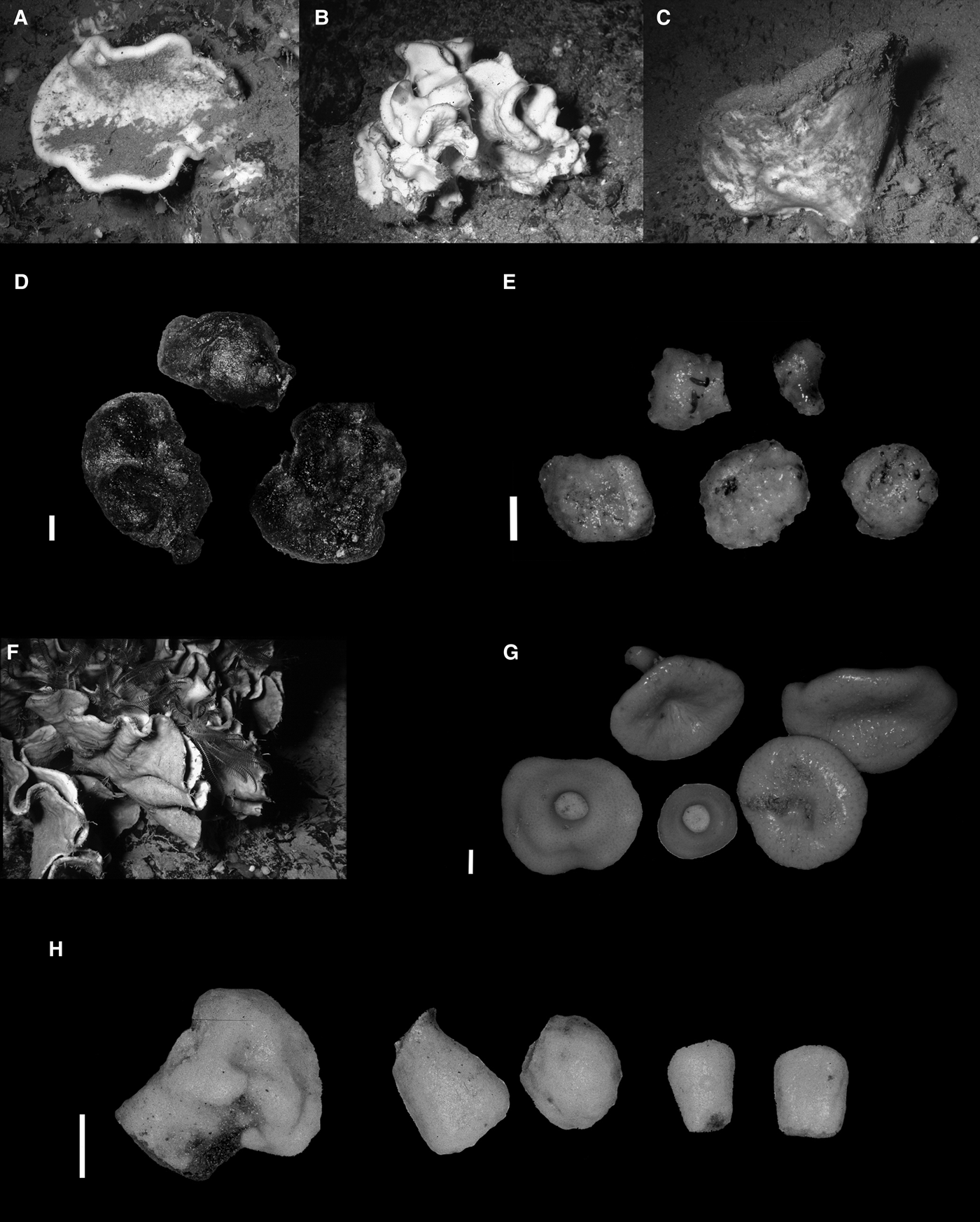
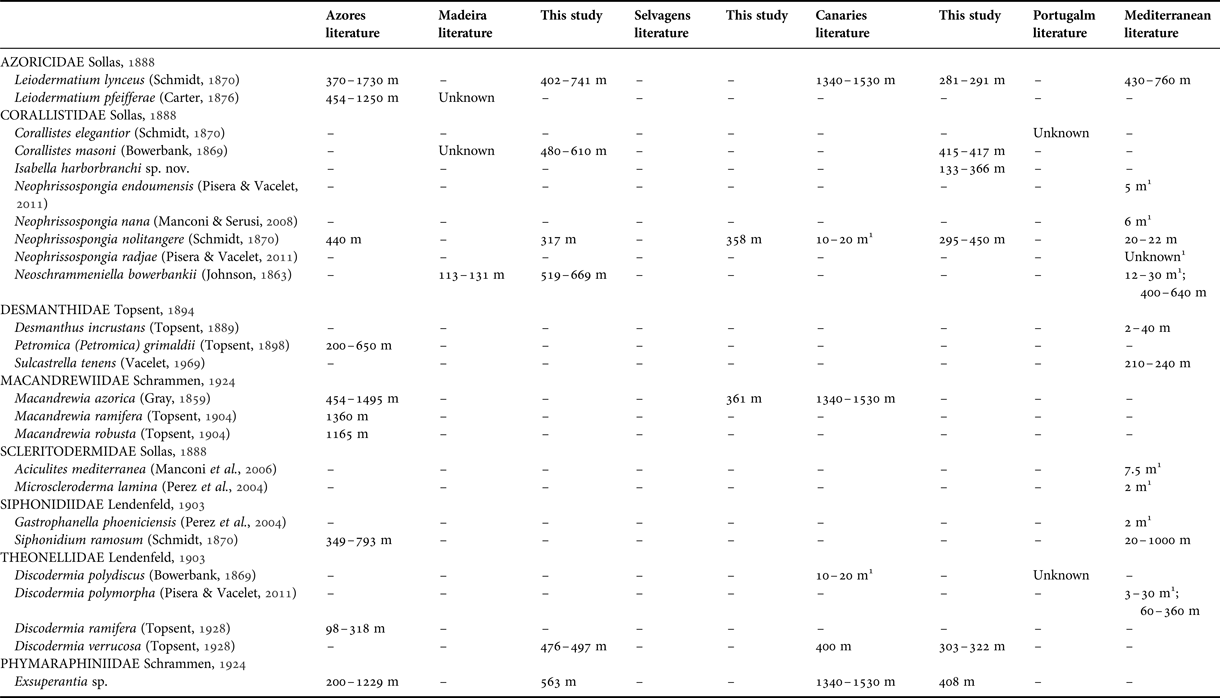
A total of 32 specimens were analysed and assigned to eight species representing eight genera and five families. Six species were found in Madeira, of which four—L. lynceus, N. nolitangere, D. verrucosa and Exsuperantia sp.—constitute new records for this area. Similarly, six species were found in the Canary islands, of which one—C. masoni—constitutes a new record for the archipelago and one—Isabella harborbranchi sp. nov.—is a new species for science (see description below). The only two species found in Selvagens—N. nolitangere and M. azorica—constitute new records for this small archipelago (Table 1; Figure 2; see also Supplementary Material).
Lithistid species found in the present study: (A) Corallistes masoni (Bowerbank, Reference Bowerbank1869); (B) Neophrissospongia nolitangere (Schmidt, Reference Schmidt1870); (C) Neoschrammeniella bowerbankii (Johnson, Reference Johnson1863); (D) Isabella harborbranchi sp. nov.; (E) Discodermia verrucosa Topsent, Reference Topsent1928; (F) Leiodermatium lynceus Schmidt, Reference Schmidt1870; (G) Macandrewia azorica Gray, Reference Gray1859; (H) Exsuperantia sp. Scale bars: 1 cm.
Lithistid species found in this study in Madeira, Selvagens and Canary Islands and reported in the literature for these archipelagos as well as for the Azores and Mediterranean Sea. Bathymetric ranges are indicated.
m, mainland coast; 1occurring inside sublitoral caves; Literature data source: Bowerbank (Reference Bowerbank1869); Carter (Reference Carter1876); Cruz (Reference Cruz2002); Du Bocage (Reference Du Bocage1869); Gray (Reference Gray1859); Johnson (Reference Johnson1863); Longo et al. (Reference Longo, Mastrotaro and Corriero2005); Magnino et al. (Reference Magnino, Gravina, Righni, Serena and Pansini1999); Manconi et al. (Reference Manconi, Serusi and Pisera2006); Manconi & Serusi (Reference Manconi and Serusi2008); Perez et al. (Reference Perez, Vacelet, Bitar and Zibrowius2004); Pisera & Vacelet (Reference Pisera and Vacelet2011); Schmidt (Reference Schmidt1870); Topsent (1889, Reference Topsent1892, Reference Topsent1904, Reference Topsent1928); Vacelet (Reference Vacelet1969).
SYSTEMATICS
Class DEMOSPONGIAE Sollas, Reference Sollas1885
‘Lithistid’ Demospongiae sensu Pisera & Lévi, Reference Pisera, Lévi, Hooper and van Soest2002
Family CORALLISTIDAE Sollas, Reference Sollas1888
Genus Isabella Schlacher-Hoenlinger et al., Reference Schlacher-Hoenlinger, Pisera and Hooper2005
DIAGNOSIS
Massive shallow cup, globular to cushion shaped lithistids, dark brown in colour and discolouring the ethanol purplish/reddish-brown; ectosomal megascleres are smooth dichotriaenes that can be accompanied by short- and long-shafted triaenes; choanosomal root/vine-like dicranoclone desmas and two types of oxeas; microscleres are microacanthoxeas (may be centrotylote), and two types of spirasters (never rhabd-like) (emended after Schlacher-Hoenlinger et al., Reference Schlacher-Hoenlinger, Pisera and Hooper2005).
TYPE SPECIES
Isabella mirabilis Schlacher-Hoenlinger et al., Reference Schlacher-Hoenlinger, Pisera and Hooper2005.
Isabella harborbranchi sp. nov.
MATERIAL EXAMINED
USNM1249991, HBOM 003:00709, HBOM 003:00644, HBOM 003:00558.
ETYMOLOGY
Named after Harbor Branch Oceanographic Institute (Florida Atlantic University) in recognition of their long commitment to the study of the systematics, biology and natural products chemistry of deep-water sponges.
TYPE MATERIAL
Holotype: USNM1249991 (HBOI 1991 eastern Atlantic Expedition, Station 51, JSL-I-3017, Canary Islands, west coast of Tenerife; coordinates: 28°12.69′N 16°50.72′W; water depth: 292 m); coll. S. Pomponi, 8 June 1991.
Paratypes: HBOM 003:00709 (HBOI 1991 eastern Atlantic Expedition, Station 57, JSL-I-3019, Canary Islands, West coast of Tenerife; coordinates: 28°18.00′N 16°56.10′W; water depth: 366 m); coll. S. Pomponi, 9 June 1991; HBOM 003:00644 (HBOI 1991 eastern Atlantic Expedition, Station 64, JSL-I-3022, Canary Islands, south-west coast of La Palma; coordinates: 28°30.25′N 17°53.25′W; water depth: 133 m); coll. S. Pomponi, 11 June 1991; HBOM 003:00558 (HBOI 1991 eastern Atlantic Expedition, Station 77, JSL-I-3029, Canary Islands, south coast of Tenerife; coordinates: 27°59.00′N 16°39.60′W; water depth: 282 m); coll. S. Pomponi, 14 June 1991; RMNH.POR.8168 (CANCAP II expedition, Station 105, Canary Islands, south of El Hierro; coordinates: 27°36′N 17°59′W; water depth: 350–600 m); coll. Rob van Soest, 3 September 1977 (examined by Rob W.M. van Soest).
EXTERNAL MORPHOLOGY
Irregularly rounded sponge, ranging in diameter from 3–15 cm; dark purple–brown alive, dark reddish brown in ethanol, which is also discolored clear reddish brown. The surface is irregular, with a thin ectosomal crust over a compressible ectosomal layer approximately 1 mm thick. The choanosome is rigid. The sponge accumulates sediment. Oscules/pores cannot be seen with naked eye; under magnification, irregularly scattered oscules, 0.25–1.00 mm in diameter, can be seen occurring singly or in clusters (Figure 2D).
SKELETON
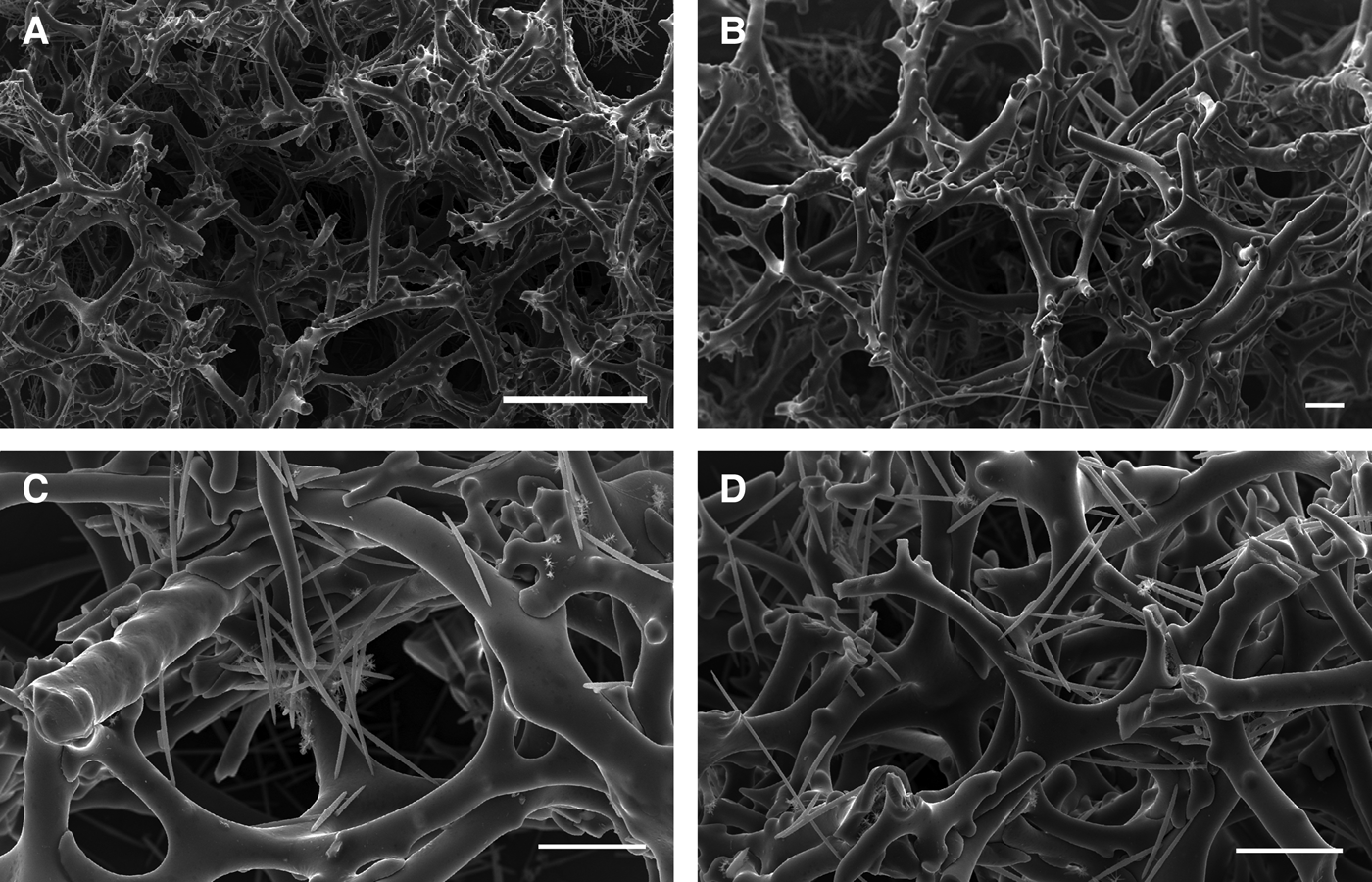
The ectosome is difficult to distinguish from the choanosome due to the large quantity of microscleres spread throughout the sponge and the dark colour of the preserved material. Ectosomal skeleton contains a small number of dichotriaenes and both long- and short-shafted triaenes spread throughout the sponge surface along with a huge quantity of microacanthoxeas. Choanosomal skeleton consists of dicranoclone desmas, two types of long oxeas and microscleres (microacanthoxeas and spirasters) (Figures 3, 4).
Isabella harborbranchi sp. nov., holotype USNM1249991; (A) overview of choanosomal surface; (B) detail of choanosome surface, note oxeas; (C) interior of the choanosome, note microacanthoxeas (some centrotylote), spirasters and streptasters; (D) detail of articulation and sculpture of dicranoclones desmas. Scale bars: A, 500 μm; B, C, D, 100 μm.
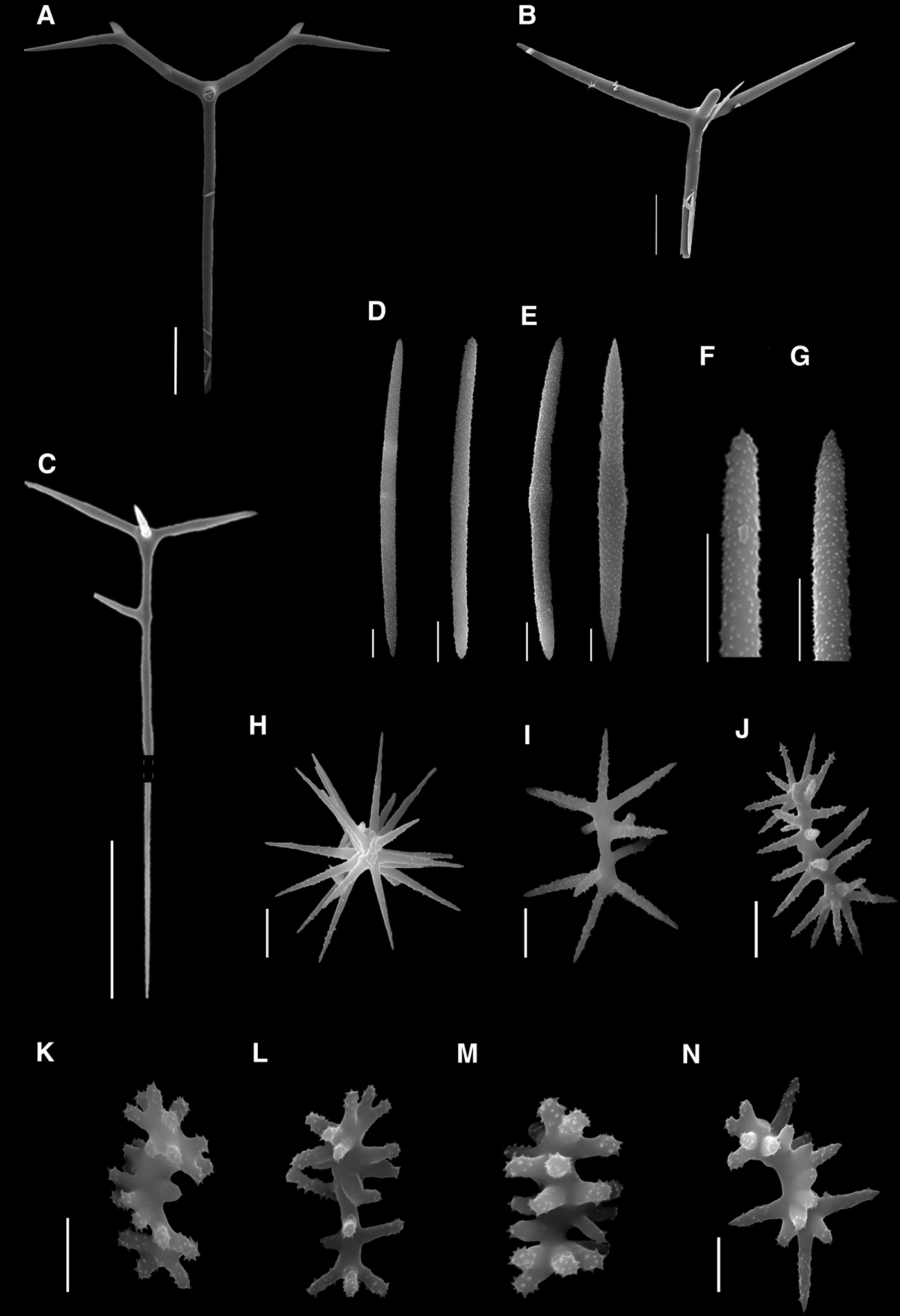
Isabella harborbranchi sp. nov, holotype USNM1249991: (A) smooth dichotriaene; (B) short-shafted ectosomal triaene; (C) long-shafted triaene; (D) fusiform microacanthoxeas; (E) centrotylote microacanthoxea; (F, G) detail of microacanthoxeas tips; (H–J) spirasters with small, thick and thorny arms; (K–N) spirasters with long, thin and thorny arms. Scale bars: A–C, 100 μm; D–G, 10 μm; H–N, 5 μm.
SPICULES
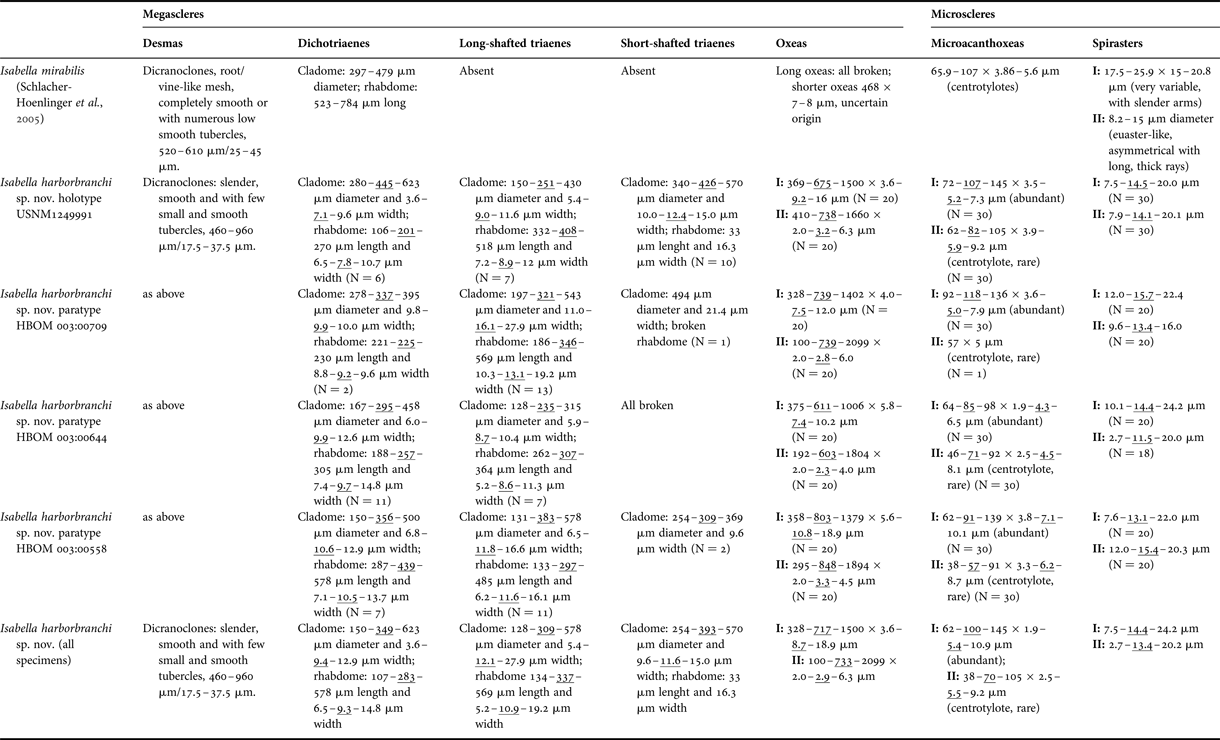
Ectosomal dichotriaenes, long-shafted and short-shafted triaenes are smooth and both the cladome and rhabdome present blunt tips. They are quite irregular in shape sometimes appearing with under-developed arms and/or small additional arms in the rhabdome (Figure 4A–C; Table 2). Microscleres are two types of slightly curved microacanthoxeas with acerate tips: type I, larger and most abundant, are fusiform (Figure 4D–F; Table 2), whereas type II, smaller and rarer, are centrotylote (Figure 4E–G; Table 2); and two types of spirasters: type I with long, thin and thorny arms, are very variable in shape and number of actines (Figure 4H–J; Table 2); type II have short, thick and thorny arms (Figure 4K–N; Table 2).
Spicular micrometric data for the holotype and paratypes of Isabella harborbranchi sp. nov. and comparison with Isabella mirabilis Schlacher-Hoenlinger et al. (Reference Schlacher-Hoenlinger, Pisera and Hooper2005). The values underlined represent the mean of all spicules measured for each spicule type.
Note: most oxeas were broken so the values presented are the maximum values measured.
Choanosomal dicranoclones desmas are slender, smooth and with few small and smooth tubercles. The desmas do not form a compact network as in most lithistid species. They are irregular and form a somewhat loose skeleton in which large quantities of microacanthoxeas and some spirasters can be observed (Figure 3; Table 2). Oxeas, of two different types, can form bundles in the choanosome. Type I are long and thick oxeas with blunt tips (in some oxeas, the tip has a small thorn); type II are long, thin and curved oxeas with acerate tips (Table 2).
DNA BARCODES
USNM1249991 (holotype)—GenBank Accession no. KM185725; Sponge Barcoding Database record no. SBD 1114.
HBOM 003:00709 (paratype)—GenBank Accession no. KM185728; Sponge Barcoding Database record no. SBD 1115.
HBOM 003:00644 (paratype)—GenBank Accession no. KM185726; Sponge Barcoding Database record no. SBD 1116.
HBOM 003:00558 (paratype)—GenBank Accession no. KM185727; Sponge Barcoding Database record no. SBD 1117.
The Folmer COI sequences obtained from all specimens were identical and differed from sequences of I. mirabilis by 6–8 bp.
DISTRIBUTION
Known only from the circalittoral and upper bathyal of the Canary Islands (west and south coasts of Tenerife, south-west coast of La Palma and south of El Hierro), between 133 and 600 m depth.
REMARKS
Isabella harborbranchi sp. nov. conforms to the diagnostic characters of the genus Isabella, until now represented by a single species I. mirabilis (Schlacher-Hoenlinger et al., Reference Schlacher-Hoenlinger, Pisera and Hooper2005). Colour, and texture are similar in both species, whereas their overall shape differs (shallow cup to artichoke-like in I. mirabilis vs irregularly rounded in I. harborbranchi sp. nov.) The main differences between the two species lie in the arrangement, shape and dimensions of mega- and microscleres (see Table 2). It is in the ectosome that these differences are notable: I. harborbranchi possesses long- and short-shafted triaenes which are absent in I. mirabilis. In addition, the dichotriaenes of I. harborbranchi sp. nov. are irregular, less abundant and have shorter rhabdome. While in I. mirabilis the microacanthoxeas are only present in the ectosome, in I. harborbranchi they are copiously present throughout the ectosome and choanosome. Both species share the presence of two types of spirasters in the ectosome and choanosome. Spirasters type-I are very similar in these two species, but normally larger in I. mirabilis. Spirasters type-II are different in size and shape. In the new species they are larger and, although with similarly thick arms, they are not euaster-like as in I. mirabilis (see Schlacher-Hoenlinger et al., Reference Schlacher-Hoenlinger, Pisera and Hooper2005, figure 26L–Q). Schlacher-Hoenlinger et al. (Reference Schlacher-Hoenlinger, Pisera and Hooper2005) found numerous long broken oxeas in I. mirabilis choanosome but were unsure if these were foreign. Despite being mostly broken, we found several complete large oxeas of two types, sometimes forming bundles, which corroborate the native nature of this spicule type in Isabella.
DISCUSSION
Previous to this work, knowledge concerning the diversity and distribution of the lithistid fauna in the Macaronesian region was mainly restricted to the Azores due to a larger sampling effort in this archipelago mostly undertaken in the course of Prince Albert I of Monaco scientific expeditions. With the new records here reported for Madeira and the Canaries these differences are considerably reduced. Yet, of the 14 species found to occur in the Macaronesian islands, only three taxa, viz. N. nolitangere, L. lynceus and Exsuperantia sp. are shared among all archipelagos, with the remainder restricted to one or two island groups. For instance the species D. ramifera, S. ramosum, M. robusta, M. ramifera and P. grimaldii have thus far only been reported from the Azores.
In a previous study, Xavier & van Soest (Reference Xavier and Van Soest2012) showed that shallow-water (above 120 m depth) sponge species of the Atlanto-Mediterranean region displayed restricted distributions, as single-area or narrow-range endemics. Although the specimens examined in the present study were collected from deeper areas, i.e. in the upper bathyal between 200–800 m depth, this same pattern seems to hold. Schlacher-Hoenlinger et al. have found similar results for the lithistid assemblages of the Norfolk Ridge seamounts. On an area spanning 250 km, they found that of the 16 species recorded, eight were found in a single locality and seven were found in two localities (Schlacher-Hoenlinger et al., Reference Schlacher-Hoenlinger, Pisera and Hooper2005). It thus seems likely that only species occurring in much deeper waters will have wider geographical ranges, as was shown for lower bathyal astrophorids (Cárdenas et al., Reference Cárdenas, Rapp, Klitgaard, Best, Thollesson and Tendal2013) or for abyssal cladorhizids (Hestetun et al., Reference Hestetun, Fourt, Vacelet, Boury-Esnault and Rapp2014).
Similarly, only three species seem to be shared between the Mediterranean Sea and these Atlantic archipelagos: N. bowerbankii (with Madeira); S. ramosum (with Azores); and L. lynceus (with Azores and Canaries).
In the Mediterranean Sea lithistids are normally associated with sublittoral caves, and records in deeper areas are scarce. This area harbours a total of 14 species, representing 10 genera and six families (Perez et al., Reference Perez, Vacelet, Bitar and Zibrowius2004; Manconi et al., Reference Manconi, Serusi and Pisera2006; Manconi & Serusi, Reference Manconi and Serusi2008; Pisera & Vacelet, Reference Pisera and Vacelet2011). Comparing the lithistid faunas of the northeast Atlantic with the Mediterranean Sea, it is possible to note some contrasts. Although the family Corallistidae is the best represented in both regions (with five species each), the Mediterranean Sea harbours two genera only, whereas five genera occur in the north-east Atlantic. Interestingly, the genus Neophrissospongia represented by a single species in the Macaronesian region is particularly rich in Mediterranean caves (four species). In general, the families known from the northeast Atlantic harbour more genera, with the exception of the families Desmanthidae Topsent, Reference Topsent1894 and Siphonidiidae Lendenfeld, Reference von Lendenfeld and Schulze1903. The families Macandrewiidae Schrammen, Reference Schrammen1924 and Scleritodermidae Sollas, Reference Sollas1888 are restricted to the north-east Atlantic and Mediterranean Sea, respectively. Of the total of 25 species reported for the north-east Atlantic and Mediterranean, only four species are shared between these areas, viz., N. nolitangere, N. bowerbankii, S. ramosum and L. lynceus. Again this finding seems to support the previous view of a distinct faunal composition in these two basins (Xavier & van Soest, Reference Xavier and Van Soest2012).
Besides the several new records for all areas, in the course of this study, a new species of Isabella, a genus only known from the south-west Pacific, was discovered and fully described. This genus, until now monotypic, was erected to accommodate the species Isabella mirabilis discovered on two seamounts of the Norfolk Ridge, a submarine ridge running between New Caledonia and New Zealand (Schlacher-Hoenlinger et al., Reference Schlacher-Hoenlinger, Pisera and Hooper2005). The first record of this genus for the Atlantic Ocean highlights how the distribution of some genera may still be poorly known. The identification of I. harborbranchi sp. nov. based on morphological characters was further supported by the molecular data obtained. The divergence levels found between mtDNA COI sequences of the two species is similar to those found in other studies concerning congeneric species within the Astrophorida (e.g. 6–7 base pairs between Geodia barretti and Geodia hentscheli, Cárdenas et al., Reference Cárdenas, Rapp, Klitgaard, Best, Thollesson and Tendal2013). Furthermore the phylogenetic reconstruction based on this gene fragment showed that I. harborbranchi sp. nov. specimens form a strongly supported monophyletic clade sister to I. mirabilis (Carvalho et al., unpublished data).
In conclusion, the present study greatly expands the knowledge on the diversity and distribution of the lithistid sponges associated with the bathyal environment of the Macaronesian Islands.
ACKNOWLEDGEMENTS
The authors wish to thank Jorge Medeiros for his support with the scanning electron microscopy, Raquel Pereira, José Diogo Carvalho and Renato Leite for their support with building the figures. We also thank HBOI scientists John Reed, Amy Wright, and Dennis Hanisak, as well as the crews of the RV ‘Seward Johnson’ and the ‘Johnson Sea Link I’ submersible, for selection and collection of the samples. The expedition was sponsored by HBOI. We further thank Rob van Soest for drawing our attention to additional material from the Canaries available at NCB Naturalis. We further thank Hans Tore Rapp, Paco Cárdenas, Michelle Kelly and an anonymous referee for their comments that greatly improved the manuscript.
FINANCIAL SUPPORT
Part of the work here presented was conducted during the International Workshop on Taxonomy of Atlanto-Mediterranean Deep-Sea Fauna, held at CIBIO-Azores, University of the Azores in April 2012. This workshop was funded by the Regional Government of the Azores, Direcção Regional da Ciência, Tecnologia e Equipamentos (DRCTE). SA Pomponi received the support of the Luso-American Development Foundation (FLAD—project 45/2012). This work was also partly funded by the Portuguese Science and Technology Foundation in the scope of J.R. Xavier's research on the biodiversity, ecology and evolution of the north-east Atlantic deep-sea sponge fauna (FCT-Portugal, postdoctoral grant no. SFRH/BPD/62946/2009).
SUPPLEMENTARY MATERIAL
List of lithistid records from the literature and from this study on Madeira, Selvagens and Canaries.
The supplementary material for this article can be found at http://www.journals.cambridge.org/mbi.