Introduction
Cognitive impairments are a core feature of schizophrenia and have been found in several domains, including verbal learning and memory, working memory and processing speed (Palmer et al. Reference Palmer, Dawes and Heaton2009). These impairments are known to contribute substantially to functional disability (Green, Reference Green1996). Although nearly all patients with schizophrenia display a decrement in cognitive function (Keefe et al. Reference Keefe, Eesley and Poe2005), there is no cognitive profile that is characteristic or unique for schizophrenia (Robbins, Reference Robbins2005). Several studies have distinguished cognitive subtypes, suggesting that the heterogeneity of schizophrenia may be reducible to more homogeneous subtypes (Joyce & Roiser, Reference Joyce and Roiser2007). Some of the subtypes observed in patients displayed selective impairments (e.g. verbal learning and memory) (Dawes et al. Reference Dawes, Jeste and Palmer2011), whereas others were characterized by impairments across multiple cognitive domains (Bruder et al. Reference Bruder, Wexler, Sage, Gil and Gorman2004). Subtypes can be of importance in the search for the underlying pathophysiological pathways to schizophrenia. Indeed, evidence emerging from imaging and genetic studies may indicate the existence of cognitive subtypes (Chow et al. Reference Chow, Watson, Young and Bassett2006; Liu et al. Reference Liu, Fann, Liu, Chen, Wu, Hung, Chen, Jou, Liu, Hwang, Hsieh, Chang, Yang, Lin, Chou, Faraone, Tsuang and Hwu2008; Lin et al. Reference Lin, Liu, Liu, Shen-Jang, Hsiao, Wu, Hung, Chen, Wu, Jou, Liu, Hwang, Hsieh, Chang, Yang, Lin, Chou, Faroane, Tsuang, Hwu and Chen2009; Cobia et al. Reference Cobia, Csernansky and Wang2011).
Cognitive alterations have also been consistently reported in non-affected siblings of schizophrenia patients (Sitskoorn et al. Reference Sitskoorn, Aleman, Ebisch, Appels and Kahn2004; Szöke et al. Reference Szöke, Schürhoff, Mathieu, Meary, Ionescu and Leboyer2005; Gur et al. Reference Gur, Calkins, Gur, Horan, Nuechterlein, Seidman and Stone2007). This indicates that the cognitive impairments in schizophrenia cannot be solely attributed to the influence of disease-related factors, such as psychotic episodes, hospitalization, unemployment or medication effects. Instead, cognitive alterations may be a marker of genetic risk for schizophrenia (Toulopoulou et al. Reference Toulopoulou, Picchioni, Rijsdijk, Hua-Hall, Ettinger, Sham and Murray2007).
We therefore wanted to determine whether there are also cognitive subtypes in siblings of schizophrenia patients, and whether these correspond with the subtypes seen in the patients’ relatives. There are indications that siblings are indeed a heterogeneous group with respect to cognition (Kéri & Janka, Reference Kéri and Janka2004; Meijer et al. Reference Meijer, Simons, Quee and Verweij2012). Some studies found that only a minority of siblings met the criteria for cognitive impairment (Kéri & Janka, Reference Kéri and Janka2004), whereas others reported larger differences between siblings and controls (Szöke et al. Reference Szöke, Schürhoff, Mathieu, Meary, Ionescu and Leboyer2005). It is thus conceivable that studying cognitive subtypes in siblings might result in profiles of siblings being similar to those found in probands. As non-affected siblings are at higher than average genetic risk for psychotic disorder, they are also at significant risk of developing subclinical expressions of liability for the disease. Identifying cognitive subtypes of siblings and comparing them with their probands may offer a useful assessment of the state of health of these siblings and the likelihood of their developing psychotic disorders.
We aimed first to identify cognitive subtypes in the non-affected siblings of schizophrenia patients and, second, to investigate whether these subtypes are associated with cognitive impairments and clinical symptoms in the probands. The study was performed within the framework of the Genetic Risk and Outcome of Psychosis (GROUP) project, a large, longitudinal study in The Netherlands that aims to investigate vulnerability and resilience factors for variation in the expression and course of non-affective psychotic disorders (Korver et al. Reference Korver, Quee, Boos, Simons and de Haan2012).
Method
Participants
There were 1064 patients (probands), 1057 non-affected siblings and 590 unrelated healthy controls participating in the GROUP study. An overview of the study objectives, sample characteristics, assessments and recruitment methods has been described elsewhere (Korver et al. Reference Korver, Quee, Boos, Simons and de Haan2012). For the current study, inclusion criteria for the controls, siblings and patients were: age between 16 and 50 years, being fluent in Dutch, and absence of substance disorder. Exclusion criteria for the controls and siblings were: presence of a psychotic disorder and non-completion of the cognitive battery. For the controls, the presence of a non-affective psychotic disorder in a first-degree relative was also an exclusion criterion. This resulted in 499 controls, 915 siblings and 908 patients being included in our study. We later limited the analyses to one sibling per family.
Cognitive assessment
The cognitive battery has been described in detail elsewhere (Meijer et al. Reference Meijer, Simons, Quee and Verweij2012). Task selection was based on cognitive domains that have been shown to be impaired in schizophrenia (Nuechterlein et al. Reference Nuechterlein, Barch, Gold, Goldberg, Green and Heaton2004). For the current study, we decided to focus on the neurocognitive (or non-social cognitive) measures. In addition, based on an earlier study (Meijer et al. Reference Meijer, Simons, Quee and Verweij2012), we selected the measures with the most significant results. For attention and vigilance, the Continuous Performance Test (CPT-HQ) was administered. The CPT-HQ is the same as the CPT known in the literature as CPT-AX (Wohlberg & Kornetsky, Reference Wohlberg and Kornetsky1973). The task for the participant is to respond to letter Q only when it is preceded by letter H. An efficiency score [(accuracy/reaction time) × 1000] was created, in which accuracy was measured as the total number of hits (range 0–28) minus the total number of errors (range 0–28), divided by 28. If this calculation of accuracy was non-positive (i.e. the number of errors equaled or exceeded the number of hits), then the accuracy was set equal to 0.005. This score was referred to as ‘CPT performance’. Intra-individual variability in reaction time (Hilti et al. Reference Hilti, Hilti, Heinemann, Robbins, Seifritz and Cattapan-Ludewig2010) on the CPT was also evaluated (‘CPT variance’), using the standard deviation score of the subject's mean response time on the hit trials. The short form of the Wechsler Adult Intelligence Scale – III (WAIS-III) was assessed for an indication of intellectual functioning, and included the following tests: ‘Block Design’, ‘Digit Symbol’, ‘Arithmetic’ and ‘Information’ (Blyer et al. Reference Blyler, Gold, Iannone and Buchanan2000). Studies have shown that Digit Symbol also requires aspects of executive function (Dickinson, Reference Dickinson2008). The Information task can be regarded as a ‘hold’ task, relatively resistant to the influence of psychosis. Finally, the Word Learning Task (WLT) was included as a measure of episodic memory (Brand & Jolles, Reference Brand and Jolles1985). For the WLT, ‘Immediate recall’ was based on the total number of items reproduced correctly after three consecutive trials; ‘Delayed recall’ was assessed after a 20-min delay.
Demographic, functional and clinical assessments
In the GROUP project, current clinical diagnoses were obtained using either the Schedules for Clinical Assessment in Neuropsychiatry (SCAN; Wing et al. Reference Wing, Babor, Brugha and Burke1990) or the Comprehensive Assessment for Symptoms and History (CASH; Andreasen et al. Reference Andreasen, Flaum and Arndt1992). Educational degree was evaluated according to the methods of Verhage (Reference Verhage1965). The percentage of subjects having had special education was also recorded. For functional outcome, the CASH and a sociodemographic questionnaire (GROUP Investigators, unpublished) were used to evaluate residential independence, financial responsibility, and enjoyment of social benefit. Overall level of pre-morbid functioning was evaluated using the Premorbid Adjustment Scale (PAS; Cannon-Spoor et al. Reference Cannon-Spoor, Potkin and Wyatt1982). Lifetime frequency of subclinical psychotic symptoms was measured using the Community Assessment of Psychic Experiences (CAPE; Brenner et al. Reference Brenner, Schmitz, Pawliuk, Fathalli, Joober, Ciampi and King2007). Positive and negative symptoms of schizotypy were evaluated using the Structured Inventory for Schizotypy – Revised (SIS-R; Vollema & Ormel, Reference Vollema and Ormel2000). For patients, the current symptom severity was measured with the 30-item Positive and Negative Syndrome Scale (PANSS; Kay et al. Reference Kay, Fiszbein and Opfer1987). Each item is scored on a scale ranging from 1 (absent) to 7 (extreme), incorporating their behavioral effect and severity. For this study, we used severity of positive, negative and disorganization symptoms from the five-factor structure (Lançon et al. Reference Lançon, Auquier, Nayt and Reine2000). Remission was evaluated cross-sectionally, using the PANSS remission items (Andreasen et al. Reference Andreasen, Carpenter, Kane, Lasser, Marder and Weinberger2005). Other clinical variables for patients were the number of psychotic episodes, age at onset of psychosis, dosage of antipsychotic medication, and the Social and Occupational Functioning Assessment Scale (SOFAS).
Statistical analysis
Descriptives
The main characteristics for the controls, siblings and patients satisfying the inclusion and exclusion criteria were compared on all variables. Linear mixed models were applied on all numerical variables to test for similarity between the three groups, with family representing the random effect. The method of maximum likelihood was used to estimate the model parameters. For gender and diagnosis, Pearson's χ 2 statistics was used to test for differences between groups. For ethnicity, the same test was used but based on the family. For special education and functional outcome, a logit model was applied with generalized estimating equations (GEEs), using an exchangeable working matrix to control for possible correlation between family members. Wald χ 2 statistics were used to test for differences between groups. If these were significant, contrast statements were executed to investigate the pair-wise differences between groups.
Normalization of cognitive scores
The cognition measures were standardized as follows: for the control group a linear regression analysis was performed for each cognition variable to establish a linear relationship between the cognition measures and age, separately for males and females. Based on this model, a predicted score for each subject was determined and subtracted from the observed score to obtain an age- and gender-corrected difference score. This score was divided by the standard deviation from the control sample to determine a z score for each subject on each cognitive measure.
Cognitive subtypes in siblings
Before cognitive subtypes were established in line with the procedures for cluster analyses described by Everitt (Reference Everitt2011), siblings were selected at random to exclude multiple siblings from the same family and to make ethnicity comparable between siblings and controls. Spearman's ρ correlation coefficients were also determined between the cognitive measures in the selected sibling population to investigate whether all the cognitive measures contributed information.
For this study, we used hierarchical cluster analysis to evaluate the number of clusters and to select the initial starting values for the K-means clustering. The hierarchical clustering was based on the nearest-neighbor principle. In a dendogram, the nearest observations are placed together as leaves in a tree structure and the stem of the dendogram indicates the size of the difference between clusters. From left to right, additional branches represent divisions within clusters. As mentioned in previous schizophrenia studies (Cobia et al. Reference Cobia, Csernansky and Wang2011), large stems may help to identify the number of clusters visually. However, Everitt (Reference Everitt2011) argues that this approach is still subjective. Therefore, the objective approach of Duda & Hart (Reference Duda and Hart1973) was applied to determine the significance of a division from one group into two groups in the dendogram starting from the right (one possibly homogeneous group of subjects), using the following formula:
 $$L(m) = \left( {1 - \displaystyle{{J_2^2} \over {J_1^2}} - \displaystyle{2 \over {\pi p}}} \right)\left( {\displaystyle{{n_m p} \over {2(1 - 8/(\pi ^2 p))}}} \right)^{1\over2},$$
where J 1 2 is the within sum of squares of the combined group, J 2 2 the sum of the two within sums of squares of the two clusters, n m the number of subjects in the combined group, and p the number of cognitive measures. The stopping rule was set at the level of a normal percentile [L(m) = 2.58, which responds to a (two-sided) significance level of α = 0.01], leading to the number of clusters.
For the K-means clustering, the Ward method was used, based on pair-wise and Euclidean distances. This clustering method aims to partition n observations into k clusters, in which each observation belongs to the cluster with the nearest mean. Instead of the means, the median scores from the hierarchical cluster analysis were used as centroids in a K-means cluster analysis. The subtypes for siblings that were obtained with the clustering strategy were evaluated by comparing demographic and clinical variables using analysis of variance (ANOVA) and the Pearson χ 2 statistic.
Proband subtypes based on siblings’ deduced cognitive subtype
Probands were compared based on the subtype of their non-affected sibling. Differences and correlations between siblings and their probands were investigated using paired t tests and Spearman's ρ respectively. Finally, differences in all observed variables between the subtypes deduced for the probands were investigated using ANOVA and the Pearson χ 2 statistic.
Release 3.0 of the GROUP database was used for the analyses. All tests were two-sided at the significance level of α = 0.05. In the case of multiple testing, Bonferroni corrections were applied. Statistical analyses were performed using SPSS version 18.0 (SPSS Inc., USA). Effect sizes were used to evaluate the clinical magnitude of the standardized mean differences between the subject groups on cognitive performances (Cohen, Reference Cohen1988). They were considered small when z score differences between the studied groups exceeded 0.2. Differences ⩾ 0.5 were considered moderate effect sizes, and differences ⩾ 0.8 were considered large.
Results
Descriptives
Mixed models were used to compare the groups of subjects meeting the inclusion criteria: 908 patients, 915 siblings and 499 controls. All main effects were found to be significant (p < 0.001), except for the diagnosis ‘other than mood disorder’. Pair-wise comparisons revealed that differences were significant between patients and controls, except for the Information subtest. On several measures, siblings displayed poorer scores than controls. The data are presented in Supplementary Table S1. The antipsychotics prescribed most commonly for the patients were olanzapine (27%), risperidone (23%), clozapine (10%) and aripiprazole (8%); 11% of the patients were medication naïve.
Cognitive subtypes in siblings
After randomly selecting one sibling per family and aligning ethnic differences between controls and siblings, we had data on 654 siblings for the cluster analyses. When we compared their cognitive performances with those of the original, full sibling group, the mean differences were negligible (with the largest differences being 1% for CPT performance). Correlations between cognitive performances of the 654 siblings were significant for most variables (Supplementary Table S2).
Three subtypes were found using hierarchical cluster analysis for siblings (Supplementary Fig. S1). The median values for each of these subtypes were used as starting points or centroids in the K-means analysis. Seventeen iterations were required for the K-means clustering to converge to a stable set of three clusters in the siblings. Subtype 1 consisted of 192 siblings (29%) and their z scores for the cognitive measures were all in the normal range. This subtype was labeled ‘normal profile’. Subtype 2 consisted of 228 siblings (35%). Their performances were more variable, with z scores ranging from −0.8 (Immediate recall) to 0.4 (Block Design). This subtype was labeled ‘mixed profile’. Subtype 3 consisted of 234 siblings (36%) and their z scores ranged from −0.4 (CPT performance) to −1.3 (Information). Many of the z scores fell in the impaired range, and this subtype was labeled ‘impaired profile’.
When the subtypes were compared, the mean values were found to be significant on all cognitive measures (p < 0.001). On CPT performance, CPT variance, Information and Digit Symbol, normal profile siblings had better scores than mixed profile siblings, who in turn had better scores than impaired profile siblings. On Block Design and Arithmetic, the performances of mixed profile siblings were better, but not significantly different, from those of normal profile siblings. On Immediate and Delayed recall, the performances of mixed profile siblings were poorer, but not significantly different, from impaired profile siblings (Supplementary Fig. S2).
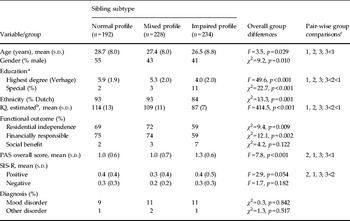
Differences between cognitive subtypes were significant with regard to age, education, ethnicity, functional outcome, PAS overall score and SIS-R positive symptoms. Siblings with an impaired profile were younger, less well educated, and they had poorer functional outcomes than those with a mixed or normal profile. Differences between normal profile and mixed profile siblings were significant only with respect to highest educational degree and estimated IQ. No significant differences were found on the CAPE. The data are given in Table 1.
Characteristics, main effects and pair-wise comparisons for the three non-affected sibling subtypes (n = 654)

PAS, Premorbid Adjustment Scale; SIS-R, Structured Inventory for Schizotypy, revised (higher scores in PAS and SIS-R reflect poorer outcomes); s.d., standard deviation.
a Education (Verhage, Reference Verhage1965): 0 (primary school not finished), 3–5 (school diploma), 8 (university degree).
b IQ, estimated: Wechsler Adult Intelligence Scale III (WAIS-III), short form.
c Comparisons are ordered from most favorable to least favorable.
Proband subtypes based on siblings’ deduced cognitive subtype
The cognitive subtypes in siblings were used for comparison with their probands. Differences on cognitive variables between normal profile siblings and their probands were highly significant on all variables (Fig. 1 a). On all measures, the siblings had better scores. Effect sizes were moderate to large, with the largest differences being observed for Digit Symbol and Immediate and Delayed recall (effect size > 1.2). Differences on cognitive variables between mixed profile siblings and their probands were significant with respect to all variables (Fig. 1 b). Again, siblings had better scores on all measures. Effect sizes were small for Information and Immediate and Delayed recall. For the other measures, the effect sizes were moderate to large. Differences on cognitive variables between impaired profile siblings and their probands were significant for all variables, except for Block Design and Arithmetic. On Information, probands had better scores than their sibling. On the other variables with significant effects, siblings had higher scores than their probands, but all effect sizes were in the small range (Fig. 1 c). Differences on cognitive variables between impaired profile siblings and their probands were significant with respect to CPT performance, CPT variance, Digit Symbol (all p < 0.001) and Immediate recall (Fig. 1 c). Correlations between the siblings and their probands were significant for the overall groups on all cognitive variables. However, correlations did not discriminate clearly between the cognitive subtypes (Supplementary Table S3).
Siblings with (a) a normal cognitive profile and their probands, (b) a mixed cognitive profile and their probands, and (c) an impaired cognitive profile and their probands (* p < 0.05, ** p < 0.01, *** p < 0.001). CPT, Continuous Performance Test.

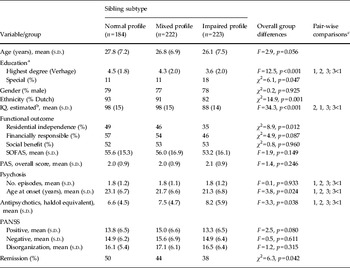
Probands were also compared on cognitive measures and other variables, based on the induced profile from their non-affected sibling. Differences between patients on the cognitive variables were highly significant on all measures (p < 0.005). Pair-wise comparisons revealed that probands with siblings with an impaired profile also performed less well on all measures. The differences between mixed and normal profiles were all non-significant (Supplementary Fig. S3). On other demographic and clinical variables, differences were significant for education, residential independence, symptomatic remission, age at illness onset and dosage of antipsychotic medication. The direction of effects was similar, in that probands with siblings with an impaired profile had worse scores than the other patients. The other two induced subtypes had similar scores. The data are shown in Table 2. A summary of all the study findings is provided in Supplementary Table S4.
Characteristics, main effects and pair-wise comparisons for patients (n = 576), based on the sibling's deduced profile

SOFAS, Social and Occupational Functioning Assessment Scale; PAS, Premorbid Adjustment Scale; PANSS, Positive and Negative Syndrome Scale (for the PAS and PANSS, higher scores reflect poorer outcomes); s.d., standard deviation.
a Education (Verhage, Reference Verhage1965): 0 (primary school not finished), 3–5 (school diploma), 8 (university degree).
b IQ, estimated: Wechsler Adult Intelligence Scale III (WAIS-III), short form.
c Comparisons are ordered from most favorable to least favorable.
Discussion
We investigated cognitive subtypes in non-affected siblings of schizophrenia patients, their characteristics and the relationship with their probands’ cognitive impairments and clinical characteristics. In line with earlier studies (Braff et al. Reference Braff, Freedman, Schork and Gottesman2007), we demonstrated that siblings could be distinguished as an intermediate group between controls and patients. However, using cluster analysis, we found evidence of three cognitive subtypes in siblings: one subtype similar to the controls, one subtype with mixed performance, and one subtype impaired on almost all cognitive measures and resembling their proband. To the best of our knowledge this is the first study demonstrating cognitive heterogeneity in siblings of schizophrenia patients that can be reliably clustered into three groups.
The subtype categories were roughly equal in sample size and were labeled ‘normal’, ‘mixed’ and ‘impaired’. The results show that sibling subtypes differ not only with respect to level of performance (e.g. normal versus impaired) but also in their pattern (Supplementary Fig. S2). The mixed profile siblings showed poorer performances for Episodic Memory and Digit Symbol and better performance for Block Design. This may mirror patterns in patients with schizophrenia who have been shown to display more severe impairments for Digit Symbol and measures of Episodic Memory, against a background of less severe impairments (Dickinson, Reference Dickinson2008; Palmer et al. Reference Palmer, Dawes and Heaton2009). Siblings in the impaired group had the poorest cognitive profile, and the most unfavorable scores for demographic and clinical characteristics (Table 2 and Supplementary Table S4). This increased expression of cognitive endophenotypes in certain subtypes may be of relevance for genetic and imaging studies. Such studies may want to take into account the different subtypes, or limit their analysis to one subtype (e.g. the impaired subtype) that may be most relevant to schizophrenia.
Not all profiles of the sibling subtypes showed similarities with the profile of their probands. Siblings with a normal profile and their probands differed most (Fig. 1 a). Large effect sizes were found for Digit Symbol and measures of Episodic Memory. Probands with normal profile siblings performed within the normal range, when using a difference of 1 standard deviation with the control group as a cut-off point. Nevertheless, it can be argued that these probands have a certain cognitive decrement, given the large differences with their unaffected family member. This is in line with the notion by Keefe et al. (Reference Keefe, Eesley and Poe2005) that nearly all patients with schizophrenia or related disorders show cognitive decrement. The profiles of the mixed profile siblings and their probands were more closely related (Fig. 1 b), whereas for impaired profile siblings and their probands, the differences were even smaller (Fig. 1 c). These findings suggest that there is an increasing overlap between siblings and their probands from normal profile to impaired profile. Thus, the poorer the profile of the sibling, the more it corresponds to that of the affected family member. By contrast, siblings with a normal profile were more similar to controls. This observation raises the question of whether siblings should truly be viewed as an intermediate group between patients and controls. Future studies should investigate the underlying environmental and genetic factors that can explain why siblings of schizophrenia patients fit into certain cognitive subtypes. Our findings do not correspond directly with a recent factor analysis by Dickinson et al. (Reference Dickinson, Goldberg, Gold, Elvevåg and Weinberger2011), who showed that cognitive performances of patients, siblings and controls sort into the same factors. The authors did conclude performance impairment in schizophrenia to be more generalized, and less domain specific. In subsequent comparisons of patients versus controls, and patients versus siblings, there was a significant reduction in model fit when the factor loadings were constrained to be equal. This is also reflected in our results, showing a variety of differences on the cognitive tests between siblings and their affected family member, from normal to impaired.
Several studies have found cognitive subtypes in patients with specific impairment profiles (e.g. Joyce & Roiser, Reference Joyce and Roiser2007). In this study, using the sibling subtype to characterize their proband resulted in only two distinguishable patient groups (Supplementary Fig. S3). Probands with normal and mixed profile siblings were roughly similar with respect to their cognitive performances. However, probands with impaired siblings did show a profile different from those with siblings of normal and mixed subtypes. These differences were found not only with respect to cognition but also in demographic and clinical characteristics (Table 2 and Supplementary Table S4). Probands with impaired siblings were less likely to be in remission, became ill at a younger age and were prescribed higher dosages of medication although the severity of their clinical symptoms was similar to that of the other patients. This may reflect a poorer course of the illness. Indeed, earlier studies in schizophrenia patients have shown cognitive impairment to be predictive for the course of the illness (Dickerson et al. Reference Dickerson, Boronow, Ringel and Parente1999). So far, no studies have shown a relationship between certain cognitive subtypes of siblings and the course of illness in their proband. We do not know whether our findings can be explained by similarities in genetic loading between affected and non-affected siblings. In addition, there may be differences in their genetic profiles. We speculate that, compared to normal and mixed profile siblings, the siblings with cognitive impairment have inherited a larger number of genetic variants associated with schizophrenia. Further studies are needed to test these hypotheses.
Using cognitive subtypes in siblings may also provide insight into those subjects at higher risk for psychosis. Siblings with an impaired profile were more often from an ethnic minority and they had poorer levels of pre-morbid adjustment. Their probands not only had a similar cognitive profile but also were more severely ill. We do not know why these siblings had not developed a psychosis in the past, although several factors may be responsible. First, psychosis is likely to be triggered by a combination of risk factors, of which cognitive impairment is but one. Indeed, impaired siblings also showed higher scores on positive schizotypal symptoms. There may also be protective factors preventing the siblings from making the transition to psychosis. The majority of these siblings (>60%) were female. Estrogen in females has been hypothesized to have a protective and antipsychotic-like effect in women at risk for a future psychosis (Riecher-Rössler, Reference Riecher-Rössler2002). As levels of estrogen decrease in women after the age of 40, late-onset psychosis is more likely for females (Valia et al. Reference Vahia, Palmer, Depp, Fellows and Golshan2010). In males, a history of depression has been found to be related to greater cognitive impairment, which possibly reflects a subclinical expression of schizophrenia (Wisner et al. Reference Wisner, Elvevåg, Gold, Weinberger and Dickinson2011). Future studies are needed to determine whether cognitively impaired siblings are indeed more prone to developing psychosis.
The strengths of our study include the large sample size of siblings (and patients), the inclusion of a control group, the assessment of a comprehensive battery and the methods used to assess the number of clusters. There have been no earlier schizophrenia studies that have used a method such as that described by Duda et al. (Reference Duda and Hart1973) to evaluate the number of clusters objectively. The advantage of our clustering approach is that it is exploratory; we did not have to assume a latent variable driving the results, as is the case in factor analysis. In addition, the cognitive performances in siblings were corrected for age and gender, and populations were matched on ethnicity. This makes it less likely that the study findings are biased by demographical variables.
The limitations of our study should also be mentioned. First, there is the selection of siblings; in the case of multiple siblings participating in the study, only one of them was included in the cluster analysis. This resulted in the exclusion of some of the participants. However, we decided that the use of independent subjects would be the best strategy here. Because family members have cognitive similarities, including multiple siblings from one family would probably have an effect on the clustering results, with some observations being more strongly weighted than others. Second, because of a methodological flaw, we are not able to present data of medication usage in siblings. Third, educational degree was not used to normalize the cognitive scores. Parental educational degree may be a good proxy to evaluate how far the expected level of cognitive performance differs from the level of observed performance. Fourth, the cognitive battery was comprehensive, but not complete. It did not include a measure of verbal fluency. In addition, there were other measures of (neuro)cognition that were included in the GROUP study: the Response Set-shifting Task and the Benton Facial Recognition Task. When we added these measures in a clustering analysis retrospectively, these variables did not explain substantial additional variance in the clusters. This suggests that the cognitive measures included in our cluster analysis were most relevant in forming the clusters. We did not explore the existence of a construct for schizophrenia because our research aim was primarily to explore cognitive subtypes in siblings and how they relate to patients. Finally, using other cognitive tests might have resulted in different cognitive subtypes. Whether this would change the increasing overlap between siblings and their probands (from normal to impaired profile) is less straightforward.
In conclusion, our results reveal that siblings of schizophrenia patients are cognitively heterogeneous, and that dividing siblings into three, more homogeneous subtypes may well have scientific and clinical relevance. Cognitive profiles between siblings and their probands tended to be more congruent if the sibling has a relatively poor cognitive profile. This increased expression of endophenotypes in certain subtypes may be of importance for genetic and imaging studies, the development of pharmacological drugs, and possibly for predicting which siblings are at risk of psychosis.
Appendix
GROUP Investigators are: R. S. Kahn1, D. H. Linszen2, J. van Os3, D. Wiersma4, W. Cahn1, L. de Haan2, L. Krabbendam3, I. Myin-Germeys3 and R. Bruggeman4
-
1 Department of Psychiatry, University Medical Center Utrecht and Rudolf Magnus Institute of Neuroscience, The Netherlands
-
2 Department of Psychiatry, University of Amsterdam, Academic Medical Centre Amsterdam, The Netherlands
-
3 Maastricht University Medical Centre, South Limburg Mental Health Research and Teaching Network, EURON, Maastricht, The Netherlands
-
4 Department of Psychiatry and Rob Giel Research Center, University of Groningen, University Medical Center Groningen, The Netherlands
Supplementary material
For supplementary material accompanying this paper, visit http://dx.doi.org/10.1017/S0033291713000809.
Acknowledgments
The infrastructure for the GROUP study is funded by the Geestkracht program of the Dutch Health Research Council (ZON-MW, grant no. 10-000-1002) and matching funds from participating universities and mental health-care organizations (Site Amsterdam: Academic Psychiatric Center AMC, Ingeest, Arkin, Dijk en Duin, Rivierduinen, Erasmus MC, GGZ Noord Holland Noord; Site Utrecht: University Medical Center Utrecht, Altrecht, Symfora, Meerkanten, RIAGG Amersfoort, Delta; Site Groningen: University Medical Center Groningen, Lentis, GGZ Friesland, GGZ Drenthe, Dimence, Mediant, GGZ De Grote Rivieren and Parnassia Bavo Groep; Site Maastricht: Maastricht University Medical Center, GGZ Eindhoven en de Kempen, GGZ Midden-Brabant, GGZ Oost-Brabant, GGZ Noord-en Midden-Limburg, Mondriaan Zorggroep, Prins Clauscentrum Sittard, RIAGG Roermond, Universitair Centrum Sint-Jozef Kortenberg, CAPRI University of Antwerp, PC Ziekeren Sint-Truiden, PZ Sancta Maria Sint-Truiden, GGZ Overpelt, OPZ Rekem). We thank the families who gave their time and effort to make this GROUP project possible. The research leading to these results has received funding from the European Community's Seventh Framework Program under grant agreement HEALTH-F2-2009-241909 (Project EU-GEI). We thank J. Senior for editing the text.
Declaration of Interest
None.