


I. Introduction
In 1991, Joseph Weiler made a pathbreaking contribution to the study of transnational governance via a captivating claim: the European Union (EU)—perhaps the world’s most developed example of regional integration and supranational delegation—is neither solely a bargaining process controlled by European states (e.g., Moravcsik Reference Moravcsik1998) nor the creation of supranational technocrats at the European Commission (e.g., Sandholtz Reference Sandholtz1992; Ross Reference Ross1995). Rather, European integration is a process driven in fundamental ways by the collaborative actions of national and European judges.
In so doing, Weiler articulated a political theory of integration via law that situated the EU within broader processes in the judicialization of politics (Shapiro and Stone Sweet Reference Shapiro2002; Ginsburg Reference Ginsburg2003; Hirschl Reference Hirschl2007). In Weiler’s (Reference Weiler1991, 2426) view, European political development has been “a narrative of plain and simple judicial empowerment.” On the one hand, by “courting” national courts into a dialogue, the European Court of Justice (ECJ) garnered the raw material—domestic disputes involving national and EU law—to reshape the balance of power between the EU and the member states. On the other hand, by applying EU law over conflicting national law, lower courts in founding member states gained powers of judicial review previously denied. All it took was a willingness to punt cases to the ECJ via Article 177 of the Treaty of Rome (now Art. 267 of the Treaty on the Functioning of the European Union, known as the “preliminary reference procedure”) and set aside national laws when they conflicted with the ECJ’s interpretation of EU rules.
In other words, beyond affirming broader claims about the expansion of judicial power vis-à-vis legislative or executive actors, Weiler’s theory stresses that it is low-level judges who have the most to gain from European integration: “Lower courts and their judges,” Weiler (Reference Weiler1991, 2426) wrote, “were given the facility to engage with the highest jurisdiction in the Community and thus to have de facto judicial review of legislation. For many this would be heady stuff.” Over the years, Weiler (Reference Weiler1994, 523) doubled down on these claims.
This judicial empowerment thesis (JET) quickly became the master frame for analyzing Europe’s exemplary process of transnational integration through law (Kelemen and Stone Sweet Reference Kelemen2017). For example, Burley and Mattli (Reference Burley1993, 54, 62) influentially elaborated how “assumptions of good will, harmony of interests, or dedication to the common good need not be postulated to account for integration. Ruthless egoism does the trick by itself… . While offering lower national courts a ‘heady’ taste of power, the ECJ simultaneously strengthens its own legal legitimacy.” In a subsequent elaboration, Alter’s (Reference Alter2001) “inter-court competition” model emphasized how lower court judges began to collaborate with the ECJ to break from the disliked case law of their superior courts, thereby becoming “the motors of EC legal integration” (Alter Reference Alter1996, 467).
In this article, I propose that the JET masks some key dynamics behind the ways in which transnational integration through law unfolds on the ground, particularly within those domestic judiciaries whose aggregate rates of referral to the ECJ appear to support lower court empowerment arguments. I argue for shifting focus to the way in which institutional path dependencies discipline judges’ everyday practices and their openness to Europeanization. By probing the lived experience of lower court judges as they manage professional knowledge and their work, it becomes clear that what appears as an opportunity for empowerment in theory is often perceived as a fastidious burden in practice. Specifically, the reputational drive to mask gaps in EU legal knowledge, the utilitarian incentive to manage one’s workload, and the cultural attachment to a traditional self-conception as a civil law judge can interact to entrench habits resistant to collaborating with the European Court. Understanding these micropolitics of judicial practice, then, illuminates how the “judicial construction of Europe” (Stone Sweet Reference Stone Sweet2004; Kelemen Reference Kelemen2016) can remain “contained” (Conant Reference Conant2002) and the ways in which transnational governance via law is negotiated on the ground (Halliday and Shaffer Reference Halliday2015).
To make this argument, I unpack a “most likely” case for the JET to hold—that of the Italian judiciary—and situate it in a broader comparative context of European legal orders. By combining a quantitative analysis of Italian preliminary references to the ECJ with hundreds of qualitative interviews with lawyers and judges, I use process tracing methods to reconstruct the unwritten practices that discipline the dialogue between national and European judges. The results suggest that even within a founding member state of the EU, to this day a broad set of entrenched habits within lower courts obstruct collaborations with the ECJ to enforce EU law. To conclude, I discuss the comparative and theoretical implications of this finding and elucidate future research paths.
II. Judicial Empowerment Revisited
The JET continues to muster substantial scholarly support. For example, one recent reevaluation posits that the thesis “underestimated just how transformative the constitutionalization of the EU legal system really was [since] judicially-driven integration proved to be self-reinforcing” (Kelemen and Stone Sweet Reference Kelemen2017, 205). Indeed, most of the debate about the extent to which the EU is a judicial construction has focused less on the dynamics of domestic judicial collaboration with the ECJ and more on the extent to which it liberates the European Court from the influence of national governments (Carrubba, Gabel, and Hankla Reference Carrubba2008; Stone Sweet and Brunell Reference Stone Sweet2012). Nevertheless, a number of qualifications—and a few challenges—have been made.Footnote 1
Alter’s scholarship provides one important qualification. She argues that member state governments and national high courts can obstruct a mutually empowering dialogue between the ECJ and lower courts, for example, by limiting access to lower courts or deriving a Euroskeptic jurisprudence from domestic constitutions (Alter Reference Alter2000, 513–14; Martinsen Reference Martinsen2015). Importantly, however, the claim that “lower courts are much more willing to send references to the ECJ” (Alter Reference Alter2000, 513) remained a component even of Alter’s analysis of the backlash to European legal integration. Indeed, scholars who have perceptively analyzed national judges’ resistance to EU law (Rasmussen Reference Rasmussen2007; Davies Reference Davies2012; Bobek Reference Bobek2014; Dyevre Reference Dyevre2017) have focused primarily on domestic supreme courts (Pollack Reference Pollack2013, 1273–75), which—even in Weiler’s original claims—we would expect to jealously defend the scope of their interpretive powers.
Other works have assessed how different types of constitutional and political structures interact with judicial empowerment to temper its effects. For example, some scholars have posited that states with a dualist constitutional tradition might disincentivize a judicial dialogue with the ECJ (Carrubba and Murrah Reference Carrubba2005), although most qualitative case studies and quantitative econometric analyses find little support for this claim (Alter Reference Alter2001; Dyevre Reference Dyevre2013; Dyevre and Lampach Reference Dyevre2017). A more convincing qualification is provided by Wind (Reference Wind2010), who finds that judges in Nordic states with a majoritarian political tradition and a scarce history of countermajoritarian constitutionalism are reluctant to directly support the ECJ’s supranational judicial review powers. However, Wind’s is more so a claim against the generalizability of the JET rather than a challenge to its validity for the EU’s founding member states.
Importantly, none of this scholarship considers the ways in which European integration unfolds within the everyday work environment of lower courts. By taking seriously this underexplored dimension within one of the judicial orders that inspired the JET in the first place, this article extends this important debate.
A. Theory: European Integration Meets the Everyday Politics of Judging
The proposed argument is simple: Behind the numbers and on the ground, “political integration through law” can be fruitfully studied as a historical institutionalist process (Pierson Reference Pierson1996) that sparks a micropolitics of everyday practice and knowledge management within the preexisting judicial apparatus of national states. To understand the limits of transnational legal governance, we must thus take seriously the ways in which supranational norms are negotiated and resisted in local institutional practice.Footnote 2
In the EU, political integration constitutes “layering’’ supranational laws atop existing domestic laws. Since the EU lacks the tools through which national states coerce compliance—such as military power or direct taxation (Kelemen Reference Kelemen2016)—compliance with EU law hinges in no small part on the “conversion” of national courts into European courts of first instance ready to enforce supranational law (Kelemen and Pavone, Reference Kelemenforthcoming).Footnote 3 Under the JET, national judges interpreted this as a relatively costless political opportunity (Alter Reference Alter1996, 466). But like all processes of political development (Orren and Skowronek Reference Orren2004), this conversion has not been frictionless, for it entails changing entrenched institutional practices and professional self-understandings to accommodate a new body of rules and legal knowledge. Particularly for judges within lower courts, these preexisting institutional practices hold such self-reproducing dynamics of “path dependence” (Mahoney Reference Mahoney2000) that—to this day—they resist the costly investments required to dialogue with the ECJ. Three reasons stand out.
First, baseline gaps in knowledge—universal in the past owing to the absence of judicial training in European law and still diffuse today—entail that judges are unlikely to assess the conformity of national law with EU law if unsolicited by a stubborn lawyer and will seldom incur the risks of raising a preliminary reference on their own. That is, because judges seek to protect their individual and collective reputation as custodians of legal expertise (Garoupa and Ginsburg Reference Garoupa2015), they are uncomfortable when (and often seek to avoid) dealing with a relatively unknown field like European law. Second, workload pressures—greatest among lower courts—imply that even when judges acquire knowledge of EU law, their attention will usually be monopolized by the large number of files before them today rather than the prospect of a dialogue with the ECJ tomorrow. This utilitarian drive to manage judicial labor entrenches a type of diffuse, Foucauldian discipline (Foucault Reference Foucault1975) that constrains judges’ everyday decision-making and dissuades breakups of routine to dialogue with the ECJ. Finally, entrenched self-conceptions as national civil law judges foster a reluctance to take on the creative role of European judge endowed with the power to disapply national law in favor of EU law. This logic is derived from judges’ semiotic identification with the figure of the civil law judge, conceived as an important but relatively uncreative interpreter of parliamentary statutes (Merryman and Perez-Perdomo Reference Merryman2007, 34–38).
At the “street level” of lower courts, then, the deliberate rebellions against the ECJ by a few supreme courts that have attracted the most scholarly attention are replaced by a subtler but more diffuse resistance disciplined by the quotidian demands of the institutional environment.Footnote 4 And because for non–supreme courts the decision to submit a preliminary reference is at the judge’s discretion,Footnote 5 lower courts were provided with a formal means to evade a dialogue with the ECJ. When a few iconoclastic judges did challenge these practices for motives in line with judicial empowerment, they often incurred reputational costs and remained marginalized.
B. Research Design: A Most Likely Case Study and Multimethod Approach
I evaluate the proposed argument via a “most likely case study” of judicial practice in Italy. The case selection logic is to pick a “crucial” case that maximizes the probability that the theory under scrutiny is supported by the resulting empirical evidence. As a result, if contradictory evidence emerges, a strong claim can be made that the theory requires revision (Eckstein Reference Eckstein1975; Gerring Reference Gerring2007, 237–38; Gerring and Cojocaru Reference Gerring2016, 404).
Italy constitutes a “most likely case” for empowerment for three reasons. First, the Italian judiciary is one of the contexts that inspired the JET in the first place (Weiler Reference Weiler1991, 2426; Alter Reference Alter1996, 467, 471). Indeed, the postwar Italian constitutional order denied judges—besides those on the Constitutional Court—the power to set aside national laws that conflicted with “higher” sources of law. Second, in countless seminars at law schools, empowerment narratives are invoked to describe Italian lower court references that made history, such as those involving first-instance judges in Costa v. ENEL (1964) and Amministrazione delle Finanze dello Stato v. Simmenthal SpA (1978).Footnote 6 That many such classics originated from lower courts before the Constitutional Court formally acquiesced to the ECJ’s supremacy and direct-effect doctrines in 1984 lends further historical credence to the JET.Footnote 7 Finally, among the EU’s six founding member states, Italian lower courts have submitted the greatest total number and overall share of preliminary references to the ECJ (see the next section).
Empirically, I leverage a multimethod approach that draws first on disaggregated quantitative data on Italian preliminary reference activity to uncover the propensity of lower court judges to dialogue with the ECJ. In so doing, I demonstrate how the existing debate concerning the JET has problematically inferred judicial behavior at the microlevel from aggregate preliminary reference data. When these data are disaggregated, they demonstrate that lower court judges are much less likely to refer cases to the ECJ than high court judges.
To uncover the microlevel causal mechanisms that underlie this counterintuitive finding, I subsequently draw from semistructured interviews with 225 legal professionals. By triangulating between the experience of lawyers who seek preliminary references on the one hand and judges who must decide whether to grant them on the other hand, I leverage process tracing methods (Bennett and Checkel Reference Bennett2015) to reconstruct the lived reality and workplace practices that discipline lower court judges’ encounters with EU law.
III. Quantitative Evidence: Lower Courts as Infrequent Interlocutors of the ECJ
Despite the sophisticated argumentation in Weiler (Reference Weiler1991) and Burley and Mattli (Reference Burley1993), both pieces are remarkably scarce of systematic empirical evidence. The first quantitative statistics cited to support the JET were provided by Alter (Reference Alter2000, 504–5), who found that “of the ECJ’s preliminary ruling decisions discussed in two legal textbooks … 62 percent of the references had been made by lower courts.”
When more systematic data began to be collected, however, their bearing on judicial empowerment arguments was more ambiguous (see Stone Sweet and Brunell Reference Stone Sweet1998b, 89–90; Cichowski Reference Cichowski2007, 80–81). Nevertheless, many scholars continue to assume the empirical validity of the JET. Even the challenge by Wind (Reference Wind2010, 1048) to the JET affirms that the prediction that “lower courts … refer the greatest number of cases as a means of revolting against the often strict national legal hierarchy … holds for all of the Member States other than the Nordic Countries.”
In truth, in several of the six founding EU member states, the number of high court references to the ECJ has often surpassed low court references (see the concluding section). Furthermore, in Germany, Belgium, the Netherlands, and Luxembourg, lower courts have submitted a minority of all preliminary references. However, in Italy, courts of first instance have indeed submitted the vast majority of references to the ECJ. Specifically, drawing from a new data set of preliminary references (Kelemen and Pavone Reference Kelemen2016), it is evident that of the 1,223 referrals to the ECJ by Italian judges through 2013, 76% originated from courts of first instance (fig. 1).Footnote 8 Both of these figures are the highest among founding EU member states.
Aggregate evidence: share and number of references from lower courts in the six founding EU member states, 1961–2013

Yet the fundamental problem with this sort of aggregate data analysis is rather obvious, and it is astonishing that it has not been hitherto raised: in any judicial system with an organizational hierarchy, there are exponentially more courts of first instance than courts of appeal and last instance. In Italy, for example, the civil court system alone contains some 1,300 tribunali of first instance, 26 courts of appeal, and only 1 Supreme Court of Cassation. This would be less problematic if the judicial empowerment were a structure-to-structure (Bennett Reference Bennett2013, 218) causal mechanism with lower courts behaving as a single collective actor. Yet in reality it is the single judge (or a panel of judges in a single court) who must decide whether to raise a preliminary reference. In short, the debate surrounding the JET has problematically inferred the propensity of individual courts and judges to refer cases to the ECJ from analyses of aggregate preliminary reference data.
Following Dyevre and Lampach (Reference Dyevre2017), I disaggregate these data—specifically at the individual court level—to alleviate problems of ecological inference. This permits assessing whether microlevel statistics correlate with the observable implications of the JET. Table 1 provides an overview of the analytic results, which are misaligned with the expectations of the JET.
Disaggregated Evidence: Propensity to Refer by Court Level, 1964–2013

Note.—One-year repeat referral probabilities are computed through 2012, since data span through 2013. Five-year repeat referral probabilities are computed through 2008 for the same reason.
First, if instead of assessing the total number of references from Italian lower courts we probe the propensity of individual courts to refer to the ECJ, we find that the average lower court has referred fewer than four cases over a 6-decade period. By contrast, the Court of Cassation (the supreme civil and criminal court) and the Council of State (the supreme administrative court) have each used the reference procedure over 100 times. Note that this analysis is actually rather generous vis-à-vis lower court reference rates, since it comprises only the subset of lower courts that have dialogued with the ECJ at least once. If the denominator comprised all of the thousands of lower courts that could refer to the ECJ, the resulting propensity to refer would approach zero. Clearly, a given lower court judge is exceptionally unlikely to ever refer a case to the ECJ.
Relatedly, one might ask, Given that a national court refers to the ECJ at time t, what is the probability that said court refers again at some time t + n? That is, how habitual or temporally stable is reference activity from those lower courts that do dialogue with the ECJ? Once again, the disaggregated findings are stark: a lower Italian court that refers in one year has less than a one in four probability of referring in the subsequent year. By contrast, the parallel statistic for the Court of Cassation and the Council of State is 80%. If the time interval is extended to a 5-year period, the findings are broadly unchanged. Importantly, these dynamics are relatively time invariant.Footnote 9
Finally, one might inquire, for those courts that do refer in back-to-back years (which, again, is the exception for low and midlevel courts), how long does this iterated dialogue with the ECJ last on average? The answer is fewer than 3 years for lower and midlevel Italian courts and over 6 years for courts of last instance. In other words, when the data are disaggregated at the level at which the JET’s causal mechanisms are supposed to operate, the empirical evidence does not conform with the observable implications of the thesis.
IV. Qualitative Evidence: “Eurolawyers” Confront Judicial Resistance
While revealing, even disaggregated quantitative statistics cannot tell us whether Italian lawyers perceive judicial resistance to a dialogue with the ECJ and why it would emerge in the first place. To answer these questions, over 200 semistructured interviews were conducted with Italian lawyers, judges, and law professors (see table 2). Interviewees were probed for their knowledge of contemporary practices and asked how practices have changed over the past several decades.
Descriptive Statistics of Interview Sample (N)
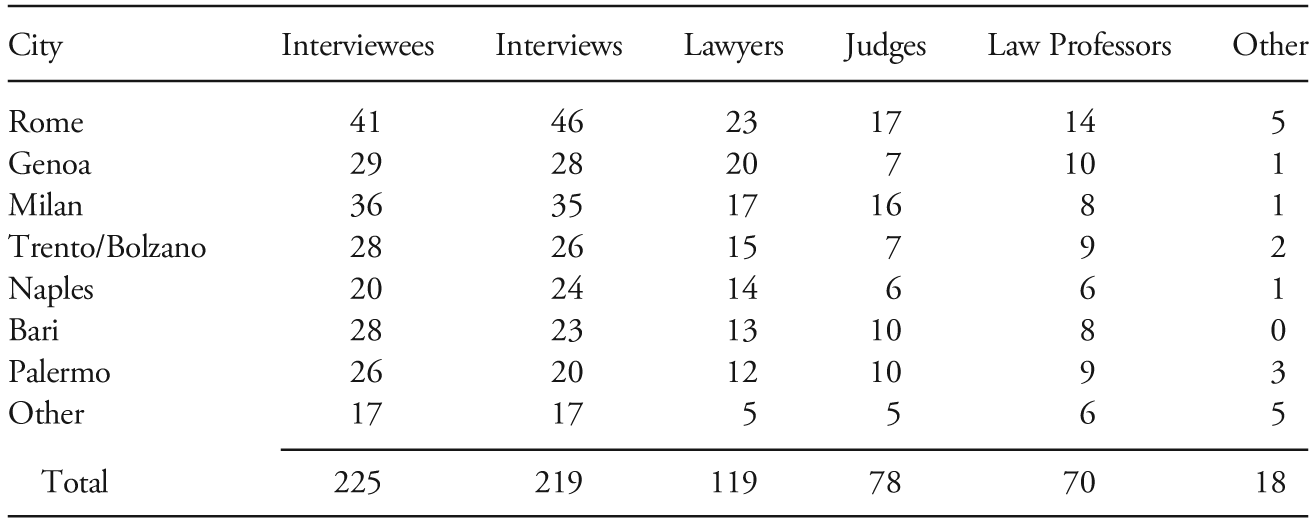
Note.—The number of interviewees and interviews does not match because some subjects were interviewed repeatedly and others as a group. Note further that many legal professionals occupy multiple roles. Interviews were conducted between June and August 2015 and between September 2016 and April 2017.
Legal practitioners were purposively selected via a form of “standardized” snowball sampling. Snowballing has been praised for producing findings that are both “emergent” and “interactional” through flexible face-to-face engagement (Gray et al. Reference Gray2007, 151–78; Noy Reference Noy2008). However, the method can exclude actors central to the causal process of interest by getting stuck in a closed network. As a result, the origins of multiple snowballs across three northern Italian cities (Genoa, Milan, and Trento/Bolzano), three southern Italian cities (Naples, Bari, and Palermo), and the capital of Rome were standardized: in each city, at least one member of the governing council of the local bar association, of each city tribunal, and of each law school faculty was interviewed. Furthermore, where possible, interviewees were asked to refer the names of local lawyers or judges with personal experience in referring cases to the ECJ, even if they lay outside their network.
To begin, I provide evidence from semistructured interviews with lawyers, who are usually the actors who solicit the judge into applying EU law or dialoguing with the ECJ in the first place. The focus is on interviews that are (1) representative of general sentiments but (2) articulated by lawyers with the greatest experience soliciting preliminary references, whom Vauchez (Reference Vauchez2015) terms “Eurolawyers.” After all, elite interviewing in processualist scholarship should aim to “identify the key political actors that have had most involvement with the processes of interest” (Tansey Reference Tansey2007, 766). As “repeat players” (Galanter Reference Galanter1974) in the field of EU law, Eurolawyers are uniquely situated to illuminate whether lower court judges are “enthusiastic” (Weiler Reference Weiler1991, 2426) about opportunities to dialogue with the ECJ.
The consensus among lawyers interviewed is that the national judges’ default position is usually resistant to encounters with EU law and the ECJ, that this was particularly true in the past, and that resistance remains concentrated in courts of first instance. This is inconsistent with the observable implications of the JET, since most national judges—particularly in the first decades of the European Community and in lower courts—should have an incentive to collaborate with the ECJ to expand their interpretive powers.
For example, a cofounder of one of the first Italian firms in Milan to specialize in European law in the 1970s notes that a decision by the judge to refer to the ECJ “remains rather rare, and in the past it was virtually impossible… . It didn’t happen, because judges didn’t study this topic, they didn’t know it, they looked at you funny as you talked!”Footnote 10 “[Judges] didn’t have the faintest idea what [EU law] was about,” confirms a lawyer who in the 1970s began practicing European law before lower courts in northern Italy; “in my very first lawsuits … when I cited European law before the judge and I asked for a preliminary reference … I had to perform a sort of crash course in European law.”Footnote 11 To this day, Eurolawyers affirm that “the judge, certainly, let’s say, on his own initiative, rarely—nay, almost never—turns to the EU judge.”Footnote 12 Indeed, virtually all lawyers interviewed were adamant that judges of first instance are unenthusiastic about dialoguing with the ECJ. “The judge isn’t going to do the homework,” confides one interviewee in Rome; “so if one doesn’t write [the reference], the judge often doesn’t write it himself.”Footnote 13
Some lawyers cited personal statistics to crystallize the extent of judicial resistance. In Genoa, one interviewee notes that if he “[asks] the court to refer to the ECJ 10 times … the reference is made two times, and zero point [x times] the judge himself decides that there’s an EU law question that isn’t raised by the parties.”Footnote 14 In Rome, a colleague similarly concludes with frustration that only a tenth of his requests for a referral are granted: “The judge often tries to do everything he can not to refer.”Footnote 15
Crucially, judges’ resistance to dialoguing with the ECJ to enforce European law was most pronounced during the first decades of European integration. A long-standing Eurolawyer describes how “in the past, we complained a lot that judges weren’t referring, especially Italian judges. Now we’ve transitioned a bit.”Footnote 16 “The judge expects you to propose a prospective reference,” notes a colleague with 4 decades of experience in preliminary reference cases; “today, there are also some very able judges… . When I got started, you’d hope that he would copy your [proposal for a reference].”Footnote 17 In Rome, a specialist in EU competition law is similarly direct: “When I first started working … more than 30 years ago … it was the judge who told you: ‘Write it for me.’”Footnote 18 This resistance, interviewees suggest, belies insecurity when dealing with a little-known, “foreign” area of law. As one interviewee put it, well into the 1990s lower court judges were reluctant to refer cases to the ECJ out of a “fear … [of] making a bad impression.”Footnote 19
While this state of affairs has generally improved over time, judicial resistance does remain, particularly in courts of first instance and small towns. As a leading litigator of EU law in Milan explains, “If they’re not judges of last instance they aren’t obligated [to refer], they prefer not to go, and to decide themselves.”Footnote 20 Indeed, a Eurolawyer and former clerk (referendaire) at the ECJ notes that courts of last instance are “more structured to [refer to the ECJ] on their own,” whereas in “the smaller tribunals in other locations where they handle EU law with less frequency, there, yes, the initiative of the lawyer is very useful.”Footnote 21 Another colleague agrees that while supreme courts often submit “a lot of references[,] … [judges] in other locations … encounter some difficulties, especially in smaller towns—how do you write a reference?”Footnote 22 Many interviewees find this unsurprising, since lower courts face first-order difficulties when confronting the field of EU law: “Oftentimes the lower courts think they have to refer a question to the Court of Justice in a foreign language. They don’t know they can do so in Italian. They’re afraid! … Oftentimes they don’t know where the Court of Justice is located…. Obviously higher courts are more used to it.”Footnote 23
V. Qualitative Evidence: Judges and Practices of Resistance
Methodologically, relying solely on interviews with lawyers can be problematic, for two reasons. First, Eurolawyers may have an inflated sense of their own influence—the problem of “exaggerated roles” that can arise when interviewees discuss their impact over a given social process (Berry Reference Berry2002, 680). In so doing, lawyers might overstate judges’ resistance to EU law. Second, lawyers can only speculate as to the reasons behind judges’ behavior, since their time in court is usually limited.
In this light, interviews with judges (see table 3) are essential to provide external validity to lawyers’ claims via “triangulation” (Arksey and Knight Reference Arksey1999, 21–32). Because judges’ reputation (Garoupa and Ginsburg Reference Garoupa2015, 24–25) depends on the perception of their mastery of the law, their incentive is to stress their practical proficiency in all legal fields. If, on the contrary, judges confirm the presence of diffuse practices resistant to encounters with EU law and the ECJ, then confidence in lawyers’ claims is bolstered. Furthermore, judges are privileged witnesses to the everyday institutional pressures that condition their willingness to dialogue with the ECJ, allowing us to illuminate the mechanisms driving the judicial behavior that lawyers describe.
Breakdown of Interview Sample of Judges (N)

Almost without fail, judges corroborated lawyers’ claims, detailing the institutional logics within the lower rungs of the judiciary that render collaborating with the ECJ fastidious, costly, and even scary. The origins of this diffuse resistance can be traced to the interaction of three variables: (1) insufficient knowledge of European law, (2) workload and time constraints, and (3) cultural aversions to invoking supranational rules to adjudicate the legitimacy of national statutes.
A. Knowledge Gaps and Workload Management
The first two logics judges underlined are baseline gaps in knowledge and workload pressures. These mechanisms are inextricably linked. To be sure, that the first coursework on EU law by the High Council of the Judiciary was established only in 1993 and that judges did not need to know EU law to pass the judicial entrance exam until 1997 is in the public record (Bartolini and Guerrieri Reference Bartolini2017, 412–13). Notably, this situation is not unique to Italy, nor has it significantly improved in recent years. For example, in a 2011 survey of domestic judges, the European Parliament found that three-fifths did not know how to refer cases to the ECJ (Coughlan, Opravil, and Heusel Reference Coughlan2011, 5). What is more unique to Italy is another well-known problem, namely, that comparatively high litigation rates can overwhelm judges, pressuring them to decide cases quickly (Sergi et al. Reference Sergi Lanau2014, 7–14). Crucially, how these two factors interact to condition judges’ lived experience and their openness to a dialogue with the ECJ remains unexplored. Interviewees suggest that in lower courts, insufficient knowledge of EU law breeds insecurity that can only be remedied by continuing training, yet workload constraints make it undesirable or impossible to obtain such training.
1. Knowledge and Judicial Reputation
Like most judges in Europe, Italian judges are drawn to the image of the Montesquieuian judge as the knowledgeable “voice of the law.”Footnote 24 As a result, insufficient training in EU law—beginning in law school and continuing within the judiciary—puts them in an uncomfortable position they would rather avoid.Footnote 25 And although opportunities to obtain EU training have increased in recent years, these opportunities are often insufficient to stay up-to-date on a continuously evolving and complex area of law, generating insecurity.
In interviews, judges discussed their colleagues’ scarce EU legal knowledge with some discomfort, as if confiding a secret: “Let me tell you, quite sincerely,” confides a judge who began his career at the Tribunal of Palermo, “that the dialogue with the ECJ has been lacking over the years for one primary reason that is often unstated: That EU law has not been well known in our legal order… . To this day, conducting research on the website of the ECJ is problematic for some colleagues.”Footnote 26 “I don’t recall any judges in particular [in the 1980s and 1990s] who confronted themselves with this reality,” confesses a long-standing first-instance and appeal judge in Milan; “no judge knew how to conduct the research… . You needed the lawyers to cite the ruling [of the ECJ] for you.”Footnote 27 “Lacking training,” echoes a colleague at the Tribunal of Bari, “we also don’t have a propensity and positive outlook—with great sincerity—we find it tiring to confront ourselves with European law.”Footnote 28
In response to this state of affairs, since the mid-1990s EU law courses have been established at the National Judicial Training School and in districts associated with each Court of Appeal. The logic is that “greater training that is ever more constant would habituate [judges] to dialogue [with the ECJ] with greater ease.”Footnote 29 Yet there are two limitations to these efforts. First, undergoing continuing EU legal training is not required: as one judge at the Tribunal of Rome highlights, “The problem with this sort of training … is that it’s person-based. That is, it’s the judge … [who] must ask to participate in that specific course.”Footnote 30 As a result, a “utilitarian conception of judicial training” pushes judges to focus instead on more recurring, everyday themes in national law.Footnote 31 Finally, even those judges who know European law and participate in EU legal training emphasize that it is usually too brief and intermittent, and “at the end of the day … we’ve trained ourselves on the job.”Footnote 32
Insufficient knowledge of EU law breeds two sorts of insecurities for lower court judges. The first concerns their interactions with lawyers. While specialist Eurolawyers can serve as important carriers of EU knowledge, judges are wary that they could be manipulated to serve the partial interests of the lawyer’s client. One judge who has spearheaded several EU training initiatives for lower court judges tries to solicit participation precisely by stressing how dependent they would otherwise be on the lawyer’s actions: “If you don’t have the right pair of glasses and you have the file in your hands, you can’t see this phenomenon—unless the lawyers tell you.”Footnote 33 “Every judge’s concern” is that “the lawyer exploits this knowledge of his and tries to manipulate the judge, and make him pose a question that is not founded,” confirms a retired judge of first instance, “and the judge that gives into this seduction errs.”Footnote 34
Second, insufficient knowledge of EU law breeds insecurity vis-à-vis dialoguing with the ECJ. Lower court judges highlight that their inexperience with drafting preliminary references engenders a fear of being publicly embarrassed should their referral be declared inadmissible.Footnote 35 This concern is not unfounded: one recent study finds that the ECJ is four times more likely to declare a lower court reference inadmissible than a reference from a court of last instance (Kelemen and Pavone Reference Kelemen2017). “It’s very risky to refer [to the ECJ],” explains a judge at the administrative court in Milan, “because your reference could be declared inadmissible. And this becomes known.”Footnote 36 A first-instance judge in Rome similarly notes how “a little reverential fear for what the Court could tell us exists, and this begets the fact that you only get there if you’re firmly convinced.”Footnote 37 Another lower court judge explains that “our judgments are the name of the Italian people…. We bear the weight of this responsibility…. You don’t just refer like that, in one week or two—you must think about it for six months! Precisely because it’s a reference that circulates at the European level…. We should add that vis-à-vis EU law you’re more insecure…. If it also comes back as inadmissible, well …”Footnote 38
2. Workload Pressures
If gaps in EU legal knowledge breed insecurity, why do judges not simply tend to these lacunae? This is a crucial question, since a recent survey analysis of German, Dutch, Polish, and Spanish judges finds that attending judicial training and participating in exchanges with foreign judges bolster their self-evaluated competence in EU law (Mayoral, Jaremba, and Nowak Reference Mayoral2014). Taking seriously the institutional constraints that are encoded in judges’ everyday work practices provides an answer.
The most important constraint reveals itself the second one enters a city’s palace of justice: the ubiquity of stacks of fascicoli (case files). The importance of files as material objects of judicial practice has already been evidenced by Zan (Reference Zan2003) and Latour (Reference Latour2010, 70–106); in this instance, files are a physical reminder to lower court judges of the daily duties that remove the gloss from a prospective encounter with EU law or the ECJ. One first-instance judge in Bari confessed that when she was first appointed, her docket comprised some 13,000 fascicoli.Footnote 39 Such numbers become palpable when noticing how case files are stuffed into suitcases to facilitate transportation, stacked atop carts, or lined into barricades partially shielding judges from view during oral arguments. Witnessing the ritual frenzy of oral arguments before judges in lower civil courts can be equally instructive. At the Tribunal of Naples—where, in 2014, the criminal divisions alone decided some 232,692 cases and faced a backlog of 122,321 proceedings (Tribunale di Napoli 2014, 41)—oral arguments constitute a stream of lawyers and clients, with paperwork in hand, simultaneously attempting to solicit the judge’s attention.Footnote 40
The impact of these workload constraints—which are most pronounced in courts of first instance, since some lawsuits are not appealed—is to encode a Foucauldian form of diffuse discipline (Foucault Reference Foucault1975) within everyday practice that resists encounters with “lesser” known courts and fields of law. The default mind-set aims for the quantitative processing of lawsuits rather than a creative search for the points of contact between facts, national law, and EU law. As one Genoese judge emphasizes, “Given the quantitative aspect of the workload, this can distract from the evaluation of additional” realms of law.Footnote 41 Interviewees stress this point through the language they use. Particularly within lower courts, judges speak of being “frustrated,” “overwhelmed,” and “crushed” by a “massacre-like” stream of lawsuits, which obstructs efforts to “deepen” EU law by “thinking higher.”Footnote 42 A binary opposition thus arises, between a heavy, everyday workload—symbolized by files of crushing weight—and an abstract notion of EU law floating higher, waiting to someday be deepened.
Exacerbating the flow of lawsuits that discipline judges into avoiding contact with EU law is the career incentive—strongest for lower court judges—to quickly decide cases. Over the past 2 decades, legislative reforms aiming to bolster the “efficiency” of justice have increased the probability that judges will face penalties should they adjudicate cases slowly.Footnote 43 As a long-standing Milanese judge explains, “We’ve had much pressure on the part of legislators … to contain the length of proceedings … also because our career can be impacted. We’re not punished in a disciplinary way, but, if you’re late, as soon as you request a promotion, every four years, it gets blocked, in terms of pay, in terms of advancement.”Footnote 44 “It’s definitely a fear,” corroborates a lower court judge in Rome, “also vis-à-vis our hierarchical superiors, or even that we might be held disciplinarily responsible, for having decided cases with lots of delay…. We all have this nightmare of letting the proceedings last too long.”Footnote 45
3. The Economy of Everyday Judging
Workload pressures bear a strong impact on the everyday economy of judging, disincentivizing participation in EU legal training and encouraging a form of cost-benefit analysis that disfavors a dialogue with the ECJ. With regard to participating in EU legal training, most lower court judges are resigned to the fact that they simply “don’t have the time.”Footnote 46 For example, one first-instance judge in Rome thinks it would be “very positive” to have “exchanges [on EU law] … [but] I’ve not been able to create this situation because of the excessive workload…. I can’t breathe because there’s too much work, so I can’t manage to live this reality.”Footnote 47 In short, “the workload is something that completely frustrates the judge,” agrees a judge at the Tribunal of Milan, “so many judges don’t come [to EU training sessions] because on Monday [through] Friday they hold hearings, on the afternoons they must write the judgments, they must attend section conferences, they have administrative duties to tend to, and in this bureaucratic silence EU law dies.”Footnote 48
A second impact concerns the perceived attractiveness of soliciting the ECJ via the preliminary reference procedure. Workload pressures incentivize adopting a cost-benefit analysis whereby the opportunity cost of a referral is weighed as the number of days spent deciding an estimated number of more quotidian lawsuits. Most of the time, the scales are tipped in favor of addressing immediate needs, reinforcing a habitus of nonreferral: “These references,” notes a Milanese judge, “in the realm of the economy of judging, tend to … must be contained.”Footnote 49 A colleague at the Tribunal of Trento puts it this way: “It’s evident that if one is under a lot of pressure, one says: ‘Alright, those ten days, I’ll dedicate to writing those judgements that impact my docket.’”Footnote 50 “Every week that I put everything down I don’t write five judgements,” highlights a judge of first instance in Rome, adding that to write a preliminary reference “you’d definitely need a week’s worth of work.”Footnote 51 Similarly, for an administrative judge in Milan, a judge only refers when “the question jumps before your eyes” since, in terms of work, a reference “is like writing ten judgments.”Footnote 52 “Over that period where you’re writing the reference,” confirms another colleague, “you could lose three, four, five working days. And so, inevitably, if you’re suffocated by the docket … you’ll never refer at all.”Footnote 53 And a civil judge at the Tribunal of Rome is similarly candid: “If I have an escape, I’ll take it, and I’ll take it gladly…. Because referring means, well, not writing four judgments, you see?”Footnote 54
Yet a simple cost-benefit ratio does not do justice to the fact that lower court judges are not used to drafting preliminary references and to think in terms of EU law. And “if you don’t apply these things … it’s clear that your mastery of these problems erodes.”Footnote 55 Hence, to submit a reference means breaking up an entrenched routine—to “put everything down” only when you feel “really, really obligated” to refer.Footnote 56 One judge highlights the psychological reaction that can be caused by this disruption: “There were some oral arguments where I brought along 500 files… . You can understand that if in one of those files someone questioned the constitutional legitimacy of an Italian law, I would already get the shivers … so let’s not even talk about a question linking national law to international law!”Footnote 57
The breakup of everyday practice can prove so burdensome that some judges feel compelled to work on weekends or to take vacation days in order to write a preliminary reference.Footnote 58 A first-instance judge in Palermo shares how for his first referral to the ECJ, “for two weeks I didn’t do anything else… . Because this was a new domain for me, I had to study … everything that was piling up at the regional administrative court and the tax court, I had to make it up by working evenings and weekends.”Footnote 59 This angst of “everything piling up” is precisely why lower court judges usually relapse into searching for an “escape” from a dialogue with the ECJ. For those few judges determined to dialogue with the European Court, the only option is often to await the arrival of an experienced Eurolawyer and partially rely on her labor: as one Milanese judge confides, “If one of the parties doesn’t request it … you don’t sit there stimulating it.”Footnote 60
B. Cultural Resistance
The foregoing conclusions raise a final puzzle: Why do so many judges remain reluctant to dialogue with the ECJ even when a Eurolawyer articulates to them why and how they (the judges) might write a preliminary reference? “In asking them,” one Eurolawyer in Rome emphasizes, “sometimes judges have preferred, how should I put it, to interpret [national] law in my favor rather than to refer to the Court!”Footnote 61 And in Palermo, one lawyer notes how in a recent set of labor disputes, all of his requests for a preliminary reference were rejected, often without motivation.Footnote 62 In many cases, there is more to this judicial resistance than workload constraints and insufficient training.
One potentially relevant dimension explored by Wind (Reference Wind2010) is a cultural resistance fostered when judges internalize the norms and ideology of a majoritarian political culture. But persuasive though Wind’s analysis may be, one would not expect it to generalize to a fragmented constitutional order like Italy. And yet to put it bluntly, for many Italian judges becoming a European judge of first instance ready to dialogue with the ECJ is neither attractive nor a priority. This is particularly true for lower court judges. One first-instance judge describes this diffuse perspective in this way: “I study what interests me, also because the reference procedure is only obligatory for courts of last instance, and not for me.”Footnote 63
In the space created by this formally legitimate zone of discretion, a traditional self-conception of lower court judges as faithful appliers of parliamentary statutes that only dialogue with their constitutional court can germinate. The contours of this cultural resistance are tied to the civil law conception of the judge as a faithful applier of the laws promulgated by Parliament, which eschews personal, creative impulses to make law (Merryman and Perez-Perdomo (Reference Merryman2007, 34–37). To support this claim, in this section I first underscore the reputational costs that threaten those judges who do empower themselves via EU law. I then provide interview evidence demonstrating that many lower court judges continue to favor a more limited role as national, civil law judges over a more powerful role as European judges of first instance.
1. Three (Iconoclastic) Perspectives on Cultural Resistance
Studying the impact of something as fickle yet ubiquitous as judicial culture is extremely challenging. While no approach is foolproof, one strategy is to tap the experience of those (few) judges who broke with said culture—oftentimes for motives in line with the JET—and trace any pushback they received.
In this light, the experience of three first-instance judges stands out: Francesco Mariuzzo at the Regional Administrative Court of Lombardy, Michele Marchesiello at the Tribunal of Genoa, and Paolo Coppola at the Tribunal of Naples. Each of these judges availed themselves of EU law in line with the expectations of the JET. And each of these efforts was criticized by their colleagues, often limiting aspirations of becoming judges of last instance and—in one case—provoking a threat of disciplinary sanction.
To begin, becoming an EU judge of first instance means “putting yourself in discussion,” as one lower court judge stated.Footnote 64 This is particularly true when the application of EU law results in the disapplication of national law, which translates into a perception of rebelling against the very state of which one is a part. For Francesco Mariuzzo, this was precisely the point: as a fiercely independent-minded judge who believed that the Italian administrative justice system was too proximate to public authorities, he began in the 1990s to refer questions to the ECJ in earnest whenever he strongly disagreed with the judgments of the Council of State.Footnote 65 Mariuzzo describes this “inter-court competition” logic (Alter Reference Alter2001) as follows: “There were many occasions to refer questions to the ECJ, because there were some judgments by the Council of State that did not persuade us. And every time we encountered these judgments … we began to send, with some frequency, our orders to the Luxembourg Court.” Yet such rebellions at the service of a supranational legal order—Mariuzzo likens this to a “war ship … taking hits, a little here, a little there”—require that the Europeanist judge be willing to bear potential reputational and career-related costs. As Mariuzzo puts it, “What one needs is … to also be a little courageous, to do things a certain way and assume responsibility. And some don’t want this responsibility… . I can tell you that I didn’t enjoy much sympathy at the Council of State, but I don’t care at all!”Footnote 66 Despite these claims, one of Mariuzzo’s former colleagues suggests that the fact that his efforts limited his career advancement did cause some personal frustration.Footnote 67
Importantly, cultural resistance to European legal integration does not originate solely from conformity to (or reverence for) supreme courts like the Council of State. Rather, it is more broadly encoded within the circumscribed role that civil law judges tend to allocate to themselves when applying the law. In Genoa, Michele Marchesiello broke from this tradition by cooperating with Genoese lawyers to punt many references to the ECJ as judge at the city court of first instance.Footnote 68 In particular, he was convinced that “EU law was a great opportunity to lessen the distance to the common law judge … to not be a bureaucrat.” Yet, just as Mariuzzo emphasized that his rebelliousness was sui generis, Marchesiello underscores that few of his colleagues are comfortable with the power afforded by assessing the conformity of national law with EU law. As a result, some of his own preliminary references and rulings invoking EU law were dismissed as insufficiently formal efforts to attract attention via “journalistic” judgments. “Our judiciary remains very functionalist,” Marchesiello laments; “they’re professionals in a way, but they’re also state employees. And therefore this precludes that liberty, independence, that affirms itself very, very slowly. Judicial review, something I’m very jealous of … here taking that step is very difficult… . This is a problem, because judges have difficulty broadening their line of sight.”Footnote 69
Few Italian judges relish an iconoclastic “broadening of the line of sight” more than Paolo Coppola at the Tribunal of Naples. Indeed, Coppola has submitted more than half of all preliminary references originating from the city, essentially because he disagreed with the established jurisprudence of the supreme Court of Cassation in labor matters and thought EU law offered greater protections to Italian workers.Footnote 70 As a result, he is intimately aware of the cultural frames that render lower courts in a civil law judiciary “diffident” regarding a dialogue with the ECJ: “To diffuse this type of culture, and the mechanisms—the fear in applying it … it scares you, of course! Because it mutates the judicial order, because someone can challenge you, because you can be afraid of ending up in the newspapers, because they can be powerful situations.” Like Mariuzzo, Coppola emphasizes that becoming a European judge of first instance can be easily perceived as a form of disobedience, thereby generating reputational costs. “Certainly [my references] bothered many people,” he confesses; “certainly there is a big block … of diffidence against those who apply EU law in this manner.” On one occasion, his recurrent referrals to the ECJ even prompted a direct “threat” of disciplinary sanction from the state legal service—a claim other interviewees confirmed.Footnote 71 And much as Mariuzzo’s controversial Europeanism caused him to shed any careerist aspirations, Coppola emphasizes that he “never submitted a request [to ascend to the Court of Cassation].”Footnote 72
2. From Diffuse Reticence to Occasional Rebellion
While the foregoing judges are unique in the degree to which they internalized the role of European judge, less iconoclastic judges tasked with training their colleagues on the matter tend to reach similar conclusions. That is, the general marginalization of EU law in the national judicial culture is a common lament. And on rare occasions, there is evidence that lower court judges can be as willing as their superiors to openly rebel against EU law and the authority of the ECJ.
The marginalization of EU law in national judicial culture—a “narrow vision” breeding “resistance towards the communitarian phenomenon”—was cited as a key motive for establishing the first EU legal coursework for Italian judges in 1993.Footnote 73 Twenty-five years later, interviewees suggest that not much has changed. In Milan, the judge charged with EU legal training explains that lower court judges make “tons of references to the Constitutional Court, which they interpret as their own court, vis-à-vis the ECJ… . There isn’t this culture that EU law is something that concerns you.”Footnote 74 In Rome, a colleague confides that “in our jurisdiction EU law and international law generally were marginalized and treated as subjects reserved for those with a penchant … for writing the interesting judgment, that which would be published… . The value of EU law didn’t permeate our conscience.”Footnote 75 And one judge who organized EU law courses at the high judiciary school confirms that “this training in EU law is considered a luxury” rather than a necessity.Footnote 76
Furthermore, in interviews some judges conveyed cultural viewpoints valorizing domestic legal traditions with correlative hints of tepid Euroskepticism. One lower court judge notes how “we already have our own laws, lots of them, some of them are also really beautiful … so we maybe don’t even feel a need to search elsewhere for points of reference for our decisions.”Footnote 77 And when asking a pair of formerly lower court judges in Bari about their reluctance to appropriate the greater interpretive powers offered by EU law—including the power of disapplying national laws—they replied that “this is not our culture.”Footnote 78 Other interviewees agree. For example, one Milanese administrative judge confides that “while one could disapply national law without referring, personally I don’t want to do it. I apply the [national] law, unless the Court of Justice pronounces itself. This out of a logic of respect for the national legislator. He wrote the law, surely he thought it over.”Footnote 79
Finally, on rare occasions subtle judicial nationalism can boil over into outright rebellion. For example, when in 2013 a young Eurolawyer in Palermo sought a preliminary reference in a labor dispute, the first-instance judge at the Tribunal of Termini Imerese was less than pleased.Footnote 80 Not only did he reject the request; he transformed his 14-page judgment into a manifesto against the internal validity of EU law. Affirming that “the laws stemming from the European Union do not have any legal direct effect in the domestic order,” the lower court judge concluded that “the judgments” of the “European Court of Justice … cannot bind the Italian judge,” for only in this way can “the Italian people exercise their sovereignty.”Footnote 81 Putting the cherry on top, the judge ordered the lawyer’s clients—a group of part-time teachers—to refund the Ministry of Education’s legal fees to the tune of 10,000 euros (over $13,000).Footnote 82
VI. Conclusion: Implications, Comparison, and Future Research
By combining disaggregated preliminary reference data at the individual court level with hundreds of semistructured interviews with lawyers and judges, it becomes clear that Weiler’s (Reference Weiler1991, 2426) statement that “lower national courts in particular made wide and enthusiastic use” of their dialogue with the ECJ is at the very least exaggerated. It is therefore unsurprising that scholars who refined Weiler’s insights also tended to underestimate the enduring institutional constraints that dissuade judges from promoting European integration through law.Footnote 83
In truth, this article suggests that lower national courts face real, quotidian, and path dependent institutional pressures to evade collaborating with the European Court. Even in Italy, where nearly eight out of 10 referrals to the ECJ are submitted by lower courts, those few judges who are enthusiastic about dialoguing with their European counterparts underline the associated reputational costs. The only practices that can be described as “wide” are those that incentivize judges to inhabit fields of law over which they have mastery, to manage large quantities of judicial work by limiting breakups of routine, and to interpret their judicial review powers narrowly. Each of these mutually reinforcing logics is an obstacle to encounters with EU law and the ECJ.
But what are the implications of such a finding, and does the evidence “disconfirm” the JET? Such a conclusion would be too strong. As recent scholarship in case study methods has shown (Gerring Reference Gerring2007), a “crucial case” can only “disconfirm” a hypothesis to the extent that said hypothesis makes a universal and deterministic causal claim. Ambitious though the works of Weiler (Reference Weiler1991), Burley and Mattli (Reference Burley1993), and Alter (Reference Alter1996) may have been, to impute a universalist determinism to them would amount to building a straw man.
A more fruitful approach would be to qualify the explanatory power of the JET by articulating scope conditions. The first qualification is to stress how the thesis is a perceptive account of the effects of European integration on the power of national judges but may be less robust than previously thought as a causal account of national judges’ decision to support or resist European legal integration. Doubtless, the power to disapply national law that contravenes EU law or to cite a preliminary ruling from the ECJ when breaking from the jurisprudence of a high court constitutes an awesome broadening of ordinary national courts’ judicial tool kit. Nevertheless, this article suggests that while judges who sought to empower themselves via a dialogue with the ECJ do exist, they were and remain the exception rather than the rule. Understanding why most judges, to this day, choose not to empower themselves via EU law is just as important as understanding why a few of them do.
In a sense, these findings support the initial skepticism of the JET expressed by Stone Sweet and Brunell (Reference Stone Sweet1998b, 70–71). However, I deviate from their work by casting doubt on the claim that the judicial construction of Europe nonetheless constitutes a “self-sustaining logic of institutionalization” (72). For national judges—especially within lower courts—deviating from their traditional role as efficient, expert appliers of domestic law is not a costless process of institutional conversion, nor is it an obviously desirable transformation of their everyday practice. By drawing on historical institutionalist insights into how “change agents” must confront a preexisting institutional constellation that constrains their efforts (Mahoney and Thelen Reference Mahoney2010), it becomes clear that there is nothing automatically self-reinforcing about lower courts collaborating to promote European integration.
This conclusion can reorient scholars to study subtler yet more diffuse forms of resistance to transnational governance than the explicit rebellions of supreme courts (e.g., Rasmussen Reference Rasmussen2007) or legislative-executive forms of noncodification (e.g., Falkner, Trieb, and Holzleithner Reference Falkner2008; Martinsen Reference Martinsen2015) that have garnered much important attention. Namely, by probing how institutional path dependencies limit the degree to which European integration is embedded within the routines of local courts, researchers would uncover a privileged context for studying the various ways in which transnational governance is negotiated and resisted “far from its well-recognized, well-marked official sites” (Sarat and Kearns Reference Sarat1995, 7). This matters because it is at the “street level”—before courts of first instance—that most ordinary citizens have an opportunity to come into contact with the authority of transnational legal orders like the EU. To the extent that diffuse institutional constraints and entrenched habits dissuade lower courts from fully availing themselves of their new powers under EU law, the “on the ground” reach of Europe’s legal authority stands to remain “contained” (Conant Reference Conant2002).
A second conclusion would be that the JET should no longer be assumed to be a sufficient explanation of the causal origins of the judicial construction of Europe, even within the EU’s founding member states. As previously noted, out of the six founding EU member states, Italy has by far the greatest and most enduring share of preliminary reference activity originating from lower courts. Indeed, over the past 2 decades, references from high courts have approached or surpassed references from lower courts in all founding member states except Italy (see fig. 2). Furthermore, in two founding member states—the Netherlands and Luxembourg—lower court references have never made up the plurality of reference activity. Thus, even in the very contexts that inspired the JET, “reluctance” seems to usually win out over “enthusiasm” in relation to the ECJ. Future research could probe the generalizability of these findings: if diffuse habits resistant to an interjudicial dialogue are so evident among Italian lower courts, then lower courts in other founding member states should also be reluctant to empower themselves by dialoguing with the European Court.
Preliminary references by court level in founding EU member states, 1961–2010.

Finally, this analysis bears theoretical insights that span a much wider landscape than Italy or the EU. The EU has served as the prime example of what Hirschl (Reference Hirschl2007) calls a “juristocracy,” or what has more broadly been termed the “judicialization” of politics (Shapiro and Stone Sweet Reference Shapiro2002; Hirschl Reference Hirschl2008). The JET has played a central role in solidifying the image of Europe as a self-reinforcing “judicial construction” (Stone Sweet Reference Stone Sweet2004), and it has served as a referent for how transnational legal orders outside of Europe could “transplant” the process of regional integration through law (Alter and Helfer Reference Alter2017). While it would be incorrect to infer from the foregoing evidence that judicial politics do not underlie supranational governance in Europe, the centrality of the drive to power of national lower courts ought to be contextualized and qualified. “Ruthless egoism” does not do “the trick by itself,” as Burley and Mattli (Reference Burley1993, 54) claim, nor is it relatively costless for judges to indulge their drive for self-empowerment, as Alter (Reference Alter1996, 466) suggests. Seemingly inconsequential nitty-gritty tasks—like managing one’s workload—can ossify into diffuse and institutionalized practices of enormous consequence to the actors responsible for negotiating transnational governance on the ground. And as international and supranational rules are layered atop domestic institutions and spark a micropolitics of everyday practice, actors hitherto receiving less attention—like stubborn “Eurolawyers” (Vauchez Reference Vauchez2015) who push judges to break out of their routines and avail themselves of transnational law—may oftentimes play a more central role than judges alone. In short, recontextualizing judges within a broader constellation of actors and webs of quotidian practice that resist institutional change stands to uncover both the practical limits of—and alternative pathways to—the judicial construction of transnational governance.



