INTRODUCTION
Anglo-Saxon Graves and Grave Goods of the 6th and 7th Centuries AD: a chronological framework, published in 2013, was the product of fifteen years’ collaborative research by a multi-disciplinary team, and combined a range of archaeological techniques, old and new.Footnote 1 A key feature of the integrated approach was the use of mathematical methods to process archaeological data that could be organised or described in quantitative/numerical form – including the co-ordinates of data-points in diagrammatical space – in order to construct chronological models; in this case of a period of approximately two centuries during which the deposition of artefacts in graves with the human dead was a regular practice in southern and eastern England. Bayesian modelling could concurrently measure the validity of these models.
The outputs offered alternative partitions of the sequence of furnished male graves based upon different methods of identifying realistic ‘phases’ within the sequence: one, coded as phases AS-Mp to AS-Mt, identifying clusters and breaks in the parabola of points in a two-dimensional plot of the co-ordinates of the Objects (graves) generated by this method of analysis; the other, coded as phases AS-MB to AS-MF, based upon phases defined by the introduction of leading types from the sorted matrix ordered according to the co-ordinates of the graves and artefact-types on the first principal axis. There was, conversely, just one partition of the female grave sequence (coded AS-FB to AS-FE) because the same two approaches produced identical results. A combination of high-precision radiocarbon dating of targeted samples (albeit with sample selection limited by availability) and Bayesian modelling of the radiocarbon data generated a series of precise statistical estimates of the date-ranges within which the boundaries between the modelled phases belong. It was recognised that phases preceding the first fully modelled phases of each sequence should eventually be incorporated into developments of the framework, and these were therefore coded as AS-M(o), AS-MA and AS-FA respectively.Footnote 2
A period of seven years since the publication of that report proves a short time for an assessment of the impact of the new national chronological framework for a key period in the archaeology of England and thus one with wider significance both within Britain and in a European context. The excavation and study of large sites to which this framework could or should be applied will inevitably be sporadic, while it will also take time for new reference data and results such as these to be embedded into ambitious and complex post-excavation or other analytical project designs. The results proved of value in the interpretation of the large collection of artefactual material in the Staffordshire Hoard (found in 2009), although fundamental to study of that assemblage had to be emphasis on the marked contrast between what is represented in the hoard and what was still being deposited in a regular manner in graves of the third quarter of the seventh century ad.Footnote 3 It is disappointing not to have seen more impact from the framework, from the details of common artefact typology through to the phase-sequences and the calendrical chronological date-ranges that go with them, in substantial cemetery-site publications such as Tranmer House by Sutton Hoo, Suffolk, and Barrow Clump, Wiltshire.Footnote 4 The most productive focus of attention now is to consider why that may be so. At a more modest scale, it is informative that a report on a cemetery of some eighty inhumation and two cremation burials at Wolverton, Milton Keynes, Buckinghamshire, employed the typology in more straightforward cases (the seaxes) but not in others (particularly the shield bosses and spearheads).Footnote 5
Two more positive cases have had the benefit of members of the English Heritage project team of 1998–2013 being centrally involved in post-excavation study and research. The grave goods in the ‘princely’ chamber grave excavated at Prittlewell in Essex late in 2003 could be included in the male seriation of the national scheme (coded as PritPI). In that case, the alternative schemes of partition of the male sequence produced noticeably variant results in suggesting a date-range for this burial.Footnote 6 These differences further appeared to pose critically important questions concerning the overt expressions of Christian allegiance in the Prittlewell grave-assemblage, in the form of the two gold foil crosses and the inscribed silver spoon. Still in 2013, it seemed those ought to imply a date no earlier than the historically attested mission sent by Pope Gregory to Kent in ad 596. Now, however, radiocarbon dates from remains of organic artefacts amongst the Prittlewell grave goods (a wooden cup and a drinking horn) have been obtained and built into the chronological models.Footnote 7 Assigned to a place in the national framework defined by ‘leading artefact-types’ (phase AS-MD) and assuming an overwhelmingly terrestrial rather than marine-sourced diet for the human remains that date this phase, this implies that the burial most likely took place in the period of ad 580–605. That would pre-date the introduction of Christianity to the kingdom of Essex as we should understand that process according to what Bede believed when compiling and writing Historia Ecclesiastica Gentis Anglorum some 130 years later.Footnote 8 Further historical reflection, however, proves amenable to accepting a looser historical narrative of the early Conversion Period of Anglo-Saxon England.Footnote 9
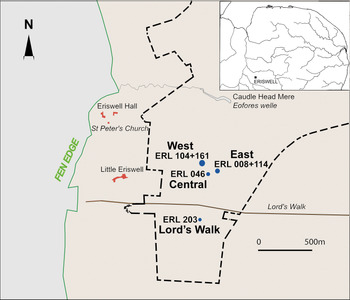
Since 2009, the present author has been working with Suffolk Archaeology (now Cotswold Archaeology) on the post-excavation analysis and preparation of a report on the excavations of 1998–2008 of four discrete Anglo-Saxon burial grounds at RAF Lakenheath, Eriswell parish, on the Suffolk fen-edge.Footnote 10 These excavations uncovered at least 450 identifiable burials, mostly inhumations, but also at least eight cremations in the largest of the burial grounds. Three of the burial grounds were in concurrent use, labelled ‘West’, ‘Central’ and ‘East’;Footnote 11 the West site apparently came into use first and is where cremation is evidenced; it also continued in use long after burial ceased at the other two locations. Eight inhumation graves at a separate location some 300m south, alongside Lord’s Walk, may follow sequentially on from the end of burial in the West site (fig 1; and see below). The study and interpretation of the artefact-types among the grave goods has been fully consistent with the scheme used for the national chronological framework. Project funding also allowed us to obtain radiocarbon dates, most of them high-precision determinations, for fifty of the burials in these four burial grounds.
The position of the Anglo-Saxon burial grounds found within the area of RAF Lakenheath (dotted line = perimeter), Eriswell parish, Suffolk. Also shown are the historical hamlet of Little Eriswell, with the adjacent church and hall, and the spring at Caudle Head Mere, close to which Early Anglo-Saxon settlement evidence has been found and which is likely to have been the Eofores welle from which the name of Eriswell derives. Image: author.

Calibration curves, and Grave 323
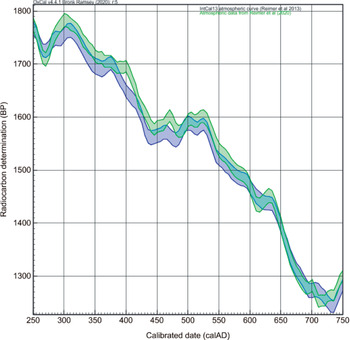
The national chronological framework used a new and precise calibration curve for radiocarbon dating generated in the radiocarbon laboratory at Queen’s University, Belfast.Footnote 12 This ‘project-specific’ calibration curve was based upon decadal samples (ie ten-year chunks) of known-age wood. Those data were incorporated into the international calibration curve IntCal13, which remained the current reference standard for seven years. The analytical work reported on here was initially produced using IntCal13. In comparison with the project-specific curve, it was expected to return results that were a little less precise but more robust (ie reproducible).Footnote 13
In August 2020, the new IntCal20 calibration curve was issued, co-ordinated with the release of a new version of OxCal (4.4) to which this curve is the default setting. For the period ad 290–486, this curve is based upon single-year known-age wood measurements.Footnote 14 The difference between IntCal13 and IntCal20 across the period of cal ad 250–750 is shown in fig 2. The shapes of the two curves are essentially very similar, except in the range c cal ad 360–80, where a ‘plateau’ created by a zigzag is replaced by a more regular slope, while in the period c cal ad 600–45 the new result is the inverse of that. Most importantly, though, the major plateau formerly covering the period of c cal ad 425–540 has been narrowed to c cal ad 435–545 – which may not seem very much, but it is particularly important as the range of radiocarbon ages affected by this plateau has been reduced by ten years and moved earlier, from 1600–1540 bp to 1615–1565 bp. The net improvement in precision in terms of the squared area covered by the plateau is around 25 per cent. The position of that improvement proves to be remarkably productive in enabling radiocarbon dating and informed modelling of the results to shed light upon the very beginning of the Anglo-Saxon period, and the transition from Roman Britain.
The calibration curves IntCal13 (blue) and IntCal20 (green) for the period cal ad 250–750. From OxCal 4.4. Image: author.

The chronological chapter of the RAF Lakenheath report, already refereed, was revised in light of IntCal20, which proves to sharpen and enhance the probability of the results significantly. Similarly, the present paper has been revised to embed the greater quality of resolution provided by IntCal20. That can reduce the visibility of the impact of changes in other data contributing to the chronological models (eg additional grave-assemblages and their impact on seriation: see below), and in one case here (see table 4) results produced using IntCal13 are also quoted to illustrate such an issue. However, it is appropriate to use the most up-to-date and readily accessible calibration curve, to provide the best quality results and illustrate the value of the methods, and thus to encourage further analytical research on this basis.
One burial in the West site was of a spectacular character that attracted popular interest as soon as it was found in 1998: the grave of a relatively young adult male (c 18–25yr at death), interred beneath a barrow represented by a ring-ditch, equipped with a sword, shield and spear together with a very large iron-bound tub, and buried with a horse that was sacrificed for this burial and saddled and very richly harnessed when it was laid into the grave pit.Footnote 15 This was the one grave-assemblage from RAF Lakenheath that could be included in the national chronological study, under the site HER code as ERL104: it is now grave 323 in the site sequence. High-precision radiocarbon dates were obtained on both remains of the deceased man and the horse. Statistically these are consistent, and so can be combined to give a more precise radiocarbon age for the burial of 1626±15 bp. Prior to IntCal20, this yielded a calibrated date with a wide spread of probability between cal ad 395 and cal ad 535. However, the fact that the bridle was decorated with pendants and mounts representing Salin’s Style i artwork allowed us to refer to a terminus post quem of c ad 450 for the introduction of that style, which implied that the burial most probably dated no earlier than the final decade of the fifth century, while a date up to the early 530s remained possible.Footnote 16 Using IntCal20, remodelling a sequence in which the introduction of Style i at ad 450 precedes the burial adds greater precision and confidence to these estimates, so that the radiocarbon date now has satisfactory agreement with its terminus post quem (Amodel 60.2), and the estimated date of burial is cal ad 460–80 (9 per cent probability) and cal ad 490–540 (86 per cent probability).
TYPICAL EARLY ANGLO-SAXON CEMETERY SITES AND THE NATIONAL CHRONOLOGICAL FRAMEWORKS
The RAF Lakenheath study may be considered the most representative and informative example to date of how the national chronological framework can be applied to the evidence of a reasonably typical but large excavated site. The present paper, however, has not been conceived simply as a worked case study, to boost confidence and take-up more widely (although it is hoped those will be among its impacts). The large amount of new data we have from this closely connected group of burial sites provides exceptionally valuable insights into appropriate degrees of differentiation between a national framework, a site-specific chronological structure and, in this case, also a regional framework developed for inhumation burials of this period in East Anglia (the counties of Suffolk and Norfolk) – not completely independently of the approach to the national chronological objectives.Footnote 17 Before doing that, however, it is appropriate to reflect upon the primary difficulties that have been encountered and reported by those seeking to use the new chronological framework.
The typological basis of the study covered eleven primary categories of artefact-type, of which only one, buckles and belt-fittings (BU-), can be counted as non-gender-specific.Footnote 18 The most innovative schemes of typological classification were introduced in relation to the weaponry: shield bosses (SB-), spearheads (SP-), swords and scabbard-fittings (SW-) and seaxes and their sheath-fittings (SX-). The SW-range depends straightforwardly on visual identification. The SB-, SP- and SX- ranges all make use of measured data to define typo-chronologically significant variance in the shape and size of the objects, and these have proved difficult to reproduce, especially in the case of the most populous categories: spearheads and shield bosses. What needs to be emphasised is that while a few unproblematic dimensions can be typologically crucial – for instance, whether or not a spearhead or a seax is classified as ‘long’ or ‘short’ (or stages in between), or a shield boss is ‘tall’ (ie at least 105mm in ‘height’ from the level of the base to the apex of its cone) – the remaining measurement points and ratios are intended largely to provide reference data from which the perceived outlines of objects may be checked, not to override observational evidence. The type definitions have to assume ‘idealised’ forms – namely, perfectly round shield bosses with a single diameter value, and perfectly symmetrical spearheads. Reality is always messier, and it is crucial to remember and to be confident that the descriptive definitions of the classes and types are fundamental: if a spearhead visibly has a concave edge between the tip and the widest part of the blade, or a shield boss a convex profile to the cone, one does not need to undertake measurements and calculations to prove it. It is equally crucial to realise that archaeology does not work with natural and therefore invariable typologies: artefacts should be grouped and classified according to the practical objectives of the analytical and interpretative exercise being undertaken. That will never justify a casual approach to the redefinition of types, but typological schemes are no more beyond valid and productive re-adjustment than any other analytical basis.
We are now seeing more and more radiocarbon dates on Early Anglo-Saxon graves being obtained, primarily as recognition of the dependability and the relative precision of radiocarbon dates, and that the procedure, not prohibitively expensive, is becoming widespread. What are needed most of all are clear and easily followed guidelines on sample selection, to indicate where the resources can be spent so that the results will be most valuable. Again, there is not necessarily only one correct approach: how one should best proceed will vary according to the interpretative objectives. As the case study discussed below will illustrate, the questions of greatest interest, and therefore the priorities for sample selection, will vary according to whether one foregrounds the understanding of the individual site, a regional perspective or a national one. Such objectives need not be incompatible, and should never be absolutely so, but they will nonetheless create conflicting aims and may pose difficult choices.
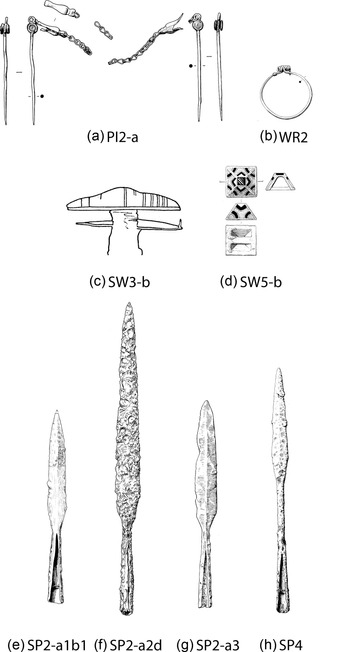
More detailed conclusions and recommendations will properly come after the evaluation of the new data below, but it is important to emphasise that the radiocarbon dates obtained and used to construct and test the national chronological framework were not employed only in phased chronological models, even though that was the primary objective. The evidence these data could provide for the demonstrable date-ranges of individual artefact-types (‘currency models’) is also valuable. The key reference data for the number of dates available per type in 2013 were summarised in table 10.1 of that report, but with insufficient explication of how those data could be made further use of. A minimum number of six dates was considered requisite for a valid estimation of currency per type: no fewer than nine artefact-types fell just short of that threshold with five radiocarbon dates then available, and there were seven types each associated with four and three radiocarbon dates. Among these were artefact-types that are key in defining phases: shield bosses of Class SB5 (see fig 14; three dates) for AS-MF; beads of types BE1-Orange (see fig 5b; five dates) for the start of AS-FC, and BE1-Disc (three dates) for AS-FE; and also linked pins of type PI-2a (four dates) and wire rings of type WR2 (three dates) characteristic of phase AS-FE (fig 3a–b). Perhaps most worryingly, there were no dates at all for burials of shield boss-type SB4-a1+2 (see figs 12 and 14), the leading type defined by seriation for the start of phase AS-ME, and only two and one dates respectively for sword-fittings SW3-b and SW5-b (see fig 3c–d), the leading types for the start of AS-MD. One could go on listing and identifying the value of additional dates for certain types, such as spearheads SP2-a1b1 (five dates) and SP2-a2d (two dates) of AS-ME/F, or SP2-a3 (three dates) and SP4 (five dates) of AS-MC/E (fig 3e–h); PE8 (bulla pendants: five dates), PE10-a (whole cowrie shells: four dates) and WBX (workboxes: three dates) of AS-FD/E. The critical matter is to understand where to look in order to be able to appreciate what the potential contribution of a new dating could be in the national perspective.
Artefact-types with some radiocarbon dates, but fewer than six, the minimum number required for a currency model. (a) Linked pins of type PI-2a; (b) wire ring of type WR2; (c) sword pommel of type SW3-b; (d) sword-belt stud of type SW5-b; (e–h) spearheads of types SP2-a1b1, SP2-a2d, SP2-a3 and SP4 respectively. Image: author.

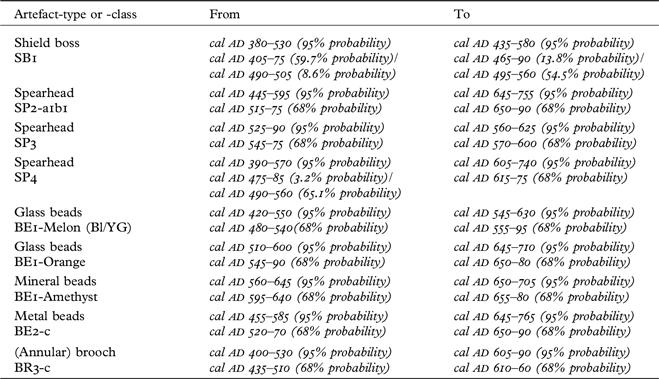
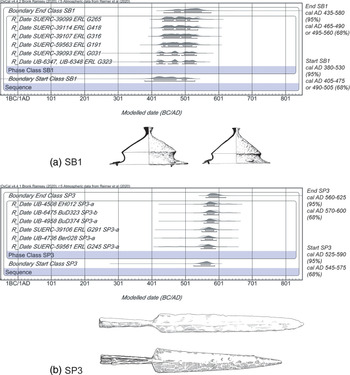
New data now allow us to create currency models for a considerable number of artefact-types in addition to those presented in the report of 2013. This is not the place to go through those in detail: the results are tabulated in table 1, and the data in the form of the OxCal model codes are available in the Supplementary Material.Footnote 19 In the case of male artefact-types, it has proved possible to produce currency models for the spearhead-types SP2-a1b1 and SP4 just referred to, but the results are very broad and effectively sit uninformatively within the range of the furnished male graves of the Early Anglo-Saxon period. Considerably more significant has been modelling the currency of Class SB1 shield bosses and Class SP3 spearheads. These models confirm that Class SB1 is a relatively early form of shield boss, while the six datable SP3 spearheads form a relatively tight cluster, fundamentally from the second half of the sixth century (fig 4).Footnote 20
A conspectus of the results of currency models for individual artefact-types as defined in Bayliss et al Reference Bayliss, Hines, Høilund Nielsen, McCormac and Scull2013, which can now be produced with the additional dates available from RAF Lakenheath. The code for the modelling of the dates on each artefact-type as a single continuous phase are available in digital form (.rtf files) in the Supplementary Material, SM1–9.

Probability distributions of dates from graves containing (a) Class SB1 shield bosses and (b) Class SP3 spearheads. Image: author.

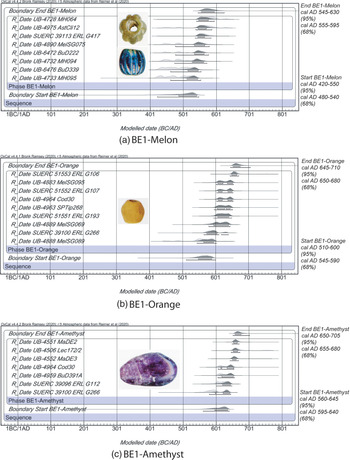
Among typically female dress-accessories, it is now possible to add currency models for further bead-types, BE1-Amethyst and BE1-Orange, while a model has also been produced for BE1-Melon beads, albeit without distinction of the colour difference between yellow-green and blue sub-types (fig 5).Footnote 21 As expected, the melon beads are essentially a sixth-century form and amethyst beads were probably introduced around or very shortly after ad 600. It is of interest to note that the earliest radiocarbon date on a burial with an amethyst bead, RAF Lakenheath grave 266, fails to reach the threshold of agreement in a continuous phase of burial with the remainder of the data (A 53.1), even though the overall model is fully satisfactory (see fig 5c). The currency of BE1-Orange (see fig 5b) is especially important because this is a type that was in use through the period of the middle to later sixth and early seventh centuries when furnished female burials became relatively few and difficult to identify.Footnote 22
Probability distributions of dates from graves containing (a) BE1-Melon beads, (b) BE1-Orange beads and (c) BE1-Amethyst beads. Image: author.

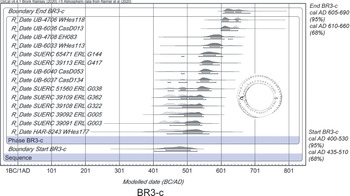
The currency model for the common flat-band annular brooch-type BR3-c has been re-run, both because the number of available datable contexts has increased from seven to eleven and because this is a brooch-type in respect of which the restriction of the analysis in the national project to grave-assemblages of AS-FB onwards, and the results of comparing the RAF Lakenheath sample with both the East Anglian and the national seriated matrices, have shown that the different sampling foci – earlier and later, respectively – produce markedly divergent results. The results imply that specimens of this brooch-type were current from the second half of the fifth century (fig 6). The East Anglian regional chronology assigned variants of these brooches (coded as ASlot and ARound on the basis of shape of the perforation through which the pin was hooked) to phase FA2, dated c ad 480 onwards.Footnote 23 Although there are specimens from burial contexts radiocarbon dated within the seventh century too, these are relatively few, and the youngest date, from West Heslerton grave 118, where the brooch was associated with glass beads of type BE1-Koch34 that are most characteristic of AS-FB, appears abnormal, either because this was an anachronistically late burial of such a costume assemblage or through a relatively inaccurate radiocarbon age.Footnote 24
Probability distributions of dates from graves containing type BR3-c annular brooches. Image: author.

Conversely, in seeking to understand an individual site, it is essential to appreciate that randomly selected, non-related dates will usually generate random and unconnected data that provide little information on the site as a whole. There can be valid reasons for dating human skeletal remains from unfurnished or very sparsely furnished burials, especially if those can be argued, for instance on stratigraphical or chorological grounds, to form some distinct chronological phase; then, however, sufficient data to compare at least two phases or groupings of burials are essential for the results to be used in a meaningful way. A hypothetical phase-structure for the site will allow samples to be selected that will test the validity of the hypothesis and provide information on the probable currencies of the phases concerned and their chronological relationship: eg if they are contiguous and sequential, chronologically separate, or overlap. The simplest model is that of a single ‘uniform’ phase of activity represented by the data – and this can be taken as the default model for randomly collected dates; even those can be informative, as the case of fifth-century burials at the former Roman villa at Shakenoak, Oxfordshire, demonstrates.Footnote 25 But a small number of radiocarbon dates from a given site is intrinsically likely to prove more consequential if it is used to correlate the site with some wider regional or national perspective. However, what is needed before anything else for guidance on how to select samples most effectively for radiocarbon dating is to address the skills and confidence gap over the use of appropriate IT programs – currently provided by OxCal – to put dates together, at least into uncomplicated but meaningful models. Understanding and practice must unconditionally go hand in hand.
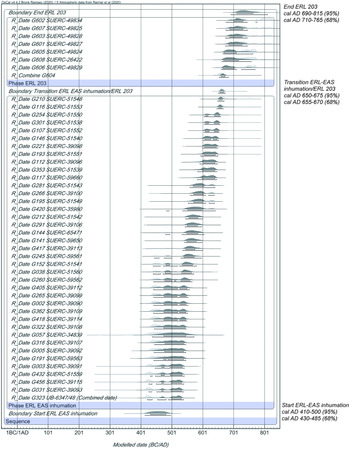
The excavations at RAF Lakenheath have also produced data relevant to a further question of chronological interest. The evidence from the Early Anglo-Saxon West, Central and East sites, in which ‘furnished’ burial is the norm, can be correlated with the later burial ground (Lord’s Walk) represented by eight excavated graves that had been inserted in or alongside a Bronze Age barrow adjacent to what appears to have been an ancient routeway running some 300m further south (see fig 1). Typical for what we recognise as Middle Anglo-Saxon burial grounds, most of these graves contained no artefacts, although two had simple knives and one a buckle as well. All of these burials were radiocarbon dated, and a model constructed to test the hypothesis that Lord’s Walk was a successor to the West site, where Early Anglo-Saxon burial continued much longer than in the other two burial grounds. This model has good agreement (Amodel 79.9), albeit with poor individual agreement for the earliest dated burial from Lord’s Walk (grave 604: A 53.9), indicating that it is possible that there was some degree of overlap, with the burial area at Lord’s Walk coming into use before the West site was abandoned (fig 7). That the postulated shift from one site to the other was correlated is nonetheless highly likely. The estimated date-range for the transition modelled as a non-overlapping shift lies within the third quarter of the seventh century, with the mean at cal ad 663.
Probability distributions of dates from inhumation graves in the four discrete burial grounds of RAF Lakenheath modelled as two consecutive continuous phases: ERL-EAS inhumation burial followed by ERL 203. Image: author.

A CHRONOLOGICAL FRAMEWORK FOR EAST ANGLIA
In addition to the national chronological framework, there is a regional framework for East Anglia to which the study and interpretation of the evidence from RAF Lakenheath could refer. That was the product of the study of four major inhumation cemeteries in Suffolk and Norfolk excavated in the 1970s: the inhumation graves alongside the massive cremation cemetery at Spong Hill, plus Bergh Apton and Morningthorpe in Norfolk; and Westgarth Gardens, Bury St Edmunds, Suffolk.Footnote 26 Published by Penn and Brugmann in Reference Penn and Brugmann2007, this framework incorporated a typological scheme and correspondence analysis largely undertaken by Karen Høilund Nielsen and the present author in 1997–8, but crucially could also incorporate Birte Brugmann’s subsequently published classification and chronology of Early Anglo-Saxon glass beads from female grave-assemblages.Footnote 27
The work on the East Anglian framework therefore took place just as the national chronological project was being devised by a team including the same specialists. Especially in typological terms, there is consequently considerable consistency between the two schemes. There is, however, a key difference in focus. The East Anglian framework was designed to organise the material into a reliable relative-chronological sequence, ideally identifying phases, and it was never anticipated that radiocarbon dating could make any contribution in view of the virtually non-existent survival of human skeletal remains in the graves of most of those cemeteries. Conversely, with reference to the most favourable opportunities offered by the calibration curve, as well as prior understanding of the apparent date of a key transition in Early Anglo-Saxon cemetery chronology, the national project was initially conceived as a study of the period from c ad 570 onwards – a horizon by which inhumation burial at Bergh Apton and at Spong Hill had ceased.
In the event, there is real overlap between the regional and national sequences, primarily because the data-set used for seriation through correspondence analysis within the national scheme extended back towards the beginning of the sixth century in the case of female graves and into the fifth century for male graves, in order to produce clear sequences. Nonetheless, the differences between these chronological frameworks remain great. Group xvi great square-headed brooches of phase 3 occur within type ‘SqH1’ in the East Anglian scheme but as type BR1-d in the national scheme; annular brooches appear in both schemes, but sub-classified completely differently.Footnote 28 Most of the brooch-types, clasps and belt-fittings in the East Anglian female seriation are not included in the national study, while 50 per cent of the bead-types used to produce the former were excluded as too early to be relevant to the objectives of the national project. In the case of the weaponry characteristic of male graves, while the variables of shape and size of shield bosses, spearheads and seaxes considered are consistent between the two studies, the typology eventually generated for the national study is so much more detailed and finely sub-divided than the East Anglian classification that simple translation between the schemes is unfeasible.
Thus no purpose is served in exploring the evidence from RAF Lakenheath in terms of the typology and seriation of male graves and grave goods in the East Anglian scheme. The classificational system of the regional scheme has been superseded by that of the national framework, and the latter covers the same range of time as the former and more. That, however, was not least the case because – in contrast to the situation with female graves and grave goods – there has long appeared to be limited regional variance in the weaponry that is core to the comparison and sequencing of male grave-assemblages. In fact, the results reported on in this paper suggest that greater allowance for regional variation needs to be made henceforward.
Seriation by correspondence analysis: RAF Lakenheath and the East Anglian female chronology (EA-F)
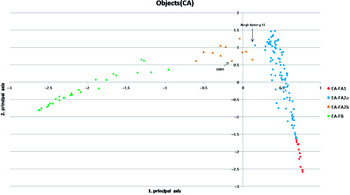
It was, conversely, appropriate to test the East Anglian scheme of female grave-assemblages phased into four successive phases FA1, FA2a, FA2b and FB (referred to from here on with the prefix EA-) against the evidence from RAF Lakenheath. No fewer than sixty-nine grave-assemblages from RAF Lakenheath could be added to the 104 from the four East Anglian inhumation cemeteries included in Penn and Brugmann’s Correspondence Analysis 6 and their final seriated matrix.Footnote 29 Only one of the newly added grave-assemblages appeared anomalous: grave 336, which has a pair of annular brooches (ARound/BR3-c), a plain scutiform pendant (scutiform/PE2-a) and a yellow glass melon bead together with one ‘Traffic Light Twisted Trail’ bead. In terms of the re-run correspondence analysis, this could be rectified by postulating that the Traffic Light glass bead was an anachronistically old object and discounting it, although further analysis (cf below) also suggests that the undifferentiated category ‘scutiform’ (pendant) used in the East Anglian scheme is too general.
The resultant correspondence analysis plot of the first two principal axes (fig 8) – as was the case with the results produced by Penn and Brugmann, and indeed in the national schemeFootnote 30 – implies that there is greater differentiation amongst the earlier female grave-assemblages on the second principal axis not the first. Consequently, the data-matrix was re-sorted using the co-ordinates on the second principal axis to ordinate the earlier burials (with a co-ordinate of > 0.15 on the first principal axis) and the co-ordinates on the first principal axis subsequently. The output is clearer in showing the gradual introduction of artefact-types characteristic of phase EA-FA2b,Footnote 31 which is eventually defined by the introduction of the great square-headed brooches of Phase 3 and melon beads, with scutiform pendants, girdle hangers without zoomorphic decoration (gh3 in the East Anglian scheme) and iron buckles with a rectangular backplate (buckle 1) appearing earlier. Bergh Apton grave 15 is assigned to EA-FA2a in fig 8, but clearly adjacent to EA-FA2b. This is a thoroughly typical EA-FA2a assemblage but with a scutiform pendant.
The output of correspondence analysis of the female graves included in Penn and Brugmann’s final seriation of the East Anglian scheme (2007: fig 5.6c, Correspondence Analysis 6) with sixty-nine additional grave-assemblages from RAF Lakenheath, assigned to four consecutive phases as discussed in the text. The data-matrix containing the statistics and plots produced by correspondence analysis is available in digital form (.xcl file) in the Supplementary Material, SM17. Image: author.

The earliest phase, EA-FA1, remains elusive, with few identifiable grave-assemblages and a limited range of diagnostic artefact-types. Trefoil-headed small long brooches without lappets (sm2), form B12 wrist-clasps, and bead-assemblages with five or more monochrome annular blue glass beads, are the most characteristic grave goods; the transition to phase EA-FA2a is defined by the introduction of wrist-clasps of forms B7 and B13 alongside flat-ring annular brooches and bead-types of Brugmann’s Combination Group A2.Footnote 32 When we subsequently proceed to evaluating radiocarbon dates, there are no dated graves of EA-FA1 to use to construct models. However, modelling supports the proposition that phases EA-FA2a and EA-FA2b are sequential (see further below).
Seriation by correspondence analysis: RAF Lakenheath and the national female chronological framework (AS-F)
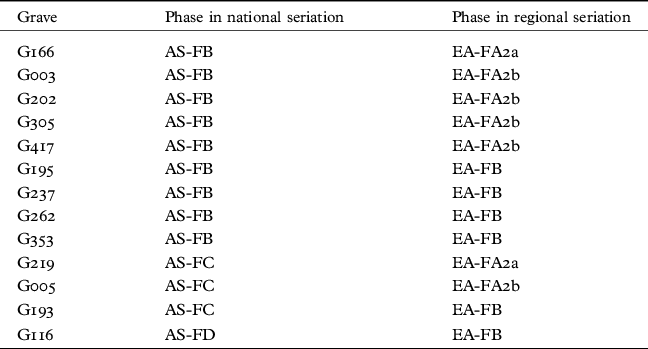
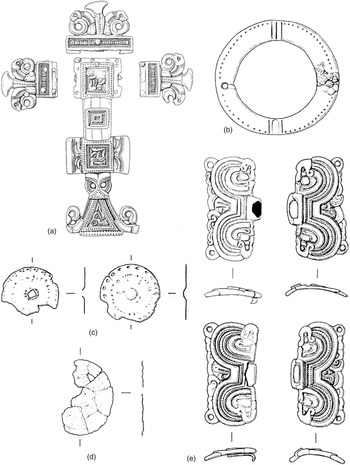
The incorporation of RAF Lakenheath female graves into the data-matrix used for the national seriation and phasing has to use a largely different typological basis from the regional analysis, primarily in terms of range but to some extent also in terms of classification. The national project had a clearly defined starting horizon identified by the presence of bead-types assigned by Brugmann to Combination Group B; radiocarbon dating and modelling indicated that this phase (AS-FB) begins around or shortly after the end of the first quarter of the sixth century.Footnote 33 Some grave-assemblages from RAF Lakenheath can nonetheless be included in both schemes (see table 2), and this reveals that there is considerable overlap between EA-FA2b in the regional scheme and the range of AS-FB in the national one – as already noted in the case of great square-headed brooches of Group xvi. Wider shifts occur in the cases of grave 005, from EA-FA2b to AS-FC, and grave 219, from EA-FA2a to AS-FC. In the former case, the pair of scutiform pendants present are reclassified as PE-2b on the basis of design, although in fact the radiocarbon date of grave 005 is consistent with the earlier phase-date not a later one; it appears also that the systematic exclusion of earlier contexts involving brooch-type BR3-c is a distorting factor in the national seriation (cf fig 6). Grave 005 is a richly furnished grave-assemblage, including a gilt copper-alloy florid cruciform brooch, Class C wrist-clasps and a pair of copper-alloy D-bracteates (fig 9). The regional scheme takes fuller account of the range of this assemblage than the national analysis. Grave 005 actually has a relatively poor fit when added to the national correspondence analysis,Footnote 34 and in analyses directed to a different end should properly be omitted from seriation based upon that data sample. In the present case, however, keeping it in view is more informative for illustrating critical issues. In the case of grave 219, the assemblage is differentially assessed because contrasting bead-types are taken into account. This grave-assemblage has two different annular brooch-types, BR3-b (with moulded ‘astragalus’-style decoration) and BR3-c, but also beads of type ConCyl (Brugmann’s Combination Group A2) that are not included in the national seriation.Footnote 35 This grave has not been radiocarbon dated and so does not impact subsequent modelling.
Female grave-assemblages from RAF Lakenheath that can be incorporated in the correspondence analysis matrices of both the national (AS-) and the regional (EA-) schemes.

A selection of artefact-types from RAF Lakenheath (site ERL 046) grave 005. (a) Gilt copper-alloy florid cruciform brooch; (b) copper-alloy annular brooch, form BR3-c; (c) pair of silver scutiform pendants; (d) copper-alloy D-bracteate; (e) two pairs of gilt silver wrist-clasps, Class C. The D-bracteates in this grave are extremely worn and fragmentary. Scale: (a) 1:2; remainder 1:1. Drawing: Donna Wreathall. © Suffolk Archaeology CIC, reproduced with kind permission.

Phase EA-FB has no end-boundary defined by the transition to a subsequent phase, unlike AS-FB. This is particularly evident in the impact of the presence of BE1-Orange beads, excluded as a type from the East Anglian scheme, along with artefact-types that allow some grave-assemblages to be included in the regional matrix, where they fall into EA-FB, but put them into AS-FC in the national scheme (graves 193 and 262), while the presence of annular brooch-type BR3-b has the same effect in the case of grave 237. Grave 116, which is radiocarbon dated, moves even later to phase AS-FD, following the more precise classification of its scutiform pendant as PE2-b and the inclusion of BE1-Orange beads.Footnote 36
A site-specific phasing of female burials at RAF Lakenheath (ERL-F)
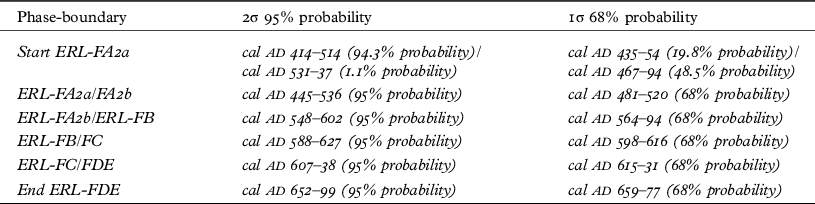
It has proved possible to define five sequential phases in a site-specific chronological model for the three Early Anglo-Saxon burial grounds at RAF Lakenheath. These have the prefix ERL-. Bayesian modelling validates a sequential chronological relationship between ERL-FA2a and ERL-FA2b (including grave 005), although the radiocarbon ages do not really differ: the imprecision of the calibration curve for this period creates elasticity and is permissive. ERL-FB is defined by grave-assemblages that fall within EA-FB in the regional seriation or AS-FB in the national one but no later on the basis of more precise classifications or additional artefact-types in the latter scheme. ERL-FB appears to succeed to phase ERL-FA2b in the second half of the sixth century. The two remaining phases are ERL-FC (with two radiocarbon-dated graves) and a combined ERL-FDE (with four dated graves). The radiocarbon-dated graves of the latter phase include grave 266, discussed above with an unusually early date for bead-type BE1-Amethyst, which continues to show poor individual agreement (A 33.6). The overall estimates of the phase-boundaries for the Early Anglo-Saxon female burials at RAF Lakenheath are shown in table 3.Footnote 37
The highest posterior density estimates for the five-phase model of the female burial sequence based upon dated graves from RAF Lakenheath (from Caruth and Hines forthcoming).

THE MALE GRAVES FROM RAF LAKENHEATH AND THE NATIONAL FRAMEWORK
The problem of form SB4-a (= type SB4-a1+2) shield bosses
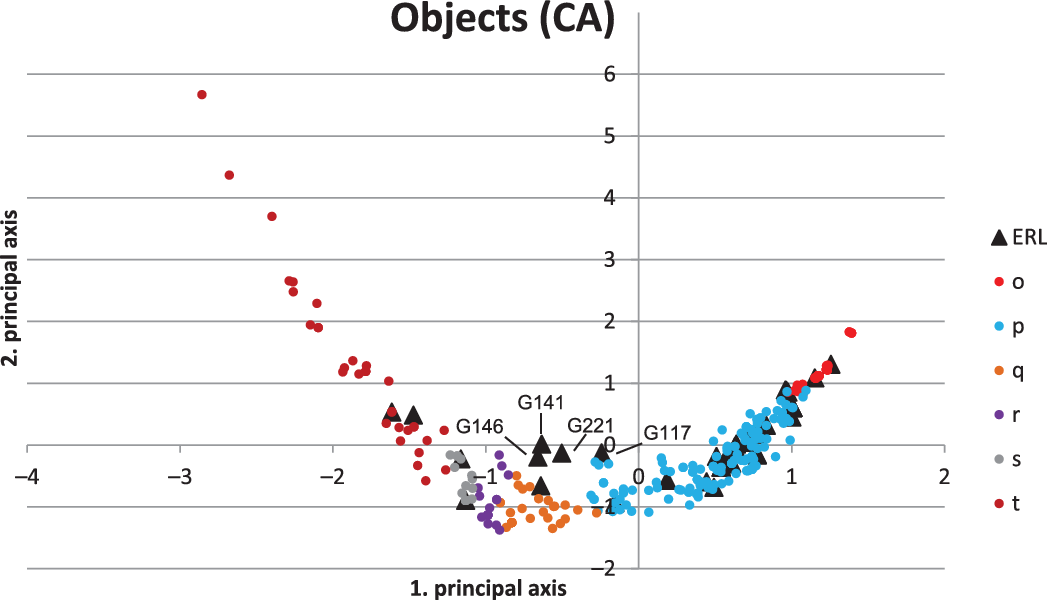
Initially, it appears possible to add forty further male grave-assemblages from RAF Lakenheath to the 272 in the final national seriation, where RAF Lakenheath grave 323 was already present.Footnote 38 The addition of these graves to the national data-matrix immediately reveals a problem, however, in respect of four RAF Lakenheath grave-assemblages which fall inside the parabola of points of Objects (= graves): graves 117, 141, 146 and 221 (fig 10). All of these have shield bosses of Class SB4 (see figs 11–12 and 14), the former three of type SB4-a1+2 but one of type SB4-b1+2 in grave 221, combined with spearheads within the general class of SP2-b – spearheads with concave edges to the blade (see fig 13), which had appeared to be generally early.Footnote 39 In the national study, in fact, one such spearhead (of type SP2-b1a4) among the abnormally large collection of spears in the Sutton Hoo Mound 1 ship burial (SutH01) was suppressed as an anachronistically old object for the purposes of correspondence analysis.Footnote 40 If these spearheads are similarly suppressed in the case of the RAF Lakenheath graves in question, the anomaly in the correspondence analysis is resolved and all the grave-assemblages in question except grave 117 can still be included in the seriated matrix through the association of the shield bosses with buckle-type BU7. However, what may be valid as a reasoned adjustment in a solitary case is a great deal less justifiable when the same problem has recurred five times over.
The output of correspondence analysis of the male graves included in the final seriation of the national scheme (Bayliss et al Reference Bayliss, Hines, Høilund Nielsen, McCormac and Scull2013, e-fig 6.6) with the forty additional grave-assemblages from RAF Lakenheath first added. The data-matrix containing the statistics and plots produced by correspondence analysis is available in digital form (.xcl file) in the Supplementary Material SM18. Image: author.

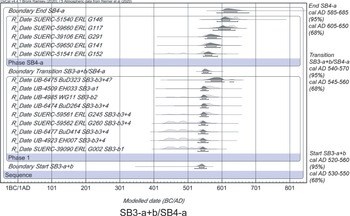
Probability distributions of dates from graves containing shield bosses of sub-classes SB3-a and SB3-b and SB4a, respectively, modelled as two consecutive continuous phases. The code for the model is available in digital form (.rtf file) in the Supplementary Material SM10. Image: author.

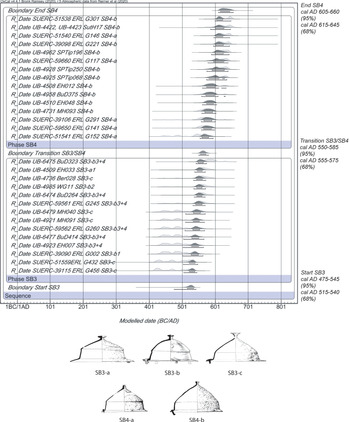
Probability distributions of dates from graves containing shield bosses of Classes SB3 and SB4, modelled as two consecutive continuous phases. The code for the model is available in digital form (.rtf file) in the Supplementary Material SM12. Image: author.

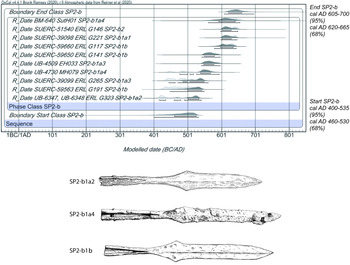
Probability distributions of dates from graves containing sub-class SP2-b spearheads. The code for the model is available in digital form (.rtf file) in the Supplementary Material SM13. Image: author.

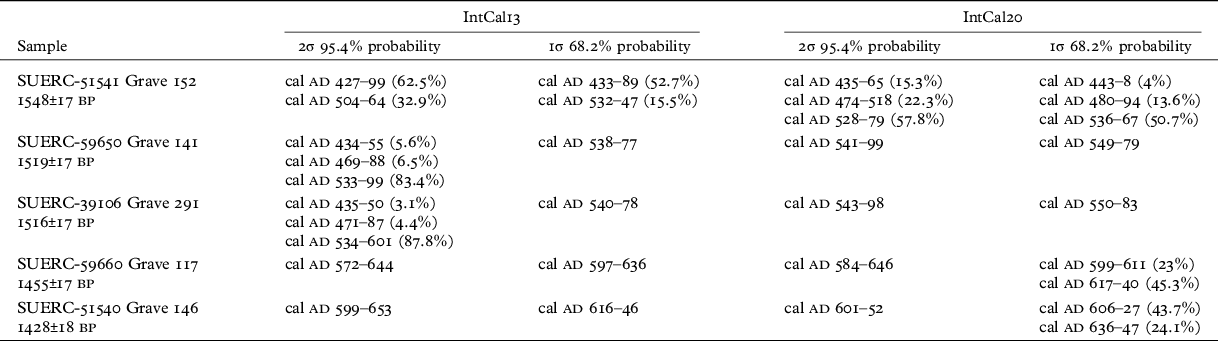
As noted above, although shield boss-type SB4-a1+2 was identified as a leading type of phase AS-ME in the partition based upon leading types of the national scheme, no specimens of this type were from radiocarbon-dated contexts. We now have dates on five of these burials (table 4). That is insufficient for a currency model by the criterion previously noted (minimum n = 6), although it is manifest that some of these datings appear considerably earlier than the models that placed the transition from phase AS-MD to AS-ME at cal ad 585–605 (68 per cent probability) or cal ad 580–610 (95 per cent probability) would suppose.Footnote 41 In terms of form, too, a hiatus in the introduction of type SB4-a1+2, defined by dome-headed rivets typically on a narrow flange and an overhanging carination between the straight or slightly convex profiled cone and a straight-sided wall, from the obvious immediate ancestors in the shield bosses of the various forms of Classes SB3-a and SB3-b, differing only in the type of rivets and the width of the flange (see fig 12), is a priori implausible. We can now construct a model postulating a direct sequence of succession from SB3-a+b to SB4-a. That model initially fails (Amodel 56.3; model not shown), but does so because the two ‘phases’ overlap chronologically, not because they are separated. The only individually dated grave that does not conform to the model is Buckland Dover grave 323, with a shield boss of type SB3-b and a spearhead of type SP3-b (see above and fig 4b), which is abnormally late within the earlier phase (A 24.3). In these circumstances, it is logical to hypothesise that the later date than expected is the result of exceptional survival. If that dated sample is treated as an outlier, the resultant model has a good index of agreement (Amodel 92.1; fig 11) and all of the remaining graves have satisfactory scores. The transition between phase SB3-a+b and phase SB4-a, was very probably complete by cal ad 560–70: much earlier than the previously modelled start of phase AS-ME.
Radiocarbon dates for five graves from RAF Lakenheath containing SB4-a1+2 shield bosses, calibrated with reference to IntCal13 and IntCal20.

If this sequence holds for SB3-a+b to SB4-a, then it can be expected also to do so in the case of SB3-c to SB4-b, which differ only on the equivalent variable of having an angled or smooth profile between the wall and the cone (see fig 12). There are five dates for shield bosses of type SB3-c compared with ten for SB4-b1+2; the model (not shown) is fully satisfactory (Amodel 99) with a transition between the two phases in the range of cal ad 560–90 (68 per cent probability) or cal ad 545–600 (95 per cent probability).Footnote 42 These data were then combined into a general model hypothesising a bounded sequence from Class SB3 to Class SB4, with all the radiocarbon data included. This, too, proved satisfactory (Amodel 73; see fig 12), although, as one would have predicted, Buckland Dover grave 323 still has a low index of agreement (A 38.8) in phase SB3, as does RAF Lakenheath grave 152 (A 47) in phase SB4. The transition between the two phases has now been narrowed to around or just after the third quarter of the sixth century. The three earliest dates on contexts for specimens of Class SB4 are all from RAF Lakenheath, and all involve type SB4-a1+2 shield bosses.
In light of the problems of combinations of SB4-a1+2 shield bosses with SP2-b (ie concave-sided) spearheads under correspondence analysis, it is reasonable also to construct a general model of the currency of Class SP2-b spearheads, for which we now have ten radiocarbon dates. This proves satisfactory (Amodel 86.3; fig 13), and all the individual dated samples show good agreement. The model implies the continuous presence of this form of spearhead from the late fifth century well into the seventh. The latest dated contexts are Sutton Hoo Mound 1 and graves at RAF Lakenheath. We may note, though, that the radiocarbon ages of relatively late-dated contexts at Edix Hill, Cambridgeshire, grave 33 and RAF Lakenheath grave 141 are almost identical. The model is constructed of no fewer than seven dated contexts from RAF Lakenheath, two others from East Anglia and Cambridgeshire (Sutton Hoo and Edix Hill) and one specimen from Mill Hill, Deal, Kent. This, therefore, is not remotely a representative sample in geographical terms. It would appear possible that spearheads of this blade-shape remained in use considerably longer in and around East Anglia than they did elsewhere. This question needs to be investigated further.
Modelling a phased sequence: RAF Lakenheath and the male chronological framework based upon clustering identified by correspondence analysis (phases AS-Mo to AS-Mt)
As noted, alternative modes of partition to phase the seriated sequence of male graves produced by correspondence analysis were examined under the national project: one based upon clustering in the plot of the co-ordinates of the grave-assemblages; the other identifying phases defined by the introduction of leading types. If the correspondence analysis of a data-matrix as shown in figure 10 is able to represent the hitherto unidentified combination of both earlier dates than expected for contexts containing shield bosses of type SB4-a1+2 and later dates than postulated for various types of spearhead of the general form SP2-b, then the anomalous position of RAF Lakenheath graves 117, 141, 146 and 221 produced primarily by their co-ordinates on the second principal axis could still mean that they are realistically positioned in an intermediate zone along the first principal axis. Consequently, it is reasonable first to examine the validity of the two-dimensional partition as a means of phasing.
Incorporating the new data from RAF Lakenheath, this model had to be constructed on the basis of its counterpart shown in the report of the national project figure 6.50 – ie on seriated grave-assemblages alone, not including additional graves more loosely associated with a certain range within these seriated data. This model, however, is quite unable to sustain five dated graves from RAF Lakenheath: graves 117 in phase AS-Mp; graves 146, 221 and 301 in phase AS-Mq; and grave 152 in phase AS-Mt. Of these, graves 117, 146 and 221 represent the ostensibly problematic combination of a Class SB4 shield boss with a spearhead of type SP2-b2, while grave 152 has a shield boss of type SB4-a1+2 and a spearhead of type SP2-a1b1. Both of those artefact-types are also present in the range of phase AS-Ms within this data-set, but in combination fall in phase AS-Mt. The radiocarbon date of grave 152 would in fact be too early in phase AS-Ms too. In the case of grave 301, this is a grave that may only be incorporated in the correspondence analysis if we accept the uncertain typological identification of the fragmentary spearhead it contains as SP2-a2c. On this evidence, that has to be considered unreliable.
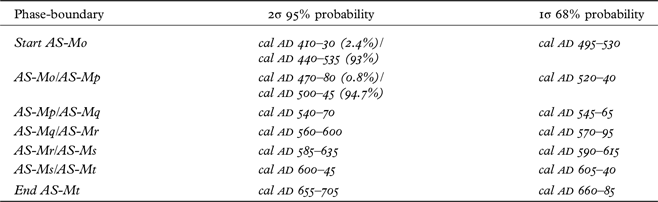
We can then reproduce a satisfactory phased model based upon the two-dimensional partition by rejecting RAF Lakenheath grave 301 as not having two unambiguously classified artefact-types, and treating graves 117, 146, 152 and 221 as unexplained outliers.Footnote 43 What this means, then, is that two graves with type SB4-a1+2 shield bosses have to be discounted because they appear too early in the correspondence analysis plot of grave-assemblages. Graves 117 and 146 in fact have relatively similar radiocarbon dates, which imply that the predominant placement of form SP2-b spearheads in the national data-matrix is distortingly early for the accurate positioning of those grave-assemblages. Grave 141, by contrast, can be comfortably incorporated in its intermediary position in phase AS-Mq. The radiocarbon date for grave 291 has poor individual agreement with its assignation to phase AS-Ms; there would appear, however, to be nothing particularly anomalous about this radiocarbon date for a context containing a spearhead of type SP3-a (see above and fig 4b). Grave 456 also has a radiocarbon date that is marginally early for its position in phase AS-Mq (A 56.8). Nevertheless, this model has included dates for the initial phase, AS-Mo, and incorporates no fewer than eleven newly dated graves from RAF Lakenheath. The stresses and problems that the incorporation of the new data have revealed are significant and illuminating, but do not destroy the model per se. The estimates for the phase-boundaries are given in table 5 and the full plot of the model is available in the digital archive associated with this paper.Footnote 44
The highest posterior density estimates for the revised six-phase model of the male burial sequence based upon interpretation of the two-dimensional plot of graves produced by the first two principal axes of the correspondence analysis incorporating dated graves from RAF Lakenheath, as described in the text. The code for the model is available in digital form (.rtf file) in the Supplementary Material, SM14.

Modelling a phased sequence: RAF Lakenheath and the male chronological framework defined by leading types (AS-MA to AS-MF)
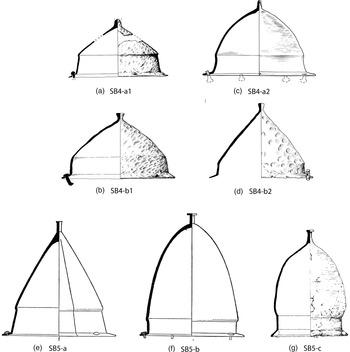
Turning to the leading-type partition of the sequence, it was appropriate first to see if some typological sub-division of the Class SB4-a shield bosses, and similarly Class SB4-b, might now provide a better model. The logical basis for doing so was through the sub-types SB4-a1 and SB4-a2, and SB4-b1 and SB4-b2, defined by Karen Høilund Nielsen:Footnote 45 these are differentiated on the basis of the sub-types -a2 and -b2 having taller cones in relation to the wall-height (‘HD’ 49–75 per cent: fig 14). As there is a typological progression in shield-boss form to the tall types of Class SB5,Footnote 46 with HD ratios of > 75 per cent, it is reasonable to hypothesise that the taller types are later. No sign of that is produced, however, by distributional associations with other artefact-types as detected by correspondence analysis. The distribution involving the divided sub-types retains a good sequence of grave-assemblages and artefact-types – certainly no worse than with the two sub-classes (ie SB4-a1+2 and SB4-b1+2) undivided – and indeed this process does reflect greater overlap in distribution of the contrasting shield boss profiles. But the result in terms of phasing is, in practice, to homogenise the centre of the male sequence. In modelling terms, it produces a considerable loss of detail. We may regard this, therefore, as a process that may represent more accurately and realistically the chronological situation in certain areas, but at the expense of disguising distinctions that appear valid at a national level. The product can, then, be regarded as genuinely uninformative, and as a result it was decided to proceed further on the basis of undivided shield boss-types SB4-a1+2 and SB4-b1+2.
Shield bosses of types (a) SB4-a1, (b) SB4-b1, (c) SB4-a2, (d) SB4-b1, (e) SB5-a, (f) SB5-b and (g) SB5-c as initially defined for the typology of Bayliss et al Reference Bayliss, Hines, Høilund Nielsen, McCormac and Scull2013. Image: author.

In order to produce a workable basis for successful modelling of the leading-type partition, we must again return to the informed and explicable if unwanted ‘editing’ of the data that involves the suppression of the Class SP2-b spearheads in RAF Lakenheath graves 117, 141, 146 and 221.Footnote 47 To do so removes only grave 117 completely from the process of analysis. In contrast to the two-dimensional model, grave 141 is then moved as late as phase AS-MF and its radiocarbon date has to be discounted in the analysis because it is too early; as already noted, this grave-assemblage appears to be perfectly located in AS-Mq without suppressing the spearhead, but that cannot be done selectively for this comparative exercise. Graves 152 and 291 are also placed as late as phase AS-MF in terms of this analysis – ie later than the first occurrence of Class SB5 shield bosses elsewhere – and these radiocarbon dates consequently have to be discounted. RAF Lakenheath grave 245, meanwhile, with a shield boss of type SB3-b3+4 together with a sword with a pommel of type SW3-b, moves the earliest instance of that SW-type, formerly a leading type of AS-MD along with pyramidal sword studs SW5-b (see fig 3c–d),Footnote 48 earlier in the sorted matrix of seriated grave-assemblages and artefact-types, so that in practice the latter and not the former remains as the sole leading type defining the start of AS-MD.
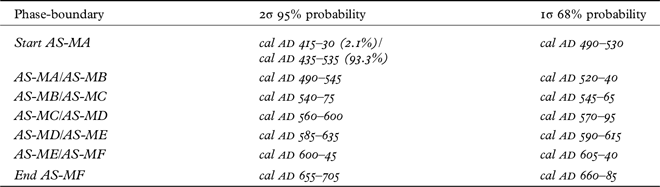
In comparison with the two-dimensional partition, therefore, this procedure proves weaker in dealing with the RAF Lakenheath evidence. Nevertheless the model has again been expanded to incorporate a modelled phase AS-MA, with four dated graves, all from RAF Lakenheath. The radiocarbon date of grave 456 again has marginally low agreement for its place in phase AS-MB (A 57.7). As a date for a context containing a shield boss of type SB3-c, however, it is closely paralleled by another radiocarbon-dated grave from the same burial ground: grave 432.Footnote 49 Having made the adjustments to RAF Lakenheath graves 117, 141 and 146 in respect of their Class SP2-b spearheads, the two-dimensional plot-cluster partition and the leading-type partition become almost identical. The only effective change is that RAF Lakenheath grave 265 moves from the first phase, AS-Mo, to the second, AS-MB: the difference that makes to the estimated date-ranges within which the phase-boundaries lie is truly minimal. Once again, we may argue that the value of this exercise is primarily to show us precisely where the stresses and the problems lie, so that, comparing this model with that of the two-dimensional partition, we can explain exactly what is going on within an improved chronological understanding of the complexities involved in different bases of partition and different levels of study. The estimates for the phase-boundaries are given in table 6 and the full plot of the model is available in the digital archive associated with this paper.
The highest posterior density estimates for the revised six-phase model of the male burial sequence based upon the point of introduction of leading types incorporating dated graves from RAF Lakenheath, as described in the text. The code for the model is available in digital form (.rtf file) in the Supplementary Material, SM15.

A site-specific phasing of male burials at RAF Lakenheath (ERL-M)
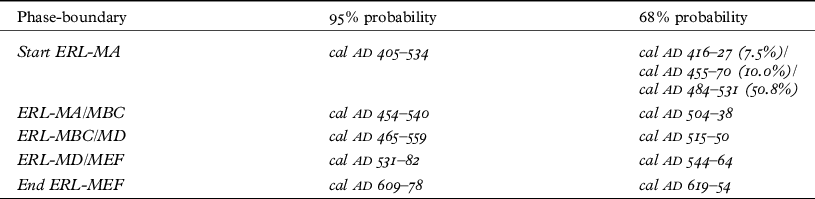
Converted into a practical site-specific chronological phasing, four distinct and successive phases in the male burial sequence from the Early Anglo-Saxon burial grounds at RAF Lakenheath can be defined. ERL-MA coincides closely with AS-MA. With the thorough difference in the chronological range of the Class SB4 shield bosses at this site, and the absence of the latest artefact-types (shield bosses of Class SB5 and the later seaxes and seax-fittings of Classes SX2 and SX3), it is impossible to mirror a series comparable with AS-MB to AS-MF. A phase ERL-MBC is distinguished first and foremost through the presence of Class SB3 shield bosses. Basing analysis on the national scheme of 2013 it is also possible to identify what should better be regarded as a sub-phase of ERL-MBC but which was nevertheless labelled ERL-MD, represented by just one dated grave, grave 245, with the shield boss of type SB3-b3+4 and sword of type SW3-b noted above. With AS-MD redefined with SW5-b pyramidal studs as its leading type, grave 245 fits comfortably into AS-MC, as the shield boss-type would suggest. The concluding phase, labelled ERL-MEF, is the phase in which Class SB4 shield bosses occur (table 7). The latter is much the same as the broad and ‘homogenised’ phase of burial produced by dividing the lower and the taller examples of Class SB4 shield bosses noted above. This corroborates an essential consistency in the different levels of chronological modelling.
The highest posterior density estimates for the four-phase model of the male burial sequence based upon dated graves from RAF Lakenheath (from Caruth and Hines forthcoming).

MODELLING A PHASED SEQUENCE: THE FEMALE GRAVES FROM RAF LAKENHEATH AND THE NATIONAL FRAMEWORK
Altogether, twenty-seven grave-assemblages from RAF Lakenheath can be fitted into the seriation matrix along with the 300 grave groups already included in the national framework, although grave 005 stretches the course of the parabola noticeably.Footnote 50 There are ten grave-assemblages from RAF Lakenheath in AS-FB, eight in AS-FC, four in AS-FD and two in AS-FE. Discrepancies respecting positions under the regional and the national schemes respectively have been noted (cf table 2). A robust modelled phase-sequence using radiocarbon dates on female burials at RAF Lakenheath distinguishes the sequence from ERL-FA2a to ERL-FA2b, and so through ERL-FB and ERL-FC to a combined ERL-FDE. Within that site-specific model, however, grave 266 assigned to ERL-FDE has poor agreement at A 33.6, because the radiocarbon age is considerably older than expected (cf fig 5c). Although ERL-FC and ERL-FDE are equivalent to AS-FC, AS-FD and AS-FE, ERL-FB and AS-FB cannot be considered near equivalents as AS-FB appears to overlap considerably with ERL-(EA-)/FA2b.
We might nonetheless expect that the radiocarbon dates from RAF Lakenheath would fit relatively comfortably into an expanded model with the phased national data, but that is far from the case. The process of developing a satisfactory model has to begin with the explicable modification of phase AS-FB into a joint phase AS-FB+EA-FA2b – which, in effect, means that the radiocarbon date of grave 005 is assigned to this phase, using the fuller data considered according to the East Anglian regional scheme, rather than to AS-FC, where it would fit most closely on the basis of the national seriation. Initial runs of the model were undertaken without including the four dates available from RAF Lakenheath of graves to be assigned to the earliest phase that can be modelled, ERL-FA2a, but did assign the dated graves from RAF Lakenheath that fall into AS-FD and AS-FE respectively to those as separate and successive phases.Footnote 51 This model fails thoroughly at Amodel 16.5. No fewer than five of the thirteen dated graves from RAF Lakenheath that had been added to the model have markedly poor agreement in the phases they are assigned to.
To achieve a satisfactory incorporation of the RAF Lakenheath data into the national framework, it is necessary to override the strict sequencing of the correspondence analysis co-ordinates in the case of some of the graves from this site, which means assigning those graves with the poorest indices of agreement to broader phases constructed of consecutive individual phases representing the full range of currency of the artefact-types present within the grave-assemblages. Consequently, grave 353, which has a date that is too late for phase AS-FB+EA-FA2b, goes to an extended phase from AS-FB+EA-FA2b to AS-FD; grave 116, with a date that is too early for AS-FD, to a highly permissive phase that lies anywhere between the start of AS-FB+EA-FA2b and the end of AS-FE; and grave 210, which has a date that is too late for AS-FD, into a phase that covers the range from AS-FC to AS-FE inclusively.Footnote 52 This modification could, of course, be applied to many other grave-assemblages in the data-matrix, but is a procedure that was rejected as over-simplifying and coarsening what are demonstrably valid models at the national level.Footnote 53 With these modifications there is one dated grave from RAF Lakenheath that cannot be incorporated in the model: grave 266, where the radiocarbon date is simply too early for the characteristically late amethyst and cowrie-shell beads represented in the assemblage (see above and esp. fig 5c). Accordingly, this radiocarbon date has to be discounted as an outlier.
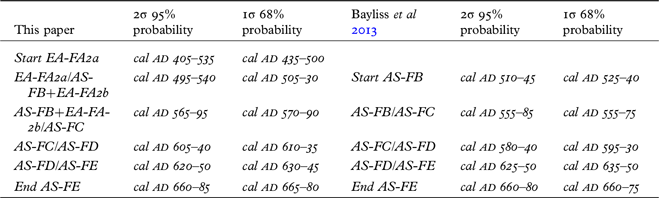
This model, incorporating also the termini post quos provided by datable coins in a number of burials within the national data-set, produces good agreement as a sequence of four phases starting with the modified phase AS-FB+EA-FA2b and proceeding sequentially through phases AS-FC and AS-FD to AS-FE, with an overall index of agreement of Amodel 80.8. For the highest posterior density estimates for the phase-boundaries, see table 8 (and footnote 54), where the outputs for the equivalent phase-boundaries in the national framework are shown for comparison. As with this model run within the national project, a number of graves have relatively poor agreement with the phases to which they have been assigned: in particular But4275 (A 44.8) with a radiocarbon date that is too early for its position in phase AS-FE, and CasD096 and MelSG089 with radiocarbon dates that are too early for their position in phase AS-FC, more seriously so in the latter case (A 57.3 and A 25.2 respectively). In these cases it would be possible to redistribute these dates to more flexible double phases, but that is not needful to produce a valid chronological model.
The highest posterior density estimates for the five-phase model of the female burial sequence incorporating dated graves from RAF Lakenheath (left) and starting from a phase ERL-FA2a, compared with the phase-boundaries for the female sequence AS-FB to AS-FE (right: Bayliss et al Reference Bayliss, Hines, Høilund Nielsen, McCormac and Scull2013, table 8.2). The code for the model is available in digital form (.rtf file) in the Supplementary Material, SM16.

The logical next step is to see if the same model can incorporate the four radiocarbon-dated graves assigned to phase ERL-FA2a in the site-specific scheme, which should represent an earlier phase than AS-FB+EA-FA2b. This five-phase model achieves a very similar, satisfactory index of agreement, with exactly the same individual graves that do not achieve satisfactory indices of agreement and near identity in the highest posterior density estimates for the phase-boundaries (Amodel 80.4, table 8).Footnote 54 The start of phase ERL-FA2a in this model is necessarily relatively imprecise in calibrated calendrical terms. There is, however, a relatively tight estimate of the transition from ERL-FA2a to AS-FB+EA-FA2b in the first half and quite probably within the first third of the sixth century.
CONCLUSIONS
This paper seeks to illustrate the critical and evaluative impact of confronting the chronologies for male and female graves respectively produced as a national chronological framework for the Early Anglo-Saxon period – in respect of both the methodology of analysis and the results produced – with a substantial additional body of evidence from a single site that was studied in a way that sought to achieve maximum consistency with the national framework. Underlying this initiative are the intention and the belief that this will help in promoting understanding of and familiarity with the national chronological framework: how it is constructed, and how it can be used. That framework is not an inflexible grid that must either be accepted and imposed or rejected wholesale: the application of the results published in 2013 means the continued development of a chronological frame of reference for the study of Early Anglo-Saxon sites and artefacts.
It has been judged unnecessary for the purposes of the present paper to pursue the analyses through the alternative modelling options allowing for dietary offsets, or to produce models showing changes in the other sensitivity tests explored in the full report of the national project.Footnote 55
Irrespective of the favourable circumstance of having a new calibration curve to use, it is fully acknowledged that the experience of seeking to combine the data and structures of the national framework with the evidence from RAF Lakenheath may seem to cast more doubt than one would have wished on the conclusions previously drawn. It has proved impossible simply to insert the new data from this site into either the existing correspondence analyses or the Bayesian models and to achieve essentially the same results in the case of both gendered sets. In the case of shield bosses of Class SB4-a1+2, it can now be demonstrated that the generation of sequential phases and identification of the artefact-types that define them, which appeared to be validated in 2013, cannot be correct, at least in every region. In both the full male and female phased models, radiocarbon-dated graves from RAF Lakenheath have had to be discounted as outliers, or accommodated by allowing a looser parallel structure of combined or chained phases.
Nonetheless, with limited and fully explicable adjustments, the majority of the RAF Lakenheath data do coincide credibly with the model of chronological change represented by the national frameworks. The evidence discussed and explored above very clearly illustrates the crucial difference between realistic and demonstrable chronological frameworks at the site-specific, regional and national levels. We should accept with equanimity that such frameworks should be congruent and consistent with one another, but they need not, and maybe never will be, fully isomorphic. It may eventually be possible to devise a structure that will accommodate and pragmatically integrate all of these ‘levels’, but we are a long way from the empirical basis upon which such ambitions might be pursued. Divergences at the different levels can at present be attributed partly to the fact that the full range of data that can be collated in a national overview is intrinsically unlikely to be adequately, let alone fully, reflected in microcosm in a more limited geographical context. At the same time, the more detailed evidence available for and focused upon in respect of key ranges of male weaponry – Class SB4 shield bosses and form SP2-b spearheads – strongly suggests that there is greater regional differentiation in the chronological ranges of some such forms than was previously detectable.
That point also emphasises the value of currency models for individual artefact-types. As we move forward from an overarching national framework – itself composite in terms of alternative partitions and the gender dichotomy – towards a multi-stranded chronological model, those currencies should be as significant as any general or more locally specific phased schemes. Further work on regional and chronologically comprehensive data-sets of female graves and grave goods must include typological reassessments of some of the types included in the national framework, as well as the incorporation of additional types. It will clearly be impossible to continue, for instance, with an undifferentiated type BR2-a for all cast saucer brooches, although that was adequate for the purposes of the national study and its intended chronological range. The experience with RAF Lakenheath in comparison with both the regional and the national frameworks has shown that the sub-types and ranges of scutiform pendants need reassessment. The pursuit of additional dated graves that will allow these to be produced for particular types of pin (PI-) and workboxes (WBX) can be highlighted as practical short-term objectives. Besides further data on some of the variants of Class SB4 (and SB3-c) shield bosses, as fully discussed above, it would be desirable for further dates to be obtained for the shield bosses of the later Class SB5 in order to determine more precisely what their range was, and for the seaxes of Classes SX2 and SX3 and the sheath-fittings associated with them.
An immediate priority for further research in this field is that we need a comprehensive series of regional schemes – of around the same geographical scope of the East Anglian framework, but chronologically covering the entirety of the Early Anglo-Saxon period. It has always been appreciated that this is requisite in the case of female graves and grave goods because of the sharp regional differences.Footnote 56 These may well prove to grow together in the period covered by AS-FB, and then remain largely unified through to the end of furnished burial at the end of phase AS-FE, but that remains to be determined. The question of whether or not the inception of a phase equivalent to AS-FB (although here modified to incorporate the new data as a phase AS-FB+EA-FA2b, while ERL-FA2b and ERL-FB can be kept separate in the site-specific framework) as a co-ordinated shift across the distinct regions will be a fundamentally informative one. Such work is already underway in relation to early sites in Wessex, especially under the panoply of work done by Wessex Archaeology with Breaking Ground Heritage and Operation Nightingale, and in Northumbria too, while in relation to the south-east the existing ASKED database provides a basis for complementary work.Footnote 57
In respect of male graves and grave goods, the work on the Wessex burial evidence strongly confirms that shield bosses of Class SB2 (with concave-profiled cones, and often prominent apical spikes: Böhme’s Typ Liebenau)Footnote 58 are a distinctly ‘Saxon’ phenomenon. Concomitantly, there appear to be significantly different phasing and chronological ranges involving the development of Class SB4 shield bosses, and the much longer continued use of form SP2-b spearhead-forms in East Anglia, than appears in the national perspective. There may not be the same a priori basis for attempting a comprehensive range of regional male schemes that there is for the female graves and grave goods rather than selected studies, but that, too, must be kept under review.
We are now far beyond the stage at which radiocarbon data can be regarded with scepticism, although the need to consider the possibility of site-specific soil chemistry affecting the results, or even different laboratory practice, must be noted. Clearly anomalous cases from RAF Lakenheath are female graves 144 and 262, noted above, which both returned results that are unbelievably young. These cases, however, are not only immediately identifiable as anomalies, but also amount to just 4 per cent of the samples dated from the site. The overwhelming majority of the RAF Lakenheath data can be shown to be consistent with the national chronological framework. The discrepancies have in fact been shown partly to be attributable to the ‘generalising’ tendency of correspondence analysis, which will produce median values for objects and variables in terms of their co-ordinates against the principal axes of variation, and so may iron out the position of these objects and variables against inconsistent and complex, only partly overlapping, chronological ranges. It is worth reiterating the point, though, that the problematic position of grave 005 from RAF Lakenheath in the female seriation is in fact identified by normal correspondence analysis. The fact that permitting the assignation of more dated graves to double and even longer multiple phases for the model incorporating the full the burial evidence has ultimately produced markedly more clearly focused ranges for phase-boundaries in key areas needs both to be emphasised and to be viewed with considerable interest; we need, as a result, to consider how this might be developed in a principled way in order to refine the chronological models more widely and yet still to maintain their quality as realistic representations of what was happening in fact rather than just examples of what one may be able to do with statistical data. The critical point is not that the mathematical and scientific methods are intrinsically unreliable and need to be manipulated to produce the results desired, but rather that the interpretation of seriation produced by correspondence analysis in order to define phases will bear refinement.
Caitlin Buck and Sulit Sahu investigated the impact of mathematically explicit adjustments to the ‘expected’/‘estimated’ distribution of variables that is key to the calculation of χ2 values for correspondence analysis, but could find no procedural ‘magic bullet’ for such problems of ‘noise’ in correspondence analysis.Footnote 59 They noted in passing that correspondence analysis is typically used in an ‘exploratory’ manner to assess data, and that ‘prior information’ such as stratigraphical relationships should be especially informative in the search for the best chronological orders in data seriated by correspondence analysis. Demonstrated regional variance and known currency limits for artefact-types – both the horizon of introduction and the extent of continuing relative frequency before complete obsolescence – are vital pieces of prior information of such a kind. I would go as far as to aver that it is precisely the exploratory use of correspondence analysis that renders it most informative as a process in the context of interpretative archaeology.
Finally, while demonstration of the productivity of these approaches may stimulate interest, it is a regrettable fact that the practical difficulties of fully understanding the procedures and practice in applying them can stimulate a sense of near hopelessness, and for too many people cause them to give up when faced with these challenges because the issues appear incomprehensible and the whole field of research too difficult. We badly need to organise programmes of suitable training: by which is meant wide availability and being designed to establish a reliable ‘entry-level’ competency, both in the use and interpretation of matricised quantitative data and in Bayesian modelling. Confidence in well-informed sample selection would follow from that. Despite the welcome improvements offered by IntCal20, the nature of the calibration curve seems destined to continue to mean that for precise laboratory dating of the earliest contexts of the Early Anglo-Saxon period, from the mid-fifth century ad into the early sixth, some different technique will be needed. Conversely, the value of having early dates to ground a model has been clearly demonstrated in the case of both the male and the female sequences. None of the desiderata can be dismissed as no more than a utopian pipedream. There is every reason to approach the continuing development of chronological analysis with enthusiasm and confidence; not least also with the understanding that as complementary insights produced by, for instance, ancient DNA analysis grow, this will provide deeper knowledge and understanding for future generations.
SUPPLEMENTARY MATERIAL
To view supplementary material for this article, please visit https://doi.org/10.1017/S0003581520000517.