Introduction
Treatment-resistant schizophrenia (TRS) is a major clinical problem, since in approximately a third of schizophrenia patients psychotic symptoms persist despite appropriate antipsychotic treatment (Elkis, Reference Elkis2007). In TRS negative symptoms are prominent (de Bartolomeis et al. Reference de Bartolomeis, Balletta, Giordano, Buonaguro, Latte and Iasevoli2013) and associated with impaired working memory (Zierhut et al. Reference Zierhut, Schulte-Kemna, Kaufmann, Steiner, Bogerts and Schiltz2013), impaired verbal memory (de Bartolomeis et al. Reference de Bartolomeis, Balletta, Giordano, Buonaguro, Latte and Iasevoli2013; Anderson et al. Reference Anderson, McIlwain, Kydd and Russell2015) and deficits in cognitive flexibility, processing speed, executive functions and verbal fluency (Frydecka et al. Reference Frydecka, Beszlej, Gościmski, Kiejna and Misiak2016).
Patients with TRS may be suffering from a normodopaminergic subtype of schizophrenia (Howes & Kapur, Reference Howes and Kapur2014; Kahn & Sommer, Reference Kahn and Sommer2015; Lawrie et al. Reference Lawrie, O'Donovan, Saks, Burns and Lieberman2016), since in patients with TRS the striatal dopamine synthesis capacity is not increased (Demjaha et al. Reference Demjaha, Murray, McGuire, Kapur and Howes2012). Moreover, anterior cingulate cortex glutamate levels are elevated in TRS compared with patients with treatment-responsive schizophrenia (Demjaha et al. Reference Demjaha, Egerton, Murray, Kapur, Howes, Stone and McGuire2014; Mouchlianitis et al. Reference Mouchlianitis, Bloomfield, Law, Beck, Selvaraj, Rasquinha, Waldman, Turkheimer, Egerton, Stone and Howes2015). Therefore glutamatergic alterations may be a plausible explanation for the lack of response to dopamine-blocking antipsychotic medication in TRS patients. Glutamate receptors (N-methyl-d-aspartate; NMDA) are therefore a candidate target for intervention in TRS (Veerman et al. Reference Veerman, Schulte and de Haan2014b ). Clozapine acts as a glutamate agonist and has proven superior efficacy for positive symptoms relative to other antipsychotic medication (Leucht et al. Reference Leucht, Cipriani, Spineli, Mavridis, Orey, Richter, Samara, Barbui, Engel, Geddes, Kissling, Stapf, Lässig, Salanti and Davis2013). However, up to 70% of patients treated with clozapine show insufficient response (Buckley et al. Reference Buckley, Miller, Olsen, Garver, Miller and Csernansky2001; Agid et al. Reference Agid, Foussias, Singh and Remington2010) and clozapine is not consistently associated with improvement of cognitive impairments (Bourque et al. Reference Bourque, Lakis, Champagne, Stip, Lalonde, Lipp and Mendrek2013).
Memantine targets the NMDA receptor and has been shown to improve cognition in patients with Alzheimer's disease (McShane et al. Reference McShane, Areosa and Minakaran2006). Findings of two proton magnetic resonance spectroscopy (1H-MRS) studies showed elevated γ-amino butyric acid (GABA) and glutamate levels in the medial prefrontal cortex (Kegeles et al. Reference Kegeles, Mao, Stanford, Girgis, Ojeil, Xu, Gil, Slifstein, Abi-Dargham, Lisanby and Shungu2012; de la Fuente-Sandoval et al. Reference de la Fuente-Sandoval, Reyes-Madrigal, Mao, León-Ortiz, Rodríguez-Mayoral, Solís-Vivanco, Favila, Graff-Guerrero and Shungu2015) and in the dorsal caudate (de la Fuente-Sandoval et al. Reference de la Fuente-Sandoval, Reyes-Madrigal, Mao, León-Ortiz, Rodríguez-Mayoral, Solís-Vivanco, Favila, Graff-Guerrero and Shungu2015) in antipsychotic-naive patients with schizophrenia and subjects at ultra-high risk. In a 1H-MRS study memantine decreased hippocampal glutamate levels, which supports the hypothesis that memantine protects against excitotoxicity (Glodzik et al. Reference Glodzik, King, Gonen, Liu, De Santi and de Leon2008). In a functional magnetic resonance imaging (fMRI) study memantine augmentation of atypical antipsychotics normalized brain activity in the inferior frontal gyrus (Cerullo et al. Reference Cerullo, Adler, Strakowski, Eliassen, Nasrallah and Nasrallah2007), which is altered in patients with schizophrenia (Fletcher et al. Reference Fletcher, McKenna, Frith, Grasby, Friston and Dolan1998; Thermenos et al. Reference Thermenos, Goldstein, Buka, Poldrack, Koch, Tsuang and Seidman2005) and is involved in working memory (Lawrence et al. Reference Lawrence, Ross, Hoffmann, Garavan and Stein2003; Tomasi et al. Reference Tomasi, Ernst, Caparelli and Chang2006).
de Lucena et al. (Reference de Lucena, Fernandes, Berk, Dodd, Medeiros, Pedrini, Kunz, Gomes, Giglio, Lobato, Belmonte-de-Abreu and Gama2009) found substantial effects of adjunctive memantine to clozapine in TRS on global cognitive functioning, negative symptoms, positive symptoms and overall symptoms with exceptionally large effect sizes (ESs) varying from 1.32 to 3.33. In a larger and more elaborate crossover study (n = 52) we found more modest favourable effects of memantine augmentation in TRS on memory (ES = 0.30) and negative symptoms (ES = 0.29). Executive function (ES = 0.12), positive symptoms (ES = 0.15), overall symptoms (ES = 0.19) and global severity of disease (ES = 0.11) did not significantly improve (Veerman et al. Reference Veerman, Schulte, Smith and de Haan2016).
Given the paucity of effective interventions to ameliorate cognitive dysfunction, negative and positive symptoms in TRS these results are clinically relevant. There are several indications that longer treatment than the mean trial duration of 8–12 weeks may be needed for an optimal treatment effect (Keefe et al. Reference Keefe, Buchanan, Marder, Schooler, Dugar, Zivkov and Stewart2013). In order to show an enduring effect on cognition the Measurement and Treatment Research to Improve Cognition in Schizophrenia (MATRICS) guidelines recommend a trial duration of at least 26 weeks (Buchanan et al. Reference Buchanan, Davis, Goff, Green, Keefe, Leon, Nuechterlein, Laughren, Levin, Stover, Fenton and Marder2005). And, for instance, Zoccali et al. (Reference Zoccali, Muscatello, Bruno, Cambria, Micò, Spina and Meduri2007) showed a robust improvement of negative and positive symptoms (ESs 1.21 and 0.97, respectively) after 24 weeks of lamotrigine treatment, while in four trials with a treatment duration varying from 12 to 14 weeks those symptoms did not significantly improve (Veerman et al. Reference Veerman, Schulte, Begemann, Engelsbel and de Haan2014a ).
We therefore performed a 1-year extension study of our former 26-week randomized, double-blind placebo-controlled crossover study evaluating memantine augmentation in clozapine-refractory schizophrenia. Since there is some preliminary evidence that memantine has beneficial effects on depressive and obsessive–compulsive symptoms (Zdanys & Tampi, Reference Zdanys and Tampi2008; Sani et al. Reference Sani, Serra, Kotzalidis, Romano, Tamorri, Manfredi, Caloro, Telesforo, Caltagirone, Panaccione, Simonetti, Demontis, Serra and Girardi2012; Gameiro & Esteves, Reference Gameiro and Esteves2015), we explored the effects of memantine on these co-morbid symptoms as well. We also evaluated the long-term effects on severity of impairments of psychosocial functioning, quality of life and tolerability of memantine add-on therapy to clozapine.
Method
Study design
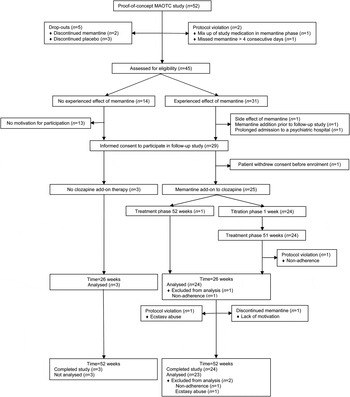
A 1-year open follow-up study was carried out in which all patients who had completed a previous double-blind, placebo-controlled randomized trial (RCT) were asked to participate (see Fig. 1). Participants who experienced beneficial effects during 12 weeks of memantine in the trial were allowed to be treated with memantine for 1 year. Those without beneficial effect on 12 weeks of memantine could participate without memantine augmentation.
Patient disposition in an open-label extension study of adjunctive memantine for clozapine-resistant schizophrenia. MAOTC, Memantine add-on therapy to clozapine.

Study population, and inclusion and exclusion criteria
The study was conducted from August 2014 to September 2015 at 11 Flexible Assertive Community Treatment (FACT) facilities of the Mental Health Service Organization Noord-Holland Noord (the Netherlands) (van Veldhuizen, Reference van Veldhuizen2007).
In the original single-centre, double-blind, placebo-controlled crossover study 52 severely ill patients were included [mean Clinical Global Impression Severity Scale (CGI-S) score 6.15, mean age 42.35 years and mean duration of illness 22.88 years], both male (n = 39) and female (n = 13), who met Diagnostic and Statistical Manual of Mental Disorders, 4th edition (DSM-IV) criteria for schizophrenia on the Mini International Neuropsychiatric Interview Plus (MINI-Plus) (Overbeek et al. Reference Overbeek, Schruers and Griez1999). At inclusion participants suffered from persistent residual psychopathology (Andreasen et al. Reference Andreasen, Carpenter, Kane, Lasser, Marder and Weinberger2005) after treatment with clozapine for at least 6 months (mean clozapine plasma level 421 ng/ml, range 50–878 ng/ml) (Veerman et al. Reference Veerman, Schulte, Smith and de Haan2016). All participants received care from an out-patient facility, while living independently (n = 30), in a sheltered home (n = 16) or in an open long-stay ward (n = 6).
Adjunctive memantine treatment was allowed provided that more beneficial effects were established in the memantine phase compared with the placebo phase on primary outcomes after 12 weeks memantine add-on therapy in the placebo-controlled trial. Exclusion criteria included admission to an acute treatment ward, pregnancy, lactating women and female subjects without adequate contraception, known hypersensitivity to memantine, co-medication with glutamate modulators, lactose intolerance, uncontrolled epilepsy, myocardial infarction, uncontrolled hypertension, renal insufficiency, liver failure or Alzheimer's disease (Wesemann et al. Reference Wesemann, Sontag and Maj1983). Substance use was not an exclusion criterion, but needed to remain as stable as possible, while changes were monitored throughout the study as a possible confounder.
All subjects gave informed consent after receiving a complete description of the extension study from the principal investigator. Compliance was monitored on a daily basis in patients in sheltered homes and open long-stay wards and was at the discretion of the care providers in patients who lived independently.
Clinical assessments
Outcome measures and assessments were identical to those in the double-blind trial. Key primary outcomes were memory and executive function. We used the MATRICS Consensus Cognitive Battery (MCCB) to assess six cognitive domains using the Cambridge Neuropsychological Test Automated Battery (CANTAB) (Levaux et al. Reference Levaux, Potvin, Sepehry, Sablier, Mendrek and Stip2007): reaction time and psychomotor speed, sustained visual attention, verbal memory, visuospatial memory, learning and association ability, working visuospatial memory and strategy use, spatial planning and motor control and emotion recognition (Nuechterlein et al. Reference Nuechterlein, Green, Kern, Baade, Barch, Cohen, Essock, Fenton, Frese, Gold, Goldberg, Heaton, Keefe, Kraemer, Mesholam-Gately, Seidman, Stover, Weinberger, Young, Zalcman and Marder2008; Barnett et al. Reference Barnett, Robbins, Leeson, Sahakian, Joyce and Blackwell2010). A composite memory score was assessed by computing the sum of the CANTAB scores of four tasks: verbal recognition memory (VRM) free recall and VRM recognition, and paired associates learning (PAL) total errors and PAL first trial memory score. A parallel form of the VRM task, equivalent in difficulty, was used for the second measurement in order to reduce practice effects. Executive function was assessed by computing a composite score of the sum of three CANTAB task scores: spatial working memory (SWM) strategy, SWM between errors and One Touch Stockings of Cambridge problems solved on first choice.
Other primary outcomes included effects on the severity of negative, positive and total symptoms of schizophrenia, using the Positive and Negative Syndrome Scale (PANSS) (Kay et al. Reference Kay, Fiszbein and Opler1987), and on global severity of psychopathology, using the CGI-S (Guy, Reference Guy1976).
Secondary outcome measures related to social cognition (facial emotion recognition and theory of mind, as assessed with the Emotion Recognition Task of the CANTAB and the Reading the Mind in the Eyes test; Baron-Cohen et al. Reference Baron-Cohen, Jolliffe, Mortimore and Robertson1997), severity of depressive symptoms (Calgary Depression Scale for Schizophrenia; Addington et al. Reference Addington, Addington and Schissel1990), severity of obsessive–compulsive symptoms (Yale–Brown Obsessive–Compulsive Scale; Goodman et al. Reference Goodman, Price, Rasmussen, Mazure, Delgado, Heninger and Charney1989), severity of impairments of psychosocial functioning [Health of the Nation Outcome Scales (HoNOS); Wing et al. Reference Wing, Lelliott and Chaplin1999] and quality of life (Manchester Short Assessment of Quality of Life; Priebe et al. Reference Priebe, Huxley, Knight and Evans1999).
Analyses of the safety and tolerability of memantine augmentation to clozapine included measurements of blood pressure and waist circumference, laboratory tests of white blood cell count and differentiation, liver and renal function, blood glucose, lipids, and clozapine plasma level (12 ± 0.5 h after ingestion). Subjects used the self-rating Liverpool University Neuroleptic Side-Effect Rating Scale (LUNSERS) to determine the occurrence and severity of side effects (Day et al. Reference Day, Wood, Dewey and Bentall1995). Three possible side effects of memantine (thrombosis, dyspnoea and mycosis) were assessed with separate Likert scales.
All primary and secondary outcomes were rated at baseline (t0), after 26 weeks (t26) and after 52 weeks (t52). In one patient the baseline measurement was conducted directly after the 12-week memantine treatment phase of the double-blind study and the second and third assessments were conducted after a treatment period of 38 weeks and 64 weeks of continuous treatment with memantine. The trainers in the instruments to assess severity of psychopathology in the first study also trained the three raters of the extension study. Inter-rater agreement between the first two raters was moderate, as indicated by the Spearman correlation coefficient (ρ = 0.42, p = 0.001) based on four live patient interviews under supervision (Mukaka, Reference Mukaka2012). Inter-rater agreement between the second and third rater was high, (ρ = 0.81, p < 0.0005), based on seven assessments of joint interviews with subjects. Inter-rater agreement between the first and third rater was high (ρ = 0.78, p < 0.0005) based on three interviews under supervision.
Any undesirable experience occurring to a subject during the study, whether or not considered to be related to memantine, was defined as an adverse event (AE). AEs were reported by either the subject or his or her case manager, community mental health nurse or psychiatrist. Alternative causes of AEs were explored through physical examination by a general practitioner and additional laboratory measurements. Criteria for premature termination of the study were withdrawal of consent, lack of motivation of the participant to complete the study, or a medical emergency.
Statistical analysis
We conducted the analyses of the effects of memantine using a per-protocol analytic approach including protocol completers. To analyse the three repeated measurements we used the Skillings–Mack test (Chatfield & Mander, Reference Chatfield and Mander2009). We chose this within-subject non-parametric statistical test because it can be used to analyse longitudinal data when some data are missing completely at random.
Post-hoc analyses for t26 v. t0 and t52 v. t26 were conducted by means of Wilcoxon signed-rank tests. The ES r’s of significant differences were calculated as Z/sqrt N (Tomczak & Tomczak, Reference Tomczak and Tomczak2014).
We applied the highly conservative Holm–Bonferroni method (Holm, Reference Holm1979) to control for the family-wise error rate inherent in multiple comparisons with the following criteria:
Primary cognitive parameters (CANTAB memory composite score, CANTAB executive function composite score): Skillings–Mack test [Holm–Bonferroni correction for two parameters (α = 0.05/2 = 0.025)] and Wilcoxon [Holm–Bonferroni correction for two parameters and two post-hoc tests (α = 0.05/4 = 0.0125)].
Primary rating scale parameters (PANSS negative symptoms, PANSS positive symptoms, PANSS total symptoms and CGI-S): Skillings–Mack test [Holm–Bonferroni correction for four primary parameters (α = 0.05/4 = 0.0125)] and Wilcoxon [Holm–Bonferroni correction for four parameters and two post-hoc tests (α = 0.05/8 = 0.0062)].
Secondary parameter (HoNOS total): Skillings–Mack test [no Holm–Bonferroni correction (α = 0.05)] and Wilcoxon [Holm–Bonferroni correction for two post-hoc tests (α = 0.05/2 = 0.025)].
Memantine-related side effects and all subscales of the LUNSERS of the entire group were analysed. Changes in laboratory measurements, waist circumference and blood pressure were analysed in individual subjects.
In accordance with the first study we conducted a post-hoc analysis on the effect of memantine on two subdomains of primary negative symptoms. We used a two-factor model of the PANSS constructed by Liemburg et al. (Reference Liemburg, Catelein, Stewart, van der Gaag, Aleman and Knegtering2013): (1) expressive deficits [flat affect (N1), poor rapport (N3), lack of spontaneity and flow of conversation (N6), mannerisms and posturing (G5), motor retardation (G7) and avolition (G13)]; and (2) social amotivation [emotional withdrawal (N2), passive/apathetic social withdrawal (N4) and active social avoidance (G16)].
We conducted a second post-hoc analysis using the five-factor model of the PANSS constructed by van der Gaag et al. (Reference van der Gaag, Hoffman, Remijsen, Hijman, de Haan, van Meijel, van Harten, Valmaggia, de Hert, Cuijpers and Wiersma2006) to explore effects of memantine on specific PANSS subscales.
Patients who did not receive memantine add-on therapy to clozapine (n = 3) were not analysed due to the small sample size of this control group.
Reliability of analyses
Change in clozapine dosage, concomitant medication, substance use, and psychotherapy during the study were analysed in individual subjects as possible confounders.
The element of expectation was analysed by examining a correlation between pre-trial expectations of positive effects of memantine and difference scores (t26 – t0 and t52 – t26) of the PANSS and the HoNOS.
The original RCT was approved by the Central Committee on Research Involving Human Subjects and the Medical Research Ethics Committee (MREC) of Alkmaar Medical Centre. The MREC was informed about the 1-year open-label extension study, which did not require official approval, because the study was conducted in accordance with the post-trial provisions of the Declaration of Helsinki (World Medical Association, 2013), enabling all participants in an RCT to be treated with memantine augmentation (see Fig. 1).
Results
Baseline characteristics
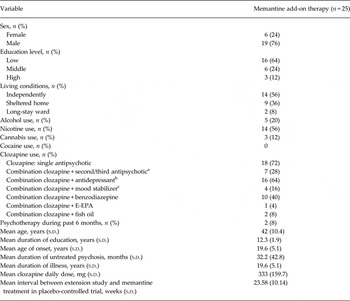
Fig. 1 presents participant screening and enrolment flow data. Of 31 patients who had experienced beneficial effects of memantine, three patients did not participate in the extension study for various reasons and two patients chose to participate without adjunctive memantine, one patient withdrew consent, leaving 25 patients to be included in the extension study. Table 1 presents demographic and clinical characteristics of the study population of these 25 patients (mean age 42 years and mean duration of illness 19.6 years). Online Supplementary Table S1 shows demographic and clinical characteristics of the three patients who participated without adjunctive memantine, but were not included in the analysis. Subjects received care from an out-patient facility while living independently (n = 14) or in a sheltered home (n = 9), or had been admitted to an open long-stay ward (n = 2).
Patient demographics and baseline characteristics

E-EPA, Ethyl eicosapentaenoic acid; s.d., standard deviation.
a Six aripiprazole, one aripiprazole and pimozide.
b Seven fluvoxamine, one fluvoxamine and sertraline, one sertraline, one paroxetine, one fluoxetine, three citalopram, one nortriptyline and one amitriptyline.
c Three valproate, one lithium.
After the crossover RCT, the interval without memantine treatment varied (range = 4–35 weeks). Memantine augmentation was restarted with a dose of 10 mg memantine taken orally once daily and titrated to the full dose of 20 mg after 1 week. In one patient memantine treatment was not interrupted between the RCT and the current extension study: the memantine phase of the crossover study was followed directly by the extension study. As much as possible, all medication remained unaltered throughout the study. Treating psychiatrists notified the principal investigator of any changes in medication.
Clinical efficacy results
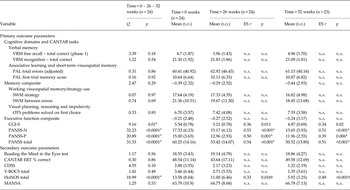
Table 2 summarizes results and statistics on all primary and secondary outcomes. Analysis of effects using the Skillings–Mack test indicated no significant differences between the three repeated measurements for the CANTAB composite scores for executive function and memory. Significant differences were found between the three repeated measurements for the remaining primary outcome variables: PANSS negative symptoms (Q = 32.23, p < 0.0001), PANSS positive symptoms (Q = 20.89, p < 0.0001), PANSS total symptoms (Q = 31.33, p < 0.0001) and CGI-S (Q = 9.16, p = 0.01). Post-hoc Wilcoxon signed-rank tests revealed a significant improvement between t0 and t26 in PANSS negative symptoms (r = 0.53), PANSS positive symptoms (r = 0.50) and PANSS total symptoms (r = 0.54). Improvement of CGI-S did not survive the Holm–Bonferroni correction and showed a positive trend with a moderate ES (r = 0.36). After Wilcoxon signed-rank post-hoc tests the same primary outcome variables showed significant improvement between t26 and t52: PANSS negative symptoms (r = 0.51), PANSS positive symptoms (r = 0.39) and PANSS total symptoms (r = 0.51). Once again, improvement of CGI-S did not survive the Holm–Bonferroni correction (r = 0.34). However, between t0 and t52 a post-hoc Wilcoxon signed-rank test revealed a large significant improvement of CGI-S (r = 0.67, p = 0.001).
Results and analysis of primary and secondary treatment effects of memantine addition to clozapine
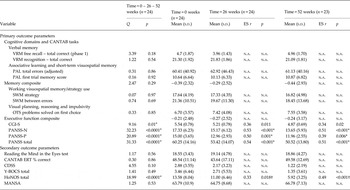
Q, Test statistic Skillings–Mack; s.d., standard deviation; ES, effect size (r) = Z/sqrt(N); CANTAB, Cambridge Neuropsychological Test Automated Battery; VRM, verbal recognition memory-immediate (free recall) and verbal recognition memory-delayed (recognition); n.a., not applicable, since the Skillings–Mack test indicated no significant differences between the three repeated measurements; PAL, paired associates learning; SWM, spatial working memory; OTS, One Touch Stockings of Cambridge; CGI-S, Clinical Global Impression Severity Scale; PANSS, Positive and Negative Syndrome Scale; PANSS-N, PANSS negative subscale; PANSS-P, PANSS positive subscale; PANSS total, PANSS total symptom score; ERT, emotion recognition task; CDSS, Calgary Depression Scale for Schizophrenia; Y-BOCS total, Y-BOCS total symptom score; HoNOS total, Health of the Nation Outcome Scales total symptom score; MANSA, Manchester Short Assessment of Quality of Life.
a Skillings–Mack test indicated significant differences between the three repeated measurements at baseline, t = 26 weeks and t = 52 weeks.
* Significant beneficial effect after Holm–Bonferroni correction for two post-hoc tests and four primary observation scales (α = 0.0062).
† Significant beneficial effect after Holm–Bonferroni correction for two post-hoc tests (α = 0.025).
A post-hoc analysis of the two dimensions of negative symptoms (Liemburg et al. Reference Liemburg, Catelein, Stewart, van der Gaag, Aleman and Knegtering2013) showed a substantial significant effect of memantine add-on therapy on expressive deficits between t0 and t26 (r = 0.40, p = 0.006) and between t26 and t52 (r = 0.34, p = 0.022). Similar results were found for social amotivation at t26 (r = 0.35, p = 0.016) and t52 (r = 0.48, p = 0.001).
A post-hoc analysis of PANSS subscales (van der Gaag et al. Reference van der Gaag, Hoffman, Remijsen, Hijman, de Haan, van Meijel, van Harten, Valmaggia, de Hert, Cuijpers and Wiersma2006) showed moderate significant improvement of excitement (r = 0.37, p = 0.009) and emotional distress (r = 0.47, p = 0.001) after post-hoc Wilcoxon signed-rank tests between t0 and t26. Post-hoc Wilcoxon signed-rank tests revealed substantial improvement of disorganization between t0 and t26 (r = 0.54, p < 0.001) and between t26 and t52 (r = 0.38, p = 0.011).
The Skillings–Mack test indicated significant differences between the three repeated measurements for a single secondary outcome variable: the HoNOS. After Wilcoxon signed-rank post-hoc tests the HoNOS showed significant improvement between t0 and t26 (r = 0.33) and again between t26 and t52 (r = 0.49). Social cognition, depressive symptoms, obsessive–compulsive symptoms and subjective quality of life did not significantly change during the study.
One patient discontinued memantine at t26 after a period of non-compliance. Discontinuation was not related to memantine treatment.
Possible confounders
Clozapine dosage (mean 333 mg, range = 75–700 mg) remained unaltered in all but four subjects and alterations in concomitant medications were limited to seven subjects (see online Supplementary Table S2). During the extension study psychotherapy and use of substances did not change significantly. One patient started using ecstasy on a weekly basis after 26 weeks, whereas he had not used this psychoactive substance during the first 6 months of the extension study. External factors which were deemed to be not related to memantine treatment triggered ecstasy abuse.
Safety and tolerability
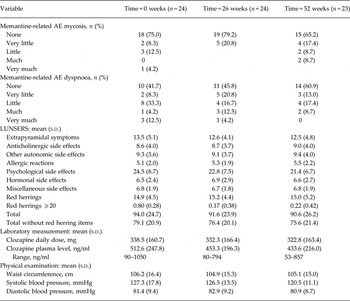
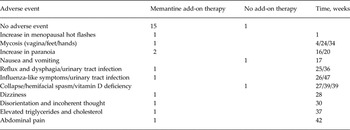
Memantine did not affect liver and renal function or metabolic parameters, such as waist circumference, blood pressure, blood glucose, or lipids. There was no significant increase in reported side effects assessed by LUNSERS (see Table 3).
Side effects and safety measures

AE, Adverse event; LUNSERS, Liverpool University Neuroleptic Side-Effect Rating Scale; s.d., standard deviation.
Table 4 represents AEs. Only two AEs were possibly related to memantine: both regurgitation and mycosis are rare side effects of memantine (⩾1/1000 and ⩽1/100). An alternative cause for regurgitation was a high plasma clozapine level in this patient. A hazard for the development of transient mycosis in the other patient was labour in an animal shelter. No serious AEs were observed.
Adverse events

Discussion and conclusions
In our former placebo-controlled crossover study (n = 52) we found a small improvement of memory and negative symptoms after 12 weeks of memantine treatment (Veerman et al. Reference Veerman, Schulte, Smith and de Haan2016). The current 1-year extension study provided an opportunity to find an indication whether further improvement can be expected from long-term memantine treatment of clozapine-refractory schizophrenia.
In the former placebo-controlled trial memantine showed a small significant improvement of memory after 12 weeks of treatment. This effect was sustained in the extension study without further improvement. Both the placebo-controlled trial and the extension study failed to show any effect of memantine on executive function.
While in the placebo-controlled trial negative symptoms significantly improved with a small ES, in the extension study negative symptoms ameliorated further, with a large ES between t0 and t26 and between t26 and t52. In the placebo-controlled trial a non-significant small effect was found for one subdomain: diminished expression (d = 0.17). An equal and moderate effect of memantine on expressive deficits and social amotivation was found after t26 and t52.
Although positive and overall symptoms of schizophrenia did not significantly improve in the placebo-controlled trial, these symptoms showed substantial significant improvement after 26 weeks of memantine adjunctive treatment, followed by even further improvement at t52. The ESs ranged from moderate to large.
Whereas in the primary placebo-controlled study only memory and negative symptoms significantly improved, in the 1-year extension study most outcomes (negative symptoms, positive symptoms, overall symptoms and impairments in psychosocial functioning) showed improvement, with moderate to large ESs. Long-term beneficial effects of memantine were also reflected in a moderate positive trend of the CGI-S at t26 and t52.
Memantine was well tolerated without significant change in side effects or metabolic parameters. No serious AEs were reported.
In summary, positive long-term effects of memantine add-on therapy to clozapine were found on nearly all aspects of interest, except executive function, social cognition, depressive symptoms, obsessive–compulsive symptoms and subjective quality of life.
A possible explanation for the more substantial beneficial effects in the extension study compared with the placebo-controlled study is the longer treatment duration. It is conceivable that the 12-week treatment period with memantine in the placebo-controlled trial was too short and that clinical improvement would have occurred in more subjects in the placebo-controlled trial if memantine add-on therapy had been extended for a longer period. After 1 year of memantine addition to clozapine we found moderate to large beneficial effects for most outcomes. These effects were more substantial than in the double-blind trial, but still not as large as the very large ESs of the short-term RCT by de Lucena et al. (Reference de Lucena, Fernandes, Berk, Dodd, Medeiros, Pedrini, Kunz, Gomes, Giglio, Lobato, Belmonte-de-Abreu and Gama2009). This discrepancy may be explained by the differences in patient population. Our participants were older (mean 7.7 years older), more severely ill (CGI-S scores 6.15 v. 5.34) due to severe cognitive impairments, and had been suffering from schizophrenia for a longer period of time (mean 5.04 years longer). Therefore, substantial improvement of symptoms may have been more difficult to reach in our patient population.
Our results must be interpreted within their limitations. Because only three patients chose to participate without adjunctive memantine treatment, we were unable to compare the intervention group with a control group. Moreover, the open-label design is susceptible to bias such as observer and participant expectancy effects, which may have resulted in overestimation of the beneficial effects of memantine (Sackett, Reference Sackett1979; Fisher & Greenberg, Reference Fisher and Greenberg1993; Crow et al. Reference Crow, Cage, Hampson, Hart, Kimber and Thomas1999). However, these biases are thought to have a more modest influence on CANTAB results (Barnett et al. Reference Barnett, Robbins, Leeson, Sahakian, Joyce and Blackwell2010). Furthermore, subjective quality of life was not rated as significantly improved, at least showing that expectancy was not pervasive to all outcome domains. This is supported by measurements of expectations in participants before the extension phase. In our patient population the measured expectations of efficacy of memantine were very small to small in approximately 50%. Furthermore, no association was found between expectation scores and experienced effect of memantine (data not shown). Another potential bias is participation in a medication trial, which might possibly lead to better care and adherence which in turn might mediate better outcomes (Kinon et al. Reference Kinon, Potts and Watson2011). However, participating patients did not receive any extra attention or treatment apart from being given memantine and participating in three assessment sessions – at t0, at t26 and at t52. Substantial improvement due only to these three sessions seems unlikely. Practice effects for the CANTAB due to serial cognitive assessments are another possible limitation. In healthy subjects some CANTAB tests show low test–retest relability, in particular tests on executive function (Lowe & Rabbitt, Reference Lowe and Rabbitt1998). Test–retest stability is lower in patients with schizophrenia (Beglinger et al. Reference Beglinger, Ahmed, Derby, Siemers, Fastenau, Crawford-Miller, Shekhar and Kareken2003). Practice effects in patients with severe cognitive impairments suffering from refractory schizophrenia are even more improbable. In our study comparisons of verbal memory were even less compromised than other cognitive domains, because the second VRM task differed from the first and third VRM tasks. Because the interval was 26 weeks between three cognitive assessments, significant practice effects in this patient population were highly unlikely.
Considering that robust evidence is limited for treatment options for residual symptoms in clozapine-refractory schizophrenia, future studies are imperative to find effective approaches. The presently available results on memantine in combination with clozapine in refractory schizophrenia should encourage a large, double-blind, placebo-controlled trial with a treatment duration of at least 26 weeks in order to ascertain any beneficial effects of memantine. In patients with less severe residual symptoms, memantine may have even stronger beneficial effects after a shorter treatment period, given the large ESs that de Lucena et al. (Reference de Lucena, Fernandes, Berk, Dodd, Medeiros, Pedrini, Kunz, Gomes, Giglio, Lobato, Belmonte-de-Abreu and Gama2009) found in this group. Because renal clearance of memantine is superior in adult patients compared with elderly, a higher dosage of 30–40 mg is thought to be safe (Wiech et al. Reference Wiech, Preissl, Kiefer, Töpfner, Puali, Grillon and Birbaumer2001, Reference Wiech, Kiefer, Töpfner, Preiss, Braun, Unertl, Flor and Birbaumer2004; Areosa & Sherriff, Reference Areosa and Sherriff2003; Beister et al. Reference Beister, Kraus, Kuhn, Dose, Weindl and Gerlach2004; Schwenkreis et al. Reference Schwenkreis, Witscher, Pleger, Malin and Tegenthoff2005; Ferguson & Shingleton, Reference Ferguson and Shingleton2007; Schifitto et al. Reference Schifitto, Navia, Yiannoutsos, Marra, Chang, Ernst, Jarvik, Miller, Singer, Ellis, Kolson, Simpson, Nath, Berger, Shriver, Millar, Colguhoun, Lenkinski, Gonzalez and Lipton2007) and may prove to be more efficacious. It is also conceivable that memantine has more efficacy in patients in the early stages of schizophrenia when neurodegenerative changes are more limited. At present no dose-ranging study has been conducted in schizophrenia patients. It would be interesting to investigate dose-dependent effects of memantine, because a higher dosage than 20 mg may yield more improvement. Future study could also include younger clozapine-treated patients with TRS. In our study as well as previous clinical trials in patients with TRS the effect of memantine on parameters of central glutamatergic transmission and brain activity was not assessed. In future studies it would be interesting to use 1H-MRS and fMRI to investigate whether memantine normalizes glutamate levels and brain activity in TRS and whether this is related to treatment effects.
Given the paucity of efficacious pharmacological options for clozapine-refractory schizophrenia patients, adjunctive memantine is an interesting treatment option based on the glutamate hypothesis, two positive double-blind, placebo-controlled RCTs, and the current open-label extension study.
Supplementary material
The supplementary material for this article can be found at https://doi.org/10.1017/S0033291716002476
Acknowledgements
This research received no specific grant from any funding agency, commercial or not-for-profit sectors. This work was funded by the Community Mental Health Division of Mental Health Service Noord-Holland Noord. We thank the participants of this study for their dedication and commitment and their care providers for their assistance and support. We also thank M. Monden for his contribution to the excellent training of the raters.
Declaration of Interest
S.R.T.V. and J.B.D. report no financial relationships with commercial interests. P.F.J.S. reports personal fees from H. Lundbeck A/S, unrelated to the present work, and is a board member of the Dutch Clozapine Collaboration Group. L.d.H. has received investigator-led research grants or reimbursement for presenting his research from Eli Lilly, Bristol-Myers Squibb, Janssen-Cilag and AstraZeneca.