Introduction
Both the striped flea beetle, Phyllotreta striolata (Fabricius), and crucifer flea beetle, Phyllotreta cruciferae (Goeze) (Coleoptera: Chrysomelidae), are invasive alien species to North America. In western Canada, they are the most significant insect pests of cruciferous (Brassicaceae) crops including Brassica napus Linnaeus, Brassica rapa Linnaeus, Brassica juncea (Linnaeus) Czern, and Sinapis alba Linnaeus (Soroka and Elliott Reference Soroka and Elliott2011; Reddy et al. Reference Reddy, Tangtrakulwanich, Wu, Miller, Ophus and Prewett2014). Their economic impact on cruciferous crops is estimated to exceed US$ 300 million annually in North America (Knodel and Olson Reference Knodel and Olson2002). Mitigation strategies include reduced tillage, the use of large-sized seed with high seedling vigour qualities and insecticide-coated seed treatments (Dosdall and Stevenson Reference Dosdall and Stevenson2005). Antwi and Reddy (Reference Antwi and Reddy2016) also examined the efficacy of entomopathogenic nematodes (Nematoda), formulated as a sprayable polymer gel, for flea beetle management in canola. Seed treatments using neonicotinoid insecticides are the dominant management tactic used by canola producers (Soroka and Elliott Reference Soroka and Elliott2011). However, Tansey et al. (Reference Tansey, Dosdall, Keddie and Sarfraz2008) reported that P. cruciferae fed less on seedlings of canola grown from neonicotinoid-treated seed and had higher mortality than did P. striolata.
The natural history and the ecology of the two Phyllotreta Chevrolat have been previously described (Wylie Reference Wylie1979; Soroka and Elliott Reference Soroka and Elliott2011; Soroka Reference Soroka2013; Olfert et al. Reference Olfert, Weiss, Elliott and Soroka2017). In western Canada, adults feed and reproduce on spring-seeded cruciferous crops. They have one generation per year; new adults emerge from the soil in fall, feeding briefly before migrating to overwintering sites. Recent reports suggest that populations of P. striolata are increasing in numbers and expanding their geographic range (Kielen Reference Kielen2012; Soroka Reference Soroka2012).
In western Canada, crop losses at a regional level are generally attributed to one, rarely both species. This is likely due to species-specific responses to growing season weather. Olfert et al. (Reference Olfert, Weiss, Elliott and Soroka2017) developed bioclimatic simulation models (CLIMEX, Hearne Scientific Software Pty, Melbourne, Australia) to estimate the potential range and relative abundance of P. cruciferae and P. striolata. CLIMEX derives an ecoclimatic index (EI), which defines the climatic suitability of specific locations for species survival and reproduction and provides an estimate of relative abundance (Sutherst et al. Reference Sutherst, Maywald and Kriticos2007). Olfert et al. (Reference Olfert, Weiss, Elliott and Soroka2017) reported that, although ranges of the two species do overlap, species-specific responses to temperature and precipitation resulted in temporal and spatial differences. Model output agreed with field observations that P. striolata tends to be more prevalent in conditions that are cooler and wetter, while P. cruciferae tends to be more abundant in warmer, dryer climates (Soroka and Elliott Reference Soroka and Elliott2011). Based on a comparison of observed occurrence and model output (Olfert et al. Reference Olfert, Weiss, Elliott and Soroka2017) of the two species, EI⩾20 indicated locations where flea beetle population densities would be significant enough to cause economic crop losses (Burgess Reference Burgess1977; Soroka and Elliott Reference Soroka and Elliott2011).
Climate change can affect ecological habitats and, in turn, species distribution. Different species will respond differently to climate change variables, based on species-specific environmental niche properties (Pearson et al. Reference Pearson, Dawson, Berry and Harrison2002; Thuiller Reference Thuiller2004; Olfert and Weiss Reference Olfert and Weiss2006). General circulation model inputs, applied to bioclimatic simulation models, have been used to assess impact and related system vulnerability for future climates in North America (Mika and Newman Reference Mika and Newman2010; Olfert et al. Reference Olfert, Weiss, Turkington, Beckie and Kriticos2012, Reference Olfert, Haye, Weiss, Kriticos and Kuhlmann2016). Previous studies on the impact of climate change on insect pests in western Canada, have assessed the impacts on the range of ecoclimatic index from “unfavourable” to “very favourable” habitats (Olfert and Weiss Reference Olfert and Weiss2006; Olfert et al. Reference Olfert, Weiss and Kriticos2011, Reference Olfert, Haye, Weiss, Kriticos and Kuhlmann2016). Olfert et al. (Reference Olfert, Weiss, Elliott and Soroka2017) indicated that their flea beetle bioclimatic models could be extended with general circulation models to analyse potential impacts of future climates on distribution, abundance and species overlap of P. cruciferae and P. striolata in North America.
Given the severe pest status of these two species under current climate (Soroka and Elliott Reference Soroka and Elliott2011), the focus of this study was on populations with an ecoclimatic index of “Favourable” and above (EI⩾20). The objective was to assess the impact of a changing climate on the response of these economic population densities of P. cruciferae and P. striolata to future climates for both spatial (continental and regional) and temporal (annual and weekly) scales through the application of two general circulation models for Canada.
Methods
The bioclimatic models for P. cruciferae and P. striolata, developed using CLIMEX 3.0 (Sutherst et al. Reference Sutherst, Maywald and Kriticos2007), were described by Olfert et al. (Reference Olfert, Weiss, Elliott and Soroka2017). The bioclimatic modelling process of validating model output using published species distribution data has been previously illustrated (Haye et al. Reference Haye, Olfert, Weiss, Gariepy, Broadbent and Kuhlmann2013; Olfert et al. Reference Olfert, Weiss and Elliott2015). CLIMEX uses an annual growth index to describe the potential for population growth as a function of soil moisture and temperature during favourable conditions, and stress indices (cold, wet, hot, dry) to determine the effect of abiotic stress on survival in unfavourable conditions. The growth and stress indices are calculated weekly and then combined into an overall annual index of climatic suitability (ecoclimatic index). The ecoclimatic index ranges from EI=0 for locations where the species are not able to persist, to EI=100 for locations that are optimal for the species.
Bioclimatic model runs for the periods of 2030 and 2070 were conducted for Canada using general circulation model data obtained from global climatologies for bioclimatic modelling (CliMond 10 spatial resolution; see CliMond 2017) as input (Kriticos et al. Reference Kriticos, Webber, Leriche, Ota, Macadam, Bathols and Scott2012). The 10′ gridded data set included a hybrid historical data set for current climate (based on CRU CL2.0 and WorldClim; centred on 1975), and two general circulation models (CSIRO Mark 3.0 and MIROC-H) for the 2030 and 2070 time periods. Climate projections were based on the special report on emission scenarios (SRES) A1B emission scenario (Nakicenovic and Swart Reference Nakicenovic and Swart2000).
Two data sets, annual and weekly, were produced for each model run. Annual data sets were analysed at the continental and regional scales. Weekly output was analysed at the regional scale. A geographic rectangle, 2° latitude by 2° longitude was used to delineate a geographic region around each location and model output was averaged across the region. These data sets permitted spatial and temporal comparison of variables. Surface maps were displayed using only EI⩾20, to represent regions where population densities that result in economic crop losses could exist. In addition, surface maps included areas where both P. cruciferae and P. striolata overlapped and occurred with EI⩾20. These surface maps were further constrained by limiting P. cruciferae and P. striolata to regions where soils were suitable for crop production, based on Kirkwood et al. (Reference Kirkwood, Bootsma, de Jong, Dumanski, Hiley and Huffman1993). Five locations were selected for regional analysis: Toronto, Ontario, Canada (43.8°N, 79.4°W); Winnipeg, Manitoba, Canada (49.9°N, 97.1°W); Saskatoon, Saskatchewan, Canada (52.1°N, 106.6°W); Edmonton, Alberta, Canada (53.6°N, 113.6°W); Grande Prairie, Alberta, Canada (55.1°N, 118.5°W).
Results and discussion
Population shifts
In a previous study, Olfert et al. (Reference Olfert, Weiss, Elliott and Soroka2017) developed bioclimatic simulation models (CLIMEX) to estimate the potential range and relative abundance of the two flea beetle species using six categories to define ecoclimatic index values as very unfavourable (1–5), unfavourable (5–10), marginal (10–15), suitable (15–20), favourable (20–25), and very favourable (>25). In this study, EI⩾20 was used as a baseline to assess where potential economic population levels of P. cruciferae and P. striolata may occur in current and future climates. Our model predictions for both species indicated that distributions would shift north into the Boreal Shield Ecozone of Canada, which is beyond regions where canola is currently grown. Boreal Shield Ecozone soils are thin and relatively unsuitable for crop production, due to the low humus and organic material content (Urquizo et al. Reference Urquizo, Bastedo, Brydges and Shear2000). Hence, it is unlikely that canola production will expand northward into the Boreal Shield Ecozone, even though climate variables may be suitable for crop growth. With this in mind, the geographic scope of the study was limited to regions where soils were appropriate for canola production.
Previous studies have shown that the distribution of P. cruciferae occurred between 36°N and 56°N (Beirne Reference Beirne1971; Wylie et al. Reference Wylie, Turnock and Burgess1984; Global Biodiversity Information Facility 2015). Not surprisingly, Olfert et al. (Reference Olfert, Weiss, Elliott and Soroka2017) showed that ecoclimatic index values for P. cruciferae were greatest across the Mixed and Moist Mixed Grasslands Ecoregions (Kirkwood et al. Reference Kirkwood, Bootsma, de Jong, Dumanski, Hiley and Huffman1993). High population densities of P. cruciferae, relative to P. striolata, were also reported at Winnipeg (Turnock et al. Reference Turnock, Lamb and Bilodeau1987). The geographic area where the range of P. cruciferae populations occurred is across the largest canola-growing region of the prairies and indicated that P. cruciferae had the potential to be a more significant pest across southern and central areas of the Prairie Ecozone (Fig. 1A).
Map of ecoclimatic index values for Phyllotreta cruciferae and Phyllotreta striolata based on current climate (A); CSIRO Mark 3.0 projections for 2030 (B) and 2070 (C); and MIROC-H projections for 2030 (D) and 2070 (E). Presented ecoclimatic index values represent nodes with EI⩾20. Surface maps were constrained by limiting P. cruciferae and P. striolata to regions where soils were suitable for crop production in Canada. Yellow=P. cruciferae; green=P. striolata; red=species overlap. Five regional locations were represented: 1 – Toronto; 2 – Winnipeg; 3 – Saskatoon; 4 – Edmonton; 5 – Grande Prairie.

Compared to current climate, P. cruciferae distributions for future climates were predicted to expand north and west and the change in distribution was greater for 2070 than for 2030 (Fig. 1A–E). By 2030, the distribution of P. cruciferae was predicted to extend north to where current P. striolata populations occur (Fig. 1A–B, D). By 2070, model projections indicated that economic populations of P. cruciferae would extend from southern Ontario to most of the Peace River region of Alberta and British Columbia (Fig. 1C, E). Results were similar for both CSIRO Mark 3.0 and MIROC-H general circulation models. Other studies also reported similar findings for an assessment of the impact of climate change on distribution of the migratory grasshopper, Melanoplus sanguinipes (Fabricius) (Orthoptera: Acrididae) (Olfert et al. Reference Olfert, Weiss and Kriticos2011) and on the parasitoid Peristenus digoneutis Loan (Hymenoptera: Braconidae) (Olfert et al. Reference Olfert, Haye, Weiss, Kriticos and Kuhlmann2016).
Based on model output for current climate, there were five provinces (Ontario, Manitoba, Saskatchewan, Alberta, and British Columbia) with areas of EI⩾20 for P. striolata. In western Canada, areas where EI⩾20 for P. striolata were associated with the Aspen Parkland and Boreal Ecoregions (Kirkwood et al. Reference Kirkwood, Bootsma, de Jong, Dumanski, Hiley and Huffman1993) of the Canadian prairies. The occurrence of populations of P. striolata, in areas of EI⩾20, was projected to be north of where economic populations of P. cruciferae were predicted to occur by Olfert et al. (Reference Olfert, Weiss, Elliott and Soroka2017) (Fig. 1A). Since P. striolata distribution already occurs across most of the Aspen Parkland, both general circulation models predicted that P. striolata population distributions, in areas of EI⩾20, would not expand north or west. Warmer and dryer climates associated with both general circulation models were predicted to result in range contraction across southern regions of Alberta, Saskatchewan, Manitoba, and Ontario (Fig. 1A–E).
Currently, P. cruciferae and P. striolata distributions overlap across the Great Plains of North America (Beirne Reference Beirne1971; Wylie et al. Reference Wylie, Turnock and Burgess1984; Global Biodiversity Information Facility 2015). The degree of overlap is related to growing season rainfall and temperature (Olfert et al. Reference Olfert, Weiss, Elliott and Soroka2017). Model projections for current climate indicated that regions where both species occur at densities considered to be economic are confined to localised regions in Ontario, Manitoba, Saskatchewan, and Alberta (Fig. 1A). In this study, a large area extending from southeastern Manitoba to the Peace River region of Alberta was projected to consist of both species having EI⩾20 by 2030 (Fig. 1B, D). By 2070, both species were predicted to occur at economic levels across large areas of the Peace River region (Fig. 1C, E). Although model output in our study predicted that economic populations of P. cruciferae and P. striolata are likely to overlap in future climates, it is unclear how the two flea beetle species interact at the plant level, specifically larval interactions on roots. Since climate data refers to long-term weather patterns, our model projections do not indicate whether or not species overlap will occur on an annual basis. Study results simply indicated that there is the potential for both species to occur at economic levels across specific regions.
Geographic area analysis
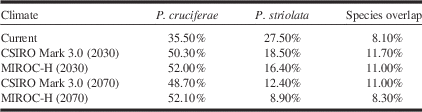
Model output for current climate indicated that 35.5% and 27.5% of Canada (limited to regions of Canada with soils suitable for crop production) was categorised as EI⩾20 for P. cruciferae and P. striolata, respectively (Table 1).
Canadian agricultural area (% of total) where ecoclimatic index (EI⩾20) for Phyllotreta cruciferae and Phyllotreta striolata and the overlap of both species, based on current climate and two general circulation models (CSIRO Mark 3.0 and MIROC-H) for 2030 and 2070.
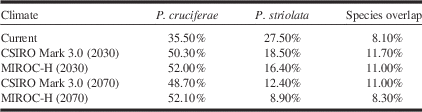
In the case of P. cruciferae, the most significant shifts in population distribution due to climate change were predicted to occur by 2030, with minimal further changes occurring by 2070. Predictions were similar for both general circulation models. For 2030, 50.3% and 52.0% of Canada was projected to have EI⩾20 for CSIRO Mark 3.0 and MIROC-H, respectively. For 2070, the total geographic areas where EI⩾20 was predicted to be comparable for CSIRO Mark 3.0 (52.0%) and MIROC-H (52.1%).
Conversely, P. striolata populations were predicted to decrease for both general circulation model time periods, relative to current climate. The area with EI⩾20 was predicted to decrease by 2030 and to a greater extent by 2070. By 2030, these “favourable” to “very favourable” areas for P. striolata were predicted to be 18.5 and 12.4% of the total geographic area by the CSIRO Mark 3.0 and MIROC-H general circulation models, respectively. By 2070, areas with EI⩾20 were predicted to be 8.8% for MIROC-H and 12.4% for CSIRO Mark 3.0.
In relation to species overlap, 8.1% of the area (EI⩾20) was predicted to be suitable for co-existence of both species under current climate conditions (Table 1). By 2030, this area was predicted to increase to 11.7% and 11.0% for CSIRO Mark 3.0 and MIROC-H, respectively. However, by 2070, these areas were predicted to decrease once again, minimally for CSIRO Mark 3.0 (11.0%), but more significantly by MIROC-H (8.3%). Although, the areas predicted to be suitable for co-existence of both species were somewhat similar for current climate (8.1%) and for MIROC-H 2070 (8.3%), there were spatial differences. For current climate, the region of species overlap was predicted to occur across Manitoba and east central Alberta (Fig. 1A). By 2070, the area of species overlap (EI⩾20) was predicted to shift northwest to the Peace River regions of Alberta and British Columbia.
Site-specific analysis
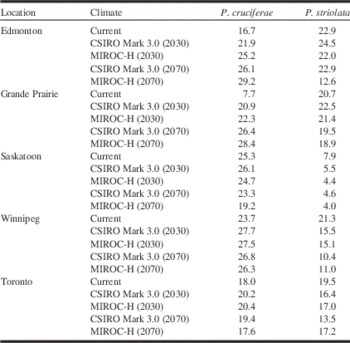
In earlier studies, species abundance and distribution were predicted to be both temporally and geographically specific in response to future climates (Olfert et al. Reference Olfert, Weiss and Elliott2015, Reference Olfert, Haye, Weiss, Kriticos and Kuhlmann2016). To assess this in more detail for this study, predicted ecoclimatic index values for both species were analysed at five locations (Toronto, Winnipeg, Saskatoon, Edmonton, and Grande Prairie) for both general circulation models under current climate and for both time periods (2030 and 2070). Results showed that predicted ecoclimatic index values were specific for each location/time period/general circulation model combination (Table 2). For current climate, predicted ecoclimatic index values for P. striolata were greater than for P. cruciferae at Edmonton and Grande Prairie, but lower than P. cruciferae at Saskatoon. For the other two locations (Winnipeg and Toronto), predicted ecoclimatic index values were similar for the two species under current climate conditions. In relation to future climates, ecoclimatic index values for P. striolata were consistently predicted to decrease at Saskatoon, Winnipeg, and Toronto for both general circulation models and for both 2030 and 2070. Conversely, ecoclimatic index values for P. cruciferae at Winnipeg, Edmonton, and Grande Prairie were consistently predicted to increase for both general circulation models and for both 2030 and 2070.
Ecoclimatic index values for Pyllotreta cruciferae and Phyllotreta striolata (% of Canadian agricultural area) based on current climate (1975) and general circulation models CSIRO Mark 3.0 and MIROC-H for 2030 and 2070 at five locations in Canada.
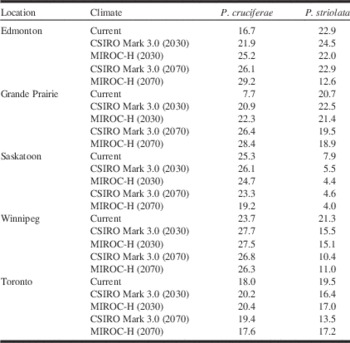
Notes: Values were obtained by calculating the average across all nodes delineated by a geographic rectangle (2° latitude by 2° longitude centred on each location) for each location.
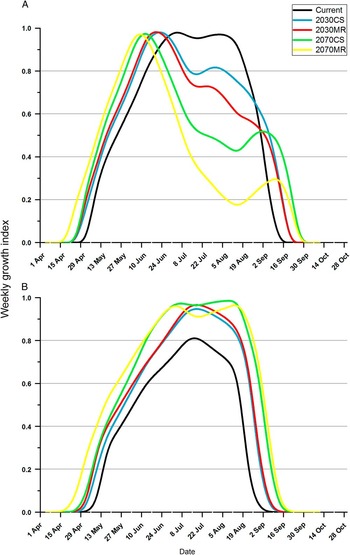
CLIMEX reports a weekly growth index (GIw) that describes weekly suitability for growth during the growing season (Sutherst et al. Reference Sutherst, Maywald and Kriticos2007). CLIMEX sets GIw=0 during the period when the species is in diapause. Rather than analysing annual values (ecoclimatic index) across large geographic regions, GIw analysis permits analysis of weekly growing season performance at site-specific resolution. In our study, P. cruciferae populations near Saskatoon were predicted to emerge one week earlier by 2030 than for current climate and fall populations would enter diapause one week later (Fig. 2A). Output indicated that temperatures would exceed the lower limiting development threshold (DV0) at an earlier date by 2030 than current climate. This would promote earlier flea beetle activity in spring. However by mid-growing season, temperatures would exceed the upper optimal temperature (DV2) in future climates, resulting in suboptimal conditions and reducing weekly GIw values. Warmer, dryer weather from mid-June to late August predicted lower GIw values for both general circulation models. By 2070, MIROC-H predicted that emergence of adults in spring was predicted to be two weeks earlier than current climate and both general circulation models resulted in later diapause induction in the fall. At Grande Prairie, growing seasons were predicted to be longer by both general circulation models for both 2030 and 2070 (Fig. 2B). Mid-growing season GIw values at Grande Prairie were not as reduced as those predicted for Saskatoon.
Weekly growth index (GIw) for Phyllotreta cruciferae based on current climate and general circulation model projections for Saskatoon, Saskatchewan (A) and Grande Prairie, Alberta (B). Weekly values were obtained by calculating the average across all grid cells (n=144) delineated by a geographic rectangle, 2° latitude by 2° longitude centred on each location. Black=current climate; blue=CSIRO Mark 3.0 (2030); red=MIROC-H (2030); green=CSIRO Mark 3.0 (2070); yellow=MIROC-H (2070).

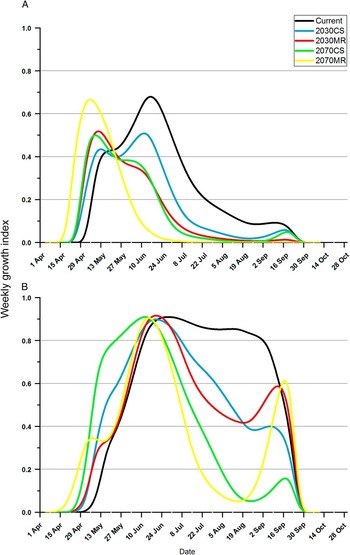
The responses of P. striolata to future climates at Saskatoon and Grande Prairie were more variable. At Saskatoon, warmer, dryer conditions resulted in earlier spring activity, however, mid-growing season GIw values were much lower during July and August (Fig. 3A). Responses were relatively similar across time periods and general circulation models. At Grande Prairie, P. striolata response to future climate was more variable (Fig. 3B). Although 2030 GIw values in July and August were less than for current climate, they were greater than for 2070.
Weekly growth index (GIw) for Phyllotreta striolata based on current climate and general circulation model projections for Saskatoon, Saskatchewan (A) and Grande Prairie, Alberta (B). Weekly values were obtained by calculating the average across all grid cells (n=144) delineated by a geographic rectangle, 2° latitude by 2° longitude centred on each location. General circulation models: black – current climate; blue – CSIRO Mark 3.0 (2030); red – MIROC-H (2030); green – CSIRO Mark 3.0 (2070); yellow – MIROC-H (2070).

Concluding comments
Our model output indicated that the response of P. cruciferae and P. striolata to future climate did not have similar trends in all conditions, but were specific to each species/location/time period/general circulation model combination. Our study predicted that changing climates would result in P. cruciferae becoming the dominant species across the eastern prairies and in P. striolata populations being limited to northwestern Alberta and the Peace River region (Fig. 1A–E). The degree of species overlap was predicted to shift north in future climates and that the area of overlap would be greater than for current climate. This suggests that the two species could potentially cause economic losses over an expanded area in the future. Historically, regional crop losses are rarely attributed to both species, due to species-specific responses to growing season weather (Olfert et al. Reference Olfert, Weiss, Elliott and Soroka2017). In cool and damp years, P. striolata will be more abundant than P. cruciferae and the latter would be more abundant in warm, dry growing seasons. Within a growing season, spatial weather patterns differ across large geographic areas. Across large geographic areas such as the Northern Great Plains, both species may be abundant in different regions within the same growing season. This, in turn, could impact selection of chemical control options for canola growers given the reported lower efficacy of neonicotinoid seed treatments on P. striolata (Tansey et al. Reference Tansey, Dosdall, Keddie and Sarfraz2008; Soroka Reference Soroka2013).
Constraining the geographical area of our study to regions where soils were appropriate for crop production indicated that changing climates would result in species shifts that are very different than for current climate. To our knowledge, we are not aware of research that has quantified how these two species compete with each other. Competition likely exists since adults (leaves) and larvae (roots) would be competing for similar resources.
A changing climate would also impact crop production (agronomy, seeding dates, etc.) and, in turn, crop–insect interactions. For example, seeding date influences the extent of flea beetle damage to canola to varying degrees in different regions of the Prairie Ecozone. In North Dakota, United States of America, flea beetle damage to canola was reported to be greater when crops were planted in late April to early May as opposed to those planted in late May (Milbrath et al. Reference Milbrath, Weiss and Schatz1995; Knodel et al. Reference Knodel, Olson, Hanson and Henson2008). Cárcamo et al. (Reference Cárcamo, Otani, Dosdall, Blackshaw, Clayton and Harker2008) found that canola planted in April in southern Alberta had lower flea beetle populations and less plant damage than crops planted in May, while the opposite occurred in more northern regions of Alberta. As a result, future studies will need to take into account the impacts of a changing climate on crop production in relation to flea beetle activity.
Studies are now beginning to investigate how two or more species respond to climate change including biological control agents (Olfert et al. Reference Olfert, Haye, Weiss, Kriticos and Kuhlmann2016) and crop pests including weeds, insects, and crop pathogens (Olfert et al. Reference Olfert, Weiss, Turkington, Beckie and Kriticos2012). Although P. cruciferae and P. striolata are the most chronic and economically important flea beetle pests of cruciferous crops in western Canada, a number of insect species are associated with crop losses of cruciferous crops including Lygus Hahn (Hemiptera: Miridae), M. sanguinipes, Contarinia nasturtii (Kieffer) (Diptera: Cecidomyiidae), Meligethes viridescens (Fabricius) (Coleoptera: Nitidulidae), and Ceutorhynchus obstrictus (Marsham) (Coleoptera: Curculionidae). Studies have shown that each of these species will potentially shift north in future climates (Olfert and Weiss Reference Olfert and Weiss2006; Mika et al. Reference Mika, Weiss, Olfert, Hallett and Newman2008; Olfert et al. Reference Olfert, Weiss and Kriticos2011).
Our approach of focusing on ecoclimatic index values associated with population densities that result in economic losses, as well as comparing spatial overlap of two species, has resulted in a novel way to assess impacts of future climates on pest insect species. In order to assess impacts of this species complex on cruciferous crops, this approach may be applied to studies that investigate the potential spatial interaction of canola pests in future climates.
Acknowledgements
The authors would like to acknowledge the financial support of the Canola/Flax Canadian Agri-Science Cluster Program (Canola Council of Canada and Agriculture and Agri-Food Canada) and the Western Grains Research Foundation.