“Artists often tell me that their work ‘speaks for itself,’ but trust me, curators, conservators, and researchers always want more information. Your photographs, records, and recollections are significant to understanding a work of art, its place in history, a movement, and even within your own body of work.” Carolyn Kastner, Curator, Georgia O’Keeffe Museum (Gendron et al. 2022)
Introduction
Art libraries in museums have a dual role, serving as the repositories of the documentary heritage of the institution they belong to, while also promoting dissemination and research of those materials. These two roles may seem contradictory at first, as the function of conserving and preserving for the future must not necessarily include making these collections known. The new information and communication developments that museum libraries and archives face bring about uncertainties in the treatment, dissemination, and research of these sources. Choosing appropriate management systems implies deciding which type of users to target, where to set the limits for digitisation, and to what extent the institution is willing or able to make its archives available openly in the long term. According to Badenas Población (2020), ‘the web presence of the archives allows us to overcome the local, transcend the nearby public, and be consulted from anywhere on the planet, granting us both ubiquity and a certain immortality. Thus, appearing in the top results of Google searches would be a good strategy.’
The Library of Fundación Juan March manages bibliographic collections, the archives of the institution and legacies of artists that have been donated. Several decisions have been made regarding the classification, cataloguing, dissemination, and preservation of these resources, which have influenced the way information is displayed and how users interact with it.
The Fundación Juan March and its Library and Research Support Centre
The Fundación Juan March is an active, family run institution created in 1955 with the mission of promoting culture in Spain. In its early years, up until 1975 when it moved to its current headquarters in Madrid, it awarded over five thousand scholarships in the cultural, artistic, and scientific fields. From that year, it evolved into a cultural foundation that organizes exhibitions, concerts, and conferences, all of which are free. It is also a custodian of the Museo de Arte Abstracto Español, in Cuenca and the Museu Fundación Juan March in Palma. It also houses a Library and Research Support Center specialized in contemporary Spanish music, theatre, illusionism, art and curatorial studies as well as a Data Laboratory dedicated to data analysis and dissemination.
The contemporary art and curatorial collection
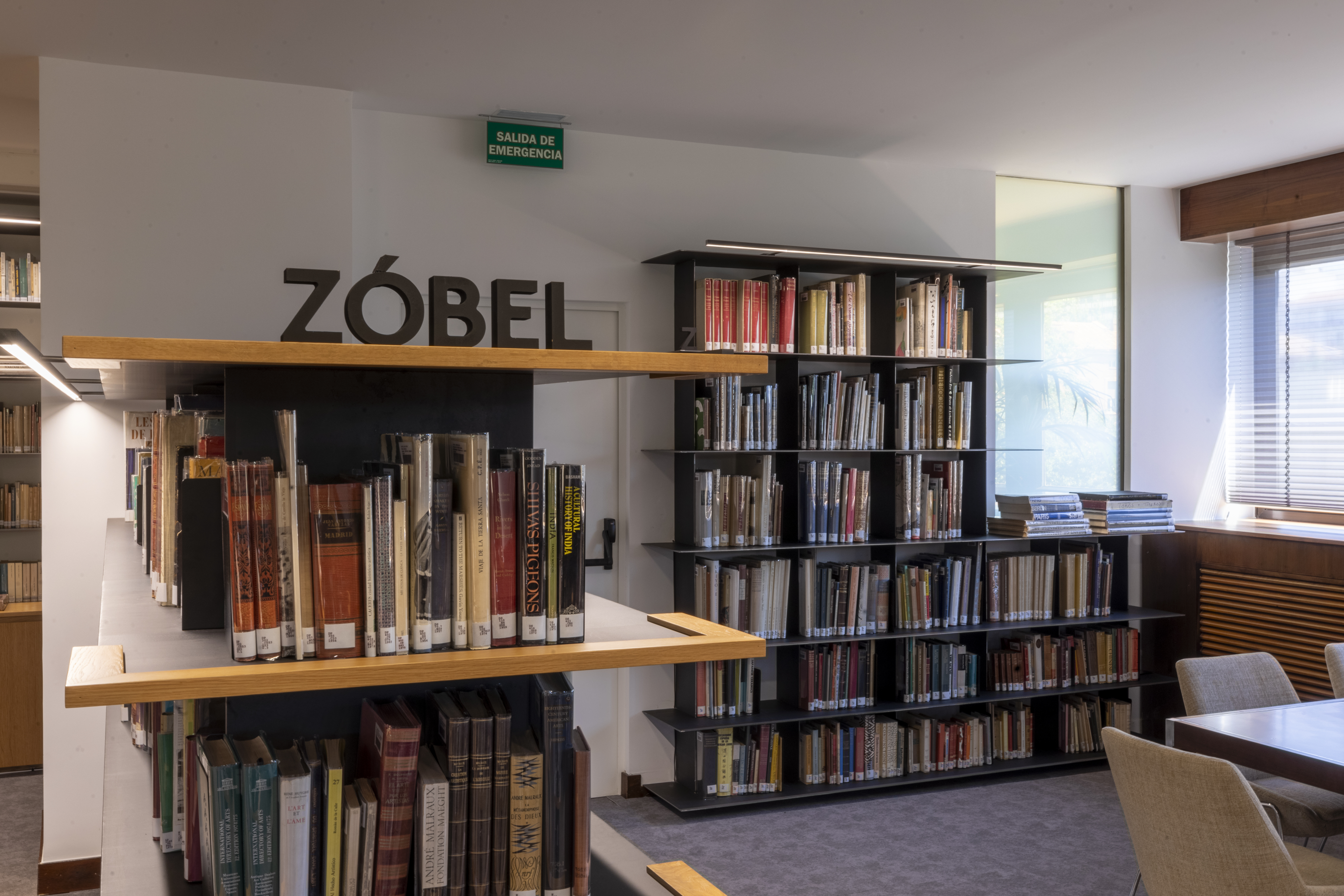
The art section of the Library (https://www.march.es/en/biblioteca), the most recent addition, was set up In 2014. It encompasses bibliographic materials acquired over the years for the exhibitions organized by the Department of Exhibitions along with catalogues and monographs of artists from the collections held at the museums in Cuenca and Palma. Additionally, the collection included the personal library of Fernando Zóbel, and a collection dedicated to curatorial practice (museology, museography, and curatorship) which began in 2011 and with its 1,000 volumes, it is one of the most popular collections.
Altogether, the art section of the Library holds 25,000 items including catalogues, magazines, monographs, artists’ books, sound recordings, and audiovisual materials. The collection is distributed between the library at the Madrid headquarters and the libraries of the museums in Cuenca and Palma, which serve as branch libraries. Additionally, the collection includes subscriptions to leading journals and publications on art and curatorship.
Section of Curatorial Studies and Practices and the Personal Library of Fernando Zóbel.

Image 1 Long description
The image shows a section of the Curatorial Studies and Practices library, specifically highlighting the personal library of Fernando Zobel. The scene includes two black bookshelves filled with a variety of books, some of which are arranged horizontally while others are stacked vertically. The shelves are mounted on a white wall, and above them, there is a wooden shelf with more books. A green emergency exit sign in Spanish, 'Salida de Emergencia,' is visible on the wall. The room is well-lit, with natural light coming through a window on the right side, which is partially covered by blinds. A chair is positioned near the window, and the overall setting appears to be a quiet, studious environment.
In addition to the bibliographic collections, the library manages several archives: the personal archive of the artist Fernando Zóbel, the exhibition archive of the Fundación, the Archivo de Artistas Abstractos en España (AAAeE), the archives of the museums in Cuenca and Palma, and the most recent, the personal archive of the artist Modesto Ciruelos.
Archive of Fernando Zóbel
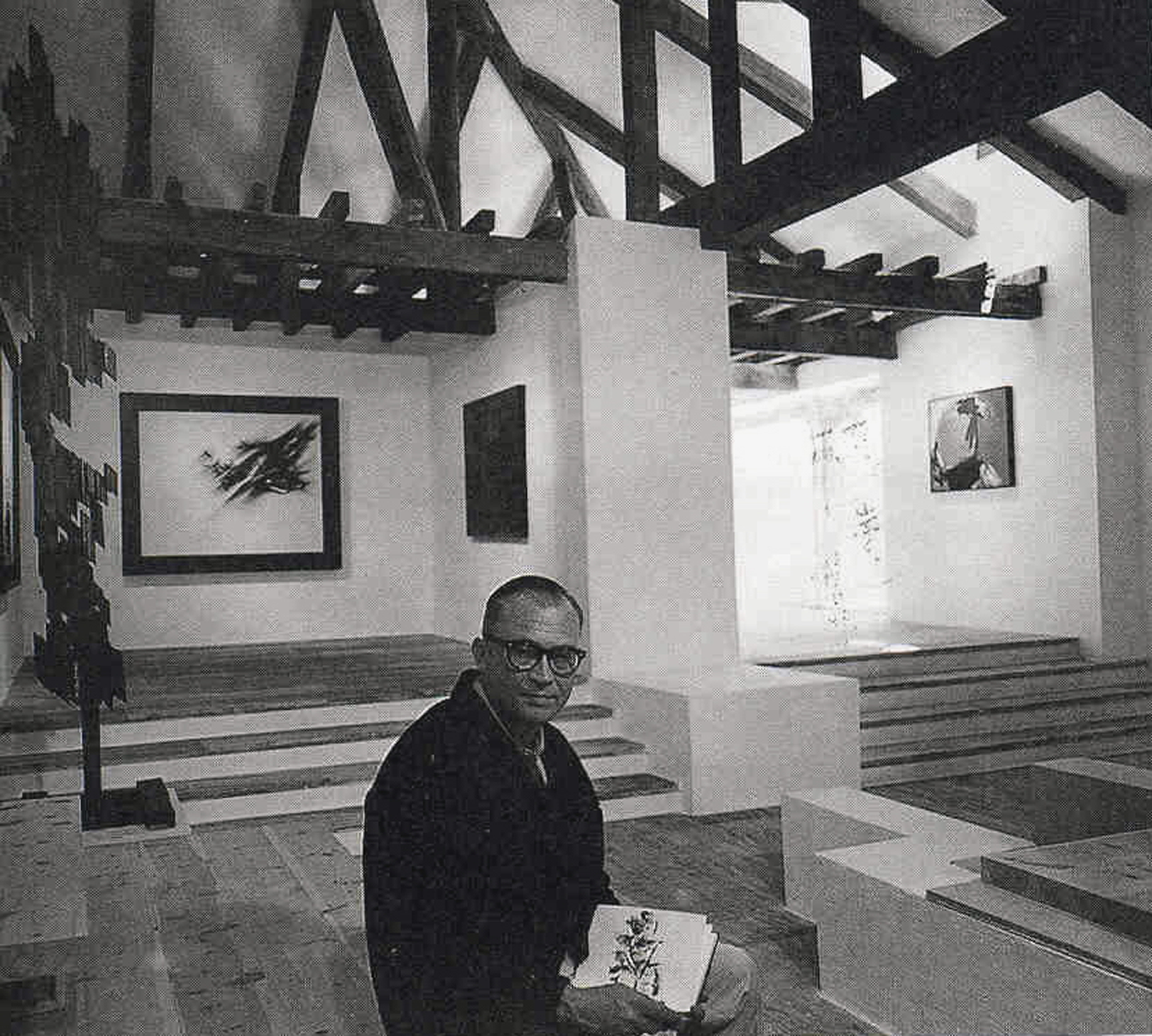
Fernando Zóbel (Manila, 1924 - Rome, 1984) was an artist and the founder of the Museo de Arte Abstracto Español in Cuenca in 1966. In 1981, Zóbel donated to the Fundación Juan March his art collection, personal library, notebooks, journals, press albums and photographs. Since then, the Fundación has been the museum’s holder and is responsible for the preservation and update of its legacy.
In 2014, coinciding with the creation of the art section of the Library at the Madrid headquarters, Zóbel´s library and archive were relocated there. In 2016, the cataloguing of his library began, using a Library system for bibliographic data, and applying the Library of Congress classification. The library included an important section on Oriental art and calligraphy as well as many annotated books. A digital repository with the digitised book covers was created to allow users to browse the contents. In 2020, the description of Zóbel’s archive began using ArchivesSpace, an open-source application for archive management. The materials included 430 photographs, seventeen press albums, six photographic albums, and 143 notebooks.
That same year, an exhibition of these notebooks, along with his artistic work, was held at the Museo del Prado under the title “The Future of the Past”, and the documentary “Memories of the Instant: The Notebooks of Zóbel” was shown, giving him great visibility and thus greater recognition of the artist’s figure, significantly increasing researcher inquiries.
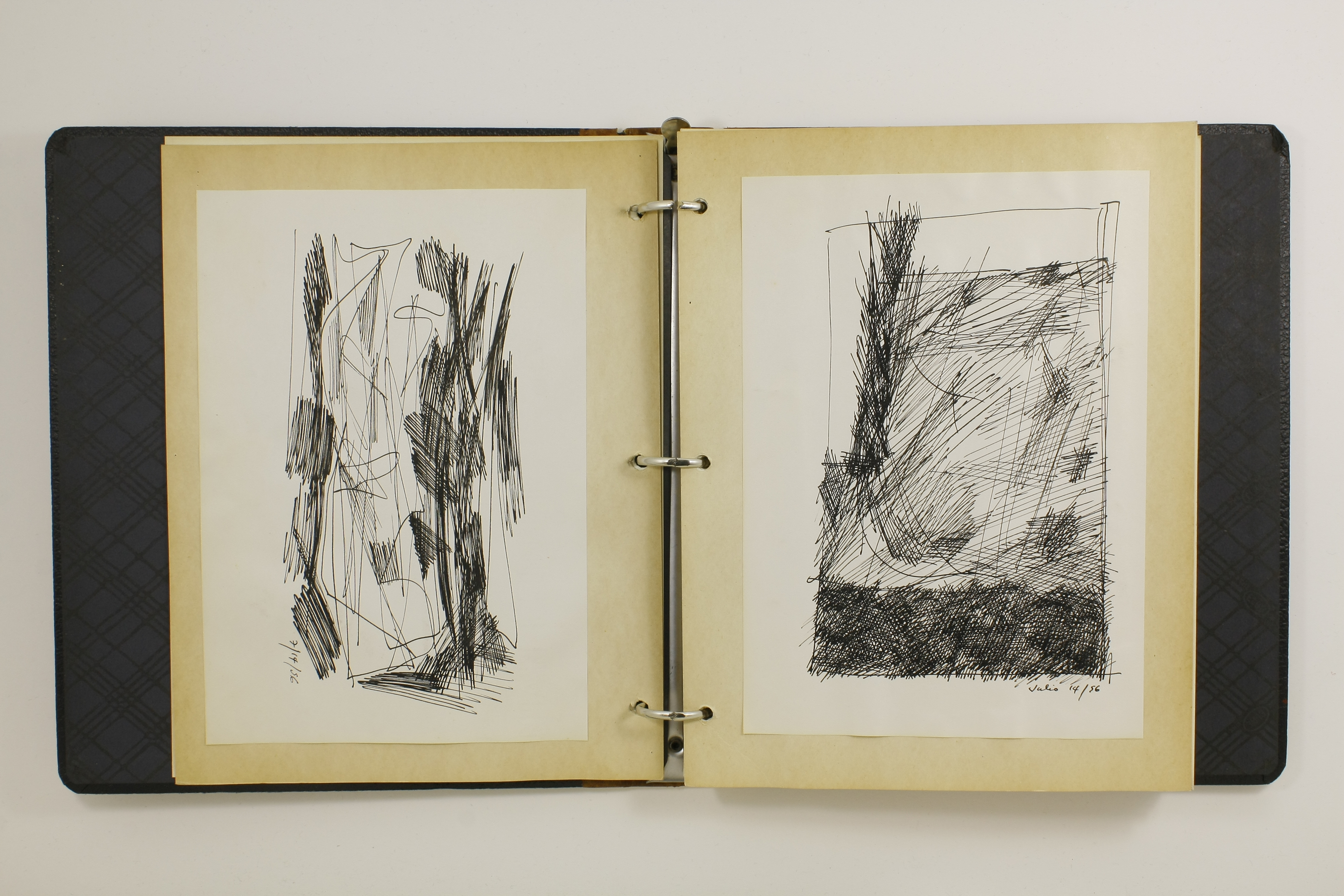
The artist´s notebooks are halfway between an archival document and an artistic work. Recent cataloguing has been conducted by the Department of Exhibitions, revising the concept of the artist’s notebook, to include them in the art collection instead of the archive. Here arises the dichotomy between archival document and artwork, which is common among personal collections of artists: where is the boundary between work and document? Can they be considered document-works? According to Colombo and Ramírez Casado (2022), ‘The records of artistic practices constitute a hybrid space with the category of document-work, as they contain artistic pieces and account for exhibitions and events’. That´s is why Zóbel’s drawing notebooks are now part of the Fundación´s art collection as drawings, notes, and photographs have served as inspiration for his works.
Zóbel in the large room of the Spanish Abstract Art Museum in Cuenca, 1966.

Image 2 Long description
A man wearing glasses and a dark jacket sits on a step in a spacious room with high wooden beams and white walls. The room features several framed artworks, including abstract pieces and a portrait. The man holds a piece of paper with a drawing on it. The room has a minimalist and modern design with a mix of traditional architectural elements.
Sketchbook 40 (1964). Viaje por España.

Image 3 Long description
An open sketchbook displaying two black-and-white sketches on beige paper. The left page features a sketch of a tall, narrow structure with intricate lines and shapes, possibly a tower or monument. The right page shows a more complex structure with dense, overlapping lines, suggesting a detailed architectural drawing. Both sketches are signed in the lower right corner.
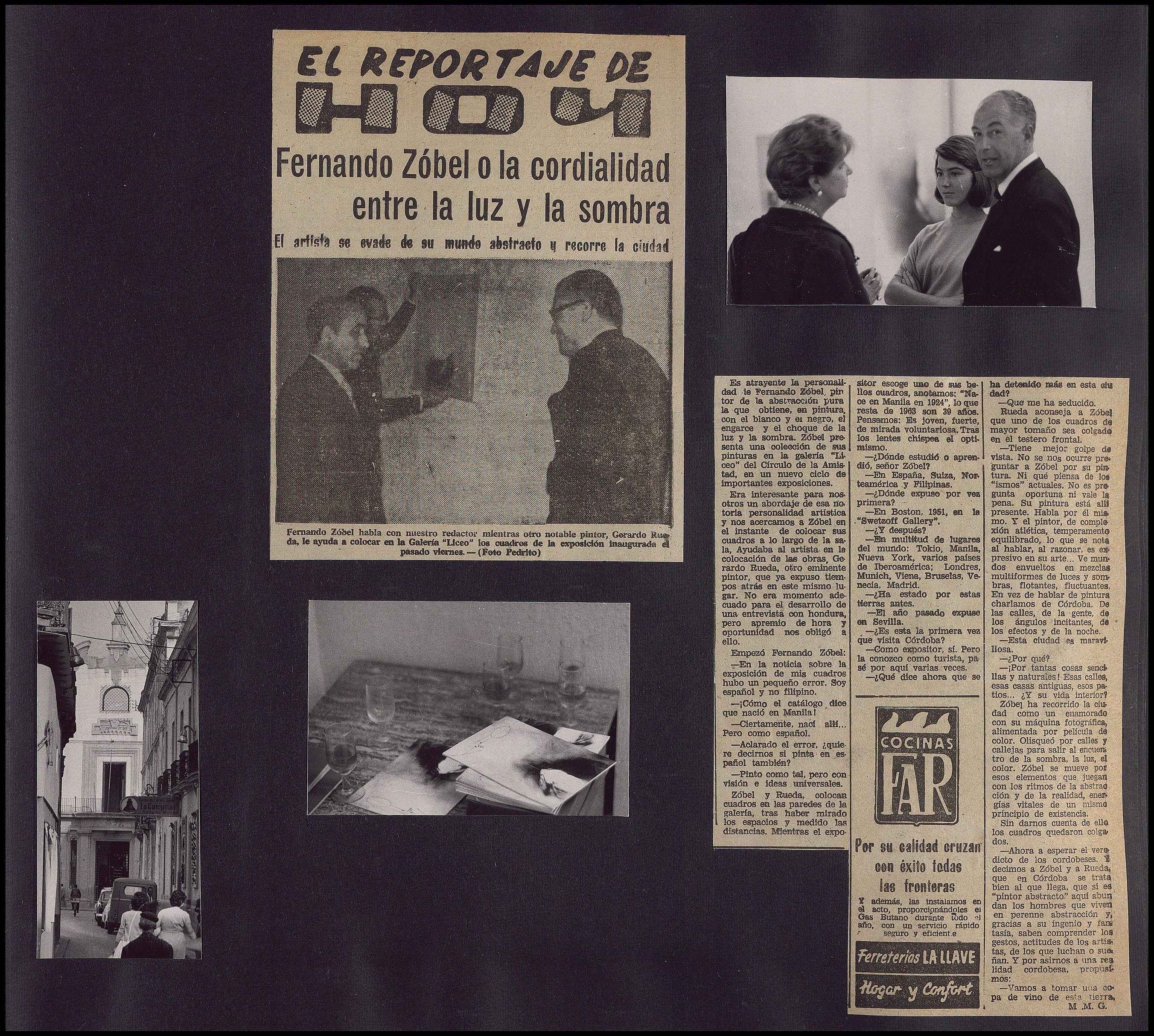
Scrapbook 1963-1964.

Image 4 Long description
The scrapbook page contains multiple images and text excerpts. The main image is a newspaper article titled 'El reportaje de Fernando Zóbel o la cordialidad entre la luz y la sombra.' The article discusses Fernando Zóbel and his work, with a photograph of him and another individual. There are additional images, including a group of people conversing, a street scene with a building, and a close-up of a table with papers. The text excerpts provide context and additional information about the images and the subjects discussed.
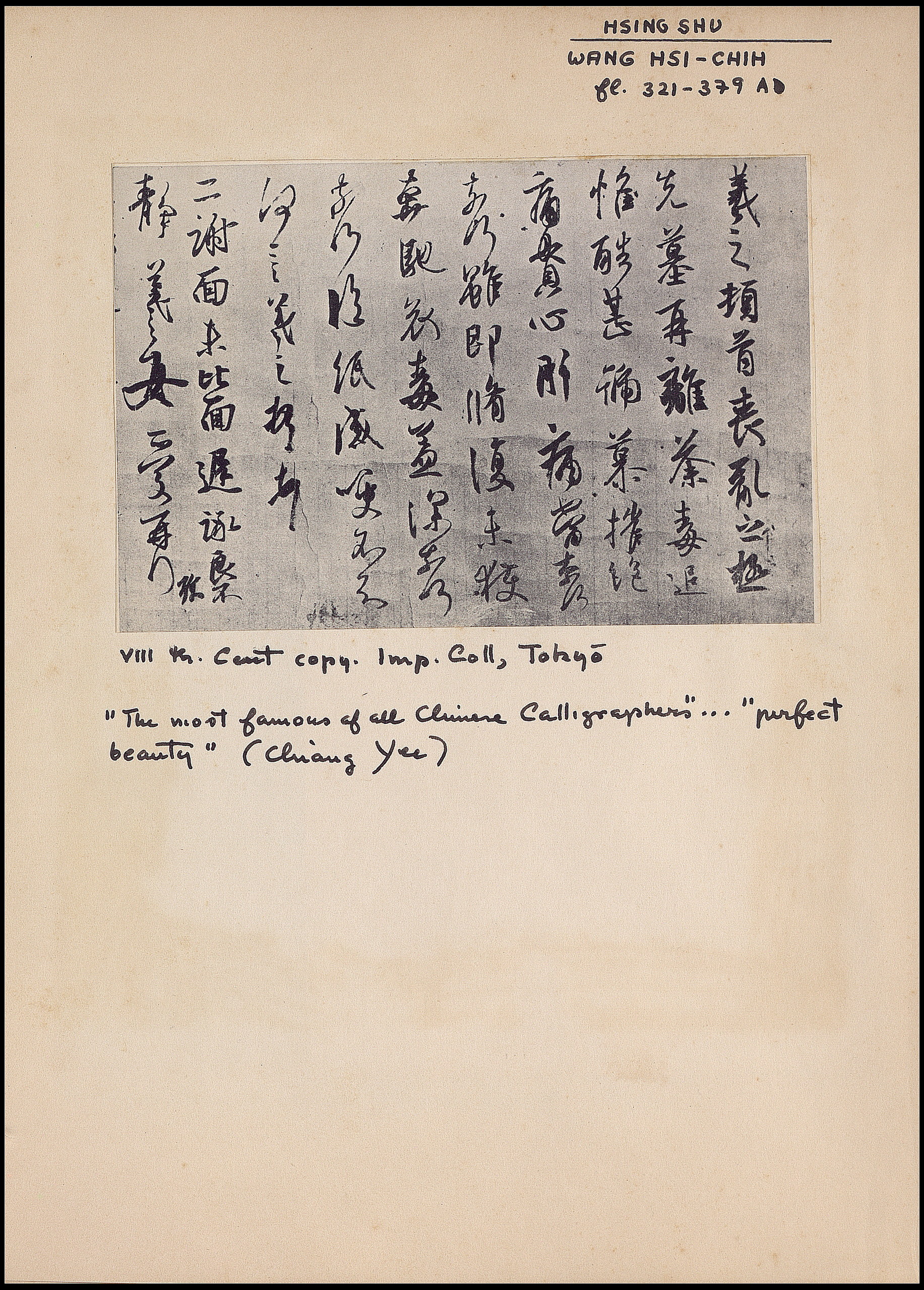
Fragment of notes on Chinese painting and calligraphy from his classes in Manila. (1956-1957).

Image 5 Long description
The image shows a page featuring Chinese calligraphy in black ink. The calligraphy is arranged in vertical columns. Below the calligraphy, there are handwritten notes in English. The notes include a reference to a copy from the Imperial Collections in Tokyo and a quote describing the calligrapher as the most famous of all Chinese calligraphers, noted for their perfect beauty. The page has a beige background with some visible creases and slight discoloration.
Archive of Artistas Abstractos en España (AAAeE)
The Archive of Artistas Abstractos en España (AAAeE) preserves information and documentation on Spanish abstract artists or those living in Spain. Some of the artists are lesser known, making the archive one of the few sources where information about them can be found.
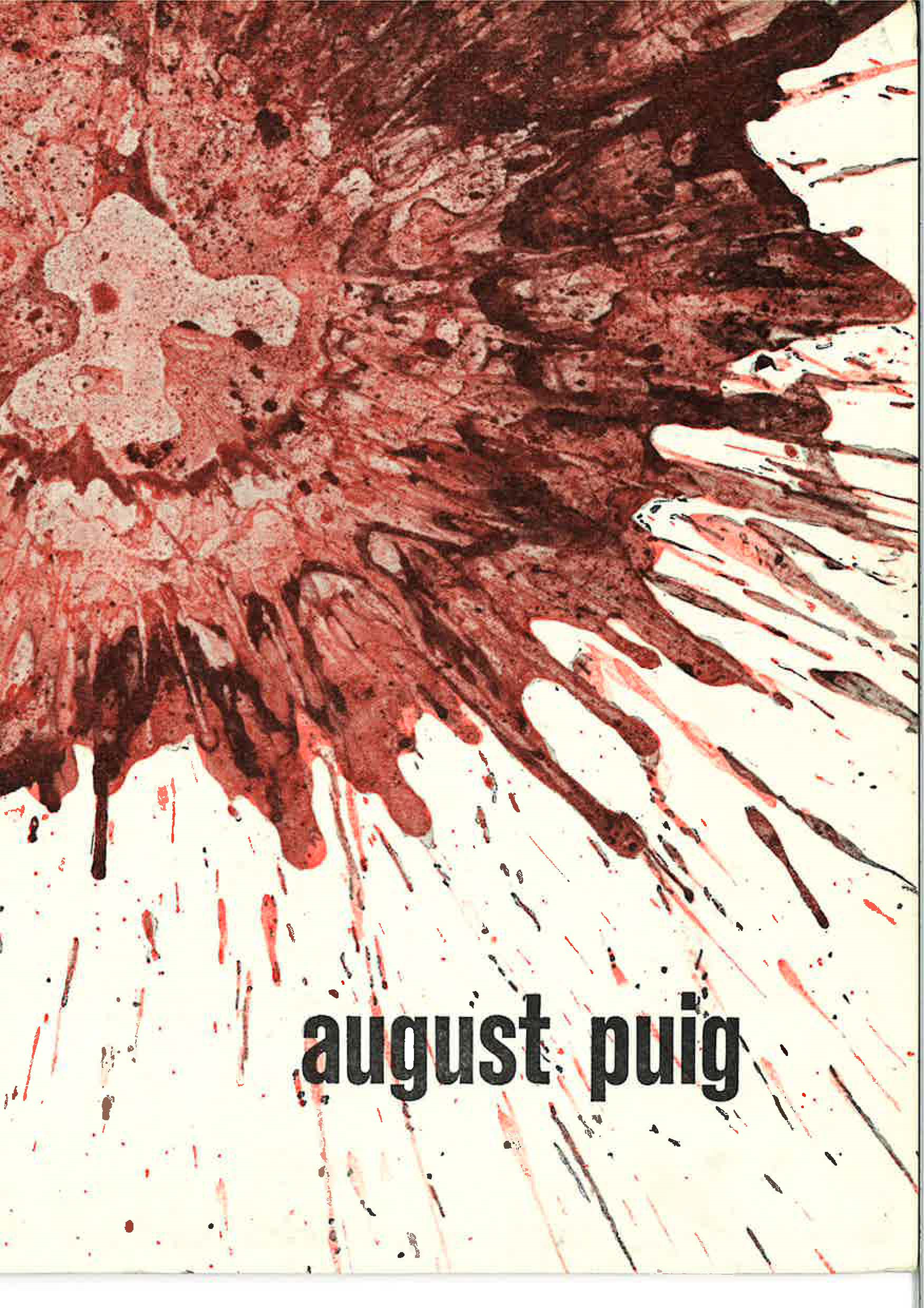
The project began in 1966 when the original purpose was to create a dictionary of Spanish abstract artists. To assemble the dictionary, Zóbel sent a series of letters requesting biographical information, exhibitions held, artistic work in collections, and bibliography of each artist. The artists provided the information and sent all sorts of ephemera such as posters, invitations, photographs, and small catalogues. The dictionary with the information of five hundred artists was published in 1980 and all original materials were kept in boxes.
In 2020, the Fundación Juan March revived the project to create a living archive, the AAAeE. This archive not only includes materials from the earlier artists, it also expands them with many more. Again, ArchivesSpace is the software used for describing the materials including descriptions for over 1.200 artists. The physical materials are distributed in 120 boxes which will increase due to its ongoing updates. In November 2024, the archive moved back to Cuenca, returning to where the original project started.
Catalogue of August Puig (1947), Ateneo de Madrid.

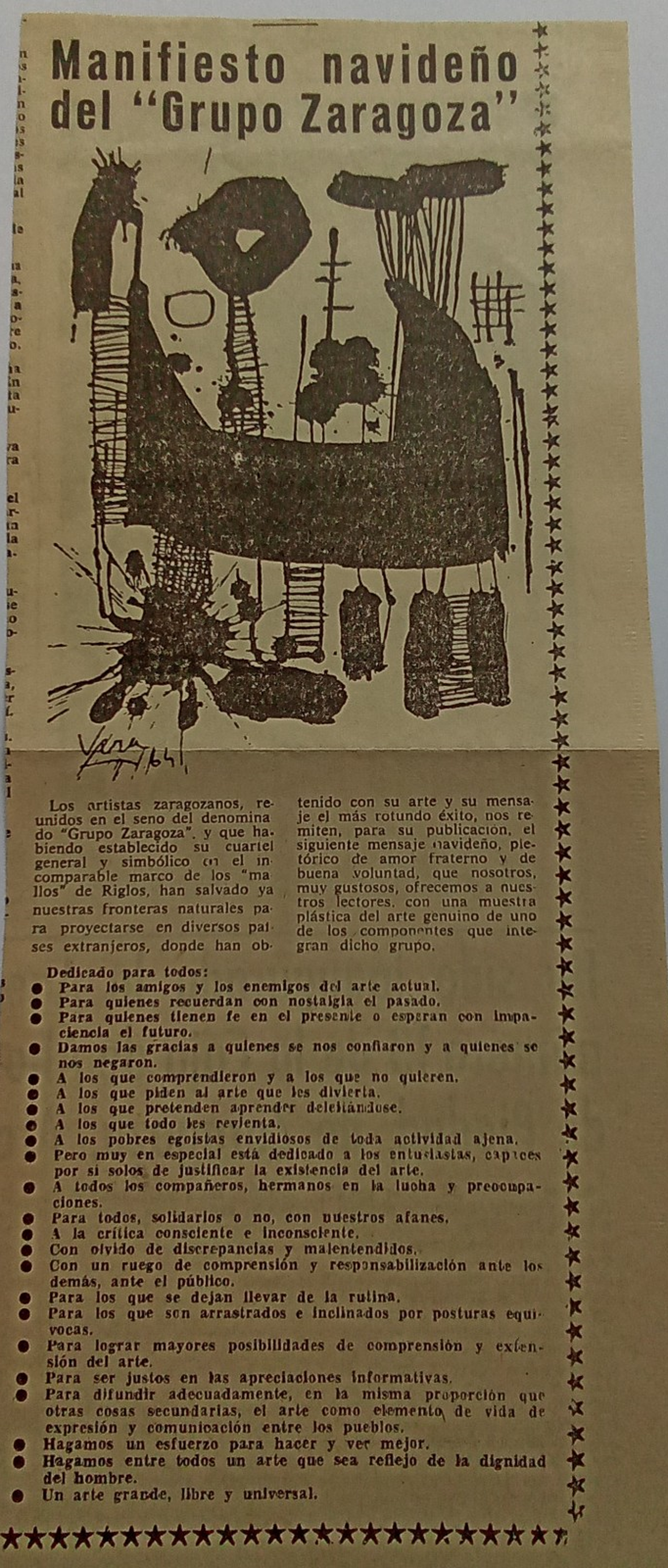
Manifesto of the “Zaragoza Group” ca. 1964.

Image 7 Long description
An illustration featuring abstract, stylized figures in black and white. The figures appear to be engaged in various activities, with some holding objects. Below the illustration, there is a block of text in Spanish, titled 'Manifiesto navideño del “Grupo Zaragoza”'. The text is dense and appears to be a manifesto or statement from the Zaragoza Group, dated around 1964.
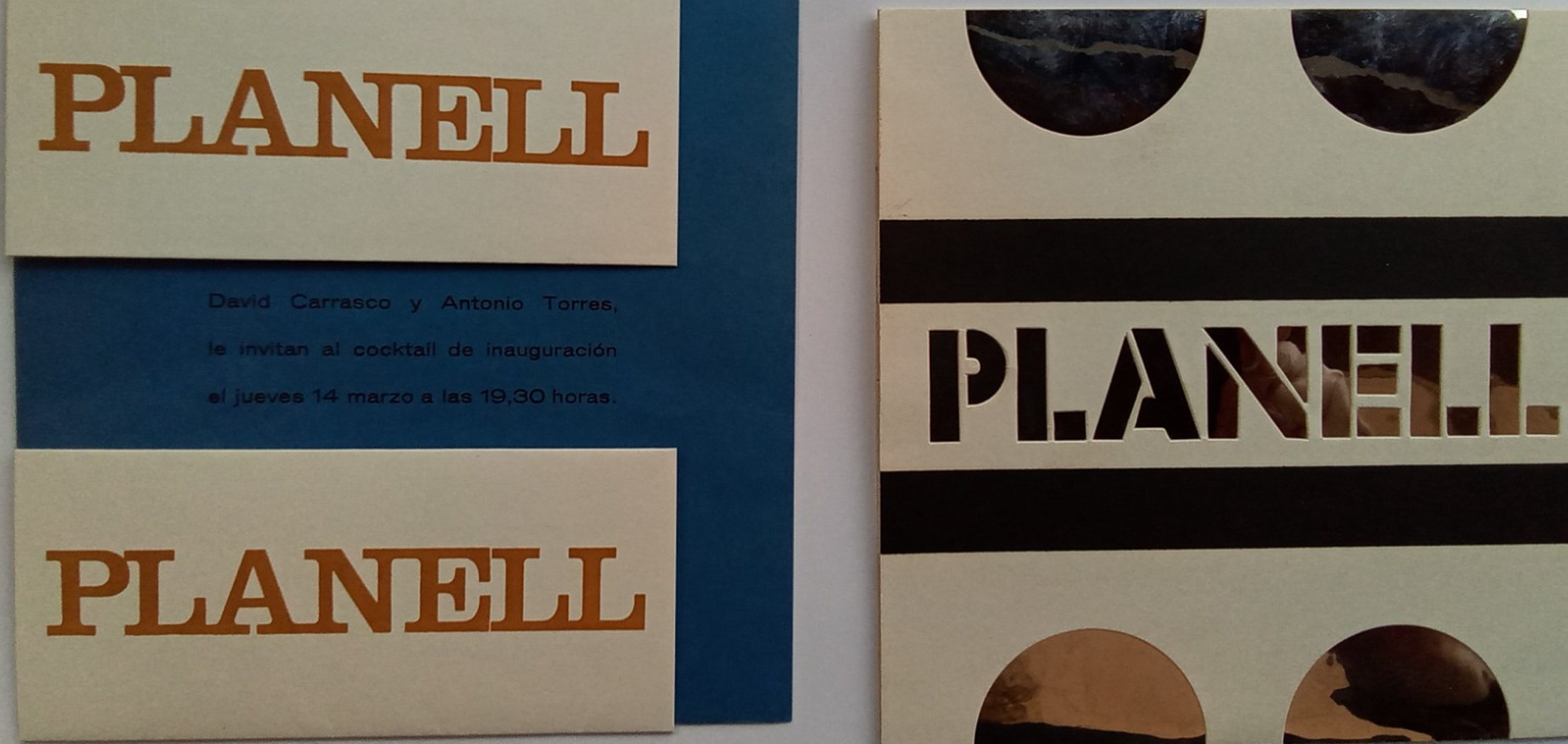
Invitation to an exhibition by Planell at Basílica de La Galería Ten (Madrid).

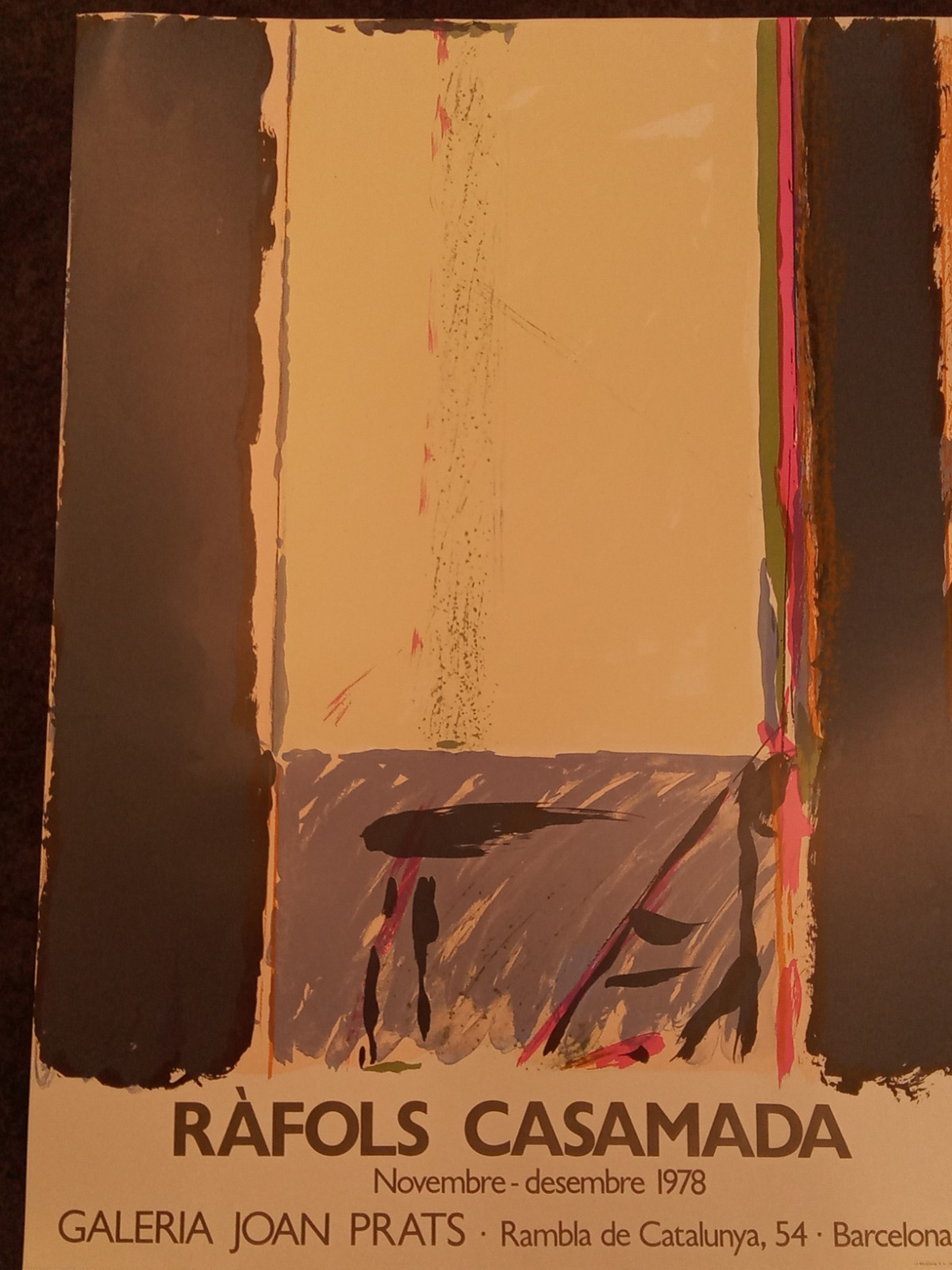
Rafols Casamada Exhibition Poster, 1978.

Image 9 Long description
The poster features an abstract design with a beige background and vertical black and brown stripes on the left and right sides. In the center, there is a dark brown silhouette of a person walking, with a pink and green vertical stripe on the right side. The text at the bottom reads 'RÀFOLS CASAMADA Novembre - desembre 1978 GALERIA JOAN PRATS Rambla de Catalunya, 54 · Barcelona'.
Archive of exhibitions at Fundación Juan March
The exhibitions´ archive of the Fundación began to develop with the documentation and materials published for the first exhibition held in 1973. It includes a range of materials such as invitations, listings, programmes, posters, postcards, bookmarks, educational notebooks, and in recent years, stationery.
Initially, the Department of Exhibitions managed via a spreadsheet inventory the registration and storage of materials. In 2015, along with the rest of the museum archives, the responsibility was transferred to the Library. At this point, classification, description, and preservation principles began to be applied to all materials and processes. Binders and photo albums were replaced with conservation boxes, and photographs were stored in preservation envelopes. The entire archive was then integrated with the other archival materials managed by the Library.
The archive is organized into three levels using ArchivesSpace: series (by decades, from the beginning to the present), subseries (by exhibition title), and items, which are the physical objects. In a later phase, a detailed description of each item will be carried out, and digital objects will be added.
This archive, which is part of the documentary heritage of the Fundación, is of great value both to internal staff and external users. Both types of users can access documentation easily and conveniently since everything is centralized. This archive is also particularly useful as it allows for an understanding of the evolution of the institution, framing its different eras with the documentation that helps to contextualize them. This is reflected by Chicote Pompanin (2024) in the interview conducted with the archivist of the Museo Nacional de Artes Decorativas in Madrid.
A cohesive digital strategy for the Library
The DataLab is the digital service of the Library, responsible of the data curation and analysis across the institution. As such, it is tasked with developing a cohesive strategy for the management of digital information. To support this goal, the DataLab maintains and enhances a technological infrastructure based on open-source software, tailored to meet the diverse requirements of various data types through specialized systems.
The library’s infrastructure comprises several integrated systems, each tailored to handle specific types of data. Koha, an open-source library management system, is utilized for cataloguing books and journals and managing all bibliographic information. For archival information management and web access, ArchivesSpace is used, a platform specifically designed for and by archivists. Additionally, the infrastructure includes two Islandora repositories: one is dedicated to the dissemination of digital objects, such as Zóbel’s personal library, while the other focuses on preservation, ensuring the long-term accessibility of master copies of all digital materials.
The integration of artificial intelligence into archival practices is becoming an essential element of modern digital strategies. The Fundación has established a committee dedicated to fostering an AI culture through initiatives such as courses and the deployment of tools like ChatGPT. Within the archives, AI is employed to classify materials and enhance metadata, utilizing algorithms to identify objects, people, and places. Additionally, AI is used to extract and correct OCR errors or transcribe audio files, further enriching the archival content.
Conclusion
In small institutions, it is common for the same staff to handle library and archival work. However, this does not mean that the treatment for each area is not differentiated. Centralizing the cataloguing of bibliographic holdings and archival documentation offers advantages, but distinguishing between these processes allows for tailored handling of each material, such as classification, organization, description, or even location based on its origin and purpose.
In the case of artists’ archives that include a variety of published materials (monographs, catalogues, or artists’ books that have been collected throughout their lives), the latter are classified as bibliographic holdings and are catalogued in Koha. A note in field 561 shows that item as part of the artist’s donation. Having these items as part of the institution’s library catalogue allows for the development of a collection that stands out from the rest of the repository and enables much more specific and varied searches.
The rest of the documentation, such as letters, photographs, press albums, personal items, or materials produced for their work and exhibitions (invitations, listings, etc.), receives archival treatment via ArchivesSpace. Here each item can be detailed very meticulously and subjects assigned according to their peculiarities, setting up interesting relationships between authorities for research and data curation purposes.
From an archival perspective, prioritizing provenance and original order is crucial, while from a library perspective, standardization and access are key. A middle-ground solution is to ensure the interoperability of description systems by creating integrated search tools that respect the specificities of each type of material, so that users do not lose information.
Regarding the collections known as ‘ephemera,’ which primarily make up the historical archives of exhibitions, it must be noted that these materials have only relatively recently been recognized for their documentary value. Previously, they were either not preserved or, if saved, not kept in optimal conditions for future recovery. In recent years, stationery items related to exhibitions (tote bags, notebooks, etc.) have been produced, and we face the same dilemma that our predecessors faced with ephemeral materials: should we give them the same documentary and conservation treatment as the rest of the archive collection? If we do not, are we repeating the same mistakes for the future? A limit could be set based on the historical and cultural value an object might gain, or its ability to reflect social practices, design trends, and specific contexts of a time, though always bearing in mind that space is finite and the imagination to promote an exhibition is infinite.
Ultimately, it is crucial to not only possess the tools for documenting bibliographic and archival collections but also to implement systems for disseminating digital objects and their metadata, as well as preserving digital master copies in specialized environments. Additionally, the increasing use of AI tools is enhancing the process of enriching these digital collections to improve accessibility and discoverability whilst making the management processes more efficient.