INTRODUCTION
Mild cognitive impairment (MCI) is a syndrome that frequently represents the early stage of a neurodegenerative disease process, often Alzheimer’s disease (AD; Petersen et al., Reference Petersen, Lopez, Armstrong, Getchius, Ganguli, Gloss and Rae-Grant2018). Amnestic MCI is diagnosed when a person has an objectively measured memory abnormality as compared to others of similar age, yet is still functionally independent in instrumental activities of daily living (Albert et al., Reference Albert, DeKosky, Dickson, Dubois, Feldman, Fox and Phelps2011; R. Petersen et al., Reference Petersen, Smith, Waring, Ivnik, Tangalos and Kokmen1999; GE Smith et al., Reference Smith, Petersen, Parisi, Ivnik, Kokmen, Tangalos and Waring1996). These individuals are at greater risk for progressing to dementia than the general population. One of the primary distinctions between people with MCI (pwMCI) and those with dementia rests upon how independent they are in daily functioning. Indeed, it is increasingly acknowledged that forestalling functional loss, irrespective of brain disease progression and measured cognitive decline, constitutes dementia prevention (Smith, Reference Smith2016). Research has shown that reductions in modifiable, lifestyle-based risk factors associated with dementia (such as obesity, high blood pressure, limited cognitive, and physical activity) could have a tremendous public health impact, potentially preventing millions of AD cases worldwide (Barnes & Yaffe, Reference Barnes and Yaffe2011). Thus, targeting lifestyle interventions to pwMCI has dramatically expanded in the hopes of reducing dementia risk. Particular attention has been paid to interventions that include physical exercise (Song, Yu, Li, & Lei, Reference Song, Yu, Li and Lei2018), cognitive exercise (Barnes et al., Reference Barnes, Yaffe, Belfor, Jagust, DeCarli, Reed and Kramer2009; Sherman, Mauser, Nuno, & Sherzai, Reference Sherman, Mauser, Nuno and Sherzai2017), diet (M. C. Morris et al., Reference Morris, Tangney, Wang, Sacks, Bennett and Aggarwal2015), and social engagement (Fratiglioni, Paillard-Borg, & Winblad, Reference Fratiglioni, Paillard-Borg and Winblad2004).
Increasingly, the focus has moved beyond single interventions to multicomponent programs (Blumenthal et al., Reference Blumenthal, Smith, Mabe, Hinderliter, Lin, Liao and Sherwood2019; Chandler, Parks, Marsiske, Rotblatt, & Smith, 2016; Ngandu et al., Reference Ngandu, Lehtisalo, Solomon, Levalahti, Ahtiluoto, Antikainen and Kivipelto2015). With multiple promising behavioral interventions being reported, a current research gap in the field is which combination of interventions is most effective for key outcomes. For over a decade we have been exploring this question, focusing on computerized cognitive training (CCT) (Smith et al., Reference Smith, Housen, Yaffe, Ruff, Kennison, Mahncke and Zelinski2009), compensatory calendar training (Chandler et al., Reference Chandler, Locke, Duncan, Hanna, Cuc, Fields and Smith2017; Greenaway, Duncan, & Smith, Reference Greenaway, Duncan and Smith2013), and more recently, wellness education (WE)/behavior change discussion, social support, and physical exercise. These components have been combined to form the Mayo Clinic HABIT Healthy Action to Benefit Independence and Thinking ® program. The program is a 50-hr group-based treatment program that includes compensatory calendar training, CCT, WE class, support group (SG), and physical exercise via yoga. Most recently, we have reported the primary outcome results from our Patient-Centered Outcomes Research Institute (PCORI)-funded research into the comparative effectiveness of the components of the HABIT program as they pertain to patient quality of life, self-efficacy, and mood (Chandler et al., Reference Chandler, Locke, Crook, Fields, Ball, Phatak and Smith2019) and care partner outcomes (Amofa et al., Reference Amofa, Locke, Chandler, Crook, Ball, Phatak and Smith2021). In brief, we found that WE had more impact on quality of life and mood in comparison to CCT, and yoga had a greater effect on memory-related activities of daily living than did SGs. Here, we present the results of our comparative effectiveness study (Smith, et al., Reference Smith, Chandler, Locke, Fields, Phatak, Crook and Cochran2017) as they pertain to secondary outcomes of the study. Specifically, in this analysis, we investigated functional outcomes 18 months after intervention as assessed by the widely used functional status measures in the same cohort previously described in the Amofa et al., Reference Amofa, Locke, Chandler, Crook, Ball, Phatak and Smith2021, Chandler et al. (Reference Chandler, Locke, Crook, Fields, Ball, Phatak and Smith2019), Smith et al. (Reference Smith, Chandler, Locke, Fields, Phatak, Crook and Cochran2017) citations above. Our objective was to understand which of the five Mayo Clinic Healthy Action to Benefit Independence and Thinking (HABIT®) interventions had the greatest positive impact on functional independence 18 months later. While the HABIT intervention is relatively brief (2 weeks), the purpose of the intervention is to initiate lasting behavior change (habits). Participants completed two booster sessions post-HABIT and were given materials in order to encourage ongoing behavioral change. Thus, we expected to see independent effects from each of these ongoing behaviors on functional measurements at 18 months posttreatment.
METHODS
Funded as a comparative effectiveness study, shaped by stakeholder and patient and partner advisory groups, we undertook to compare evidence-based interventions with one another rather than to a no-treatment control group. The details of the recruitment methods, measures, interventions, and study protocol have been described in detail in a prior publication (Smith, Chandler, Locke, et al., Reference Smith, Chandler, Locke, Fields, Phatak, Crook and Cochran2017).
Participants
Participants were recruited as dyads made up of a partner and a pwMCI. The study sample consisted of a total of 272 dyads (for pwMCI mean (standard deviation (SD)) age of 75(8) years; 58.8% male). All participants were recruited from clinical encounters in Neurology or Neuropsychology departments at various Mayo Clinic campuses (Jacksonville, FL, Rochester, MN, Scottsdale, AZ) and the University of Washington, Seattle. Use of human subjects was performed in accord with the ethical standards of the Committee on Human Experimentation and the Helsinki Declaration with protocol approval from the Institutional Review Board at Mayo Clinic and the University of Washington. Participants were referred to the program after their clinical evaluations were completed and indicated a diagnosis of MCI. Inclusion criteria were a clinical diagnosis of amnestic (single or multidomain), MCI, Clinical Dementia Rating (CDR) score of 0.5 or lower, fluency in English, and stable on or not taking nootropic medications for at least 3 months in the patient. A cognitively normal partner (Mini-Mental Status Examination score above 24) with whom the patient had at least twice per week contact was also required. Spouses (or live-in romantic partners) comprised 85% of study partners. Nine percent of partners were adult children, and the remainder were other family or friends. The mean age of partners was 70 (10) years. Partners served as the informants for both the Functional Activities Questionnaire (FAQ) and CDR.
Interventions
The interventions were five behavioral treatments: CCT, yoga, Memory Support System (MSS) training, peer SG, and WE, each delivered to both with pwMCI and care partners, in a group-based program, 10 times over 2 weeks and lasting 45–60 min in duration for each session. These are the components of the Mayo Clinic Healthy Action to Benefit Independence and Thinking (HABIT®). At 6 and 12 months points after the initial intervention, participants were provided with 1-day “booster” sessions intended to reinforce and remind participants of key principles/concepts for each of the four interventions in their original session. Participants completed questionnaires assessing adherence at both follow-up time points. Adherence criteria for each component led to classification of participants as “adherent,” “indeterminate,” or “nonadherent.” Full details of adherence have been reported elsewhere (Amofa et al., Reference Amofa, DeFeis, De Wit, O’Shea, Mejia, Chandler and Smith2019). Briefly, physical exercise had the highest number of participants in full adherence at 12 months, while SG had the least.
The MSS is a paper-based calendar/planner system that has an annual calendar, daily schedule, daily to-do list, and daily journal sections. Each dyad was provided with structured, individualized training on how to utilize the MSS to help compensate for memory loss. The MSS training curriculum progresses through up to three learning phases (acquisition, application, and adaptation) which each have specific target questions that are asked three times per day to help with procedural learning. For sessions randomized to include MSS, participants were encouraged throughout the program to refer to their MSS for information about their daily schedule, to write tasks on the to-do list section, and to use the journal section to take notes in. Participants were provided with the MSS calendar system for the entirety of the 18-month study (and beyond if desired) to encourage ongoing use.
Both pwMCI and partners engaged in CCT. This involved six select modules (“brain games”) from the Posit Science product BrainHQ, which is a commercially available computerized cognitive exercise program. Each individual had their own BrainHQ account, so that they would receive customized difficulty levels based on their performance on the modules both in the moment and over time. Participants were monitored in a group while engaging in BrainHQ and provided with technical assistance as needed. Participants were provided with an ongoing subscription to the BrainHQ program to encourage continued use.
The SG component involves separate, simultaneous peer SGs for pwMCI and their program partners. The MCI group is facilitated by a clinical psychologist using a structured approach based on reminiscence therapy principles. The partner group is less directed and more driven by the needs of the particular group of partners, but still facilitated by a trained member of the team, who encouraged emotion processing and validation of feelings in the group, suggested topics for discussion when needed, and provided specific tips for improving communication between partners and pwMCI.
WE discussions involve a brief lecture on a topic important for brain health (e.g., nutrition, sleep, physical exercise, cognitive exercise, social engagement, and mood/stress management) followed by a group discussion focused on goal-setting, predicting and planning on overcoming obstacles for behavior change, and outlining concrete steps to achieving specific changes.
The physical exercise component of the program involved Hatha yoga as it was suited to the constrained space and the different levels of baseline physical activity of our participants and partners. Hatha yoga as a group-based physical exercise intervention is highly adaptable to the varied capabilities of older adults. We were able to adapt the yoga practice as needed so that deconditioned participants or those with imbalance could sit on chairs for some asana (poses) and use the chair for support for balance during other standing poses and for other parts of the sequence. The HABIT® (yoga) intervention was intended to initiate and sustain a schedule rather than a type of physical activity. Because most clinical trials of yoga include group classes supported by home practice, we provided a customized DVD as a supplement for continued use and practice after the program to those that opt to continue yoga. The DVD included sections on the following: poses, modifications, benefits, breathing, and meditation practices. However, our primary goal post-programming was for participants and partners to maintain a schedule of 150 min of their preferred physical exercise per week. Post-program, we considered yoga, swimming, walking, running, or exercise programming (water aerobics, resistance training, etc.) to count equivalently towards this total. The sessions used an armless, sturdy chair placed on top of a sticky yoga mat. HABIT® yoga also incorporated breathing and meditation. Our instructors had at least 200 hr of training and were certified. The appropriately sequenced HABIT® yoga practice met the American College of Sports Medicine recommendation for older adults for muscle strengthening and flexibility.
Design
To compare interventions, we employed a fractional factorial study design (Collins, Dziak, Kugler, & Trail, Reference Collins, Dziak, Kugler and Trail2014) wherein we randomly suppressed (withheld) one of the five HABIT® interventions in each of the group sessions. In other words, this was a cluster-randomized design where four included interventions were delivered in a session. In the end, we conducted 24 group sessions with between 8 and 20 pwMCI–partner dyads in a session. Randomization was performed by a statistician and conditions were blinded to personnel and participants delivering treatments until recruitment of a session was finalized. Additional outcome raters were kept delivery blinded to the make-up of the sessions. Each site ran each condition once, and some sites ran additional select conditions to achieve recruitment goals and equalize the number of subjects receiving each combination of interventions as much as possible. The Consolidated Standards of Reporting Trials (CONSORT) diagram is included in supplement 1.
Outcome Measures
Functional ability outcomes were the focus of the present study and included the FAQ total score and the Clinical Dementia Rating-Sum of Boxes (CDR-SOB) score. Both measures are routinely collected in large-scale dementia trials, including contributors to the National Alzheimer’s Coordinating Center (NACC).
The FAQ (Pfeffer, Kurosaki, Harrah, Chance, & Filos, Reference Pfeffer, Kurosaki, Harrah, Chance and Filos1982) informant rating includes 10 questions measuring the patient’s ability to perform routine activities of daily living. Each of the 10 items is scored as 0 = normal, 1 = has difficulty but does by self, 2 = requires assistance, and 3 = dependent. The FAQ total score is calculated by summing the 10 items with a possible range of 0–30. If more than two items were skipped or marked as “not applicable,” then the total score was not calculated. This measure was collected at baseline, completion of treatment, 6 months posttreatment, 12 months posttreatment, and 18 months posttreatment. The CDR (J. C. Morris, Reference Morris1993) was collected only at baseline and 18 months. It consists of six subscales (memory, orientation, judgment and problem-solving, community affairs, home and hobbies, and personal care) and one global scale. The global scale and each subscale are rated as 0 = none (meaning not demented), 0.5 = questionable (possible dementia), 1 = mild, 2 = moderate, or 3 = severe. The CDR-SOB score was calculated by summing the six subscales with possible values ranging from 0 to 18.
Statistical Analysis
Baseline FAQ total score and CDR-SOB were summarized with the mean and SD separately according to study arm. Baseline differences in these scores between study arms were evaluated using linear mixed effects regression models with fixed effects for study arm and random effects for site and group session. For the primary analysis, a longitudinal mixed effects regression model was used to compare FAQ total score at 18 months between the five study arms. The analysis used data from baseline (BL), end of treatment, and follow-up at 6, 12, and 18 months. Baseline FAQ total score was modeled with fixed effects for age, sex, and site. The mean change in FAQ total score was modeled with fixed effects for age, sex, and study arm (no yoga, no CCT, no WE, no SGs, and no MSS). The multiple measurements over time were accounted for in the model with person-specific random effects. Pairwise differences in study arm effects on FAQ total score at 18 months were of primary interest. We additionally examined the fitted trajectories of FAQ total score over time for each of the five study arms. Statistical tests were performed using likelihood ratio tests, and corresponding 95% confidence intervals were estimated using the profile likelihood method. Two-sided p < 0.05 was considered to be statistically significant. The effect size (ES) for FAQ total score at 18 months was calculated as the fitted mean difference between study arms at 18 months divided by the baseline SD of FAQ total score. For the analysis of CDR-SOB, we used the same analytical approach as we used for FAQ total score; however, CDR-SOB was only collected at baseline and 18 months and those were the only two time points included in the model. Analyses were performed using R statistical software, version 3.2.3 (R Foundation for Statistical Computing).
RESULTS
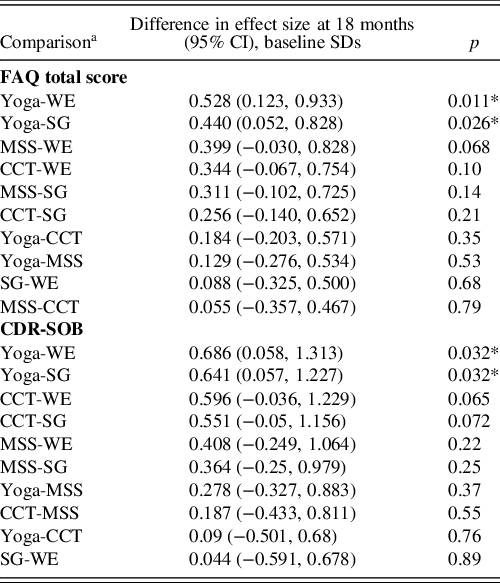
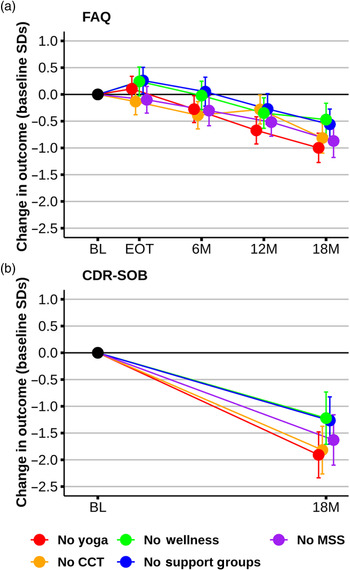
An analysis evaluating associations between study arm and baseline values of FAQ and CDR revealed no statistically significant associations of study arm with either baseline FAQ (chi-square = 6.18, df = 4, overall p = 0.19) or baseline CDR (chi-square = 8.18, df = 4, overall p = 0.09). (Table 1). The comparative incremental effects on FAQ total score and CDR-SOB are shown in Table 2. As expected, given the likelihood that most pwMCI have a neurodegenerative disease process as the primary etiology, participants in all study arms show a negative trend in CDR and FAQ scores from baseline to 18 month follow-up. However, with respect to our hypothesis that we would see independent, incremental effects of each intervention, there were statistically significant differences (p = .032) and moderate ESs (greater than 0.6) on CDR-SOB in groups that had yoga withheld and replaced with WE or SG, with worse functioning in those who had yoga withheld. In addition, trends were observed, with moderate ESs (∼0.55), for poor functioning in those who had MSS or CCT withheld and replaced with WE or SG. Figure 1 shows the ESs by study arm. Thus, withholding yoga, and possibly CCT or MSS training, led to more progression of functional impairments as measured by the CDR-SOB than did withholding WE or SG. For the FAQ, the pattern was similar. PwMCI who did not receive yoga appear to fare worse at 18 months than those that did not receive WE or SG, with statistically significant differences (p = .011–.026), but slightly smaller effects sizes (.44–.53) than found on the CDR-SOB. There were also nonsignificant trends with mild to moderate ESs for a negative impact on FAQ scores for those who did not receive MSS training, followed by those who did not receive CCT (.26–.40). Overall, those who received yoga, especially in combination with CCT and MSS, had a lesser rate of decline in functional ability than those in which one those interventions were left out.
Baseline FAQ and CDR by study arm

Abbreviations: CCT, computerized cognitive training; MSS, Memory Support System; FAQ, Functional Activities Questionnaire; CDR-SOB, Clinical Dementia Rating-Sum of Boxes.
a Superscripts indicate the number of patients with missing FAQ scores.
Comparative incremental effects on patient outcomes at 18 months for pairs of HABIT components when added to the remaining three components of HABIT

Abbreviations: CI, confidence interval; WE, wellness education; CCT, computerized cognitive training; SG, support group; MSS, Memory Support System.
a To ease interpretation, the two components compared are ordered such that the first component listed has a higher effect size than the second component.
* Significant at p < .05.
Effect sizes by study arm.

DISCUSSION
The present report is an extension of our prior comparative effectiveness studies (Amofa et al., Reference Amofa, Locke, Chandler, Crook, Ball, Phatak and Smith2021, Chandler et al., Reference Chandler, Locke, Crook, Fields, Ball, Phatak and Smith2019) of the HABIT® program developed at Mayo Clinic. We compared the impact of combinations of the HABIT® behavioral interventions including MSS, CCT, SG, WE, and yoga. We found that withholding yoga resulted in the steepest declines in functional status, while including yoga with CCT and MSS training yielded the lowest rate of decline. This finding at 18 months is not only consistent across two separate but related functional measures but also consistent with our previous finding (Chandler et al., Reference Chandler, Locke, Crook, Fields, Ball, Phatak and Smith2019) on a separate measure, the Everyday Cognitive Function (Farias et al., Reference Farias, Mungas, Reed, Cahn-Weiner, Jagust, Baynes and Decarli2008) Memory subscale assessed at 12-months. Note that in the report (Chandler et al., Reference Chandler, Locke, Crook, Fields, Ball, Phatak and Smith2019), yoga combined with MSS, WE, and SG interventions associated with better quality of life and mood outcomes. For these patient-wellness variables, CCT was expendable relative to WE.
Reduction in dementia risk and cognitive decline through participation in physical exercise has been well documented (Song et al., Reference Song, Yu, Li and Lei2018) and is recounted elsewhere in this this JINS Special Section. Arguably physical exercise, the strongest evidence base for all behavioral interventions, intended to preventing cognitive decline. Our finding that yoga had the most impact on functional status at 18 months is consistent with the notion that physical exercise can mitigate cognitive decline in MCI. The current findings expand on current knowledge about the relative impact of physical exercise by being among the first to assess this association within a comparative effectiveness framework. These findings suggest that physical exercise is not only helpful, but more helpful than certain other behavioral interventions, specifically WE and SGs in these analyses. This is not merely because those are inert, “active control” interventions. We have shown elsewhere (Amofa, et al., Reference Amofa, Locke, Chandler, Crook, Ball, Phatak and Smith2021, Chandler, et al., Reference Chandler, Locke, Crook, Fields, Ball, Phatak and Smith2019) that each of these is a potent intervention for other outcomes. Rather, improving physical exercise levels likely impacts modifiable risk factors such as inactivity, obesity, and high blood pressure which associate with the functional declines associated with dementia (Barnes & Yaffe, Reference Barnes and Yaffe2011).
We contend that for pwMCI, physical exercise interventions should nevertheless be embedded in multicomponent programs. There is supporting evidence herein that the MSS has an additional decelerating impact on functional decline, consistent with our observations in preliminary research (Greenaway, Duncan & Smith, Reference Greenaway, Duncan and Smith2013). The MSS is specifically designed as a memory compensation tool to help pwMCI remain functional despite their memory loss. CCT using BrainHQ from Posit Science has been shown to positively impact working memory and processing speed, with some evidence that this translates to improved functional ability (Smith et al., Reference Smith, Housen, Yaffe, Ruff, Kennison, Mahncke and Zelinski2009; Barnes et al., Reference Barnes, Yaffe, Belfor, Jagust, DeCarli, Reed and Kramer2009). More broadly, evidence on which combinations of interventions are associated with better functioning over time is relevant for the entire scientific and clinical community who are working to help pwMCI delay or avoid progression to dementia.
Limitations
The primary objective of our comparative effectiveness studies is to tease out which behavioral interventions of a multicomponent intervention for MCI have the largest impact on the outcomes of importance to pwMCI and their partners (Smith, Chandler, Fields, Aakre, & Locke, Reference Smith, Chandler, Fields, Aakre and Locke2018). Comparing within-group trajectories must be interpreted cautiously, as there was no untreated control group in our comparative effectiveness study. Further, trying to interpret the cost of not receiving an intervention component is counter to the design of most clinical trials where the incremental benefit of adding an intervention is considered. In an attempt to simplify the explanation of the results, we used pairwise comparisons. However, focusing on the absence of any one intervention ignores the probable synergy or interaction between the remaining interventions.
Our exact conclusions may not generalize to other forms of the physical exercise (e.g., resistance training, more intense aerobic exercise, etc.). Additionally, we cannot exclude the possibility that the more meditative components of yoga as opposed to the physical exertion are responsible for the observed effects. The recruited cohort was ultimately highly educated and not diverse. This limits potential generalizability of the results. The sample may have been biased by at least two major factors: education and socioeconomic status (SES). First, highly educated people may be more likely to pursue active coping approaches to manage chronic illness like MCI. Although we have previously reported that time and distance were primary reasons that eligible candidate might not enroll in this type of intervention (Locke et al., Reference Locke, Greenaway, Duncan, Fields, Cuc, Snyder and Smith2014), we did not have that information for all participants in this trial. However, the intensive nature of the program, requiring participants and partners to dedicate 40 hr per week over 2 weeks to the program, including daily travel to and from the program, and in some cases requiring self-funded hotel stays to participate, also likely biased the sample to higher SES.
In addition, although this is a large cohort relative to other behavioral intervention trials in MCI, we were only powered to detect within-group change over time but underpowered to detect pairwise differences between arms of the study. We used data from a prior clinical sample of participants in the full five-component HABIT and an untreated control group from a prior randomized clinical trial to inform statistical power. Estimated standard errors (SEs) were extracted from the fitted models from which we could estimate SEs for different sample size scenarios. We originally determined a study sample size of 300 participants with 10% attrition would be powered (80% at 5% significance level) to detect an effect of 0.53 baseline SDs of any one of the five interventions on quality of life at 12 months. However, subsequent analysis proved this sample size to be an underestimate. Our study had a novel statistical design, and our initial statistical power assessment was unrealistic. Further, we should have considered that comparative effectiveness trials, especially with cluster randomization, will generate smaller ESs than placebo-controlled studies (Sox & Goodman, Reference Sox and Goodman2012). We subsequently have determined that for pairwise comparisons, we were powered (80% power at the 5% significance level) to detect differences with effects sizes of 0.72 or higher, while accounting for multiple testing adjustment. Thus, the study was not sufficiently powered for these pairwise comparisons. Given this finding, we thought it important to also list pairwise comparisons with moderate ESs that were significant without multiple analysis adjustments because a future, better-powered study could demonstrate those ESs to be statistically significant. However, we acknowledge that there is a possibility of a type I error (i.e., false-positive finding) in our current study owing to the multiple tests performed.
The interpretation challenges notwithstanding, we offer these results to encourage more multicomponent and comparative effectiveness trials in pwMCI. As noted at the outset, there is emerging evidence to justify multiple component interventions and thankfully large-scale trials are now underway (cf. Baker et al., Reference Baker, Beavers, Cleveland, Day, Decarli, Espeland and Carrillo2019). Perhaps 60%–80% of pwMCI have a degenerative disease as the cause of cognitive decline, mostly commonly AD (Petersen et al., Reference Petersen, Aisen, Boeve, Geda, Ivnik, Knopman and Jack2013). It seems to us that offering pwMCI multiple component interventions is a rational response to the significant morbidity they face. Not only do multiple component comparative trials avoid the ethical dilemma of offering no treatment to some participants, but they bring the best current hope of benefit to pwMCI. We also note that our work included only pwMCI. It would also be beneficial to evaluate the effectiveness of nonpharmacological interventions in multicomponent programs in cognitively normal older adults as well.
Conclusion
The noted limitations of this study notwithstanding, there was a statistically significant finding that physical exercise in the form of chair-based yoga muted declines in functional status at 18 months post-intervention, across two independent measures. This is especially true when the physical exercise was paired with intensive training in a calendar-based memory compensation system and engagement in CCT. This is meaningful, especially as there are few treatment options for pwMCI. This finding should encourage the continued recommendation of physical exercise as a component of potentially beneficial multicomponent lifestyle interventions for pwMCI. Additional work on expanding access to such programs for older adults with and without MCI could contribute to improving public health.
SUPPLEMENTARY MATERIAL
To view supplementary material for this article, please visit https://doi.org/10.1017/S1355617721000485
Financial Support
The institutions that employ the authors generate revenue from the HABIT clinical programs; the authors do not derive any direct financial benefit. Research reported in this manuscript was partially funded through a Patient-Centered Outcomes Research Institute (PCORI) Award (CER-1306-01897). The statements in this publication are solely the responsibility of the authors and do not necessarily represent the views of the PCORI, its Board of Governors, or Methodology Committee.
CONFLICTS OF INTEREST
The authors have nothing to disclose.