Introduction
Endocrine surgeons often refer patients to a laryngologist for the assessment of vocal fold mobility prior to thyroid and/or parathyroid surgery, because of concerns regarding intra-operative recurrent laryngeal nerve (RLN) injury.
The American Academy of Otolaryngology – Head and Neck Surgery (AAO-HNS) published a clinical practice guideline in 2013 for improving outcomes following thyroid surgery.Reference Chandrasekhar, Randolph, Seidman, Rosenfeld, Angelos and Barkmeier-Kraemer1 The clinical practice guideline makes recommendations to physicians who do not routinely perform laryngoscopy, such as endocrine surgeons, as to when referral to a laryngologist is appropriate.
Given that the rate of vocal fold paralysis associated with thyroid surgery can be as high as 18 per cent,Reference Chambers and Bhattacharyya2,Reference Farrag, Samlan, Lin and Tufano3 assessing pre-operative vocal fold mobility is of paramount importance. Although documenting pre-operative vocal fold mobility status is important, pathology unrelated to RLN injury can cause dysphonia. Development of dysphonia has important implications, as it has been shown to significantly impact quality of life. Patients with voice disorders have reported severe levels of voice handicap, and reduced health-related quality of life comparable to patients with chronic obstructive pulmonary disease or congestive heart failure.Reference Cohen, Dupont and Courey4
As referrals to otolaryngologists to evaluate pre-operative laryngeal function are increasing,Reference Farrag, Samlan, Lin and Tufano3 the diagnosis of non-neurological pathology such as muscle tension dysphonia and structural lesions is more likely. Identifying these structural and functional voice pathologies may help to better predict post-operative voice outcomes and direct appropriate treatment for dysphonia. The impact of the AAO-HNS practice guideline on referral patterns is not well known. Furthermore, endoscopic findings during routine pre-operative screening in patients undergoing thyroid and/or parathyroid surgery have not been reported in the literature. This study aimed to report the pre- and post-operative laryngeal endoscopic findings in patients undergoing thyroid surgery, referred by non-otolaryngologists, and to determine the number and nature of referrals before and after the release of the clinical practice guideline.
Materials and methods
The Massachusetts General Hospital institutional review board approved this study. A retrospective review was conducted of the medical records and endoscopy findings for all adult patients referred for laryngeal endoscopy by the endocrine surgery service at Massachusetts General Hospital and other Partners Healthcare International institutions, from 2007 to 2018 (n = 166: 95 pre-operative, 71 post-operative). Data regarding patient demographics, reason and date of referral, and laryngoscopic findings were recorded. A fellowship-trained laryngologist interpreted all laryngoscopic examinations.
The Mann–Whitney U test was used to determine the level of significance of annual referrals for laryngoscopy before versus after the release of the AAO-HNS clinical practice guideline for improving voice outcomes after thyroid surgery. Reasons for pre- and post-operative referral and laryngoscopic findings were compared using chi-square analysis (p < 0.05) (with SPSS statistical software; IBM, Armonk, New York, USA).
Results
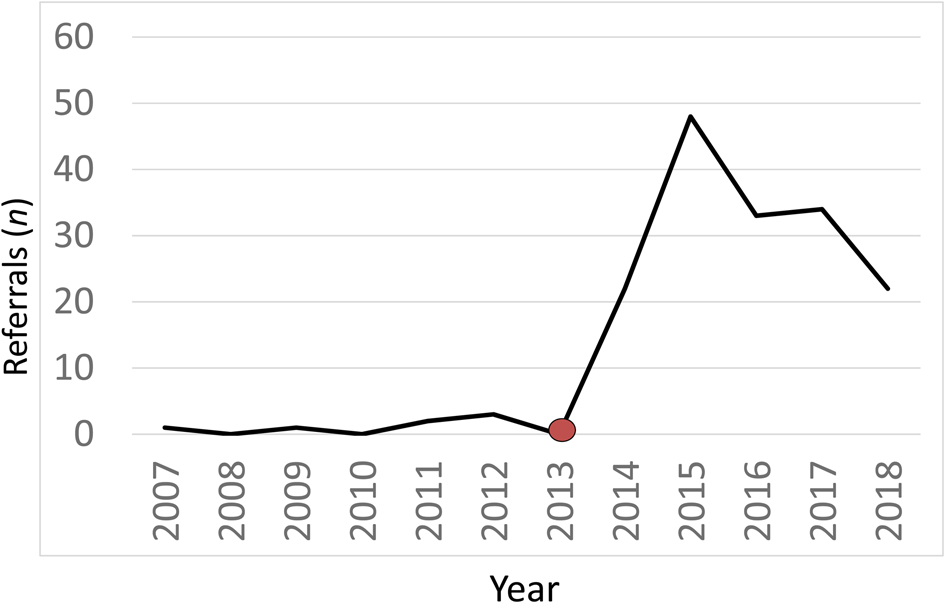
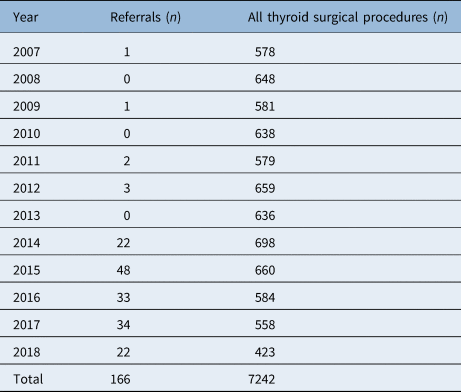
The endocrine surgery service referred 166 patients for laryngeal endoscopy, from a total of 7242 surgical procedures performed (2.3 per cent). Independent sample t-tests determined that the pre- and post-operative referral cohorts were similar in age and gender. The number of referrals for laryngoscopy during the seven years after the release of the clinical practice guideline on improving voice outcomes after thyroid surgery (average of 32 referrals per year) was significantly higher than during the five years before its release (average of 1 referral per year) (U = 35.00, p = 0.003) (Figure 1). The difference remained significant when the percentage of referrals per thyroid surgery performed at our institution was examined (U = 35.00, p = 0.003). The number of referrals and total thyroid and parathyroid surgical procedures conducted by year is shown in Table 1.
Number of referrals for laryngoscopy by year (red dot indicates the year the American Academy of Otolaryngology – Head and Neck Surgery clinical practice guideline was published).

Referrals and total thyroid surgical procedures performed by year

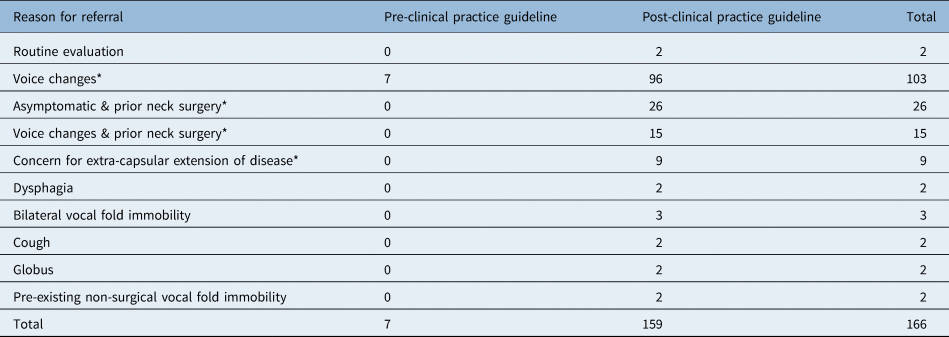
Prior to the release of the clinical practice guideline, the only indication for referral was voice change (n = 7). The indications for referral after release of guideline expanded greatly to include several additional recommendations, which are listed in Table 2. The two patients with pre-existing non-surgical vocal fold immobility had a vagal nerve schwannoma and a known pre-existing idiopathic vocal fold immobility, respectively. Patients referred for ‘routine evaluation’ had no symptoms and there were no specific concerns raised by the referring provider or patient.
Reasons for referral before and after release of AAO-HNS clinical practice guideline

Data represent numbers of cases. *Indicates American Academy of Otolaryngology – Head and Neck Surgery (AAO-HNS) clinical practice guideline recommendation for referral for laryngoscopy
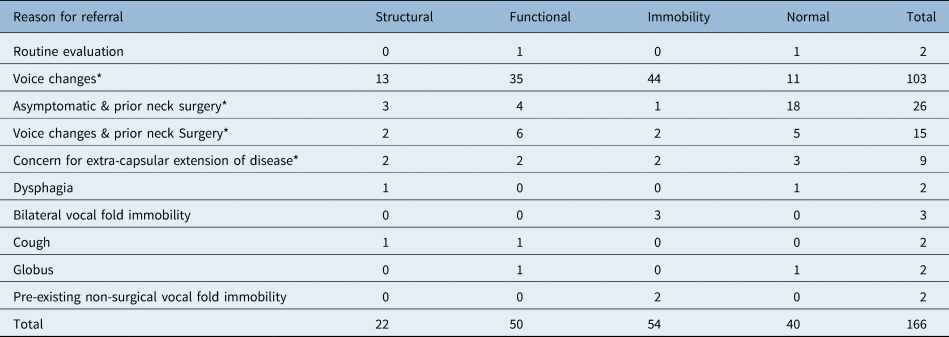
After the release of the AAO-HNS clinical practice guideline, 153 patients (92.1 per cent) were referred for an indication recommended by this guideline. Of these patients, 116 (75.8 per cent) were diagnosed with a functional (n = 47, 30.7 per cent), structural (n = 21, 13.7 per cent) or neurological (n = 48, 31.3 per cent) vocal pathology. Patients referred for a non-AAO-HNS clinical practice guideline indication were just as likely as those referred for an AAO-HNS clinical practice guideline indication to have vocal pathology identified, including structural (n = 2, 15 per cent), functional (n = 3, 23 per cent) and neurological (n = 5, 38.4 per cent) vocal pathology (χ2 = 0.008, p = 0.93). Endoscopic laryngeal findings based on indication for referral are summarised in Table 3.
Endoscopic findings for each referral reason

Data represent numbers of cases. *Indicates American Academy of Otolaryngology – Head and Neck Surgery clinical practice guideline recommendation for referral for laryngoscopy
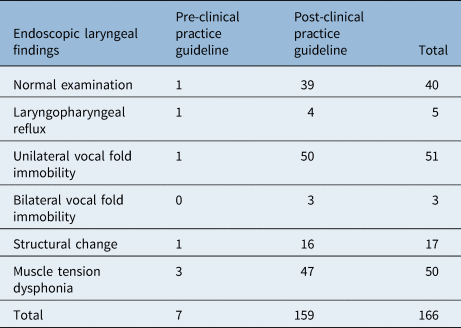
Endoscopic laryngeal findings before and after release of the clinical practice guideline are reported in Table 4. Prior to the release of the clinical practice guideline, patients were only referred pre-operatively for laryngoscopy (n = 7). Following the release of the clinical practice guideline, 88 patients were referred pre-operatively and 71 patients were referred post-operatively. The most common indication for referral pre-operatively (n = 40, 49 per cent) and post-operatively (n = 63, 74 per cent) was voice changes. Post-operative patients were significantly more likely to be referred for voice changes (χ2 = 39.8, p < 0.001, odds ratio = 11.1) and significantly more likely to have an abnormal finding on laryngoscopy (χ2 = 29.0, p < 0.001, odds ratio = 16), especially vocal fold immobility (χ2 = 43.1, p < 0.001, odds ratio = 13.5). The most common indication for referral with abnormal laryngoscopic findings was voice changes (χ2 = 22.9, p < 0.001, odds ratio = 6.1). The most common laryngoscopic abnormality found with voice changes was immobility (n = 103, 62 per cent).
Endoscopic laryngeal findings before and after release of clinical practice guideline

Data represent numbers of cases.
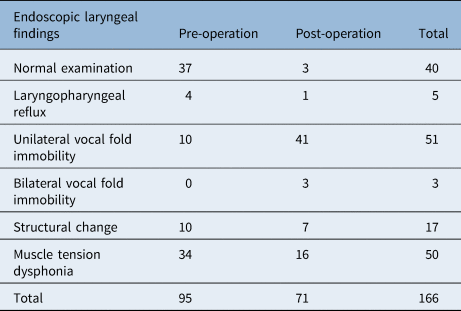
Pre- and post-operative endoscopic laryngeal findings are reported in Table 5. The most common finding on laryngoscopy pre-operatively was a normal examination (n = 37, 38.9 per cent) and post-operatively was unilateral vocal fold immobility (n = 41, 57.7 per cent). Structural laryngeal pathology was noted in 14 pre-operative (14.7 per cent) and 8 post-operative (11.2 per cent) patients. Functional voice pathology (muscle tension dysphonia) was diagnosed in 34 pre-operative (35.7 per cent) and 16 post-operative (22.5 per cent) patients.
Pre- and post-operative endoscopic laryngeal findings

Data represent numbers of cases.
Discussion
Evaluation of vocal fold mobility before and after thyroid and parathyroid surgery is often the primary reason that endocrine surgeons refer patients; yet, as this study showed, other causes of dysphonia can be present, including structural (14.7 per cent pre-operative and 11.2 per cent post-operative) and functional (35.7 per cent pre-operative and 22.5 per cent post-operative) aetiologies. On routine laryngoscopy, 2 per cent of asymptomatic patientsReference Brodnitz5 and more than 36 per cent of dysphonic patients will have a structural vocal fold lesion.Reference Brodnitz5,Reference Lancer, Syder, Jones and Le Boutillier6 Furthermore, more than 25 per cent of symptomatic patients will have some form of functional dysphonia.Reference Morrison, Nichol and Rammage7
The American Thyroid Association guidelines recommend laryngoscopy if clinical suspicion exists.Reference Haugen, Alexander, Bible, Doherty, Mandel and Nikiforov8 Surgeons often rely on the presence or absence of voice changes to decide if enough clinical suspicion exists to refer a specific patient, but the symptom of voice changes may not correlate well with laryngoscopic findings. In a study of 285 pre-operative patients diagnosed with vocal fold paralysis, Lorenz et al. found only 25 per cent were hoarse, and 13 per cent had no symptoms whatsoever.Reference Lorenz, Abuazab, Sekulla, Schneider, Nguyen Thanh and Dralle9 Similarly, Sittel et al. found that nearly one-third of patients with unilateral vocal fold immobility were asymptomatic or eventually compensated to become asymptomatic.Reference Sittel, Stennert, Thumfart, Dapunt and Eckel10
The AAO-HNS 2013 clinical practice guideline for improving voice outcomes after thyroid surgery recommends laryngeal examination in: patients with pre-operative voice changes, those who have thyroid cancer with suspected extra-thyroidal extension, or those who have had prior neck surgery.Reference Chandrasekhar, Randolph, Seidman, Rosenfeld, Angelos and Barkmeier-Kraemer1 Vocal pathology other than immobility was found in 116 patients in this study (75.8 per cent) who underwent laryngoscopy for these specific clinical practice guideline guided reasons. Patients referred for non-AAO-HNS clinical practice guideline indications were just as likely to have vocal pathology identified, however.
The AAO-HNS advocated for all patients to undergo laryngoscopy prior to thyroid surgery; however, there was not enough evidence to make this a key action statement.Reference Chandrasekhar, Randolph, Seidman, Rosenfeld, Angelos and Barkmeier-Kraemer1 The British Association of Endocrine and Thyroid Surgeons, and the German Association of Endocrine Surgeons, both recommend that all patients undergo pre- and post-operative examination before and after thyroid surgery, regardless of symptoms and history.Reference Chandrasekhar, Randolph, Seidman, Rosenfeld, Angelos and Barkmeier-Kraemer1,Reference Musholt, Clerici, Dralle, Frilling, Goretzki and Hermann11 The National Comprehensive Cancer Center and British Thyroid Association recommend laryngoscopy for any patient undergoing thyroid cancer, regardless of suspicion for extra-capsular extension.Reference Chandrasekhar, Randolph, Seidman, Rosenfeld, Angelos and Barkmeier-Kraemer1
In this study, only nine thyroid cancer patients who did not also have a history of prior surgery or significant dysphonia were referred for pre-operative endoscopy. This indicates that recommendations from the practice guideline to refer any patient undergoing total thyroidectomy for cancer were not routinely followed at our institution. Only 2.3 per cent of all patients undergoing thyroid or parathyroid surgery at our institution during the study period were referred, although it is not known whether patients were referred to other institutions for laryngoscopy, but this is not likely.
Even though the number of referrals increased significantly after publication of the AAO-HNS clinical practice guideline in 2013, this study does not establish the publication of this guideline as the reason for the referrals. In fact, it is just as likely that referrals increased as a result of greater familiarity with the referral process and increased efforts to boost referrals by the laryngeal surgery service at our institution. Nonetheless, more cases of treatable vocal fold pathology have been diagnosed as the number of referrals has increased.
Recently, transcutaneous laryngeal ultrasonography has gained favour in the assessment of pre-operative vocal fold mobility.Reference Heller12,Reference Wong, Au, Lam and Lang13 It has a reported sensitivity of 93–100 per cent in post-operative and 88.9 per cent in pre-operative patients with vocal fold paralysis.Reference Wong, Au, Lam and Lang13 Flexible laryngoscopy served as a ‘gold standard’ for diagnosis in these studies. Transcutaneous laryngeal ultrasonography has many advantages, including the ability to rapidly and non-invasively assess neurological vocal fold function, and to integrate easily within the normal diagnostic workflow (most patients will be undergoing a diagnostic ultrasound with fine needle aspiration or surveillance ultrasound prior to thyroid surgery). The major limitation of transcutaneous laryngeal ultrasonography is that this procedure does not diagnose structural and functional laryngeal disorders which may be contributing to dysphonia. Patients with these findings would therefore not have their dysphonia explained or treated effectively.
Patients undergoing thyroid and parathyroid surgery can benefit from a diagnosis of structural and functional vocal fold pathology other than mobility problems. For example, post-operative patients with normally mobile vocal folds may benefit from voice therapy if they have a functional dysphonia such as muscle tension dysphonia, which was the second most common pathology identified in our post-operative cohort. In addition, laryngeal surgery may be warranted to remove structural lesions, which can be benign or malignant. Two patients (one with leukoplakia and one with a subglottic mass) had potentially malignant lesions that required further investigation and definitive treatment unrelated to their thyroid problem.
• Thyroid and/or parathyroid surgery can damage the recurrent laryngeal nerve (RLN), leading to changes
• Pathology unrelated to the RLN can cause voice changes, including structural and functional voice pathologies
• Referrals for laryngoscopy increased following release of the guideline on improving voice outcomes after thyroid surgery
• Post-operative referrals were more likely to be for voice changes than pre-operative referrals, and were more likely to have an abnormal finding on laryngoscopy
• Peri-operative thyroid and/or parathyroid patients have laryngoscopic findings other than vocal fold immobility, such as structural lesions and functional pathologies
• If identified early, such findings can help in surgical planning and to better manage peri-operative voice expectations
This study is limited by its retrospective design. Moreover, the amount of laryngeal structural and functional pathology may be underestimated; this further underscores the importance of routine laryngoscopy in patients undergoing thyroid surgery. An additional limitation of the study is the fact that most of the patients were referred from the Partners Healthcare International system, which tends to pull patients from Northeastern USA, and consists of mainly insured patients from the middle to upper socioeconomic classes. As such, these findings may not be generalisable to all populations.
Earlier diagnosis and treatment for patients with voice disorders may help to expedite recovery and lead to an improved quality of life.Reference Kavookjian, Holcomb, Garnett and Kraft14 By referring a patient for laryngoscopy, endocrine surgeons can have pre-operative understanding of vocal fold mobility for surgical planning. Knowledge of pre-operative laryngoscopy findings can allow the surgeon to proceed confidently, knowing that a patient with dysphonia has an accurate diagnosis for their pre-operative symptoms, for which further surgery is not likely to lead to airway compromise. Finally, serious conditions such as vocal fold carcinoma may be identified early and treated accordingly.Reference Friedman, Hillman, Landau-Zemer, Burns and Zeitels15 The utility of pre-operative examination extends beyond the simple evaluation of vocal fold mobility; it should also include a thorough assessment of the function and anatomy of the larynx, to guide surgical planning and manage post-operative voice expectations.
Conclusion
Referrals for laryngoscopy from endocrine surgeons have increased significantly since the release of the AAO-HNS clinical practice guideline on improving voice outcomes after thyroid surgery. Peri-operative thyroid and parathyroid patients have laryngoscopic findings other than vocal fold immobility, such as structural lesions and functional problems. In addition to determining vocal fold mobility status, laryngoscopy is warranted to detect structural and functional pathology.
Acknowledgement
This work was supported in part by the Voice Health Institute, Boston, Massachusetts, USA.
Competing interests
None declared