Introduction
With the growing global population, the exploitation of biodiversity for food security has become a major challenge. Landraces represent an important underutilized source of diversity, due to their properties mainly linked to a broader genetic base and adaptation to the habitats of origin. To date, particular attention is given to climate changes and food security issues, and, for this reason, several ongoing breeding programmes are aiming at the constitution of more resilient and qualitatively improved varieties.
Pepper belongs to the genus Capsicum, which had its principal centre of origin in the tropical regions of America. To date, about 31 species have been identified, as described by Moscone et al. (Reference Moscone, Scaldaferro, Grabiele, Cecchini, Sanchez Garcıa, Jarret, Davin, Ducasse, Barboza and Ehrendorfer2007). The most cultivated species, with an important role to play in the economy of many countries, is C. annuum, which vaunts a world harvested area estimate of 3.8 Mha (FAOSTAT, 2012). The European consumption is mostly represented by sweet types derived from the Mediterranean area. In such locations, a combination of favourable soil and climatic conditions allows for the development of a large number of adapted landraces carrying peculiar characteristics that are highly appreciated by consumers (Portis et al., Reference Portis, Nervo, Cavallanti, Barchi and Lanteri2006; Cavagna et al., Reference Cavagna, Camerini, Fibiani, Andreani, Cella, Concia and Lo Scalzo2012). The sweet pepper ‘Friariello’ (C. annuum L.), developed in the Campania region, is one of the most common Italian ecotypes. Nowadays, its cultivation is widespread in different Italian areas. This ecotype is usually eaten fried and much appreciated by end users for the high digestibility and the strong flavour; it produces small horn-shaped fruits that are commercialized unripe when the colour is bright green (Caruso et al., Reference Caruso, Villari and Impembo2004).
The aim of this study was to assess the potentiality of the ‘Friariello’ landrace by evaluating its genetic diversity and agronomic and quality traits, in comparison with commercial hybrids and cultivars with similar fruit typology. For this purpose, molecular genetic diversity among and within accessions was investigated by using simple sequence repeats (SSR) markers, which are abundant in the pepper genome and could be efficiently used for detecting genetic variation at the intra-specific level (Varshney et al., Reference Varshney, Graner and Sorrells2005; Nicolai et al., Reference Nicolai, Pisani, Bouchet, Vuylsteke and Palloix2012). Comprehensive analysis of the nutritional value was carried out by investigating the content of ascorbic acid (AsA, vitamin C) and volatile organic compounds (VOCs). AsA, the anti-scorbutic factor, is a required human nutrient, and its biological functions are centred on its antioxidant properties in biological systems, preventing common degenerative processes (Padayatty et al., Reference Padayatty, Katz, Wang, Eck, Kwon, Lee, Chen, Corpe, Dutta, Dutta and Levine2003). VOCs not only play an important role in fundamental processes such as signalling mechanisms and inter-organism interactions (Shulaev et al., Reference Shulaev, Silverman and Raskin1997; Liechti and Farmer, Reference Liechti and Farmer2002; Dicke et al., Reference Dicke, Agrawal and Bruin2003; Dudareva et al., Reference Dudareva, Pichersky and Gershenzon2004), but they also have a great agronomic importance as the major determinants of food and flower quality in terms of flavour and fragrance (Tikunov et al., Reference Tikunov, Lommen, de Vos, Verhoeven, Bino, Hall and Bovy2005; Keurentjes et al., Reference Keurentjes, Fu, de Vos, Lommen, Hall, Bino, van der Plas, Jansen, Vreugdenhil and Koornneef2006). Results obtained are discussed in the context of biodiversity recovery programmes, aiming to enhance the use of underutilized crops both for the improvement of regional economies, promoting their direct adoption by local farmers, and as a source of allelic variation for improving quality and adaptation of derived cultivars.
Materials and methods
Plant material and agronomic characterization
Genetic material (Supplementary Fig. S1, available online) consisted of 18 traditional pepper accessions collected from different farms located in two main districts of Campania region: the Agro Sarnese-Nocerino area and the Pontecagnano area (Salerno Province), and the Torre del Greco-Napoli area (Napoli Province); five commercial hybrids (‘Dolcetto’, ‘Tenerello’, ‘Torre’, ‘Torricello’, ‘Vesuvio’) and two similar ecotypes (‘Lombardo’, ‘Corno di Capra’). The accessions studied represent well the entire variability, considering the area of cultivation and the farms that typically manage this landrace from where the genotypes were retrieved. For the assessment of morphological characteristics, agronomic performances and biochemical compounds, the above-mentioned pepper germplasm was grown in an open field located in Battipaglia (40°37′00″ N; 14°58′00″ E; 65 m above sea level) during spring–summer 2012. This is an intensive horticultural area, characterized by an annual mean rainfall of 947 mm and an annual mean temperature of 16.6°C (30-year average data, available upon request). Seeds were sown in April and seedlings were transplanted at the end of May in single rows, with distances of 110 cm among the rows and 40 cm on the rows. Field trials were conducted in a randomized block experimental design with three replicates and ten plants for each genotype. Four harvests (1st and 4th week of August, 3rd week of September and October) were performed. Irrigation, plant protection and weed control were carried out according to local practices; the cultivation techniques included stakes as support and galvanized wires. Agronomic traits scored include the following: (1) yield and its components – total yield (g) (TY) assessed as the total weight of fruits taken from each plant before full ripening, commercial yield (CY) and waste, which represent, respectively, the marketable and unmarketable portion; (2) earliness (EA), expressed as the ratio of first two harvests/four total harvests (%); (3) size homogeneity (SZH) and shape homogeneity (SPH) estimated using a scale (1 = worst value; 10 = best value); (4) dry matter (DM) (drying at 65°C until constant weight); (5) fruit longitudinal diameter and equatorial diameter (cm); (6) average fruit weight (FW; g); (7) fruit shape index (FSI; Supplementary Table S3, available online) as the length:width ratio – higher index means more elongated fruits (horn-shaped), while lower index means shorter fruits (trapezoidal). Agronomic performances including (1)–(4) were analysed in all genotypes except the similar ecotypes (‘Corno di Capra’ and ‘Lombardo’); on the contrary, the last three measurements (5)–(7) were carried out on all genotypes.
In order to highlight the variability in the ‘Friariello’ collection, a morphological characterization was carried out using the DUS-TEST protocol, European Union – Community Plant Variety Office (2007) (CPVO-TP/076/2 Final; Supplementary Table S1, available online) on all traditional genotypes, hybrids and similar ecotypes. The fruit characteristics analysed were as follows: intensity of colour before maturity; anthocyanin coloration; shape in longitudinal (FLS) and in cross section; sinuation of pericarp including the basal part and excluding the basal part; glossiness; number of locules; thickness of flesh; aspect of calyx; shape of apex (FAS). Other morphological traits not included in the CPVO protocol were also assessed: the number of lobes at the blossom end using a scale (1 = apex with one lobe; 2 = apex with one/two lobes; 3 = apex with two/three lobes); FW, length and width (W) by means of five classes identified on the basis of metric measures on the fruits.
Biochemical analysis
For each genotype, fruits were collected from three biological replicates. For each replicate, a selection of ten mature green fruits was pooled to have a representative fruit sample. The fruit material was immediately frozen in liquid nitrogen and stored at − 80°C until the analysis. Each biological replicate was assessed for both Asa and VOCs. AsA content was determined from an aqueous extract of the pepper pericarp (1 g plus 3 ml of 6% metaphosphoric acid in distilled water), homogenized for 30 s through an Ultra-Turrax, and then centrifuged at 3000 rpm for 15 min. The extraction was repeated twice on the pellet, and the supernatant was collected each time and finally made to 10 ml with the extracting solvent. The extracts were filtered through 0.2 μm PTFE filters and analysed by an Ultimate 3000 UPLC system (Thermo Fisher Scientific, Sunnyvale, CA, USA) at room temperature. A 5 μl sample was injected on a Kinetex (75 × 4.6 mm, 100 Å, particle size 2.6 μm) column (Phenomenex, Torrance, CA, USA). The mobile phase was constituted by a 0.02 M H3PO4 aqueous solution at a flow rate of 0.35 ml/min. Quantification of AsA was made at 254 nm using a calibration curve of the authentic chemical standard of AsA from Sigma-Aldrich.
The GC–MS analysis of VOCs was performed as described by Tikunov et al. (Reference Tikunov, Lommen, de Vos, Verhoeven, Bino, Hall and Bovy2005) with some modifications. A solid-phase micro-extraction (SPME)-fibre (65 μm polydimethylsiloxane–divinylbenzene; Supelco, Bellefonte, PA, USA) was used to sample the VOCs and then assayed with a GC/MS (Scion SQ; Bruker Daltonics Inc., Billerica, MA, USA). Separation of VOCs was carried out on a BR-5 FS (50 m × 0.32 mm × 1.0 μm; Bruker Daltonics Inc.) capillary column, using helium as a carrier gas. VOCs were identified by comparing the mass spectral data of the samples with those of the National Institute of Standards and Technology (NIST, Gaithersburg, MD, USA, http://www.nist.gov). Mass spectral data from the literature were also compared. Overall, 42 analytical grade chemicals (Sigma-Aldrich, St Louis, MO, USA) were used as authentic standards to optimize the SPME/GC/MS method and for metabolite identification. These include the following: cis-3-hexenal, β-ionone, hexanal, 1-penten-3-one, 2-methylbutanal, trans-2-hexenal, 2-isobutylthiazole, trans-2-heptenal, phenylacetaldehyde, 6-methyl-5-hepten-2-one, cis-3-hexenol, 2-phenylethanol, 3-methylbutanol, methylsalicylate, 2-methylbutanol, 3-methylbutanol nitrite, 1-hexanol, pentanal, 1-pentanol, heptanal, salicylaldehyde, eugenol, guaiacol, ethylbenzene, styrene, benzaldehyde, benzonitrile, benzyl alcohol, β-phenylpropionaldehyde, phenol, p-cresol, acetophenone, 4-methylacetophenone, geranylacetone, α-isophorone, β-cyclocitral, α-citral, β-citral, limonene, cis- and trans-linalool oxide, α-terpineol.
Genetic analysis
Genomic DNA was extracted from three plants for each accession using a NucleoSpin® Plant II Midi kit (MACHEREY-NAGEL GmbH & Co. KG., Düren, Germany). DNA concentration and quality were measured by absorbance at 260 and 280 nm, respectively, using a UV–Vis spectrophotometer (ND-1000; NanoDrop, Thermo Scientific, Wilmington, DE, USA). DNA solution was then diluted to a working concentration with distilled water and stored at − 20°C until use.
Genetic diversity was assessed using 24 previously published SSR primer pairs (Mimura et al., Reference Mimura, Inoue, Minamiyama and Kubo2012; Minamiyama et al., Reference Minamiyama, Tsuro and Hirai2006) (Supplementary Table S2, available online). PCR amplifications were performed in 15 μl reactions containing 40 ng of template DNA, 0.5 μl of each forward and reverse primer, 1 × Dream Taq Green Buffer (Fermentas, Waltham, MA, USA), 0.2 mM of each dNTP and 1.5 U Dream Taq DNA polymerase (Fermentas, Waltham, MA, USA). The reactions were amplified using a C-1000 Touch™ Thermal Cycler (Bio-Rad, Hercules, CA, USA). Amplification consisted of an initial denaturation at 95°C for 4 min, followed by ten cycles of amplification with denaturation at 95°C for 30 s, annealing at 60°C for 1 min decreasing by 1°C per cycle and extension at 72°C for 1 min; 30 cycles of 94°C for 30 s, 55°C for 1 min, and 72°C for 1 min, a final extension of 72°C for 10 min; soaking at 8°C. Amplification products were separated on 3% Metaphor agarose (Lonza, Basel, Switzerland) gels in 1 × TBE buffer (89 mM Tris base, 89 mM boric acid, 2 mM EDTA) at a constant voltage of 120 V for 2 h at 4°C. Fragment sizes for each locus were evaluated using 1 kb DNA plus ladder (Life Technologies™, Carlsbad, CA, USA). Visualization of the amplicons was performed by SYBR® Safe (Life Technologies™) staining, and fluorescence was viewed using Gel Doc™ XR (Bio-Rad). SSR data were evaluated using the software program Numeric Taxonomy Ntsys-pc (Numerical Taxonomy and Multivariate Analysis System) version 2.0 (Exeter Software, Setauket, NY, USA). Only the clearest and strongly repetitive PCR products were used for the analysis. Amplified bands were scored for presence and absence as 1 and 0, respectively, and polymorphic fragments were combined into a separate rectangular binary matrix. A similarity triangular matrix was created from each rectangular matrix using the band-based Jaccard similarity coefficient (Jaccard, Reference Jaccard1908). Once the similarity matrix was constructed, the UPGMA (unweighted-pair group method with average linkages; Sneath and Sokal, Reference Sneath and Sokal1973) was used to cluster the patterns. Polymorphism information content (PIC) value was estimated by determining the frequency of alleles per locus using the formula proposed by Botstein et al. (Reference Botstein, White, Skolnick and Davis1980). Effective multiple ratio (EMR) and marker index (MI) were also calculated in order to obtain a measure of the utility of the marker system and to characterize the capacity of each primer to detect polymorphic loci among the genotypes (Powell et al., Reference Powell, Morgante, Andre, Hanafey, Vogel, Tingey and Rafalski1996). The EMR is defined as the product of the number of bands (n) analysed per primer and the percentage of polymorphic loci. The MI is defined as the product of the average PIC for the polymorphic bands in any assay and the EMR for that assay.
Data analysis
Agronomic, AsA and targeted VOC data were subjected to ANOVA using the JMP v7.0 software package (SAS Institute, 2007, Cary, NC, USA) according to a completely randomized design. Means were compared by using Tukey's HSD (honest significant difference) test (P= 0.05). Cluster analysis based on morphological traits was performed using the computer package XLSTAT 2012.1. Similarities between genotypes were estimated using Ward's coefficient. Agronomic traits were subjected to the principal component analysis (PCA) to determine those that were most effective in discriminating among accessions. VOC chromatography and spectral data were evaluated using MSWS 8.0 software (http://www.bruker.com). The metabolic profiles aligned were subjected to multivariate analyses, such as hierarchical cluster analysis (HCA) (using Pearson's correlation coefficient) and PCA, to search for metabolic differences between the pepper genotypes at the level of molecular fragments. The multivariate analyses were performed using Genesis software, version 1.7.6 (http://www.genome.tugraz.at). A log2 transformation was applied to the data prior to multivariate analyses. Factorial discriminant analysis, based on targeted VOCs involved in flavour determination, was performed using the computer package XLSTAT 2012.1. Pearson's correlation coefficients were calculated for agronomic traits and AsA from a regression of genotype mean values using the statistical software JMP v7.0.
Results
Morphological and agronomic traits
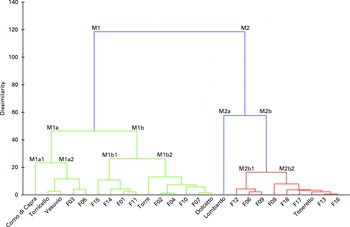
For morphological traits, a dendrogram separated the genotypes into two main clusters (Fig. 1). The first cluster (M1) was subdivided into two more sub-clusters: M1a, which grouped the similar type ‘Corno di Capra’ (M1a1) on the one side and the hybrids ‘Torricello’, ‘Vesuvio’ and the ecotypes F03 and F05 on the other (M1a2); M1b, which was subdivided in two subgroups including eight ‘Friariello’ ecotypes and two hybrids: F01, F11, F14, F15 (M1b1) and F02, F04, F07, F10, ‘Torre’ and ‘Dolcetto’ (M1b2). The second main cluster (M2) was subdivided into two subgroups: M2a, including only the similar type ‘Lombardo’; M2b, which was subdivided into M2b1 with the accessions F06, F09 and F12, and M2b2 with the genotypes F08, F13, F16, F17, F18 and the hybrid ‘Tenerello’. The accessions belonging to the M1 and M2 groups differed from each other with respect to several morphological characteristics (Supplementary Table S1, available online). Most of the ‘Friariello’ accessions belonging to the M1 group showed trapezoidal-shaped fruits with a light green colour before maturity, a non-enveloping aspect of calyx and apex moderately depressed with two/three lobes. The accessions belonging to the M2 group were characterized by horn-shaped fruits showing a medium-dark green colour and moderately acute apex with one/two lobes with the highest value for FLS and the lowest value for FAS. A distinctive trait, which allowed us to distinguish the similar ecotypes from the other genotypes, was the strong sinuation of pericarp including the basal part of the fruit. In addition, ‘Lombardo’ was characterized by the presence of one locule, a light colour of the fruit before maturity and a very acute FAS, while ‘Corno di Capra’ showed a very dark colour before maturity and a length of the fruit higher than the other accessions analysed in the present study.
Cluster analysis based on morphological traits evaluated on eighteen traditional ‘Friariello’ accessions, and seven genotypes including five commercial hybrids and two similar ecotypes.

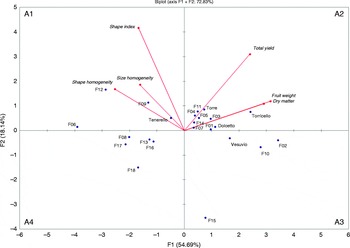
The results for productive traits are summarized in Supplementary Table S3 (available online). Data analysis showed that the average TY per plant was 1651 g, ranging from 705 to 2724 g (F15 and ‘Torricello’, respectively). All hybrids as well as nine out of the 18 tested accessions showed higher values than the average for both TY and CY. EA showed an average of 56.41% with the highest values for the accessions F17 and F06 (64.0% and 62.7%, respectively) and lowest value for F10 (42.8%). The observed trends showed that late genotypes were generally the most productive (‘Torricello’ hybrid as well as the F10, F11 and F14 accessions). FW was on average 14.84 g, ranging from 7.42 g (F06) up to an average of 20 g (F10 and F02). For merceological traits, the results showed an average in SZH of 8.1, ranging from 6.5 to 8.9 (F15 and F08, respectively), whereas SPH was on average 8.3, ranging from 5.9 to 9.5 (F15 and F06/F09, respectively). Other accessions (F18, F10, F13, F06, F11, F07, F04, F17 and F08) and the hybrid ‘Tenerello’ showed good size and shape uniformity with the highest values for these two traits. The PCA in the first two principal component dimensions, for the six main agronomic traits in landraces and hybrids, revealed 72.83% of the total variance (Fig. 2). The first component, which explained 54.69% of the total variance, was positively correlated with FW, TY and DM, and negatively correlated with SPH, SZH and FSI. The second component, which explained 18.14% of the total variance, was positively correlated with all the traits analysed (Fig. 2). Based on the PCA, it was possible to identify four groups: A1, including highly homogeneous accessions showing the most elongated fruits; A2, including the most productive genotypes and showing fruits with low FSI (trapezoidal); A3, including trapezoidal productive accessions that were less homogeneous with respect to those in A2; A4, including homogeneous landraces with a high FSI (horn-shaped fruits) and less productive than those grouped in A2 and A3.
Principal component analysis based on six main agronomic traits for 18 ‘Friariello’ accessions and five hybrids.

Metabolic characterization
The mean contents of AsA and targeted VOCs in the analysed genotypes, respectively, are reported in Supplementary Table S4 (available online). The highest content of AsA was shown by accession F18 (106.25 mg/100 g FW); significantly lower contents were detected in ‘Corno di Capra’, ‘Dolcetto’, ‘Torre’, F17, ‘Vesuvio’ and F01 genotypes (51.95, 49.05, 46.64, 46.56, 43.83 and 41.60 mg/100 g FW, respectively).
Of the 42 targeted VOCs analysed, 29 were significantly different among the pepper genotypes studied, eight were monomorph, while five were not detected in the samples analysed. Headspace (HS)-SPME/GC/MS chromatogram analysis of pericarp samples from mature green fruits, collected in both the 18 pepper accessions of ‘Friariello’ ecotype and the seven hybrids/cultivars, allowed us to identify further 127 different VOCs. These 127 volatiles were putatively identified on the basis of both their mass spectrum and retention index (Supplementary Table S5, available online). All the 127 volatiles identified had a NIST match factor above 700 and a retention index deviation of less than 50 units, and their putative identification was, therefore, considered as reliable. Three further VOCs did not have a NIST match factor and/or a retention index deviation; therefore, they were listed as unknown. Accession-specific VOCs were also detected in our study, in particular seven of them were evidenced in the F15 accession, whereas in ‘Vesuvio’, ‘Corno di Capra’ and ‘Tenerello’, three, one and one specific VOC were evidenced, respectively. The volatile fraction composition specifically consisted of alcohols, aldehydes, fatty acids, esters, ketones, hydrocarbons, monoterpenes, sesquiterpenes and pyrazines (Supplementary Table S5, available online). Aliphatic aldehydes, alcohols and terpenes were the most representative chemical classes of the volatile fraction analysed; in particular, 2-hexenal, 3-hexen-1-ol, hexanal, 2-heptenal, 1-hexanol and trans-linalool oxide were among the main compounds found in almost all the samples analysed. The flavour note of these substances is described as the odour of freshly cut grass or ground leaves and green plant materials or citrus, floral and fruity aroma (http://www.flavornet.com/d_odors.html; http://thegoodscentscompany.com; Luning et al., Reference Luning, de Rijk, Wichers and Roozen1994a, Reference Luning, van der Vuurst de Vries, Yuksel, Ebbenhorst-Seller, Wichers and Roozenb; Rodríguez-Burruezo et al., Reference Rodríguez-Burruezo, Kollmannsberger, Gonzalez-Mas, Nitz and Fernando2010).
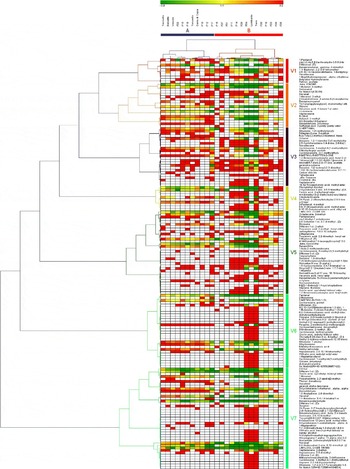
PCA analysis based on 167 total VOCs revealed a clear separation into two accession groups (data not shown). The HCA confirmed PCA results and evidenced two main accession clusters, indicated as A and B (Fig. 3). This separation was determined by a large set of VOCs, which were much more abundant in the fruits of accession cluster B with respect to A. The former cluster included most Friariello accessions (12) plus the similar type ‘Lombardo’ and the hybrid ‘Torre’, whereas the latter comprised the remaining Friariello accessions, the similar type ‘Corno di Capra’ and the other four hybrids analysed. We arbitrarily divided the volatiles into seven groups from V1 to V7 based on their accumulation pattern (Fig. 3). In particular, V3, V4 and V5 groups were mainly characterized by the presence of terpenes, whereas a major portion of the volatile compounds belonging to the V6 and V7 groups consisted of various methyl-branched esters, which were the products of the branched-chain amino acid degradation pathway. Molecules belonging to the V6 and V7 groups were particularly abundant in the accession F04 as well as in ‘Lombardo’ and ‘Torre’. Furthermore, some components of V3, V4 and V5 groups were relatively more abundant in the ‘Lombardo’ genotype and in some Friariello accessions (F04, F06, F11 and F14). Although genotype × environment interactions cannot be ruled out, these results suggest genetic variability for VOC content in the population analysed and the possibility to select better genotypes.
Heat map of 167 volatile organic compounds (VOCs) in 25 ‘Friariello’ pepper genotypes. The matrix represents the mean values of the metabolite intensity in two biological replicates of pepper accessions, which is log2 transformed and mean-centred. The different metabolite intensities determine the separation of the 25 genotypes into two clusters (A and B). The ordinals (V1–V7) represent VOC clusters (on the left). The label above the dendrogram corresponds to the ‘Friariello’ pepper genotypes studied.

Correlation between traits
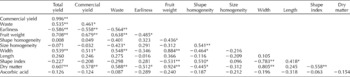
The statistical relationships between agronomic traits and AsA in the pepper genotypes studied are reported in a correlation matrix (Table 1). Most agronomic traits were positively correlated with each other, with the exception of EA, which was significantly negatively correlated with all the productive traits (P< 0.01). The strongest positive and negative correlations were found, respectively, between TY and CY (0.996) and width and FSI ( − 0.783). Slightly negative correlations, albeit not significant, were detected between all agronomic traits and AsA.
Correlation coefficient matrix (Pearson) for agronomic traits and ascorbic acid on 18 traditional accessions and five hybrids of ‘Friariello’

Significant at * P< 0.05 and ** P< 0.01.
Genetic diversity
A total of 30 alleles were detected among the 24 loci analysed. Of these, four were polymorphic with two to three alleles identified at each locus (Supplementary Table S2, available online). The mean PIC value was 0.41, with values ranging from 0.37 (for markers CAMS-647 and CAMS-405) to 0.51 (for CAMS-606). The MI ranged from 0.24 (for the markers CAMS-647 and CAMS-405) to 0.51 (for CAMS-606).
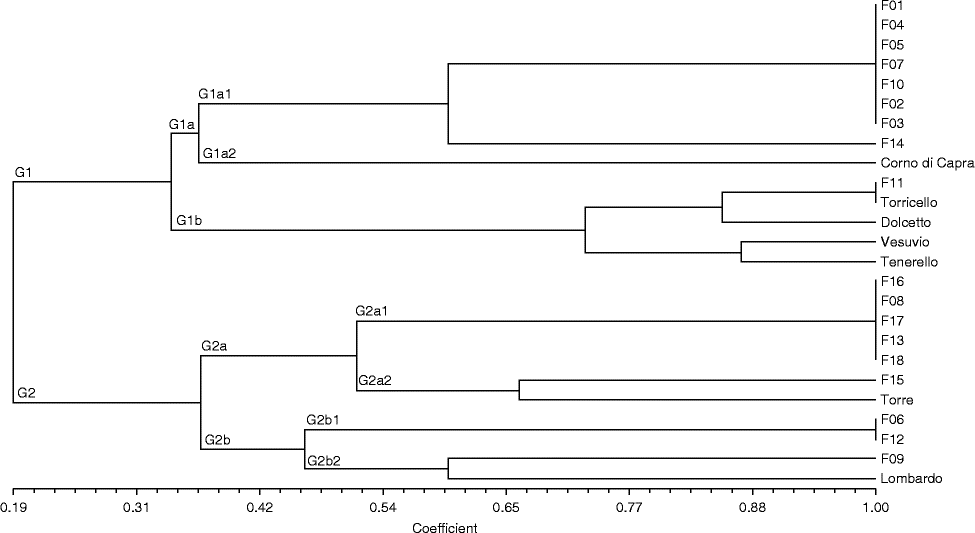
The resulting dendrogram separated all genotypes into two main distant clusters, denoted as G1 and G2, with a similarity coefficient of 0.19 (Fig. 4). The first cluster was divided into two sub-clusters, which differentiated eight ‘Friariello’ accessions (F01, F02, F03, F04, F05, F07, F10, F14) and the similar type ‘Corno di Capra’ (G1a) from the hybrids and accession F11 (G1b). The second cluster (G2) allowed us to distinguish the other landraces into two groups: G2a, containing six landraces (F08, F13, F15, F16, F17, F18) and the commercial hybrid ‘Torre’; G2b, including three accessions (F06, F09, F12) and the similar type ‘Lombardo’. Microsatellite analysis showed no intra-ecotype variability and allowed to differentiate the ‘Friariello’ landraces into six groups at a similarity coefficient of 0.6. Several accessions clustered at a similarity coefficient of 1.0 (Fig. 4). The largest groups included eight (G1a1) and five (G2a1) accessions, respectively.
UPGMA (unweighted-pair group method with average linkages) dendrogram (Jaccard coefficient) based on SSR marker data showing the genetic relationships among the pepper accessions analysed in this study.

Discussion
The major challenges of modern agriculture concern the demand for a higher food security under the continuous increasing of the world population and the general climate change. This global situation requires a new view of agricultural systems, which needs to face the requirement of food quality, the environmental protection and the low-input farming. For this reason, the characterization and management of local germplasm represents a critical strategy in order to enhance the productivity, sustainability and resilience of crop varieties and agricultural systems. The Mediterranean area is notably rich in landraces of many species, and southern Italy represents a hotspot for vegetables and some minor crops (Veteläinen et al., Reference Veteläinen, Negri, Maxted, Veteläinen, Negri and Maxted2009); in particular, pepper includes a highly heterogeneous germplasm selected locally across the years with different purposes as fresh or cooked vegetable. The assessment and the conservation of the variability within germplasm is essential for broadening and exploiting the genetic basis of cultivars. The present study was performed in order to characterize the diversity and the relationships of landraces of the horn-shaped sweet pepper ‘Friariello’ by means of phenotypic and genetic traits.
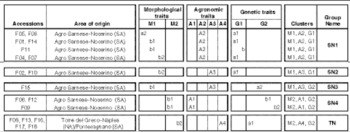
Morphological, agronomic and genetic analyses allowed us to differentiate five groups, which were named according to the area of origin as SN (Agro Sarnese-Nocerino) and TN (Torre del Greco-Napoli) (Table 2). The main distinctive traits regard the number of lobes at the blossom end of the fruit that were two/three in SN1–SN3 and, respectively, one/two for SN4 and TN (Supplementary Fig. S2, available online). Moreover, we observed a low number of polymorphic microsatellites, probably due to a low power to detect polymorphisms among the accessions of ‘Friariello’. However, the null heterozygosity observed in these pepper accessions is in agreement with the predominant autogamous reproductive behaviour of this species and the intensive cultivation in restricted areas that has minimized the possibility of contamination with other cultivars. SN1 and SN2 were the most productive groups, showing the highest values of yield, FW and DM content; SN3, with the exception of AsA, showed low values for the agronomic traits analysed; SN4 and TN was observed to be less productive but much more homogeneous in terms of shape and size; moreover, the fruits of these groups showed lower FW and DM contents. The presence of distinct groups with well-defined features does suggest the targeted selection of different ‘Friariello’ types during the past centuries. This hypothesis is likely, given the variability observed between the coastal area (Torre del Greco-Naples and Pontecagnano) and the internal area (Agro Sarnese-Nocerino) of the Campania region. In particular, since the 13th century, the sea was the preferred way for trades (Sereni and Litchfield, Reference Sereni, Litchfield, Sereni and Litchfield1997), which could explain the distribution of the accessions belonging to the TN group in two different sea locations. In addition, the lack of land exchanges between rural areas, and the selection carried out traditionally by local farmers across the past centuries, could clarify the existence of different sub-types of ‘Friariello’, which results in the main groups selected in the Agro-Nocerino Sarnese. The strategy used in this study aimed to distinguish and classify the accessions collected on the basis of the main features. This cannot exclude the possibility of potential admixture between accession/groups that could occur, increasing the number of phenotyping traits or accessions studied. Anyhow, the groups detected well represent the variability, which is the result of the selection process carried out by farmers, and confirm their key role in the recovery and rescue of the traditional genetic resources. The presence of such defined internal variability, as well the rescue of ancient landraces, is a starting point for genetic improvement and selection of new cultivars (Cavagna et al., Reference Cavagna, Camerini, Fibiani, Andreani, Cella, Concia and Lo Scalzo2012). Particularly, landraces could represent a valuable source of complex traits, especially those underlying flavour and taste.
Pepper ‘Friariello’ groups, based on the reassortment of 18 traditional accessions by means of morphological, agronomic and genetic traits

The understanding of the role of volatile flavour components represents a key element, but only some studies have been performed in pepper. Previous research conducted to assess the content of VOCs in Capsicum germplasm revealed the presence of different patterns of volatiles. Luning et al. (Reference Luning, de Rijk, Wichers and Roozen1994a, Reference Luning, de Rijk, Wichers and Roozenb) identified 64 VOCs in fresh bell pepper at three ripening stages (green, turning, red) with dynamic headspace. The composition of VOCs indicated that the majority of green-related odour volatile compounds decreased or even disappeared during maturation. Pino et al. (Reference Pino, Sauri-Duch and Marbot2006, Reference Pino, González, Ceballos, Centurión-Yah, Trujillo-Aguirre, Latournerie-Moreno and Sauri-Duchb2007) studied the changes of volatile constituents in ten Habanero chilli peppers (C. chinense Jack.) cultivars during maturation and identified 63 volatile metabolites, evidencing marked differences among the cultivars analysed. Ziino et al. (Reference Ziino, Condurso, Romeo, Tripodi and Verzera2009) identified 64 VOCs by HS-SPME/GC/MS in six Calabrian C. annuum (hot pepper) cultivars that exhibited great variability in size, shape, colour, pungency and aroma. Eggink et al. (Reference Eggink, Maliepaard, Tikunov, Haanstra, Pohu-Flament, de Wit-Maljaars, Willeboordse-Vos, Bos, Benning-de Waard, de Grauw-van Leeuwen, Freymark, Bovy and Visser2012) assessed a total of 254 putative volatiles, 129 of which had a reliable identity in a diverse panel of 24 breeding lines of fresh sweet pepper (C. annuum) including cultivars and hybrids. Compared with previous studies, the number of volatiles developed in the ‘Friariello’ pepper is well represented by a high and variable number of compounds. The observed metabolic differences between the accession groups allowed us to select possible genotypes to breed for novel aromas. According to the findings of Eggink et al. (Reference Eggink, Maliepaard, Tikunov, Haanstra, Pohu-Flament, de Wit-Maljaars, Willeboordse-Vos, Bos, Benning-de Waard, de Grauw-van Leeuwen, Freymark, Bovy and Visser2012) in different sweet pepper typologies, we recognized 22 targeted VOCs presumably involved in flavour determination in the ‘Friariello’ genotypes studied; ten of these were the main determinants of the variability observed and could have a predictive value for different aromas (Supplementary Table S6, available online). The variation patterns of such contributing odour volatiles clearly discriminated the five groups identified previously, with a main overlap between SN2 and TN (Supplementary Fig. S2, available online). A high concentration of VOCs potentially related to a fruity aroma (e.g. Linalool oxide trans; Ethanone, 1-phenyl-CAS) was observed in SN2 and TN accessions. In particular, linalool seems to be one of the best candidates for the fruit aroma in cultivated pepper (Eggink et al., Reference Eggink, Maliepaard, Tikunov, Haanstra, Pohu-Flament, de Wit-Maljaars, Willeboordse-Vos, Bos, Benning-de Waard, de Grauw-van Leeuwen, Freymark, Bovy and Visser2012; Wahyuni et al., Reference Wahyuni, Ballester, Tikunov, de Vos, Pelgrom, Maharijaya, Sudarmonowati, Bino and Bovy2013). A discrete level of other compounds such β-ionone was observed in SN3, but the high within-group variability shown by the latter, combined with the results obtained with the morpho-agronomic and genetic analysis, suggests that SN3 is not a good candidate for genetic improvement programmes. Overall, the content of volatiles represents an indication of the underlying aroma, which, however, should be confirmed by sensory analysis and taking into account the complexity of the volatome.
Conclusions
The present study aimed to investigate the potentiality of a traditional pepper landrace widespread in the Mediterranean basin. Starting from the collection of seeds by local farms located in the native area, different typologies were identified and key distinctive traits assessed. Since the globalization process is causing the decline of many landraces and the narrowing of crop biodiversity with a consequent food quality loss (Davis, Reference Davis2009), the recovery and evaluation of local germplasm, as a valuable source of quality-linked traits, represents an essential strategy to follow in order to develop new cultivars in the next decades. The phenotypic information coming from different sources will allow us to select, among the genotypes investigated, potential lines for both cultivation and breeding programmes. It is also important to consider that evaluation of local populations will allow us to cover part of the narrow genetic variability present in the cultivated genotypes, enhancing the possibility to combine the alleles of interest with new genotypes.
Supplementary material
To view supplementary material for this article, please visit http://dx.doi.org/10.1017/S1479262115000490
Acknowledgements
This work was supported by the ‘Biodati’ project funded by the Italian Ministry of Agricultural, Food and Forestry Policies (MiPAAF), and the ‘GenHort’ project funded by the Italian Ministry of University and Research (MIUR, PON02_00395_3215002). The authors acknowledge Semencoop, Olter, Franchi Sementi, Semiorto Sementi and Nunhems for kindly providing the pepper accessions for this study. The authors thank Mrs Giovanna Festa, Mr Alberto Senatore and Mr Antonio Vivone (CREA-ORT) for technical support.
The authors declare that they have no conflicts of interest.