Introduction
Background
Bone-anchored hearing aids (BAHAs) provide hearing improvement for people with hearing loss and for whom conventional behind-the-ear hearing aids are not appropriate. 1 BAHAs comprise a titanium implant that is surgically placed into the skull behind the ear and a detachable sound processor which clips onto the titanium implant. As sound from the BAHA bypasses the middle ear, the devices are effective in the presence of middle-ear pathology.Reference Snik, Mylanus, Proops, Wolfaardt, Hodgetts and Somers 2 Bone-anchored hearing aids are also used for patients with unilateral sensorineural hearing loss (SNHL): the skull conducts the sound from the side of hearing impairment to the ‘good’ ear.
Many patients do not take up BAHAs despite their effectiveness, and the reasons for this are not fully understood. It is important to understand why patients decline BAHAs so that healthcare professionals can support patients to make the best decision. If patients decline out of fear or uncertainty, then healthcare professionals can provide appropriate information and support. However, it may be that for some patients, maximum satisfaction and quality of life (QoL) result from not undergoing the procedure, in which case it is helpful to be alert to this.
This review aimed to establish why people choose to have, or not to have, a BAHA fitted, and how satisfied people are with their decisions. Research examining uptake and the possible reasons for not taking up BAHA is considered, and literature addressing patient satisfaction and the perceived benefits to those who have (or have not) opted to receive a BAHA are reviewed. As this review addresses patient decision-making and perspectives, the focus is on patient-reported outcomes related to uptake and satisfaction, rather than to audiometry findings.
Clinical context
National Health Service (NHS) England, UK, funds the fitting of a unilateral BAHA for patients with one of the following conditions: bilateral conductive or mixed hearing loss; unilateral conductive hearing loss unlikely to benefit from other treatments; or profound unilateral SNHL unsuitable for other treatment. Patients must also meet audiological criteria. 3 Thus, for many patients in England, cost is not an issue in deciding whether to receive a BAHA. In other countries, patient cost varies according to the particular device, healthcare system and insurance coverage. 4
Literature review
A narrative review was performed with the aim of exploring the context and scope of literature in this area rather than a systematic review (defined by an a priori protocol). However, the review was conducted in a systematic manner. Initial searches of the Web of Science database were conducted on 31 July 2015, using the search terms: (1) bone anchored hearing aid AND (satisfaction OR psychology OR qualitative OR illness representations OR body image OR anticipated regret); and (2) bone anchored hearing aid AND (uptake OR adherence OR compliance). Empirical studies of uptake and/or decline rates in people offered BAHA, studies describing the reasons for accepting or declining BAHA and studies providing data on patient satisfaction with BAHA were included. Titles and abstracts of retrieved studies were checked for relevance and full texts of all potentially relevant papers were retrieved. The reference lists of all papers included from this search were checked for further relevant papers, and all members of the author team checked the review to ensure that they knew of no additional relevant papers. Only studies published in the English language were included because of resource limitations but the search was not limited by date: the advent of BAHA technology was a date limiter for relevant papers.
Results
Bone-anchored hearing aid uptake
There is a lack of published data indicating the size of the BAHA-eligible population. The NHS Commissioning Board Clinical Reference Group for Specialised Ear Surgery (2013) cites sources stating that the incidence of bilateral chronic suppurative otitis media (a middle-ear infection which could indicate benefit from BAHA) is unknown but that ‘clinical observation would suggest this is a considerable problem’. 3
Few studies report the BAHA acceptance rate, but available data suggest that BAHA uptake is low. Siau et al. reviewed data from 90 consecutive adult British patients with unilateral SNHL referred to a BAHA programme between 2008 and 2011.Reference Siau, Dhillon, Andrews and Green 5 Most (n = 79) were deemed audiologically suitable for BAHA and offered a trial of a bone conduction aid attached by a headband. Of these, 24 (30 per cent) accepted a BAHA and 55 (70 per cent) declined, 2 without undertaking the trial. In a study of BAHA-eligible patients with conductive and mixed hearing loss, similar findings were reported: 38 (39 per cent) accepted implantation and 60 (61 per cent) declined. When the sample was divided into patients with unilateral or bilateral hearing problems, acceptance rates were 64.2 per cent (n = 27) and 19.6 per cent (n = 11) respectively.Reference Siau, Dhillon, Siau and Green 6
A Danish group reported the treatment decisions of adult patients with unilateral SNHL following surgery for acoustic neuroma.Reference Andersen, Schrøder and Bonding 7 , Reference Schrøder, Ravn and Bonding 8 Of the 52 participants who responded to a question about testing a BAHA, 38 (73 per cent) expressed interest and were invited to a test session. Twenty-six patients (50 per cent of 52) attended the test session and trialled a bone conduction aid on a headband. Fourteen of these decided that they wanted a BAHA, and only 11 (21 per cent of 52) went on to actually receive the implant.
In contrast, a study of 90 new BAHA-eligible patients (68 children, 22 adults) in Montreal, Canada, reported that only 10 patients (11 per cent) declined implantation (2 adults and 8 children).Reference Zawawi, Kabbach, Lallemand and Daniel 9 It is unclear why patients found BAHA implantation more acceptable in this study, but there were differences in the study cohort, in particular, most participants were children, so the parents may have made the decision on their behalf. Thus, apart from in this final study, BAHA uptake was lower than might be expected given the effectiveness of the intervention. The next section reviews research into the reasons why some people decline BAHA.
Reasons for declining a bone-anchored hearing aid
In the Canadian study, the most common reason for refusal was cosmetic concerns (n = 6).Reference Zawawi, Kabbach, Lallemand and Daniel 9 Siau et al. reviewed clinical notes of patients with unilateral SNHL to determine patients’ reasons for declining a BAHA.Reference Siau, Dhillon, Andrews and Green 5 Reasons given were perceived limited benefits (n = 26); reservations about surgery (n = 18); preference for an alternative device (contralateral wireless routing of signals (‘CROS’); n = 13); and cosmetic reasons (n = 12).Reference Siau, Dhillon, Andrews and Green 5 Of the 55 patients who declined, 32 received wireless contralateral routing of signals devices, but 23 received no device, suggesting that patients chose no hearing support over the BAHA.Reference Siau, Dhillon, Andrews and Green 5 In another study of a conductive and mixed hearing loss sample, Siau et al. found the most common reasons for rejection to be anxiety about the surgery (reported by 27 patients; 45 per cent), cosmetic concerns (n = 18; 30 per cent) and insufficient benefit during a softband trial (n = 16; 27 per cent).Reference Siau, Dhillon, Siau and Green 6 While Siau and colleagues provide some indication of the reasons for declining, neither study was specifically designed to explore the reasons for refusal: instead, these were gleaned from clinical notes. Patients’ reasons for declining were noted, but there was limited elaboration or explanation of these reasons. For example, if someone was concerned about surgery, there was no explanation about exactly what worried them.
The Danish study provided no information as to why only 26 of 52 potential participants attended a test session.Reference Andersen, Schrøder and Bonding 7 , Reference Schrøder, Ravn and Bonding 8 Twelve participants declined after testing a bone conduction aid on a headband. Of these, seven declined because they considered the gains to be ‘too small or lacking’ or for ‘other reasons’ (not specified). Five had doubts and, after further, extended testing of a conventional bone conduction aid, chose not to have the BAHA (reasons not specified). It is also unclear why 3 of the 14 who did want the BAHA did not receive it.
Patients' records were reviewed at a private otology practice in the USA and appropriate patients were invited for evaluation for BAHA.Reference Burkey, Berenholz and Lippy 10 A letter describing BAHA was sent to 538 potential candidates, of whom 162 (30 per cent) made a consultation appointment and 146 were confirmed as potential candidates. After the BAHA was discussed and shown to individuals, 92 per cent of these patients tried a BAHA on a test band in the office. Patients with single-sided deafness were more likely to try the headband than those with conductive or mixed hearing loss (94 per cent vs 83 per cent). Those with conductive or mixed hearing loss who declined tended to have had previously unsuccessful operations and were hesitant about undergoing another procedure, whereas the reasons for not trying the BAHA in patients with single-sided deafness included adaptation to having only one hearing ear, aversion to surgery, cosmetic concerns, lack of insurance coverage and absence of effect on tinnitus. Of the 134 who tried the BAHA test band, most (n = 123) liked the experience; of these, 41 (30.6 per cent of 134) were scheduled for surgery within 1 year. The most important factors in deciding not to have surgery were inadequate insurance or an inability to afford the procedure. Seventy per cent of individuals in this study did not respond positively to the invitation letter, but these were not followed up to determine their reasons for not engaging in the process.
In a prospective study, a Swiss sample of 46 adults with SNHL in 1 ear tested bone conduction aids on headbands for 7–10 days, after which 17 declined and 29 accepted a BAHA.Reference Kompis, Pfiffner, Krebs and Caversaccio 11 Prior to surgery, participants underwent audiometric tests and rated their perceptions of the benefits of the bone conduction aid. No differences were found between decliners and acceptors in aetiology, deafness duration, transcranial attenuations or air conduction thresholds. However, of the 26 participants who returned the questionnaire, the 10 accepters reported a greater benefit of the test aid compared with decliners in the following contexts: speaker at a distance, speech in noise, group conversation and overall assessment. Thus, understanding patient experiences and satisfaction levels may be more useful than biological, audiometric tests for predicting BAHA acceptance.
This research indicates that a large proportion of patients eligible for BAHA do not receive treatment that could optimise their hearing. However, it is unclear why people decline BAHA. It is important to understand whether people decline because of misunderstanding or fear, which can be addressed with appropriate support, or whether declining is actually the best decision for many people, leading to optimal satisfaction and QoL. The next sections of this review examine satisfaction in patients who have been offered a BAHA. Firstly, studies using cross-sectional and retrospective designs are considered. Most reports identified fall into this group, but such designs are weak and limit conclusions. Secondly, studies using other, more robust designs are discussed.
Patient satisfaction
Cross-sectional and retrospective studies
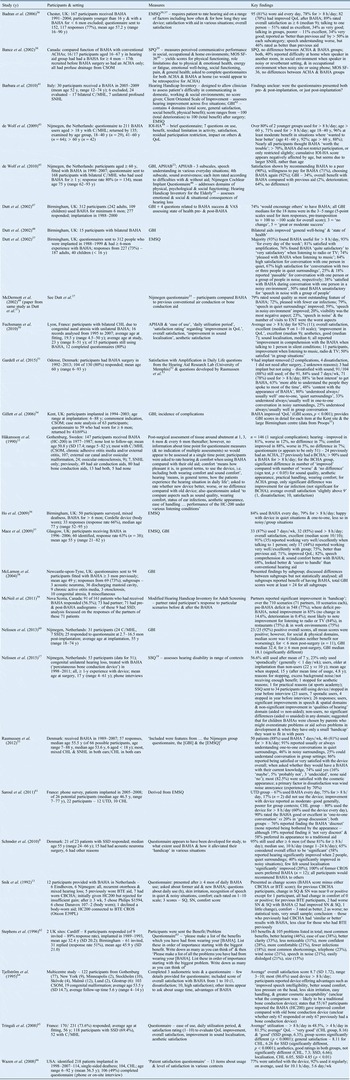
Many reports of surveys of satisfaction in patients who have received a BAHA were identified. Most were cross-sectional or retrospective studies, with patients completing postal questionnaires or telephone interviews to report their current perceptions of, or change in well-being since, having the BAHA implanted (see Table I for a summary). Generally, satisfaction and usage levels were high. Devices were particularly useful in one-to-one conversations in quiet settings but less so in group conversations in noisy settings. Two studies suggested that the BAHA may be perceived more positively by those with previous experience of bone conduction hearing aids than those who had previously used air conduction hearing aids.Reference Håkansson, Líden, Tjellström, Ringdahl, Jacobsson and Carlsson 12 , Reference Snik, Jorritsma, Cremers, Beynon and van den Berge 13
Cross-sectional and retrospective studies into patient satisfaction with bone-anchored hearing aids

*Assumed to indicate the arithmetic mean. Y = years; mon = months; BAHA = bone-anchored hearing aid; EMSQ = Entific Medical Systems (Nobel Biocare) questionnaire; h = hours; QoL = quality of life; ACHA = air conduction hearing aid; CSOM = chronic suppurative otitis media; SPQ = Sanders’ Profile Questionnaire; MOS SF-36 = Medical Outcomes Study Short Form 36; C/MHL = conductive/mixed hearing loss; SNHL = sensorineural hearing loss; IOI-HA = International Outcome Inventory for Hearing Aids; GBI = Glasgow Benefit Inventory; APHAB = Abbreviated Profile of Hearing Aid Benefit; VAS = visual analogue scale; CHL = conductive hearing loss; TV = television; wk = weeks; SD = standard deviation; BCHA = bone conduction hearing aid (not bone anchored); SSD = single-sided deafness; SSQ = Speech, Spatial and Qualities of Hearing Scale; UTD = unilateral total deafness; CROS = contralateral wireless routing of signals hearing aid; CBCHA = conventional bone conduction hearing aid; BTE = behind the ear; SQ = speech recognition in quiet; SN = speech recognition in noise
It was common for researchers to wait six months between implantation and survey completion to avoid ‘enthusiasm bias’ owing to the novelty of having a new device. However, it is still possible that people who had undergone invasive surgery were biased towards finding benefits to justify the personal investment of undergoing a surgical procedure. According to cognitive dissonance theory, people are uncomfortable with clashing thoughts and aim to reduce dissonance.Reference Festinger 14 Therefore, having made the decision to undergo surgery and having made effortful investment into this decision, people will be reluctant to admit to having made the wrong decision. There is evidence that people show ‘confirmation bias’, that is, a preference for information that is consistent with decisions they have made.Reference Jonas, Schulz-Hardt, Frey and Thelen 15 , Reference Hart, Albarracín, Eagly, Brechan, Lindberg and Merrill 16
In studies that asked participants to compare their satisfaction or QoL at the time of the questionnaire with how they recall feeling prior to surgery, it is possible for recall to be influenced by a range of factors. A prospective design in which participants are asked about their experiences pre-operatively and then again post-BAHA implantation would provide more reliable data.
Many studies used mixed samples of children and adults. This is problematic because it is unclear who has completed the questionnaire for children, and parents may introduce their own perspectives when helping a child to complete the questionnaire. There also seem to be different issues for adults and children, for example, regarding who makes the decision to have the BAHA and who decides when to stop using it (see Nelissen et al.Reference Nelissen, Mylanus, Cremers, Hol and Snik 17 ).
Finally, all of the retrospective studies were limited by only including people who received a BAHA. Thus, no information was gained on patient satisfaction in those who declined a BAHA. It is possible that, despite a high level of satisfaction in those who received a BAHA, patients who decline a BAHA could experience similar or higher satisfaction levels. A comparison of patients with and without a BAHA is therefore needed to control for general levels of satisfaction.
Other study designs
House et al. administered postal questionnaires to 126 people with unilateral deafness who had received a BAHA (88 had undergone translabyrinthine craniotomy or another skull procedure, 38 had severe or profound SNHL with other aetiologies) and to 126 control participants who had not received a BAHA after undergoing translabyrinthine craniotomy.Reference House, Kutz, Chung and Fisher 18 Responses were received from 68 participants with a BAHA and 61 controls. In the BAHA group, 83 per cent indicated that they were satisfied (or very satisfied) with the BAHA. However, scores on the Speech, Spatial and Qualities of Hearing Scale,Reference Gatehouse and Noble 19 which assesses perceived hearing ability in a range of contexts, did not differ between the two groups.Reference House, Kutz, Chung and Fisher 18 Unfortunately, control participants were not asked how satisfied they were with their hearing.
A small number of prospective studies of patient satisfaction with BAHA were identified. Pai et al. compared pre-operative and post-operative (at over 6 months) Speech, Spatial and Qualities of Hearing Scale scores in 25 adults with acquired unilateral profound hearing loss.Reference Pai, Kelleher, Nunn, Pathak, Jindal and O'Connor 20 Participants reported significant improvements across the Speech, Spatial and Qualities of Hearing Scale, and all reported improvements in speech hearing in challenging situations. Twenty-three (92 per cent) reported improved spatial hearing. In a small study of 10 adults with unilateral deafness, participants were first fitted with a contralateral routing of signals hearing aid and assessed after 1 month. All decided that a contralateral wireless routing of signals hearing aid provided insufficient benefit and elected to have a BAHA. One month later, participants reported improvements in ‘listening in reverberant conditions,’ ‘listening in background noise’ and ‘ease of conversation’ with the BAHA compared with the contralateral wireless routing of signals hearing aid, although no statistical tests were performed.Reference Niparko, Cox and Lustig 21
Hol et al. (2004) tested 20 patients with unilateral inner ear deafness at baseline, 1 month after being fitted with a conventional contralateral wireless routing of signals hearing aid, and then 1 month after being fitted with a BAHA.Reference Hol, Bosman, Snik, Mylanus and Cremers 22 Using a Dutch version of the Abbreviated Profile of Hearing Aid Benefit (APHAB),Reference Cox and Alexander 23 participants scored the BAHA as the most beneficial option. Hol et al. (2005) continued this work by adding nine participants to the 2004 sample.Reference Hol, Bosman, Snik, Mylaus and Cremers 24 Scores on the APHAB domains ‘ease of communication’, ‘background noise’ and ‘reverberation’ remained significantly better than unaided scores at one year. Scores on the Glasgow Hearing Aid Benefit Profile (GHABP)Reference Gatehouse 25 showed that while satisfaction with BAHA declined over one year, there was higher satisfaction with BAHA at six weeks and one year compared with a contralateral wireless routing of signals hearing aid.Reference Hol, Bosman, Snik, Mylaus and Cremers 24
The same group administered a prospective postal questionnaire to 56 adult patients who received a BAHA for acquired conductive or mixed hearing loss.Reference Hol, Spath, Krabbe, van der Pouw, Snik and Cremers 26 Thirty-six of these patients had previously used air conduction hearing aids and 20 had previously used bone conduction hearing aids. While scores on the EuroQol-5 Dimension questionnaire (EQ-5D)Reference Brooks 27 and the Medical Outcomes Study 36-Item Short Form Survey (‘SF-36’)Reference Ware and Sherbourne 28 showed little change from pre-surgery to six months post-surgery, significant improvements were seen on both the disability and handicap scales of the Hearing Handicap and Disability Inventory for the Elderly,Reference Ventry and Weinstein 29 (effect sizes ≥ 0.79).Reference Hol, Spath, Krabbe, van der Pouw, Snik and Cremers 26 Before implantation, 78 per cent of air conduction hearing aid users and 90 per cent of bone conduction hearing aid users reported using their aid for 8 or more hours per day; after implantation, all 56 (100 per cent) reported using BAHA for 8 or more hours per day, implying a high satisfaction level. Similarly, in Powell and colleagues’ study of 20 paediatric patients in Birmingham, UK, all participants used their BAHA for over 8 hours per day at 6 months after fitting; only 1 participant was less satisfied with the BAHA than with their previous aid.Reference Powell, Burrell, Cooper and Proops 30
Two further small prospective studies were reported by Newman et al. (n = 8) and Wazen et al. (n = 9).Reference Newman, Sandridge and Wodzisz 31 , Reference Wazen, Spitzer, Ghossaini, Kacker and Zschommler 32 In the former, 50 per cent of participants (with unilateral SNHL) reported a significant improvement on the global benefit score of the APHAB at 6 months, rising to 75 per cent at 18 months. While 7 of the 8 participants initially used the BAHA every day, at 18 months daily use was reported by only 2. However, 7 participants said that they would undergo BAHA surgery again.Reference Newman, Sandridge and Wodzisz 31 Wazen et al. reported that patients with unilateral conductive or mixed hearing loss reported having a lower ‘handicap’ (i.e. impact of hearing loss) with the BAHA compared with pre-implantation.Reference Wazen, Spitzer, Ghossaini, Kacker and Zschommler 32 However, both of these studies have particularly small sample sizes, which limited the statistical analysis and generalisability of findings.
In a study by Mylanus et al., people who had previously used a bone conduction hearing aid were more satisfied with a BAHA at five months post-surgery than those who had previously used an air conduction hearing aid.Reference Mylanus, Snik and Cremers 33 Participants rated their hearing aid for speech recognition in quiet and noise, quality of sound, and comfort. For the bone conduction hearing aid group (n = 49), the BAHA had a higher rating than the previous aid in all categories, whereas differences between ratings did not reach statistical significance for the air conduction hearing aid group (n = 16). However, the study may have been underpowered to detect a difference in the smaller air conduction hearing aid group. All participants who had previously used a bone conduction hearing aid reported using the BAHA for more than 8 hours per day, as did 15 of the 16 participants who had previously used an air conduction hearing aid. A problem with this study is that scores from the pre-surgery questionnaire were provided to participants at the second completion of the questionnaire, making findings particularly vulnerable to confirmation bias.
Finally, Hol et al. conducted long-term follow-up research.Reference Hol, Snik, Mylanus and Cremers 34 In a 1998 study, 33 patients with BAHA completed the Nijmegen questionnaire; 9 years later, this was again presented to 27 of the original cohort.Reference Hol, Snik, Mylanus and Cremers 34 , Reference Mylanus, van der Pouw, Snik and Cremers 35 In the initial study, 27 (82 per cent of 33) preferred the BAHA to their previous aid; 9 years later, 24 (89 per cent of 27) preferred the BAHA.
Discussion
The evidence reviewed suggests that BAHA uptake by eligible patients is low, and few studies have examined patients’ reasons for declining this treatment. Possible reasons for declining BAHA are limited perceived benefits, concerns about surgery, preference for an alternative device, aesthetic concerns and the treatment cost. However, studies primarily aimed at exploring and understanding patients’ reasons for declining (or accepting) BAHA were not identified.
In general, the large body of research into patient satisfaction and subjective hearing improvement after receiving BAHA indicates that patients experience benefits with BAHAs and are satisfied with their aids. However, many of these studies had small samples, thus limiting generalisability and possibilities for statistical analysis, and most were conducted retrospectively with people who had opted for BAHAs. This means that the findings depend on patients’ recall of their hearing experiences prior to receiving their BAHA, and patients who chose not to have a BAHA tend not to be followed up as a comparison group. It is therefore possible that individuals who do not have a BAHA fitted are just as satisfied with their aid and/or hearing as those who do. In addition, many studies used a mixture of paediatric and adult populations. It is likely that developmental stage will influence responses and children may complete the questionnaires with parental support; in the latter case, the response may not accurately represent the patient's perspective. Mixing paediatric and adult samples therefore makes it difficult to interpret findings.
In the single case–control study identified, there was no significant difference between BAHA users and controls in terms of perceived hearing ability.Reference House, Kutz, Chung and Fisher 18 Nevertheless, findings from prospective studies, in which patients are followed over time (ideally comparing pre- and post-operative scores), suggest that patients do experience benefits with BAHA. However, they may be biased towards perceiving their BAHA positively to avoid cognitive dissonance or their adaptation to their hearing problem may change over time. Prospective research is therefore needed that compares people who received a BAHA with those who chose not to.
There is a suggestion in some studies that people with unilateral impairment had a greater preference for BAHA compared with those with bilateral hearing lossReference Siau, Dhillon, Siau and Green 6 and people with single-sided deafness seemed to be more likely than those with mixed and/or conductive hearing loss to try a bone conduction device.Reference Burkey, Berenholz and Lippy 10 Also, people seemed to be more positive about a BAHA if they had previously used a bone conduction hearing aid rather than an air conduction hearing aid.Reference Håkansson, Líden, Tjellström, Ringdahl, Jacobsson and Carlsson 12 , Reference Snik, Jorritsma, Cremers, Beynon and van den Berge 13 However, there is a need for more rigorous research into these possibilities.
Future research should focus on two areas. Firstly, further quantitative research needs to be conducted to compare satisfaction in patients who receive BAHA and in those who opt for an alternative device or no treatment at all. This would enable health professionals to provide patients with clearer advice about satisfaction levels for people who choose to have, or not to have, a BAHA. Secondly, it is important to conduct research which aims to understand why patients decline (or accept) a BAHA. Qualitative research in which participants are encouraged to talk openly about their experiences, perceptions and reasons for choosing to have, or not to have, a BAHA would be appropriate. A clearer understanding of the issues considered by patients when deciding whether to have a BAHA will enable health professionals to address their uncertainties and concerns.
Conclusion
At present, the evidence base for understanding why people decline BAHAs, and for establishing patient satisfaction with BAHAs, is limited. Where research has been conducted, study designs have generally been weak, so firm conclusions cannot be reached. Good quality research into the reasons for accepting or declining BAHA and establishing patient satisfaction levels in those receiving a BAHA is needed to enable healthcare professionals to provide appropriate support to patients offered a BAHA. In-depth research aimed at understanding the individual reasons for accepting or declining BAHA is necessary, together with good quality prospective studies that include both participants who accept and those who decline a BAHA.