INTRODUCTION
Serpulid polychaetes are common on hard substrates, some conspicuous by their coloured branchial crown (Bastida-Zavala & Salazar-Vallejo, Reference Bastida-Zavala and Salazar-Vallejo2000). The body is separated into two regions: a thorax, with a thoracic membrane always present, and with dorsal capillary and limbate chaetae, and ventral uncini; an abdomen, with ventral chaetae and dorsal uncini (Fauchald, Reference Fauchald1977; Bastida-Zavala & ten Hove, Reference Bastida-Zavala and ten Hove2003a). The branchial crown is formed by one pair of lobes, with a double function: feeding and respiration; a radiole may be transformed into an operculum (Bastida-Zavala & ten Hove, Reference Bastida-Zavala and ten Hove2003a). In serpulids, calcareous tubes are always present (Fitzhugh, Reference Fitzhugh1989; Fauchald & Rouse, Reference Fauchald and Rouse1997). The genus Hydroides Gunnerus, 1768 belongs to the subfamily Serpulinae Rafinesque, 1815 and is characterized by the following features: operculum complex, with a basal funnel and a distal verticil (Bastida-Zavala, Reference Bastida-Zavala2008). An important systematic revision was made by Pillai (Reference Pillai1972), which discusses phylogenetic aspects and the zoogeography of the genus.
Posteriorly, other important taxonomic revisions were made by Bastida-Zavala & ten Hove (Reference Bastida-Zavala and ten Hove2003a,Reference Bastida-Zavala and ten Hoveb), which include Hydroides from the western Atlantic region and from the eastern Pacific region and Hawaii, respectively.
In Brazil five species of Hydroides have been recorded: H. diramphus Mörch, 1863, H. plateni (Kinberg, 1867), and H. cf. brachyacanthus Rioja, 1941 for the south-eastern region, H. gairacensis Augener, 1934 for the southern region, and H. parvus Treadwell, 1902 for the north-eastern region (Bastida-Zavala & ten Hove, Reference Bastida-Zavala and ten Hove2003a).
SYSTEMATICS
Taxonomic key to similar species of genus Hydroides from the western Atlantic region
1. Funnel with tip of radii pointed 2
— Funnel with tip of radii blunt; 12–26 radii; 8–13 verticil spines; 2–3 dorsal verticil spines larger than ventral spinesH. similoides (Gulf of Mexico, Caribbean Sea, and north-eastern Brazil)
2. One dorsal verticil spine larger than ventral 3
— 3–4 dorsal verticil spines larger than ventral; funnel with 26–39 radii; 14 verticil spinesH. similis (Baja California to Panama)
3. Funnel with 19–30 radii; 7–8 verticil spines; peduncle length 1.4–32 mm H. cf. brachyacanthus (Western coast of Baja California Sur, Gulf of California to Ecuador; Brazil)
— Funnel with 30 radii; 9 verticil spines; peduncle length 1.6–5.2 mm H. branchyacanthus (Western coast of Baja California Sur, Gulf of California to Equador, questionably circum (sub-tropical))
MATERIAL EXAMINED
One adult animal from Picãozinho reefs (7°7′2.44′′S 34°48′30.09′′W), Tambaú, Paraíba, Brazil (CIPY-POLY-UFPB 175).
DESCRIPTION
Colour and size: a complete specimen with 75 chaetigers, uniformly yellow, and a total length of 10 mm.
Branchial crown: 1/3 of total length of the body, with 17 radioles, and 1.6 mm in length.
Peduncle: peduncle and operculum 2.5 mm in length, inserted to the left. Pseudoperculum absent.
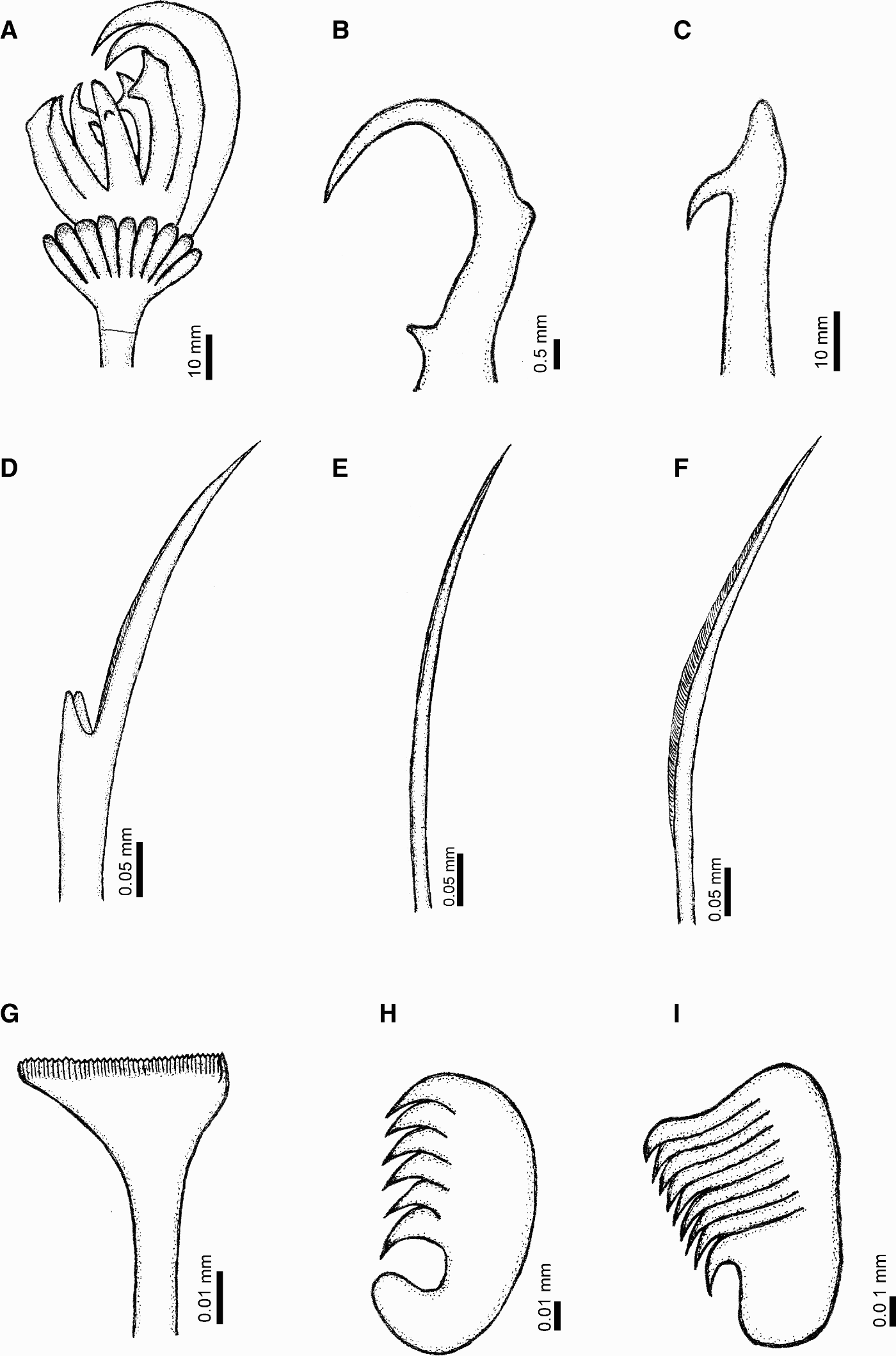
Operculum: total length 1.0 mm, having 26 radii and with blunt tips. Interradial grooves 1/3 of the funnel length (Figure 1A). Verticil with ten yellow to light-brown spines curving smoothly, not having lateral spinules, but with basal internal spinules or spines. Two dorsal hooks bigger than others, covering the central disc. The other spines are similar in shape and size, having pointed tips, and a knob, curving abruptly, geniculate (Figure 1B,C).
(A) Operculum, lateral view; (B, C) verticil spines, lateral view; (D) bayonet chaeta; (E) hooded (capillary) chaeta; (F) thoracic hooded (limbate) chaeta; (G) anterior abdominal flat-trumpet chaeta; (H) thoracic saw-shaped uncinus; (I) abdominal posterior rasp-shaped uncinus.

Collar chaetae: bayonet chaetae with pointed elongate teeth and distal blade smooth (Figure 1D); hooded (capillary) chaetae present (Figure 1E).
Thorax: 1.9 mm in length. Thoracic membrane well developed, forming apron. Six chaetigers with hooded (limbate) chaetae (Figure 1F). Thoracic uncini saw-shaped (Figure 1H).
Abdomen: with 61 chaetigers. Anterior and middle abdominal chaetigers with flat-trumpet chaetae (Figure 1G). Posterior chaetigers with ‘capillary’ chaetae. Anterior uncini saw-shaped and posterior uncini rasp-shaped (Figure 1G,H).
DISTRIBUTION
Gulf of Mexico, Caribbean Sea and Brazil (Paraíba).
DISCUSSION
The specimen is similar to the original description of Bastida-Zavala & ten Hove (Reference Bastida-Zavala and ten Hove2003a), who compared this species with three similar species, Hydroides similis (Treadwell, 1929), H. brachyacanthus Rioja, 1941 and H. cf. brachyacanthus Rioja, 1941. Our specimen does not have a tube; perhaps the collector withdrew it during sampling. The specimen has a smaller length in relation to the original description. One character that differed was the number of radii. Our specimen has 26 radii, while the specimens from the Caribbean have 17 radii (see Taxonomic key). In this paper we extend the known distribution of H. similoides from Venezuela to Picãozinho reefs in the State of Paraíba, north-eastern Brazil, in the south-western Atlantic.
ACKNOWLEDGEMENTS
We thank Dr Rolando Bastida-Zavala (LABSIM, UMAR, Oaxaca) for providing information about the species and for sending some references, and CNPq (Conselho Nacional de Desenvolvimento Científico e Tecnológico) for providing a Masters scholarship to J.E. de Assis, a scientific junior grant to D.A. Costa, and productivity grant to Dr M.L. Christoffersen. We also thank anonymous referees for valuable suggestions on the manuscript.