INTRODUCTION
Knowledge about the composition and diversity of metazoan (helminth) parasite communities in naturally depauperate ecosystems is limited. Deserts, tundras, or naturally acidic lakes and streams, are not frequently considered for patterns in biodiversity, probably because of their low species diversity (Odum, 1959). Yet, these unique natural ecosystems, like many other types, are under increasing threat from anthropogenic induced changes that may result in extirpation, or even extinction, of their unique fauna before it is better understood (Turner et al. 1999). In this study, we compare the diversity of parasites between naturally depauperate streams that vary in anthropogenic disturbance, and explain how changes may be affecting the composition of helminths and their hosts in these stream communities.
In the coastal-plains region of the eastern United States, naturally acid blackwater streams are among the most abundant type of freshwater ecosystem (Meyer, 1992; Smock and Gilinsky, 1992). Acid water limits the distribution of many organisms, including fish species that are not very acid tolerant, or which are trophically limited (Graham and Hastings, 1984). Increased urbanization and changing agricultural practices from traditional farming to industrial style animal production is changing the landscape (Whal et al. 1997; Mallin, 2000), and blackwater streams are more vulnerable to nutrient loading from agricultural and urban runoff than clear-water systems (Meyer, 1992; Mallin et al. 2004). There is evidence that anthropogenically derived stressors have changed water chemistry and significantly impacted the composition of fish communities in these stream ecosystems (Zampella and Bunnell, 1998).
In aquatic ecosystems, parasites are frequently used as biological tags, or indicators, for various aspects of host biology. Parasites can provide information on fish stock separation, fish recruitment migrations, fish diet and feeding behaviour, and host phylogenetics and systematics (Williams et al. 1992; Barber et al. 2000). Parasites rank among the most sensitive bioindicators because the prevalence and intensity of parasite infections in fish can reflect the health of entire aquatic communities (MacKenzie et al. 1995; Marcogliese and Cone, 1997; Marcogliese and Price, 1997). A typical parasite life-cycle may include the fish definitive host and several intermediate invertebrate hosts, and for the parasite to survive, all hosts must co-occur in a stable community structure (Thompson, 1982; Marcogliese and Cone, 1997). Changes in environmental conditions that affect any of the hosts, directly or indirectly, will have a significant effect on the prevalence and intensity of infection, and on the diversity of parasites infecting fish (MacKenzie et al. 1995; Marcogliese and Cone, 1997).
Environmental disturbance can have a positive, negative or neutral effect on parasites, depending on the type of pollution and parasite taxa (Möller, 1987; Khan and Thulin, 1991; Poulin, 1992; MacKenzie et al. 1995; Lafferty, 1997; Valtonen et al. 1997). Acid precipitation has a mixed effect on the intensity and prevalence of parasitic helminths (Lafferty, 1997), but eutrophication from the addition of fertilizers, and farm and sanitary waste has an overall positive effect on parasite abundance and diversity (Hanek and Fernando, 1978; Moser and Cowen, 1991; Lafferty, 1997). In these scenarios, variations in parasite response reflect the effect of disturbances on intermediate and definitive host survival, and on the survival of the free-living stages of parasites. Thus, parasites may be key in elucidating the impact of disturbances on whole communities and ecosystems, and in understanding the response to environmental disturbance by animals in the food web (Marcogliese and Cone, 1997; Marcogliese, 2003).
This study examines the composition and diversity of helminth endoparasite communities (Acanthocephala, Cestoda, Digenea, and Nematoda) that infect fish in the Mullica River watershed, which is located within the New Jersey (NJ) coastal plains region known as the Pine Barrens, or Pinelands (Forman, 1998). The Pinelands is a region of over 1 million acres of forests, farms, and developed areas nestled in the centre of one of North America's most populous regions, i.e. the New York City and Philadelphia metropolitan areas. High acidity and low concentrations of dissolved solids characterize minimally disturbed streams in this region (Morgan and Good, 1988; Zampella, 1994). These ‘reference’ streams typically support native fish communities (Zampella and Bunnell, 1998; Zampella et al. 2001). However, in streams degraded by eutrophication resulting from upland agriculture and development, native fish communities are vulnerable to invasion by non-Pinelands species (Patrick et al. 1998; Zampella and Bunnell, 1998). Patterns from various ecosystems suggest that as nutrients are added, species diversity often increases from very low to moderate levels with a rise in productivity (Mittelbach et al. 2001). Therefore, we tested the prediction that parasite species diversity would be higher in fish from Pinelands streams degraded by anthropogenic eutrophication.
MATERIALS AND METHODS
Characterization of study sites
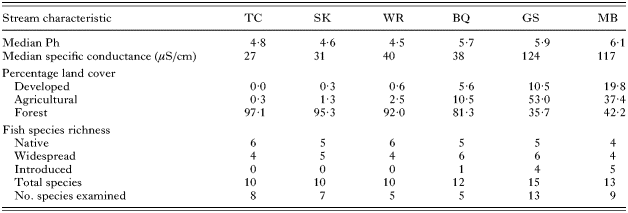
The Mullica River watershed is the largest basin within the Pinelands and consists of several coastal plains stream ecosystems (~1473-km2) within a wide range of land-use characteristics (Zampella et al. 2001). We selected 6 stream stations within a disturbance gradient characterized by increasing water pH, specific conductance, and percentage of developed and agricultural land. The stations were Skit Branch (SB), Tulpehocken Creek (TC), West Branch Wading River (WR), Batsto River at Quaker Bridge (BQ), Muskingum Brook (MB) and Great Swamp Branch (GS) (Zampella and Bunnell, 1998). These stations were used in previous fish and vegetation studies (Zampella and Laidig, 1997; Zampella and Bunnell, 1998). The median pH, median specific conductance, and proportion of upstream developed and agricultural land for each stream are summarized in Table 1. Previous studies have found larger fish assemblages, with an increasing presence of peripheral or non-Pinelands fish, in more degraded and less acid streams (Zampella and Bunnell, 1998).
Table 1. A summary of stream station biotic and abiotic characteristics, including the total number of fish species reported to occur in each stream and the number examined for parasites in this study (TC=Tulpehocken Creek, WR=Wading River, SK=Skit Branch, BQ=Batsto River, GS=Great Swamp Branch, MB=Muskingum Brook. Data are from Zampella and Bunnell (1998).)

Characterization of fish fauna
A total of 33 fish species has been reported from Pinelands waters, and these fish have been separated into 4 major biogeographical groups: restricted native, widespread native, peripheral, or introduced (Hastings, 1984, 1998). Restricted native species are limited to the Pinelands, whereas widespread native species occur throughout NJ. Peripheral fish species are native to NJ, but are mostly found outside of the Pinelands. Introduced species are not native to the state. In this paper we have grouped peripheral and introduced species together, and refer to them as introduced.
Fish sampling and examination for parasites
Fish were collected using a 4-mm seine for 1 h in all habitat types at each sampling station on 3 occasions between 1992 and 1995 (see Zampella and Bunnell, 1998). Fish were killed and stored in 70% alcohol in the laboratory until examined for internal parasites. At least 3 voucher specimens were kept for each fish species collected at each station (Zampella and Bunnell, 1998), and this prevented examination of all species in every stream's fish community for parasites. Thus, only 8 of 10 fish species from TC, 7 of 10 from SK, 5 of 10 from WR, 5 of 12 from BQ, 13 of 15 from GS, and 9 of 13 fish species from MB were examined for parasites. At 4 streams, TC, SB, MB, and GS, seining in 1998 and electroshocking in 1999 permitted collection of a larger sample size of fish specimens.
Each fish was given a unique Accession number based on its species name and site of collection. The entire fish was examined for internal parasites using standard parasitological methods, and parasites were identified to the genus level when possible using the keys of Hoffman (1999).
Data analysis
For every helminth parasite species within a stream, the proportion of each fish species infected, i.e. prevalence of infection was determined. The total number of worms of each parasite species infecting each fish species within a stream was calculated, and mean abundance (±S.D.) of every parasite was estimated. Two measures of parasite community diversity were used to compare between streams, including species richness (SR) and evenness using the Shannon diversity index (H1; Shannon, 1948). An SR and H1 value was calculated for the parasite community in individual infected fish, i.e. for every parasite infra-community (Bush et al. 1997). Then, parasite diversity was compared (1) between sites for all fish hosts regardless of species, i.e. the parasite component community (Bush et al. 1997); and (2) between fish species and fish biogeographical groups, i.e. native, widespread or introduced, within each stream. The catch-per-effort of some fish species was low, possibly reflecting a small population size relative to the other species caught in each stream. We therefore decided to include only those fish species with a minimum sample size of 3 infected individuals to get an estimate of variance for statistical analysis between fish species.
Diversity values were analysed using non-parametric statistics. Kruskal-Wallis one-way analysis of variance by ranks was done to analyse parasite component communities, with stream site as the grouping variable. For analyses within sites, a Mann-Whitney test was used when the grouping variables, fish species or biogeographical groups, compared 2 samples; a Kruskal-Wallis one-way analysis of variance by ranks was done when considering more than 2 samples (Daniel, 1990). Correlation between parasite diversity measures in each stream (mean SR and H1) and 3 surrogate measures of stream disturbance (median water pH and conductance, and the proportion of agricultural plus developed land) was explored using Spearman rank-order correlations. Significance for all comparisons was set at P<0·05. All statistical comparisons were done using SYSTAT 10.0 (SPSS Inc., Chicago, Illinois, USA).
RESULTS
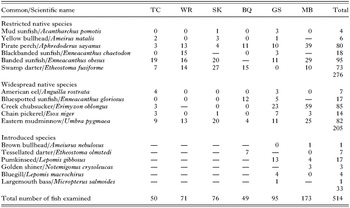
The total number of fish examined for parasites was 514, and these included individuals from 6 restricted native, 5 widespread native, and 6 introduced species. Introduced fish species occurred in only 3 streams, BQ, GS and MB, the most degraded stations with 16–63% developed and agricultural land (Table 1). The number of individuals for each fish species that was examined for parasites varied between streams (Table 2).
Table 2. The number of fish examined for helminth parasites in Tulpehocken Creek (TC), West Branch Wading River (WR), Skit Branch (SK), Batsto River (BQ), Great Swamp Branch (GS), and Muskingum Brook (MB) (– Represents fish that have not been recorded in the particular stream. Fish distribution status in the Pinelands (native, widespread, or introduced) is based on the classification in Hastings (1998).)

Overall, 401 (78%) of fish examined for parasites were infected with at least 1 type of parasite. The overall prevalence of infection in the fish community was over 85% at MB, GS and BQ. The lowest proportion of infected fish occurred at WR and was 44%. At SB and TC, the prevalence of infection in fish was 72%.
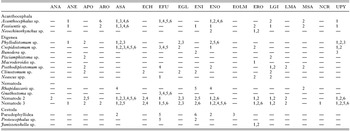
Eighteen helminth endoparasite species were found infecting fish from the 6 streams in this study. These parasites included 3 species of Acanthocephala, 3 species of Cestoda, 8 species of Digenea, and 4 species of Nematoda (Table 3). Thirteen species occurred as adults in fish, and 5 were juvenile stages that mature in fish-eating birds, mammals or other fish. Eleven of the adult parasites infected the intestine of fish, and these included all of the Acanthocephala (Acanthocephalus sp., Fessisentis sp., Neoechinorhyncus sp.), 4 of the Digenea (Crepidostomum sp., Bunodera sp., Pisciamphistoma sp., Macroderoides sp.), 1 of the Nematoda (Rhapidascaris sp.), and all Cestoda (Pseudophyllidea, Proteocephalus sp., and Janiszewskella sp.). Adults of Phyllodistomum sp. (Digenea) infected the fish urinary bladder, and the unidentified ‘nematode2’ (Nematoda) infected the swim bladder. Posthodiplostomum sp. (Digenea) occurred as juveniles, or metacercariae, in several fish visceral organs including the liver and spleen. Neascus sp. and Clinostomum sp. (Digenea) metacercariae infected fish skin or muscle, respectively. Gnathostoma sp. (Nematoda) occurred as juveniles in the intestine of fish. An unidentified ‘nematode3’ (Nematoda) occurred in cysts around the stomach or bile duct, and each cyst sometimes contained hundreds of individuals; the densities reported for this study are for the number of cysts. The life-cycles for all parasites have been described by Hoffman (1999).
Table 3. Summary of parasite occurrence in fish within the 6 streams studied (1=MB, 2=GS, 3=BQ, 4=WR, 5=SB, 6=TC) (Column labels represent the following fish species: ANA=yellow bullhead, ANE=brown bullhead, APO=mud sunfish, ARO=American eel, ASA=pirate perch, ECH=blackbanded sunfish, EFU=swamp darter, EGL=blue spotted sunfish, ENI=chain pickerel, ENO=banded sunfish, EOLM=Tessellated darter, ERO=creek chubsucker, LGI=pumpkinseed sunfish, LMA=bluegill sunfish, MSA=largemouth, NCR=golden shiner, and UPY=E. mudminnow.)

There were variations in the distribution of parasites among the different fish hosts within each stream community. Tables summarizing prevalence of infection, parasite abundance, and the proportion of the total number of individual worms in fish populations in each stream are available electronically at http://aesop.rutgers.edu/~sukhdeo/njpine.pdf. In many streams, the prevalence, abundance and the proportion of the total number of individual worms for the 5 most common parasites (Acanthocephalus sp, Fessisentis sp, Phyllodistomum sp., Crepidostomum sp, and nematode2) were higher in pirate perch fish relative to other fish.
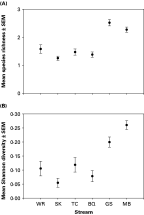
The diversity of the helminth endoparasite community infecting fish varied significantly between streams. There were significant differences in SR between streams (Kruskal Wallis test statistic (H)=94·94, D.F.=5, P<0·0001), and the highest richness was in fish from GS and MB (Fig. 1A). Shannon index for parasite species also varied significantly between streams (H=75·03, D.F.=5, P<0·0001), and GS and MB had the highest values (Fig. 1B).

Fig. 1. Helminth parasite community diversity in fish from 6 NJ Pinelands streams. (A) Mean parasite species richness and (B) mean parasite Shannon diversity index.
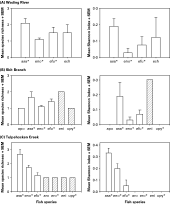
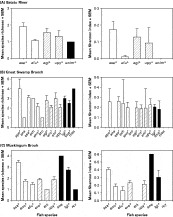
Within streams, there were significant differences in diversity between helminth communities infecting the various fish species. There were significant differences in parasite SR between fish at WR (H=8·2, D.F.=2, P=0·017), SB (H=7·87, D.F.=3, P=0·049), TC (H=16·96, D.F.=4, P=0·002), BQ (H=14·23, D.F.=4, P=0·007), GS (H=17·49, D.F.=8, P=0·025) and MB (H=57·48, D.F.=5, P<0·0001). In every stream, except GS, pirate perch were the fish with the highest parasite species richness (Figs 2 and 3). At GS, mud sunfish had the highest parasite richness, and pirate perch had the second highest value.

Fig. 2. Helminth parasite community diversity (mean species richness and Shannon's diversity index) in fish from (A) Waiding River, (B) Skit Branch and (C) Tulpehocken Creek in the NJ Pinelands. White bars represent native fish to the NJ Pinelands and stripped bars are widespread fish throughout NJ. Fish species labels are defined in Table 3. *Fish species with a minimum sample size of 3 infected individuals that were used in statistical analysis when species was the grouping variable (see Materials and Methods section).

Fig. 3. Helminth parasite community diversity (mean species richness and Shannon's diversity index) in fish from (A) Batsto River, (B) Great Swamp Branch and (C) Muskingum Brook in the NJ Pinelands. White bars represent native fish to the NJ Pinelands and stripped bars are widespread fish throughout NJ. Black bars represent fish introduced to Pinelands and to NJ. Fish species labels are defined in Table 3. *Fish species with a minimum sample size of 3 infected individuals that were used in statistical analysis when species was the grouping variable (see Materials and Methods section).
Parasite community H1 varied significantly between fish at WR (H=7·52, D.F.=2, P=0·023), SB (H=7·79, D.F.=3, P=0·05), TC (H=14·63, D.F.=4, P=0·006), BQ (H=13·95, D.F.=4, P=0·007), and MB (H=36·25, D.F.=5, P<0·0001). There were no differences in parasite community H1 between fish at GS (H=1·96, D.F.=8, P=0·98). Pirate perch in every stream had the highest parasite community evenness (Figs 2 and 3).
When fish were classified according to their biogeographical distribution, i.e. native, widespread or introduced, there were significant differences in parasite diversity between groups in some streams (Figs 2 and 3). Parasite SR was significantly different between fish groups at TC and was highest in native fish (Fig. 2; Mann-Whitney test statistic (T)=228, D.F.=1, P=0·001). At GS introduced fish had the highest parasite SR, and widespread fish had the lowest (Fig. 3; H=8·21, D.F.=2, P=0·016). Parasite SR was highest in introduced and native fish relative to widespread species at MB (H=14·13, D.F.=2, P=0·001). There were no significant differences in parasite SR between fish groups at SB (T=230·5, P=0·443) or BQ (H=3·2, P=0·202). No statistical comparison was made at WR because only native fish were infected.
Parasite community H1 was significantly different between fish groups at TC (T=228, D.F.=1, P=0·001). Native fish had a high parasite community H1 relative to widespread species in the same stream (Fig. 2). There were no significant differences in parasite community H1 between fish groups at the other streams (SB: T=227, P=0·515; BQ: H=3·5, P=0·171; GS: H=0·89, P=0·641; MB: H=4·71, P=0·09). No statistical comparison was made at WR because only native fish were infected.
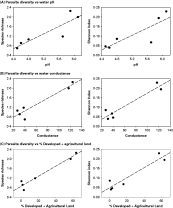
Measures of stream disturbance correlated positively with parasite diversity (Fig. 4). Parasite SR and H1 were significantly positively correlated with water pH (Spearman correlation coefficient (rs)=0·943 and 0·886; P=0·005 and 0·02 for each respectively). Conductance did not correlate significantly with parasite SR or H1 (rs=0·6 and 0·543; P=0·21 and 0·27 for each respectively). Both SR and H1 were positively correlated with the percentage of agricultural plus developed land in each stream (rs=0·771 and 0·60 for each respectively), but these correlations were not significant (P=0·07 and 0·21 for each respectively).

Fig. 4. The relationship between helminth parasite community diversity (mean species richness and Shannon's diversity index) and (A) water pH, (B) water conductance, and (C) percentage of forest land surrounding streams in the NJ Pinelands. See Results section for further details.
DISCUSSION
The fish species studied for helminth parasites from these 6 Pinelands streams are typical of coastal-plains ecosystems throughout the United States (Meffe and Sheldon, 1990; Sheldon and Meffe, 1994; Adams et al. 2004; Greenfield and Bart, 2005). In NJ, fish communities in these naturally acid streams are generally species poor, with only 16 of the 70 species reported as native to freshwaters in the State occurring in these unique ecosystems (Hastings, 1998). Introduced species occur as a result of humans stocking these fish for sport, and changes in water chemistry caused by agricultural and urban runoff have facilitated their survival and reproduction (Hastings, 1998). Most of the fish species previously recorded from each of the 6 streams studied (Zampella and Bunnell, 1998), including non-native species, were examined for parasites.
The helminth parasite communities infecting fish from acid blackwater streams have not been studied before. In the NJ Pinelands all major groups of endoparasitic helminths were found in the majority of streams, and all species require at least 1 invertebrate intermediate host. Digenea typically require mollusks and aquatic juvenile insects, and the Acanthocephala, Nematoda and Cestoda generally use crustaceans as their intermediate hosts. Thus, trophic interactions between fish and crustaceans, or fish and insects, are necessary for the successful completion of each parasite's life-cycle.
The majority (13/18) of endoparasite helminths in Pinelands stream fish are autogenic species, and trophic condition of blackwater acid streams may determine composition of the helminth community. Autogenic parasite species complete their entire life-cycle within the confines of an aquatic ecosystem, while species that use fish as intermediate hosts and mature in birds or mammals are considered allogenic species (Esch et al. 1988). In the Pinelands, only 4 helminth endoparasites complete their life-cycle outside of a stream and mature in birds or mammals. The trophic condition of an ecosystem is thought to be the ultimate determining factor for the type of helminth communities that infect fish (Wisniewski, 1958; Chubb, 1963; Esch, 1971). For example, a lack of interactions with organisms outside the system, like birds or mammals, in oligotrophic lakes is thought to result in the presence of more adult parasites and fewer larval stages than in eutrophic lakes (Esch, 1971), although this may not always be the case (e.g. Halvorsen, 1971; Wootten, 1973; Kennedy, 1978). Fish in the Pinelands are generally trophic limited because few organisms are acid tolerant (Graham and Hastings, 1984). Land-use around reference streams are mostly forested lands, and this may also limit wading birds from feeding regularly on fish in these streams. However, a combination of changes to the landscape and anthropogenic eutrophication is affecting conditions in some Pinelands streams. More degraded streams have less forested land and more open agricultural and developed areas surrounding these ecosystems (Zampella et al. 2001), and this may allow more trophic interactions between fish, and birds or mammals to occur. At the same time, anthropogenic eutrophication is making waters less acidic and more hospitable to a greater variety of invertebrate prey for fish (NJDEP, 2001). Our data show that the effects of these changes to the Pinelands coastal-plains ecosystem are being reflected in the helminth community composition that infects fish, with a greater presence of allogenic species at more degraded sites.
Variations in helminth parasite diversity between fish species suggest that pirate perch have the most diverse parasite community in the Pinelands. Pirate perch are a native species to NJ, and occur exclusively in Pinelands freshwaters within the State (Hastings, 1998). In North America, these fish are the only living genus and species in their family, the Aphredoderidae (Cooper, 1983; Nelson, 1984). Therefore, it is likely that pirate perch are a living-fossil species with old associations within Pinelands stream animal communities, and hypotheses that attempt to explain patterns in helminth parasite community diversity propose that phylogenetically older host species should have a higher diversity of parasites (reviewed by Poulin, 1998).
Native fish may have had a longer association with parasites in Pinelands waters, and a higher diversity, prevalence and abundance support the idea that the association is old (see Aho and Bush, 1993). Few studies have examined differences in the diversity of parasites infecting native versus introduced host species. Parasites that were introduced with exotic freshwater fishes in Hawaii are now infecting native fish species (Font and Tate, 1994). In areas where exotics have not invaded, the native fish are parasite free. In sharp contrast, hosts introduced into a novel environment generally do not carry their parasites with them because obligate intermediate hosts may not exist in the new habitat (Torchin et al. 2003). Introduced fish in the Pinelands are generally infected with a similar helminth parasite fauna as the native fish, but introduced fish have higher parasite infection levels with allogenic species that develop as juveniles in fish and that mature to adulthood in fish-eating birds. These parasites occur mostly in degraded streams, but the small incidence of infection in native species suggests that these fish are also vulnerable to infection.
Parasite species diversity is positively correlated to measures of anthropogenic eutrophication, or disturbance, in Pinelands streams. A review of patterns from diverse ecosystems predicts that anthropogenic eutrophication that results in an increase in productivity is positively related to species richness (Mittlebach et al. 2001). Anthropogenic eutrophication has been shown to result in an increase in the numbers and kinds of parasites in several ecosystems (Hanek and Fernando, 1978; Kennedy, 1978, 1985; Moser and Cowen, 1991; Valtonen et al. 1997). Land-use changes associated with anthropogenic eutrophication were used as surrogate measures for disturbance in the Pinelands, and patterns show that parasite diversity is positively correlated, especially with increasing water pH. In addition, some helminth species that occur in both reference and degraded sites show an increase in the total number of individuals present in the more degraded and productive stream ecosystem. For example, nematodes common in fishes' swim bladders occur in all 6 streams studied, and in each of the 3 most degraded sites, the total number of individuals is greater than in the 3 reference streams combined. These types of change could have significant effects on fish populations. For example, eutrophication in Lake Constance has resulted in an increase in diplostomid parasites that cause periodic early summer kills of adult perch fish (Perca fluviatilis) (Hartmann and Numann, 1977). Thus, anthropogenic eutrophication in the Pinelands increases the diversity of parasite species, and continued changes could eventually lead to detrimental effects to fish populations.
This study has described the composition and diversity of helminth parasite communities in naturally depauperate ecosystems undergoing changes related to anthropogenic disturbance. In the Pinelands, changes in water chemistry due to anthropogenic eutrophication results in changes to fish community composition because stream habitat becomes more hospitable to introduced species. These changes are influencing trophic interactions that affect helminth parasite community composition, and our data may help understand the structure and function of animal communities from these naturally depauperate ecosystems before continued anthropogenically induced changes results in the extirpation or extinction of their unique fauna.
We are grateful to R. Zampella for access to fish collected between 1992 and 1995. We thank the NJDEP for collecting permits, especially R. McDowell for permission to collect fish, and R. Barker, J. Rozmuz, and T. Pogranicy for permission to work at Wharton State Forest. S. Sukhdeo and R. Zampella provided useful comments on earlier drafts of this manuscript. Statistical advice and assistance from C. Goss and two anonymous reviewers are greatly appreciated. This study was partially funded by grants to A.D.H. and M.V.K.S. by the New Jersey Water Resources Research Institute, and State Hatch funds to M.V.K.S.