The 2011 Nobel Peace Prize was awarded to Liberian president Ellen Sirleaf Johnson and grassroots activists Leymah Gbowee from Liberia and Tawakkol Karman from Yemen, in recognition of the contributions of women's organizations to foster peace. Does the award merely reflect wishful thinking, or do women's organizations (WOs) actually make a difference for peace and postconflict reconstruction? The Nobel Committee's emphasis on WOs in peacemaking contradicts the common perception that civil society organizations (CSOs) rarely matter during postconflict transitions (e.g., Donais Reference Donais2012; Richmond and Mac Ginty Reference Richmond and Ginty2015). However, I argue that social actors and WOs can make a difference in peacebuilding and postconflict reconstruction under the right conditions. Looking at social networks helps us understand when local CSOs and WOs can help United Nations (UN) peace missions engage with local actors in peacebuilding.
Successful peacebuilding—which I define as overcoming the causes of previous conflicts and fostering stable postconflict peace through political institutions and social and economic reconstruction (Paris and Sisk Reference Paris and Sisk2009)—requires both state capacity and horizontal networks to support social trust and cooperative ties between the state, elites, and civil society. Networks bringing together different communities and local actors enhance bridging social capital and connect separate networks. Thus, bridging social capital facilitates the flow of information on the needs and demands of local actors to elites and state structures (Granovetter Reference Granovetter1973; Lange Reference Lange2003, 374).
In this article, I detail how the structure and types of social networks in postconflict environments impact local peacebuilding. Sustainable postconflict reconstruction requires both vertical networks linking elites and societal actors and horizontal social networks building bridging social capital. While linking social capital shapes ties between elites and social actors, stronger horizontal social networks give communities higher capacity to mobilize and engage with political elites. In a postconflict context, state capacity and social capital are generally low, or in some cases nonexistent, with weak links between elites and societal actors. UN missions can function as a broker between political elites and civil society by enhancing preexisting horizontal networks and reinforcing links between elites and local communities. I apply insights from research on social capital and network analysis to capture connectedness between actors and how this can strengthen or weaken peacebuilding. Stronger horizontal networks do not alone guarantee peace, but bridging horizontal social networks that transcend ethnic, tribal, and religious divisions provide greater social capital for postconflict reconstruction.
WOs are an example of horizontal social networks that connect different groups and facilitate the flow of information from society to elites. WOs are civil society organizations usually led by women. While these organizations can have diverse aims, often overlapping with those of other CSOs, they predominantly use a gendered approach focusing on the interests, needs, and wants of local women, such as gender-based violence, peacebuilding, agriculture, and economic development. WOs can play an effective role and engage with external actors, such as UN peace missions, if there is sufficient preexisting capacity to mobilize. At that point, the UN can provide additional resources to help strengthen these organizations’ ability to engage with local political elites. I evaluate these theoretical claims about WOs and their interactions with UN agencies over the period 2003–11, using evidence from semistructured interviews conducted with WOs in Liberia, other local CSOs, and officers of the United Nations Mission in Liberia (UNMIL), as well as staff in other UN agencies, international nongovernmental organizations (INGOs), and staff in the Liberian Ministry of Gender, Children and Social Protection (Ministry of Gender). Using regional variation in social networks within Liberia allows me to examine how differences in peace-building success were contingent on the activities of local WOs and what constraints impeded them from working with external actors.
Liberia's WOs played an important role in the peacebuilding process and mediated the Accra Comprehensive Peace Agreement, signed in 2003 to end the second Liberian civil war that had resumed in 1999 (O'Reilly, Súilleabháin, and Paffenholz Reference O'Reilly, Súilleabháin and Paffenholz2015). Combined, the two Liberian civil wars (1989–96 and 1999–2003) led to approximately 250,000 deaths (nearly 10% of the population), the displacement of around a million people into refugee and internally displaced person camps, the dismantling of the national economy and infrastructure, and the destruction of the Liberian state (Karim and Gorman Reference Karim and Gorman2016). The UN peacekeeping mission in Liberia arrived in 2003 to support the postconflict state structures and assist in the maintenance of law and order. The UNMIL at its peak was one of the largest UN missions, consisting of up to 15,000 UN military personnel and 1,115 police officers, along with a civilian component, and deploying in both rural and urban Liberia, including regions bordering Sierra Leone, Guinea, and Côte d'Ivoire. It finally completed its mandate on March 30, 2018.
In general, horizontal networks have been more robust in areas where local communities and women already had a tradition of organizing, thus boosting bridging social capital.Footnote 1 However, these networks have remained fairly weak, because the UNMIL's and UN organizations’ policies tend to strengthen hierarchical ties and elite networks. Supporting hierarchical links undermines bridging social networks and prevents local WOs and CSOs from playing an active part in postconflict reconstruction and meaningful interactions with elites and the state.
In the next section, I review existing research on local actors in peacebuilding. The following section uses concepts from the social network literature to show how different forms of social capital and networks impact postconflict reconstruction. Then I outline the research approach and describe the evidence from Liberia on the interactions between WOs and UN organizations along two dimensions: the degree of strength of WOs and the presence of the UNMIL and UN agencies in a region. The final section concludes and expands on policy implications.
UN PEACE MISSIONS AND LOCAL ACTORS
Many observers take a pessimistic view of the ability of UN missions to foster peace, highlighting the spectacular failures in Somalia, Rwanda, and the Democratic Republic of the Congo. By contrast, optimists point to successful UN operations in Mozambique, Namibia, and Sierra Leone (Howard Reference Howard2008). Some highlight how UN peacekeeping operations in general limit the recurrence of violence and protect civilians (e.g., Fortna Reference Fortna2004, Reference Fortna2008; Howard Reference Howard2002; Ruggeri, Dorussen, and Gizelis Reference Ruggeri, Dorussen and Gizelis2017). Others stress that UN peacekeeping operations often fail to build sustainable peace by not addressing peripheral communal conflicts, engaging local communities, or adequately protecting civilians (e.g., Autesserre Reference Auteserre2010; Hultman Reference Hultman2010; Pouligny Reference Pouligny1999, Reference Pouligny2006).
Both peacekeeping optimists and skeptics highlight the challenges of engaging with local actors. Missions often follow a top-down organizational logic, targeting central authorities, and peacekeepers and external actors are often insufficiently sensitive to local agendas and sources of conflict (Autessere Reference Auteserre2010; Paris Reference Paris2004; Paris and Sisk Reference Paris and Sisk2009). Missions often lack the resources, expertise, or political will to enhance political engagement by local actors or to provide effective governance during the transition from a conflict to a postconflict society (Auteserre Reference Auteserre2009, Reference Auteserre2010; Pouligny Reference Pouligny2006). Contradictory perspectives and visions on peacebuilding often lead to divergent goals and agendas by external actors, undermining the involvement of grassroots organizations. Civil society actors depend on external donors who shape the policy agenda for funding and often get entangled in local disputes dominated by the political elites. Thus, local civil organizations cannot flourish without the security and safety that UN missions can provide (Belloni Reference Belloni2001, Reference Belloni2007; Donais Reference Donais2012; Fagan Reference Fagan2005).
Two theoretical traditions offer competing viewpoints on how external actors should engage with locals in a postconflict country. The liberal tradition assumes that institutional transformation of postconflict countries can facilitate conflict management and resolution in the long run. This approach focuses on interactions between external interveners and local elites (Donais Reference Donais2012; Paris Reference Paris1997). External actors act as brokers and guarantee peace by supporting political transformation (Duffield Reference Duffield2001; Sisk Reference Sisk1996; Walter Reference Walter1997). Local elites or political entrepreneurs are perceived as actors in the conflict and must be involved in any solution to prevent recurrence (Cunningham Reference Cunningham2006; Lake and Rothchild Reference Lake and Rothchild1996). The liberal tradition leaves little space for CSOs or WOs to be relevant to peacemaking and peacebuilding.
The alternative communitarian approach emphasizes the importance of grassroots and community organizations in postconflict reconstruction (Lederach Reference Lederach2008). Grassroots and civil society organizations are particularly relevant in the aftermath of civil wars in deeply divided societies (Azar Reference Azar1990; Ramsbotham, Woodhouse, and Miall Reference Ramsbotham, Woodhouse and Miall2011). The bottom-up approach focuses on local ownership and active engagement of communal groups, local business people, religious leaders, women, and youth organizations (Pouligny Reference Pouligny2006). The concept of “peace” is expanded to incorporate the experiences and perceptions of different actors, including WOs. Several scholars underline the limits of the liberal approach to peacebuilding (Mac Ginty and Richmond Reference Mac Ginty and Richmond2013). The hybridity approach emphasizes intersubjective mediation between local and international factors and norms, while conflict between the international and the local is mitigated in everyday life (Richmond Reference Richmond2015, 51). Others emphasize friction and unexpected outcomes in interactions (Millar, van der Lijn, and Verkoren Reference Millar, van der Lijn and Verkoren2013, 142). Yet most approaches to peacebuilding do not develop a comprehensive framework to capture the structures in which these diverse actors interact.
LOCAL SOCIAL NETWORKS IN POSTCONFLICT CONTEXT
Research on governing the commons emphasizes the role of social organizations and localized leadership in collective action and effective governance (Ostrom Reference Ostrom, Dasgupta and Serageldin1999). The structure of social networks shapes the abilities of communities to self-organize, pool resources, and coordinate with the central government. Unlike other forms of capital that are tangible, such as individual assets, social capital is embedded in relations and interactions among agents, but it still helps individuals achieve ends they otherwise could not obtain (Coleman Reference Coleman1990, 302; Lin Reference Lin2002). There are multiple definitions of social capital emphasizing different dimensions (for an extensive review, see Portes Reference Portes1998). I rely primarily on Coleman's definition of social capital to emphasize communal relationships and networks in a particular social context. More specifically, social capital is determined by the social structure linking different entities that facilitate interactions between actors (Coleman Reference Coleman1988, 98; Coleman Reference Coleman1990, 302; Putnam Reference Putnam2000, 19). Coleman's definition is quite broad, but it highlights the links between social capital and human capital creation (Portes Reference Portes1998). Net social capital in a community facilitates collective action and enhances human capital, thus contributing to overall development (Coleman Reference Coleman1988; Colletta and Cullen Reference Colletta and Cullen2000; Grootaert Reference Grootaert1998; North Reference North1990; Putnam Reference Putnam1993, Reference Putnam2000; Woolcock Reference Woolcock1998).
Pretty and Ward (Reference Pretty and Ward2001, 211) identify four components of social capital: trust, reciprocity, common rules and sanctions, and connectedness between networks and groups. Networks and groups can be linked by vertical or hierarchical connections (linking social capital) or horizontal ones (bridging social capital). In peacebuilding, initial vertical connections are primarily developed between external actors and local actors, both elites and CSOs. During postconflict reconstruction, hierarchical connections develop between local elites, while horizontal connections (bridging social capital) grow between local CSOs. Horizontal connections tend to be symmetrical in power and foster trust, producing distinct ties that transcend ethnic or kinship lines. Such networks can mitigate interethnic conflict and foster more cooperative relationships and forums to build consensus (Varshney Reference Varshney2001; Woolcock and Narayan Reference Woolcock and Narayan2000). Trust, in turn, allows for information and resources to flow between different groups and ultimately strengthen horizontal networks.
When intrastate wars destroy formal institutions and the economy, local informal and traditional social structures provide alternatives to overcome challenges in the aftermath of war. Even if conflict weakens horizontal social networks, the remnants of prior stronger social capital and informal networks can still improve the prospects for postconflict reconstruction (Colletta and Cullen Reference Colletta and Cullen2000; Collier et al. Reference Collier, Elliot, Hegre, Hoeffler, Reynal-Querol and Sambanis2003). Yet synergies between local associations and networks do not always arise automatically in postconflict states but require UN's willingness to interact with local actors and networks as well as the ability of local actors to sustain and develop horizontal networks. Integrating local communities into peacebuilding processes reinforces the flow of information from societal actors to elites transforming the institutions that have contributed to the conflict in the first place (see Doyle and Sambanis Reference Doyle and Sambanis2000). External actors can provide CSOs with additional resources to enhance their sustainability, expand ties with other organizations, and build their capacity to interact with elites. Beyond financial resources, this also includes “know-how” such as skills training, empowerment, and developing local leadership. This transfer of resources from external actors to local organizations can help foster denser horizontal networks transmitting information to elites and representing the interests of different communities.Footnote 2
In Liberia, there are many examples of external actors reinforcing local networks and fostering synergies between local social actors and the state. The United Nations Development Fund for Women (UNIFEM) and the United Nations Development Programme (UNDP) supported farming projects and other small-scale communal activities by women's organizations. These programs were intended to build the capacity of local organizations and empower women to become active in the local economy. The UNDP worked with the government of Liberia and the Ministry of Gender, Children and Social Protection in Liberia to assess the impact of gendered policies in agriculture improving productivity (Bekoe and Parajon Reference Bekoe and Parajon2007; UNIFEM and UNDP 2004). One of the best examples of UN activities encouraging local horizontal networks was the collaboration between local women and UN police (UNPOL) personnel. Kristin Fjell (a former UNMIL police officer) and Jane Rhodes initiated the Female Police Support Network in 2013 to create a channel for communication between female local police officers and UNPOL. The network included a committee of female police leaders in the UNMIL and local officers. The network evolved to include leadership and riot training, a motorcycle course, and first aid, and it allowed local policewomen to set the agenda to fit their local needs. The network survived after Fjell's departure. Fjell attributed the success of the network to two factors: the commitment of the UNMIL leadership and the capacity of the Liberian female officers to maintain the network on their own (narrative at the “Local Communities and Effective Peacekeeping” workshop, London, June 2, 2016, and UNMIL PowerPoint report 2013–14).
Yet, while foreign actors often develop hierarchical links with local CSOs, as the examples from Liberia illustrate, these efforts do not automatically create or regenerate social capital, especially bridging capital (Pretty and Ward Reference Pretty and Ward2001). Providing resources in hierarchical ways can also be counterproductive, if it does not foster bridging social capital leaving horizontal networks fragile, unable to bridge different ethnic, religious, and tribal groups. Titeca and Vervisch (Reference Titeca and Vervisch2008, 2219) illustrate how in Uganda external actors failed to balance hierarchical support with developing bridging capital among local communities. In fact, new external resources and information often overwhelm existing local networks and erode local trust and CSOs connections to other organizations. As a result, CSOs do not deepen their networks and lose the capacity to generate new resources. Without strong horizontal networks, CSOs have limited ability to engage with the state, while the flow of information toward state institutions becomes restricted leading to lower accountability by the state (Pretty and Ward Reference Pretty and Ward2001).
The theoretical arguments developed in this section imply that horizontal networks present in an area should help identify conditions that weaken or strengthen prospects for peacebuilding success. Successful synergies between local social actors and elites depend on two conditions. First, local horizontal networks must be sufficiently dense to transmit information between diverse actors. Areas with a history of more organizations in the prewar period are expected to have denser horizontal networks in the postwar period and thus better prospects for peacebuilding. Second, horizontal networks are not a sufficient condition for peacebuilding. How UN missions interact with existing horizontal networks impacts their ability to play an active role in peacebuilding and connect to local elites.
Women experience conflict, but also postconflict environments, in different ways than men; thus, they form their own preferences and priorities for peacebuilding. Issues of development and often human rights concerns intersect with security, giving rise to a more inclusive idea of peace (O'Reilly, Súilleabháin, and Paffenholz Reference O'Reilly, Súilleabháin and Paffenholz2015, 6). At the same time, postconflict social networks, such as CSOs and WOs, adopt values from the international community, but convergence with the priorities promoted by international organizations, NGOs, and the UN system is not uniform or consistent. Gaps between international resolutions and programs and the priorities of local CSOs and WOs lead to a decoupling of general values from practical action (Gizelis and Joseph Reference Gizelis and Joseph2016). A mismatch of priorities between external and civil society actors, along with a reliance on policies that strengthen hierarchical structures, will eventually weaken horizontal social networks and groups. UN peace missions that focus on providing resources without improving the independent capacity of civil society to pursue its own priorities might undermine peacebuilding.
RESEARCH DESIGN
I use WOs as an example of horizontal networks. Gender identity provides a broader foundation for recruitment across other identities, and women often unite across different social, economic, ethnic, and religious backgrounds. Moreover, women have traditionally followed different patterns of political engagement than men, favoring informal social networks in which they play more prominent roles than in traditional political institutions. They tend to prefer activities that appear at first to be apolitical, focusing on issues relevant to the well-being of their communities. For this reason, they become more active at the local level and prefer structures that are less hierarchical (Eliasoph Reference Eliasoph1998).
Liberia has significant variation in societal organizations across its different counties, reflecting different traditions and customs of organization among a large number of ethnic groups and local languages.Footnote 3 Women's status within Liberia varies across urban and rural areas and across regions depending on historical local customs and practices. These differences in local capacity in organization and mobilization help identify distinct forms of networks in postconflict Liberia. Although not all WOs bridge, representatives of WOs in Liberia have stressed the importance of gender identity in experiencing conflict as well as the need to recruit women from different backgrounds.
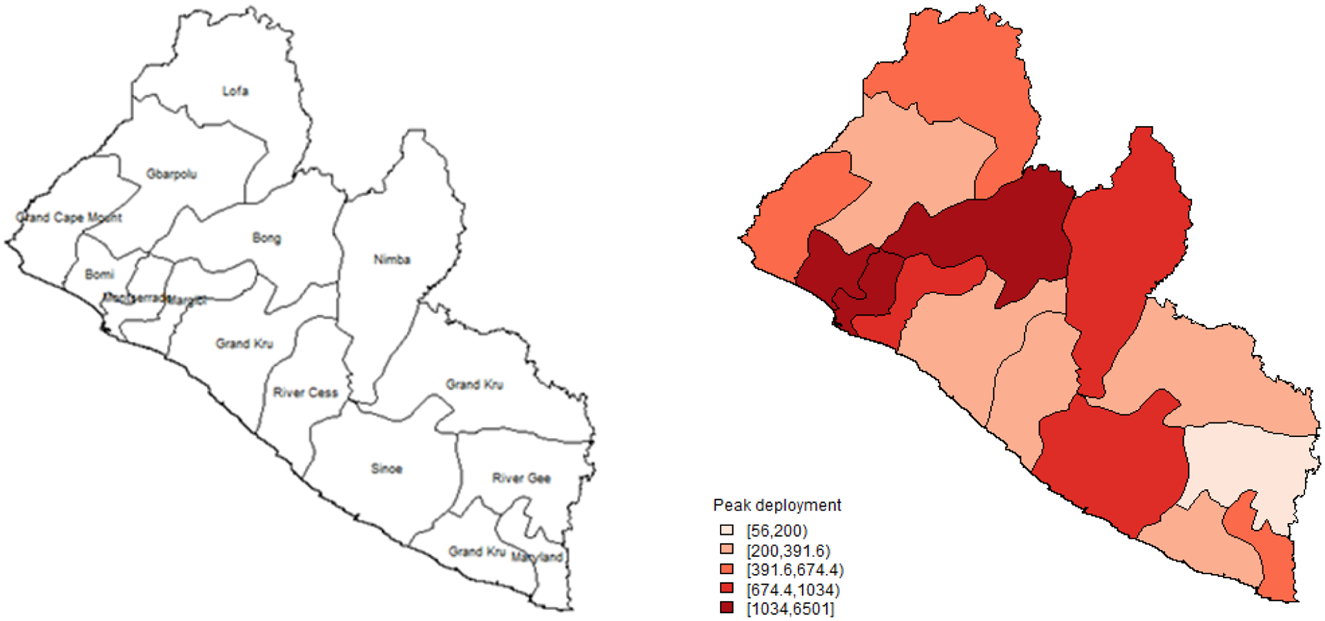
I conducted interviews in four counties, which were selected based on two criteria. The first criterion was UN presence, as a proxy for external actors. I gauged UN presence by the net number of peacekeepers in a particular area. Figure 1 plots the number of peacekeepers for each county in Liberia (based on data sources from Ruggeri, Dorussen, and Gizelis Reference Ruggeri, Dorussen and Gizelis2017).Footnote 4 It is clear from Figure 1 that most peacekeepers were deployed in Monrovia and in a corridor running through Bong County. We also see high numbers of peacekeepers in the counties of Margibi, Nimba, and Sinoe.
Counties and locations of the UNMIL in Liberia.

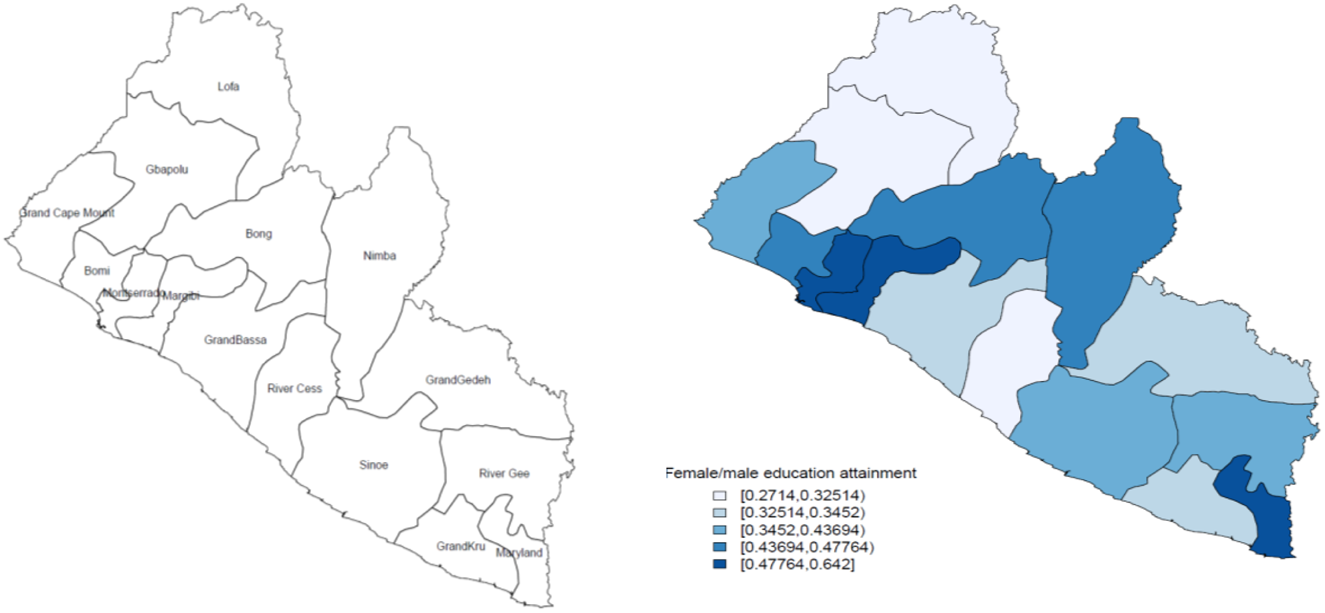
The second criterion was the ratio of female to male educational attainment as a proxy for women's relative status (Figure 2). There has been a long debate on how best to measure female empowerment and status (Caprioli Reference Caprioli2005; Hudson et al. Reference Hudson, Caprioli, Ballif-Spanvill, McDermott and Emmett2008–09; Melander Reference Melander2005). Here, I chose educational attainment to reflect relative differences in women's education rather than absolute development. Additionally, educational attainment could be an appropriate proxy for skills and ability to organize and mobilize (Barro Reference Barro1997; Hausmann, Hwang, and Rodrik 2007; King and Hill Reference King and Hill1993). I used information on female and male educational attainment from the prewar census of 1974 and the first postwar census of 2008.Footnote 5 Figure 2 shows the differences in female/male education attainment ratio in the 1974 prewar census.Footnote 6 The ranking of the relative differences in female and male educational remained stable in the 2008 census across counties, despite the devastating absolute impact of the civil war.
Female/male education attainment ratio.

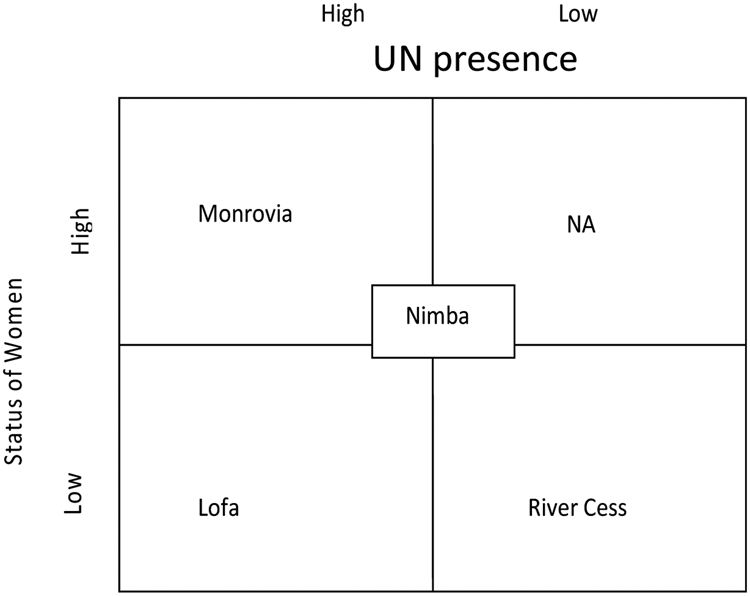
Figure 3 summarizes the selection of the interview areas based on UN presence and female/male educational attainment ratio. Monrovia was a case of high UN presence and high female status. Lofa had high UN presence but low female status. River Cess was low on both criteria. Unfortunately, in Liberia there was no area that combined low UN presence and high female status. However, Nimba provides an intermediate case with high UN presence, with women's status in between the levels in Monrovia and Lofa. The classification of the different counties as high and low areas of female empowerment was consistent with other studies (Fuest Reference Fuest2008; LISGIS 2008a, 2008b).Footnote 7
Selection criteria and counties in Liberia.

Based on the characteristics of the counties and the historical role of WOs, I expect significant variation in the capacity of local organizations. Denser networks and higher levels of interactions between WOs, external actors, and UNMIL might be more common in Monrovia, Nimba, and to some extent Lofa. I investigate these relationships using semistructured interviews. The sample included 28 WOs and CSOs: six in Monrovia, nine in Nimba County, five in River Cess, and seven in Lofa.Footnote 8 The interviews also involved 10 (four women and six men) UN officials and representatives of major international NGOs deployed in Liberia in 2011.Footnote 9 I also interviewed three gender coordinators (the representatives of the Ministry of Gender in the counties) in Lofa, Nimba, and River Cess.
The WOs did not constitute a randomly selected, representative sample because there was no available information on the population of all WOs. However, the local organizations included in the interviews were diverse and varied significantly in other features that might have been relevant to their experiences and priorities, such as size, capacity, longevity, education of leaders, and range of activities. Initial contacts in the Office of the Gender Adviser in the UNMIL provided a list and contact names of the most prominent WOs in Monrovia, while a local researcher (Salif Massalay) provided information on local organizations in the selected areas.
I used two initial criteria to choose organizations within the counties: the age and the location (urban versus rural) of the organizations. The expectation was that the presence of older, better-established WOs would constitute evidence of higher capacity and stronger horizontal networks. Subsequently, I used snowballing sampling to increase the number of organizations included in the sample. During the interviews, it became apparent that some of the interviewees were representing larger umbrella organizations such as Rural Women with clear links to local gender coordinators, while other groups functioned in the fringes of their respective networks with very limited contacts either with the coordinators or with other organizations.
Most WOs and CSOs had more than one representative present during the interview. One case included seven representatives, but in most cases two or three representatives participated. Most of the representatives were women. The interviews followed a preset protocol of questions in four sections. The protocol included questions on the history of the organization and its members; questions about the ability of women to organize in Liberia as a whole and in the region/county in particular, including about the number of women's organizations within a particular region or city; and questions about the specific organization, its structure, membership, and ways of communicating with members and other organizations. The last section of the protocol focused on interactions between the local organizations and external actors, especially the UNMIL and other UN agencies.Footnote 10
In some interviews, I deviated from the original set of questions and asked additional questions or rephrased questions to corroborate information obtained from previous interviews or personal observations. In several instances, I asked additional questions to assess the ability of the representatives to engage with the political processes in the country at the time, and I used independent observations to verify some of the claims (Fujii Reference Fujii2010). For instance, if the interviews were conducted in a women's center, I asked about the funding, construction, and use of the center. The overall state of the centers provided independent information about the capacity of the organization and its autonomy. Additionally, questions on how they were communicating with their members provided clues about to their ability to travel to remote areas. In general, the year of the organization's establishment, their experiences of directly collaborating with UN agencies or INGOs, the areas of activities of the organization, and the ability of the representatives to comment on current events provided a good indication of the relative capacity of the organizations and the potential of forming sustainable horizontal networks.Footnote 11 While it was clear that in some interviews, the representatives were either evasive or not forthcoming about the state of organizations, in most interviews they were quite vocal and both eager and animated on the challenges they faced, as well as their hopes and fears about the future. By 2011, women representatives were outspoken and forthcoming on the state of their communities and in many instances openly critical of the government, the Ministry of Gender, and the UN.Footnote 12
Among the organizations, some were established in the mid-1990s, but many WOs were on the ground between 2004 and 2005—eight organizations out of the 28 included in the analysis. Another seven organizations were established in the period 2008–10, a few years after Ellen Sirleaf Johnson became president. Most organizations sought to both promote the economic welfare of their members through efforts such as agricultural projects and engaging in local peacebuilding. Very few organizations, mostly supported by INGOs, focused exclusively on a single topic, such as female genital mutilation or sexual violence. For the majority of the organizations, strengthening economic projects was the clear priority and means to support other community-oriented projects such as literacy, health education, and peacebuilding.
WOMEN'S ORGANIZATIONS IN THE LIBERIAN CONTEXT
Although it is a poor country with a history of political dominance by the descendants of the Americo-Liberian settlers, Liberia has developed an extensive civil society. Local CSOs emerged in Liberia in the late 1940s. Despite the two devastating civil wars, independent media began to flourish in the 1990s, while an influx of foreign NGOs and international actors provided resources to CSO and local NGOs. The 2010 CIVICUS Civil Society Index awarded Liberia a score of 55.9, indicating a high level of civil and citizen engagement. Yet the capacity of Liberian organizations has remained low, especially in rural areas, where most CSOs are in dire need of continuous support from external donors and have limited ability to establish comprehensive bridging networks with other NGOs (Heinrich and Fioramonti Reference Heinrich and Fioramonti2007).
High civic engagement in Liberia is often rooted in the so-called secret societies—Poro for men and Sande for women. These societies are linked to traditional forms of organization and mystical religious beliefs among West African ethnic groups, especially ethnic groups belonging to the languages of Kuwa (southern Liberia), Mel (northern borders and coast), and Mende (northwest). They are not unique to Liberia but cut across ethnicity and borders with Guinea, Côte d'Ivoire, Liberia, and Sierra Leone. Historically, they have been predominantly active in northern, northwestern and central-western, Liberia including the counties of Lofa and Nimba. The secret societies have been protected by official regulations since 1924 and have often been co-opted by the central government (Sawyer Reference Sawyer2005). During the civil war, despite forced migrations that exacerbated the depopulation of the northwestern counties, the secret societies were able to restructure their power in the local communities to fill the power vacuum left by the receding central government during the civil war, albeit in a more limited role. On the contrary, in southeastern Liberia, communities lacking the structures of the secret societies fled into the rainforest to avoid the conflict as a survival strategy (Sawyer Reference Sawyer2005, 6).
Secret societies remained prominent after the end of the war. The chief Poro zoe is the head of the National Council of Chiefs and Elders, the representative body of traditional authorities in Liberia, and advises the government of Liberia on matters of internal security and stability (UNMIL and OHCHR 2015, para. 20). Variation in networks is also mirrored in women's organizations, with Sande being the most active traditional organization in northwestern and central Liberia. According to the 2007 Demographic and Health Survey (LISGIS 2008a), between 80% and 90% of women in north-central and northwestern Liberia were members of the Sande society, but only 1.5% in parts of southeastern Liberia. Sande has been active primarily in the areas of social etiquette, controlling the behavior of women as wives and members of the community, and building bonds among women, but also engaging in controversial practices and human rights abuses (Fuest Reference Fuest2010; Immigration and Refugee Board of Canada 2017; personal interview with male UN official in Lofa County, June 2011). In addition to preexisting social networks in the form of Sande, women in north-central counties of Liberia, such as Nimba, have had relatively higher education than men, which, in turn, provided considerable opportunities to act politically (Fuest Reference Fuest2008, 206–7).Footnote 13
The Liberian civil wars created unique conditions in which women in Nimba and Lofa became family breadwinners by necessity, while the interborder trade with Guinea offered them new employment opportunities. The war forced them to abandon agriculture and concentrate on more commercial activities such as baking and selling produce across the border (interview with female representative of WOs, Lofa County, June 2011). By the late 1990s, women had started organizing, often using previous networks and experiences, in the refugee camps to address the serious economic and social problems they were facing. These social organizations, primarily driven by the need for survival, aimed to support women who were widowed and lacked the means to support themselves and their families (personal interviews with women's organizations in Lofa and Nimba, June 2011).
Charles Taylor supported entrepreneurial activities among women to guarantee food supplies during the civil war, inadvertently strengthening their role as local mediators, peacemakers, and even as informants (Porter Reference Porter2007). Liberian women fostered contacts with faction leaders and facilitated meetings between Taylor and rebel leaders (African Women and Peace Support Network 2004). They lobbied faction leaders to gain access to the treaty talks while mobilizing women to use nonviolent methods such as public sit-ins and prayers (interview with Lindora H. Diowara, coordinator of WIPNET, Monrovia, June 2011). In the formal peace talks in Akosombo and Accra in 2003, the Liberian section of the Mano River Union Peace Network (MARWOPNET) was accredited as a participant to the conference. The women facilitated the process as mediators and their involvement was instrumental in supporting the demobilization process (interview with Mary Brownell, former chair of the Liberian Women's Initiative and founding member of MARWOPNET, Monrovia, June 2011). After the completion of the negotiations, WOs shifted their focus to other issues such as disarmament, demobilization, and reintegration (DDR) programs, engaging women in the peacebuilding process, and mobilizing women to participate in the elections of 2005 (Basini Reference Basini2013; Bekoe and Parajon Reference Bekoe and Parajon2007).
Evidence of Horizontal Networks: Local Variation Matters
Earlier, I argued that areas with a greater history of prewar organizations and networks should be expected to have denser horizontal networks in the postwar period. Inevitably, the better-known and better-organized WOs were established in Monrovia. Yet various interviewees suggested that WOs focusing on women's concerns had emerged in Nimba County by the late 1990s. The networks in Nimba and Lofa have had higher overall capacity and ability to develop deeper interactions with wider range of societal actors and groups (e.g., youth clubs, other CSOs) compared with the more rural areas of Lofa or River Cess counties, where the organizations relied on walking or setting up meetings during the market day or occasionally used radio stations to reach women in the most remote parts of the country.
The interviews suggested four factors contributing to the rise of WOs in that region. One, social networks through societies such as Sande existed before the wars. Historically, women in Nimba formed social clubs and provided support for members in the form of sou-sou, a common form of pooling resources in West African communities. Women from Nimba County narrated how their mothers often met to socialize. But they also clearly drew a difference between the social groups common in previous generations to the more structured organizations that have emerged in postconflict Liberia. While interviewees in Nimba mentioned sou-sou, that was not the case in River Cess or Lofa (interviews with several female representatives of WOs and a female government official in Nimba, June 2011).
The existence of informal social clubs among women provided evidence of loose networks prior to the onset of the civil wars, at least in parts of Nimba and maybe in parts of Lofa. In these prewar networks, most of the members were members of Sande. It is not coincidental that Sande has remained particularly influential among rural women in Nimba and Lofa counties. Despite controversial practices such as female genital mutilation, historically Sande fostered bonding and support among its members, adding an extra layer of interconnections among these networks. A lot of the rural WOs’ leaders appeared to maintain links with Sande, but the role of Sande on matters related to peacebuilding projects is not prominent. A couple of the interviewees, despite the overall secrecy surrounding the role of Sande, hinted at the existence of such links. Rural WOs that focus on developmental goals such as education, economic production, and peacebuilding among religious and ethnic communities can have links to Sande without any obvious tensions. On the contrary, WOs focusing primarily on gender-based violence have been predominantly linked to INGOs such as the International Rescue Committee through hierarchical networks. It is questionable whether these WOs could promote their agenda in the absence of the International Rescue Committee or any linking capital, especially since the emphasis on gender-based violence could lead to tensions with Sande and isolation from other horizontal networks.
Second, in Nimba, women have had higher levels of education relative to men compared with regions with lower relative female status and no history of social networks (River Cess County). Moreover, as outlined in the previous section, trade became a means for women to increase income and cooperation during the conflict, especially in Nimba and Lofa, both of which are counties with porous borders. The civil war originated in Nimba and Lofa, generating an immediate interest from foreign NGOs and the UN (HIC 2004, 2005). The influx of resources in the region reinvigorated traditional and older organizations, transforming them into the new type of WOs and CSOs present in 2011. Many of the refugee camps were located in the vicinity of Nimba and Lofa, expanding opportunities for women to establish new networks using resources provided in the refugee camps. Moreover, the continuous provision of workshops and training contributed to new organizations in these areas.
As a result, in the aftermath of the war, some of the most resilient WOs outside Monrovia were in Nimba. Upper Nimba has been the most developed and densely populated part of the county, where a nexus of urban centers has facilitated the development and sustainability of social networks, and, not surprisingly, it has the most vibrant CSOs and WOs outside Monrovia. This fits with the argument that where there was a history of women forming networks, postwar networks have been denser and more resilient. In cities such as Sanniquellie (11,000 inhabitants), the interviewees reported that nine WOs were present in addition to youth organizations or other forms of CSOs. Some of these nine organizations consisted of women belonging to different religious and ethnic groups, including Muslims, Christians, as well as Mandingo and Loma (interview with female leaders of local WOs in Ganta and Sanniquellie, Nimba, June 2011). In parts of Lofa County (Voinjama and Zorzor), women's organizations resemble those in Nimba in terms of bridging capital and vibrancy of local networks. For instance, the Zorzor district, with a population of 40,352, has around 14 WOs per the reports of the local female representatives of WOs (interviews in Zorzor, June 2011).
Some of the leaders of WOs in Nimba were business owners who had developed connections across different ethnic and religious groups and were able to finance local activities such as games or meetings. In one interview, the representatives narrated how Ecobank in Ganta observed their work in farming and asked them to register and open an account with the bank. Eventually, Ecobank gave them a loan that they used to help themselves and to encourage other women who were not in business to start their own businesses (interviews with female representatives of WOs in Ganta, Nimba, June 2011). Two examples of positive cases of WOs that played a role in horizontal networks but also vertically with elites are the Ganta Concerned Women Group (GCWG) and the War Affected Widows (WAW). GCWG started when staff of UNIFEM (as UN Women was known in 2002) observed the women of Ganta working together to clean the city after the fighting. GCWG had initially five members in 2002 but had grown to 1,000 by the time of the interview. Using funds from UNIFEM, GCWG acquired a cassava mill to expand its agricultural project. By the time of the interview, GCWG owned a fairly large center, built in a joint venture 50-50 with the International Rescue Committee, and a day care center with funds provided from collecting arms during the decommissioning (DDR programs) process (UN newsletter, 2008; interview with one male and one female representative of GCWG and personal observation during the author's visit to the center, Ganta, Nimba, June 2011). They also worked together and liaised with the police and INGOs to support victims of gender-based violence.
In 2011, the representative of WAW was the first female commissioner in Nimba (2003–10). A former refugee, she clearly had a better understanding of funding processes and the political system. The center where we met representatives of WAW had training rooms for women to learn how to use computers and sewing machines. The group also engaged in developmental projects, such as building a local school in 2009, commercial activities such as baking and soap making, and traditional agricultural production. During the meeting, I was impressed not only by the vibrancy of the center but also the presence of youth representatives and other local groups that eloquently conveyed the needs of the local community and articulated their concerns about political and economic decisions. The meeting at the WAW's center was an example of a vibrant gathering of CSOs with some links to the ruling elites.
In contrast to Lofa and Nimba counties, in River Cess, there was hardly any evidence of viable networks. River Cess is poor and remote without traditional local networks. Several themes outlining this fragility emerged during the interviews. First, there were reports of animosities and competition among WOs, indicating a lack of trust and weak networks that could not develop into bridging social capital (interviews with female representatives of WOs, Cestos, River Cess, June 2011 and personal observations during the interview process). Second, in River Cess, all women's organizations started emerging after the presidential election of 2005 and the subsequent establishment of the Ministry of Gender, Children and Social Protection. Before 2005, there were no reports of any other form of social organization, besides local branches of INGOs such as Save the Children. Third, unlike the organizations in Lofa and Nimba that often had a center to gather, the WOs in River Cess either had no center or relied on INGOs to build one for them, without being able to make some autonomous contributions. This is a striking difference from WOs in Nimba, where most of them had a place to gather and provide local women with new skills.
The challenges of WOs in River Cess to build strong horizontal networks have been heightened by the absence of self-funded transportation combined with the cost of reaching remote areas in River Cess County. Walking for four to five hours from farm to farm and village to village has been their only option to bring women together (interviews with female representatives of WOs, in Cestos, River Cess, June 2011). On the contrary, the cost of transportation and connectivity with remote farms was less noticeable in Nimba and Lofa, where representatives of WOs claimed they could rent motorbikes or taxis or even borrow motorbikes from the Ministry of Gender, Children and Social Protection or larger local NGOs to reach out to women in remote areas.Footnote 14 In one case, a local representative who owned a store in the market stated that she could pay to transport members of her organization.
Although WOs displayed differences in their overall capacity to form resilient horizontal networks and interact with hierarchies, most WOs pursued similar goals regardless of their location. A word cloud of the most common words articulated by representatives of WOs revealed that words such as “together,” “peacefully,” “money,” “more” (as in more resources and training), “capacity,” “projects,” “children,” and “funds” were the most frequently used by women. Most WOs recognized their needs for technical skills, such as writing proposals or project management. Yet the WOs that could make difference had members with deeper connections to local communities, better soft skills in organization, and more experience in engaging with external actors such as the UN.
Do UN Activities Support Local Horizontal Networks?
What do interactions between the UN and local organizations look like in areas where horizontal networks have been active? Given the theoretical discussion, one might expect to see more interactions between the UN and its agencies and WOs in areas where WOs have had higher capacity with higher bridging capital.
Indeed, in Nimba and parts of Lofa County, UN agencies had more space to engage and support CSOs and WOs; thus, there were more frequent interactions between WOs and the UN. This was illustrated in the case of the GCWG, one of the most successful women's organizations in rural Liberia. UN Women and GCWG interactions highlighted the possibilities and pitfalls of the collaboration between the UN, external actors, and local CSOs in postconflict societies. In 2007, UN Women (formerly known as UNIFEM) assisted 500 females and six male farmers, all members of the GCWG, in 11 villages in Nimba County, Liberia, to improve the ways in which they produce and sell cassava leaves and to turn a small production into a sustainable agribusiness (UN newsletter, 2008). The project involved several partners, including the World Bank, Food and Agriculture Organization, and UN Education and Cultural Organization, as well as local nongovernmental organizations, such as Agriculture Relief Services. Yet the cassava mill funded by the UN Women's agricultural project did not lead to the anticipated increase in productivity and subsequent financial independence of the organization, because of the faulty equipment that, unbeknown to the members of the organization, the project officer purchased in Monrovia (interview with one female and one male representatives of GCWG in Ganta, Nimba, June 2011).
The cases of GCWG and WAW and their interactions with external actors and UN agencies did not hide the fact that there were few attempts to capitalize on or support horizontal networks. One of the reasons why the UNMIL and other external actors’ efforts had failed to strengthen existing horizontal networks was that external donors and actors determined the areas to be funded, while local organizations often simply adjusted to these demands in order to secure funding. Thus, even in areas with a history of bridging social capital, the influx of resources and linking capital did not increase local social capacity or the sustainability of existing social organizations, nor did it create conditions allowing contact between local actors and political elites (Pouligny Reference Pouligny1999, Reference Pouligny2006; personal interviews with WOs’ representatives and UN officials, Liberia, 2011). Even worse, the flood of resources led to new organizations, creating increased competition with existing CSOs over limited resources.
The abundance of external resources to Liberia led to a dramatic increase in the number of WOs and an increase in hierarchical ties between external actors and local organizations or local organizations and state institutions, but not bridging social capital. The proliferation of new WOs and CSOs, especially after 2008 in areas such as River Cess, was not an indicator of the health and vibrancy of the Liberian civil society but reflected splinter groups from larger groups that felt disenfranchised and unable to access resources. As a frustrated female leader of a splinter organization highlighted, her organization was promised funds from its umbrella organization, but nothing had happened by the time of the interview. She was convinced that the funds were not distributed in a transparent way (interview with a female leader of a splinter group in Ganta, June 2011).
Recently established WOs, especially in River Cess, emerged from intensive “workshop” participation and funding by external actors with specific agendas, such as human rights, sexual and physical violence, and female genital mutilation. These agendas often failed to resonate with locals and antagonized rural WOs with different priorities, leading to hollow organizations with limited ability to form broader networks (based on personal observations and interviews with female representatives of WOs in Cestos, River Cess, June 2011). One respondent poignantly highlighted the unintended consequences of funding new CSOs:
Most of them organizations fail because once they have a project to implement, they bring foreign organizations from Monrovia to the county and they will fail because they do not understand the culture, they do not understand the terrain and what have you and they are being here shortly … when the period is over they going back, but they are here, they are the grassrooters, you know, they actually need that project; they should be given a period to implement, because they live on the ground, they understand the culture, they understand the terrain. (Local NGO male leader in Voinjama, Lofa, June 2011)
The availability of resources and funding, at least in the early years of the peacebuilding process, created expectations and increased demands among WOs without translating into improvements in their capacity to become sustainable. The failure by UNMIL and other external actors to fully capture indigenous and preexisting forms of social capital in meaningful ways led to the neglect of existing networks in local communities (e.g., Nimba). Thus, the sustainability of these WOs has been questionable, and the networks may weaken in the long run, while negative perceptions and stereotypes among external actors (both UN officials and foreign NGOs) about the capacity of local organizations have been perpetuated leading to a vicious cycle of patronizing behavior toward WOs and mistrust between agencies and local CSOs.
Even in areas of denser social networks, such as Nimba or Lofa, the policies and emphasis of UNMIL and UN agencies on certain agendas led to perverse outcomes, undermining deeply rooted development for two key reasons. Instead of functioning as brokers between elites, state institutions, and the societal organizations, the practice of working with WOs involved the central government as an actor, leading to further marginalization of the CSOs. The Ministry of Gender was acting as the gatekeeper of the resources that were distributed to local CSOs and WOs through the UN PKO and agencies. Even though some of the most established NGOs were able to sidestep the governmental bureaucracy, the Ministry of Gender controlled which WOs could be matched with the programs funded by external agencies because of the low capacity of most WOs. In rural parts of Liberia, the gender coordinator has become crucial in assisting or hampering the efforts of WOs. Competent or committed to peacebuilding gender coordinators have been working with UN agencies to support WOs, but often gender coordinators lacked motivation or interest in connecting with WOs (interview with male UN civilian official, Ganta, Nimba, June 2011).
Often the Ministry of Gender became a competitor rather than a supporter of the local WOs, by implementing projects instead of building the capacity of the WOs: “Ministry of Gender are not supposed to be implementing … they are policy making body” (female chairperson of WO in Monrovia, June 2011). The result was the strengthening of linking and hierarchical structures between government agencies, elites, and societal actors at the expense of strengthening horizontal networks representing local interests.
A second reason why external intervention failed to support existing networks was the unwillingness to include organizations as active participants in postconflict reconstruction, provide public goods, and focus on skills training tailored to the needs of women (Basini Reference Basini2013; Blattman, Fiala, and Martinez Reference Blattman, Fiala and Martinez2012; Duflo and Udry Reference Duflo and Udry2004; Palmer and Zwi Reference Palmer and Zwi1998). An example of how existing policies failed to transform linking social capital into bridging capital is the limited provision of adult literacy and training programs for local women. Most of the interviewees, from the CSOs to the UN and the foreign NGOs identified the lack of advocacy and weak leadership as the core problem for WOs. Two of the major contributing factors to the lack of leadership have been low human skills (illiteracy) and traditional practices and customs that prescribed that women should be represented by men. The WOs’ representatives often lacked the ability to write proposals and gain access to external funding, leaving them completely dependent on donors’ decisions to approach them or on the Ministry of Gender's decision to link their organization to an external donor, either a foreign NGO or one of the UN agencies. As one of the women said, “You can be present and excluded because you don't have the capacity to defend yourself or to articulate your needs in a way that will be heard in that forum” (interviews with representative of WOs, Nimba, June 2011).
The lack of skills to write proposals that external donors consider worth funding rendered WOs unable to build their own projects and further develop their connections with other organizations, both national and international:
Because one of the reasons is we don't know how to write proposals they are helping us because they are catering to women and children men and all of us welfare. We have not gotten any support from international or national donors because we don't know how to write a proposal they come and interviewer us … We fill in we fill in the forms … we have not gotten any projects that will empower us (personal interviews with female representatives of WOs in Nimba, June 2011).
Yet improving the technical skills of WOs to write project proposals was never flagged as a priority in any of the interviews with UN or INGO officials. Supporting WOs became less of a priority: “I don't think anybody has done capacity assessment just of women's NGO's in the last few years that I've been here anyways you know” (female senior adviser, UNMIL, Monrovia, Liberia, April 2011). As a result, most WOs have been limited to small subsistence agricultural projects. Very few WOs, mostly in Nimba and Monrovia, have built enough capital to sustain their programs and centers or to expand their activities into other commercial areas and community projects on diverse issues such as HIV/AIDS, prostitution, protection of children, and literacy.
CONCLUSION AND DISCUSSION
I started with the question of whether women's organizations actually make a difference for postconflict reconstruction. Using the concept of “social networks” to capture conditions that can strengthen or weaken peacebuilding, I argue that stronger horizontal networks do not alone guarantee peace, but bridging horizontal social networks provide greater social capital for postconflict reconstruction. Women's organizations can be construed as such horizontal networks that facilitate interactions between local populations and elites. Horizontal social networks create better conditions for UN peace missions and agencies to engage with local actors. UN missions can enhance the capacity of horizontal networks allowing for the flow of information from local communities to the state, leading to better coordination of policies and representation of different groups. Linking social capital from external actors to local social actors can be beneficial if it supports the development of stronger horizontal networks and bridging social capital.
An analysis of semistructured interviews in Liberia shows that denser horizontal networks and more constructive interactions between external actors and local communities emerge in regions where WOs have been historically better organized. Still, interactions between external actors and local communities have not always been positive or resulted in stronger bridging social networks. Even when UN agencies and local organizations interacted, they were following the structure of hierarchical networks. Most policy interventions overwhelmed and, subsequently, undermined the effectiveness of existing horizontal social networks. It is possible that some of the WOs reflected forms of gender discrimination embedded in the local networks that adversely shaped their practices and ability to engage with external actors. Yet the analysis showed positive cases of horizontal networks and fruitful interactions with UN agencies.
What factors can explain the failure to fully engage with existing local networks and capitalize on their presence? Organizational biases in UN missions and agencies on what constitutes a local organization and horizontal networks in the local context partly explain the limited role of WOs in peacebuilding (Autesserre Reference Auteserre2010; Gizelis and Joseph Reference Gizelis and Joseph2016). The role of the central government, often competing against WOs over limited resources and projects, further weakens the capacity of social actors to form resilient networks. The triangulation of interactions between UN agencies, Ministry of Gender, and local WOs showed that good intentions can lead to perverse incentives, damaging the fragile bridging social networks that exist in local communities. Although the main focus is on UN agencies and WOs, the findings also apply to foreign NGOs and CSOs more generally. Studies on the health system in Liberia and other West African countries have showed that the relevance of horizontal social networks to other areas of development is considerable beyond peacebuilding policies. The recent Ebola crisis brought in the forefront the devastating effects of policies that strengthened linking capital and vertical networks at the expense of horizontal networks that provided local communities with resilience against the epidemic.
This study shows more generally that UN missions can capitalize on existing networks—for example, local women's organizations—by drawing on their resources and including them in the planning of policies such as disarmament and demobilization. An example of good practice in Liberia has been the UNDP's partnership with the Ministry of Gender, Children and Social Protection to incorporate gender mainstreaming within agricultural policies and assess the impact of gendered policies in improving productivity of the cassava farmers in Nimba County (Bekoe and Parajon Reference Bekoe and Parajon2007; UNIFEM and UNDP 2004). Doing so requires knowledge of regional variations and a better understanding of local forms of organization within communities. The channels of support to the local CSOs and the links with the central government must also be revisited and reassessed. One way is to partner with local organizations with the ability to reach rural areas and develop links with CSOs and WOs in the rural areas. NGOs based in Monrovia often provide rural CSOs with partial funding under the condition that the local CSO will raise the remaining capital necessary to complete a project, in the process fostering the capacity of local organizations. More importantly, assessing local capabilities and patterns of social organization prior to formulation and implementation of policies should be an integral component of designing sustainable postconflict reconstruction.