Introduction
Montmorillonite (Mnt), a natural aluminosilicate, is a layered clay mineral with platelet morphology (Ho & Glinka, Reference Ho and Glinka2003). Each platelet is composed of two sheets of silicon-oxygen in tetrahedral geometry sandwiching a central sheet of aluminum-oxygen in octahedral geometry (de Jong et al., Reference de Jong, Spiers and Busch2014; Teich-McGoldrick et al., Reference Teich-McGoldrick, Greathouse, Jove-Colon and Cygan2015). The isomorphic substitutions of some Al(III) ions in the octahedral sheet by Mg(II) or Fe(II), etc. and some Si(IV) ions in the tetrahedral sheet by Al(III) lead to negatively charged platelets (Madejová, Reference Madejová2003). To counterbalance these negative charges on the surfaces of Mnt platelets, some hydrated metal cations such as Ca2+, Na+, etc. are adsorbed in the interlayer spaces of Mnt (Salles et al., Reference Salles, Bildstein, Douillard, Jullien and Van Damme2007). The generally high hydrophilicity of raw Mnt limits its application in organic environments. The hydrated metal cations in the interlayer spaces of Mnt can be exchanged by organic cations. Thus, hydrophilic inorganic Mnt becomes hydrophobic organo-montmorillonite (OMnt). The organic modification of Mnt has expanded its applications into many disciplines and technologies, including rheological control agents, clay polymer nanocomposites, leakage-resistant agents, cosmetics, coatings, lubricants, and oil-based drilling fluids, etc. (Burgentzlé et al., Reference Burgentzlé, Duchet, Gerard, Jupin and Fillon2004; Leach et al., Reference Leach, Hopkinson, Franklin and Van Duijneveldt2005; Zhuang et al., Reference Zhuang, Zhang, Fu, Ye and Liao2015).
The dispersibility and swellability of OMnt in solvents need to be taken into consideration for industrial applications. For polymer-OMnt nanocomposites, uniform dispersion of individual OMnt platelets (~1 nm thick) or a few OMnt platelets at the nanometer scale can improve mechanical, fire-retardancy, and gas-barrier properties (Burgentzlé et al., Reference Burgentzlé, Duchet, Gerard, Jupin and Fillon2004). The long alkyl chains of surfactants could help to stabilize the suspension of OMnt particles (Patel et al., Reference Patel, Somani, Bajaj and Jasra2007). Cetyltrimethyl ammonium bromide (CTAB) and octadecyltrimethyl ammonium chloride (OTAC) are used commonly as the organic modifiers to prepare OMnt in industrial applications. It is difficult for a complete 1 CEC (cation exchange capacity of Mnt) of cetyltrimethylammonium (CTA+) or octadecyl trimethyl ammonium (OTA+) cations to be intercalated into the interlayer spaces of Mnt through ion exchange (He et al., Reference He, Ma, Zhu, Yuan and Qing2010; Lapides et al., Reference Lapides, Borisover and Yariv2011). Besides, the OTAC or CTAB-modified OMnts exhibited a low swellability and non-uniform dispersion in the organic medium because the trimethyl ammonium cation is a hydrophilic group (Moraru, Reference Moraru2001; Zhuang et al., Reference Zhuang, Zhang, Fu, Ye and Liao2015; Yu et al., Reference Yu, Zhu, Tong, Wang, Wu and Zhou2017). According to Moraru (Reference Moraru2001), the swellability of OMnts depends mainly on the nature of the exchanged ions and strong bridging between the platelets of the alkylammonium-modified OMnts due to the existence of electrostatic attraction. Their platelets, therefore, cannot be exfoliated fully.
Erucylamide (EA), a non-ionic surfactant, is one of the most important derivatives of erucic acid. Its super-long carbon-chain structure gives it excellent surface properties (Sankhe et al., Reference Sankhe, Janorkar and Hirt2003; Shuler et al., Reference Shuler, Janorkar and Hirt2004). In addition, it is non-toxic(Hamberger & Stenhagen, Reference Hamberger and Stenhagen2003), used extensively as a slip or release agent in the polymer processing industry (Sankhe & Hirt, Reference Sankhe and Hirt2002; Poisson et al., Reference Poisson, Hervais, Lacrampe, Krawczak, Falher, Gondard and Ferreiro2010; Moreira et al., Reference Moreira, Alves, Barbosa, de Carvalho and Carvalho2016), and as a variety of functional additives in printing inks, anti-binders, lubricants, plasticizers, plastic products for food packaging, coatings, etc. CTAB, OTAC, and EA have different polarities and hydrophobicity. CTAB has shorter alkyl chain than OTAC and EA. The co-modification of OTAC and EA onto Mnt led to a high swell index (100%) in xylene and tailored surface hydrophobicity of OMnts (Zhou et al., Reference Zhou, Li, Gates, Zhu and Yu2019). The OTAC and EA co-modified OMnts were aggregated into large particles (≥5 μm) in xylene. Both OTAC (clogP = 8.688) and EA (clogP = 8.408) have similar hydrophobicity and similar alkyl chain lengths, which brought about inflexible hydrocarbon chains in the interlayer spaces of Mnt and prevented more surfactants from entering the interlayer spaces. Co-modification of Mnt with CTAB, OTAC, and EA can make the arrangement of the long alkyl chains flexible and adsorb more surfactants into the interlayer spaces. Furthermore, co-introduction of ternary surfactants onto Mnt can improve surface properties of Mnt and increase the d 001 value. For example, Liao et al. (Reference Liao, Lv, Cai and Wu2016) found that co-modification of ternary-surfactant CTAB, sodium dodecyl sulfate (SDS, anionic surfactant), and hydrogenated castor oil (nonionic surfactant) onto Na+-Mnt led to a large d 001 value (4.14 nm) and a large contact angle (90°). Co-adsorption of ternary-surfactant CTAB, SDS, and lauryl alcohol ethoxylated (nonionic surfactant) onto calcium bentonite resulted in a swelling index in mineral oil or isopropanol (6–10 mL/g), a high d 001 value (~4.42 nm), and a contact angle of 79.76° (Monteiro et al., Reference Monteiro, de Oliveira, dos Santos, Neto, Leite, Aroucha and Silva2018). So far, however, to the best of the present authors’ knowledge, no study on the co-modification of ternary-surfactant CTAB, OTAC, and EA onto Mnt has been reported.
The present study aimed to determine the effects of nonionic EA on the microstructure, dispersion, and swellability of OMnts. A further purpose was to understand the interaction mechanisms between EA molecules and Mnt. The over-arching goal was to provide novel information in the development of new OMnts with finer particle sizes, stable dispersion, and high swellability toward industrial applications.
EXPERIMENTAL
Materials
Ca2+-Mnt was obtained from Anji, Zhejiang, China. Its CEC is 69.5 meq/100 g which was measured by the ammonium chloride-HCHO titration method (Zhu et al., Reference Zhu, Zhu, Zhu and Xu2008; Yu et al., Reference Yu, Ren, Tong, Zhou and Wang2014). Its chemical formula is (Ca0.34Na0.02K0.14)[Al2.83Fe(III)0.17Mg1.23][Si7.93]O20(OH)4. CTAB (C16H33N(CH3)3Br, analytical grade, ≥99.0%) was procured from Shanghai Baiao Bioscience and Technology Co., Ltd. (Shanghai, China). EA (cis-C8H17CH=CH(CH2)11CONH2, analytical grade, ≥85.0%) was obtained from Shanghai Aladdin Biochemical Technology Co., Ltd. (Shanghai, China). OTAC (C18H37N(CH3)3Cl, analytical grade, ≥99.0%) and AgNO3 (analytical grade, ≥99.8%) were purchased from Sinopharm Chemical Reagent Co., Ltd. (Shanghai, China). Ethylene glycol (analytical grade, ≥95.0%) and xylene (analytical grade, ≥99.0%) were purchased from Hangzhou Shuanglin Chemical Reagents Co., Ltd. (Hangzhou, China). Na2CO3 (analytical grade, ≥99.8%) was purchased from Taicang Meida Reagent Co., Ltd. (Taicang, Jiangsu, China).
Characterization
Powder X-ray diffraction (XRD) patterns were recorded on a PANalytical X'Pert PRO X-ray diffractometer (PANalytical, Almelo, The Netherlands) using Cu Kα radiation (λ = 1.542 Å). Fourier-transform infrared (FTIR) spectra were recorded using a Nicolet 6700 FTIR spectrometer (Thermo-Nicolet, Madison, Wisconsin, USA) and the KBr-sample pellet method. Thermogravimetry-differential thermogravimetry (TG-DTG) analyses were carried out on Mettler Toledo TGA/DSC 1 instrument (Mettler Toledo Corp., Zurich, Switzerland) at a temperature ramp of 10°C/min from room temperature to 800°C in N2 atmosphere.
Water contact angles of the samples were measured using a Krüss-DSA100 goniometer (Hamburg, Germany) by the sessile drop method. Surface morphologies of the samples were observed under a Hitachi S-4700 (Hitachi, Ibaraki, Japan) scanning electron microscope (SEM). In each experiment, a very small amount of the powder sample was placed on a stub and then coated with gold prior to recording the images. The acceleration voltage was set at 2–10 kV.
Particle-size distributions of the dry powder samples dispersed in deionized water were measured using a Winner 2005A Laser Particle Size Analyzer (Jinan, Shandong, China). The instrument provided a continuous volume percentage of particle sizes in a range of 0.01–200 μm. Before measurement, 2 wt.% of the dry powder was dispersed in deionized water by using sonication to ensure the uniform dispersion of particles. Average particle sizes of the OMnt samples dispersed in xylene were tested using a Zetasizer nano ZS90 (Malvern Instruments Ltd., Worcestershire, UK). 0.2 g of dry OMnt particle powder was added to xylene (10 mL) and stirred for 30 min. After sonicating for a further 20 min, the resulting suspension of OMnt in xylene was measured five times to obtain the average particle sizes.
Swelling indices of the OMnt samples were measured in xylene. 1 g of OMnt was added to xylene (50 mL) and then stirred for 30 min at room temperature to obtain the mixture. After leaving the mixture static for 1–96 h, swelling indices (mL/g) were determined according to the volume of OMnt swollen in xylene.
Preparation of OMnt
Na-modification and purification of Mnt
5 g of raw Ca2+-Mnt powder was dried at 105°C for 12 h. Then, the dried Ca2+-Mnt was dispersed uniformly in a solution of Na2CO3 (0.25 g in 75 mL of deionized water) to transform it into Na+-Mnt by ion-exchange. The resulting mixture was stirred for 1 h at room temperature, and then kept at 60°C for 3 h. The mixture was kept static for a week at room temperature, then purified, first by gravity sedimentation followed by centrifugation at 5000×g for ~2 min using a TDL-5-A Flying Pigeon centrifuge (Shanghai Anting Scientific Instrument Factory, Shanghai, China). The distances from the sediment and suspension surfaces to the axis of the centrifuge rotor were 12.8 and 6.0 cm, respectively. According to Stokes’ law, the size of purified Mnt particles was estimated to be ~4 μm (Veiskarami et al., Reference Veiskarami, Sarvi and Mokhtari2016). The supernatant with dispersed particles (~≤4 μm in diameter) was collected and identified as purified Na+-Mnt suspension for the next organic modification.
Surfactant modification of Mnt
Typically, 0.50 CEC of CTAB, 1.0 CEC of OTAC, and a certain amount of EA were dispersed in 25 mL of ethylene glycol. The surfactant mixture was kept at 80°C for 1 h with vigorous stirring and then the purified Na+-Mnt suspension was added dropwise. The resulting mixture of the surfactants and Na+-Mnt suspension was stirred vigorously at 80°C for 3 h to obtain the OMnt suspension, which was then cooled to room temperature, centrifuged, and washed with deionized water to remove the excess surfactants until no halide ions were detected. The OMnt was air dried at 80°C for 12 h and ground into a fine powder and sieved with a 200-mesh sieve. The OMnt samples were labeled as COE(x)/Mnt, where C, O, and E refer to CTAB, OTAC, and EA, respectively; x was the fraction (0.25, 0.50, 0.75, or 1.0) of the CEC of Ca2+-Mnt of EA that was added. CO/Mnt and E(1.5)/Mnt were prepared in a similar way to COE(x)/Mnt. In the preparation of E(1.5)/Mnt, 1.5 CEC of EA was added to the Na+-Mnt suspension without adding CTAB and OTAC, whereas in the preparation of CO/Mnt, no EA was added and the amount of CTAB and OTAC added was the same as for COE(x)/Mnt.
RESULTS AND DISCUSSION
XRD Patterns
The XRD patterns of Na+-Mnt and OMnts (Fig. 1) revealed that the reflection of E(1.5)/Mnt at 5.96°2θ was the same as pure EA and Na+-Mnt, demonstrating that pure EA solid has a molecular crystal structure. According to the Bragg equation, the d 001 value for both Na+-Mnt and E(1.5)/Mnt was 1.48 nm, indicating that EA adsorption caused no layer expansion and, thus, leading to the conclusion that EA molecules did not enter the interlayer spaces of Na+-Mnt by cation exchange. This would not be surprising because the EA molecule is a non-ionic surfactant.
Powder XRD patterns of Na+-Mnt, EA, and OMnts

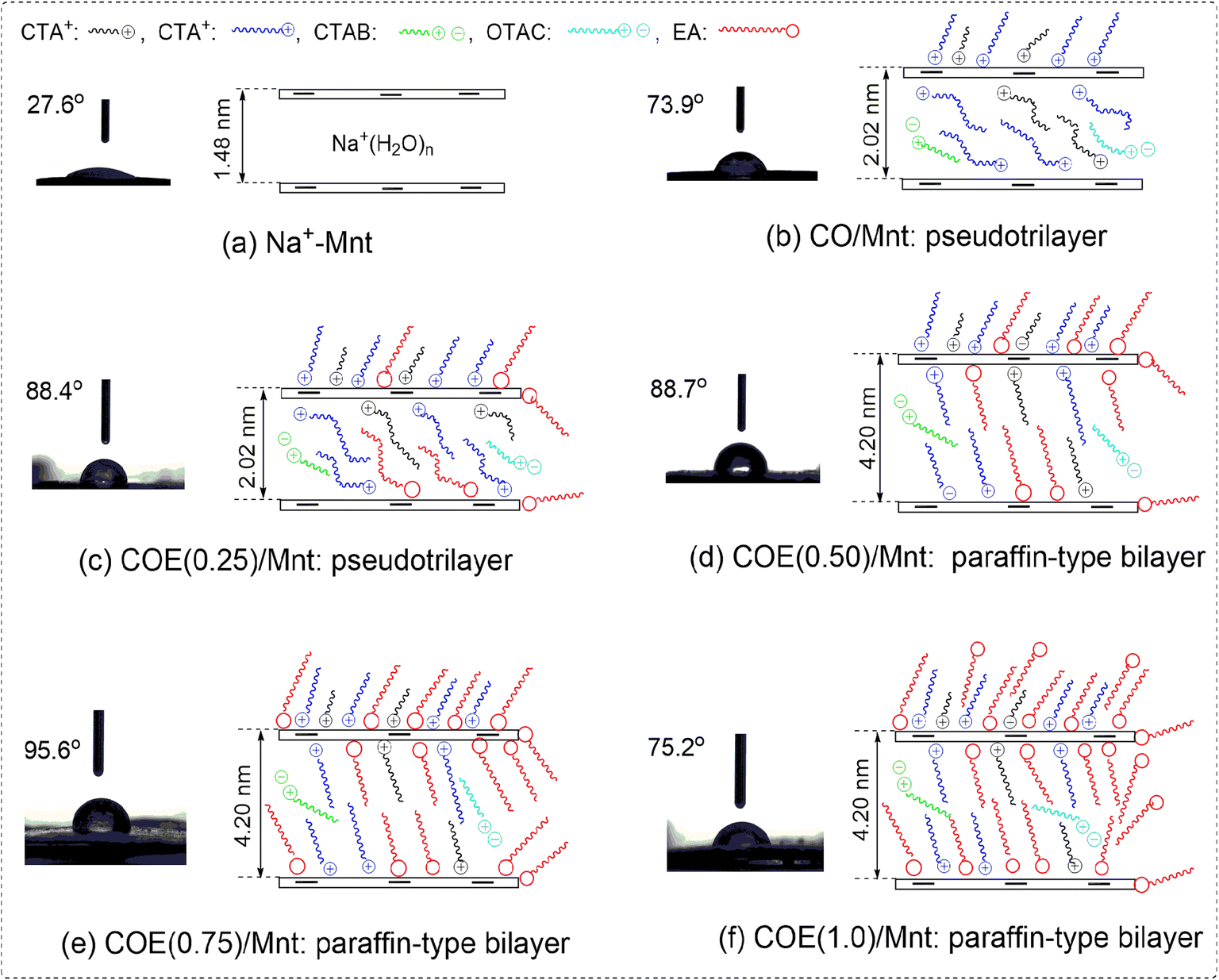
CO/Mnt exhibited a (001) reflection at 4.38°2θ (2.02 nm). Hence, the co-modification of Na+-Mnt with dual surfactants of CTAB and OTAC led to an expansion of the interlayer space from 1.48 nm to 2.02 nm by ion exchange. Others (e.g. Xi et al., Reference Xi, Ding, He and Frost2004; Yu et al., Reference Yu, Ren, Tong, Zhou and Wang2014) have shown that CTAB and/or OTAC can be arranged in various configurations in the interlayer of OMnt (Fig. 2), including as a lateral monolayer, lateral bilayer, pseudotrilayer, paraffin-type monolayer, and paraffin-type bilayer, giving d 001 values of 1.45−1.47, 1.75−1.85, 1.91−2.02, 2.25−2.50, and 3.85−4.14 nm, respectively. Thus, with a d 001 of 2.02 nm (Fig. 1) the CTA+ and OTA+ cations adopted a pseudotrilayer model in the interlayer spaces of CO/Mnt.
Arrangement models of the surfactants adsorbed on OMnts and contact angles of Na+-Mnt and OMnts

COE(0.25)/Mnt exhibited the same (001) reflection at 4.38°2θ as CO/Mnt (Fig. 1). The result indicated that the small amount of EA added (0.25 CEC) in the preparation of OMnt had little impact on the intercalation of the CTAB, OTAC, and EA surfactants into the interlayer spaces of Na+-Mnt. COE(x)/Mnt (x = 0.50−1.0) exhibited the dual reflections at 2.11°2θ (d 001 = 4.20 nm) and 4.38°2θ (d 001 = 2.02 nm). This result suggested that the CTAB, OTAC, and EA surfactants were arranged heterogeneously in the interlayer spaces, in a paraffin-type bilayer and pseudotrilayer in COE(x)/Mnt (x = 0.50−1.0) (Fig. 2). The heterogeneous introduction of surfactants to the interlayer space is commonly found in organic modifications of Mnt (Xi et al., Reference Xi, Frost, He, Kloprogge and Bostrom2005; Kooli et al., Reference Kooli, Liu, Alshahateet, Messali and Bergaya2009; Yu et al., Reference Yu, Ren, Tong, Zhou and Wang2014). The increase in the d 001 value indicated that adding large amounts of EA (i.e. >0.25 CEC) may also have facilitated the entry of EA molecules into the interlayer spaces of Mnt.
Based on the XRD patterns described above (Fig. 1), the OTA+ and CTA+ cations first entered the interlayer spaces of Mnt by ion exchange, and then EA molecules were drawn into the interlayer spaces by the alkyl chains of the OTA+ and CTA+ cations, the driving force being the hydrophobic affinity between the alkyl chains of the surfactants.
FTIR Spectra
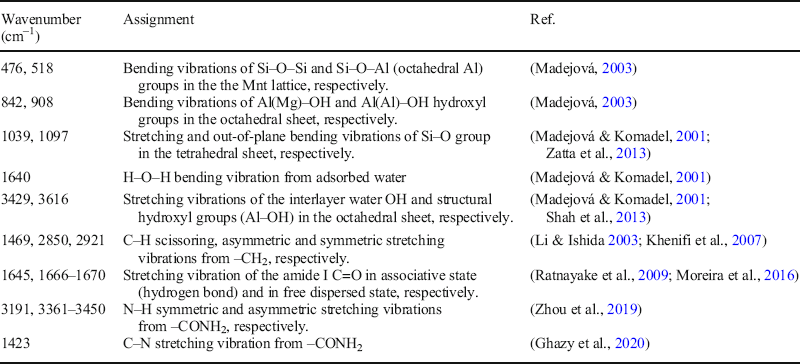
All the OMnts retained the characteristic Si–O–Si, Si–O–Al, and structural hydroxyl bands from Mnt (Table 1). For COE(x)/Mnt, the 3429 cm–1 band from interlayer water seen in the spectrum for Na+-Mnt disappeared (Fig. 3), demonstrating the diminishing amount of water in the interlayer spaces of OMnt due to introduction of the organic surfactants (Parolo et al., Reference Parolo, Pettinari, Musso, Sanchez-Izquierdo and Fernandez2014), as confirmed by the mass losses below 120°C (2.2–2.8% for COE(x)/Mnt and 8.9% for Na+-Mnt, Table 2). The 1469, 2850, and 2921 cm–1 (C–H) bands for all the OMnts were detected because of the adsorption of the alkyl chains of the surfactants on Mnt. The Si-O band at 1039 cm-1 observed in sample Na+-Mnt was unchanged in sample E(1.5)/Mnt, whereas in samples CO/Mnt and COE(x)/Mnt, it was split into two distinct bands, at 1039 cm–1 (in-plane Si–O stretch) and 1097 cm–1 (out-of-plane Si–O stretch) (Madejová & Komadel, Reference Madejová and Komadel2001; Zatta et al., Reference Zatta, Ramos and Wypych2013). The strong electrostatic interactions between the polar OTA+ and CTA+ cations in the interlayer spaces of Mnt and the polar negatively charged Si–O groups in the tetrahedral sheet of Mnt changed the Si–O vibration modes, but this splitting was absent from the spectrum of E(1.5)/Mnt because the polarity of non-ionic EA is lower than that of OTA+ and CTA+ cations.
Assignment of vibrational absorption bands in the FTIR spectra of Na+-Mnt and OMnts

FTIR spectra of Na+-Mnt, EA, and OMnts

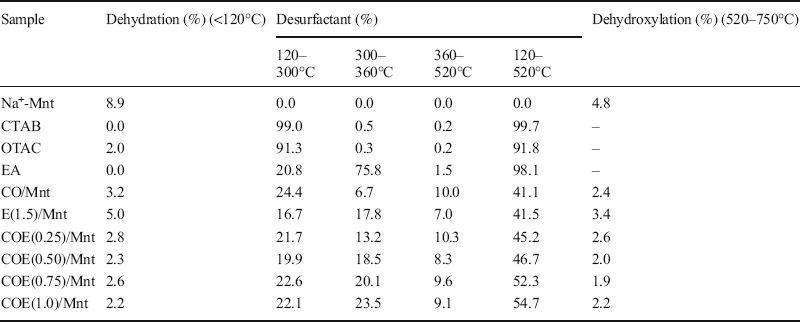
Mass losses (%) in the different temperature stages from the TG data (compare with Fig. 5)

The amide I band from C=O stretching at 1645 cm−1 is characteristic of the pure EA crystal (Fig. 3), indicating a strong interaction among the EA molecules through hydrogen bonding. Other bands observed in the pure EA were derived from N–H (3191 and 3361 cm–1) and C–N (1423 cm–1). Sample E(1.5)/Mnt exhibited these same absorption bands, unperturbed by the Mnt, thus providing strong evidence that the EA molecules were adsorbed to the external surfaces. The coverage of external surfaces by the solid-like EA molecules apparently was extensive, as indicated by the mass loss of 41.5 wt.% in the 120–520°C region of the TG-DTG curves (see below, Fig. 5, Table 2). This finding was in accordance with the XRD patterns above.
All the COE(x)/Mnt samples exhibited the amide I C=O bands at 1666–1670 cm–1 due to adsorption of EA. Their amide I C=O bands shifted from 1645 cm–1 to higher wavenumbers 1666–1670 cm–1 compared with those of pure EA and E(1.5)/Mnt. Co-modification of CTAB, OTAC, and EA onto Mnt broke the large association via hydrogen bonds among EA molecules adsorbed on the external surfaces. A 20 wt.% EA/quaternaryammonium-modified OMnt was prepared by Ratnayake et al. (Reference Ratnayake, Haworth and Hourston2009) by melt mixing at 100°C; those authors found that the amide I band shifted from 1645 cm–1 for pure EA to a higher wavenumber (1670 cm–1) after adsorption of EA onto the quaternary ammonium-modified OMnt. A similar finding was reported by Moreira et al. (Reference Moreira, Alves, Barbosa, de Carvalho and Carvalho2016). In addition, COE(x)/Mnt also exhibited a shift of the N–H bands from 3361 cm–1 towards higher wavenumbers (3388–3450 cm–1) due to the breakage of hydrogen bonds between EA molecules adsorbed on Mnt. The results from Fig. 3 suggested, therefore, that the EA molecules adsorbed on COE(x)/Mnt were well dispersed at the molecular level (Ratnayake et al., Reference Ratnayake, Haworth and Hourston2009).
For COE(x)/Mnt, the intensity of the C=O and N–H bands increased with increasing amounts of EA added from 0.25 to 0.75 CEC, and then decreased when the amount of EA added increased further to 1.0 CEC. COE(0.75)/Mnt exhibited the strongest absorption peaks of the C=O and N–H bands, for two probable reasons: (1) COE(0.75)/Mnt had a large amount of EA loading (52.3 wt.% of mass loss in the 120–520°C region, Table 2); and (2) the arrangements of the surfactants (molecules and cations) were more ordered in the interlayer spaces of COE(0.75)/Mnt than in COE(x)/Mnt (x = 0.25, 0.50, and 1.0), as confirmed by the XRD patterns above.
Adsorption Mechanisms
Adsorption mechanisms of the surfactants (CTAB, OTAC, and EA) onto Mnt involve electrostatic attraction, hydrophobic interaction, hydrogen bond, and van der Waals forces (Fig. 4). Firstly, CTA+ and OTA+ cations were intercalated into the interlayer spaces of Mnt by cation exchange due to electrostatic interaction (Fig. 4a)(Xi et al., Reference Xi, Ding, He and Frost2004). Then, the outer EA molecules, CTAB, and OTAC molecules in the form of ion pairs (CTA+-Br– and OTA+-Cl–) were drawn into the interlayer spaces of Mnt by the long alkyl chains of the CTA+ and OTA+ adsorbed in the interlayer spaces of Mnt in the first step due to strong hydrophobic affinity (Fig. 4b)(Meleshyn & Bunnenberg, Reference Meleshyn and Bunnenberg2006). Meanwhile, OTA+ and CTA+ could also be adsorbed onto the external exposed-face surfaces of Mnt by electrostatic attraction (Fig. 4c) between the CTA+ and OTA+ cations and the negatively charged platelets of Mnt (Xi et al., Reference Xi, Ding, He and Frost2004). CTA+ and OTA+ cations were scarcely adsorbed at the positively charged edges of Mnt under neutral conditions due to their electrostatic repulsions (van Olphen, Reference van Olphen1964; Patel et al., Reference Patel, Somani, Bajaj and Jasra2007).
Adsorption mechanisms of EA, CTAB, and OTAC onto Mnt

For the adsorption of nonionic EA surfactant onto Mnt, besides hydrophobic affinity (Fig. 4b), hydrogen bond and van der Waals forces are also driving forces. Some silanol (Si–OH) groups are present on the exposed faces (Shattar et al., Reference Shattar, Zakaria and Foo2020) and at the broken edges of Mnt, some silanol (Si–OH) and aluminol (Al–OH) groups also exist (Burgentzlé et al., Reference Burgentzlé, Duchet, Gerard, Jupin and Fillon2004). Hence, EA molecules can be bound to the exposed face and edge surfaces of Mnt through hydrogen bonds between the CONH2 groups of EA molecules and the silanol (Si–OH) and aluminol (Al–OH) groups of Mnt (Fig. 4d). Certainly, the polar CONH2 groups of EA molecules can also interact through van der Waals forces with the polar sites of the Mnt silicate layers on the inner and outer surfaces (Fig. 4e).
Hydrogen bonds between EA molecules adsorbed on the surfaces of Mnt (Fig. 4f) and hydrophobic interactions among the long alkyl chains of EA molecules and the surfactant cations (OTA+ and CTA+) (Fig. 4b) made the co-adsorption of the ternary surfactants onto Mnt more complex.
TG-DTG Analyses of OMnt
A TG test can be used to study the thermal stability of OMnt and packing arrangement of the intercalated surfactants in OMnt. The TG-DTG curves of the Na+-Mnt, EA, CTAB, OTAC, and OMnts modified by single organic species (EA), dual organic species (CTAB and OTAC), and ternary organic species (EA, CTAB, and OTAC) are displayed in Fig. 5. The TG-DTG curves of Na+-Mnt and all the OMnts showed the mass losses in the 50–120°C and 520–750°C regions due to the elimination of the physically adsorbed water and structural –OH groups of Mnt, respectively (Xi et al., Reference Xi, Zhou, Frost and He2007; Ikhtiyarova et al., Reference Ikhtiyarova, Özcan, Gök and Özcan2012).
TG-DTG curves of Na+-Mnt, EA, CTAB, OTAC, and OMnts

The pure CTAB, OTAC, and EA solids exhibited only one stage of mass loss in the 120−520°C region. The mass losses were 99.2, 91.1, and 96.7% for pure CTAB, OTAC, and EA solids in the 184−310, 140−294, and 200−364°C regions, which were close to their mass losses in the 120−520°C region, respectively (Table 2). The results suggested that the pure CTAB, OTAC, and EA solids were decomposed completely at 310, 294, and 364°C, respectively. EA exhibits the greatest thermal stability, whereas the thermal stability of pure CTAB and OTAC solids is less than EA but similar to each other.
The mass losses for CO/Mnt in the 120−300, 300−360, and 360−520°C regions corresponded to removal of the CTA+ and OTA+ cations adsorbed on the external surfaces of Mnt (24.4%), the CTAB and OTAC molecules bound in the interlayer spaces of Mnt (6.7%), and the CTA+ and OTA+ cations adsorbed in the interlayer spaces of Mnt (10.0%) (Xi et al., Reference Xi, Frost, He, Kloprogge and Bostrom2005), respectively. The decomposition temperatures for the CTAB and OTAC surfactants (molecules and cations) adsorbed on CO/Mnt were different from those for the pure CTAB and OTAC solids due to the different adsorption sites of Na+-Mnt and the various interactions (Fig. 4) between the CTAB and OTAC surfactants (molecules and cations) and the Mnt silicate layers (Xi et al., Reference Xi, Frost, He, Kloprogge and Bostrom2005; Yu et al., Reference Yu, Ren, Tong, Zhou and Wang2014).
E(1.5)/Mnt displayed three stages of mass loss due to removal of adsorbed EA molecules, in the ranges of 120−215°C (3.7%), 215−419°C (33.8%), and 419−520°C (4.0%). The total mass loss was 41.5% in the 120−520°C region. Such thermal behavior was different from that for the pure EA solid, and indicated that the EA molecules adsorbed on E(1.5)/Mnt appeared in three different molecular environments. The mass loss in the 120−215°C region (3.7%) was attributed to the removal of the well dispersed EA molecules at the molecular level from the external surfaces of Mnt which were held by weak van der Waals forces (Fig. 4e). There are no hydrogen bonds between these EA molecules.
The mass-loss temperature range of the second stage (215−419°C) was close to that of the pure EA solid (200−364°C), suggesting that >80% of the mass loss over the 120−520°C region came from EA in a nearly pure phase mixed with the Mnt. This is consistent with the XRD data and the FTIR spectra that indicated these EA molecules were not introduced into the interlayer spaces but existed mainly in a solid-like state (namely a pseudo-pure phase of EA) on the external surface of Mnt. The extent of interaction between this phase and the Mnt is unclear besides van der Waals forces, but some interactions such as hydrogen bonds between these EA molecules (Fig. 4f) were probably present because the decomposition temperature was slightly greater than for the pure EA crystals.
The mass loss (4.0%) in the highest-temperature region (419−520°C) corresponded to the EA molecules being more tightly bound, for example, via hydrogen bonding between the CONH2 groups of the EA molecules and the silanol (Si–OH) and aluminol (Al–OH) groups exposed at the edges and plane face surfaces of the Mnt (Fig. 4d)(Ratnayake et al., Reference Ratnayake, Haworth and Hourston2009).
Co-modification of the Mnt by CTAB, OTAC, and EA made the thermal behavior complex. As in EA(1.5)/Mnt, three stages of mass loss with increasing temperature were observed in COE(x)/Mnt, in the 120−300, 300−360, and 360−520°C regions. In light of the thermal decomposition behaviors of CO/Mnt and E(1.5)/Mnt, of the XRD patterns, and of the FTIR spectra above, the mass loss from COE(x)/Mnt in the 120−300°C region (first step) was probably due to the decomposition of the well dispersed EA molecules at the molecular level bound by van der Waals forces and of the CTA+ and OTA+ cations electrostatically adsorbed on the external surfaces of the Mnt.
The mass loss in the 300−360°C region (second step) corresponded to removal of the EA molecules in a solid-like state on the external surfaces of Mnt and by the interlayer OTAB and OTAC molecules, along with EA attracted to the OTAB and OTAC hydrophobic interlayer sites. The mass loss in the 360−520°C region (third step) was mainly caused by the elimination of the inner ion-exchanged OTA+ and CTA+ cations and the outer hydrogen bonded EA molecules.
The dehydration below 120°C for Na+-Mnt, CO/Mnt, COE(x)/Mnt, and E(1.5)/Mnt was 8.9, 3.2, 2.2–2.8, and 5.0% respectively. Compared to Na+-Mnt, all the OMnts contained less physically absorbed water due to adsorption of the hydrophobic organic surfactants. Moreover, CO/Mnt and COE(x)/Mnt contained less interlayer water compared with E(1.5)/Mnt because most of the hydrated cations (Na+) in the interlayer spaces of Mnt were replaced by OTA+ and CTA+, whereas for E(1.5)/Mnt, no EA molecules entered the interlayer spaces, leaving only Na+.
Mass losses of the surfactants adsorbed on E(1.5)/Mnt and CO/Mnt in the 120−520°C region were 41.1 and 41.5%, respectively. For COE(x)/Mnt, the amount of the adsorbed surfactants was equal to the mass loss in the 120−520°C region and increased from 45.2 to 54.7% as the addition of EA increased from 0.25 to 1.0 CEC.
Contact Angles
The surface and interface properties of OMnt are important for its use in organic systems. The solid-water contact angle reflects the surface hydrophobicity or hydrophilicity of a solid material (Alghunaim et al., Reference Alghunaim, Kirdponpattara and Newby2016); the larger the contact angle of the material, the greater the surface hydrophobicity. Na+-Mnt is hydrophilic and its contact angle was 27.6°. After introduction of CTA+ and OTA+ , the contact angle increased to 73.9° (for sample CO/Mnt) which is similar to the reported value (Liao et al., Reference Liao, Lv, Cai and Wu2016).
The contact angles of COE(x)/Mnt (x = 0.25 and 0.50) were similar to each other (88.4° and 88.7°), but when x increased to 0.75 (COE(0.75)/Mnt), a maximum contact angle of 95.6° was reached. On the other hand, when x increased further to 1.0 (sample COE(1.0)/Mnt), the contact angle dropped to only 75.2°. The values of contact angle depend on the loading amounts of surfactants and the orientation of the hydrophobic groups on the outer surfaces (Zhuang et al., Reference Zhuang, Zhang, Sun and Liao2016). At low surfactant loadings of COE(x)/Mnt (x = 0.25, 0.50, and 0.75) (mass losses of 45.2−52.3% in the 120−520°C region, Table 2), the hydrophilic groups were close to the hydrophilic polar sites of the Mnt silicate layers, whereas the hydrophobic groups were pointed outward (Fig. 2c, d, e). For COE(1.0)/Mnt, when the hydrophilic polar sites of the Mnt silicate layers were occupied by the hydrophilic groups, some hydrophilic groups were oriented outward (Fig. 2f) due to a high surfactant loading (mass loss of 54.7% in the 120−520°C region, Table 2).
Morphology of OMnt
The particle sizes of COE(x)/Mnt were ~4–40 μm larger than those of Na+-Mnt (~1–10 μm) and CO/Mnt (~2–10 μm) because of greater aggregation in COE(x)/Mnt. Most Na+-Mnt particles existed in the form of aggregates of oblate (plate-like) particles ~1–10 μm, and all the OMnts also looked oblate (Fig. 6). The trend in particle size of COE(x)/Mnt followed its contact angle trend, with COE(0.75)/Mnt showing the most massively aggregated particles due to high surface hydrophobicity (high contact angle of 95.6°).
SEM images of a Na+-Mnt, b CO/Mnt, and c COE (x)/Mnt: x = 0.25, d 0.50, e 0.75, and f 1.0

Particle Sizes of Na+-Mnt and OMnt in Water
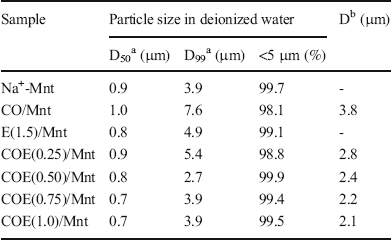
For Na+-Mnt, the cumulative volume of the particle size ˂5 μm accounted for 99.7% in deionized water (Table 3). The result was in accord with the sizes of Na+-Mnt particles (~≤ 4 μm) estimated according to Stokes’ law in the purification by particle sedimentation.
Particle sizes of the samples dispersed in deionized water and in xylene

aD50 and D99 refer to the particle sizes corresponding to the sample with cumulative volume percentages of 50% and 99%, respectively
bAverage particle sizes of the OMnts in xylene
100% of the OMnt particles were kept as <10 μm in deionized water (Fig. 7). The D50 values of the OMnt particles were 0.7−1.0 μm, similar to that of Na+-Mnt (0.9 μm). The D99 value of CO/Mnt (7.6 μm) was greater than that of Na+-Mnt (3.9 μm) (Table 3). These results indicated that the CO/Mnt particles were increased in size over Na+-Mnt due to the CTAB and OTAC modification. A similar phenomenon was observed by Moslemizadeh et al. (Reference Moslemizadeh, Aghdam, Shahbazi, Aghdam and Alboghobeish2016). Particle sizes and swelling in water depend on delamination of platelets or dissociation of particles by crystalline or osmotic swelling. Na+-Mnt is hydrophilic and adsorbs water easily, which results in osmotic swelling. Such osmotic swelling led to Mnt platelet delamination or particle dissociation (Moslemizadeh et al., Reference Moslemizadeh, Aghdam, Shahbazi, Aghdam and Alboghobeish2016). The degree of osmotic swelling of CO/Mnt was less than that for Na+-Mnt because its hydrophilicity was less; full crystalline swelling for CO/Mnt was difficult because of an incomplete intercalation of CTA+ and OTA+ cations (<1 CEC) into the interlayer spaces of Mnt. As a result, the platelets of CO/Mnt hold together tightly in water.
Cumulative size distribution of the particles of Na+-Mnt and OMnts

The D99 value of E(1.5)/Mnt (4.9 μm) was also greater than that of Na+-Mnt (3.9 μm), for two reasons: no crystalline swelling occurred because EA molecules were not intercalated into the interlayer spaces of Mnt; and, the EA molecules adsorbed on the external surfaces of Mnt prevented water from permeating into the pores of Mnt. The large surface hydrophobicity for E(1.5)/Mnt was not beneficial for osmotic swelling.
Most (99.4−99.9%) of the COE(x)/Mnt (x = 0.50−1.0) particles were retained as <5 μm in deionized water. Compared to CO/Mnt (7.6 μm), COE(x)/Mnt exhibited a smaller D99 value (2.7−5.4 μm) in deionized water due to crystalline swelling. The EA molecules adsorbed in the interlayer spaces of Mnt weakened the electrostatic forces between platelets of COE(x)/Mnt. Thus, the particles of COE(x)/Mnt were easier to dissociate than those of CO/Mnt.
Particle Sizes of OMnt in Xylene
The average particle sizes of COE(x)/Mnt (2.8–2.1 μm) in xylene were smaller than that of CO/Mnt (3.8 μm) in xylene. The particle sizes of COE(x)/Mnt decreased with an increase in the amount of EA added, from 0.25 CEC to 1.0 CEC in the OMnt preparation (Table 3). The particle sizes and the swelling in xylene depend on Mnt crystalline swelling and steric repulsion. Firstly, the XRD results above proved that COE(x)/Mnt had a greater level of intercalation and more ordered arrangements of the surfactants in the interlayer spaces of Mnt than CO/Mnt. Hence, COE(x)/Mnt was easier to exfoliate into single Mnt platelets or smaller particle sizes than CO/Mnt. Besides, the EA molecules adsorbed on Mnt could prevent the Mnt platelets from agglomeration due to steric hindrance. The EA molecule has a super-long carbon chain structure with a cis spatial conformation; this conformation prevented extensive associations among the OMnt particles. The steric repulsive forces among the particles improved the long-term dispersibility of OMnt in solvents (Zhang et al., Reference Zhang, Li, Xu and Sun2013).
Swelling Indices of OMnt in Xylene
Swelling indices of OMnt in xylene (Fig. 8) reflect the dispersion degree of the OMnts. The swelling of Na+-Mnt in xylene was small (5 mL/g after 1 h and stable thereafter) due to its high hydrophilicity. The swelling indices were 50 and 39 mL/g for CO/Mnt after static placement for up to 24 h and 48–96 h, respectively, whereas for COE(0.25)/Mnt, the swelling indices were 50 and 45 mL/g. Apparently, standing for 48 h or more enabled CO/Mnt and COE(0.25)/Mnt to reach a stable swelling state in xylene. The swelling indices of COE(x)/Mnt (x = 0.50, 0.75, and 1.0) reached a stable value of 50 mL/g during 1–96 h. The result indicated that COE(x)/Mnts were high swelling materials (Zhuang et al., Reference Zhuang, Zhang, Fu, Ye and Liao2015). Clearly, the swelling indices of COE(x)/Mnt were greater than that of CO/Mnt in xylene. Hence, co-modification of Mnt with ternary surfactants of CTAB, OTAC, and EA improved dramatically the dispersion stability of OMnt in xylene. The result was probably due to the following four reasons: (1) the average particle sizes of COE(x)/Mnt (2.8–2.1 μm) were smaller than that of CO/Mnt (3.8 μm) in xylene. The particles with small sizes prevented settling and were beneficial for high dispersibility of OMnt in solvents (Marras et al., Reference Marras, Tsimpliaraki, Zuburtikudis and Panayiotou2007; Fan et al., Reference Fan, Zhu, Li and Chen2015). (2) The large amount of adsorption of the CTAB, OTAC, and EA surfactants in the interlayer spaces of Mnt brought about exfoliation of more Mnt platelets. (3) The concentration of the EA molecules adsorbed on the surfaces of Mnt affected the stability of the COE(x)/Mnt particle suspensions in xylene. When the surfactant concentration of the OMnt suspensions in non-polar solvent reached a saturated state, the solid-liquid interfacial energy was a minimum and the dispersion was stable, according to Leach et al. (Reference Leach, Hopkinson, Franklin and Van Duijneveldt2005). (4) The super-long carbon chains with a cis spatial conformation of EA molecule increased the steric repulsive forces between the particles. The steric stabilization of particles in xylene made the suspensions of COE(x)/Mnt more stable (Zhang et al., Reference Zhang, Li, Xu and Sun2013).
Effect of time on the dispersion stability of the OMnt suspensions in xylene

The suspensions of CO/Mnt and COE(x)/Mnt (x = 0.25 and 1.0) in xylene looked turbid (Fig. 9) due to a low level of platelet exfoliation in xylene for CO/Mnt and COE(0.25)/Mnt or high surfactant coverage on the external surfaces of COE(1.0)/Mnt. The suspensions of COE(x)/Mnt (x = 0.50 and 0.75) were clearer than those of CO/Mnt and COE(x)/Mnt (x = 0.25 and 1.0).
Images of the 48 h settling of the suspensions of aCO/Mnt and b COE(x)/Mnt: x = 0.25, c 0.50, d 0.75, and e 1.0. Note: the concentration of OMnt in xylene was 0.02 g/mL

Swelling Mechanisms of OMnt in Xylene
Mnt is composed of nanoplatelets (Ho & Glinka, Reference Ho and Glinka2003). The thickness of individual platelets was ~1 nm and they were ~0.5–1 μm long (Le Pluart et al., Reference Le Pluart, Duchet, Sautereau, Halley and Gerard2004). A few platelets were assembled to form the primary particles of Mnt (referred to as tactoids) by face-to-face association due to electrostatic attractions (Burgentzlé et al., Reference Burgentzlé, Duchet, Gerard, Jupin and Fillon2004). The platelets of Mnt exposed two different surfaces (i.e. the crystal plane face and the crystal edge). On the crystal plane face surfaces of the platelets, negative charges exist. At the edge surfaces of platelets, the charge is positive under neutral and acidic conditions due to the disruption of Mnt lattice and the exposure of broken bonds (van Olphen, Reference van Olphen1964).
Based on the particle sizes and the swelling states of CO/Mnt and COE(x)/Mnt in xylene, probable swelling mechanisms were proposed (Fig. 10). When CO/Mnt was dispersed in xylene, the platelets of CO/Mnt were partly delaminated to form tactoids and the tactoids were kept tightly packed due to the low level of intercalation of CTA+ and OTA+ into the interlayer spaces of Mnt. The tactoids were associated with the large particles (house-of-cards matrix, Fig. 10a) by face (negative)-to-edge (positive) association due to electrostatic attractions under the neutral environment (van Olphen, Reference van Olphen1964; Burgentzlé et al., Reference Burgentzlé, Duchet, Gerard, Jupin and Fillon2004). These house-of-cards matrices were assembled further to form larger particles, thus creating a large number of tactoids having a house-of-cards structure (Fig. 10b). While COE(x)/Mnt (x = 0.50, 0.75, and 1.0) was dispersed in xylene, the platelets were fully exfoliated to individual nanoplatelets because of high levels of intercalation of the surfactants into the interlayer spaces of Mnt. The strong electrostatic repulsion between the negatively charged nanoplatelets (face-to-face repulsion) kept the individual nanoplatelets separate. Similarly, the negative faces were attracted by the positive edges of the nanoplatelets (face-to-edge attraction) (Lagaly, Reference Lagaly1981; Patel et al., Reference Patel, Somani, Bajaj and Jasra2007). Moreover, the hydrophobic groups of the EA molecules adsorbed at the edges of the Mnt nanoplatelets were drawn to each other by hydrophobic interactions (edge-to-edge). Thus, the single Mnt nanoplatelets were associated to form the house-of-cards matrix (Fig. 10c). These house-of-cards matrices were also associated further with larger house-of-cards matrices throughout the suspension (Fig. 10d). The super-long carbon chain structure with the cis spatial conformation of EA molecules led to steric repulsions between the Mnt nanoplatelets. Face-to-edge attraction, face-to-face repulsion, edge-to-edge repulsion, and the face-to-face, face-to-edge, and edge-to-edge hydrophobic interactions and steric repulsions led to more stable dispersion and smaller particle sizes of COE(x)/Mnt (x = 0.50, 0.75, and 1.0) (Fig. 10e) than those of CO/Mnt in xylene.
Swelling mechanisms of OMnts in xylene

Conclusions
Hydrophobic OMnts with large surface area were successfully prepared by the co-modification of Na+-Mnt with ternary surfactants CTA+, OTA+, and EA. Such co-modification achieved three improvements: (1) the surface hydrophobicity of OMnt increased and a maximum contact angle (95.6°) was obtained for COE (0.75)/Mnt; (2) high swellability and dispersion stability with a 50 mL/g of swelling index in xylene were obtained; and (3) the OMnt particles in xylene and water were refined.
In addition to the swelling, the nanoplatelets or the tactoids of OMnt in xylene were delaminated further and then assembled to a house-of-cards structure by face-to-edge and edge-to-edge configurations. This gave the OMnt high swellability and high dispersion stability. The process and structure involved electrostatic attractions, electrostatic and steric repulsions, and hydrophobic interactions.
ACKNOWLEDGMENTS
This work was supported by the National Natural Science Foundation of China [22072136, 21506188, 41672033]; Engineering Research Center of Non-metallic Minerals of Zhejiang Province, Zhejiang Institute of Geology and Mineral Resource, Hangzhou, China [ZD2020K07]; and the Zhejiang Provincial Natural Science Foundation of China [LY16B030010, LQ19F050004]. This work is also dedicated to the 5th anniversary (2017-2021) of the foundation of Qing Yang Institute for Industrial Minerals (QYIM, www.qyim-cn.com).
Funding
Funding sources are as stated in the Acknowledgments.
Declarations
Conflict of Interest
The authors declare that they have no conflict of interest.