Introduction
Parkinson's disease (PD) is associated with a wide range of neuropsychiatric symptoms (NPS) in addition to motor disturbances (Aarsland et al., Reference Aarsland1999). Severe NPS contribute to a reduced quality of life for the patient and distress for his or her caregivers. Most PD patients eventually develop dementia, and patients who have dementia associated with Parkinson's disease (PDD) frequently display NPS (Emre, Reference Emre2003). Prior studies have attempted to simplify the wide range of NPS into syndromes of neurodegenerative diseases (Lyketsos et al., Reference Lyketsos2001; Mirakhur et al., Reference Mirakhur, Craig, Hart, McLlroy and Passmore2004; Bronnick et al., Reference Bronnick, Aarsland and Larsen2005; Emre et al., Reference Emre2007; Kulisevsky et al., Reference Kulisevsky, Pagonabarraga, Pascual-Sedano, Garcia-Sanchez and Gironell2008). The clustering of symptoms, rather than focusing on an individual symptom, may be useful from both the clinical and pathophysiological perspectives. This approach may help medical professionals to understand the underlying mechanisms of a disease and to determine appropriate treatments.
Factor analysis and cluster analysis are well-established statistical methods for identifying specific subgroups of NPS. Previous studies have focused on NPS that tend to group together in individual patients (Fuh et al., Reference Fuh, Liu, Mega, Wang and Cummings2001; Peters et al., Reference Peters2008), and have also identified patient types presenting with the same NPS (Bronnick et al., Reference Bronnick, Aarsland and Larsen2005; Emre et al., Reference Emre2007; Kulisevsky et al., Reference Kulisevsky, Pagonabarraga, Pascual-Sedano, Garcia-Sanchez and Gironell2008). The clinical applications of these two methods differ, that is, the subgrouping of symptoms within a patient versus the grouping of patients with similar symptoms. The former indicates a similar pathophysiological cause of symptoms among one cluster, while the latter reveals the specific clinical phenotypes of the disease.
We previously studied NPS in Alzheimer's disease (AD) patients. Factor analysis revealed three distinct groups of NPS, and aberrant motor behavior was significantly correlated with Mini-Mental State Examination (MMSE) scores (Fuh et al., Reference Fuh, Liu, Mega, Wang and Cummings2001). Cluster analyses of NPS in patients with either PD or PDD have been previously reported (Bronnick et al., Reference Bronnick, Aarsland and Larsen2005; Emre et al., Reference Emre2007; Kulisevsky et al., Reference Kulisevsky, Pagonabarraga, Pascual-Sedano, Garcia-Sanchez and Gironell2008), and a correlation has been noted between cognitive impairment and hallucination in such patients (Williams and Lees, Reference Williams and Lees2005; Galvin et al., Reference Galvin, Pollack and Morris2006). However, different clusters of NPS may exert unequal influences on cognitive function in PD and PDD patients. The present study explored the specific subgroups of NPS and investigated the possible correlation between cognitive functioning and NPS in PDD patients. The results may aid in understanding the heterogeneity of NPS in PDD patients.
Methods
Participants
We recruited 141 patients who had been diagnosed with idiopathic PD, and who displayed cognitive decline as reported either by the patients themselves or by knowledgeable informants from 2010 to 2011. The patients were recruited from the Department of Neurology at the Taipei Veterans General Hospital. All patients had been diagnosed as having PD according to the UK Parkinson's Disease Society Brain Bank criteria (Gibb and Lees, Reference Gibb and Lees1988). The diagnosis of dementia associated with PD was made by the same neurologist in each instance, based on an interview with the patient and his or her caregiver, with reference to the recommendation of the Movement Disorder Society Task Force (Dubois et al., Reference Dubois2007; Emre et al., Reference Emre2007). Patients who had developed dementia within one year after PD onset or who had other diseases that could impair cognition (e.g. stroke, hydrocephalus, epilepsy, or major depressive disorder) were excluded. The patients’ age, sex, years of education, and length of time since PD diagnosis were recorded. None of the patients with PDD was treated with cholinesterase inhibitors during evaluation. When the PDD diagnosis was defined, the pharmacological therapies including levodopa, dopamine agonists, neuroleptics, antidepressants, and benzodiazepines were recorded. The stage of PD was evaluated using the Hoehn and Yahr (H&Y) scale (Hoehn and Yahr, Reference Hoehn and Yahr1967). The study protocol was approved by our institution's review board.
Clinical evaluation
The patients’ general cognitive functioning was evaluated using the MMSE (Folstein et al., Reference Folstein, Folstein and McHugh1975). We also administered a battery of neuropsychological tests recommended by the Movement Disorder Society Task Force, which measured the patient's functioning in four cognitive domains: attention, executive functions, visuospatial function, and memory. These four domains are approximately equivalent to the following dimensions of the MMSE: serial “7s,” semantic verbal fluency (Harrison et al., Reference Harrison, Buxton, Husain and Wise2000), pentagon copying, and three-word delayed recall test, respectively (Dubois et al., Reference Dubois2007; Emre et al., Reference Emre2007).
The patients’ NPS were assessed using the 12-item Neuropsychiatric Inventory (NPI; Cummings et al., Reference Cummings, Mega, Gray, Rosenberg-Thompson, Carusi and Gornbein1994). The presence or absence of each NPS was scored by assigning a “1” for the presence of a symptom and a “0” for its absence. Next, symptoms were scored for both severity (range: 0–3) and frequency (range: 0–4). Finally, an intensity score was calculated by multiplying the severity and frequency scores (range: 0–12 for each NPS). The total NPI score was obtained by summing the 12 intensity scores (range: 0–144).
Data analysis and statistics
All statistical analyses were performed using SPSS (version 17.0). We divided the patients with PDD into two groups, one with the use of dopamine agonists and the other without; the MMSE and NPI scores of the two groups were compared by t test. The same method of analysis applied to the use of neuroleptics and antidepressants. The clinical profiles of patients with and without at least one neuropsychiatric symptom were also compared by t test or χ2 test when appropriate. Factor analysis (FA) with principal component analysis (PCA) was used to classify the groups of NPS among PDD patients. The FA with PCA employed normal varimax rotation to interpret the factors of NPS. We interpreted only factor loadings greater than 0.50. Furthermore, we conducted correlation analysis for three variables, namely NPI item intensity score, MMSE score, and H&Y score. To assess the clinical significance of each NPI item, hierarchical regression analyses were performed to ascertain whether the NPI item intensity scores were able to predict general cognitive functioning as assessed by MMSE. The significance level was set at p < 0.05. Results are reported as mean ± standard deviation (SD) unless otherwise indicated.
Results
Study participants
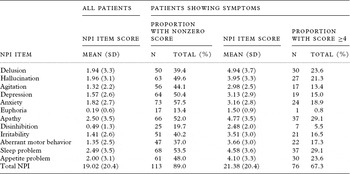
Of the 141 PD patients evaluated for this study, eight patients were excluded because we did not know how much time had elapsed between their PD onset or diagnosis and the development of dementia; a further six patients were excluded because they displayed subjective cognitive impairment without dementia. The remaining 127 patients (76 males, 51 females; mean age 77 ± 6.3 years) diagnosed as probable PDD according to the recommendation of the Movement Disorder Society Task Force (Dubois et al., Reference Dubois2007) constituted the final sample for analysis. The median of duration since diagnosis of PD was six years, the lower quartile was three years, and the upper quartile was ten years. Seven PDD patients were in H&Y stage I, 37 in stage II, 46 in stage III, 25 in stage IV, and 5 in stage V (data were missing in 6 patients). Levodopa was used in 98.1% PDD patients (mean daily dosage 573.5 ± 261.6 mg), dopamine agonists in 16% PDD patients; neuroleptics in 19.8% PDD patients, antidepressants in 8.5% PDD patients, and benzodiazepines in 24.8% PDD patients. The mean MMSE score was 17 ± 6.5, and the mean NPI intensity score was 19.0 ± 20.4. The majority of patients, namely 113 individuals (89% of the group), presented at least one NPS. Table 1 displays mean NPI scores for all patients, and mean NPI scores for only those patients displaying NPS. The most prevalent NPI items were anxiety (57.5%), sleep problems (53.5%), and apathy (52%). The least common NPI items were euphoria (13.4%) and disinhibition (19.7%). Among patients with NPS, the highest scores were obtained for delusion, apathy, sleep problems, and appetite problems (mean score ≥ 4).
NPI item mean scores in all patients and in patients showing symptoms.

NPI = Neuropsychiatric Inventory.
Relationships among clinical profiles, pharmacological therapies, MMSE scores, and NPI scores
Compared with PDD patients who did not use dopamine agonists, those who did had higher MMSE scores (p = 0.04) and lower apathy intensity scores (p = 0.001). The length of time since PD diagnosis, H&Y stages, and total NPI scores were similar in PDD patients, whether they used dopamine agonist or not. Compared with PDD patients who did not used neuroleptics, those who did had a longer length of time since PD diagnosis (p = 0.008), more advanced H&Y stages (p < 0.001) and higher total NPI scores (p = 0.005). Among the NPI items, higher intensity scores were found in delusion (p = 0.009), hallucination (p = 0.001), and apathy (p = 0.004) in PDD patients who used neuroleptics. The MMSE scores of the PDD patients who used neuroleptics were similar to those who did not. The length of time since PD diagnosis, H&Y stages, MMSE scores, total NPI scores, and each intensity scores of NPI items of the PDD patients who used antidepressants were similar to those who did not. Compared with the PDD patients without NPS, those who presented at least one neuropsychiatric symptom showed more advanced H&Y stages (p = 0.03). The sex proportion, length of time since PD diagnosis, MMSE scores, dosages of levodopa, and years of education were similar between PDD patients with and without at least one neuropsychiatric symptom.
Factor analysis with principal component analysis
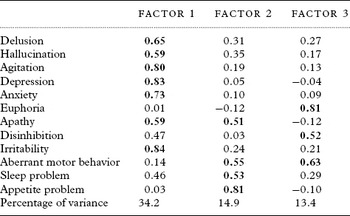
The results of the FA with PCA showed that the three interpretable factors accounted for 62.5% of the total variance in the matrix. Table 2 presents the factor loadings and the percentage of common variance accounted for by each variable. The first grouping reflected “mood and psychosis” symptoms, including delusion, hallucination, agitation, depression, anxiety, apathy, and irritability. The second grouping represented “vegetative” symptoms of sleep and appetite problems. The third grouping revealed “frontal” symptoms, including euphoria, disinhibition, and aberrant motor behavior. Among the 12 NPI items, apathy and aberrant motor behavior did not load on a single factor but rather contributed to two factors in similar patterns. The factor loadings of apathy were 0.59 and 0.51 for “mood and psychosis” and “vegetative” symptoms, respectively, indicating some predominance for “mood and psychosis.” The factor loadings of aberrant motor behavior were 0.55 and 0.63 for “vegetative” and “frontal” symptoms, respectively, indicating some predominance for “frontal.”
Factor analysis of the frequency subscale of the NPI

Values represent factor loadings. Factor loadings greater than 0.50 are shown in bold. NPI = Neuropsychiatric Inventory.
Correlations between NPI items and other assessment measures
Correlation analyses using Spearman's correlation coefficient were performed for the variables of the H&Y score, MMSE score, and the intensity scores of the 12 NPI items. Only five NPI items, namely delusion, hallucination, agitation, anxiety, and sleep problems, were significantly correlated with the MMSE and H&Y scores, as shown in Table 3. Among these five NPI items, hallucination was most strongly associated with both MMSE and H&Y scores (both p < 0.01). Total NPI score was not significantly correlated with age, sex, and years of education, but was significantly associated with the H&Y score (p < 0.01).
Correlation analyses of MMSE scores, H&Y scores, and NPI items intensity scores

Notes: Of the 12 NPI items, only five items showed significant correlation with MMSE and H&Y scores. Values are Spearman's correlation coefficients. MMSE = Mini-Mental State Examination; NPI = Neuropsychiatric Inventory; H&Y: Hoehn and Yahr scores.
*p < 0.05; †p < 0.01.
Prediction of MMSE score
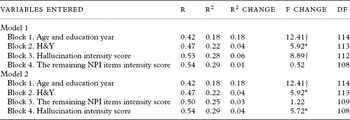
The results of the two models of hierarchical regression analyses for variables predicting the MMSE score are shown in Table 4. In each model, the patient's age and years of education were entered in the first block; both these variables are known to influence MMSE scores. The results indicated that age and education accounted for a significant amount of variance (18%, p < 0.01) in explaining the MMSE score. The H&Y score was entered in the second block, and accounted for a significant but minor amount of variance in the MMSE score (4%, p = 0.02).
Summary of hierarchical regression analyses for variables predicting the MMSE scores

The remaining NPI items are delusion, agitation, anxiety, and sleep problem.
NPI: Neuropsychiatric Inventory; H&Y: Hoehn and Yahr scores.
*p < 0.05; †p < 0.01.
In model 1, the intensity score for hallucination accounted for a significant amount of variance in the MMSE score (6%, p < 0.01) even after controlling for age, years of education, and H&Y score. After controlling for age, years of education, H&Y score, and hallucination intensity score, the remaining NPI items’ intensity scores did not predict the MMSE score. In model 2, the remaining NPI items accounted for a small and non-significant amount of variance (3%) in the MMSE score, after controlling for age, years of education, and H&Y score. After controlling for age, years of education, H&Y stage score, and the remaining NPI items’ intensity scores, a significant amount of variance (4%, p = 0.02) in the MMSE score was still explained by the hallucination intensity score. In total, the full model showed a significant influence of hallucination on the MMSE score.
Discussion
The majority (89%) of patients with PDD in the present study presented with at least one neuropsychiatric symptom. The most common NPS were anxiety, sleep problems, and apathy. A prior study of PDD patients (Emre et al., Reference Emre2007) had reported the same percentage (89%) of patients with at least one NPS. However, several symptoms, as measured by the 12 NPI items, occurred more frequently in our patients with PDD than in the Aarsland et al. study (Aarsland et al., Reference Aarsland2007). These were hallucination (39.4% vs. 24.6%), agitation (44.1% vs. 32.6%), irritability (40.2% vs. 29.7%), and aberrant motor behavior (37% vs. 22%). Similarly, patients in our study displayed a higher prevalence of every NPI symptom than patients in a prior study of non-demented individuals diagnosed with PD (PD-ND; Kulisevsky et al., Reference Kulisevsky, Pagonabarraga, Pascual-Sedano, Garcia-Sanchez and Gironell2008). Compared with those PD-ND patients, our patients displayed an especially high prevalence rate of sleep problems (53.5% vs. 26%), hallucination (49.6% vs. 16.8%), agitation (44.1% vs. 22.4%), delusion (39.4% vs. 14.4%), and aberrant motor behavior (37% vs. 13.4%). Besides, compared with a previous study about patients with dementia with Lewy bodies (DLB), anxiety was the most common NPI symptom in both DLB and PDD patients (Borroni et al., Reference Borroni, Agosti and Padovani2008). DLB patients presented only a slightly higher prevalence rate of anxiety (67.4% vs. 57.5%), depression (61.9% vs. 50.4%), and agitation (55.4% vs. 44.1%) compared with PDD patients. The prevalence rate of apathy, sleep problem, and psychosis of DLB and PDD patients was similar.
In general, most NPS are more common among PDD patients than PD-ND patients, apart from depression and anxiety, which may develop in the early stages of PD (Kulisevsky et al., Reference Kulisevsky, Pagonabarraga, Pascual-Sedano, Garcia-Sanchez and Gironell2008). In addition, apathy, anxiety, and depression are the three symptoms most commonly reported in PD-ND and PDD patients, with prevalence for each symptom of approximately 50% of all PD cases. Furthermore, we found that the frequency of appetite and sleep problems as assessed by the NPI items was relatively high among PDD patients, a finding evidently not previously reported.
Our previous research found that the most common NPS in Taiwanese AD patients were aberrant motor behavior, delusion, and anxiety (Fuh et al., Reference Fuh, Liu, Mega, Wang and Cummings2001). The current study found that although PDD patients also displayed a high prevalence of anxiety, the symptoms of aberrant motor behavior and delusion were less common. The study by Aarsland et al. revealed that apathy, agitation, disinhibition, and irritability were more common in patients with AD than in patients with PDD (Aarsland et al., Reference Aarsland, Cummings and Larsen2001). By contrast, our own previous research found that disinhibition and irritability were more common among AD patients, that apathy was more common in PDD, and that the prevalence of agitation was similar in both patient groups (Fuh et al., Reference Fuh, Liu, Mega, Wang and Cummings2001). Specifically, among the 12 NPI items, hallucination was far more common in PDD than AD patients (49.6% vs. 21%; Aarsland et al., Reference Aarsland, Cummings and Larsen2001; Fuh et al., Reference Fuh, Liu, Mega, Wang and Cummings2001). The high prevalence of hallucination was the most defining neuropsychiatric presentation in PDD patients; previously this feature was attributed to dopaminergic treatment (Factor et al., Reference Factor, Molho, Podskalny and Brown1995). More recently, the prevalence of hallucination associated with PD and PDD has been linked to the degenerative process of the disease itself rather than the use of medication (Poewe, Reference Poewe2003; Williams and Lees, Reference Williams and Lees2005; Fenelon et al., Reference Fenelon, Goetz and Karenberg2006; Galvin et al., Reference Galvin, Pollack and Morris2006).
FA with PCA showed the co-occurrence of specific NPS in patients with PDD. The “mood and psychosis” factor consisted of items measuring delusion, hallucination, agitation, depression, anxiety, apathy, and irritability. These results were congruent with those of a previous study in which a subgroup of PDD patients were found to present with agitation and irritability (Emre et al., Reference Emre2007). To explain the relationship between agitation and irritability, agitation can be viewed as the behavioral aspect and irritability as the emotional aspect of a cluster of NPS. The co-occurrence of delusion and hallucination has previously been extensively reported in patients with PD-ND, PDD, and AD (Fuh et al., Reference Fuh, Liu, Mega, Wang and Cummings2001; Emre et al., Reference Emre2007; Kulisevsky et al., Reference Kulisevsky, Pagonabarraga, Pascual-Sedano, Garcia-Sanchez and Gironell2008). However, hallucinations were more commonly found in patients with PDD, at nearly double the incidence compared with the AD group (Fuh et al., Reference Fuh, Liu, Mega, Wang and Cummings2001). By contrast, the proportion of delusional patients was similar in both the AD and PDD groups. Depression and anxiety share similar origins in the serotonergic and noradrenergic structures, including the raphe nuclei and locus coeruleus, which may be involved in PD progression (Braak et al., Reference Braak, Ghebremedhin, Rub, Bratzke and Del Tredici2004; Aarsland et al., Reference Aarsland, Marsh and Schrag2009). Depression and anxiety might also be off-period-related phenomena and respond to anti-Parkinson medication (Witjas et al., Reference Witjas2002; Aarsland et al., Reference Aarsland, Marsh and Schrag2009).
The NPI components of the “mood and psychosis” factor identified in the current study were similar to those of a previous cluster analysis of NPS among patients with PDD (Emre et al., Reference Emre2007). In another study (Aarsland et al., Reference Aarsland2007), Aarsland et al. proposed five clusters of NPS in patients with PDD, with clinical “mood” and “psychosis” being grouped separately. In the current study, “mood” and “psychosis” items tended to co-occur, and also showed an association with irritability and agitation. Apathy items loaded on both the “mood and psychosis” and “vegetative” factors. Although the associations between NPS have differed somewhat across the various studies, certain trends have been evident for NPS groupings. The collective results suggest a high degree of heterogeneity in the development of NPS in patients with PDD.
The current study also found that the symptoms of euphoria and disinhibition tended to co-occur in patients. The prevalence of these two symptoms was the lowest among all items, a finding that was replicated in two other studies of PD-ND and PDD patients (Emre et al., Reference Emre2007; Kulisevsky et al., Reference Kulisevsky, Pagonabarraga, Pascual-Sedano, Garcia-Sanchez and Gironell2008). Because of their low prevalence, these two NPS may appear relatively unimportant in studies focused on cluster analysis of patient groups. However, the association between euphoria and disinhibition has also been established among AD patients (Fuh and Cummings, Reference Fuh and Cummings2009). The close association between these two symptoms again suggests that disinhibition may be the behavioral aspect and euphoria the emotional aspect of the same cluster of NPS.
The symptoms of apathy and aberrant motor behavior did not load on a single factor in PCA. This result indicated a relatively complex correlation between the NPI items. Previous reports have indicated that apathy sometimes develops along with depression, but it is not clear whether the combination of apathy plus depression was more common than apathy without depression (Kirsch-Darrow et al., Reference Kirsch-Darrow, Fernandez, Marsiske, Okun and Bowers2006; Dujardin et al., Reference Dujardin2007). Our results suggested that in patients with PDD, apathy does not always develop along with depression or other mood and psychotic symptoms. One study of AD patients found that aberrant motor behavior was not consistently associated with any other individual symptoms (Fuh and Cummings, Reference Fuh and Cummings2009). The origins of aberrant motor behavior are as yet unclear, but recent research suggests that such behavior may share the same origins as obsessive–compulsive disorder (OCD; Rosen et al., Reference Rosen, Allison, Schauer, Gorno-Tempini, Weiner and Miller2005). Neuroimaging studies have also revealed a relationship between the dorsal anterior cingulate cortex and orbitofrontal cortex, which has been associated with OCD (Mataix-Cols et al., Reference Mataix-Cols, Wooderson, Lawrence, Brammer, Speckens and Phillips2004; Rosen et al., Reference Rosen, Allison, Schauer, Gorno-Tempini, Weiner and Miller2005; Reilly et al., Reference Reilly, Staff, Ahearn, Bentham, Wischik and Murray2011). These findings suggest that problematic behaviors among different diseases may share the same anatomical origin. This hypothesis may help to explain the lack of co-occurrence between the symptom of aberrant motor behavior and other NPS among patients with AD or PDD. That is, aberrant motor behavior may constitute a relatively unique and complex dimension of the patient's functioning.
Our results also indicated a correlation between sleep and appetite problems, a finding that has rarely been investigated or reported on for patients with PDD. Sleep problems are common in patients with PD (Karlsen et al., Reference Karlsen, Tandberg, Arsland and Larsen2000) and PDD, as revealed by the current study. Furthermore, rapid eye movement (REM) sleep behavioral disorder (RBD) was found to be a risk factor for dementia in PD patients (Marion et al., Reference Marion, Qurashi, Marshall and Foster2008). However, the NPI was inadequate for assessing the details or clinical diagnosis of sleep problems in our patients. Thus, the co-occurrence of sleep and appetite problems which we observed remains poorly understood and requires further investigation.
Correlational and hierarchical regression analyses indicated that the intensity score for hallucination was significantly correlated with cognitive functioning as measured by MMSE. The presence of hallucination remained a significant predictor of the MMSE score even after controlling for age, years of education, H&Y stage, and other correlated NPS intensity scores. A separate previous study with a longitudinal design found that for patients with PD, the presence of hallucinations was associated with a 20-fold higher risk for dementia (compared with PD patients who did not hallucinate) (Galvin et al., Reference Galvin, Pollack and Morris2006). Similarly, a retrospective study with PD patients showed that early cognitive dysfunction was associated with the early occurrence of hallucination (Williams and Lees, Reference Williams and Lees2005). Another study also reported a high prevalence (79.3%) of dementia among PD patients who experienced hallucination (Bronnick et al., Reference Bronnick, Aarsland and Larsen2005). Our results also suggested that hallucination was associated with general cognitive function in patients with PDD.
Our study was subject to certain limitations. First, it was hospital-based; thus, our results should not be regarded as representative of all PDD patients in the general population. The diagnosis of probable PDD was based on the criteria of the Movement Disorder Society Task Force (Dubois et al., Reference Dubois2007), and we excluded the patients who had developed dementia within one year after PD onset. It is possible we recruited some patients with DLB because the one-year rule could not differentiate all patients with PDD from DLB. In addition, societal norms play a critical role in the interpretation and presentation of psychiatric symptoms; thus, the clustering of NPS in patients with PDD should be studied for a variety of cultures. Second, the influence of drugs on cognition or NPS was difficult to evaluate in this cross-sectional study. Third, the patients’ NPS were assessed according to the caregivers’ ratings; thus, some subjective symptoms or those that would have been self-reported may have been missed. Fourth, the use of differing statistical methods may lead to differing results for the NPS clustering. Further statistical evaluation should be performed to confirm the reliability of our methods.
In conclusion, the present study showed a high prevalence of NPS among Taiwanese patients with PDD. Anxiety, sleep problems, and apathy were particularly common in our patients. Factor analysis of the NPS yielded three factors, which we named “mood and psychosis,” “vegetative,” and “frontal.” The correlation which emerged between apathy and aberrant motor behaviors was more complex and these two symptoms could not be loaded into a single factor. In addition, hallucination was significantly correlated with cognitive impairment, and could be a predictor of cognitive function in PDD patients.
Conflict of interest
None.
Description of authors’ roles
J. L. Fuh designed the study, assisted with writing the article, and supervised the data collection. J. L. Fuh and S. J. Wang collected the data, and W. J. Lee and C. F. Tsai wrote the paper. S. Gauthier assisted with the study design and writing of the report.
Acknowledgments
This study was supported in part by the following grants: from the National Science Council of Taiwan (97-2314-B-075–049-MY3); from Taipei Veterans General Hospital (V99C1-047, V100C-059, VGHUST100-G7-1-3); from NSC support for the Centre for Dynamical Biomarkers and Translational Medicine, National Central University, Taiwan (NSC 99-2911-I-008–100); from the Brain Research Center, National Yang-Ming University; and from the Ministry of Education “Aim for the Top” University Plan. In addition, we thank Dr Julie Desmarais for her suggestions regarding the statistical analysis.