Staphylococcus aureus is a common cause of bacterial infections worldwide,Reference Chambers and Deleo 1 causing a range of diseases including community-acquired soft tissue infections and nosocomial infections. The majority of carriage episodes are asymptomatic, and these carriers are responsible for transmission.Reference Chambers 2 While multiple body sites can be colonized, the most frequent carriage site for S. aureus is the anterior nares: approximately one-third of healthy individuals asymptomatically carry S. aureus in this location at any given time.Reference Kuehnert, Kruszon-Moran and Hill 3 , Reference Miller and Diep 4
Longitudinal studies have shown that the probability and duration of S. aureus nasal carriage vary. Typically, such studies have classified participants into 3 host classes: persistent carriers, in whom carriage lasts for many months (~20% of the adult population); intermittent carriers, who harbor S. aureus intermittently (~30% of the adult population); and noncarriers, who almost never carry S. aureus (~50% of the adult population).Reference Eriksen, Espersen, Rosdahl and Jensen 5 – Reference Williams 7 While this classification is somewhat arbitrary (eg, “persistence” depends on length of follow-up), it is a convenient summary of the observed heterogeneity. In such a population, an individual observed as a carrier may be either a persistent or an intermittent carrier, while a noncarrier at a particular moment may be either a noncarrier or an intermittent carrier.
Reduction of S. aureus transmission by interventions including hand hygiene, isolation, and decolonization reduces the incidence of nosocomial infections.Reference Wertheim, Melles and Vos 8 , Reference Huang, Septimus and Kleinman 9 To examine the effectiveness of these interventions and the transmission dynamics of the pathogen, several mathematical models have been developed.Reference Bootsma, Diekmann and Bonten 10 – Reference Forrester and Pettitt 18 These models have assumed a homogenous population in which all individuals are equally susceptible to colonization. This assumption is clearly incorrect, and the failure to discriminate between hosts that are highly resistant to colonization and those that may play a disproportionate role in transmission may alter the predicted impact of control strategies.
In this study, we show that assuming a homogeneous population causes systematic and substantial biases in model outcomes, and we illustrate how the incorporation of a heterogeneous host population changes the predictions of the model. Specifically, assumptions of homogeneity tend to underestimate transmissibility and overestimate the impacts of control interventions.
METHODS
Model Description
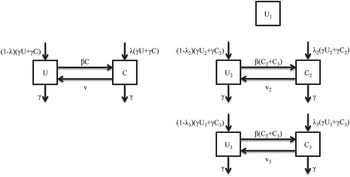
We used a deterministic susceptible-infected-susceptible (SIS)–type transmission model of S. aureus colonization in the healthcare setting; however, we used uncolonized (U) and colonized (C) to emphasize that the model tracks colonization rather than infection (Figure 1). The proportions of colonized and uncolonized patients for any time t, U(t) and C(t), sum to 1. The transmission parameter β is the rate at which hosts contact each other and transmit per unit of time and v is the natural rate at which S. aureus is cleared per unit of time. In the homogenous case, both β and v are assumed to be the same for all patients. We assumed that the discharge rate γ is the same for uncolonized and colonized patients and that the number of patients remains fixed such that the admission rate equals the discharge rate. In addition, the probability that an individual is colonized at admission is λ. The transmission model in the homogeneous case is then given by the following differential equations:
 $$\eqalignno{ & {\dot{\rm U}}=(1{\minus}{\rm \lambda })({\rm \gamma U}{\plus}{\rm \gamma C}){\minus}{\rm \beta UC}{\plus}{\rm vC}{\minus}{\rm \gamma U} \cr & {\dot{\rm C}}={\rm \lambda (\gamma U}{\plus}{\rm \gamma C)}{\plus}{\rm \beta UC}{\minus}{\rm vC}{\minus}{\rm \gamma C \ or\ }{\rm C}=1{\minus}{\rm U} $$
For comparison, we analyzed a stratified version of the transmission model that incorporates host heterogeneity. Let N1, N2, and N3 be the proportion of the population who are noncarriers, intermittent carriers, and persistent carriers, respectively. In each of these groups, a proportion U1(t), U2(t), U3(t) (of the entire population) is uncolonized at any moment, and proportions C2(t) and C3(t) are the respective proportions colonized. (There is no C1 category because this part of the population is highly resistant to colonization.) Then, N1=U1; N2=U2+C2, and N3=U3+C3. We also modeled heterogeneity such that v2 and v3 are the natural rates at which S. aureus is cleared per unit time from an intermittent carrier and a persistent carrier, respectively. In addition, λ2 is the probability that an intermittent carrier is colonized at admission and λ3 is the probability that a persistent carrier is colonized at admission. Although studies have shown that persistent carriers have a higher risk of infection, the colonization rate in different nasal carrier types remains unknown.Reference Wertheim, Vos and Ott 19 , Reference Von Eiff, Becker, Machka, Stammer and Peters 20 Given the limited data on the transmission parameter, we assumed that intermittent carriers and persistent carriers have the same per capita rate of effective contact; hence, the transmission parameter β is the same. This model is given by the following system of differential equations:
 $$\eqalignno{ {\dot{\rm U}}_{{\rm 2}} & =(1{\minus}{\rm \lambda }_{2} )({\rm \gamma U}_{2} {\plus}{\rm \gamma C}_{2} ){\minus}{\rm \beta U}_{2} ({\rm C}_{2} {\plus}{\rm C}_{3} ){\plus}{\rm v}_{2} {\rm C}_{2} {\minus}{\rm \gamma U}_{2} \cr & {\dot{\rm C}}_{{\rm 2}} ={\rm \lambda }_{2} ({\rm \gamma U}_{2} {\plus}{\rm \gamma C}_{2} ){\plus}{\rm \beta U}_{2} ({\rm C}_{2} {\plus}{\rm C}_{3} ){\minus}{\rm v}_{2} {\rm C}_{2} {\minus}{\rm \gamma C}_{2} \cr {\dot{\rm U}}_{{\rm 3}} & =(1{\minus}{\rm \lambda }_{3} )({\rm \gamma U}_{3} {\plus}{\rm \gamma C}_{3} ){\minus}{\rm \beta U}_{3} ({\rm C}_{2} {\plus}{\rm C}_{3} ){\plus}{\rm v}_{3} {\rm C}_{3} {\minus}{\rm \gamma U}_{3} \cr & {\dot{\rm C}}_{{\rm 3}} ={\rm \lambda }_{3} ({\rm \gamma U}_{3} {\plus}{\rm \gamma C}_{3} ){\plus}{\rm \beta U}_{3} ({\rm C}_{2} {\plus}{\rm C}_{3} ){\minus}{\rm v}_{3} {\rm C}_{3} {\minus}{\rm \gamma C}_{3} $$
Transmission models of S. aureus colonization for (a) the homogeneous model and (b) the heterogeneous model. The diagram shows the inflow and outflow of uncolonized (U) and colonized (C) patients. Subscripts indicate each of the three host classes (noncarriers, intermittent carriers, and persistent carriers).

Our goal here was to examine the impact of including carriage heterogeneity by comparison with a homogeneous model.
Parameter Estimates
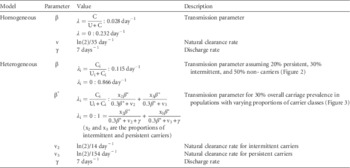
We used median S. aureus nasal survival time of 14 days among intermittent carriers and >154 days among persistent carriersReference Van Belkum, Verkaik and de Vogel 21 as the average carriage duration to parameterize the clearance rates v2 and v3 in the heterogeneous model (Table 1). We used the average median S. aureus nasal survival times for the various carrier types (0.30×14+0.20×154=35 days) to parameterize the clearance rate v in the homogeneous model. Furthermore, we used an average length of stay of 7 daysReference D’Agata, Webb, Horn, Moellering and Ruan 13 to parameterize hospital discharge rate.
Model Parameters for the Homogeneous and Heterogeneous Models of Staphylococcus aureus Carriage

Empirical observations show a 30% prevalence of S. aureus carriage in multiple settings.Reference Kluytmans, van Belkum and Verbrugh 22 We used this to find the transmission parameter β, for both models under 2 extreme scenarios: scenario A, in which the proportion colonized at admission is the same as the proportion of that host class colonized in the inpatient population [λi=Ci/(Ui+Ci)], and scenario B, in which all individuals are uncolonized at admission (λi=0). Scenario B can be thought of as an extreme case in which all transmission is limited to the hospital, and scenario A can be viewed as the alternate extreme in which either transmission is equally intense outside and inside the hospital or individuals are very rapidly readmitted after discharge. Alternatively, scenario A can also be thought of as a model for a community in which the population of hosts does not appreciably change over the time scale that would be considered in an intervention study (months to a few years).
Modeling Interventions
We considered 2 classes of control measures. The first aims to reduce the contact rate and thus the transmission parameter β through isolation of carriers or other infection control measures such as handwashing. The second class of control measures is targeted at decolonizing carriers, for example, through intranasal application of mupirocin alone or with antiseptic soaps or antimicrobial agents. These measures are modeled using the parameter δ, the rate of successful decolonization. In both the homogeneous and heterogeneous models, we calculated the new equilibrium carriage prevalence after the implementation of control measures (reducing β or varying δ). We examined the impact of interventions on carriage prevalence when varying the proportions of carrier types and the durations of persistent and intermittent carriage. All equilibrium prevalence predictions were calculated analytically and graphed using R.
RESULTS
Heterogeneous Carriage Reduces the Expected Impact of Interventions
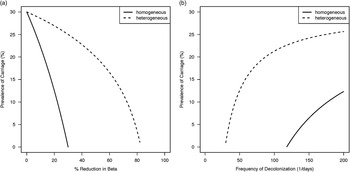
In scenario A, where the proportion of the population colonized at admission is the same as the proportion colonized among that host class [λi=Ci/(Ui+Ci)], the homogeneous model predicts that even a modest reduction in β through interventions aimed at contact rates has a marked impact on carriage prevalence (Figure 2a). A 30% reduction in β is expected to eliminate S. aureus from the population. In contrast, in the heterogeneous model, elimination requires reducing β by more than 80%. Similarly, the homogeneous model predicts that decolonization every 120 days or so will almost eliminate carriage, whereas the same regime applied to the heterogeneous population will have very little effect (Figure 2b).
Impact of interventions of (a) reducing contact and (b) decolonization on S. aureus carriage prevalence under the homogeneous model and the heterogeneous model assuming 3 hosts classes (20% persistent, 30% intermittent, and 50% noncarriers) and that only uncolonized individuals are admitted into the hospital. In both models, 30% carriage prevalence is assumed in absence of any interventions.

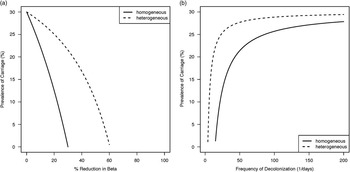
In scenario B, in which all individuals are uncolonized at admission (λi=0), the homogeneous model consistently overestimates the prevalence of overall carriage for both types of interventions but to a lesser degree than in scenario A. Reducing β by approximately 30% is expected to eliminate S. aureus in the homogeneous model, while the same outcome in the heterogeneous model requires reducing β by approximately 60% (Figure 3a). Under this scenario, decolonization strategies have little impact on reducing S. aureus carriage in both models, and in the heterogeneous model, it becomes almost impossible to eliminate carriage.
Impact of interventions of (a) reducing contact and (b) decolonization on S. aureus carriage prevalence under the homogeneous model and the heterogeneous model assuming 3 hosts classes (20% persistent, 30% intermittent, and 50% noncarriers) and that hospital admission of those colonized is the proportion colonized among that host class. In both models, 30% carriage prevalence is assumed in the absence of any interventions.

The Impact of Varying the Proportion of Carrier Classes in the Host Population
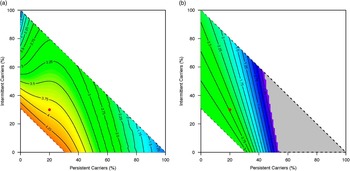
The exact proportions of persistent carriers, intermittent carriers, and noncarriers have been studied in only a few populationsReference Eriksen, Espersen, Rosdahl and Jensen 5 , Reference Kluytmans, van Belkum and Verbrugh 22 and may vary in different settings. Hence, we examined how varying the population composition impacts carriage prevalence. In scenario B, we compared the results of models with different proportions of host classes relative to the homogeneous model as a ratio of equilibrium carriage prevalence after a 25% reduction in the β* parameter or a decolonization regimen every 6 months (δ=1/180 day−1). For interventions targeting transmission, all distributions of heterogeneous populations resulted in higher equilibrium prevalence compared with the homogeneous model, with the largest proportions of noncarriers giving the highest ratio of roughly 4.25 (Figure 4a). For intervention based on decolonization, the carriage prevalence in the heterogeneous model was, at worst, 3-fold higher compared with the homogeneous model (Figure 4b). An exception to the otherwise general finding that incorporating heterogeneity reduces the predicted impact of interventions is found in populations in which 40%–45% are persistent carriers (the contour line with ratio=1; Figure 4b). Here, decolonization in the heterogeneous model is more effective compared with the homogeneous model, and the effect is markedly increased as the proportion of persistent carriers increases beyond this threshold. In scenario A, all distributions of heterogeneous populations consistently predicted higher equilibrium prevalence compared with the simple model for both interventions (Online Figure S1). For both scenarios, the distributions of hosts that we predict will have the largest negative impact on the effectiveness of both interventions was close to the range of proportions of different host classes reported in longitudinal studies.Reference Eriksen, Espersen, Rosdahl and Jensen 5 , Reference Hu, Umeda, Kondo and Amako 6 , Reference Kluytmans, van Belkum and Verbrugh 22
A heat-map of the ratios of carriage prevalence in the heterogeneous model to the homogeneous model when varying proportions of carrier classes under scenario A (admission of those colonized is the proportion colonized among that host class) with intervention of (a) reducing the β* parameter (see Table 1) by 25% and (b) setting δ parameter to 1/180 day−1. The ratio represents the magnitude of difference between the models, with >1 indicating that the heterogeneous model predicts higher carriage prevalence compared to the homogeneous model. The dotted lines enclose all possible combinations of the proportions of persistent, intermittent, and noncarriers. Complete elimination of S. aureus carriage in the heterogeneous model is shown in grey. The red dot represents assumed proportions of each carrier type for the initial analysis.

The Impact of Varying the Duration of Colonization
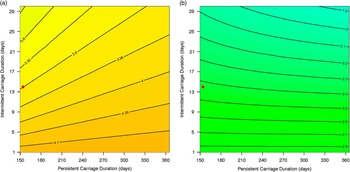
We also examined the impact of varying the duration of colonization, and hence potential transmission, among the different classes of host assuming all individuals are uncolonized at admission (Scenario B) and using the same intervention parameters described above. Again, the homogeneous model is consistently overly optimistic. As shown in Figure 5a, the heterogeneous model predicted carriage prevalence roughly 4 times that of the homogeneous model, and this result is robust regarding the durations of intermittent and persistent carriage. Similarly, as shown in Figure 5b, decolonizing individuals every 6 months was more effective in reducing the prevalence of overall carriage as predicted in the homogeneous model compared with that of the heterogeneous model, regardless of the durations of carriage assumed. Similarly, the finding that the heterogeneous model predicts higher equilibrium carriage prevalence compared with the homogeneous model regardless of durations of persistent and intermittent carriage for both interventions was also observed in scenario A (Online Figure S2).
A heat-map of the ratios of carriage prevalence in the heterogeneous model to the homogeneous model when varying persistent and intermittent carriage durations under scenario A (admission of those colonized is the proportion colonized among that host class) with intervention of (a) reducing the β* parameter (see Table 1) by 25% and (b) setting δ parameter to 1/180 day−1. The ratio represents the magnitude of difference between the models, with >1 indicating that the heterogeneous model predicts higher carriage prevalence compared to the homogeneous model. The red dot represents assumed carriage durations of each carrier type for the initial analysis.

DISCUSSION
Mathematical models of S. aureus transmission can quantitatively predict outcomes of interventions and guide decision making.Reference D’Agata, Webb, Horn, Moellering and Ruan 13 – Reference Forrester and Pettitt 18 , Reference Hogea, van Effelterre and Acosta 23 , Reference Sébille, Chevret and Valleron 24 These models include the assumption that all individuals have the same probability and duration of carriage. This is often supported by the notion that variation in susceptibility is considered to result in smaller outbreaks;Reference Kuulasmaa 25 therefore, models assuming equal susceptibility are considered worst-case scenarios in the sense of the extent of transmission they produce.Reference Bonten and Bootsma 26 However, this perception does not account for the fact that a model ignoring heterogeneity in the population will be “fooled” by the overall low prevalence of colonization into underestimating the transmissibility of the pathogen. In turn, the lower estimate of transmissibility can lead to an overestimate of the estimated impact of interventions.
We examined 2 scenarios that represent 2 extremes of time between hospital admissions. In scenario B, only uncolonized individuals are admitted simulates a very long, or even infinite, time between admissions. In scenario A, newly admitted patients are assumed to be colonized in the proportion that would be expected for hosts of that class, simulating a feedback loop in which people are frequently readmitted. Mathematically, the latter scenario is equivalent to a model of community-acquired S. aureus. In both scenarios, the homogeneous assumption causes the consistent overestimation of the effectiveness of control strategies. Moreover, this observation was robust regarding the proportions of carrier types and the carriage duration for each type. An exception occurred when persistent carriers comprised 40%–45% of the population or more. In this case, the heterogeneous model made the opposite prediction: decolonization would reduce carriage more than one would assume from the homogeneous model. This result reflects the disproportionate contribution of the persistent carriers to transmission as a result of being colonized for a longer period.
Other studies have considered the effects of heterogeneity on the spread of sexually transmittedReference May and Anderson 27 and vector-borneReference Smith, Dushoff and McKenzie 28 infections. These studies have in common the idea that the existence of particularly high-risk hosts contributes disproportionately to transmission. The key issue in both cases is that such hosts are simultaneously more likely to become infected and to transmit infection, as the same activity (ie, being bitten or sex) is necessary for both. In these settings, the basic reproductive number (R0) is proportional to the sum of the mean and the variance/mean ratio for sexual activity or rate of being bitten in simple models of heterogeneous host populations. We have considered and analyzed a different phenomenon here. In our models, hosts differ in their durations of carriage, which affects transmission but not acquisition rate. (We assume that all hosts are equally likely to become colonized, though some may have effectively zero duration.) In this setting, R0 is a simple average of the transmission from the different types of hosts, weighted by the frequency of each host type and the carriage duration in that host type. In our heterogeneous model, noncarriers are incapable of transmitting and persistent or intermittent carriers are colonized at a faster rate and naturally decolonize at a slower rate. The consequence of this characteristic is an increase of R0. Thus, ignoring heterogeneity leads to an underestimation of transmissibility and an overestimation of an intervention’s effectiveness.
Our models did not account for factors such as antibiotic resistance, compliance with interventions, or environmental or healthcare-related transmission. We developed our models to demonstrate the biases created by the failure to incorporate heterogeneity in carriage types. Our analysis was deliberately focused on variation arising from susceptibility and duration of carriage, but this was only one possible source of heterogeneity. Alternatively, hosts may be equally susceptible but vary in their ability to transmit. This has been experimentally observed in finger-to-finger transmission of enterococci.Reference Del Campo, Sánchez-Díaz and Zamora 29 Host susceptibility may be a general issue in nosocomial epidemiology across different bacteria species and colonization sites.
Improved understanding of host heterogeneity in carriage through modeling may significantly change ways in which dynamics of colonization and disease are characterized, as well as the approaches for implementing control measures. In a randomized clinical trial,Reference Harbarth, Dharan, Liassine, Herrault, Auckenthaler and Pittet 30 findings of limited reduction in methicillin-resistant S. aureus carriage despite decolonization with mupirocin may be explained in part by our analysis, which predicts that the effort required to achieve control is greater than expected. We also note that strategies that might be particularly effective in one setting may not directly translate to another setting in which the population may have a different distribution of carrier types. Future work to understand the mechanisms underlying the heterogeneity in S. aureus carriage will aid in targeted interventions that ensure optimal allocation of resources.
ACKNOWLEDGMENTS
We thank Dr. Colin Worby for his help and Dr. Derek MacFadden for his thoughtful reviews of an earlier draft of the manuscript.
Financial support. This work was supported in part by an award from the National Institute of General Medical Sciences (grant no. U54GM088558). The content is solely the responsibility of the authors and does not necessarily represent the official views of the National Institute Of General Medical Sciences or the National Institutes of Health.
Potential conflicts of interest. All authors report no conflicts of interest relevant to this article.
SUPPLEMENTARY MATERIAL
To view supplementary material for this article, please visit http://dx.doi.org/10.1017/ice.2015.269