




No CrossRef data available.
Article contents
BIZARRE chimpanzees do not represent “the chimpanzee”
Published online by Cambridge University Press: 16 June 2010
Abstract
Henrich et al. convincingly caution against the overgeneralization of findings from particular human populations, but fail to apply their own compelling reasoning to our nearest living relatives, the great apes. Here we argue that rearing history is every bit as important for understanding cognition in other species as it is in humans.
Information
- Type
- Open Peer Commentary
- Information
- Copyright
- Copyright © Cambridge University Press 2010
References
Bard, K. A. (1998) Social-experiential contributions to imitation and emotion in chimpanzees. In: Intersubjective communication and emotion in early ontogeny, ed. Bråten, S., pp. 208–27. Cambridge University Press.Google Scholar
Bard, K. A. (2008) Development of emotional expression in chimpanzee and human infants (in English with Russian translation). Psychological Bulletin of Novosibirsk State University, Russia
2(2):98–105.Google Scholar
Bard, K. A. & Leavens, D. A. (2009) Socio-emotional factors in the development of joint attention in human and ape infants. In: Learning from animals? Examining the nature of human uniqueness, ed. Röska-Hardy, L. S. & Neumann-Held, E. M., pp. 89–104. Psychology Press.Google Scholar
Boesch, C. (2007) What makes us human (Homo sapiens)? The challenge of cognitive cross-species comparison. Journal of Comparative Psychology
121(3):227–40.CrossRefGoogle ScholarPubMed
Bulloch, M. J., Boysen, S. T. & Furlong, E. E. (2008) Visual attention and its relation to knowledge states in chimpanzees, Pan troglodytes
. Animal Behaviour
76:1147–55.CrossRefGoogle Scholar
Butterworth, G. (2003) Pointing is the royal road to language for babies. In: Pointing: Where language, culture, and cognition meet, ed. Kita, S., pp. 9–33. Erlbaum.Google Scholar
Carpenter, M., Tomasello, M. & Savage-Rumbaugh, S. (1995) Joint attention and imitative learning in children, chimpanzees, and enculturated chimpanzees. Social Development
4:217–37.CrossRefGoogle Scholar
de Waal, F. B. M. (1982) Chimpanzee politics: Power and sex among apes. Harper and Row.Google Scholar
Enfield, N. J. (2001) “Lip-pointing”: A discussion of form and function with reference to data from Laos. Gesture
1:185–212.CrossRefGoogle Scholar
Fouts, R. S., Hirsch, A. D. & Fouts, D. H. (1982) Cultural transmission of a human language in a chimpanzee mother-infant relationship. In: Child nurturance: Studies of development in primates, ed. Fitzgerald, H. E., Mullins, J. A. & Gage, P., pp. 159–93. Plenum.CrossRefGoogle Scholar
Hopkins, W. D., Taglialatela, J. & Leavens, D. A. (2007) Chimpanzees differentially produce vocalizations to capture the attention of a human. Animal Behaviour
73:281–86.CrossRefGoogle ScholarPubMed
Hostetter, A., Cantero, M. & Hopkins, W. D. (2001) Differential use of vocal and gestural communication in chimpanzees in response to the attentional status of a human audience. Journal of Comparative Psychology
115:337–43.CrossRefGoogle Scholar
Inoue-Nakamura, N. & Matsuzawa, T. (1997) Development of stone tool use by wild chimpanzees (Pan troglodytes). Journal of Comparative Psychology
111:159–73.CrossRefGoogle ScholarPubMed
Itakura, S. & Tanaka, M. (1998) Use of experimenter-given cues during object-choice tasks by chimpanzees (Pan troglodytes), an orangutan (Pongo pygmaeus), and human infants (Homo sapiens). Journal of Comparative Psychology
112:119–26.CrossRefGoogle ScholarPubMed
Kellogg, W. N. & Kellogg, L. A. (1933) The ape and the child: A study of early environmental influence upon early behavior. McGraw-Hill.CrossRefGoogle Scholar
Krause, M. A. & Fouts, R. S. (1997) Chimpanzee (Pan troglodytes) pointing: Hand shapes, accuracy, and the role of eye gaze. Journal of Comparative Psychology
111:330–36.CrossRefGoogle ScholarPubMed
Leavens, D. A. (2002) On the public nature of communication. Behavioral and Brain Sciences
25:630–31.CrossRefGoogle Scholar
Leavens, D. A. (2004) Manual deixis in apes and humans. Interaction Studies
5:387–408. [Reprinted in: C. Abry, A. Vilain & J-L. Schwartz, eds. (2009) Vocalize to localize, pp. 67–86. John Benjamins.]CrossRefGoogle Scholar
Leavens, D. A. (2006) It takes time and experience to learn how to interpret gaze in mentalistic terms. Infant and Child Development
9:187–90.CrossRefGoogle Scholar
Leavens, D. A. & Hopkins, W. D. (1998) Intentional communication by chimpanzees: A cross-sectional study of the use of referential gestures. Developmental Psychology
34:813–22.CrossRefGoogle ScholarPubMed
Leavens, D. A., Hopkins, W. D. & Bard, K. A. (1996) Indexical and referential pointing in chimpanzees (Pan troglodytes). Journal of Comparative Psychology
110:346–53.CrossRefGoogle ScholarPubMed
Leavens, D. A., Hopkins, W. D. & Bard, K. A. (2005a) Understanding the point of chimpanzee pointing: Epigenesis and ecological validity. Current Directions in Psychological Science
14:185–89.CrossRefGoogle ScholarPubMed
Leavens, D. A., Hopkins, W. D. & Bard, K. A. (2008) The heterochronic origins of explicit reference. In: The shared mind: Perspectives on intersubjectivity, ed. Zlatev, J., Racine, T., Sinha, C. & Itkonen, E., pp. 187–214. John Benjamins.CrossRefGoogle Scholar
Leavens, D. A., Hopkins, W. D. & Thomas, R. K. (2004a) Referential communication by chimpanzees (Pan troglodytes). Journal of Comparative Psychology
118:48–57.CrossRefGoogle ScholarPubMed
Leavens, D. A., Hostetter, A. B., Wesley, M. J. & Hopkins, W. D. (2004b) Tactical use of unimodal and bimodal communication by chimpanzees, Pan troglodytes
. Animal Behaviour
67:467–76.CrossRefGoogle Scholar
Leavens, D. A. & Racine, T. P. (2009) Joint attention in apes and humans: Are humans unique?
Journal of Consciousness Studies
16:240–67.Google Scholar
Leavens, D. A., Racine, T. P. & Hopkins, W. D. (2009) The ontogeny and phylogeny of non-verbal deixis. In: The prehistory of language, ed. Botha, R. & Knight, C., pp. 142–65. Oxford University Press.CrossRefGoogle Scholar
Leavens, D. A., Russell, J. L. & Hopkins, W. D. (2005b) Intentionality as measured in the persistence and elaboration of communication by chimpanzees (Pan troglodytes). Child Development
76:291–306.CrossRefGoogle ScholarPubMed
Leavens, D. A., Russell, J. L. & Hopkins, W. D. (2010) Multimodal communication by captive chimpanzees (Pan troglodytes). Animal Cognition
13:33–40.CrossRefGoogle ScholarPubMed
Lyn, H., Russell, J. L. & Hopkins, W. D. (2010) The impact of environment on the comprehension of declarative communication in apes. Psychological Science
21:360–65.CrossRefGoogle ScholarPubMed
Pika, S. & Mitani, J. (2006) Referential gestural communication in wild chimpanzees (Pan troglodytes). Current Biology
16:R191–92.CrossRefGoogle ScholarPubMed
Povinelli, D. J., Bering, J. M. & Giambrone, S. (2003) Chimpanzee “pointing”: Another error of the argument by analogy? In: Pointing: Where language, culture, and cognition meet, ed. Kita, S., pp. 35–68. Erlbaum.Google Scholar
Povinelli, D. J. & Davis, D. R. (1994) Differences between chimpanzees (Pan troglodytes) and humans (Homo sapiens) in the resting state of the index finger: Implications for pointing. Journal of Comparative Psychology
108:134–39.CrossRefGoogle ScholarPubMed
Racine, T. P., Leavens, D. A., Susswein, N. & Wereha, T. J. (2008) Pointing as intersubjectivity in human and nonhuman primates. In: Enacting intersubjectivity: A cognitive and social perspective to the study of interactions, ed. Morganti, F., Carassa, A. & Riva, G., pp. 65–79. IOS Press.Google Scholar
Savage-Rumbaugh, E. S. (1986) Ape language: From conditioned response to symbol. Columbia University Press.CrossRefGoogle Scholar
Tomasello, M. (2006) Why don't apes point? In: Roots of human sociality: Culture, cognition and interaction, ed. Enfield, N. & Levinson, S. C., pp. 506–24. Berg.Google Scholar
Wilkins, D. (2003) Why pointing with the index finger is not a universal (in sociocultural and semiotic terms). In: Pointing: Where language, culture, and cognition meet, ed. Kita, S., pp. 171–215. Erlbaum.Google Scholar
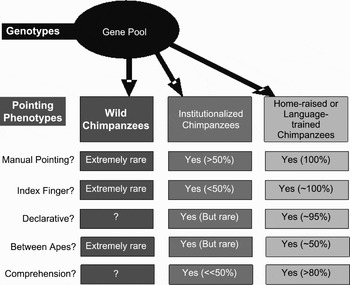
Figure 1. Pointing incidence, posture, function, and social use differ radically between different populations of chimpanzees. Manual pointing: Extension of arm and at least one finger in triadic contexts. Index finger: Pointing with outstretched arm and index finger. Declarative: Pointing to draw somebody's attention to an object or event; includes responses to queries, such as pointing to an object when asked where that object is. Between apes: Pointing by one chimpanzee for another chimpanzee. Comprehension: Understanding pointing by others. [Sources: Pointing in wild chimpanzees: Inoue-Nakamura and Matsuzawa (1997); also see Pika and Mitani (2006). Pointing in institutionalized chimpanzees: de Waal (1982); Leavens and Hopkins (1998); Leavens et al. (1996; 2004a; 2005b); Savage-Rumbaugh (1986); among others. Pointing in home-reared or language-trained chimpanzees is nearly ubiquitous and has been described by Carpenter et al. (1995); Fouts et al. (1982), Kellogg and Kellogg (1933), Krause and Fouts (1997), Lyn et al. (2010), and Witmer (1909), among others. See Leavens and Racine (2009) and Leavens et al. (2009) for reviews.]
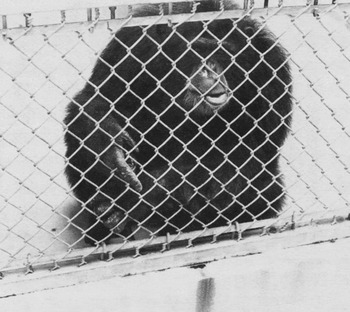
Figure 2. Merv points with his index finger and simultaneously displays the “juice-me” face, a facial expression unique to certain captive groups. Used with permission from the American Psychological Association (Leavens & Hopkins 1998).
 You have
Access
- 40
- Cited by
Henrich et al. provide a timely cross-cultural analysis of perceptual and cognitive abilities in humans, concluding that a significant number of allegedly human-universal capacities are, in fact, confined to specific socio-cultural environments. Ironically, they caution against overgeneralizing from particular humans to all humans, everywhere, but fail to correctly generalize their own arguments to nonhuman species. In section 7.1.4, Heinrich et al. highlight both the need for and the limits of comparisons between human and nonhuman primates. Their point is that contradictory conclusions about the taxonomic distribution of cognitive abilities could be reached, depending upon which human cultures are sampled. What they fail to elucidate is that precisely the same arguments also apply to nonhuman primates, particularly the great apes, humans' nearest living relatives. The over-reliance in psychology on one group of humans, WEIRD, to represent “the human” in cognitive terms has a strong parallel in the over-reliance in comparative psychology on chimpanzees raised in Barren, Institutional, Zoo, And other Rare Rearing Environments (BIZARRE) to represent “the chimpanzee.” Cross-species comparisons are appropriate only with careful consideration of specific rearing environments (e.g., Bard Reference Bard and Bråten1998; Reference Bard2008; Bard & Leavens Reference Bard, Leavens, Röska-Hardy and Neumann-Held2009; Boesch Reference Boesch2007; Bulloch et al. Reference Bulloch, Boysen and Furlong2008; Leavens Reference Leavens2002; Reference Leavens2004; Reference Leavens2006; Leavens & Racine Reference Leavens and Racine2009; Leavens et al. Reference Leavens, Hopkins and Bard2005a, Reference Leavens, Hopkins, Bard, Zlatev, Racine, Sinha and Itkonen2008; Reference Leavens, Racine, Hopkins, Botha and Knight2009; Lyn et al. Reference Lyn, Russell and Hopkins2010; Racine et al. Reference Racine, Leavens, Susswein, Wereha, Morganti, Carassa and Riva2008).
The case of manual pointing provides an example of overgeneralization in both humans and nonhumans. Western scientists portrayed pointing with the index finger as a human species-specific gesture adapted for referential communication (Butterworth Reference Butterworth and Kita2003; Eibl-Eibesfeldt 1989; Povinelli & Davis Reference Povinelli and Davis1994; Povinelli et al. Reference Povinelli, Bering, Giambrone and Kita2003). Degos (Reference Degos2001) recently asserted that “[t]he pointing gesture is exclusively human, and universal within mankind” (p. 263). In fact, although widespread, index-finger pointing is neither universal nor necessarily the predominant manner of pointing even where it is found (Enfield Reference Enfield2001; Wilkins Reference Wilkins and Kita2003). The formerly popular idea that pointing with a particular finger extended reflects the shared evolutionary history of all humans, everywhere, exemplifies the kind of reckless disregard for cultural variability that Henrich et al. rightly criticize. Production and comprehension of pointing are widely viewed as indices to cognitive processes supporting reference, perspective-taking, and the construction of shared goals (e.g., Tomasello Reference Tomasello, Enfield and Levinson2006).
Like humans, chimpanzees display group differences in pointing. Figure 1 depicts three pointing phenotypes, all emanating from the same gene pool (Leavens Reference Leavens2004; Leavens et al. Reference Leavens, Hopkins and Bard2005a; Reference Leavens, Hopkins, Bard, Zlatev, Racine, Sinha and Itkonen2008). As this figure makes clear, depending upon which chimpanzees are sampled, entirely contradictory conclusions can be reached as to whether pointing is a shared characteristic of great apes and humans. Consider the incidence of manual pointing: If home-reared or language-trained apes were compared with humans from cultures that prohibit manual pointing, one could reach the erroneous conclusion that great apes point manually, whereas humans do not; this would be a consequence of overgeneralizing from both of the specific human and chimpanzee populations sampled. Recently, numerous researchers have reached the erroneous conclusion that only humans point declaratively, because they have compared people of largely European descent (i.e., WEIRD) with wild chimpanzees or institutionalized (i.e., BIZARRE) chimpanzees. When chimpanzees are raised the way human children are raised, in richly interactive contexts, the chimpanzees will go on to point – point with the index finger, frequently point declaratively, and comprehend pointing by others (Itakura & Tanaka Reference Itakura and Tanaka1998; Leavens et al. Reference Leavens, Hopkins and Bard2005a; Reference Leavens, Hopkins, Bard, Zlatev, Racine, Sinha and Itkonen2008; Lyn et al. Reference Lyn, Russell and Hopkins2010).
Pointing incidence, posture, function, and social use differ radically between different populations of chimpanzees. Manual pointing: Extension of arm and at least one finger in triadic contexts. Index finger: Pointing with outstretched arm and index finger. Declarative: Pointing to draw somebody's attention to an object or event; includes responses to queries, such as pointing to an object when asked where that object is. Between apes: Pointing by one chimpanzee for another chimpanzee. Comprehension: Understanding pointing by others. [Sources: Pointing in wild chimpanzees: Inoue-Nakamura and Matsuzawa (Reference Inoue-Nakamura and Matsuzawa1997); also see Pika and Mitani (Reference Pika and Mitani2006). Pointing in institutionalized chimpanzees: de Waal (Reference de Waal1982); Leavens and Hopkins (Reference Leavens and Hopkins1998); Leavens et al. (Reference Leavens, Hopkins and Bard1996; Reference Leavens, Hopkins and Thomas2004a; Reference Leavens, Russell and Hopkins2005b); Savage-Rumbaugh (Reference Savage-Rumbaugh1986); among others. Pointing in home-reared or language-trained chimpanzees is nearly ubiquitous and has been described by Carpenter et al. (Reference Carpenter, Tomasello and Savage-Rumbaugh1995); Fouts et al. (Reference Fouts, Hirsch, Fouts, Fitzgerald, Mullins and Gage1982), Kellogg and Kellogg (Reference Kellogg and Kellogg1933), Krause and Fouts (Reference Krause and Fouts1997), Lyn et al. (Reference Lyn, Russell and Hopkins2010), and Witmer (Reference Witmer1909), among others. See Leavens and Racine (Reference Leavens and Racine2009) and Leavens et al. (Reference Leavens, Racine, Hopkins, Botha and Knight2009) for reviews.]
Different populations of chimpanzees also display different communicative expressions and calls. For example, Figure 2 depicts Merv pointing with his index finger to a squeeze bottle filled with juice (out of camera view). The protruded lower lip is glossed as the “juice-me” face, and to our knowledge appears only in chimpanzees that experience juice delivery from a bottle with a downward-pointing spout. Chimpanzees adapt calls to serve functions in captive environments that differ from their uses in the wild: chimpanzees in captivity selectively emit attention-getting calls and other auditory signals, tactically, as a function of whether an observer is looking at them (Hopkins et al. Reference Hopkins, Taglialatela and Leavens2007; Hostetter et al. Reference Hostetter, Cantero and Hopkins2001; Leavens et al. Reference Leavens, Hostetter, Wesley and Hopkins2004b; Reference Leavens, Russell and Hopkins2010).
Merv points with his index finger and simultaneously displays the “juice-me” face, a facial expression unique to certain captive groups. Used with permission from the American Psychological Association (Leavens & Hopkins Reference Leavens and Hopkins1998).
The validity of Henrich et al.'s argument does not suddenly collapse when applied to other species. We agree with Henrich and his colleagues that scientists need to specify to “which people” their findings can be generalized (sect. 7.3). And we argue here, that, given the variability in communicative signaling characteristics in different populations of great apes, there is no rational justification for overgeneralizing from BIZARRE chimpanzees to the entire chimpanzee species. Like humans, chimpanzees evince different cognitive adaptations to different environments; no single environmental context can elicit the full range of chimpanzees' cognitive capacities.
ACKNOWLEDGMENTS
We gratefully acknowledge discussions about these ideas with Sarah Boysen, the late George Butterworth, Josep Call, Malinda Carpenter, Deborah Custance, Mark Krause, Heidi Lyn, Simone Pika, Timothy Racine, and Jamie Russell.