Introduction
The bazaar stores were a flurry of activity in old city Lucknow in July 2013 during the Islamic holy month of Ramadan—and not just because of morning shoppers. It was fundraising season. In less than half an hour, no fewer than 12 men dressed as Muslim scholars (‘ulama) entered and left without buying a thing. The clerks exchanged a few words with each travelling fundraiser, slipped him a 100 rupee ($1.85) chandah (donation), and took the receipts presented in return, concluding with valuations of assalāmu ‘alaikum in-between customers. Even many Muslims in Lucknow were unclear about the details or extent of these chandah fundraisers’ activities, which operated in relative silence and unobtrusiveness compared to the din generated by other bazaar-goers. Such travelling fundraisers are known as safīr, Urdu for ‘ambassadors’ from the Arabic root for ‘travelling’ (‘safari’ is a cognate). The increasing number of travelling Muslim fundraisers in the late twentieth and early twenty-first centuries, moreover, has done more than simply increase crowds in commercial areas. It has also changed the Muslim associational landscape in deeper, lasting ways. Individual almsgiving has become an indispensable funding source for the founding and sustaining of Islamic educational institutions (madrasas) and other Muslim associations, and the role of the safīr as the crucial intermediary between donors and recipient institutions has been institutionalized as a fixture of Muslim public life. The increasing documentation of obligatory Islamic alms (zakat) in India, especially among revivalists but also other urban Muslims, has also significantly inflected ordinary worship practices, in a manner parallel to—but distinct from—other pious practices of Muslims in India (Osella and Osella Reference Osella and Osella2008; cf. Mahmood Reference Mahmood2005; Deeb Reference Deeb2006).
This article is based on 18 months of ethnographic fieldwork from January 2012 to August 2013 for my wider research project on Islamic charity in the Muslim-dominated old city areas of Lucknow, India. Educated, Urdu-literate Muslims were the focus of this research, centred around Islamic reformist institutions such as madrasas, welfare associations, and their fundraising practices.Footnote 1 I interviewed eight ‘ulama with experience as safīr, following three of them through bazaars and neighbourhoods as they solicited alms during the holy month of Ramadan. This article argues that—as institutionalized Islamic charity in India has undergone a shift from land bequests (waqf) to individual cash donations (often zakat)—this shift in social form is paralleled by a shift in the paper forms used in Islamic almsgiving. Such forms and documents include verification letters (taṣdīq namah), lists of fundraisers (fihrist-i safīr), account ledgers (kharchah kī kitāb), and donation receipts (chandah kī rasīt). More changes hands, however, than just currency notes in return for receipt slips. Documents such as the thin, paper zakat receipt (with its humble origins as an accounting aid for fundraisers) has become laden with myriad social significance and personal meaning. Two significant aspects I highlight below are the relationships of trust within Muslim donor publics and spiritual merit (thawāb).
Trust is a key component of zakat-giving, particularly across distances. Documents of identification serve as critical, impersonal links verifying that the safīr is who he says he is. Zakat receipts and other forms materialize new ties of collective identity, a trend that has accelerated as ordinary middle-class Indians’ incomes have risen sharply in the past two decades (Fernandes Reference Fernandes2006). Increasingly these zakat-fundraising networks have become the financial lifeblood of associational networks spanning vast distances across India. As the ritualized material basis for a dispersed symbolic community, these zakat documents are Islamic philanthropy's answer to ‘print capitalism’ (Anderson Reference Anderson2006).
Zakat receipts document and represent the pious act of fulfilling the alms obligation, and some donors imbue them with further importance as a record of individual spiritual merit (thawāb). Procedures of accounting (even bargaining) common to everyday economic life in Lucknow's old city bazaars are also apparent in zakat-giving. These visible modes of almsgiving facilitate outward expression of inner Islamic values and identity.Footnote 2 Financial alms documents thus offer another channel for Muslims to performatively express piety—mostly to themselves but perhaps occasionally to others. Donors’ ability to ‘see’ paid zakat in ledgers and receipts, and even add it up precisely, however, can also heighten the anxiety that not enough of one's requisite annual zakat has been paid or has not been paid in the right places.
Such forms of ritualized documentation aid in constructing new communities of Islamic reformism and individualized, objectified forms of personal piety as Indian Muslims re-orient themselves away from shrines and preachers towards more modern sources of authority and correct individual practice (Metcalf Reference Metcalf1982; Eickelman and Piscatori Reference Eickelman and Piscatori1996; Zaman Reference Zaman2002; Ingram Reference Ingram2014: 860). In a manner similar to that pointed out by anthropologists studying prayer (Mahmood Reference Mahmood2005), pilgrimage (Bianchi Reference Bianchi2004), Islamic banking (Tobin Reference Tobin2016), and veiling (Deeb Reference Deeb2006), paying zakat in an increasingly bureaucratized Indian society is yet another reminder for modern Indian Muslims that Islam entails highly personal religious responsibilities, which can be known, practised, and accounted for via self-study and individual discipline. Many studies have highlighted the role of literacy in reformations that shape religious life by linking believers more closely to the scriptural roots of their faith (e.g. Bowen Reference Bowen1993; Eisenstein Reference Eisenstein1980; Malley Reference Malley2004). This article investigates how financial literacy and the accompanying desire for documentation facilitate Muslim almsgivers’ view of themselves as part of a worldly moral community and as participants in a merit economy with dividends in the Hereafter.
Islamic charity in India
Charity's centrality in Islam cannot be overstated. Mandatory almsgiving, or zakat, is one of the five ritual pillars in Islam, an obligation that is incumbent on all orthoprax Muslims and traditionally given to needy kin, orphans, and other local poor. Yet in recent times a diversifying welfare sector has given modern Muslims greater agency over where and for what purposes they give zakat than in historical eras. The institutionalization of travelling fundraisers by an increasing diversity of Muslim educational welfare associations is due to the growing popularity of zakat, which has been supplanting charitable endowments over the course of the twentieth century as sources of funding for such associations.
Until recently, and for centuries, charitable endowments, especially of land, have been the primary form of Muslim philanthropy. Under India's Mughal rulers and other Muslim emperors such as the Ottomans, only wealthy Muslims had sufficient means to fund charitable institutions, and they often made these bequests in the form of gifts of land and property known as waqf (pl. awqāf; landed endowment). Waqf thus emerged from obscure foundations in Islamic inheritance law to become the main institutional channel for the charitable financing of madrasas and Islamic social service institutions (Singer Reference Singer2002, Reference Singer2008; Kozlowski Reference Kozlowski1985; McChesney Reference McChesney1990; Arjomand Reference Arjomand, Ilchman and Al1998; Hefner and Zaman Reference Hefner and Zaman2007).Footnote 3 By contrast, Muslim scholars historically have encouraged zakat as a private matter, something to be given secretly, taking their arguments from Islamic scriptures (e.g. Qur'an 2:271). Zakat was best distributed among kin and locals (see Qur'an 2:177, 4:8, 4:36, 8:41, 30:38; see also Marghinani Reference Nyazee2006: 294–295). For reasons such as these, zakat historically lacked comparable logistical feasibility as institutional philanthropy. Said Amir Arjomand (Reference Arjomand, Ilchman and Al1998: 11) found it remarkable in his history of Muslim public law that ‘waqf . . . and not the Qur'anic norms of charity—ṣadaqah and zakāt—. . . became the legal foundation of philanthropy in Islam’.
Waqf, however, has been in severe decline in India since colonial times, and its utility for Indian Muslims increasingly faded toward irrelevance after Independence, as many waqf properties are underutilized, if they have not gone completely to waste, absorbed by Indian government heritage projects, or encroached by developers or squatters.Footnote 4 In Lucknow, the Muslim elite classes took their largesse along with them to Pakistan or further abroad; charities reported to me that they have not received waqf bequests since the 1970s. Much of extant private waqf land in Lucknow was under the management of the Husainabad Trust, a heritage organization that looks after Lucknow's famous monuments. But even the Husainabad Trust was short of funds (siphoned off by corrupt managers, many locals speculated) and recent restoration work was at the initiative of citizens such as those who had revived the Shi'i Jama Masjid and the Husainabad Clock Tower (Susewind and Taylor Reference Susewind and Taylor2015).
Zakat, however, is on the rise, with more Muslims worldwide giving ritual zakat charity (76 per cent) than those performing daily ritual prayers (63 per cent), according to a recent study by the Pew Research Center (2012). In colonial India, as a direct result of anti-British mobilizations led by Muslim ‘ulama, some of the first juridical opinions (fatwa) emerged which legitimized—even encouraged—individual almsgiving for distant causes such as founding of the madrasa at Deoband in the 1860s (Metcalf Reference Metcalf1982: 97) or aiding the Ottoman caliph in the 1910s (Qureshi Reference Qureshi1999: 53–59). These colonial encounters spurred Indian Muslims to pioneer the use of zakat as a grassroots fundraising tactic for their public institutions, exemplified by the India-wide expansion of Deoband and its affiliated madrasas (Metcalf Reference Metcalf1982: 96–97; Alam Reference Alam2003). Such expansion of nineteenth-century madrasas was enabled by their utilization of print and accounting technologies which made it possible to print documents to facilitate the aggregation donations from far-flung masses of supporters over vast distances.Footnote 5 In old city Lucknow, I found that madrasas are the most popular among associational recipients of Islamic charitable donations. While other Islamic organizations fundraise for donations (including for orphanages, clinics, mosques, and sector-specific charities such as those working for widows) madrasas garnered more zakat payments by ordinary Muslims.Footnote 6 Even political party networks, such as Jama'at-i Islami in India, increasingly benefit from private donations, which can comprise the majority of their incomes (De Cordier Reference De Cordier2010).
South Asian Muslims have donated funds across continents for centuries, especially for charitable institutions that served pilgrims. However, these charitable activities were primarily in the form of waqf, expensive one-time purchases of land endowed to serve local beneficiaries by donors who travelled there themselves (Cole Reference Cole1988; Dupree Reference Dupree1973). By contrast, the zakat collected by travelling madrasa fundraisers today is a continuous flow of micro-donations. It is the safīr who must travel as well as establish his bona fides through recognizable forms of documentation, before transmitting zakat from donors to remote anonymous beneficiaries such as poor children in village madrasas.
In short, as waqf has declined, zakat has become a decidedly transformative system of public financing for Muslim education and social welfare in India. Without the financial lifeblood of the modern, middle-class donor base of zakat-givers, Indian madrasas would not be as ubiquitous as they are today. This shift can be interpreted on multiple levels: as a shift from the patronage of a few to a massive donor base of ordinary Muslims, a shift from one-time estate gifts to micro-philanthropy by thousands, or as a move away from a one-time bequest towards a charitable relationship between alms-collectors and almsgivers that is renewed annually. As a result, madrasas are financially accountable not only to a few elite families, but to swathes of ordinary Muslims. This transformation in India has parallels with the institutionalization of private Islamic charitable giving worldwide.Footnote 7
Print and piety
This study of zakat traces a well-known arc in the ‘modernization’ of religion: the bureaucratization and rationalization of pre-modern charity (Weber Reference Weber1978: 581–583). Max Weber reminds us how print literature led to upheavals in religion, most famously the Protestant Reformation linked to the translation and mass printing of the Bible (Weber Reference Weber and Parsons2005: 40–43; see also Einsenstein Reference Eisenstein1980: 329–333). Subsequent studies of scripturalism have emphasized the role of believers as readers and focused on the societal effects of their esteem for such texts as the ‘Word of God’ (Malley Reference Malley2004; Bielo Reference Bielo2009). Analyses of Islamic scripturalist movements have similarly viewed revivalists as influential due to their success in increasing scripture readership and pious self-study (Geertz Reference Geertz1960; Metcalf Reference Metcalf1982; Bowen Reference Bowen1993; Mahmood Reference Mahmood2005). Moreover, self-conscious attention to faith teachings enabled by mass literacy is what Dale Eickelman and James Piscatori (Reference Eickelman and Piscatori1996: 39–44) have termed the ‘objectification’ of Islam, giving rise to political and identitarian movements (on India see Metcalf Reference Metcalf1982; Osella and Osella Reference Osella and Osella2008).Footnote 8 However, the ubiquity of the printed word also burdened believers with new anxieties about authorship and authenticity. Traditional Islamic scholars now faced challenges from educated and modernist Muslims’ interpretation of the Qur'an. As Francis Robinson (Reference Robinson1993: 245) observes of colonial India after the advent of the printing press, ‘From now on, any Ahmad, Mahmud, or Muhammad could claim to speak for Islam.’Footnote 9 Growing networks of madrasas opened up Islamic knowledge to more and more ordinary Muslims, while primers of Islamic teachings allowed women and others to study at home (Ingram Reference Ingram2014).
Yet what is the specific role of documents not meant to be ‘read’ as texts but that nevertheless—like print literature—have been enabled by mass printing? Scholars have already made productive investigations of Islamic jurisprudence as calligraphy (Messick Reference Messick1993), digital scans of clerical opinions as ‘neo-calligraphy’ (Clarke Reference Clarke2010), the physicality of the Qur'an as a book (Suit Reference Suit and Watts2013), and printed sermons as ‘portable madrasas’ (Ingram Reference Ingram2014). The utilization of financial documents, like text intended to be read, can also influence faith, as data below illustrate. However, the documentation of alms impacts on Muslim religious life in ways other than the printed word of Allah. In this role, documents are not merely media for scriptural knowledge at the level of discursive tradition, but are also materializations of linguistic discourse, with a symbolic power beyond the ideas written on them (cf. Messick Reference Messick1993). This article argues a fresh point about tradition: scriptural tradition shapes piety through its materiality, not only its discursivity. Even though most studies of Islamic tradition examine text as a medium for scriptural discourse, the further exploration of how Muslims regard text turns a new page in the anthropology of Islam and the study of scripturalism.
Givings and misgivings: the problem of trusting alms-collectors
Question:
[Suppose] a person gave zakāt to another person thinking that he is poor. Later he learnt that this person was rich . . . Or, he gave it to someone on a dark night and later realized that the person to whom he had given the zakāt was actually his mother or daughter, or any other relative to whom zakāt is not permissible . . . What is the result?
Answer:
In all these cases, zakāt will be fulfilled and there will be no need to repeat the payment of zakāt . . . [If] a person has a doubt as to whether a certain person is rich or poor, zakāt should not be given to him until it has been ascertained whether he is eligible to receive zakāt or not. If zakāt is given to him without ascertaining his financial position, the person should check with his heart and see to which side his heart is more inclined. If his heart tells him that the person is poor, zakāt will be fulfilled. If his heart tells him that the person is rich, zakāt will not be fulfilled and will therefore have to be repeated. But if he establishes the fact that he is indeed a poor person after having given the zakāt to him, then he does not have to give the zakāt again (Thanawi Reference Thanawi1999: 156)
These juridical teachings are sample fatwas from the zakat section of Baḥishtī Zewar (Heavenly Ornaments), a basic primer of Islamic teachings written by the Deobandi scholar Ashraf ‘Ali Thanawi (d. 1943). It reflects the heightened anxiety that Indian Muslim almsgivers experienced in colonial times as many revivalists sought to study the fundamentals of the faith and ascertain ‘correct’ Islamic teachings. The premise that a person would mistake an alms-seeker (even at night) for his mother is, of course, preposterous. However, as hypothetical instances of mistakes in almsgiving, they serve to define the logical parameters that distinguishes ‘correct’ zakat. In prior centuries such hypotheticals were primarily of interest to Muslim jurists. However, Thanawi and other Deobandi scholars wrote their primers for the Muslim masses. The minutiae of medieval jurisprudence were to become increasingly important in nineteenth- and twentieth-century India in defining the precise contours of a newly objectified, ‘correct’ (ṣaḥīḥ) Islam and the boundaries of the proper Muslim community (Metcalf Reference Metcalf1982, Reference Metcalf1990; Zaman Reference Zaman2008; Ingram Reference Ingram2014).
Deobandi revivalists sought to consolidate Muslim identity and support behind their own causes. Increasingly, widespread anxieties about zakat were thus enmeshed within broader concerns over two threats to Islam: Indian shrine customs and British rule. As religious alms could constitute sizeable material resources for Islamic causes, the proper recipients of religious donations became a point of contention. Thanawi lambasted Sufi masters whose self-aggrandizing behaviour drew more followers and more funds, denigrating them as money-grubbing ‘shopkeepers’ (Zaman Reference Zaman2008: 26). The more proper beneficiaries of Islamic donations, in his view, were madrasas that provided true leadership (and were no longer financed by Muslim rulers) in the wake of British usurpation.
Thanawi also set out even more restrictions on zakat-giving to non-Muslims than previous Hanafi jurists had done. In Heavenly Ornaments, after the quote given above, Thanawi wrote,
[However] if the person finds out that the one to whom he gave zakat was really a non-Muslim [kāfir], he will have to give zakat again. (Thanawi Reference Thanawi1999: 156)
The canonical Hidāyah, the twelfth-century manual that was (and is still) taught as a primary text of Hanafi fiqh in Indian madrasas mentions the kafir (‘unbeliever’) as an acceptable recipient of accidental zakat. The Hidāyah even refers to the same hadith as Thanawi, mentioning the hypothetical accident of having ‘paid in the dark’ in its discussion permitting zakat given (by accident) to non-Muslims (Marghinani Reference Nyazee2006: 293). However, by contrast, Thanawi singles out the case of the kafir (non-Muslim) as one recipient to whom zakat cannot ever be considered as having beem correctly received—thus further inscribing the boundaries of the Muslim community by redefining the parameters of ‘correct’ almsgiving. Even though he constructed his authority as a reviver of scriptural Islam, not as an anti-colonial political leader, his writings drew clear distinctions between Muslims and non-Muslims in India, which directly served the anti-British cause.
Similar anxieties continue to pepper Lucknow Muslims’ conversations on zakat today. All of the new Islamic charities in Lucknow refuse to distribute funds marked as zakat to non-Muslim beneficiaries. Although many of the individual charity workers expressed to me in interviews their private opinion that zakat could correctly be paid to non-Muslims and still count as ‘zakat’ in Allah's eyes, their organizational policies could not take the risk of alienating donors. In a computer repair shop, the Muslim owner, who in the course of preparing for hajj had become very self-conscious about his faith practices, lectured me, ‘It is very important to find out where people's zakat is going to!’ he exclaimed.Footnote 10 ‘Isn't intention [niyyat] to give zakat in some cases considered enough?’ I replied, having recently studied this issue of giving ‘in the dark’ in a madrasa. ‘No!’ he exclaimed, ‘zakat is not about only giving with the right intention, it is about giving to the correct recipients [ṣaḥīḥ lenewāle]!’
Anxieties over correct almsgiving cluster not only around accidental contributions to non-Muslims, but to a whole host of imposter alms-seekers in Lucknow. A man once gave a donation to a dishevelled mendicant at a train station. Then, suddenly suspicious, he followed him at a distance, only to find the beggar entering a liquor store. The donor snatched his cash from the dissimulating drunkard as he tried to pay. ‘My ṣadaqah [charity] would not have been recognized by Allah, if that man had used it for sharāb [wine]!’ he explained. On another occasion, I was interviewing a group of women who explained that marriages of poor Muslims offer a good opportunity for donations that count as zakat, ‘but it is very important [ahim] to get zakat to the right place. You must first investigate [the family] and then give [samajh kar ke zakat dene chāhiye], to ensure they are deserving [mustaḥiqq]!’ Yet investigation and verification of ‘correct’ recipients of Islamic charity in every instance requires a great deal of effort, most Muslim almsgivers in Lucknow told me. As a result, many generally sought out reputable organizations and relied on credible evidence, especially documents.
‘Forms’ of Islamic charity
One of the safīrs I observed at work, Maulana Faisal, was a teacher at a madrasa in Bihar who had made the eight-hour train journey to Lucknow. It was a sweltering afternoon in July, in the midst of the holy month of Ramadan, when Muslims fast during daylight, pray additional prayers, and give charity, believing that these ritual observances accrue 70 times the spiritual merit during Ramadan. It is said that each rupee given amounts to 70 rupees in the eyes of Allah. Because of the daytime fasting (and night-time feasting), many storekeepers opened late. But by noon the alms-collector was canvassing bazaar stores for donations.
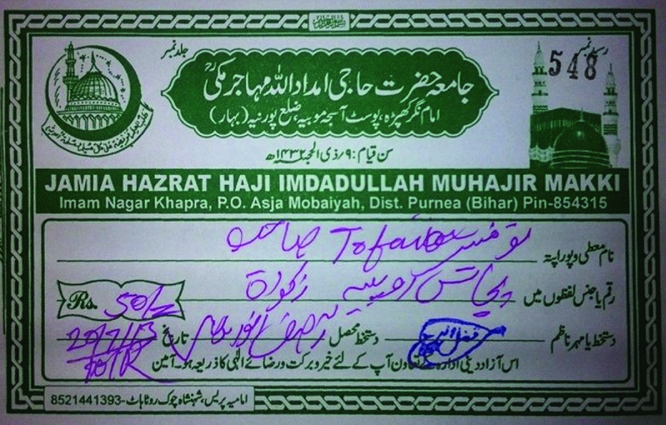
Maulana Faisal stepped into Rashid Gun Shop and introduced himself to Mr Rashid, the owner, before launching his pitch. He handed over a folder of dog-eared papers while Mr Rashid narrated to himself (and us): ‘He has come pretty far, from Bihar, and has letters of verification (taṣdīq-namah) from this Patna [in Bihar] madrasa that I've heard of. And from [the famous madrasa of] Imarat-i Shari'a in Patna.’ Maulana Faisal sat wordlessly, letting his documents speak for themselves initially, as I had seen other fundraisers do. Once he saw that Mr Rashid was not going to immediately turn him away, he pulled out his receipt book and pen. Mr Rashid nodded in approval. Faisal then began writing a receipt (see Figure 1) for the anticipated donation, breaking his silence with a question:
‘Rupee amount?’ Maulana Faisal asked.
‘Fifty rupees,’ Mr Rashid replied, putting the letters down.
‘Fifty rupees? [$1]’ Maulana Faisal repeated in a low, pained voice. ‘Please give me fifty more. See, we have a lot of needs [kāfī ẓarūratn hain ]. Water has leaked in.’
‘Yours is a small madrasa—’
‘No, it's not! On the spectrum of madrasas, it's—’
‘Where is your expense book [kharchah kī kitāb]? Bring it please.’
‘Here.’
‘How many school [branches] do you have?’ Mr Rashid asked, poring over a few sheets of paper that constitute the expense book. ‘How many students? How many teachers? What are salaries? How much is the water [bill]?’
‘All that is written there.’
‘Look, I'll give you 50 rupees only. Write the receipt for fifty. Your madrasa is OK,’ Mr Rashid concluded.Footnote 11
Donation receipt for the madrasa of Maulana Faisal.

Maulana Faisal grudgingly wrote ‘50 rupees’ on the receipt, took the bill from Mr Rashid, who turned away as the maulana (a term of respect for a religious scholar or teacher) gathered his things and moved to the next storefront. The receipt was a notable confidence-building measure, as were the verification letters and account books. Even when donors did not examine such documents, I observed the sense of reassurance they gave almsgivers
The role of documents and documentary evidence was crucial to the success of this alms transaction. The forms presented in the course of the transaction each represented a different type of appeal that spoke to various layers of semiotic meaning that Muslims commonly saw within the Islamic alms transaction. Most of the documents shared common elements attesting to their veracity: signatures and contact information of known persons, stamps, embossing, photographs, calligraphic script, and even Arabic phrases. Maulana Faisal's madrasa was a day's train ride away. Very few—if anyone—in Lucknow knew him. Historically, Muslim almsgivers almost never gave more than a few rupees to strangers, and his fundraising pitch for 50 (indeed, even 100) rupees would have been doomed in a prior era. Yet his documents attested to his identity, his authority as a member of the ‘ulama, and to the reality of his madrasa's activities on behalf of the rural, largely uneducated families it served. Verification letters (taṣdīq-namah) were written by reputable heads of other large madrasas known in Lucknow, invoking donors’ identity simply as Muslims who respect prestigious Muslim institutions. Mr Rashid had not seen the actual results and expense reports of Maulana Faisal's madrasa itself before he agreed to donate 50 rupees. The gravitas of these institutions was such that even a signed note from one of them often outweighed the personal credibility of the safīr, who were the more junior teachers and scholars, or their results-based pitches detailing their expenses.
Large madrasas with printed newsletters placed ‘lists of travelling fundraisers’ (fihrist-i safīr) in the back page of their Ramadan issue, identifying each by name and the cities assigned to them, so that the Muslim public had an official record of who would be visiting them on the madrasas' behalf. A junior teacher at Dar al-’Ulūm Nadwat al-’Ulama (known as ‘Nadwa’ madrasa) explained:
A verification letter [taṣdīq-namah] is necessary for those donors who would like to give, but who cannot come to Nadwa to verify with their own eyes. Without a letter, many Muslims would not even know that Nadwa still exists, how many students we have grown to, or what our exact needs are! They deserve a letter that explains such details.Footnote 12
This authority-based appeal constructs a link in the minds of ordinary Muslims between themselves and the bastions of traditional Islamic knowledge in India which are considered crucial preservers of Muslim identity.
Doubts remained in the minds of anxious almsgivers, however. Maulana Mustafa, one of Lucknow's more successful fundraisers and a madrasa leader, was publically opposed to the use of such letters. In an interview with me, he claimed that as many as ‘50 per cent of all madrasas are useless [bekār]. They are only sometimes open. Not complete frauds, but they close for days at a time and often skim money for themselves [paisā khāte hain].’ As more than one storekeeper told me, it is best to read through the verification letters and then simply call up the madrasa to verify the facts.
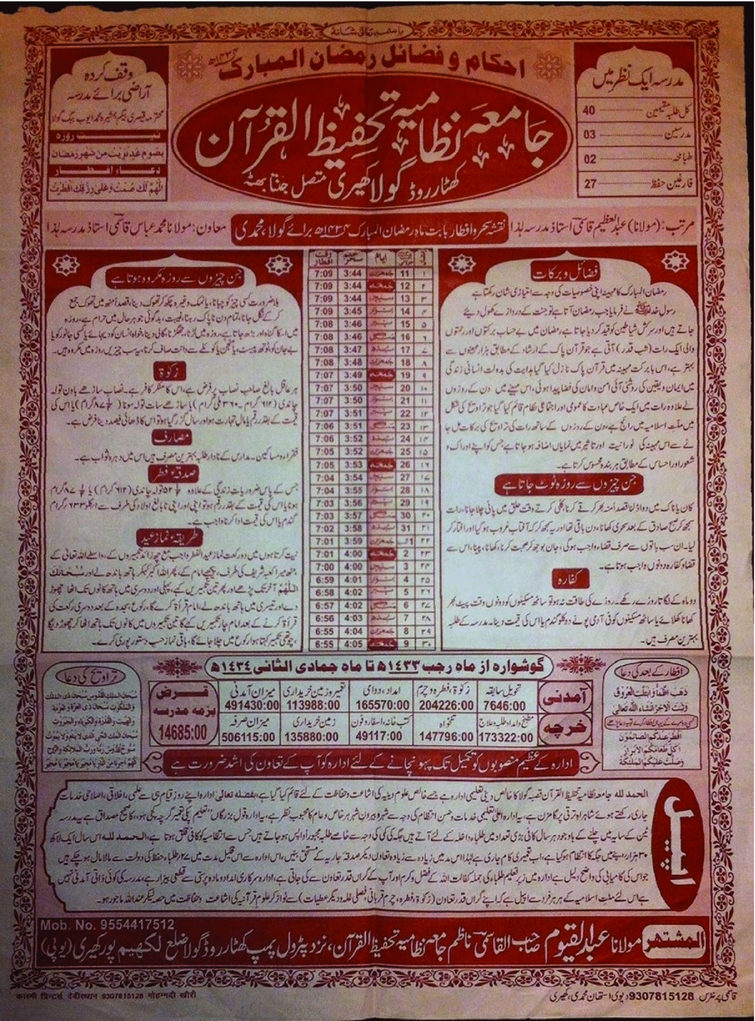
Documentation of results—such as the account book presented by the safīr—sought to loosen donors’ purse-strings based on how money is spent and the impact a madrasa is having. It targets donors’ desire to know where their donations are going. Historically, almsgivers could simply check up on neighbours or listen to local gossip to learn if alms-recipients were managing money well, but modern zakat-givers rely on photos and account books. Madrasa fundraisers come prepared with two sets of data: (1) evidence of numbers of students and quality of facilities, and (2) financial accounting reports. Reports on results in terms of students educated and facilities required in administering the madrasa (e.g. vehicles, hostels, classrooms, kitchens, libraries, presses) often included photographs. Expense reports were generally a simple table of a few categories of ‘income’ and a few categories of ‘expenses’ (see Figure 2). In fact, the actual account books were often not more complicated than these tables, I later found when visiting small and medium-sized madrasas around Lucknow. These technologies now allow fundraisers to travel across India and be recognized, whereas in pre-colonial times they would barely have been known outside their villages. Overall, documentary evidence served to reassure almsgivers that their money—while transported over great distances—was being utilized for the intended, correct purposes in order to be considered as scripturally valid zakat. But the transaction did not conclude until the almsgiver received a personalized receipt.
Fundraising flyer showing income and expenses.

Alms-receipts: accounting for piety
The receipt for transactions was a keystone of the bureaucratic edifice known as the kaghazi raj (‘bureaucratic rule’) of the British administration of India. Along with other documentary incarnations of colonial power such as the record, report, manual (Smith Reference Smith1985), and the file (Hull Reference Hull2008), receipts were one of the many technologies of bureaucracy that enabled collective action from individuals scattered across Britain's global empire (cf. Riles Reference Riles2006). Receipt books in India have long been utilized for transactions by myriad actors, from government offices to lowly village shopkeepers, and they follow a standard form: double-record sheets (usually in white and pink), a detachable slip of carbon paper, and serial numbering stamped on each page. The serial numbering is a crucial aspect, as British officers notoriously distrusted the plethora of native clerks, and the pagination would reveal if sheets had been removed for forgery (Hull Reference Hull2003: 293, 299). From the smallest shops of Lucknow's bazaars to the international corporations at the edge of the old city, receipt books were ubiquitous. Political parties and charitable societies alike utilized receipts in recording transactions for the organization, adding an air of formality for the benefit of the donor.Footnote 13 Official transactions should not go undocumented, and Islamic alms to madrasas and Muslim associations were one such official transaction.
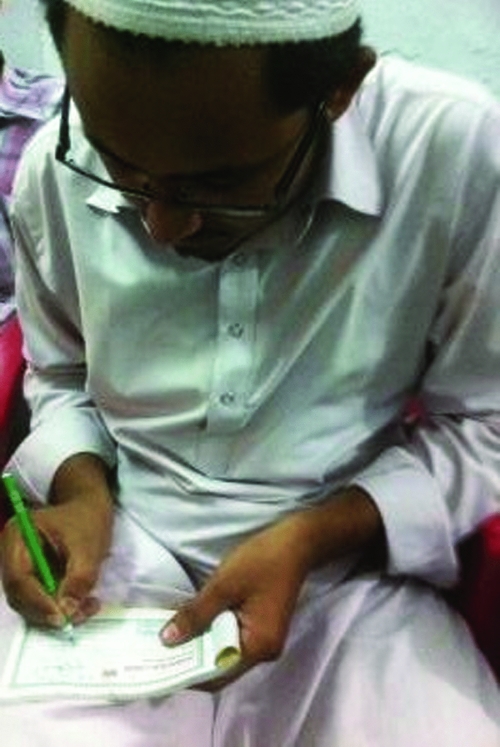
The receipt, the ability to document charitable transactions, was what distinguished organized fundraisers from other alms-seekers—especially the ubiquitous street beggar who also sat outside mosques and went door-to-door as well as store-to-store. The receipt was symbolic of donors’ ability to perceive almsgiving as an exchange between equals, a reciprocal transaction rather than a demeaning gift to the destitute and lowly that is unreciprocated and, as Mauss (Reference Mauss and Cunnison1960) proposed, thereby ‘damaging’ to the recipient. Street beggars were presumed illiterate, even ignorant of spoken Hindi-Urdu if they were migrants, considered disreputable, and often only ambiguously Muslim (such as Hindu alms-seekers masquerading as Muslims behind veils or skull-caps). By contrast, madrasa fundraisers were considered by many to be highly educated Muslim scholars and paragons of Islamic practice (see Figure 3). Their paper receipts were designed to symbolize both these traits of elevated literacy and Islamic authenticity. Safīrs possessed immense cultural capital in old city Lucknow, even if travelling safīrs were in appearance (or actuality) not much more financially well-off than the alms-seekers who did so out of necessity. Although their speech and physical bearing bore evidence of such cultural capital, this thin sliver of paper functioned as a tangible reminder, as a symbolic barrier heavy with materiality, that separated travelling madrasa fundraisers from those without receipts, letters of introduction, or other documentation: the beggars, alms-seeking poor, or (worse) undeserving scam artists.
A fundraiser writing a receipt in Lucknow.

Donors were constantly vigilant as a result of this potentially blurry line. The bazaars teemed with anecdotal stories of fake madrasa fundraisers ‘eating’ alms (paisā khāte).Footnote 14 One donor explained:
There's a lack of confidence among Muslims in general, but especially in Uttar Pradesh it is maximum. When you are collecting [chandah lene jāte hain] for a mosque, [the donor] doesn't get a receipt. He doesn't want it. He knows that his name is written up above. But when a person goes collecting for a madrasa, when that collector [chandah lene wāla] comes to the house, then that person wants a receipt.Footnote 15
Fundraisers for madrasas, in particular, who often travelled from elsewhere in the state or region, were particularly subject to suspicion. This quote illustrates precisely where and why receipts as written documentation are necessary: localized giving (e.g. to mosques) benefited from localized networks of recognition and trust. Yet India's nationwide system of madrasas were dependent on far-flung networks of donors. Donors’ faith in accruing merit from alms-gifts made to madrasas was not merely a matter of believing (as this donor said) that Allah's account book of merit (thawāb) is ‘written up above’. Rather, for many donors who were anxious about misuse of funds, alms-gifts’ ritual efficacy required a legitimization of the transaction in the form of a receipt.
Recognition was important for another reason, given the internal ideological divisions within Indian Muslims: the Sufi-inclined Barelwi sect (maslak), the reformist Deobandi schools, scripturalist Ahl-e Hadith, and various Shi'a groups being the most well known. Verification letters written by a known madrasa associated with a maslak legitimized a stranger and tied his unknown village madrasa to a larger network. While a number of bazaar donors were open to supporting multiple sects, in practice the flows of larger donations broadly mirrored ideological divisions between Indian madrasas, particularly between Shi'a and Sunni groups in Lucknow. Thus, finances only serve to reinforce the process Arshad Alam (Reference Alam2011) describes whereby Indian Muslims increasingly define their religious identity in terms of different maslaks.Footnote 16
The design and crafting of receipts took on heightened significance, more than mere records of payment. They were not only records for accounting and future potential auditing purposes, but were also documents burdened with the semiotic task of representing fundraisers’ legitimacy as representatives of madrasas. The quality of the receipt was one bulwark against being labelled an imposter. I once spent an hour (while waiting for another interviewee) in the office of a digital graphic designer who was working on crafting a madrasa donation receipt, and I became mesmerized watching him whip around Urdu calligraphy, stylized Arabic prayers, and Islamic motifs on the screen using CorelDraw software. With the ubiquity of digital printing, each madrasa's administrators find it possible to develop their own uniquely stylized calligraphic heading. Digital printing also facilitates easy counterfeiting of others’ receipts, and developing a unique calligraphic heading and ink stamp is also critical, as a madrasa would be detected and held suspect if theirs was recognized as a copy of another's.Footnote 17
Functioning as something akin to spiritual currency notes, the zakat receipts represented a transaction that transformed donors’ material wealth into spiritual merit. The first few times I made nominal donations to madrasa fundraisers early in my fieldwork, I disregarded (even discarded) my receipts. In interviews, however, donors began to impress upon me the subjective, spiritual value of such receipts. Donors carefully filed away their receipts from travelling fundraisers. They often stapled them into an actual account book, especially storekeepers with records close at hand, even though donors did not claim tax exemption for Islamic charity (as it was not recognized in the Indian tax code). While I never saw such zakat receipt collections furnished as proof to any others, donors themselves utilized receipt files to keep a personal accounting of the zakat they had given in the year. In interviews, donors often showed me their receipt file. Mr Rashid, to continue the example above, filed Maulana Faisal's receipt in his account book. He then enthusiastically displayed to me all receipts he had collected thus far, ‘I get receipts for my [obligatory] zakat. That's how I separate it from [voluntary donations of] sadaqa, after I've calculated my zakat obligation with a calculator.’
Zakat receipts, which I had once casually discarded, seemed in such cases to be functioning as spiritual fiat currency. While they had no earthly exchange value, the way donors filed away zakat receipts suggested their role as promissory notes was backed (in donor's eyes) by Allah and Islamic teachings that zakat would accrue merit for them in the Hereafter. Having no intrinsic value of their own, the receipts nevertheless were symbolically imbued with a new social value, representing the transformation of donors’ profane money into spiritual merit. This transformation, in the eyes of donors, was produced through the authenticating practices of the Muslim teachers-cum-fundraisers who received alms (in their role as qualified interpreters of Islamic law and thus perceived as legitimate conduits for correctly disbursing donors’ alms).
Receipts from madrasa fundraisers fulfilled this symbolic niche more so than donors’ person-to-person alms-gifts, such as those dropped in the outstretched hands of needy Muslim neighbours. Moreover, receipts were issued by the very institutions that produce and teach Islamic jurisprudence. Thus they assuaged any lingering concerns that these financial transactions were in fact legitimate zakat—a doubt that crept into the minds of donors I interviewed when they donated to other Muslim organizations that were run by people with less knowledge of proper Islamic practices. The stylized Islamic motifs and Arabic sayings on receipts, etched with digital publishing, spoke to this essential difference from other fiat currencies backed by temporal governments (such as the Indian government). For example, Figure 4 is a close-up of the motif of Maulana Faisal's madrasa with its accompanying Arabic phrase, which translates as ‘Seeking knowledge is a duty upon all Muslim men and women [Ṭalabu al-ʿilmi farīḍatun ʿalā kulli muslimin wa-muslimatin]’. Although the script is nearly identical to Urdu, the Arabic here includes diacritic marks on each letter. In India few people, even educated Muslims, have studied enough to write such Arabic calligraphy with diacritics, and the skill is largely the province of graduates of large urban madrasas, thus presenting an obstacle to counterfeiting. Diacritics in Arabic script, moreover, are a key marker of a particularly high-quality madrasa education, as many Indian madrasas prioritize Persian and Urdu over Arabic language instruction or do not adequately instruct students in Arabic diacritics (about a dozen different marks that are not used in Urdu or Persian). As Brinkley Messick observes in another Muslim context, ‘script, it is assumed, conveys (as precisely as a fingerprint) the person . . . While it may be difficult, it is not impossible to distinguish the mark of the just writer’ (Reference Messick1993: 215). Arabic calligraphy thus inscribed piety in a way that mere text could not. All writing communicates knowledge easily; however, piety is much more difficult (if not impossible) to properly transmit through documents, yet is an equally important characteristic for managing and fundraising for Islamic institutions.
Arabic calligraphic motif on a receipt, representing Maulana Faisal's madrasa.

Documentation also facilitates a view of zakat as an individualized act, when gifting has traditionally often been collective. Shari'a obligates each Muslim adult to make zakat, men and women. In practice, however, donations from the same family are often bundled together. In pre-literate times and places, this made zakat-giving an unavoidably collective practice executed by the heads of households. Alms were generally in the form of crops or livestock, not cash (cf. Scott Reference Scott1985: 10–11 on zakat in Malaysia). However, with the advent of both cash and zakat receipts, the potential for documenting each individual's zakat was realized. For example, I observed a man donating 600 rupees who received three receipts, each with a separate name in the ‘donor's name’ line, each written for 200 rupees, for three different family members—most likely a wife and siblings in a joint household. Individual receipts demonstrated to almsgivers themselves (and by extension, to Allah) that each had met their annual zakat obligation. Curiously, this practice of writing receipts, while it arose from colonial auditing, highlighted how very much the zakat-giving ritual is not merely financial, how sacred cash differs from profane. While the three family members all gave their zakat in one pile of ordinary money, it was also not just aggregated as profane cash was in the other household expenses, nor was the receipt merely a record of a transaction. The receipt symbolized the zakat-giving ritual as a highly personal one. Donors that I interviewed thus easily spoke of receipts as evidence of their own zakat—even if someone else had paid—and, by implication, receipts were also material evidence of their individualized ‘account’ with Allah. Spiritual merit (thawāb) was necessarily individualized, rather than collectively owned like most household assets. In short, Lucknow Muslims, in the course of ensuring this-worldly financial accountability, also utilized the receipt for their own objectification of personal piety (Eickelman and Piscatori Reference Eickelman and Piscatori1996). Documentation of zakat in modern times shapes individuals’ beliefs about Islamic almsgiving by facilitating a more precise, externalized spiritual accounting of thawāb for each individual zakat donor, which was not possible in pre-literate times.Footnote 18
Institutionalizing and authenticating almsgiving
Alms-collectors were not afraid to negotiate, as seen in the opening vignette, by refusing to write a receipt and gaining the initiative, perhaps in the hopes of increasing the donor's gift amount. Madrasa fundraisers were aware of their position of authority conveyed by (as ‘ulama) their familiarity with Islamic law and its parameters for classifying transactions as zakat. It was for this reason, in fact, that many ordinary Muslims preferred to give to madrasas; they could be more certain their zakat would be transmitted in the ‘correct’ manner, even if they themselves were unclear about Islamic law. Safīrs thus were giving even as they took charity. Receipt-giving also constituted a critical juncture for fundraisers to withhold—as seen above when Maulana Faisal delayed writing the receipt—illustrating the exception that proves the rule of their ability to grant the weight of Islamic authenticity to donors’ zakat in the course of receiving their alms-gifts.
Fundraisers sometimes became visibly upset over challenges to their role in authenticating alms. After making a donation to a fundraiser myself, I once waved dismissively when he began writing a receipt, saying that I trusted him and knew Allah recorded my gift. But he insisted. Another time I observed a man hurriedly hand over an envelope of cash along with a few words of explanation before rushing back to his motorcycle (apparently late to be somewhere), while the fundraiser, Maulana Jahangir, was deep in another conversation. Once realizing, he stood up and yelled down the street, ‘Come back here!’ With an avuncular chuckle, and as he wrote one out for the man, the maulana asked him if he really believed he could leave without a receipt. Turning to me after the man left, he elaborated, ‘It is very unconventional [ghair-rasmi] to not give a receipt with zakat. A maulana could just pocket it!’ While recognizing that it was unlikely that they would be audited by the government, madrasas and similar charities kept such records and placed value in receipts as a result of the spiritual significance of the alms they handled. Any appearance of impropriety could potentially ripple through the Muslim community in Lucknow through informal channels of gossip which enabled the only real (if incomplete) guarantee of accountability.
Moreover, the widespread attention to receipts is encouraged by madrasas and their fundraisers. It is the key materialization of their legitimacy and financial transparency (regardless of how real or purely constructed that legitimacy actually is), which is performatively on display for potential donors and the public at large witnessing the ongoing zakat collection.
In at least one transaction, a receipt documented a charitable transaction that was initially unintended as such by the man who (after the receipt was written) became the ‘donor’ to an Islamic charity.Footnote 19 In the course of registering beneficiaries for a government programme this Islamic charity submitted hundreds of student applications. It budgeted an informal processing fee, as everyone in Lucknow does when dealing with the district government office, to be paid to the clerk receiving applications (the going rate was 30 rupees per application). However, the clerk was Muslim and had interacted with this charity before. He waived the informal processing fee. ‘He knows me and that I'm a good guy,’ the charity worker explained to me. ‘I was ready to pay the bribe. That's how things work around here, you know. You have to do it. But he didn't accept it from me. He gave it back right there.’Footnote 20 This charity worker had the authority to write receipts for donations. ‘So I pulled out a receipt from our booklet and wrote it out for him right there.’ The receipt categorized the Muslim clerk's refusal to accept a bribe as a donation. While no one considered it zakat, most likely, this donation was nevertheless a contribution indistinguishable from other voluntary charity like ṣadaqah—or, rather, it would have been indistinguishable were it not for its origin as a failed bribe. The receipt semiotically named and legitimized it as charity, at least in the records of the charity organization, which is how the story came to be related to me: an act of pious generosity on the part of this Muslim clerk. Through receipts, Muslim organizations claimed the authority to document certain transactions—even sometimes unusual ones—as zakat, thereby verifying and naming donors’ currency as worth spiritual merit.
Zakat documentation also enabled the institutionalization of Islamic charity for organizational accounting. Yet this accounting had unseen consequences. Beneath each receipt, nestled underneath the sheet of the receipt booklet, lay a slip of black carbon paper. This carbon copy ensured another symbolic offering that charity recipients could give to donors: public recognition. This potential recognition highlights a critical tension in Islamic charitable giving, as scriptural injunctions encourage almsgiving in secret (Qur'an 2:271). Common NGO practice in India was to recognize donors in public announcements of gratitude, brochures, wall plaques, or reports. Although the practice of printing donor lists for public recognition (Metcalf Reference Metcalf1982: 97) was discontinued at some time in the decades between 1900 and today, the donor lists are still maintained by madrasas. Donors’ names and addresses are known to madrasa teachers, staff, board members, and other patrons; in villages and the bazaars of old city Lucknow, I overheard when this knowledge spilled out in discussions between madrasa teachers and community members regarding who were sponsors and who were not.
To mitigate immodest gossip, some pious donors attempt to conceal their donations. ‘You'd be amazed to know how many donors to us don't even want to take a receipt!’ one maulana who fundraised for the Jama'at-i Islami and its schools told me. ‘They tell us instead, “Write in the name Abdullah instead. I don't want a receipt.”’ Abdullah is a man's name, but also translates (from the Arabic) as ‘servant of God’—thus, the pseudonym serves as a convenient marker for those seeking to represent ‘service’ and spiritual motives. Another madrasa fundraiser who travelled as far as Saudi Arabia told me, ‘Our donor lists are often full of “Abdullah”, “Abdullah”, “Abdullah”!’ An identical practice in Egypt is to list the donor as ‘fa'ul al-khayr’ (doer of good).Footnote 21
A Muslim tax accountant who knew the Indian tax code explained that there is simply no legal reason for donors to bother with a receipt for Islamic alms. The application for exemption is very complex as it requires the submission of three years of financial records by a paid accountant; even then, donors may deduct only 50 per cent of their donations for income tax purposes rather than the full donation (as the US tax code allows). Madrasas and most charities are not registered to receive tax-exempt donations.Footnote 22 The complete lack of a tax benefit further suggests that the value of receipts was primarily personal and spiritual in nature, particularly since they were assuming at least a small amount of risk of increased government surveillance in donating by name to Muslim organizations in Lucknow.
Madrasas and charities were quite aware of the political implications of their donor records. One small Islamic charity that ran both welfare programmes and Qur'anic lessons for boys was briefly investigated by the police, although this was widely understood not as an actual suspicion of militant financing but rather as a scare tactic to receive bribes. All documents were seized by the police. Receipts thus reflect India's larger culture of bureaucratic auditing, and charity workers are aware of how they might expose other Muslims named in their records to government surveillance and repression. Receipts for zakat rose in popularity in order to assuage anxieties over giving alms ‘correctly’, as Muslims became more conscious of the proper categories and methods of giving zakat in scriptures. However, this solution has also produced new anxieties among Muslim almsgivers who wish to follow the Qur'anic injunction to maintain modesty (even secrecy) in almsgiving.
Conclusion
Print technology has ushered in a transformation of Islamic almsgiving as surely as it has transformed readership of scripture. Documentary zakat practices have facilitated long-distance charity that is partially replacing localized giving (as preferred in the Qur'an 2:177), with donations to travelling strangers carrying pink-and-white paginated receipt books. New techniques of accounting have had at least two impacts on personal religious practice. First, documentation of zakat-giving has made possible the long-distance circulation of both money and moral ties between individual Muslims and bastions of Islamic authority. Whereas almsgiving since the time of the Prophet Muhammad has long represented a reinforcement of local solidarities and kinship networks (e.g. Qur'an 2:177), the ritual of zakat in India today has come to be primarily identified with madrasa fundraisers who travel great distances. Bureaucratic practices and symbolic representations of piety and Islamic learning facilitate donors’ trust, even when the beneficiaries are situated miles away, too far to visit.Footnote 23 The safīr represents a new link between ordinary Muslims and their institutions. This is based not on the learning of ‘the learned’ (i.e. ‘ulama) but rather upon their persuasion skills and financial trustworthiness.
Second, at the level of individual piety, zakat receipts often serve as a visible reminder that the worldly charitable economy of cash extends into a heavenly one of thawāb. The ability to document individual donations allowed some Muslim shopkeepers to sum up this proxy for accrued spiritual merit, and fret over the lack of it. Ironically, however, this perceived documentation of the heavenly merit economy also heightened further anxieties over ‘correct’ zakat-giving, even as it solved them. Writing as a mode of communication facilitates transmission of knowledge and information but simultaneously constructs anonymity. A counterfeiter down the street could pose as a safīr from a faraway and world-famous institution. Even as zakat documents brought together givers and receivers who resided far away into relationships of mutual trust, the inherently duplicitous nature of writing also lengthens apparent ‘distance’. Although long-distance trade and patronage has occurred for centuries between India and Arabia (Zaman Reference Zaman1999), these data suggest that now-ubiquitous print technologies have transformed almsgiving for nearly all Muslim donors in Lucknow. As more Indian Muslims give zakat to safīrs, their piety is also becoming inflected with new, distinctly modern anxieties.
Brinkley Messick (Reference Messick1993: 23–26, 213–215, et passim) details a similar paradox. Medieval Muslims’ belief in the authenticity of oral testimony over written texts led to disruptions caused by the advent of the printing press, which changed Muslims’ relationship to sacred scriptures and transmitting Islamic law. In analysing a twentieth-century Islamic scholar's commentary on ‘the problem of legal documents’, Messick wrote:
Writing is a ‘safeguard,’ as it permits the preservation of life, memory, speech, event; and yet, as becomes apparent later, it harbours within it a separation and a threat of falsehood . . . It is both a remedy and a poison . . . [as the commentary inveighed] ‘any claimant can make for himself what he wants in the way of documents’ (Reference Messick1993: 213).Footnote 24
Messick emphasizes that it is writing itself that harbours such suspicion of forgery, above and beyond face-to-face speech, most especially because in-person encounters were perceived as best for discerning moral character and integrity. Calligraphy and such stylized specialist writing, as seen in the alms-receipts and documentation, however, provides an additional resource to combat the ‘distance’ (i.e. the threat of inauthenticity) that writing imposes between the reader and the presumed author.
My donor interviewees repeated litanies of angst reflecting their constant suspicion that alms-seekers were not who they said they were. Their anxieties were heightened by the fear that their alms donations would be made in error and potentially not be accepted by Allah. For many donors, the larger amount of concrete, visible proof they could muster in the discharging of their zakat obligations, the better. Account ledgers, precise calculations, verification letters from madrasas, paper receipts replete with calligraphy, records, and phone calls to confirm identities of travelling fundraisers—all documentary methods were viewed as supporting the pious end of discharging their zakat obligation in the most correct way. However, more documentation was not a pana-cea, as the receipts meant to assuage anxieties could produce further concern over their veracity. The widespread misgivings over giving, and whether zakat was done ‘correctly’, were concerns that were part of larger processes observed by anthropologists in Muslim societies that are adjusting to the destabilizing forces of contemporary times.
Individual believers may turn to the scriptural roots of their faith in a search for stability and answers, a process facilitated by print and literacy, producing what some have termed the ‘fragmentation’ of religious authority (Eickelman and Piscatori Reference Eickelman and Piscatori1996: 38; cf. Eisenstein Reference Eisenstein1980) or even an ‘Islamic Protestantism’ (Robinson Reference Robinson1993). Recent studies, however, caution against replicating Protestant teleologies within very different transformations occurring in Muslim societies (Green Reference Green2009; Ingram Reference Ingram2014). The use of printing in Muslim associations’ fundraising since colonial times has resulted in an expansion in the role and authority of ‘ulama in certain ways (rather than a uniform decline of clerical authority: Zaman Reference Zaman2002; Ingram Reference Ingram2014). This individualization of piety is tied, among other catalysts, to transformations in the distinctly Islamic institutions of the ‘ulama. The newly central role of the safīr in long-distance Islamic almsgiving has given rise not only to the financial system that allows madrasas such as Deoband to expand across South Asia, but also to a more active role for ‘ulama in Muslims’ ordinary lives such as in bazaar economies, as these data show.
Safīr and other ‘ulama work hard to preserve the Islamic tradition entrusted to them (even as they also transform tradition). This process is not specific to India but is an observed pattern worldwide (Zaman Reference Zaman2002). Moreover, while this case is based upon North Indian charity, print and digital technologies in particular have been knitting Muslims into a sense of global connectedness throughout the twentieth century (Mandaville Reference Mandaville2003; Roy Reference Roy2004). Ordinary Muslims in Lucknow viewed the rising importance of zakat-giving as the financial lifeblood of many Muslim institutions with great approval. After all, zakat is a central teaching of the Qur'an and other scriptures and a ritual pillar of the faith, while waqf as a concept was derived later in Muslim history (Arjomand Reference Arjomand, Ilchman and Al1998: 11). The transformation of Muslim philanthropy from waqf to zakat, however, also involved multiple transformations that are characteristic of modern life: from elite domination to mass-based organizing, from landed property to forms of cash transactions, and from collective Muslim identities to more individualized piety. It is an interesting twist recalling the modernity of tradition that for many Indian Muslims the shift to the Qur'anic ritual of zakat has symbolized a return to the practices of the Prophet Muhammad, while in practice reinforcing modern trends in institutionalized philanthropy.