Introduction
When the snail Galba truncatula is subjected to miracidia of Calicophoron daubneyi and Fasciola hepatica within the same time interval ( ≤ 4 h), larval forms of the former, the latter or both digeneans can develop up to cercarial shedding (Augot et al., Reference Augot, Abrous, Rondelaud and Dreyfuss1996). This finding is also noted in another lymnaeid, Lymnaea glabra. This last species is known to be completely resistant to C. daubneyi infection (Abrous, Reference Abrous1999) and age-resistant to F. hepatica (Boray, Reference Boray1978). Indeed, successful infections of this snail with F. hepatica had only been noted in juvenile snails measuring 2 mm or less at miracidial exposure (Boray, Reference Boray1978; Busson et al., Reference Busson, Busson, Rondelaud and Pestre-Alexandre1982). In contrast, the exposure of pre-adults (3–6 mm in shell height) to C. daubneyi and then to F. hepatica 4 h later resulted in the larval development of C. daubneyi, F. hepatica or both digeneans up to cercarial exit (Abrous et al., Reference Abrous, Rondelaud and Dreyfuss1996, Reference Abrous, Rondelaud, Dreyfuss and Cabaret1998). Such co-infections of G. truncatula and L. glabra with live larval forms of both digeneans were also found in the field during two malacological surveys (Abrous et al., Reference Abrous, Rondelaud, Dreyfuss and Cabaret1999, Reference Abrous, Rondelaud and Dreyfuss2000b; Rondelaud, Reference Rondelaud2004) in the French departments of Corrèze, Creuse and Haute Vienne.
A first report on G. truncatula naturally infected with F. hepatica demonstrated the scarcity of these co-infections (Rondelaud et al., Reference Rondelaud, Vignoles and Dreyfuss2004). These authors had collected a total of 24,764 G. truncatula from two French departments for 10 years (1993–2002) and had only found 111 (0.4%) snails co-infected with live larval forms of C. daubneyi and F. hepatica. In these snails, the number of live and free rediae was low: a mean of 7.1 for C. daubneyi and 6.4 for F. hepatica (Rondelaud et al., Reference Rondelaud, Vignoles and Dreyfuss2004). Experimental infections of G. truncatula with both digeneans had revealed that each co-infected snail shed a mean of 52.7 and 83.7 metacercariae for C. daubneyi and F. hepatica, respectively, during the same waves of shedding (Rondelaud et al., Reference Rondelaud, Vignoles and Dreyfuss2009a). Contrary to G. truncatula, little information on the characteristics of co-infections in L. glabra is available in the literature, and one may wonder if these characteristics were the same as those reported above for G. truncatula, as the maximal shell height of both lymnaeids at the adult stage was not the same: 18–25 mm at 12 months of life for L. glabra instead of 11–12 mm for G. truncatula (Hubendick, Reference Hubendick1951; Baker, 2012–Reference Baker2013). In view of this problem, the three following questions arose. (1) What was the prevalence of infection of each digenean in L. glabra naturally or experimentally co-infected with both parasites? (2) What was the size of redial C. daubneyi and F. hepatica burdens? (3) How many cercariae do these co-infected snails shed during the patent period? To answer these questions, a retrospective study on natural and experimental co-infections of L. glabra recorded from 1993 to 2010 was carried out. Controls were co-infected G. truncatula collected from the field or found in experimental conditions during the same period.
Materials and methods
The nomenclatures adopted by Correa et al. (Reference Correa, Escobar, Noya, Velásquez, González-Ramírez, Hurtrez-Boussès and Pointier2011) and by Jones (Reference Jones, Jones, Bray and Gibson2005) were used in the present study to identify lymnaeids and paramphistome species, respectively.
Field investigations
Field investigations were carried out from 1993 to 2010 in grasslands surrounding 168 cattle-breeding farms in the French departments of Haute Vienne and Indre. In the former department, the subsoil of these meadows was siliceous so that the dissolved calcium concentration in spring water ranged from 7 to 23 mg/l (Guy et al., Reference Guy, Rondelaud, Botineau, Dreyfuss and Ghestem1996) and the shell height of adult snails scarcely reached 18 mm for L. glabra and 8 mm for G. truncatula. In contrast, the subsoil of most sites in the department of Indre was calcareous and the calcium concentration in spring water (60–72 mg/l) allowed snails to reach 21–22 mm for L. glabra and 11–12 mm for G. truncatula. In these different habitats, a total of 25,128 adult L. glabra ( ≥ 6 mm) and 31,345 adult G. truncatula ( ≥ 4 mm) were collected in June–July and/or September–October from different snail populations (table 1). After collection, the shell height of each snail was measured using callipers before its dissection under a stereomicroscope. In L. glabra, the presence of both digeneans was noted in 186 snails. In G. truncatula, the corresponding number was 137 snails (table 1).
Main characteristics of Galba truncatula and Lymnaea glabra collected from the field between 1993 and 2010, or exposed in the laboratory during the same period.

a Snails collected were 4 mm and more in shell height for G. truncatula, 6 mm and more for L. glabra.
b Experimental infections were carried out using 4-mm-high snails at miracidial exposure.
The redial burden of F. hepatica was examined under a light microscope to determine the physiological state of the first mother redia (the life or the death of this R1a redia had a direct effect on the number of second-generation daughter rediae: Rondelaud et al., Reference Rondelaud, Belfaiza, Vignoles, Moncef and Dreyfuss2009b). The other live rediae were counted and their redial category was identified based on the gross morphology of the pharynx (Augot et al., Reference Augot, Rondelaud, Dreyfuss, Cabaret, Bayssade-Dufour and Albaret1998, Reference Augot, Abrous, Rondelaud, Dreyfuss and Cabaret1999). They were classified into the following categories: second-appearing mother rediae from the sporocyst (R1b), daughter rediae from R1a (R2a), daughter rediae from R1b (R2b) and granddaughter rediae from R1a (R3a). The mother and daughter rediae of C. daubneyi were identified using criteria reported by Abrous et al. (Reference Abrous, Rondelaud and Dreyfuss1997).
The prevalence of natural co-infections in both lymnaeids was established using the ratio: total number of co-infected individuals/total number of snails collected from the field. A χ2 test was used to determine levels of significance. The other three parameters were the shell height of co-infected snails measured before their dissection, the total number of live rediae for each digenean infection and the number of rediae for each F. hepatica category (R1b, R2a, or R2b/R3a rediae) or each C. daubneyi generation (mother or daughter rediae). Individual values noted for each of the last three parameters were averaged and standard deviations were established, taking into account the lymnaeid species, digenean infection and redial category. The normality of these last values was also analysed using the Shapiro–Wilk test (Shapiro & Wilk, Reference Shapiro and Wilk1965). As the distribution of these values was not normal, the Kruskal–Wallis test was used to establish levels of significance. All the statistical analyses were performed using Statview 5.0 software (SAS Institute Inc., Cary, North Carolina, USA).
Laboratory investigations
Experimental infections of L. glabra and G. truncatula performed with both digeneans between 1993 and 2010 were also analysed to follow the dynamics of their cercarial shedding and to determine metacercarial production of each digenean in co-infected snails. Pre-adults (4 ± 0.1 mm in shell height) were collected directly from several populations living in northern Haute Vienne and south-western Indre. Eggs of F. hepatica came from the gall bladders of naturally infected cattle at the slaughterhouse of Limoges, department of Haute Vienne. To obtain C. daubneyi eggs, adult worms were collected from the rumen of infected cattle at the Limoges slaughterhouse and were dipped in a physiological saline solution (0.9% NaCl, 0.45% glucose) before being placed at 37°C for 3 h. These eggs were washed several times with spring water and immediately incubated in the dark at 20°C for 20 days (Ollerenshaw, Reference Ollerenshaw1971).
Pre-adults were individually subjected to a single miracidium of C. daubneyi and then to another of F. hepatica 4 h later. After snail exposure to miracidia, the pre-adults were raised for 30 days in aquaria (L. glabra) and 14-cm Petri dishes (G. truncatula). The breeding methods have already been reported in a previous paper (Rondelaud et al., Reference Rondelaud, Mouzet, Vignoles, Dreyfuss and Cabaret2014). Aquaria and Petri dishes containing exposed snails were placed in an air-conditioned room at 20°C. On day 30, each surviving snail was placed in a 30-mm Petri dish with 3.5 ml spring water and pieces of dead grass, lettuce and live spring moss (Rondelaud et al., Reference Rondelaud, Mouzet, Vignoles, Dreyfuss and Cabaret2014). These Petri dishes were also maintained at 20°C. Spring water and food were changed, if necessary, every day until snail death. After their emergence, cercariae were counted and removed from Petri dishes. At the death of each infected snail, its shell was measured using callipers.
Of the 800 L. glabra and 600 G. truncatula subjected to miracidial exposures, only 24 and 38 snails, respectively, were co-infected with both digeneans (table 1). The prevalence of co-infections was calculated using the ratio: number of cercariae-shedding individuals/number of snails subjected to miracidial exposures. A χ2 test was used to compare the differences between prevalences. The shell height of co-infected snails at their death, the length of pre-patent and patent periods, the total number of metacercariae for each digenean and the quantity of cysts for each day of the patent period were also considered. Individual values recorded for each of the last five parameters were averaged and standard deviations were established for each snail group. The normality of these values was also analysed using the Shapiro–Wilk test (Shapiro & Wilk, Reference Shapiro and Wilk1965). As the distribution of these values was not normal, the Kruskal–Wallis test was used to establish levels of significance. All the statistical analyses were performed using Statview 5.0 software.
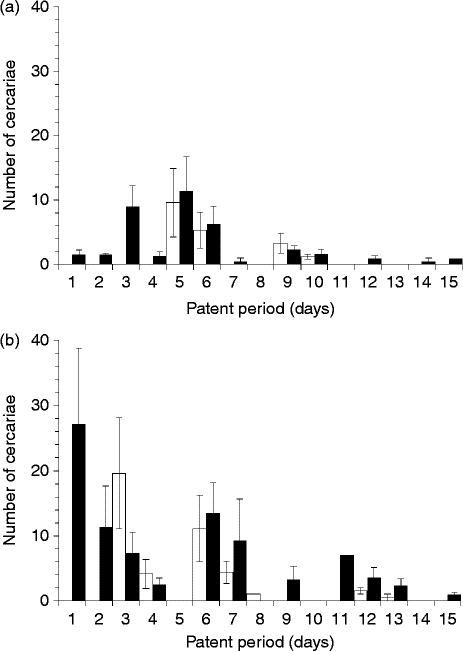
Mean values noted for pre-patent periods were compared to determine if the lymnaeid and/or the parasite species had a significant effect on this parameter. The same protocol was also used to compare the patent periods and the total numbers of metacercariae. The dynamics of cercarial shedding for both digeneans was presented for the first 15 days of the patent period (see fig. 1).
Numbers of Calicophoron daubneyi (white bars) and Fasciola hepatica (black bars) metacercariae per snail and per day of the patent period in experimentally co-infected Lymnaea glabra (a) and Galba truncatula (b). Day 1 corresponds to the first day of the patent period for F. hepatica. Values noted for C. daubneyi take day 1 of F. hepatica into account for their presentation.

Results
The prevalence of natural co-infections (table 1) was significantly higher (χ2= 22.53, P < 0.001) in L. glabra than in G. truncatula (0.7% instead of 0.4%). In contrast, that of experimental co-infections was significantly greater (χ2= 13.75, P < 0.001) in G. truncatula than in the other lymnaeid (6.3% instead of 3.0%).
Redial burdens in natural co-infections
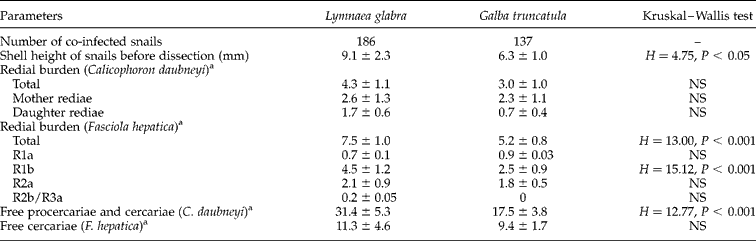
Table 2 indicates the characteristics of these infections in the two lymnaeid species. The mean shell height of these snails was significantly higher for L. glabra than for G. truncatula (9.1 mm instead of 6.3 mm) but this difference was not due to snail infection. Live and free rediae of F. hepatica were significantly more numerous in the former lymnaeid than in the latter (a mean of 7.5 per snail instead of 5.2), whereas the difference between the total numbers of C. daubneyi rediae was not significant (4.3 and 3.0 live rediae in L. glabra and G. truncatula, respectively). Among the different redial categories of F. hepatica found in these snails, the number of R1b rediae was significantly higher in L. glabra, while the values noted in the other three categories did not show any significant differences between both lymnaeids. However, it is interesting to note the low number of R2a rediae in these co-infected snails (a mean of 2.1 in L. glabra and 1.8 in G. truncatula) and the presence of a few R2b/R3a rediae only in L. glabra. Counts of procercariae and/or cercariae demonstrated a significantly greater C. daubneyi burden in L. glabra, whereas those of F. hepatica did not significantly differ from each other.
Redial and cercarial burdens contained in the bodies of naturally co-infected Lymnaea glabra and Galba truncatula.

H, Kruskal–Wallis ratio; NS, not significant; P, probability.
a Mean value ± SD.
In spite of the greater F. hepatica burden found in L. glabra, several R1b and all the R2a and R2b/R3a rediae were immature at the time of snail dissection and only morulae and/or procercarial embryos were present (data not shown).
Cercarial burdens in experimental co-infections
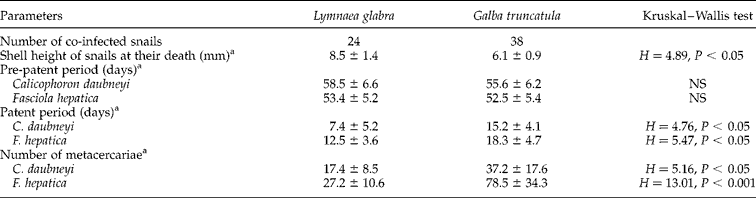
Compared to G. truncatula, the mean shell height of co-infected snails was significantly higher in L. glabra (table 3). As for redial burdens, the difference between these shell heights is due to snail species and not to snail infection. The lengths of pre-patent periods noted for each parasite in both lymnaeids were close to each other, whereas the patent periods noted in L. glabra were significantly shorter, whatever the digenean species. Metacercarial production of each parasite was also significantly lower in L. glabra than in G. truncatula. Comparison of values revealed that the mean pre-patent period, patent period and metacercarial production in each lymnaeid species were slightly lower for C. daubneyi than for F. hepatica, even if all the differences between both digeneans were not significant.
The main characteristics of Calicophoron daubneyi and Fasciola hepatica infections in experimentally co-infected Lymnaea glabra and Galba truncatula.

H, Kruskal–Wallis ratio; NS, not significant; P, probability.
a Mean value ± SD.
Figure 1 shows the dynamics of cercarial shedding in the two snail groups throughout the first 15 days of the patent period. In L. glabra (fig. 1a), the mean number of F. hepatica cercariae peaked on days 3 and 5 of the patent period, with a mean of 9.0 and 11.4, respectively. Later, cercarial shedding became discontinuous over time until day 15 of the patent period. Two peaks on days 5 and 9 were noted in the shedding of C. daubneyi cercariae and their respective mean values were 9.6 and 3.3 cercariae. In G. truncatula (fig. 1b), the mean number of F. hepatica cercariae peaked on days 1 and 6 of the patent period with a mean of 27.2 and 13.6, respectively. Two peaks were also noted for C. daubneyi, the first occurring on day 3 (at 19.6 cercariae) and the second peak on day 6 (at 11.1 cercariae). In both lymnaeid species (fig. 1a, b), cercariae of C. daubneyi and F. hepatica were released during the same shedding waves. It is interesting to note here the synchronism of several peaks for C. daubneyi and F. hepatica in L. glabra (on day 5) and G. truncatula (on day 6).
Discussion
The prevalence of natural co-infections in L. glabra and G. truncatula (0.7% and 0.4%, respectively) agreed with the value (0.4%) reported by Rondelaud et al. (Reference Rondelaud, Vignoles and Dreyfuss2004) for G. truncatula naturally co-infected with both digeneans. In contrast, the percentage recorded for experimental co-infections in L. glabra (3.0%, table 1) was lower than those reported by Abrous et al. in 1996 (10.0%) and 1998 (12.5%). A similar remark can also be noted for G. truncatula, with 6.3% prevalence (table 1) which was clearly lower than that (12.5%) given by Augot et al. (Reference Augot, Abrous, Rondelaud and Dreyfuss1996) for this lymnaeid. These differences can easily be explained by the number of snails used in these experimental infections (50 or 100 per group for the above authors, 600 or 800 per lymnaeid in the present study).
In natural co-infections of L. glabra and G. truncatula with both digeneans, the redial burdens of C. daubneyi did not significantly differ from each other (4.3 and 3.0 per snail, respectively) (table 2). This finding agreed with the numbers of C. daubneyi rediae (1.8–2.4 per co-infected snail) reported by Rondelaud et al. Reference Rondelaud, Vignoles and Dreyfuss(2009a) for G. truncatula. In contrast, the redial burden of F. hepatica was significantly greater in L. glabra than in G. truncatula (7.5 instead of 5.2 per co-infected snail) (table 2) and this finding was more difficult to explain. In our opinion, the most reliable hypothesis would be to explain this discrepancy by the difference that exists in the shell growth of both lymnaeids over the same time frame (a mean shell height of 9.1 mm in L. glabra and 6.3 mm in G. truncatula) (table 2), and this assumption is supported by the number of immature rediae found in the bodies of dissected L. glabra. The quicker shell growth of L. glabra over time (Rondelaud et al., Reference Rondelaud, Vignoles and Dreyfuss2003) would facilitate the numerical development of F. hepatica rediae, but its body volume, being narrower than that of G. truncatula (Hubendick, Reference Hubendick1951; Baker, 2012–Reference Baker2013), would only permit the full growth of a few R1b rediae. In both lymnaeids, the redial burdens of both digeneans were mainly constituted of first-generation rediae (mother rediae for C. daubneyi, R1a+R1b rediae for F. hepatica) and this finding agreed with the report by Rondelaud et al. (Reference Rondelaud, Vignoles and Dreyfuss2004) on naturally co-infected G. truncatula. The greater cercarial burden of C. daubneyi found in both lymnaeids (a mean of 31.4 free procercariae and cercariae in L. glabra instead of 11.3 free F. hepatica cercariae, for example) can easily be explained by the characteristics of C. daubneyi larval development in its host snail, with the rapid exit of procercarial embryos from parental rediae and their subsequent differentiation within the snail body up to the cercaria stage (Sey, Reference Sey1979).
In experimentally co-infected L. glabra (table 3), the mean length of the patent period (7.4 days for C. daubneyi and 12.5 days for F. hepatica) ranged within the scale of values reported by Abrous et al. (Reference Abrous, Rondelaud, Dreyfuss and Cabaret1998) and Abrous (Reference Abrous1999) in snails of the same species but infected with F. hepatica. In the same way, metacercarial production in L. glabra agreed with values reported by Abrous et al. (Reference Abrous, Rondelaud and Dreyfuss1996, Reference Abrous, Rondelaud, Dreyfuss and Cabaret1998) and Abrous (Reference Abrous1999) for the same lymnaeid harbouring larval forms of C. daubneyi, F. hepatica or both digeneans. Compared to G. truncatula, the values of the above parameters were significantly lower in L. glabra and these findings can be explained by a still incomplete adaptation between the snail and either parasite, as hypothesized by Boray (Reference Boray1966, Reference Boray1969) for several lymnaeid species and F. hepatica. However, two points in the present study warrant special comments. First, the pre-patent period noted for C. daubneyi in each lymnaeid was longer than that recorded for F. hepatica (table 3), even though the difference between mean values was not significant. As the pre-patent period in highly susceptible G. truncatula lasted a mean of 63–64 days for C. daubneyi (Abrous, Reference Abrous1999; Abrous et al., Reference Abrous, Rondelaud and Dreyfuss2000a) and 51–53 days for F. hepatica at 20°C (Rondelaud, Reference Rondelaud1993), the values recorded for each digenean infection demonstrated that each parasite kept its own developmental rhythm in co-infected snails. Secondly, C. daubneyi cercariae in both lymnaeids were released, as those of F. hepatica, during the same shedding waves and there was a synchronism in the shedding peaks, as shown in fig. 1. To explain these findings, two perhaps complementary hypotheses may be proposed. The first is to suppose that cercariae of the first digenean (C. daubneyi or F. hepatica) would dig one or several tunnel-shaped lacunae through the snail's perianal region to exit from their intermediate host and these tunnel-shaped lacunae would be used by cercariae of the other digenean. The other hypothesis is derived from the report by Kendall & McCullough (Reference Kendall and McCullough1951), who noted an accumulation of mature F. hepatica cercariae around the snail's posterior intestine before cercarial exit. In the present study, the accumulation of both digenean cercariae within this space would progressively increase parasite pressure on the snail's close viscera and finally trigger simultaneous release of cercariae.
In conclusion, the presence of lymnaeids harbouring live larval forms of C. daubneyi and F. hepatica was scarce in the field. Low redial burdens of each digenean developed within the same host snail. Cercariae of both species were shed during the same waves, with synchronization of several shedding peaks. In spite of a greater shell height for L. glabra and its higher redial burdens of F. hepatica, metacercarial production of both digeneans were lower in L. glabra than in G. truncatula, thus indicating a still incomplete adaptation between the former lymnaeid and both parasites.
Conflict of interest
None.