Introduction
In psychogeriatric patients with cognitive impairment or dementia, there is an 80% prevalence of two or more psychiatric symptoms, e.g. depression, anxiety, paranoia and aggression (Aalten et al., Reference Aalten, Vugt, de Jaspers, Jolles and Verhey2005; Bakker et al., Reference Bakker, Duivenvoorden, van der Lee and Trijsburg2005). Multiple psychiatric symptoms (MPS) have negative effects on cognitive functioning and quality of life. They are a burden for the caregiver and predict the patient's admission to a nursing home (Bakker et al., Reference Bakker, Duivenvoorden and Schudel2001; Pot et al., Reference Pot, Deeg and Knipscheer2001; Black and Almeida, Reference Black and Almeida2004; Aalten et al., Reference Aalten, Vugt, de Jaspers, Jolles and Verhey2005; Peeters et al., Reference Peeters, Van Beek, Meerveld, Spreeuwenberg and Francke2010). Moreover, these MPS are among the top three problems experienced by psychogeriatric patients and their caregivers (Peeters et al., Reference Peeters, Van Beek, Meerveld, Spreeuwenberg and Francke2010). In usual nursing home care, psychotropic drugs are widely used to treat the MPS of patients with dementia despite their limited effects and potentially harmful side effects, e.g. (a)typical antipsychotics (Schneeweiss et al., Reference Schneeweiss, Setoguchi, Brookhart, Dormuth and Wang2007; Selbaek et al., Reference Selbaek, Kirkevold and Engedal2008).
Psychotherapeutic interventions
There is a lack of integrative psychotherapeutic programs, even though reports in the literature indicate that for individual psychiatric symptoms, e.g. depression and anxiety, as well as caregiver burden, psychotherapeutic treatment may be effective in both nursing home and primary care settings (Bakker et al., Reference Bakker, Duivenvoorden and Schudel2001; Reference Bakker, Duivenvoorden, van der Lee, Olde Rikkert, Beekman and Ribbe2011; Scholey and Woods, Reference Scholey and Woods2003; Livingston et al., Reference Livingston, Johnston, Katona, Paton and Lyketsos2005; Davison et al., Reference Davison, Hudgson, McCabe, George and Buchanan2007). However, psychotherapeutic interventions focusing on the MPS of psychogeriatric patients are complex, due to their multiplicity in combination with cognitive disorders, somatic comorbidity, and social problems (e.g. relationships and loneliness; Hinchliffe et al., Reference Hinchliffe, Hyman, Blizard and Livingston1995). Furthermore, integrative psychotherapeutic programs in nursing homes have never been evaluated in large-scale comprehensive studies. For these reasons, we developed a unique integrative psychotherapeutic nursing home program: integrative reactivation and rehabilitation (IRR; Bakker, Reference Bakker2000).
Results of the primary analysis
In this paper, we report the results of a re-analysis of the effectiveness of IRR in terms of percentages of clinically relevant improved psychogeriatric patients and caregivers. The randomized controlled trial (RCT) performed was designed to test the effectiveness of the IRR on MPS in psychogeriatric patients with cognitive impairment or dementia and on caregiver burden (trial registration number ISRCTN38916563, December 2004; consort guidelines were followed). The primary analysis regarded the mean differences between IRR and the control group (usual care) on continuous data of the primary and secondary outcome variables. The results of this analysis are published elsewhere (Bakker et al., Reference Bakker, Duivenvoorden, van der Lee, Olde Rikkert, Beekman and Ribbe2011). From the perspective of the caregivers, the IRR had a significant and moderate to large surplus effect (up to 34%) in reducing the MPS of psychogeriatric patients with cognitive impairment or dementia in both the short term and long term. In fact, at the six-month follow-up there was a total reduction in MPS up to 46% in number and 61% in severity. Furthermore, with regard to caregiver burden and competence, the IRR had a large positive surplus effect (up to 36%) at the end of the treatment. During the follow-up, the surplus effect even increased to a reduction of 50%, while usual care had hardly any effect at all.
Rationale of the re-analysis
It is relevant to estimate the percentages of patients and caregivers who showed clinically relevant improvement in IRR compared to usual care, especially at the six-month follow-up. Moreover, using an intention-to-treat (ITT) strategy offers the opportunity to calculate risk ratios (RRs) and numbers needed to treat (NNTs), which can be compared with those of other interventions (Livingston and Katona, Reference Livingston and Katona2004). At the end, performing a complete cases (CC) analysis allows a more realistic estimation of the efficacy of IRR compared to usual care. Specifically, if there was a relatively high natural dropout, which is a well-known phenomenon in research on frail elderly (Callahan et al., Reference Callahan, Hendrie, Dittus, Brater, Hui and Tierney1994; Hinchliffe et al., Reference Hinchliffe, Hyman, Blizard and Livingston1995; Bakker et al., Reference Bakker, Duivenvoorden, van der Lee, Olde Rikkert, Beekman and Ribbe2011). In case of no significant differences between dropouts in both arms of the study, results of a CC analysis may represent a more accurate estimation of the potential benefit of IRR. At the end, only patients and caregivers who fully participated in the IRR program can take all the benefits of the available interventions. In this re-analysis study – following Cummings – a minimally clinically important improvement was defined as more than 30% improvement compared to the baseline value of the primary outcome variable, i.e. Neuropsychiatric Inventory (NPI)-sum-severity (Cummings et al., Reference Cummings, Koumaras, Chen and Mirski2005). This corresponds well – in this study as well as in general – with a half standard deviation or more of the baseline value (Norman et al., Reference Norman, Sloan and Wyrwich2003). The objective of this clinical–empirical study was to re-analyze the RCT with respect to long-term benefit of IRR compared to usual care (UC) in terms of percentages of clinically relevant improved psychogeriatric patients on psychiatric symptoms and of caregivers on burden and competence.
Material and methods
Patients
The psychogeriatric patients were recruited from the urban region of Nieuwe Waterweg Noord (NWN), near Rotterdam in the Netherlands (approximately 180,000 inhabitants). The patients were referred from an (ambulant) mental health service (5.4%), a general hospital (13.8%), a memory clinic (6%), and general practitioners or primary healthcare services (75.1%). Before inclusion, all referred patients underwent a comprehensive geriatric assessment. The initial inclusion criteria were a diagnostic and statistical manual of mental disorders, fourth edition (DSM-IV) classification for dementia, amnestic disorders, or other cognitive disorders. Additional inclusion criteria were: (1) age: ≥65 years; (2) cognitive functioning: the Mini-Mental State Examination (MMSE) ≥18 and ≤27 as well as Barthel index (BI) ≥5 and ≤19; (3) psychiatric symptoms: NPI at three or more symptoms (no cut-off point); and (4) informed consent. The exclusion criteria were: (1) delirium, (2) life-threatening somatic comorbidity, (3) active coercive admission regime (according to the psychiatric legislation), and (4) insufficient command of the Dutch language.
Design
The study was an open RCT, with a parallel group design, and was performed from 2001 until 2006. The psychogeriatric patients who met the selection criteria were randomly and blindly assigned to either IRR or UC, using a randomization algorithm. In the first half of the study, the assignment was in a ratio 1 (IRR): 2 (UC). Due to limited numbers of eligible patients and time restrictions of the study, in the second half the ratio was reversed to 2 (IRR): 1 (UC). The study included 168 patients (81 IRR and 87 UC). “Multiple psychiatric symptoms” of the patient was the primary outcome variable. In view of clinically relevant background information on the effects of IRR, “Burden” of the caregiver, “Cognitive functioning” of the patient, as well as “Nursing home admission” were selected as secondary outcome variables. The assessments were simultaneously executed in both groups of the study at two moments: T1 (within two weeks after intake) and T3 (follow-up; six months after the end of the intervention). Furthermore, data were gathered by trained co-workers, not members of this intervention team. The study was approved by the Medical Ethical Committee of the Erasmus University Medical Center.
Intervention
The IRR program had a duration of 13 weeks, with clinical admission to a separate 15-bed specialized unit in a psychiatric-skilled nursing home. In addition to the usual multidisciplinary nursing home care, including psychotropic drugs treatment, the IRR also consisted of interventions to reduce the MPS of the psychogeriatric patient and family therapy for the caregiver. Cognitive and somatic functioning were also optimized (Figure 1). A more extensive description of the IRR program has been published elsewhere (Bakker, Reference Bakker2000).
(Colour online) Typical IRR patient protocol and percentages of patients receiving treatment components.

Person-oriented psychotherapeutic interventions
A personal package of interventions was composed for each patient and caregiver, based on six dimensions (Bakker et al., Reference Bakker, Duivenvoorden and Schudel2000; Reference Bakker, Duivenvoorden, van der Lee, Olde Rikkert, Beekman and Ribbe2011). These six dimensions were: “Emotion” (e.g. depression, anxiety, and aggression), “Personality” (e.g. characteristics of narcissism, borderline, and dependency), “Life events” (e.g. traumatic experiences such as war, incest, and death of a spouse/child), “Social functioning” (e.g. relationship problems with spouse/children and loss of pleasant social activities), “Cognitive functioning” (e.g. problems with memory and self-care), and “Somatic functional disorders” (e.g. impaired mobility, falls, polypharmacy, nutritional deficiency, and intercurrent diseases). The following psychotherapeutic interventions based on a problem-solving theoretical framework were available and written down in specific guidelines for each discipline: (1) diagnostic assessment, (2) counseling, (3) life review, (4) interpersonal therapy, (5) (cognitive) behavioral therapy, (6) support in accepting behavior and minimizing negative effects, (7) regression approach, temporarily accepting regression behavior, (8) rehabilitation, (9) psycho-education, and (10) family therapy (Bakker, Reference Bakker2000). The interventions were mainly provided in a group, but when necessary, individually.
With regard to the percentage of patients receiving each type of intervention (Figure 1), it is important to realize that on average, the patients were treated for five functional psychiatric problems apart from the functional problems on the cognitive and somatic dimensions. The interventions for these functional psychiatric problems were generally provided by four disciplines, but sometimes a discipline used more than one type of intervention during the different phases of the IRR program. This makes the program highly flexible and it is therefore possible to compose and provide a personal package of interventions for each patient and caregiver.
Multidisciplinary intervention process
After multidisciplinary consultation, the psychogeriatrician – a nursing home physician with experience in psychiatric treatment – prescribed the interventions. The IRR team consisted of a nursing team, a psychogeriatrician, a clinical psychologist, a social worker, a music therapist, a psychomotor therapist, a creative therapist, a physiotherapist, an occupational therapist, a speech therapist, a dietician, and a welfare worker (Figure 1). Staff members were trained to systematically conduct the IRR program. The progress of the patient/caregiver was monitored weekly, guided by the method of standardized goal attainment scaling (GAS; score range 1–7; 7 = independent (no help needed)) (Rockwood et al., Reference Rockwood, Joyce and Stolee1997). Treatment fidelity was continuously monitored during the course of the personal intervention plan for each patient/caregiver. Each week, all the disciplines had to deliver a written GAS score, based on functional progress during the therapy sessions. These scores were discussed in the multidisciplinary patient meeting and a consensus GAS score was determined. All the registered data were sent to the research team after the end of the treatment. Moreover, at the end of the IRR program, each discipline had to fill in an evaluation form about the course of the therapy, including active patient participation. These data are available from the first author.
Usual care characteristics
UC consisted of a relatively high level of multidisciplinary nursing home care provided in the following settings: at home (25.3%), at home with mental healthcare (out-reaching) or psychogeriatric day care/treatment (15.7%), in a home of assisted living (7.2%), and in a nursing home (51.8%). The multidisciplinary UC staff consisted of a nursing home physician or social geriatric physician, a psychologist, a paramedical team (a physiotherapist, an occupational therapist, a speech therapist, a welfare worker), and a nursing team (registered nurses, certified nurse assistants, and/or nurse assistants).
The UC was provided by different types of core multidisciplinary teams, each with a different theoretical framework, mostly emotion-oriented.
Assessments
The primary outcome variable was the number of “MPS” assessed by number (0–12) as well as sum severity (0–144, number × frequency × severity) using the NPI (12-item version; Cummings et al., Reference Cummings, Mega, Gray and Rosenberg-Thompson1994). We distinguished four NPI clusters (Aalten et al., Reference Aalten, Vugt, de Jaspers, Jolles and Verhey2005): cluster hyperactivity: aggression, euphoria, disinhibition, irritability, and repetitive behavior; psychosis: delusion, hallucinations, and sleep disturbances; affective symptoms: depression and anxiety; and apathy: apathy and eating disorders.
The NPI was administered to the caregiver. We have chosen the caregiver NPI, because the caregivers formed a stationary group from the moment of inclusion in the study until the end of the treatment and the consecutive six-month follow-up period. Furthermore, in general, their opinions correspond more with the actual needs, thoughts, and feelings of dementia patients than those of the relatively discontinuous member of the different nursing teams (Burrows et al., Reference Burrows, Satlin and Salzman1995; Davison et al., Reference Davison, Hudgson, McCabe, George and Buchanan2007, Katona et al., Reference Katona, Livingston, Cooper, Ames, Brodaty and Chiu2007; Watson et al., Reference Watson, Zimmerman, Cohen and Dominik2009). The following secondary outcome variables were measured: “burden” for the caregiver assessed with the “NPI emotional distress” (N-emD: 0–60; 0 = no distress), the Caregiver Competence List (CCL: 28–112; 112 = optimal; Teunisse, Reference Teunisse1997) and the Caregiver Burden (CB: 0–100; 0 = optimal; van Exel et al., Reference Exel, Scholte op Reimer, Brouwer, van den Berg, Koopmanschap and van den Bos2004). To assess the “cognitive functioning” of the patient, memory was measured with the MMSE (at 0–30; 30 = normal; Folstein et al., Reference Folstein, Folstein and McHugh1975) and self-care with the Barthel Index (BI: 0–20; 20 = normal; de Haan et al., Reference Haan, Liburg, Schuling, Broeshart, Jonkers and Zuylen1993). Admission to a nursing home was measured according to length of the stay in days. The Global Deterioration Scale (GDS: 1–7; 1 = normal) was used to assess the risk of admission to a nursing home (Reisberg et al., Reference Reisberg, Ferris, de Leon and Crook1982). Somatic comorbidity was assessed with the international classification of diseases, 10th revision (ICD-10), and the DSM-IV disorders (axes I and II) were classified by a research psychiatrist. Finally, the following demographic data were collected from the patient and the caregiver: gender, age, marital status, family relationship, domicile, and level of education.
Statistical analyses
Fisher's exact tests were used to estimate differences between IRR and UC on counts such as the number of deaths. Student's t-test for unpaired samples was used to test for differences between IRR and UC on continuous data. To evaluate the effect of IRR compared to UC, the mean differences on the continuous outcome variables were calculated over time. In this re-analysis of the RCT, we tested in percentages the difference of improvement compared to baseline values between the two interventions (i.e. IRR and UC) in long term (follow-up; six months after the end of the intervention: T1–T3). Following Cummings, improvement was defined as a difference of a half standard deviation or more of the baseline value, corresponding to >30% improvement (Norman et al., Reference Norman, Sloan and Wyrwich2003; Cummings et al., Reference Cummings, Koumaras, Chen and Mirski2005). We calculated RRs (in fact benefit ratios) for the estimation of the dichotomized change in favor of IRR for each outcome variable. Furthermore, the number needed to treat (NNT) was estimated in case of a significantly higher percentage of improvement in IRR compared to UC, and vice versa. To estimate the beneficial effect on patients and caregivers, who fully participated in the IRR program, odds ratios (ORs) were calculated according a CC analysis using the data of patients who fully completed IRR, respectively UC, in long term. A risk ratio or odds ratio of >1.0 was in favor of IRR. The differences between the dropouts in the two study groups, with regard to duration over time of participation in the program, were determined by Cox regression analysis. Hazard ratio (HR) was used as the measure of performance. The length of stay in a nursing home after the end of the intervention was estimated by Kaplan–Meier analysis. The 95% confidence intervals (CI) were presented. All significance testing was set at p < 0.05 (two-tailed). The statistical analyses were performed with the software program SPSS, version 15.
Results
Characteristics of the study sample
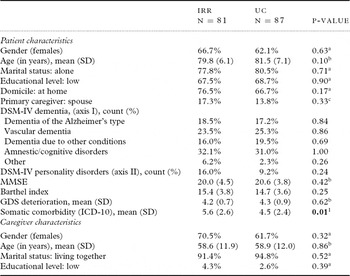
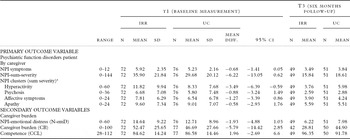
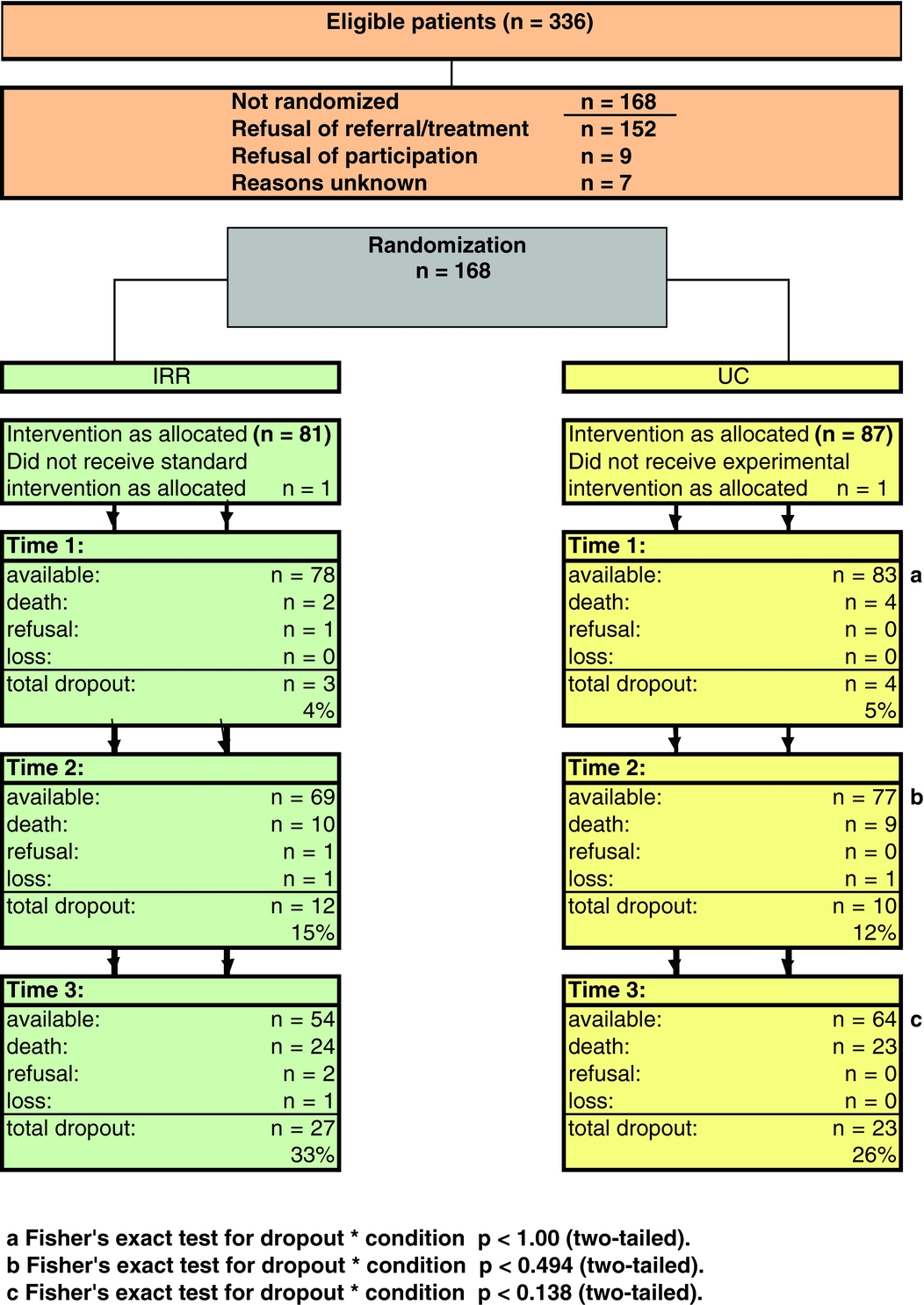
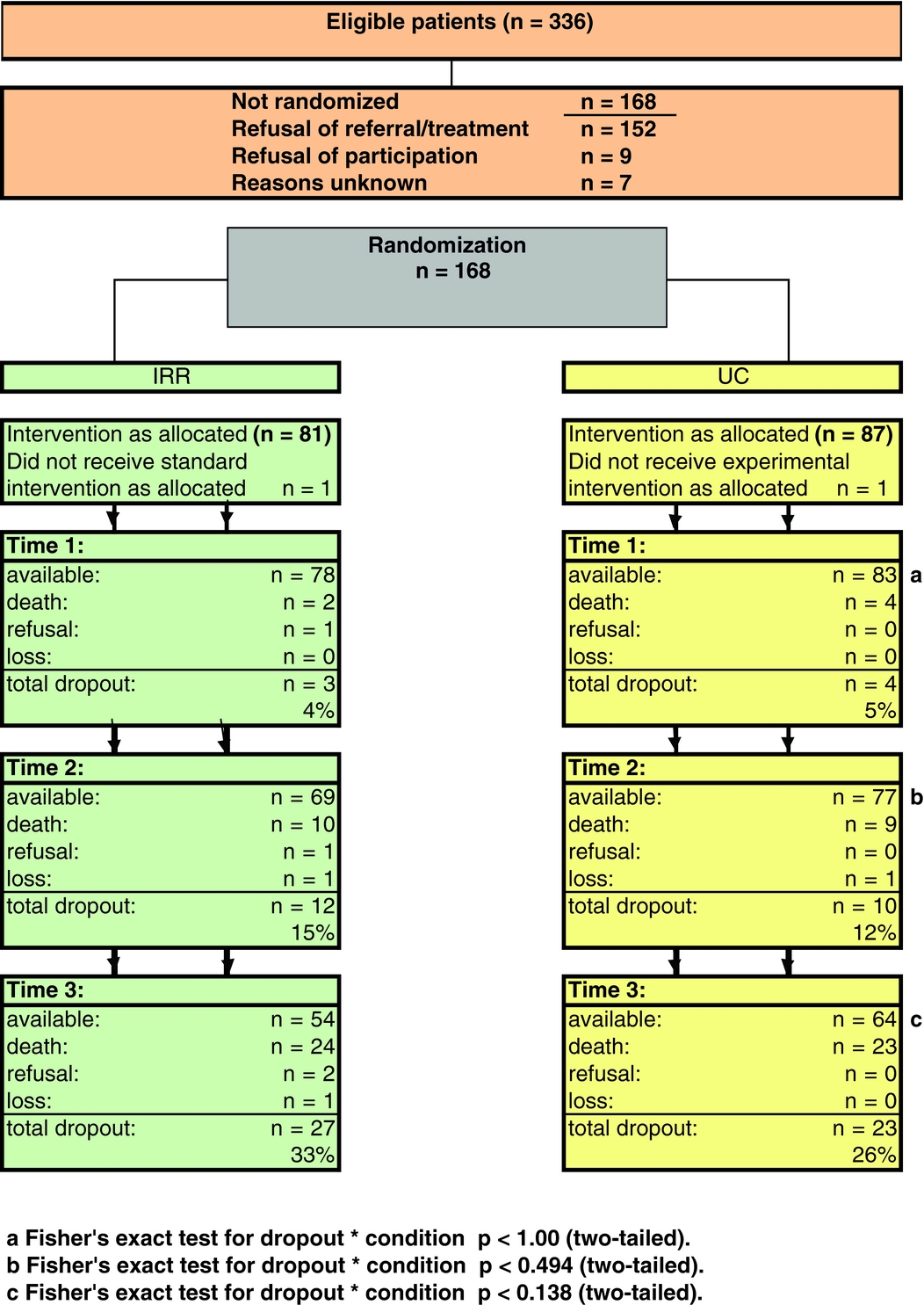
The flow chart (Figure 2) shows that, of the 336 eligible patients, 168 (50%) consented to participate. The non-participants did not differ significantly from the participants with regard to the inclusion criteria. The 168 patients were randomly assigned to either IRR (N = 81) or UC (N = 87). The differences between the two study groups in the number of dropouts – the majority caused by death – were insignificant at all measurement points. Moreover, the dropouts did not differ significantly with regard to any baseline assessment or length of time participating in the program (Cox regression analysis: HR 1.21; p < 0.54). With respect to biographical data, there were no significant differences between the two groups (Table 1). Mean somatic comorbidity in the IRR group was significantly higher [IRR 5.6 (SD 2.6); UC 4.5 (SD 2.4); p < 0.01]. In our analyses, we controlled for somatic comorbidity. A mean GDS score of 4.2 (SD 0.8) suggested that the study sample consisted of psychogeriatric patients with mild cognitive impairment who were at high risk for admission to a nursing home (Muskens et al., Reference Muskens, Noy and Verburg1992). At T1 (Table 2), there were no significant mean differences between the IRR group and the UC group with the exception of the NPI cluster hyperactivity (mean difference 3.49; 95% CI: −6.33 to −0.59).
General details of participants, distinguished by intervention

aFisher's exact test (two-tailed); bt-test (two-tailed); cPearson chi-square (two-tailed). IRR = integrative reactivation and rehabilitation; UC = usual care; MMSE = Mini-Mental State Examination; GDS = Global Deterioration Scale.
1Significant p-values are printed in boldface.
Level of outcome across time (T1 and T3) distinguished by intervention

aThe NPI clusters are composed of: hyperactivity = agitation/aggression, euphoria, disinhibition, irritability, repetitive behavior; psychosis = delusions, hallucinations, sleep disturbances; affective symptoms = depression, anxiety; apathy = apathy, eating disorders. IRR = integrative reactivation and rehabilitation; UC = usual care; NPI = Neuropsychiatric Inventory.
(Colour online) Flow chart describing progress of patients through randomized trial.
Long-term improvement: risk ratios (RR)
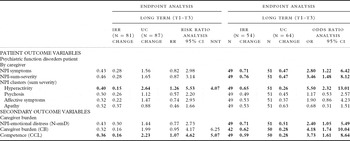
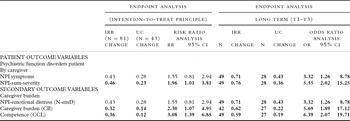
Table 3 shows the estimated RRs and NNTs of improved patients at follow-up, six months after the end of the intervention (T1–T3). On the primary outcome variable “MPS,” all RRs were in favor of IRR, with up to 46% clinically improved patients, albeit not one was statistically significant. Looking in more detail, on sum severity of the NPI-cluster hyperactivity, IRR showed a significantly positive effect (RR 2.64; 95% CI: 1.26–5.53; NNT: 4.07), with 40% improved patients in IRR. Furthermore, on “Burden” of the caregiver, the RR of competence (CCL) was 2.23 (95% CI: 1.07–4.62; NNT: 5.07) significantly in favor of IRR (with 36% improved caregivers). General burden was marginally significant (RR 1.99; 95% CI: 0.95–4.17; NNT 6.25). “Cognitive functioning” showed no significant differences between the two arms. Kaplan–Meier analysis showed that the length of the stay in a nursing home did not differ significantly between IRR and UC (IRR mean 147.04 days and UC mean 151.82 days; p < 0.62). We also executed a subgroup analysis including all IRR patients, and of UC only the nursing home patients at the start (T1; n = 43) (Table 4). All RRs were in favor of IRR. On sum severity of the NPI (RR 1.96; 95% CI: 1.01–3.81), caregiver burden (CB: RR 2.30; 95% CI: 1.07–4.95), and caregiver competence (CCL: RR 3.08; 95% CI: 1.30–6,85), the RR values were significant.
Endpoint analysis risk ratio and odds ratio, all patients, distinguished by intervention

IRR = integrative reactivation and rehabilitation; UC = usual care; NPI = Neuropsychiatric Inventory. Significant values are printed in boldface.
Endpoint subgroup re-analysis risk ratio and odds ratio, nursing home admitted patients, distinguished by intervention

IRR = integrative reactivation and rehabilitation; UC = usual care; NPI = Neuropsychiatric Inventory. Significant values are printed in boldface.
Long-term improvement: complete cases analysis (CC)
Table 3 presents the estimated ORs for improvement in long term (T1–T3) of psychogeriatric patients and caregivers, who fully completed the intervention in both groups of the RCT on MPS (number as well as sum severity of NPI symptoms), IRR showed high significant odds ratios; OR: 2.80 (95% CI: 1.22–6.42), respectively OR 3.46 (95% CI: 1.48–8.12), with up to 76% improved patients in IRR. Looking in more detail, the same holds true for NPI-sum-severity of cluster hyperactivity (OR 5.50; 95% CI: 2.32–13.01), with a high percentage (65%) improved patients. Regarding “Burden” of the caregiver, the ORs of the three outcome variables were all three significantly in favor of IRR. On NPI-emotional distress, the OR was 2.40 (95% CI: 1.05–5.49), on CB 4.18 (95% CI: 1.74–10.04) and on competence (CCL) the OR was 3.73 (95% CI: 1.61–8.64), with up to 71% improved caregivers. Of the other secondary outcome variable “Cognitive functioning,” the ORs were insignificant. In the subgroup analysis (see Table 4) using in UC only the nursing home patients at the start (T1; n = 43), all the ORs showed to be significant and substantially higher than with the total sample (0.53 up to 2.66 points) in favor of IRR.
Discussion
In this study we re-analyzed the data of the RCT with respect to the long-term benefit of IRR compared to usual care in terms of percentages of clinically relevant improved psychogeriatric patients on psychiatric symptoms and of caregivers on burden. At a six-month follow-up after the three months of the treatment, the patients who were referred at IRR showed a higher likelihood of clinically relevant improvement on hyperactivity (RR 2.64) than patients referred at usual multidisciplinary nursing home care. The number needed to treat (four) was relatively small with a percentage of improved patients at 40. If a patient fully completed the IRR program, the likelihood of improvement was much more pronounced (ORs between 2.80 and 5.50) and the percentages of improved patients was high (up to 76%). With respect to caregivers, IRR showed a higher likelihood of improvement with relatively small NNTs (five) on competence (RR 2.23; up to 36% improved caregivers). Moreover, after a fully completed program the ORs on competence and experienced burden varied between 2.40 and 4.18, with a high percentage of improved caregivers up to 71%. The results of the subgroup analysis, comparing the patients who were admitted in a nursing home at T1 (all patients of IRR and 52% of the UC patients), were even more distinct. These are important and clinically relevant results because MPS of dementia patients and burden of caregiver are the two most problematic experienced phenomena in dementia care (Peeters et al., Reference Peeters, Van Beek, Meerveld, Spreeuwenberg and Francke2010).
Comparison of results to the literature
The beneficial long-term effects of IRR on psychiatric symptoms of psychogeriatric patients and on the burden as well as on the competence of caregivers are in line with the indications in the literature that (adapted) psychotherapeutic interventions on individual psychiatric symptoms may be effective (Teri and Gallagher-Thompson, Reference Teri and Gallagher-Thompson1991; Bakker, Reference Bakker2000; Scholey and Woods, Reference Scholey and Woods2003; Livingston et al., Reference Livingston, Johnston, Katona, Paton and Lyketsos2005; Davison et al., Reference Davison, Hudgson, McCabe, George and Buchanan2007; Bakker et al., Reference Bakker, Duivenvoorden, van der Lee, Olde Rikkert, Beekman and Ribbe2011). The results of the re-analysis confirm those of the primary analyses based on the mean differences on continuous data. Moreover, the benefit of IRR was more distinct, specifically when the fully completers were taken in account.
In addition, comparison of IRR on NNTs with donepezil, memantine as well as cognitive behavior therapy (CBT) showed that the NNTs of IRR were relatively low and in the same range, i.e. donepezil NNT 10, memantine NNT 3–8, and CBT NNT 5–10 (Livingston and Katona, Reference Livingston and Katona2004).
Strength of the study
The strength of this re-analysis of the RCT data was that, as far as we know, it was one of the first comprehensive studies with a relative large sample size that addressed integrative psychotherapeutic treatment in a psychiatric-skilled nursing home setting (Hinchliffe et al., Reference Hinchliffe, Hyman, Blizard and Livingston1995; Davison et al., Reference Davison, Hudgson, McCabe, George and Buchanan2007). Furthermore, the surplus benefit for all patients who fully profited from the program could be estimated, even more explicitly comparing all nursing home patients. As the relatively large dropout group did not differ significantly between IRR and usual care on all relevant assessment parameters, neither on participation interval, there was no question of selective dropout. The majority of dropout was caused by death. Besides, the phenomenon of high dropout percentages is well-known in geriatric research even in observation studies (Callahan et al., Reference Callahan, Hendrie, Dittus, Brater, Hui and Tierney1994; Hinchliffe et al., Reference Hinchliffe, Hyman, Blizard and Livingston1995; Bakker et al., Reference Bakker, Duivenvoorden, van der Lee, Olde Rikkert, Beekman and Ribbe2011). Basically, it reflects the vulnerability of psychogeriatric patients suffering from multiple MPS rather than selective dropout as a consequence of the intervention at study, in this case IRR.
Limitations of the study
First of all, the post hoc nature of this re-analysis was a limitation. There was no a priori hypothesis formulated concerning the dichotomized improvement criteria, the more so for the subgroup analysis. Furthermore, the RCT was not blinded. In a clinical study like this, blinding is not feasible, because the trained co-workers had to visit the patients and caregivers personally, so they knew about the intervention, and because the caregivers were informed participants, they also knew about the intervention. As the assessments at baseline showed just minor differences between IRR and usual care, except for somatic comorbidity, the information bias at baseline seems to be limited. Regarding generalization of the findings of this RCT, it is of clinical relevance to keep in mind that 50% of the eligible patients refused to participate. The core motive for refraining from participation was fear of admission in case of assignment to IRR. However, in a post hoc prognostic analysis, living together showed no prognostic qualities with respect to improvement on the primary outcome variable. Furthermore, more patients were included with vascular dementia than with dementia of the Alzheimer's type, which is not in line with most epidemiological studies. This may be an effect of the inclusion criteria, i.e. suffering from both cognitive function disorders and three or more NPI symptoms. As patients with vascular dementia are expected to have more psychiatric problems, they will be overrepresented in this study, as was the case. Nevertheless, in a post hoc analysis type of dementia showed no significant modification effect on MPS of the patient or on caregiver burden.
What are the therapeutic components of IRR? It is expected that after identification of the therapeutic components and developing them to a higher level of sophistication, the beneficial effects of IRR will increase. To identify psychogeriatric patients and their caregivers with a relatively high likelihood to improve is another possibility to enlarge the beneficial effects of IRR. To that end, to optimize beneficial effects of IRR, the construction of a tool enabling the identification of suitable patients for IRR is of highly clinical interest. Such a tool contributes to optimize medical decision-making.
Conclusion
In conclusion, at six months follow-up IRR showed a significantly higher probability of improvement with a relatively small NNT (four) on multiple psychiatric symptoms in psychogeriatric patients with cognitive impairment or dementia. The results (76% improved patients) were more distinct for those who fully completed the IRR program. The same applies to the higher probability of IRR to improve NPI-related and general burden as well as competence of the caregiver (NNT of five and for those who fully participated 71% improved caregivers). Compared to donepezil, memantine, and CBT, the NNT of IRR were favorable, i.e. relatively low. Considering all available evidence, usual (inter)national psychogeriatric nursing home care and likely ambulant care programs too have to incorporate integrative psychotherapeutic treatment.
Conflict of interest
None.
Description of authors’ roles
Ton J. E. M. Bakker designed and carried out the study, and was responsible for the statistical design, statistical analysis, data analysis, and writing of the paper. Hugo J. Duivenvoorden designed the study, and was responsible for the statistical design, statistical analysis, data analysis, and writing of the paper. Jacqueline van der Lee carried out the research, supervised the data collection, and collected and analyzed the data. Marcel G. M. Olde Rikkert, Aartjan T. F. Beekman, and Miel W. Ribbe reviewed the paper and advised the researchers.
Acknowledgments
This study received a grant from The Netherlands Organisation for Health Research and Development (www.zonmw.nl), which is a national organization that promotes quality and innovation in the field of health research and healthcare, initiating and fostering new developments. The majority of ZonMw's commissions come from the Ministry of Health, Welfare and Sport (VWS).