Introduction
Attention deficit/hyperactivity disorder (ADHD) is a disorder characterised by developmentally inappropriate and functionally impairing levels of inattention and/or hyperactivity and impulsivity. ADHD becomes typically evident in the first decade of life, and tends to persist through adolescence and adulthood (Swanson et al. Reference Swanson, Sergeant, Taylor, Sonuga-Barke, Jensen and Cantwell1998). Despite extensive research, there is continuous debate on both the validity and prevalence of ADHD (Singh, Reference Singh2008). The use of medications to treat ADHD has been rapidly increasing worldwide, a phenomenon that has raised concern about the appropriateness and safety of this practice (Dalsgaard et al. Reference Dalsgaard, Nielsen and Simonsen2013; Thomas et al. Reference Thomas, Mitchell and Batstra2014). Although neurobiological correlates of ADHD, such as delayed maturation of the brain prefrontal cortex, have been documented (Shaw et al. Reference Shaw, Malek, Watson, Sharp, Evans and Greenstein2012), there is currently no biological marker that can be used for diagnostic purposes. Thus, ADHD remains a clinical diagnosis that is largely based on the observation of the child's behaviour by parents and teachers.
The prevalence of ADHD is estimated to be about 5% worldwide, but with a large variability that is mainly attributed to differences in diagnostic and ascertainment methods (Polanczyk et al. Reference Polanczyk, de Lima, Horta, Biederman and Rohde2007, Reference Polanczyk, Willcutt, Salum, Kieling and Rohde2014). In the USA, rates of 8.7 and 15.5% have been reported (Froehlich et al. Reference Froehlich, Lanphear, Epstein, Barbaresi, Katusic and Kahn2007; Rowland et al. Reference Rowland, Skipper, Umbach, Rabiner, Campbell, Naftel and Sandler2013). Such unexpectedly and increasingly high rates raise concern about the specificity of the assessment methods. Even if the validity of the ADHD construct has been proven regardless of cultural characteristics (Rohde et al. Reference Rohde, Szobot, Polanczyk, Schmitz, Martins and Tramontina2005; Buitelaar et al. Reference Buitelaar, Barton, Danckaerts, Friedrichs, Gillberg, Hazell, Hellemans, Johnson, Kalverdijk, Masi, Michelson, Revol, Sebastian, Zhang and Zuddas2006), the actual application of the diagnosis to community care is strongly influenced by cultural factors (Skounti et al. Reference Skounti, Philalithis and Galanakis2007).
In fact, the presence of the core symptoms of inattention, hyperactivity and/or impulsivity does not per se result in a diagnosis of ADHD, unless these behaviours are deemed by parents and teachers to cause functional impairment. Thus, even if the distribution of objectively measured behaviours relevant to ADHD in the population is consistent across countries and cultures, the critical factor is whether their presence is considered sufficiently extreme and impairing by parents and educators to be considered abnormal.
Over the past 30 years, the more restrictive nosological construct of hyperkinetic disorder of the International Classification of Diseases (ICD) has been largely replaced by the broader criteria of the Diagnostic and Statistical Manual of Mental Disorder (DSM) (Taylor & Sonuga-Barke, Reference Taylor, Sonuga-Barke and Rutter2008). Hyperkinetic disorder can be considered a subset of ADHD, probably accounting for about one-fourth of children clinically treated for ADHD of hyperactive or combined type (Santosh et al. Reference Santosh, Taylor, Swanson, Wigal, Chuang, Davies, Greenhill, Newcorn, Arnold, Jensen, Vitiello, Elliott, Hinshaw, Hechtman, Abikoff, Pelham, Hoza, Molina, Wells, Epstein and Posner2005). While the DSM is dominant in the USA, European psychiatry is still influenced, to varying degrees, by the more conservative criteria, thus leading to substantial differences in the rate with which ADHD is diagnosed and managed in clinical practice. The rate of diagnosis is also influenced by differences in the educational systems, as ADHD is considered reason for receiving special education in some countries but not in others (Al-Yagon et al. Reference Al-Yagon, Cavendish, Cornoldi, Fawcett, Grünke, Hung, Jiménez, Karande, van Kraayenoord, Lucangeli, Margalit, Montague, Sholapurwala, Sideridis, Tressoldi and Vio2013).
Not surprisingly, differences in diagnostic threshold carry important clinical implications for treatment. There are striking differences worldwide in the use of medications for the treatment of ADHD. In the USA, it was estimated that 3.5% of the population under age 19 received stimulant medications in 2008 (Zuvekas & Vitiello, Reference Zuvekas and Vitiello2012), and a more recent study has reported that 6.1% of children aged 4–17 years were taking medication for ADHD in 2011 (Visser et al. Reference Visser, Danielson, Bitsko, Holbrook, Kogan, Ghandour, Perou and Blumberg2014). In striking contrast, the paediatric use of stimulant medications is <1% in Italy or France (Frauger et al. Reference Frauger, Pauly, Natali, Pradel, Reggio, Coudert, Thirion and Micallef2011). Multiple factors probably contribute to these discrepancies, including, among the others, differences in nosology, healthcare and education systems, drug regulatory policy and general attitude of the public towards the use of medications in children (Vitiello, Reference Vitiello2008). Among these factors, the interpretation of the child behaviour by parents and teachers as abnormal, and hence in need of treatment, plays a critical role (Moffitt & Melchior, Reference Moffitt and Melchior2007).
Italy is one of the economically developed countries with the lowest use of medications for ADHD. Only a few studies have attempted to evaluate the rate of ADHD in Italian children. A pilot epidemiological study estimated that 3.9% of 4th grade students were ‘likely cases’ of ADHD based only on teacher ratings (Gallucci et al. Reference Gallucci, Bird, Berardi, Gallai, Pfanner and Weinberg1993). In a sample of first graders in Italy, teachers endorsed symptom criteria for ADHD in 7.1% of the children (3.5% with inattentive subtype and 3.6% with hyperactive or combined subtype) (Mugnaini et al. Reference Mugnaini, Masi, Brovedani, Chelazzi, Matas, Romagnoli and Zuddas2006). Parent ratings, however, were not obtained, and, as underscored by the authors of this study, the real prevalence of the disorder is likely to be lower. It is remarkable that an epidemiological study of Italian adolescents (age 10–14 years) found that the overall prevalence of mental disorders (8.2%) was similar to that reported in other European countries, but the prevalence of externalising disorders, which also includes ADHD, was only 1.2% (Frigerio et al. Reference Frigerio, Rucci, Goodman, Ammaniti, Carlet, Cavolina, De Girolamo, Lenti, Lucarelli, Mani, Martinuzzi, Micali, Milone, Morosini, Muratori, Nardocci, Pastore, Polidori, Tullini, Vanzin, Villa, Walder, Zuddas and Molteni2009). More recently, in a sample of elementary and middle school population in Syracuse, Italy, the prevalence of ADHD was estimated to be 3%, with most of the cases meeting criteria for the combined or hyperactive type, and about a quarter for the inattentive type (Bianchini et al. Reference Bianchini, Postorino, Grasso, Santoro, Migliore, Burlò, Tata and Mazzone2013).
There is evidence that the population rate of ADHD varies widely based on the diagnostic criteria and the ascertainment methods used (Skounti et al. Reference Skounti, Philalithis and Galanakis2007; Rowland et al. Reference Rowland, Skipper, Umbach, Rabiner, Campbell, Naftel and Sandler2013). In particular, the cut-off chosen for symptom endorsement is a key factor. It is conventionally accepted that a manifestation of inattention or hyperactivity that occurs ‘often’ in the eyes of the teacher or the parent qualifies for a symptom of ADHD and therefore counts towards the diagnosis. However, the increasing rate of ADHD reported in epidemiological studies over recent years suggests that the current criteria may be too broad. In particular, concern has been raised that many of the children diagnosed with ADHD in the community have only mild or moderate symptoms, and that some of those diagnosed may not meet the full diagnostic criteria for the disorder (Thomas et al. Reference Thomas, Mitchell and Batstra2014).
The clinical interpretation of mild symptoms is more likely to be influenced by contextual and cultural factors than that of severe hyperactivity, impulsivity or inattention, which can be more clearly recognised as abnormal. A focus on severe ADHD can help targeting treatment intervention to those most in need while minimising inappropriate exposure to medications. Based on current clinical guidelines, pharmacotherapy is especially indicated for severe ADHD (National Institute for Health and Clinical Excellence, 2013).
The purpose of this study was to assess the prevalence of severe ADHD using an epidemiological sample of Italian school children by adopting extremely stringent criteria for symptom endorsement. The aim was to estimate the proportion of children with unquestionably abnormal levels of inattentive and/or hyperactive and impulsive behaviour, for which treatment would be clearly indicated.
Methods
Sample selection and characteristics
An epidemiological sample of 2016 children was derived from 17 elementary and middle public schools in the Italian regions of Tuscany and Latium. The schools were selected according to the Italian population census, which indicated that 67.02% of children under age 15 lived in municipalities with <50 000 inhabitants, 18.50% in municipalities between 50 000 and 250 000 inhabitants, and 14.46% in municipalities with over 250 000 inhabitants, and that 45.01% of Italian students attended schools with <250 students (Istituto Nazionale di Statistica, 1995; Italian Ministry of Public Education, 2000). Within these schools, a representative sample for grades 2–8 was randomly obtained, reflecting an equal distribution of children attending these grades in the Italian population (Italian Ministry of Public Education, 2000).
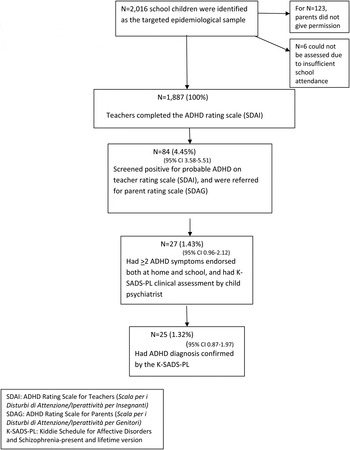
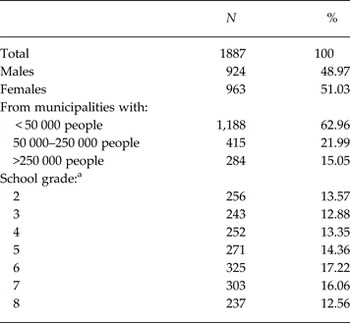
The study was approved by the relevant school districts. Written informed consent was requested from the parents to assess their child in school. Of the 2016 parents contacted, 1893 (93.9%) gave permission. Teachers completed rating scales for 1887 children (Fig. 1 and Table 1). All the data were collected in the school year 2002–2003.
Study's steps and subject flow.

Sample characteristics

aThe proportion of males within the grades ranged from 46.81 to 54.38%.
Procedures and assessments
At the first step, the teachers of the 1893 children for whom parental permission was granted were asked to complete the Italian version of the ADHD Rating Scale for Teachers (Scala per i Disturbi di Attenzione/Iperattività per Insegnanti or SDAI) (Cornoldi et al. Reference Cornoldi, Gardinale, Masi and Petteno1996; DuPaul et al. Reference DuPaul, Power, Anastopoulos, Reid, McGoey and Ikeda1997). The SDAI Scale asks the teacher to rate on a 4-point scale the frequency/intensity of the each of the nine symptoms of inattention and the nine symptoms for hyperactivity/impulsivity reported of the Diagnostic and Statistical Manual of Mental Disorders, 4th ed. (DSM-IV; American Psychiatric Association, 1994). Each symptom can be scored as ‘never or rarely’, ‘sometimes’, ‘often’ or ‘very often’. The SDAI has demonstrated excellent inter-rater reliability and test–retest reliability (Marzocchi & Cornoldi, Reference Marzocchi and Cornoldi2000).
At the second step, the parents of the children with at least six inattentive symptoms and/or at least six hyperactivity/impulsivity type scored as present ‘very often’ were asked to complete the parent version of the ADHD rating scale (Scala per i Disturbi di Attenzione/Iperattività per Insegnanti or SDAG) (Cornoldi et al. Reference Cornoldi, Gardinale, Masi and Petteno1996), which is structured in the same way as the SDAI.
Last, children with at least six inattentive symptoms and/or at least six hyperactivity/impulsivity type scored as present ‘very often’ by the teacher and at least two of these symptoms scored to be present ‘very often’ also by the parent were further assessed with a comprehensive in person psychiatric evaluation. Each child and parent were separately administered the Italian version of the Kiddie Schedule for Affective Disorders and Schizophrenia-present and lifetime version (K-SADS-PL, Kaufman et al. Reference Kaufman, Birmaher, Brent, Rao, Flynn, Moreci, Williamson and Ryan1997). The K-SADS-PL is a semi-structured psychiatric interview to assess the presence of the most common psychiatric disorders. The K-SADS-PL was administered by an experienced child psychiatrist trained in the use of this diagnostic instrument (RD). Children's intelligence level was measured by Wechsler Intelligence Scale for Children-Revised (WISC-R), and an IQ < 70 was an exclusion criterion from a diagnosis of ADHD. Other exclusion criteria were: a diagnosis of bipolar disorder, major depression, dysthymic disorder, schizophrenia, developmental pervasive disorder or generalised anxiety disorder. Functional impairment was assessed using Children's Global Assessment Scale (CGAS), on a scale from 0 (severe impairment) to 100 (superior functioning), with a score below 70 indicating clinically the significant dysfunction (Shaffer et al. Reference Shaffer, Gould, Brasic, Ambrosini, Fisher, Bird and Aluwahlia1983). The Strengths and Difficulties Questionnaire (SDQ) was completed by the teachers and parents (Goodman et al. Reference Goodman, Ford, Simmons, Gatward and Meltzer2000).
To evaluate the sensitivity of the ascertainment process for ADHD, a sample of 102 children (mean age 8.9 years) and their parents, randomly selected from the children with a negative teacher ADHD rating scale (SDAI) score, were interviewed with the K-SADS PL 1.0. Of them, none met the criteria for ADHD. Inter-rater reliability of the K-SADS-PL interviewers was assessed on a sample of 87 children. The agreement between the interviewers was 89.66%., and the Cohen's kappa coefficient for the diagnosis of ADHD was 0.81.
Data analysis
Descriptive statistics was applied to the data. The number and percentage of children exceeding the set cut-off scores on the SDAI, both SDAI and SDAG and further meeting criteria for ADHD on the K-SADS-PL were computed. Within the subgroup of children with ADHD on the K-SADS-PL, the prevalence of ADHD subtypes and abnormal scores on the parent and teacher SDQ and clinician C-GAS scores were examined.
A conservative approach to missing data was adopted. Of the parents who were requested to complete the SDAG, 5.56% were failed to return the forms, and 8.82% of the parent SDQ forms were similarly missing. In the absence of parent information, a diagnosis of ADHD could not be formulated, and these children were accounted as non-ADHD cases.
Results
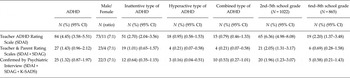
Figure 1 and Table 2 summarise the study steps, subject flow and main findings. Of the 2016 children included in the epidemiologically selected sample, 123 children could not be assessed because their parents did not give permission, and other six children could not be assessed because they had been absent from school for extended periods of time. A total of 1887 children (93.6% of the selected sample) were assessed on the ADHD Rating Scale for Teachers (SDAI).
Rate of ADHD by assessment step (N = 1887)

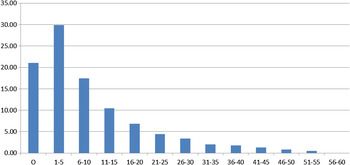
The distribution of the SDAI total score in the sample followed a positively, right skewed distribution (Fig. 2). In total 78% of the children had at least one ADHD-relevant behaviour rated by the teacher to be present ‘sometimes’; 39% had at least one behaviour rated ‘often’; and 6% had at least one behaviour rated ‘very often’.
Frequency distribution of total scores of ADHD rating scale for teachers (SDAI) (N = 1887).

Of the 1887 children assessed, 4.45% (95% CI 3.58–5.51) met the number and severity of symptoms for ADHD in the school setting (based on teacher rating); 1.43% (95% CI 0.96–2.12) had also severe symptoms at home (based on both teacher and parent ratings), thus meeting the diagnostic criterion of pervasiveness across more than one setting; and 1.32% (95% CI 0.87–1.97) had their diagnosis of ADHD confirmed by a comprehensive psychiatric evaluation by a child psychiatrist.
Among the children who screened positive on both the teacher and parent ADHD ratings, the psychiatric evaluation did not confirm the diagnosis in three cases: in two cases the symptoms could be better explained by another, non-ADHD, condition, and in one case the full criteria for ADHD were not met because there was no clear-cut evidence of dysfunction.
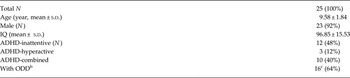
The prevalence of severe ADHD was 1.96% (95% CI 1.23–3.07) among elementary school children, and 0.58% (95% CI 0.21–1.43) among middle school children. The male/female ratio was 7:1. The demographic and clinical characteristics of the children with severe ADHD are summarised in Table 3. They had C-GAS scores ranging between 40 and 60, which are indicative of clinically significant impairment in global functioning. All had SDQ-teacher abnormal scores, and 19 had SDQ-parent abnormal scores, further documenting functional impairment. ADHD-inattentive type was documented in 12 (48%) of the cases, and ADHD hyperactive or combined type in the other 13 (52%). Sixteen (52%) met the DSM-IV criteria for oppositional defiant disorder and four of these also for conduct disorder.
Characteristics of the identified ADHD samplea

aADHD, diagnosed by psychiatric interview based on K-SADS-PL.
bODD, oppositional defiant disorder.
cOf these, 14 were male. Four (all male) also met criteria for conduct disorder.
Discussion
By examining an epidemiological sample of elementary and middle school children in two regions of Italy, and requiring extremely stringent criteria for the endorsement of ADHD-relevant symptoms by both teachers and parents, with final confirmation after a clinical assessment with a child psychiatrist, we estimated that about 1.3% of children suffer from severe ADHD. These children are functionally impaired as documented by CGAS scores in the 40–60 range. This is a conservative estimate because of the requirement that each ADHD symptom be present ‘very often’ based on both teacher and parent report. Not surprisingly, the rate is much lower than reported in other studies that used the DSM-III-R or DSM-IV criteria with the usual cut-off of ‘often’ for presence of ADHD symptoms. By sacrificing diagnostic sensitivity, we have aimed at maximising specificity and therefore avoiding false-positive diagnoses. Focus on severe ADHD can help in planning for more targeted treatment interventions.
Our data confirm that ADHD symptoms are continuously distributed in the population (Fig. 2), so that any cut-off for disorder identification can be considered arbitrary. By selecting ‘very often’ to endorse the presence of each symptom, the likelihood of false positive was minimised. In fact, a score of ‘often’ for at least one item of the ADHD Rating Scale for Teachers (SDAI) was found for 39% of the surveyed children, whereas a score of ‘very often’ for a least one item was found only in 6% of them. By requiring that severe ADHD symptoms may also be present in non-school setting as documented by the ADHD Rating Scale for Parents (SDAG), we ensured the pervasiveness of the condition. Two-thirds of the children meeting the strict criteria by teacher rating did not qualify for pervasiveness of severe ADHD symptoms based on parent rating (Fig. 1).
The 1.3% rate of severe ADHD in this study is similar to the prevalence of hyperkinetic disorder, a nosological construct commonly used before the advent of the DSM criteria of ADHD (Taylor et al. Reference Taylor, Döpfner, Sergeant, Asherson, Banaschewski, Buitelaar, Coghill, Danckaerts, Rothenberger, Sonuga-Barke, Steinhausen and Zuddas2004). A diagnosis of hyperkinetic disorder requires the concurrent presence of all three in the core domains of ADHD (i.e., hyperactivity, impulsivity and inattention) and the exclusion of any comorbid condition. The 7:1 male/female ratio for severe ADHD in this study is remarkable. That ADHD is substantially higher in boys and has been consistently documented across studies and countries, but usually with a rate of about 3:1. The data indicate that the male/female ratio increases with the severity of the condition. It should be noted that about half of the children identified with severe ADHD had predominantly inattentive symptoms (Table 3). These data do not obviously rule out that prominent, although not extremely severe, hyperactivity and impulsivity were concomitantly present in these children, but point to the relevance of inattention as a severe cause of impairment in a subset of children. These results also confirm the developmental nature of ADHD, with attenuation of the symptoms as children grow into adolescence.
The study sample was epidemiologically derived and based on the distribution of the school-age population in the targeted geographical area of Tuscany and Latium. Although limited to two regions, the data are likely informative at the Italian national level given the common cultural characteristics and the same educational and health care system across the entire country. Several limitations of the study should be acknowledged. First, the data were collected in 2002–2003 and only recently analysed. Despite the 10-year hiatus, however, it seems unlikely that the rate could have changed during this period as a recent systematic review and meta-regression analyses of data across the past 3 decades have found no evidence of a historical increase in the population prevalence of ADHD when consistent and validated assessment methods are used (Polanczyk et al. Reference Polanczyk, Willcutt, Salum, Kieling and Rohde2014). Second, because of funding limitations for this study, a more detailed examination of the sample or inquiry into the use of different symptom cut-offs could not be done.
It should also be noted that there is currently no universally agreed upon definition of severe ADHD (Thomas et al. Reference Thomas, Mitchell and Batstra2014). Neither the American nor the Australian diagnostic guidelines operationalise the criteria for severity, and the UK National Institute for Health and Clinical Excellence (NICE) guidelines equalise severe ADHD to hyperkinetic disorder (National Institute for Health and Clinical Excellence, 2013).
More than 20 years ago, it was observed that the diagnosis of ADHD ‘is seldom, if ever, made by clinicians in Italy’ and that ‘psychostimulants generally considered to be an important, if not the primary treatment for ADHD, are not available in the Italian pharmacopoeia’ (Gallucci et al. Reference Gallucci, Bird, Berardi, Gallai, Pfanner and Weinberg1993). In fact, no pharmacological treatment of ADHD was available in Italy until 2007, when methylphenidate and atomoxetine were introduced but subjected to strict prescribing regulations through enrolment into a national registry (Arcieri et al. Reference Arcieri, Germinario, Bonati, Masi, Zuddas, Vella, Chiarotti and Panei2012). In the first 3 years (2007–2010), only 1758 were enrolled in the registry vis-à-vis a population of about 7 million children and adolescents aged 6–18 years (Arcieri et al. Reference Arcieri, Germinario, Bonati, Masi, Zuddas, Vella, Chiarotti and Panei2012).
The data from this study indicate that, even if extremely conservative criteria are applied, about 1.3% of school-age children suffer from severe symptoms of ADHD that are pervasive, frequently accompanied by comorbid behavioural disturbance, and associated with clinically significant functional impairment. The impairment is global and not limited to school setting. Given the level of dysfunction, treatment is clearly indicated. While there is no cure for ADHD, symptoms can be successfully managed, and a number of evidence-based treatment modalities are available, including psychosocial and pharmacological interventions.
Financial Support
This study received no specific grant funding, but was supported by resources within the Italian National Health System.
Conflict of Interest
None.
Ethical Standards
The authors assert that all procedures contributing to this work comply with the ethical standards of the relevant national and institutional committees on human research.