Introduction
Avian migration is a worldwide phenomenon that allows birds to forage in the breeding period and to overcome unfavourable climatic seasons at the expense of high energetic cost (Newton, Reference Newton2007; Somveille et al., Reference Somveille, Manica, Butchart and Rodrigues2013; Flack et al., Reference Flack, Fiedler and Blas2016). In fact, birds in poor condition are unlikely to be able to migrate, since a good body condition is essential to face the migration challenge (Anderson et al., Reference Anderson, Duijns, Smith, Friis and Nol2019). Many European-breeding species migrate to south in winter through the Palaearctic–African route, thus increasing the connectivity between sedentary and migrant avian populations (Hahn et al., Reference Hahn, Bauer and Liechti2009). The black stork (Ciconia nigra) is a long-distance migrant that is scarce in western Europe due to the deterioration of habitats and human impacts (Chevallier et al., Reference Chevallier, Baillon, Le Maho, Blanc, Brossaul and Massemin2013). Part of the European black stork population, which mostly breeds in central and eastern areas of the continent, but also in the Iberian Peninsula (del Hoyo et al., Reference Del Hoyo, Elliott and Sargatal1992; Elliott et al., Reference Elliott, Christie, Garcia, Boesman, del Hoyo, Elliott, Sargatal, Christie and de Juana2020), migrates via the western route that crosses Europe and northern Africa to reach the Sahel. However, in common with other Ciconiidae species in Europe, an increasing number of black storks winter in the Iberian Peninsula (Cano et al., Reference Cano, Pacheco, Refoyo and Tellería2014; Rotics et al., Reference Rotics, Turjeman, Kaatz, Resheff and Nathan2017).
Migrant birds are exposed to many vectors and pathogens, both in their breeding and wintering areas, where habitat types, diet and, consequently, epidemiological characteristics are often different (Newton, Reference Newton2007; Altizer et al., Reference Altizer, Bartel and Han2011; Fecchio et al., Reference Fecchio, Clark and Bell2021). According to the scientific literature, they have been associated with zoonotic and non-zoonotic pathogen dispersion around the world, including not only bacteria and viruses, but also parasites (Literák & Sitko, Reference Literák and Sitko2006; Abulreesh et al., Reference Abulreesh, Goulder and Scott2007; Jourdain et al., Reference Jourdain, Gauthier-Clerc, Bicout and Sabatier2007; Fuller et al., Reference Fuller, Bensch, Müller, Novembre, Pérez-Tris, Ricklefs, Smith and Waldenström2012; Ferraguti et al., Reference Ferraguti, Martínez-de la Puente, García-Longoria, Soriguer, Figuerola and Marzal2019). Considering the strong linkages between climate and migration, it is urgent to obtain comprehensive and reliable information about how climate change may modulate the spread of pathogens by migratory birds (Fuller et al., Reference Fuller, Bensch, Müller, Novembre, Pérez-Tris, Ricklefs, Smith and Waldenström2012). In this sense, alteration of migratory routes in breeding storks has been detected in the Iberian Peninsula, showing sedentary behaviour due to favourable climatic conditions and food availability (Tortosa et al., Reference Tortosa, Máñez and Barcell1995). Large-scale studies using tracking techniques, such as bird ringing, are an effective way to improve our knowledge about disease ecology in wild birds. This case describes a Chaunocephalus ferox (Digenea: Echinostomatidae) infection in a black stork ringed in north-eastern Europe and found injured in the south-east of the Iberian Peninsula.
Case report
A five-month-old male black stork (identification ET6251-LATVIA RIGA) was submitted to the Wildlife Rescue and Rehabilitation Centre ‘El Valle’ (Murcia, south-eastern Spain) on 3 November 2017, being the first documented report of this animal in the Iberian Peninsula. The bird was ringed at the nest in May 2017 in Gavieze Parish (south-western Latvia) and, after leaving the nest, was sighted by ornithologists twice in Poland in mid-September and once in Switzerland in early October before reaching south-east of the Iberian Peninsula. The black stork, which was unable to fly despite having a good body condition (2.2 kg), was found in Jumilla municipality, Murcia province, south-east Spain (38°28.604′N, 1°19.318′W). Clinical examination detected burn wounds in the keel and both tarsometatarsus, and an open fracture in the carpometacarpus. The stork also showed reduced sensitivity and mobility of limbs. All these clinical data were indicative of recent electrocution. Despite treatment, the animal died on the day of admission to the rescue centre.
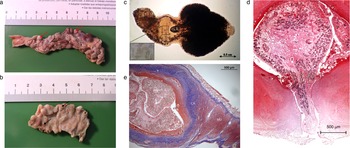
A detailed post-mortem examination was performed, and all thoracic and abdominal organs and corporal cavities were carefully examined. The most remarkable macroscopic finding was granulomatous enteritis with 143 nodulations of 0.5–0.7 cm diameter in the small intestine, protruding into the intestinal serosa and mucosa (fig. 1a). Inside these nodulations a total of 275 trematodes were isolated, mainly mature stages. Most nodulations (92.3%; 132/143) contained two flukes, although nodules with only one trematode were also described (7.7%; 11/143). Nodules were linked to the intestinal lumen through an orifice (fig. 1b). Trematodes were cleared using Amman's lactophenol and mounted in Hoyer's medium to evaluate their microscopic structures (fig. 1c). The morphological and morphometrical characteristics of parasites corresponded to the trematode C. ferox (Patnaik et al., Reference Patnaik, Rao, Acharjyo and Mohanty1970; Choe et al., Reference Choe, Lee, Park, Jeon, Lee, Na, Park and Eom2016; Greben et al., Reference Greben, Kudlai, Korol, Kornyushin, Vasilkovska and Kobylinsky2016). As diagnosis was achieved with mature trematode identification, no coprological examination was performed. Several nodules were fixed in 10% buffered formaldehyde, embedded in paraffin, sectioned, and stained with the haematoxylin–eosin and Masson's trichrome stains, which were performed to describe the morphological characteristics of the parasitic nodule and to evidence the collagen fibres that delimit the nodulation, respectively. Microscopic evaluation revealed the formation of fluke-occupied nodules, mainly located in the intestinal muscular layer causing a focal destruction of the tunica muscularis and forming a thick connective capsule around them. As macroscopically evidenced, nodulations were connected to the lumen of the organ by a pore, where the oral sucker of the parasite was observed (fig. 1d,e).
(a) Granulomatous enteritis caused by Chaunocephalus ferox and (b) duodenal mucosa with orifices (black arrow) corresponding to the connection between each parasite nodule (red arrow) with the intestinal lumen; (c) C. ferox specimen under stereomicroscope after clearing with Amman's lactophenol, showing eggs within a mature fluke in more detail; (d) microscopic image stained with haematoxylin–eosin of a parasitic nodule in the small intestine with the fluke inside. The nodule is located in the tunica muscularis but is connected to the lumen of the organ by a channel through the submucosal and mucosal tunics; and (e) microscopic image stained by Masson's trichrome staining technique. The disruption of the tunica muscularis (MU) of the intestine due to the presence of a thick connective capsule (CA) of the parasitic nodule (PN) can be observed.

Discussion
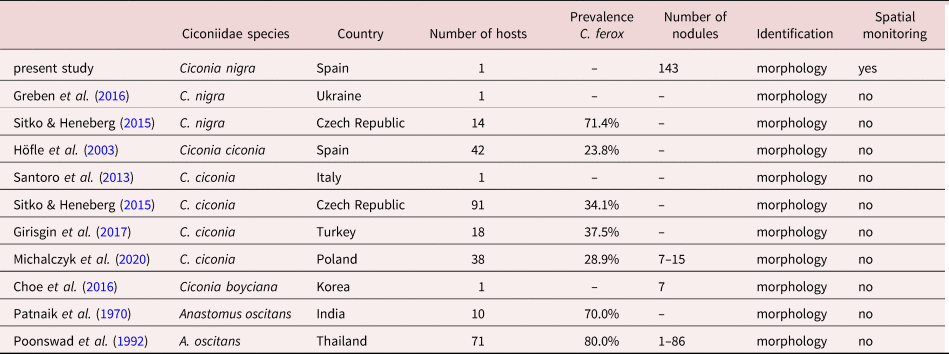
Chaunocephalus ferox is a Digenean trematode with a life cycle in which snails of the family Planorbidae act as first intermediate hosts (Kostadinova, Reference Kostadinova, Jones, Bray and Gibson2005; Saad, Reference Saad2009), and amphibians and fishes as second intermediate hosts (Patnaik et al., Reference Patnaik, Rao, Acharjyo and Mohanty1970; Höfle et al., Reference Höfle, Krone, Blanco and Pizarro2003). This trematode species has been described in black storks and other Ciconiidae species from Spain and other European and Asian countries (table 1), mainly due to the diet of storks that includes fish and amphibians (Elliott et al., Reference Elliott, Christie, Garcia, Boesman, del Hoyo, Elliott, Sargatal, Christie and de Juana2020). Most of the studies that have described C. ferox in individuals of the family Ciconiidae used morphological criteria to identify this trematode species (table 1).
Epidemiological studies and case reports about Chaunocephalus ferox infection in the Ciconiidae family published to date, indicating the number of animals sampled, the prevalence found, the number of intestinal nodules detected, the trematode identification method employed and the use of tools to monitor the bird movements (e.g. bird ringing).

Chaunocephalosis can negatively affect the health status of infected hosts and may hinder successful migration, particularly in individuals with high parasite intensity or concomitant health problems. Cachexia associated with granulomatous enteritis has been previously described in dead storks with C. ferox infection (table 1) (Santoro et al., Reference Santoro, Degli Uberti, Galiero, Di Prisco, D'Alessio and Veneziano2013; Choe et al., Reference Choe, Lee, Park, Jeon, Lee, Na, Park and Eom2016). Because of these alterations, it is thought that chaunocephalosis produces a weakened state that can reduce flight performance and, consequently, be a predisposing factor for crashes leading to trauma and electrocution (Santoro et al., Reference Santoro, Degli Uberti, Galiero, Di Prisco, D'Alessio and Veneziano2013). However, the two most striking features in this case were: (1) the good body condition of the bird after the migration from northern Europe to south-east Spain; and (2) its ability to complete a long-distance migratory route, in spite of having a high number of parasitic nodules caused by the C. ferox infection, compared to other studies (table 1). This report may indicate a non-chronic course of chaunocephalosis in the black stork due to the absence of a cachectic state, which has been only described in sub-adult and adult storks (Santoro et al., Reference Santoro, Degli Uberti, Galiero, Di Prisco, D'Alessio and Veneziano2013; Choe et al., Reference Choe, Lee, Park, Jeon, Lee, Na, Park and Eom2016). However, as we have no information on the behaviour of the black stork before it was found in south-east Spain, it is difficult to assess in detail the potential impact that this trematode infection has had on the health of the bird.
As migratory birds may use a variety of habitats, they have a higher risk of being exposed to a parasite infection compared to sedentary species (Koprivnikar & Leung, Reference Koprivnikar and Leung2015; Leung & Koprivnikar, Reference Leung and Koprivnikar2016). The infection by C. ferox found in this black stork is an example of trematode dispersal at an intracontinental scale. The presence of mature C. ferox specimens in the small intestine of the stork, along with its sighting in Central Europe in October 2017 before its capture in the Iberian Peninsula in early November 2017, suggest that the infection may have occurred before it arrived in south-eastern Spain, as it has also been stated in the case of the Oriental white stork (Ciconia boyciana) (Choe et al., Reference Choe, Lee, Park, Jeon, Lee, Na, Park and Eom2016). However, the variation of individual migration patterns described in black storks (https://migrationatlas.org/node/1654), as well as the wide range of prepatent periods reported for parasites belonging to the Echinostomatidae family in intermediate (27–40 days) and definitive hosts (two–four weeks), indicate the need for further research about the biology of chaunocephalosis in wild birds (Huffman & Fried, Reference Huffman and Fried1990; Maldonado et al., Reference Maldonado, Vieira, Garcia, Rey and Lanfredi2001; Chevallier et al., Reference Chevallier, Baillon, Le Maho, Blanc, Brossaul and Massemin2013). Moreover, the knowledge about intermediate host species involved in the life cycle of C. ferox is scarce, particularly with regard to amphibians and fish acting as secondary intermediate hosts.
This is the first report of C. ferox infection in black storks in the Iberian Peninsula, having been recorded so far only in white storks in this area (Höfle et al., Reference Höfle, Krone, Blanco and Pizarro2003; table 1). Moreover, the fact that it has been possible to obtain precise information on the dates of sighting of the bird during its migration through Europe, as well as the certainty about the age of the host and its origin area thanks to the bird ringing, are the basis that allow us to affirm that the area where the bird acquired the infection is most probably outside the Iberian Peninsula, since otherwise the trematodes found in the intestine of the black stork would not have had enough time to reach the adult stage. Therefore, it is plausible to state that this is a well-documented case of the spread of a parasite through a migratory bird.
Chaunocephalus ferox can reach high prevalence in storks, and although health disorders are usually described in individuals suffering from high parasite intensity, severe problems have been reported in low parasitized storks (Choe et al., Reference Choe, Lee, Park, Jeon, Lee, Na, Park and Eom2016; Michalczyk et al., Reference Michalczyk, Sokół, Gesek, Mączyński and Będzłowicz2020). For these reasons, and taking into account the findings described in our study, it seems relevant to monitor the presence of C. ferox in the distribution area of black storks in the Iberian Peninsula, a bird species classified as ‘Vulnerable’ by the ‘Red Book of the birds of Spain – 2021’ (López-Jiménez, Reference López-Jiménez2021). This issue is particularly relevant after reporting the highest intensity of infection by C. ferox in black storks described to date, highlighting the possibility of massive infections in this host species.
Another highlight of this study is the information provided by bird ringing, which has made it possible to obtain key data to interpret, from an epidemiological viewpoint, the dispersal of C. ferox within Europe. In addition, ringing has also revealed that a bird highly parasitized by C. ferox may be capable of completing long migratory routes. This demonstrates the utility of bird ringing in the study of parasite spread, as described previously for other pathogens (Jourdain et al., Reference Jourdain, Gauthier-Clerc, Bicout and Sabatier2007). We suggest that information on host migration should be included in epidemiological studies (table 1) to help understand epidemiological aspects of parasitofauna in migratory birds. If other host species are able of migration when infected, it may be possible to create epidemiological risk maps at their breeding, passage and wintering sites.
In summary, the present study highlights the potential relevance of migratory birds as long-distance spreaders of parasites to new areas, as well as the usefulness of bird ringing not only for ecological purposes, as traditionally used (Baillie et al., Reference Baillie, Robinson, Clark and Redfern2009; Sharp, Reference Sharp2009), but also for epidemiological studies. Our study shows the value of spatial data to understand the epidemiology of parasites hosting wild birds worldwide.
Financial support
None.
Conflicts of interest
None.
Ethical statement
No approval of research ethics committees was required to accomplish the goals of this study because the animal manipulation and samples collection were carried out on the dead bird.
Data availability
Data available on request from the authors.