Excessive alcohol use among college students is a major public health issue, associated with serious adverse short- and long-term consequences and present in the great majority of higher education institutions in both the US (see Berkowitz & Perkins, Reference Berkowitz and Perkins1986; Ham & Hope, Reference Ham and Hope2003; O´Malley & Johnston, Reference O´Malley and Johnston2002, for a review) and Europe (see Wicki, Kuntsche, & Gmel, Reference Wicki, Kuntsche and Gmel2010, for a review). These consequences include serious damage to physical and mental health (e.g., injuries, loss of consciousness, suicide attempts), educational underachievement (e.g., failure to attend classes, procrastination in academic work, non-compliance with important college commitments), unsatisfactory interpersonal relationships within the college community, risky sexual behaviors (e.g., engaging in unprotected and unwanted sex), and antisocial behaviors (e.g., driving under the influence of alcohol, physical violence, and sexual assault) among others (see Hingson, Zha, & Weitzman, Reference Hingson, Zha and Weitzman2009; Perkins, Reference Perkins2002, for a review). Previous research confirms the high prevalence of negative alcohol-related consequences within Portuguese college student samples (see Calvário, Lizardo, Loureiro, & Santos, Reference Calvário, Lizardo, Loureiro and Santos1997; Carvalho, Reference Carvalho2010; Leite, Silva, Breda, Frazão, & Pinto, Reference Leite, Silva, Breda, Frazão and Pinto1998; Martins, Coelho, & Ferreira, Reference Martins, Coelho and Ferreira2010, for example).
Read, Kahler, Strong, and Colder (Reference Read, Kahler, Strong and Colder2006) suggested that early detection of these negative consequences is essential to prevent both short- and long-term alcohol-related problems. Therefore, it is appropriate to assess alcohol-related consequences among college students in order to determine how individuals at risk should be treated and which type and level of intervention is the most suitable for each individual case. Such assessments also are needed to evaluate the impact of interventions to reduce alcohol-related harms. These goals can only be successfully achieved if there are reliable and valid measures of alcohol-related consequences that enable early detection of students at risk of developing increasingly severe alcohol problems and provide useful information to practitioners intervening to reduce alcohol-related consequences among college students.
Problematic alcohol use among college students has been assessed with a wide range of self-report measures, including the Rutgers Alcohol Problem Index, RAPI (White & Labouvie, Reference White and Labouvie1989), the Young Adult Alcohol Problems Screening Test, YAAPST (Hurlbut & Sher, Reference Hurlbut and Sher1992), the Alcohol Use Disorders Identification Test, AUDIT (Saunders, Aasland, Babor, de la Fuente, & Grant, Reference Saunders, Aasland, Babor, de la Fuente and Grant1993), the College Alcohol Problems Scale, CAPS (O´Hare, Reference O´Hare1997) and the Young Adult Alcohol Consequences Questionnaire, YAACQ (Read et al., Reference Read, Kahler, Strong and Colder2006) whose later improvement and renovation enabled new and more efficient ways of assessing and intervening (see Devos-Comby & Lange, Reference Devos-Comby and Lange2008, for a review). Notwithstanding this wide range of self-report measures of alcohol-related consequences, consensus among researchers on which is the most sensitive, reliable, and fine-grained measure able to successfully identify college students at different degrees of problematic drinking continues to prove difficult.
According to Read, Merril, Kahler, and Strong (Reference Read, Merrill, Kahler and Strong2007), the negative consequences associated with alcohol consumption among college students “reflect the uniqueness of the population itself, and include a spectrum of [specific] deleterious outcomes” (Read et al., Reference Read, Merrill, Kahler and Strong2007, p. 2599). Considering this unique pattern of negative alcohol-related consequences, Read et al. (Reference Read, Kahler, Strong and Colder2006) developed the Young Adult Alcohol Consequences Questionnaire (YAACQ). This 48-item self-report questionnaire was designed to measure the levels of a wide range of negative alcohol-related consequences frequently experienced by college students (Read et al., Reference Read, Merrill, Kahler and Strong2007) and proved to be strongly correlated with the RAPI, the YAAPST, the AUDIT and also with several drinking variables (Devos-Comby & Lange, Reference Devos-Comby and Lange2008; Read et al., Reference Read, Kahler, Strong and Colder2006; Read et al., Reference Read, Merrill, Kahler and Strong2007). Devos-Comby and Lange (Reference Devos-Comby and Lange2008) acknowledged that the YAACQ “represents the most elaborate categorization of problems that [they] could find in college drinking literature” (p. 358) and even indicated this questionnaire is “the most complete measure reviewed” (p. 359).
Kahler et al. (Reference Kahler, Strong and Read2005), using Rasch model analysis (Rasch, Reference Rasch1960), developed a brief version of the YAACQ — the Brief Young Adult Alcohol Consequences Questionnaire (B-YAACQ) — that has been the subject of considerable interest and recognized as a relevant tool both for research and applied practice in college alcohol prevention and treatment. The application of the B-YAACQ has demonstrated at least four essential advantages (Devos-Comby & Lange, Reference Devos-Comby and Lange2008; Kahler et al., Reference Kahler, Strong and Read2005; Kahler, Hustad, Barnett, Strong, & Borsari, Reference Kahler, Hustad, Barnett, Strong and Borsari2008). Specifically, this questionnaire is a unidimensional measure with strong psychometric properties among college students. Its items cover the full range of the spectrum of alcohol-related consequences ranging from mild immediate consequences of drinking (nausea, hangover) to more significant consequences such as those related to alcohol abuse and dependence. By doing so, college students can be positioned along an alcohol problem severity continuum. Additionally, it has proved to be free of gender bias, thus indicating no differential item functioning between male and female students. Lastly, it presents minimal redundancy between its items, and the reduced number of items with a dichotomous response format allows quick and easy administration.
Taking these advantages into account and recognizing the existing gap concerning self-report measures capable of assessing negative alcohol-related consequences among college students in Portugal, we conducted a validation study in order to examine the psychometric properties of a Portuguese version of the Brief Young Adult Alcohol Consequences Questionnaire, gathering evidence for its appropriate use within Portuguese higher education cultural context. In addition, we examined if there were statistically significant differences by gender and by different types of college students drinkers (e.g., hazardous and non-hazardous drinkers) regarding the percentage of endorsement of B-YAACQ items.
Method
Participants
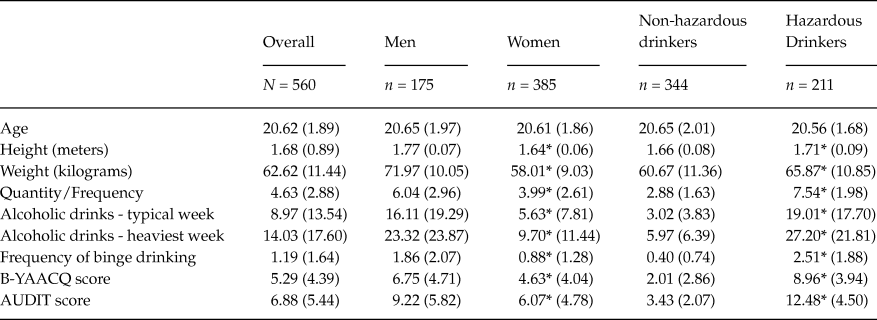
The questionnaires were administered to 620 college students. Of these participants, 560 reported drinking alcohol, of which 175 (31.25%) were men and 385 (68.75%) were women ranging age from 17 to 25 years-old (M = 20.62; SD = 1.89). All the respondents were students enrolled in the various departments (i.e., Humanities, Law, Medicine, Sciences & Technology, Pharmacy, Economics, Psychology & Education Sciences, and Sports & Physical Education) of the University of Coimbra, a mid-sized public university located in the center part of Portugal. Table 1 presents descriptive statistics of demographic and alcohol use and alcohol-related consequences variables.
Means and Standard Deviations in Parentheses for Demographic and Drinking Variables of Students Who Consume Alcohol (90.3%)

Note: The sample of hazardous and non-hazardous drinkers Footnote 1 together is not equal to the overall sample because some participants (n = 5) did not respond to at least one item of AUDIT and, therefore, were excluded from the analysis. *p < .05.
Procedure
Data collection was conducted between February and April of the academic year 2009/2010. Participants were provided a brief written explanation of the aim of the study. Researchers responsible for this study assured that data collected would be treated according to the ethical rules of scientific research in order to enable informed consent on the part of participants. Following this procedure, participants were asked to respond voluntary and anonymously, without any type of reward, to the self-report questionnaires during class time and, in some cases, in their university departments out of classes.
Measures
Data collection involved completion of self-report questionnaires that, aside from the background questionnaire constructed for this study, also included the following instruments: (a) Alcohol Use Disorders Identification Test (AUDIT), (b) Drinking Daily Questionnaire-Revised (DDQ-R), and (c) Brief Young Adult Alcohol Consequences Questionnaire (B-YAACQ).
Background questionnaire
The background questionnaire collected data to describe the socio-demographic characteristics of the sample, including age and gender, among others. Such questions were used in a close-ended question format in which participants were able to select an answer that most accurately described their status.
Alcohol Use Disorders Identification Test (AUDIT)
Participants responded to a Portuguese translation of AUDIT (Cunha, Reference Cunha2002; AUDIT; Saunders et al., Reference Saunders, Aasland, Babor, de la Fuente and Grant1993). The AUDIT is composed of 10 items divided into three domains (a) alcohol consumption, (b) drinking behavior, (c) alcohol-related problems and adverse reactions (Saunders et al., Reference Saunders, Aasland, Babor, de la Fuente and Grant1993). This measure has been shown to validly discriminate among individuals at different risk levels for alcohol abuse and dependence among a wide variety of population subgroups, especially college students (Babor, Higgins-Biddle, Saunders, & Monteiro, Reference Babor, Higgins-Biddle, Saunders and Monteiro2001; Fleming, Barry, & MacDonald, Reference Fleming, Barry and MacDonald1991). The total score ranges from 0 to 40, whereby a higher score indicates a more harmful drinking behavior. In this study, the Cronbach’s alpha for the AUDIT was .82. The quantity/frequency of alcohol use was measured using items 1-3 items (α = .83) from the AUDIT (Saunders et al., Reference Saunders, Aasland, Babor, de la Fuente and Grant1993).
Drinking Daily Questionnaire-Revised (DDQ-R)
The Portuguese translation of the DDQ-R (DDQ-R; Collins, Parks, & Marlatt, Reference Collins, Parks and Marlatt1985) was used to assess drinking behavior. This questionnaire is a self-report measure assessing the quantity and frequency of alcohol consumption on the basis of two drinking records. Participants completed a daily record of the number of standard drinks consumed, and the time spent in that consumption in a typical week and in the heaviest drinking week during the previous 30 days. In addition, one open-ended format question was also used to assess the frequency of having five or more drinks in a row for men and four or more drinks for women over the previous two weeks. Participants were provided the following definition: “An alcoholic beverage is defined as a measure of 33 cl of beer (that is, most bottles and/or cans of beer); 16 cl of wine (a small glass of wine) or a 4.4 cl shot (a shot glass). Although these drinks contain different volumes of liquid, in general the glasses used contain an identical amount of alcohol (that is, approximately 12 to 16 grams of pure alcohol). It should be remembered that some drinks have more alcohol content than one shot. For example, ‘Long Island Iced Tea’, a mixed drink consisting of Vodka, Gin, Rum and Tequila, is equivalent to 4 shots and, therefore, equivalent to 4 drinks measured by alcohol content.”
Brief Young Adult Alcohol Consequences Questionnaire (B-YAACQ)
Participants were also asked to respond to the Portuguese translated version of the B-YAACQ (B-YAACQ; Kahler et al., Reference Kahler, Strong and Read2005), designed to measure the “alcohol problem severity continuum in college students” (Kahler et al., Reference Kahler, Strong and Read2005, p.1180). This questionnaire has 24 items that describe different alcohol-related problems. Participants were asked to respond, using a dichotomous response format (Yes/No), according to their experience of alcohol-related problems over the past-year. The total score ranges from 0 to 24, whereby the higher the total score, the greater the predisposition to experience problems and consequences related to the consumption of alcoholic beverages.
Analysis Plan
The original version of the B-YAACQ was submitted to a translation-back-translation procedure following the recommendations proposed by Brislin (Reference Brislin, Lonner and Berry1986) with all professionals involved in this process having background in alcohol research. Thus, two Portuguese-English bilinguals carried out the translation into Portuguese of the B-YAACQ items. Then, some changes in wording were made for purpose of clarity in writing by three native Portuguese speakers. This checked version was subsequently blindly translated back to English by another two Portuguese-English bilinguals. After the translation and back-translation procedures, the original English and back-translation versions were compared and examined in detail for the purpose of seeking possible discrepancies. Discrepancies between the two versions were mainly due to wording without any change of meaning. Lastly, the final Portuguese version of the B-YAACQ (see Appendix) was tested with a small group of college students (n = 5) before this validation study was conducted.
Descriptive statistics were obtained for all main study variables by gender and hazardous and non-hazardous drinkers. Unanswered items were treated as missing data and as result excluded from the analyses. There was not a significant number of participants who left items blank or unanswered (less than 1%).
The percentages of responses were calculated for each item of the B-YAACQ. A Chi-square test was performed in order to determine the statistical significant of differences (p < .05) between men and women as well as between hazardous and non-hazardous drinkers. To determine whether items provided a valid additive assessment of a unidimensional latent construct, Rasch model analysis was performed using the computer program BIGSTEPS (Linacre & Wright, Reference Linacre and Wright1998). For a more detailed analysis of this statistical procedure, see Bond and Fox (Reference Bond and Fox2007). For information on how we used Rasch analysis and the purpose of using this method, see descriptions given by Kahler and colleagues (Kahler et al., Reference Kahler, Strong and Read2005; Kahler & Strong, Reference Kahler and Strong2006; Kahler, Strong, Read, Palfai, & Wood, Reference Kahler, Strong, Read, Palfai and Wood2004) as the same steps and procedures were undertaken. The interpretation of the items’ infit statistics followed the recommendations given by Linacre and Wright (Reference Linacre and Wright1994), which suggest that infit mean squares should be considered acceptable between 0.6 and 1.40.
Cronbach’s alpha was calculated to assess the internal consistency of the B-YAACQ. Pearson’s correlation coefficients were calculated between drinking variables (i.e., quantity/frequency of alcohol use; alcoholic drinks during a typical week; alcoholic drinks during heaviest week; frequency of binge drinking) and B-YAACQ score. In addition, these coefficients were computed between the AUDIT total score and the B-YAACQ score in order to evaluate concurrent validity. Lastly, a regression analysis was conducted to identify the predictive power of drinking variables on alcohol-related consequences.
Results
Results from the descriptive analyses revealed that the majority of the participants (90.3%) reported drinking alcohol on a regular basis and a high percentage (38%) of those participants reported engaging in hazardous drinking (cut-off AUDIT score equal or greater than 8).
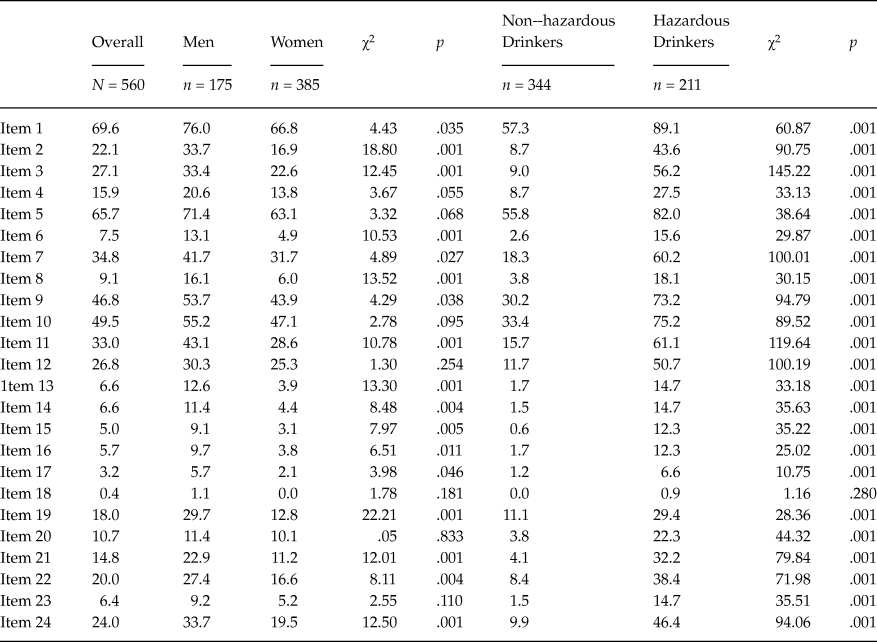
The mean frequency of alcohol-related consequences (B-YAACQ) in the past year reported by participants was 5.3 (SD = 4.4), with a possible score ranging from 0 to 24. As shown in Table 2, item 1 [“I have a hangover (headache sick stomach) the morning after I had been drinking”; 69.6%], and item 5 (“I have had less energy or felt tired because of my drinking”; 65.7%) were the most commonly reported, whereas item 17 (“My drinking has created problems between myself and my boyfriend/girlfriend/spouse, parents, or other near relatives”; 3.2%) and item 18 [“I have felt like I needed a drink after I´d gotten up (that is, before breakfast)”; 0.4%] were the least commonly reported alcohol-related consequences in our sample. Moreover, almost half of the participants reported that they had said or done embarrassing things under the influence of alcohol (item 9; 46.8%), and/or had felt very sick or thrown up after drinking (item 10; 49.5%) in the past year.
Percentage of B-YAACQ Items that Were Endorsed by Gender and Types of Drinking

Men endorsed all items of the B-YAACQ at higher rates than women, but no statistically significant gender differences were found for items 4, 5, 10, 12, 18, 20, and 23. On the other hand, endorsement percentages were higher for hazardous drinkers than for non-hazardous drinkers, and statistically significant differences were found on all items except for item 18.
Results obtained through the Rasch model analysis indicated that all item responses fit this unidimensional measurement model well. Items infit statistics ranged from .82 to 1.27, all within the acceptable range. In this context, it is worth noting that the items spanned the continuum of severity although most were clustered at and above the median level of problem severity in the sample.
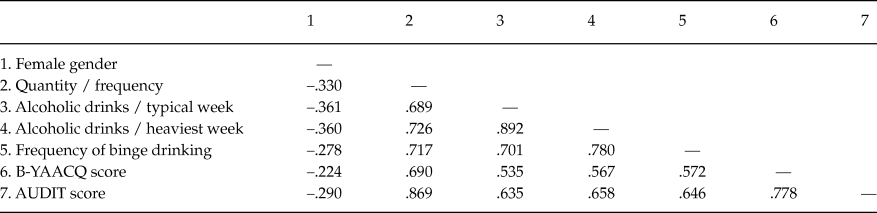
Cronbach's alpha suggested highly internal consistency (α = .87). The Pearson correlation coefficients between drinking variables, B-YAACQ score and AUDIT total score are shown in Table 3. Correlations between drinking variables were statistically significant and high in magnitude, ranging from .69 to .89. The high magnitude of the positive correlation between the B-YAACQ score and the AUDIT total score, r(553) = .78, p < .001, suggests good concurrent validity.
Correlation Coefficients between Gender, Drinking Variables and Alcohol-Related Consequences (B-YAACQ and AUDIT Scores)

Note: All correlations were statistically significant, p < .001. Gender: 0 = male and 1 = female.
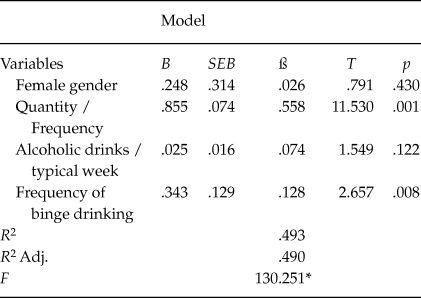
Table 4 presents the summary of multiple regression analysis to evaluate the predictive power of drinking variables on alcohol-related consequences (total B-YAACQ score). The results from regression analysis revealed that the model was statistically significant, accounting for 49.3 % of the variance of the alcohol-related consequences, R 2 = .493, F(4, 535) = 130.251, p < .001. The variables quantity/frequency of alcohol use, β = .558, p < .001, and frequency of binge drinking, β = .128, p = .008, were significant predictors of the consequences associated with alcohol consumption.
Summary of Multiple Regression Analysis for Studying the Gender and Drinking Variables as Predictors of Alcohol-Related Consequences (B-YAACQ)

Note: Gender: 0 = male and 1 = female. *p < .001.
Discussion
This study was designed to assess the psychometric properties of the Portuguese version of the Brief Young Adult Alcohol Consequences Questionnaire - B-YAACQ (Kahler et al., Reference Kahler, Strong and Read2005) amongst a sample of Portuguese college students. Results indicated that responses to the items fit a unidimensional Rasch model well consistent with the findings of previous studies (Kahler et al., Reference Kahler, Strong and Read2005; Verster, Herwijnen, Olivier, & Kahler, Reference Verster, Herwijnen, Olivier and Kahler2009). Results support the unidimensionality of the Portuguese version of the B-YAACQ, and the interpretability of the total score obtained through the adding the items endorsed. Furthermore, our findings suggested a satisfactory level of internal consistency of the B-YAACQ, as well as an adequate concurrent validity. In this regard, it is worth noting the high value of Cronbach's alpha found in this study, which seems to be in accordance with what has been achieved in prior studies (Kahler et al., Reference Kahler, Strong and Read2005; Verster et al., Reference Verster, Herwijnen, Olivier and Kahler2009). Also worth emphasizing is the strong relationship found between the B-YAACQ score and the AUDIT total score, as well as that the variables quantity/frequency of alcohol use and frequency of binge drinking, which turned out to be significant predictors of alcohol-related consequences assessed through the B-YAACQ. Taken together, these findings suggest that the Portuguese version of the B-YAACQ has good psychometric qualities.
The mean level of reporting of the alcohol-related consequences in our sample, 5.3 (SD = 4.4), was slightly higher than the level reported for the Dutch sample (Verster et al., Reference Verster, Herwijnen, Olivier and Kahler2009), but lower than the level reported for the US sample (Kahler et al., Reference Kahler, Strong and Read2005), 4.7 (SD = 3.7) and 9.3 (SD = 4.7), respectively. More than half of the participants reported that they had had “a hangover” and had engaged in behaviors involving “foolish risks” after drinking alcohol, whereas fewer than 5% of the participants reported that they had been “rude, obnoxious or insulting” and they had “needed larger amounts of alcohol to feel any effect”. The rank order and endorsement percentage for each BYAACQ item for the Portuguese sample (present study) were similar to those reported for the Dutch sample (Verster et al., Reference Verster, Herwijnen, Olivier and Kahler2009), but somewhat different from those reported for the US sample (Kahler et al., Reference Kahler, Strong and Read2005). For example, the item 5 (“I have had less energy or felt tired because of my drinking”) was endorsed by 65.7 % of our sample and 63.9% of the Dutch sample (Verster et al., Reference Verster, Herwijnen, Olivier and Kahler2009), but only 19.2% of the US sample (Kahler et al., Reference Kahler, Strong and Read2005). These discrepancies may be attributed, at least in part, to the cultural differences across these countries.
In summary, the results suggest that Portuguese college students experience a range of adverse alcohol-related consequences and support the utility of the Portuguese version of the B-YAACQ as a brief assessment of alcohol-related consequences among Portuguese college students. The B-YAACQ provides a brief self-report questionnaire with items readily understood, thus allowing a quick and easy administration. In addition, its scoring is a simple sum, providing a single total score which is easy to interpret as the number of consequences experienced. Our findings show that items covered the full range of the problem severity continuum in our sample, providing evidence for the appropriate use of the B-YAACQ with Portuguese college students.
Appendix QUESTIONÁRIO DE AVALIAÇÃO DAS CONSEQUÊNCIAS DO CONSUMO DE BEBIDAS ALCOÓLICAS NOS JOVENS ADULTOS
Apresenta-se uma lista de situações que, por vezes, acontecem às pessoas, durante ou depois de terem consumido bebidas alcoólicas. Ao lado de cada item, apresentado em baixo, marque com (X), na coluna do SIM ou do NÃO, para indicar se esse item descreve algo que lhe aconteceu no último ano.