Introduction
The fall armyworm, Spodoptera frugiperda (J. E. Smith), is a polyphagous pest with a wide host range damaging several economically important crops. In the south of the Tropic of Cancer, it can reproduce all year round without diapause (Garcia et al., Reference Garcia, Godoy, Thomas, Nagoshi and Meagher2018; Ramya et al., Reference Ramya, Padala, Sagar, Rupali, Kumar, Reshma, Yadav and Subramanian2024). Since its initial invasion of China through Yunnan, S. frugiperda has rapidly expanded across the country, leveraging its high polyphagy and adaptability, which pose a significant threat to agricultural production nationwide (Jing et al., Reference Jing, Guo, Jiang, Zhao, Sethi, He and Wang2019; Tang et al., Reference Tang, Li, Xiang, Gu, Wu, Zhang, Bai, Niu, Li, Wei, Pan and Zhou2021). According to statistics, there are more than 350 kinds of hosts, belonging to 76 families (Paredes-Sánchez et al., Reference Paredes-Sánchez, Rivera, Bocanegra-García, Martínez-Padrón, Berrones-Morales, Niño-García and Herrera-Mayorga2021). The S. frugiperda can harm common crops such as corn, wheat and rice and feed on various vegetables and field weeds (Moraes et al., Reference Moraes, da Silva, Leite, Karam and Mendes2020; Sotelo-Cardona et al., Reference Sotelo-Cardona, Chuang, Lin, Chiang and Ramasamy2021). Gramineous weeds, a crucial component of the agricultural ecosystem, significantly impact crop growth. Additionally, they serve as a vital intermediary host for numerous crop pests, diseases, and pest vectors, aggravating the occurrence and spread of pests and diseases (Lima et al., Reference Lima, Silva, Oliveira, Silva and Freitas2010). Corn and wheat rotation is the main cropping system in North China (Liang et al., Reference Liang, Liu, Lv, Zhao and Yu2024). The fall armyworm is significantly harmful to this crop habitat due to its superior biological characteristics. However, when the deterioration of crop habitats leads to food shortages, non-crop habitats such as weeds and ridges may become the primary refuges and alternative hosts for pests. Previous studies in our laboratory have found that S. frugiperda can complete its life cycle on various weeds such as goosegrass. Among them, goosegrass is the main weed found in the field during the rotation of maize and wheat. (Fang et al., Reference Fang, Yao, Tang, Li and Jiang2020). We hypothesize that goosegrass may act as an alternative host, supporting the reproduction and survival of S. frugiperda populations. However, the adaptation mechanisms enabling S. frugiperda to switch between crop and non-crop hosts remain poorly understood. Currently, synthetic pesticides and the planting of transgenic (Bt) crops are the most effective methods for controlling S. frugiperda. Over-reliance on these methods will not only cause the insects to develop corresponding resistance (Abbasi and Daliri, Reference Abbasi and Daliri2024b, Reference Abbasi, Daliri and Bonizzoni2024a; Abbasi et al., Reference Abbasi, Daliri, Mohseni, Zamani, Alivand and Moemenbellah-Fard2025a, Reference Abbasi, Daliri, Talbalaghi, Mehrpouya, Arab, Aslvaeli and Moemenbellah-Fard2025b), making insect management more difficult. It will also cause ecological damage (Zhao et al., Reference Zhao, Huang, Ni, Guo, Yang, Wang and Wu2020; Zhu et al., Reference Zhu, Blanco, Portilla, Adamczyk, Luttrell and Huang2015). Therefore, understanding the feeding adaptability of S. frugiperda across different host plants is essential for developing innovative and sustainable strategies for its control and management.
Phytophagous insects and host plants influence each other owing to their co-evolution. Various host plants serve as the main food source for herbivorous insects, providing them with different nutrients and energy substances (Kergoat et al., Reference Kergoat, Meseguer and Jousselin2017). Host plants predominantly depend on chemical compounds within their tissues to protect themselves from insect-related damage, influencing insects’ feeding preferences and behaviour (El-Refaie et al., Reference El-Refaie2024; Ribeiro et al., Reference Ribeiro, Klock, Nesi, Luczkievicz, Travi and Rech2020; Saha et al., Reference Saha, Mukhopadhyay and Bahadur2012). Various secondary metabolites in plants, such as tannins, alkaloids, phenols, and terpenoids, can inhibit insect digestion and absorption, paralyze their bodies, and disrupt their reproductive systems. This leads to reduced insect survival, egg production, and population density (Chen et al., Reference Chen, Ni and Sun2002; Ponsankar et al., Reference Ponsankar, Sahayaraj, Senthil-Nathan, Vasantha-Srinivasan, Karthi, Thanigaivel, Petchidurai, Madasamy and Hunter2019; Su et al., Reference Su, Zhou, Zhang, Shi, Zhang, Jin, Wang and Li2018; Yang et al., Reference Yang, Sun, Yan, Pan, Zhang and Cai2017; Zhang et al., Reference Zhang, Fang, Pu, Sun, Zhou and Cai2013).
Insects have evolved adaptive mechanisms to counteract the defensive strategies employed by plants (Carrasco et al., Reference Carrasco, Larsson and Anderson2015; Gao et al., Reference Gao, Ji, Li, Wang, Zhao, Xu, Chen, Sun, Kang and Liu2024). This greatly depends on the insect’s diverse digestive enzymes and complex detoxification systems, which enable them to utilize host plants with lower biomass diversity as a food source (Borzoui et al., Reference Borzoui, Naseri and Rahimi Namin2015; Hafeez et al., Reference Hafeez, Li, Zhang, VZhang, Huang, Wang, Khan, Shah, Fernández‐Grandon and Lu2021; Simon et al., Reference Simon, d’Alençon, Guy, Jacquin-Joly, Jaquiéry, Nouhaud, Peccoud, Sugio and Streiff2015). The variation in the activation of detoxifying enzymes in herbivore insects indicates the insect’s ability to adapt to different host plants (Després et al., Reference Després, David and Gallet2007). Insects have developed several detoxification enzyme systems to cope with challenges posed by plants and the synthesis of exogenous substances, including cytochrome P450 (CYP), carboxylesterase, and glutathione-S-transferase (GST) (He et al., Reference He, Shi, Ding, Huang, He, Xue, Gao, Zhang, Li and Qiu2023; Wang et al., Reference Wang, Li, Staehelin, Xin and Su2015a; Zhang et al., Reference Zhang, Meng, Chen, Wang, Jing, Zhu‐Salzman and Cheng2024). GST is a universal multifunctional gene family encoded by a super-large gene family. They enhance the water solubility of the conjugates by catalysing the coupling reaction between reduced GSH and toxic substances, facilitating their excretion from cells and promoting detoxification (Lu et al., Reference Lu, Xu, Meng, Wang, Niu and Wang2020). GST is a crucial detoxification enzyme involved in various cellular physiological activities, including the detoxification of endogenous and exogenous compounds, as well as the biosynthesis of hormones (Frova, Reference Frova2003; Yang et al., Reference Yang, Sun, Yan, Pan, Zhang and Cai2017). Cytoplasmic GST can be divided into at least six subfamilies: delta, epsilonomega, sigma, theta, and zeta, of which delta and epsilon are two insect-specific subfamilies (Liu et al., Reference Liu, Zhang, Wang, Zhang and Li2017; Zhang et al., Reference Zhang, Meng, Chen, Wang, Jing, Zhu‐Salzman and Cheng2024). To date, several studies have shown that insect GSTs play an important role in detoxifying a wide range of substances, including plant chemosensitizers, which are involved in insect adaptation to host plants (Koirala et al., Reference Koirala, Moural and Zhu2022). For example, salicin and rutin can significantly induce the expression of LdGSTe4 and LdGSTo1 in Lymantria dispar. Under the influence of plant secondary substances, silting LdGSTe4 can substantially reduce the body weight of L. dispar (Ma et al., Reference Ma, Sun, Zhao, Wang, Zou and Cao2021). The transcription and protein levels of SlGSTe1 in the midgut were significantly upregulated following S. litura feeding on mustard or food containing indole-3-carbinol and allyl isothiocyanate. RNAi-mediated silencing of SlGSTe1 affects the growth of the S. litura. Therefore, SlGSTe1 is considered a key detoxification gene, which may be involved in host plant adaptation (Zou et al., Reference Zou, Xu, Zou, Liu, Chen and Feng2016). However, few studies have investigated the specific function of GST in insects’ adaptation to switching between crops and non-crops.
In this study, the growth of S. frugiperda feeding on three host plants, corn, wheat and goosegrass, were monitored, and GST enzyme activity was determined. Secondly, the differentially expressed genes (DEGs) were screened based on transcriptome sequencing, and the expression patterns of the SfGSTs2 gene in different hosts, ages, and tissues were evaluated. Furthermore, we investigated the function of the SfGSTs2 gene through RNA interference to explore its role in the adaptation of S. frugiperda to both crop and non-crop hosts. This study may enhance our understanding of the feeding preferences of S. frugiperda, help predict its population dynamics, and support the implementation of effective prevention and control measures.
Materials and methods
Host plants and insects
The S. frugiperda larvae were originally collected in the corn field of Wanzhong Comprehensive Experimental Station of Anhui Agricultural University in Hefei, Anhui Province, China, belonging to the ‘corn strain’. The S. frugiperda were reared separately on three host plants, corn, wheat, and goosegrass, in the Insect Molecular Ecology Laboratory of Anhui Agricultural University. Seeds were purchased from an agricultural company (Shouhe Co., Ltd., China). Each plant grows to the three to four true-leaf stage before being used in research (Zheng et al., Reference Zheng, Yao, Peng, Chen, Yang, Chen and Tang2022). Colonies were maintained at 25 ± 1°C and 70 ± 10% relative humidity in 16:8 Light: Dark conditions. Adults were fed 10% honey solution.
Determining the host plant adaptation of S. frugiperda
Newly hatched larvae were reared on corn, wheat, and goosegrass leaves. To prevent cannibalism, once the larvae reached the third instar, they were transferred to 12-well acrylic plates (Biosharp®, Labgic Technology Co., Ltd., China). The developmental time of larvae was recorded daily (30 larvae for each replication) for S. frugiperda raised on the three plants, with three replications carried out for each treatment. Larval and pupal weights were also recorded. The average total number of larvae per treatment (host plant) was 45 (3 replicates, 15 larvae per replicate).
Sample collection for enzyme activity and RNA extraction
The midgut of the fifth instars of S. frugiperda reared in successive generations (corn, wheat, and goosegrass) was dissected in 0.9% normal saline, intestinal content was cleared, frozen with liquid nitrogen and stored at −80°C until enzyme activity assay and RNA extraction. For each treatment, 18 larvae were divided into three replicates (6 individuals per replicate).
Enzymatic activity measurement
The above sample was weighed with 0.1 g and added with 0.9% normal saline 900 μL to prepare 10% sample homogenate. The homogenate was ground in ice water bath for 4 min and centrifuged at 2500 rpm for 10 min at 4°C. Then, the supernatant was sucked out with a pipette and used as the enzyme source. The enzyme activity was determined and calculated following the requirements of the Glutathione S-Transferase (GST) assay kit (Nanjing Jiancheng Bioengineering Institute, China). Each sample was subjected to three technical replicates during enzyme activity measurement. The enzyme activity following RNAi was also determined according to this method.
Transcriptome sequencing and analysis
Total RNA was extracted using the TRIzol reagent (Invitrogen, USA) according to the manufacturer’s protocol. The quality of total RNA was determined by 1.5% agarose gel electrophoresis and a Nano-drop 2000 spectrophotometer (Thermo Scientific, USA). RNA quality and quantity were assessed and validated using the Agilent bioanalyzer (Agilent Technologies, Inc; Santa Clara, CA). Samples were submitted to Wuhan Hope Group Biological Co., Ltd (Hubei, China) to be sequenced using the Illumina HiSeq 2500 (San Diego, CA). The raw reads obtained from Illumined platform sequencing were subjected to quality control, filtering out adaptor reads and low-quality bases to get clean reads. Aligned Clean reads to S. frugiperda’s genome database. Furthermore, DEGs between samples were screened from the gene expression results. DEG analysis of detoxification was carried out using DESeq2 (Love et al., Reference Love, Huber and Anders2014). Then, significant enrichment analysis of Gene Ontology (GO) and Kyoto Encyclopedia of Genes and Genomes (KEGG) was performed based on DEGs (p < 0.05).
Expression analysis of detoxification genes by qRT-PCR
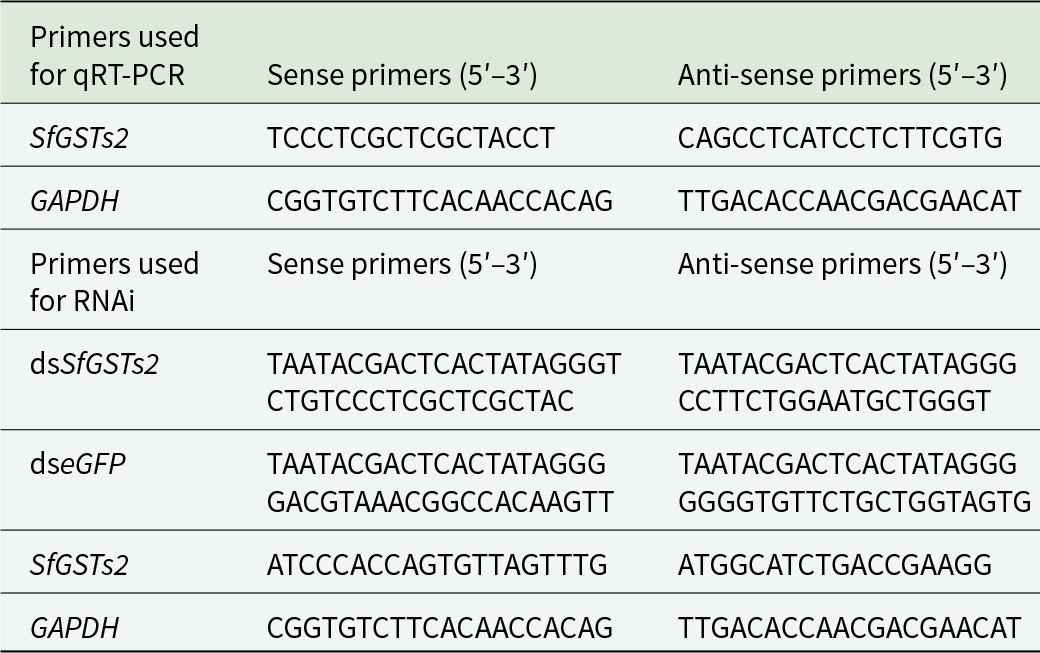
To explore the expression profile of detoxification genes in different host plants (corn, wheat and goosegrass) and developmental stages, samples from six instars of the larva were ground in liquid nitrogen and stored at −80°C. To explore the expression profile in S. frugiperda larval tissues, fifth instars were anesthetized on ice and dissected to collect heads, salivary glands, midguts, blood, fatbodies, and epidermis. For each treatment, 36 larvae were divided into three replicates (12 individuals per replicate) and tested. Collected tissues were immediately homogenized in RNAiso Plus reagent (TaKaRa, China). cDNA was synthesized from 2 µg total RNA using PrimeScript TM RT reagent kit (TaKaRa, China). qRT-PCR (95°C 30 s,40 cycles of 95°C 5 s, 60°C 30 s) was performed using SYBR Green (TaKaRa, China) with the CFX96 real-time PCR detection system (Bio-Rad, Hercules, CA, USA). GAPDH (Gen-Bank: KC262638.1) was used as the internal control genes for normalization by Bustin et al (Bustin et al., Reference Bustin, Benes and Garson2009). Three biological replicates and three technical replications for each cDNA sample were used for qRT-PCR analysis. The relative gene expression level was calculated by the 2−∆∆CT method (Livak and Schmittgen, Reference Livak and Schmittgen2001). Primer information is provided in table 1.
List of all primers used in this study

‘TAATACGACTCACTATAGGG’ is the T7 promoter.
Preparation, quantification, and purification of double-stranded RNA
Enhanced green fluorescent protein (eGFP) was used as a control. For dsRNA synthesis, SfGSTs2 and eGFP with fragment sizes of 873 bp and 229 bp were amplified by PCR. The primers used for the dsSfGSTs2 and dseGFP amplifications were designed to add the T7 polymerase promoter sequence to the 5 ends of each strand (table 1). Likewise, the dseGFP was prepared using the same method as a control (table 1). According to the specification provided by T7 RiboMax Express RNAi System Kit (Promega, Madison, WI, USA), the dsGSTs2 and dseGFP were prepared from the purified PCR-generated templates. Then, the dsRNA was purified using the MEGAclearTM Kit (Ambion, Austin, TX, USA). The resulting dsRNA was quantified by a NanoDrop® spectrophotometer (NanoDrop Technologies, USA), and integrity was verified using 1.5% agarose gels electrophoresis. The other collected samples were stored at −80°C until use.
dsRNA feeding bioassays for mortality and larval growth
In order to avoid damage to the larvae by injection, we used the feeding method for RNA interference (Singh et al., Reference Singh, Gupta, Pandher, Kaur, Goel, Rathore and Palli2019). The dsRNA was first diluted with diethylpyrocarbonate (DEPC)-treated water to 800 ng/μL before dsRNA feeding experiments. The diluted dsRNA was evenly spread on the leaves (1 cm in diameter) of corn, wheat, and goosegrass, with 10 μL applied to each leaf. The thirty newly hatched larvae were placed in a 6 cm petri dish on each treated leaf. One-day-old 3rd-instars (starved for 6 h) of S. frugiperda were moved individually in sterilized 12-well tissue culture plates with a treated leaf. Similarly, the plants treated with DEPC-treated, as a control, were prepared using the same method. A total of 90 newly hatched larvae were divided into three replicates (30 individuals per replicate) for the mortality assay and 45 one-day-old third instars were divided into three replicates (15 individuals per replicate) for the weight assessment. The mortality and larval mass were recorded at 24, 48, 72 h after feeding on different treatments.
RNA extraction and cDNA preparation for qRT-PCR after RNAi
The midguts were dissected from larvae of different treatments and times after ingesting dsSfGSTs2 or dseGFP (as a control). For each treatment, 36 larvae were divided into three replicates (12 individuals per replicate). Total RNA was extracted, and the cDNAs were synthesized as described above. The primers were designed using Premier 5, and the sequences of the primers used for candidate genes are listed in (table 1). qRT-PCR was performed using SYBR Green (TaKaRa, China) according to the manufacturer’s instructions on a CFX96 TM Real-Time PCR Detection System (Bio-Rad). Three biological replicates and three technical replications for each cDNA sample were used for qRT-PCR analysis.
Statistical analysis
The data were statistically analysed using Excel, and the difference in mean values of the treatments was calculated by one-way ANOVA using SPSS 23.0 software. Multiple comparisons were performed using the post-hoc Tukey test to determine the significant differences between treatments. p < 0.05 was considered statistically significant.
Results
Effects on the development of S. frugiperda by feeding on different plants
To investigate the feeding adaptability of invasive S. frugiperda on different hosts, larvae were fed corn, wheat and goosegrass. The growth and development duration of corn feeding was significantly shorter than that of wheat and goosegrass feeding (fig.1A), which were 14.733 ± 0.082 days, 15.800 ± 0.305 days, and 16.700 ± 0.322 days, respectively. The 10 days old larvae weight was heavier on corn (0.177 g) compared with wheat (0.119 g) and goosegrass (0.054 g) (F = 252.549; df = 2, 42; p < 0.001) (fig. 1B). Pupal weight was significantly different on different hosts. It was heaviest on corn (0.193 g) among the wheat (0.138 g) on goosegrass (0.170 g) (F = 174.80; df = 2, 132; p < 0.001) (fig. 1C). The GST activity of the larvae was significantly different among the three hosts. The highest GST activity was 15.977 U/mg prot on goosegrass, followed by wheat (14.035 U/mg prot), and the lowest enzyme activity was 12.956 U/mg prot on corn (F = 88.51; df = 2, 24; p < 0.001) (fig. 1D).
Effect of different hosts on the growth of S. frugiperda. (A) The developmental duration of S. frugiperda feeding on corn, wheat and goosegrass. Each colour represents the developmental time of insects feeding on different hosts. The 1st to 6th instars were larval instars (n = 30). (B) The 10 days old larvae weight (n = 15). (C) pupal weight (n = 15). (D) The GST activity of fifth instars that fed on corn, wheat and goosegrass (n = 6). Each bar shows the mean with 95% confidence intervals. The data are presented as mean ± standard error of three biological replicates. According to Tukey’s honest significant difference test, different letters on the column indicated significant difference (P < 0.05).

Transcriptome sequencing and identification of DEGs
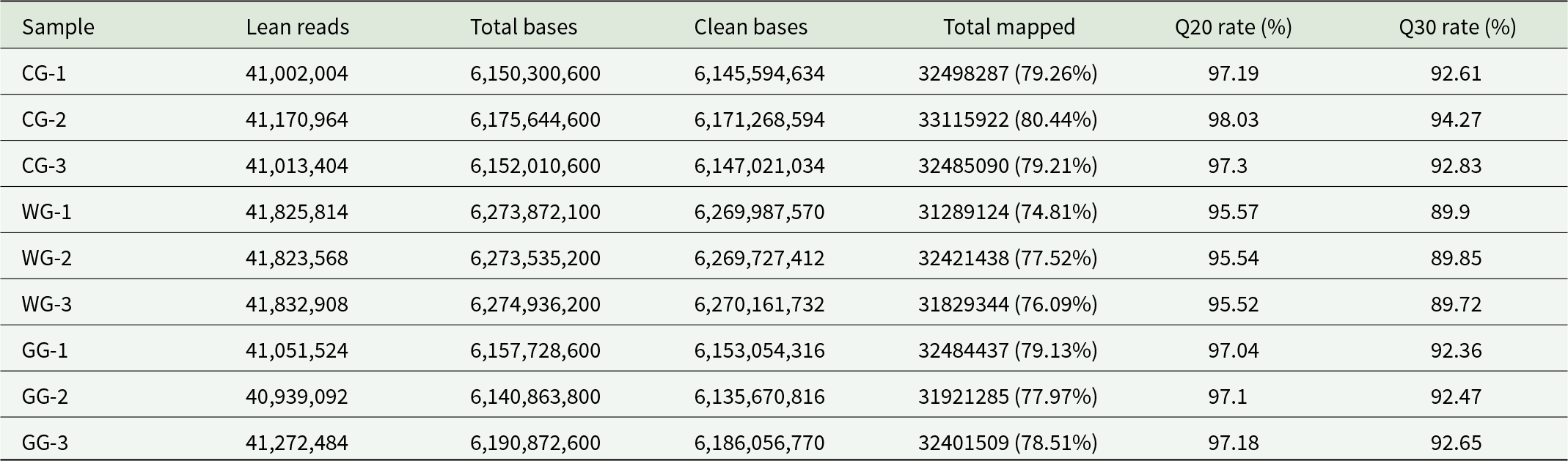
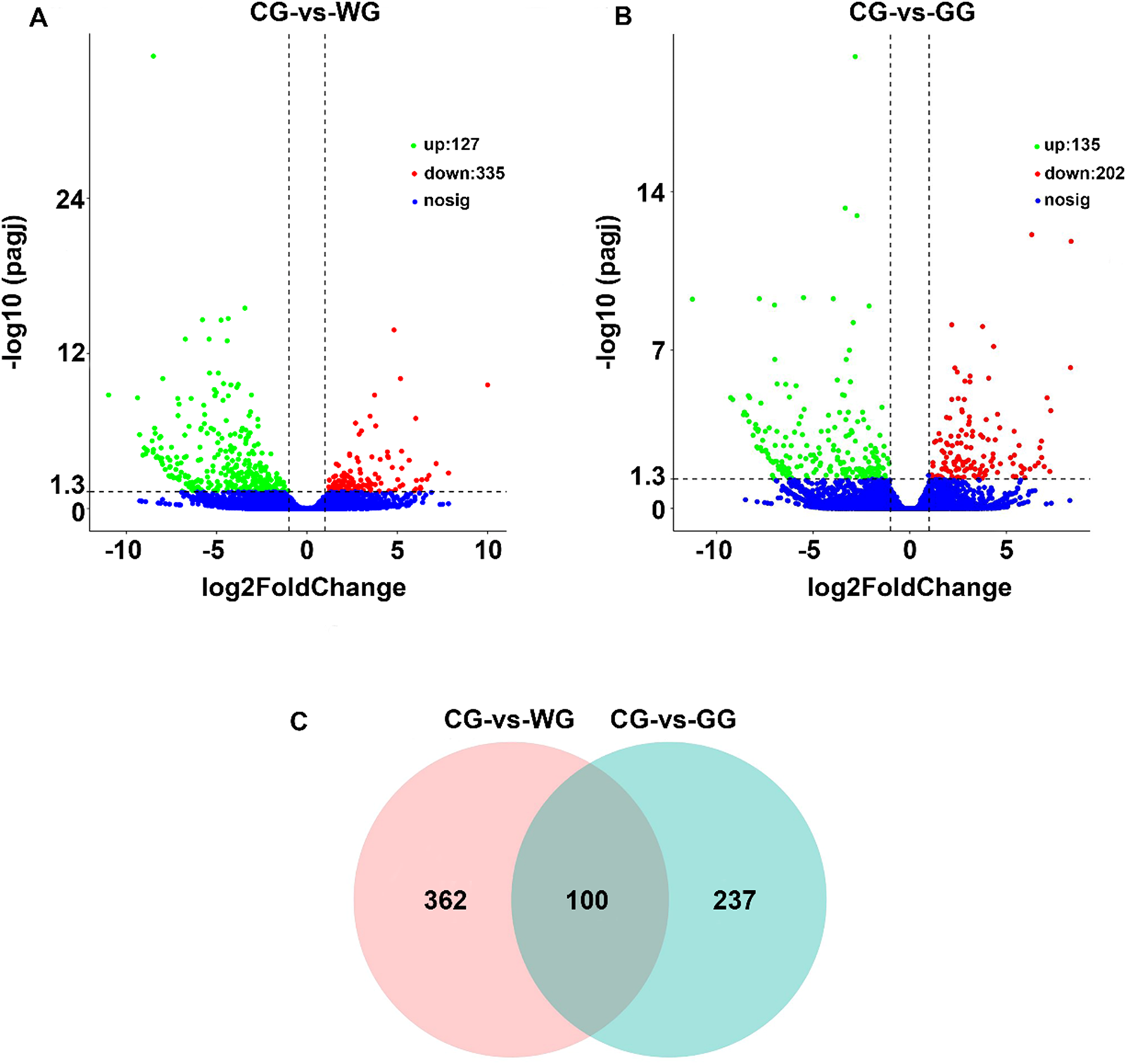
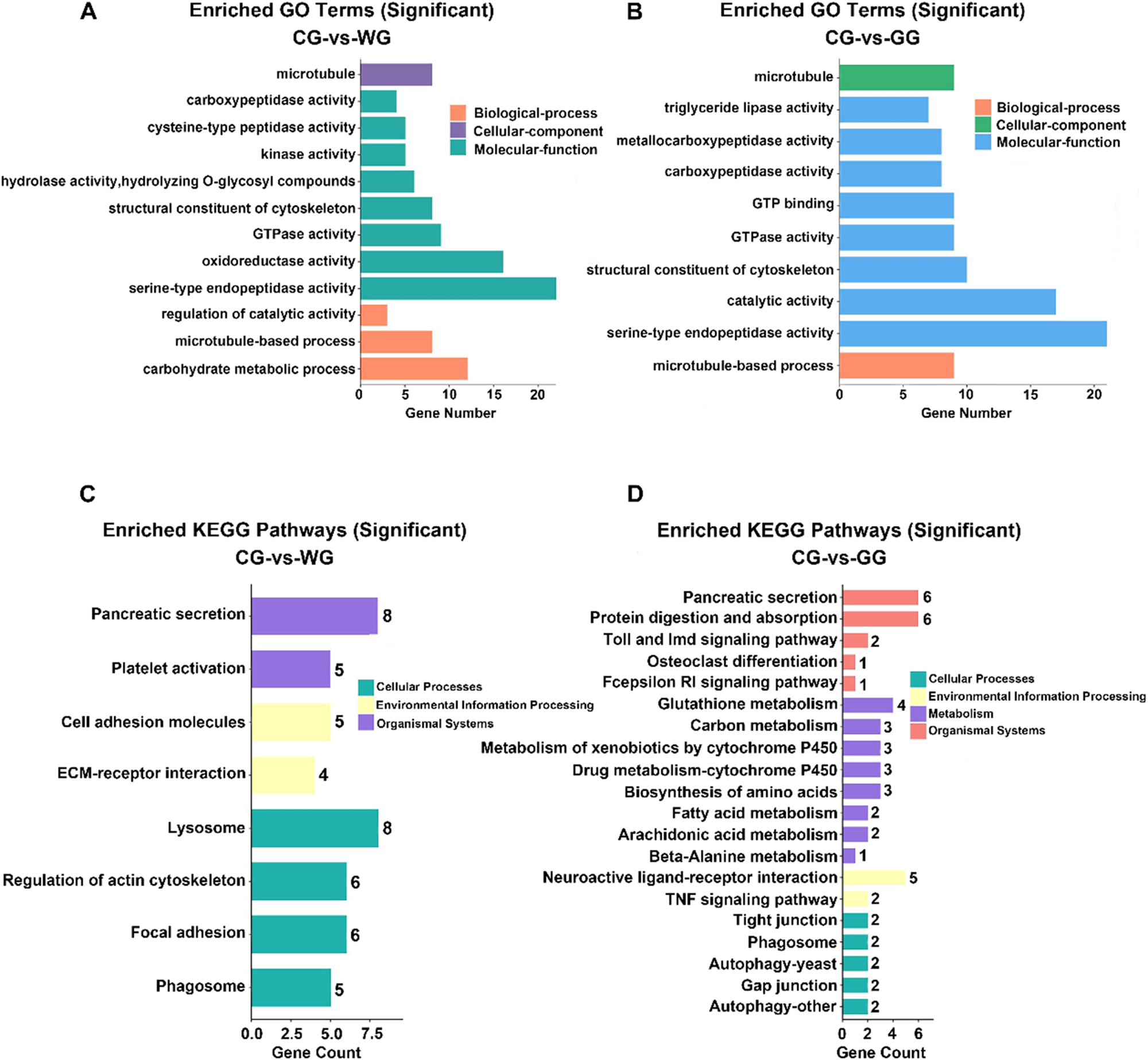
To explore the feeding adaptation mechanism, transcriptome sequencing was performed on the midgut of the 5th instars feeding on three host species. Wheat group (WG) and goosegrass group (GG) were used as treatment, and corn group (CG) was used as control. A total of 3 RNA libraries (three replicates per group) were prepared with sequencing depths ranging from 40,939,092 to 41,832,908 (table 2). DESeq2 was used for differential expression analysis, with P < 0.05 and log2-fold change ≥2 or ≤–2 as cutoff values for CG-vs-WG and CG-vs-GG, respectively. The results showed that 462 DEGs were detected in the CG-vs-WG, among which 127 upregulated and 335 downregulated DEGs were detected (fig. 2A). A total of 337 DEGs were found in the CG-vs-GG, including 135 upregulated and 202 downregulated DEGs (fig. 2B). 100 DEGs were shared among CG-vs-WG and CG-vs-GG, 362 typical DEGs to CG-vs-WG, and 237 typical DEGs to CG-vs-GG (fig. 2C). Through GO analysis, the functions of DEGs were annotated as biological process, cellular component, and molecular function. The number of DEGs enriched by CG-vs-WG in the three categories based on ‘Carbohydrate metabolic process’ and ‘Microtubule’ and ‘Serine-type endopeptidase activity’ were the most abundant (fig. 3A). The number of DEGs enriched by CG-vs-GG in the three categories based on ‘Microtubule-based process’ and ‘Microtubule’ and ‘Serine-type endopeptidase activity’ were the most abundant (fig. 3B). DEGs were mapped to reference pathways in the KEGG database to identify significantly enriched metabolic or signal transduction pathways. The most significant source of CG-vs-WG secretion were ‘Pancreatic secretion’ in the organismal systems, ‘Cell adhesion molecules’ in the environmental information processing and ‘Lysosome’ in the cellular processes (fig. 3C). Most of the CG-vs-GG significantly annotated DEGs were ‘Pancreatic secretion’ and ‘Protein digestion and absorption’ in the organismal systems, ‘Neuroactive ligand-receptor interaction’ in the environmental information processing, followed by ‘Glutathione metabolism’, ‘Metabolism of xenobiotics by cytochrome P450’ and ‘drug metabolism-cytochrome P450’ which are related to detoxification metabolic pathways in the metabolism and ‘Tight junction’, ‘Phagosome’ in the cellular processes (fig. 3D).
The statistical analysis of sequencing data

Overview of transcriptome data. (A) Volcano map of all obtained genes in the corn group (CG) and the wheat group (WG). (B) Volcano map of all obtained genes in the corn group (CG) and the goosegrass group (GG). (C) Analysis of degs. Venn diagrams showing the differentially expressed genes (degs) in the two sets (cg-vs-wg and cg-vs-gg).

Histogram of GO and KEGG enrichment analyses (significant). (A,B) GO enrichment analysis of degs (cg-vs-wg and cg-vs-gg). (C,D) KEGG annotation of degs (cg-vs-wg and cg-vs-gg). Significance terms are shown for each group sorted according to p-value.

Expression profiling of the SfGSTs2 gene at developmental stages, different host plants, and tissues
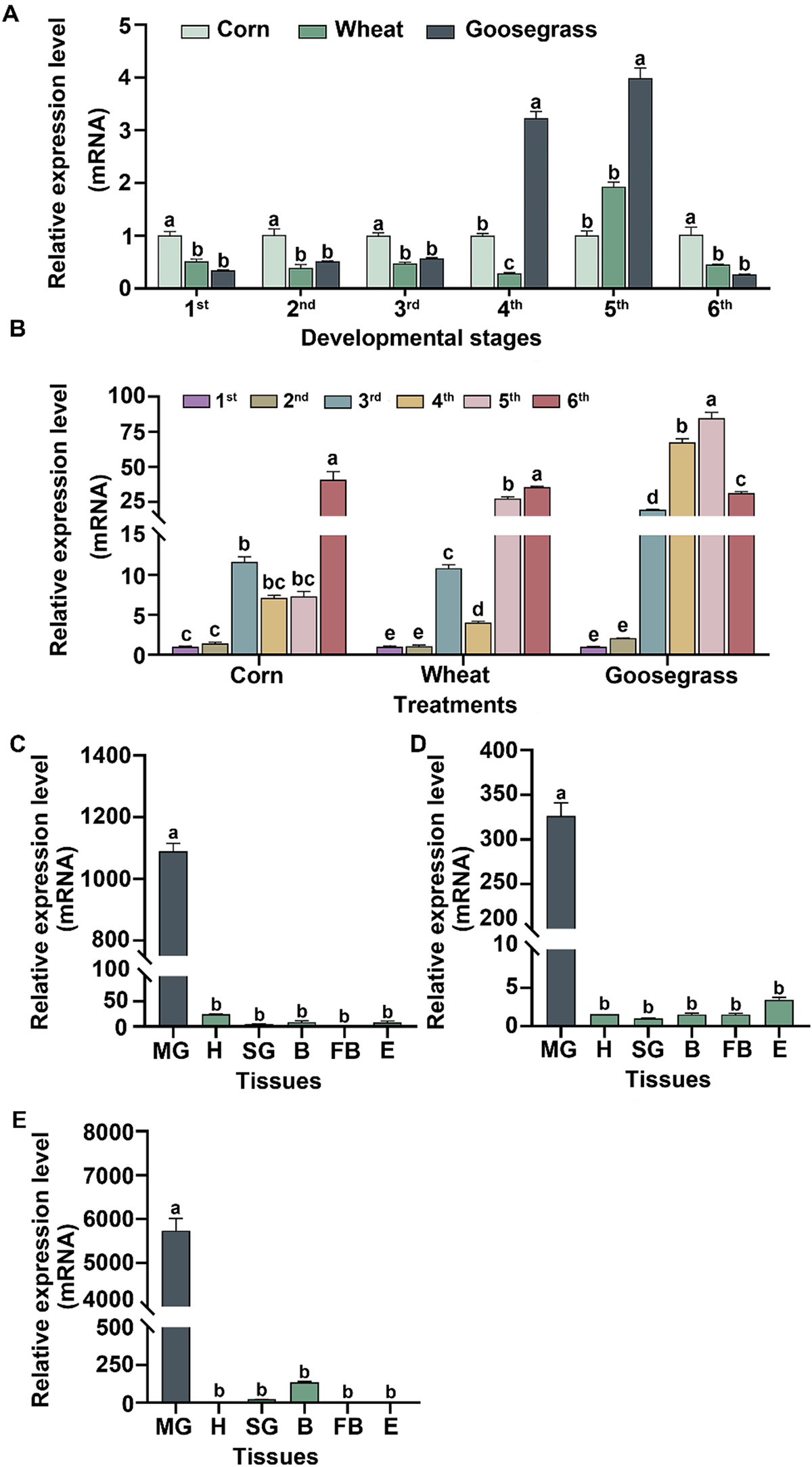
The transcriptome data of the midgut of the fifth instars feeding on three host plants were analysed. A total of 100 DEGs were screened from CG-vs-WG and CG-vs-GG. Only one GST Gene family selected from 100 DEGs was SfGSTs2 (Gene ID: LOC118272232). The mRNA expression level of the SfGSTs2 gene at developmental stages, different host plants, and diverse tissues of S. frugieprda were measured. Firstly, the expression of the SfGSTs2 gene in larvae feeding on three different host plants was detected by qRT-PCR (fig. 4A) (1st: F = 43.387; df = 2, 6; P < 0.001, 2nd: F = 17.659; df = 2, 6; p < 0.01, 3rd: F = 69.754; df = 2, 6; p < 0.001, 4th: F = 411.681; df = 2, 6; p < 0.001, 5th: F = 136.066; df = 2, 6; p < 0.001, 6th: F = 21.544; df = 2, 6; p < 0.01). Results indicated that at the 1st to 3rd instar stage, the expression of the SfGSTs2 gene in the larvae fed on corn was significantly higher than that fed on wheat and goosegrass. In contrast, at the 4th to 5th instar, SfGSTs2 gene expression was the highest on goosegrass. Simultaneously, the SfGSTs2 gene expression levels of S. frugiperda fed on three host plants were detected at each instar (fig. 4B) (Corn: F = 38.119; df = 5, 12; p < 0.001, Wheat: F = 616.115; df = 5, 12; p < 0.001, Goosegrass: F = 299.942; df = 5, 12; p < 0.001). SfGSTs2 was highly expressed in the sixth instars fed on corn and wheat, while in the fifth instars fed on goosegrass. In addition, we analysed the tissue distribution and expression levels of the SfGSTs2 gene. Results showed that there were significant differences in the expression levels of the SfGSTs2 gene in different tissues (fig. 4C–E) (C: F = 135.065; df = 5, 12; p < 0.001, D: F = 482.302; df = 5, 12; p < 0.001, E: F = 432.203; df = 5, 12; p < 0.001). The SfGSTs2 gene was highly expressed in the midgut of S. frugiperda that fed on the three hosts, while it was low expressed in other tissues. The expression level of SfGSTs2 in the midgut of S. frugiperda fed on goosegrass was the highest, about 17.6 times that of the wheat population and 5.3 times that of the corn population, respectively.
(A) Developmental expression pattern of Spodoptera frugiperda sfgsts2. (B) Expression profiles of sfgsts2 after feeding on three different host plants. The tissue-specific expression pattern of sfgsts2 after feeding on corn (C), wheat (D) and goosegrasss (E). MG: midgut; H: head; SG: salivary glands; B: blood; FB: fat body; E: epidermis. qRT-PCR analysis was used to determine relative transcript levels. Each bar shows the mean with 95% confidence intervals, n = 12. Data shown are means ± standard error. Different letters above bars indicate significant differences (P < 0.05) according to Tukey’s honestly significant difference test.

dsSfGSTs2 effects on larval mortality and weight
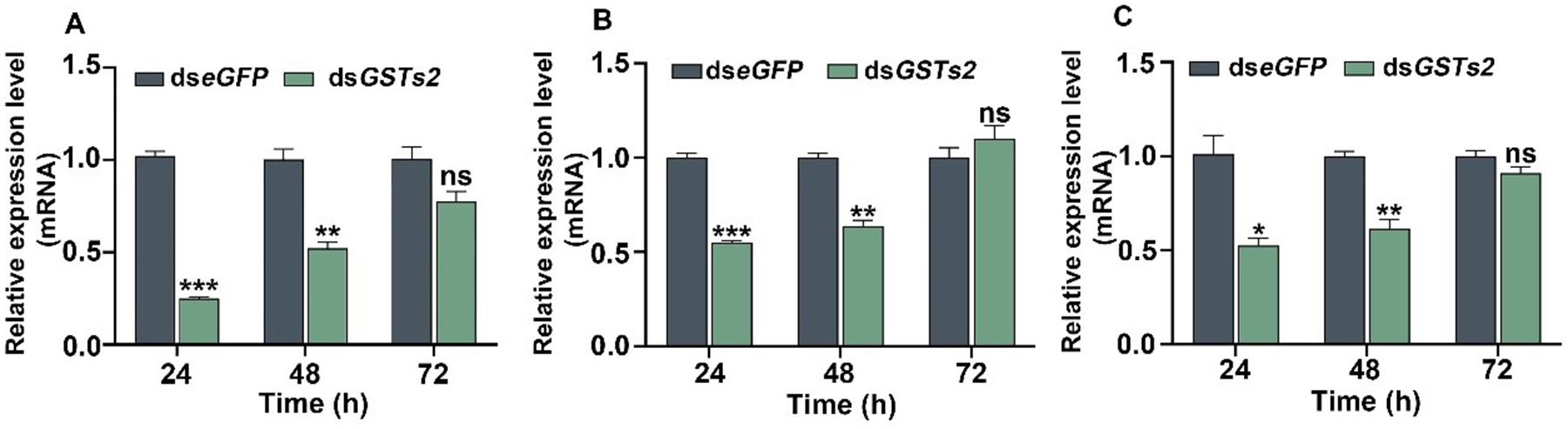
RNA interference was conducted to evaluate the function of the SfGSTs2 gene in S. frugiperda host adaptation. The results indicated that after 24 h of RNAi, the interference efficiency of corn was the highest (75.1%), followed by that of goosegrass (47.4%) and wheat (45.0%) compared with dseGFP control (fig. 5A–C) (A (24 h: F = 86.095; df = 1, 4; p < 0.001, 48 h: F = 54.587; df = 1, 4; p < 0.01, 72 h: F = 7.187; df = 1, 4; p > 0.05); B (24 h: F = 353.432; df = 1, 4; p < 0.001, 48 h: F = 98.235; df = 1, 4; p < 0.01, 72 h: F = 1.310; df = 1, 4; p > 0.05); C (24 h: F = 20.489; df = 1, 4; p < 0.05, 48 h: F = 53.181; df = 1, 4; p < 0.01, 72 h: F = 4.331; df = 1, 4; p > 0.05)). The dsSfGSTs2 was fed to newly hatched larvae to investigate the impact of SfGSTs2 gene silencing on the mortality of S. frugiperda. Results revealed that compared with the dseGFP group, the mortality of S. frugiperda fed on three host plants coated with dsRNA was significantly increased. After 72 h of RNAi, the mortality of corn, wheat, and goosegrass populations increased by 34.5%, 16.7%, and 26.9%, respectively, compared with the control group (fig. 6A–C) (A (24 h: F = 3.125; df = 1, 4; p > 0.05, 48 h: F = 54.0; df = 1, 4; p < 0.01, 72 h: F = 150.0; df = 1, 4; p < 0.001); B (24 h: F = 16.0; df = 1, 4; p < 0.05, 48 h: F = 32.0; df = 1, 4; p < 0.01, 72 h: F = 42.250; df = 1, 4; p < 0.01); C (24 h: F = 1.143; df = 1, 4; p > 0.05, 48 h: F = 20.643; df = 1,4; p < 0.05, 72 h: F = 23.143; df = 1, 4; p < 0.01)). Additionally, to assess the effects of SfGSTs2 gene interference on the growth and development of S. frugiperda, the third instars larvae were fed three host plant leaves treated with dsSfGSTs2 and weighed. Compared with the dseGFP group, the weight of three groups of larvae fed with dsRNA reduced observably (fig. 6D–F) (D (0 h: F < 0.001; df = 1, 58; p > 0.05, 24 h: F = 152.528; df = 1, 58; p < 0.001, 48 h: F = 145.593; df = 1, 58; p < 0.001, 72 h: F = 229.558; df = 1, 58; p < 0.001); E (0 h: F = 0.087; df = 1, 58; p > 0.05, 24 h: F = 4.236; df = 1, 58; p < 0.05, 48 h: F = 55.153; df = 1, 58; p < 0.001, 72 h: F = 123.721; df = 1, 58; p < 0.001); F (0 h: F = 0.349; df = 1, 58; p > 0.05, 24 h: F = 45.372; df = 1, 58; p < 0.001, 48 h: F = 46.978; df = 1, 58; p < 0.001, 72 h: F = 81.457; df = 1, 58; p < 0.001)). After 72 h of RNAi, the weights of the corn, wheat, and GGs decreased by 57.6%, 37.7%, and 28.6%, respectively.
Relative miRNA transcript levels in the midgut of S. frugiperda larvae after ingestion of dssfgsts2 at different times. (A) Corn group; (B) wheat group; (C) goosegrasss group. Each bar shows the mean with 95% confidence intervals, n = 12. Data shown are means ± standard error. Variation analysis was determined by one-way ANOVA followed by Tukey’s post hoc test. ‘ns’ represents no significant difference, *, p < 0.05; **, p < 0.01; ***, and p < 0.001.

Effect of feeding dssfgsts2 to newly hatched larvae on mortality at different time intervals in corn (A), wheat (B) and goosegrass (C) groups (mean with 95% confidence intervals, n = 30). Effect of feeding dssfgsts2 to third instars on weight at different time intervals in corn (D), wheat (E) and goosegrass (F) groups (mean with 95% confidence intervals, n = 15). Data shown are means ± standard error. Variation analysis was determined by one-way ANOVA followed by Tukey’s post hoc test. ‘ns’ represents no significant difference, *, p < 0.05; **, p < 0.01; ***, and p < 0.001.

GST activity assays of 3rd instars after RNAi
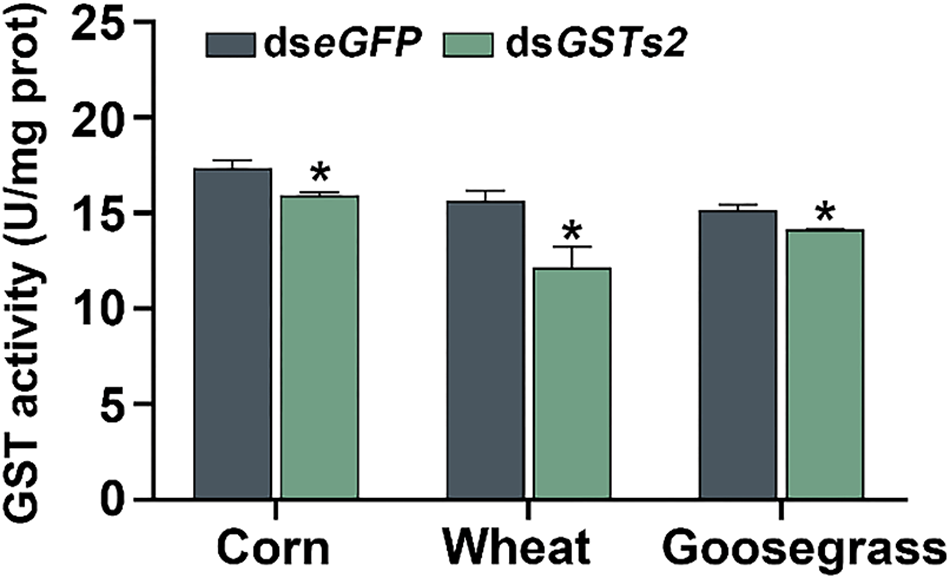
After 72 h of RNAi, the midgut of S. frugiperda larvae was dissected to detect GST activity. The results showed that the GST activity of S. frugiperda in three host populations was significantly decreased after feeding dsSfGSTs2 compared with dseGFP. The GST activity of the corn population was 15.97 U/mg prot (down 8.0%), followed by the wheat population with 12.15 U/mg prot (down 22.3%), and the goosegrass population with 14.13 U/mg prot (down 6.8%) (fig. 7) (Corn: F = 10.320; df = 1, 4; p < 0.05, Wheat: F = 8.219; df = 1, 4; p < 0.05, Goosegrass: F = 12.864; df = 1, 4; p < 0.05).
Detection of GST activity in third instars of S. frugiperda after RNAi. Each bar shows the mean with 95% confidence intervals, n = 6. Data shown are means ± standard error. Variation analysis was determined by one-way ANOVA followed by Tukey’s post hoc test. ‘ns’ represents no significant difference, *, p < 0.05; **, p < 0.01; ***, and p < 0.001.

Discussion
The adaptations of phytophagous insects to their host plants are essential for insect growth, development, reproduction, and evolution (Fürstenberg-Hägg et al., Reference Fürstenberg-Hägg, Zagrobelny and Bak2013; War et al., Reference War, Taggar, Hussain, Taggar, Nair and Sharma2018; Yactayo-Chang et al., Reference Yactayo-Chang, Tang, Mendoza, Christensen and Block2020; Zhu-Salzman and Zeng, Reference Zhu-Salzman and Zeng2015). Plants synthesize chemicals to defend themselves from phytophagous insects, and insects have evolved strategies to overcome these challenges (Borzoui et al., Reference Zalucki, Clarke and Malcolm2015b; Heidel-Fischer and Vogel, Reference Heidel-Fischer and Vogel2015 Zalucki et al., Reference Borzoui, Naseri and Rahimi Namin2002). As a highly polyphagous agricultural pest, the S. frugiperda possesses a wide range of digestive enzymes and a complex detoxification system to rapidly expand its damage (Gouin et al., Reference Gouin, Bretaudeau, Nam, Gimenez, Aury, Duvic, Hilliou and Durand2017; Moné et al., Reference Moné, Nhim, Gimenez, Legeai, Seninet, Parrinello, Nègre and d’Alençon2018).
Host plants are an important factor influencing the growth and development of the S. frugiperda. While S. frugiperda can feed various plants, it tends to feed on specific hosts during the adaptation process, facilitating its development on those preferred hosts (Silva-Brandão et al., Reference Silva-Brandão, Horikoshi, Bernardi, Omoto, Figueira and Brandão2017). In this study, we found that the developmental duration of the larvae fed on corn was shorter than those fed on wheat and goosegrass. Weights of 10-day-old larvae and pupal weights were significantly higher in those fed corn than in those fed wheat and goosegrass. The results were consistent with previous findings that corn is a preferred and suitable host for S. frugiperda feeding compared to other plants such as wheat, sorghum, foxtail millet, Chinese cabbage, crabgrass, and goosegrass (Fang et al., Reference Fang, Lu, Yao, Li, Zheng and Tang2022; He et al., Reference He, Zhao, Gao and Wu2021; Wu et al., Reference Wu, Zhao, Liu and Pan2023). In response to plant defences, herbivorous insects increase the production of detoxification enzymes for chemosensors, including GST (Francis et al., Reference Francis, Vanhaelen and Haubruge2005). Insect GSTs have been confirmed to directly degrade chemical defence substances produced by various plants, protecting insects from damage. For example, GSTe1 of Spodoptera litura can metabolize glucosinolates and xanthotoxins in its host, Brassica juncea (Zou et al., Reference Zou, Xu, Zou, Liu, Chen and Feng2016). SmGSTd1, SmGSTe1 and SmGSTe2 of Sitodiplosis mosellana can metabolize ferulic acid and tannin (Zhang et al., Reference Zhang, Meng, Chen, Wang, Jing, Zhu‐Salzman and Cheng2024). In this process, insect detoxification requires energy consumption. Therefore, the activity and quality of GST vary according to the insect’s feeding behaviour and the different chemical defence substances present in plants. According to a previous study (Fang et al., Reference Fang, Lu, Yao, Li, Zheng and Tang2022), C/N content in corn was remarkably higher than in wheat and goosegrass. In comparison, the content of secondary substances, such as total phenols, was notably lower in other plants. Our results also showed that the lowest GST activity was found in larvae fed on corn, followed by those fed on wheat, with the highest activity in those fed on goosegrass. This indicates that when expanding their host range, insects adapt to new hosts by enhancing their detoxification capacity.
We sequenced the transcriptomes of the three sets of samples to systematically investigate the molecular mechanism of the changes in growth and development and in vivo GST activity after feeding on the three host plants of S. frugiperda. The results indicated that there were 100 shared DEGs, primarily enriched in detoxification metabolic pathways, such as neuroactive ligand-receptor interactions, glutathione metabolism, and the metabolism of xenobiotics by CYP. Several studies have demonstrated the critical role of CYP genes in host acclimatization of S. frugiperda (Hafeez et al., Reference Hafeez, Li, Chen, Ullah, Huang, Zhang, Zhang, Siddiqui, Zhou, Ren, Imran, Assiri, Lou and Lu2023; He et al., Reference He, Shi, Ding, Huang, He, Xue, Gao, Zhang, Li and Qiu2023), but the role of GST genes has been less studied. We filtered the data to obtain only one gene of the GST family, SfGSTs2. The expression profile of GSTs is differentially expressed at different developmental stages and in different tissues of insects due to functional diversification of the genes (Jing et al., Reference Jing, Wu, Li, Wei, Smagghe and Wang2017; Liu et al., Reference Liu, Rao, Li, Feng, He and Li2015). We characterized the spatiotemporal and temporal expression profiles of the SfGSTs2 gene in S. frugiperda across different hosts, developmental stages, and tissues. qRT-PCR analyses showed that the SfGSTs2 gene was highly expressed in the older larvae and the midgut tissue. Moreover, the expression of the SfGSTs2 gene was higher in larvae fed on goosegrass than that fed on corn and wheat. This phenomenon may be because goosegrass is enriched with more plant allelopathic substances, and the feeding activity of insects increases in the later stages (Wang et al., Reference Wang, Li, Staehelin, Xin and Su2015a). The midgut tissue is the main digestion and detoxification site where insects digest food and metabolize plant secondary and toxic substances (Gui et al., Reference Gui, Hou, Liu, Qin, Li and Jin2009; Hafeez et al., Reference Hafeez, Li, Chen, Ullah, Huang, Zhang, Zhang, Siddiqui, Zhou, Ren, Imran, Assiri, Lou and Lu2023). When ingesting large amounts of secondary substances and exogenous toxins, S. frugiperda needs to increase the mRNA expression level of SfGSTs2 and enzyme activity to enhance its plasticity and adaptability to host plants. This has also been confirmed in other insects. The expression level of SIGSTs in S. litura was higher in the midgut than in other tissues. The high expression level of SIGSTs in the midgut may be due to the oxidative stress caused by feeding, bacterial infection, and exogenous compounds (Huang et al., Reference Huang, Xu, Lin, Feng and Zheng2011). Therefore, the specific expression of SfGSTs2 in S. frugiperda suggests that it might be involved in detoxifying plant xenobiotics in the midgut, enabling the insect to adapt to different host plants.
RNAi has been widely used to explore the function of important genes in insects (Adeyinka et al., Reference Adeyinka, Riaz, Toufiq, Yousaf Ibhatti, Batcho, Olajide, Nasir and Tabassum2020; Choi and Vander Meer, Reference Choi and Vander Meer2019; Kim et al., Reference Kim, Issa, Cooper and Zhu2015; Ullah et al., Reference Ullah, Gul, Tariq, Hafeez, Desneux, Gao and Song2022). When S. litura fed on mustard or food containing phytochemicals such as mustard, the transcription and protein levels of SlGSTe1 gene in the midgut of S. litura were upregulated. The expression of SlGSTe1 in larvae was inhibited by RNAi, which reduced the growth and feeding rate of larvae (Zou et al., Reference Zou, Xu, Zou, Liu, Chen and Feng2016). The larvae feeding on dsRNA of the GST gene significantly reduced the detoxification ability of Asian corn borer larvae. It increased the mortality of Asian corn borer by 54% (Zhang et al., Reference Zhang, Zhang, Fu, Yin, Sayre, Pennerman and Yang2018). Similarly, our study showed that silencing the SfGSTs2 gene led to a decline in the detoxifying ability of S. frugiperda towards toxic substances produced by three different host plants. This resulted in decreased feeding, weight loss, and even higher mortality rates. These findings further indicate that SfGSTs2 may be a key factor in the adaptation of S. frugiperda to multiple host plants. However, larval mortality was lower, and the decrease in GST activity was smaller after RNAi. This suggests that insects rely on complex detoxification metabolic mechanisms for host adaptation, which do not depend solely on a single gene but may require the synergy of multiple detoxification genes. The role of the SfGSTs2 in metabolizing plant defensive chemicals remains unclear. Therefore, further functional studies are needed to better understand the mechanisms underlying S. frugiperda’s adaptability to different host plants.
In conclusion, we found that the development of S. frugiperda larvae fed on corn was better than that of wheat and goosegrass. The detoxification ability of S. frugiperda SfGSTs2 was diminished after RNAi, leading to weight loss and increased mortality in larvae fed on three different host plants. This suggests that the SfGSTs2 gene may play an important role in the adaptation of S. frugiperda to both crop and non-crop hosts. The results deepen our understanding of the feeding preferences of S. frugiperda and lay a foundation for further study on the role of insect GST in host adaptability. Additionally, they provide experimental evidence for the comprehensive consideration of field habitat when formulating prediction and prevention strategies for the control of S. frugiperda.
Funding
This research was supported by the Anhui Provincial Natural Science Foundation, China (Grant No. 2208085MC63), Major Program of Natural Science Foundation of the Higher Education Institutions of Anhui Province, China (Grant No. 2024AH040075), Natural Science Research Projects of Anhui College, China (Grant No. 2022AH050921), Natural Science Research Projects of Anhui Agricultural University, China (Grant No. 2021zd32), Talent Research Fund Project of Anhui Agricultural University, China (Grant No. rc342105) and Anhui Provincial Fruit Industrial System, China (Wannongke Letter, 2021-711).
Author contributions
Conceptualization, Qianqian, Li and Fan Yang; Data curation, Qianqian, Li and Renwen Zheng; Formal analysis, Zihan Chen and Jinhui Zhang; Methodology, Yue Liu and Sihan Lu; Visualization, Jun Peng and Dongyan Huang; Writing – original draft, Qianqian Li; Supervision, Yangjunlu Shen and Cui Liu; Funding acquisition, Qingfeng Tang and Renwen Zheng; Writing – review & editing, Qingfeng Tang and Renwen Zheng.
Competing interests
The authors declare no competing interests.