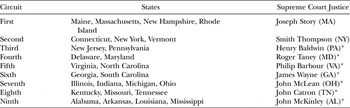
It is an axiom of judicial politics that the membership of the Supreme Court matters to the shape of constitutional law. Indeed, one need not think that justices are simply black-robed politicians likely to vote their crudest policy preferences or reject the idea that precedent and legal theory constrain judicial decision making in order to recognize that where the Court stands depends, at least in part, upon who sits on it. It is, of course, the justices actually on the bench who determine not only what cases will be heard but also how they will be decided and upon what grounds; it is they who hold the key to developing constitutional doctrine and guiding constitutional jurisprudence. In fact, it is largely because of this connection between the composition and outputs of the Court that appointments to the Supreme Court matter—that they provoke as much political attention and energy as they do—in the context of contemporary American politics. And it is largely because such appointments matter for the present and future of both the Court specifically and the nation more generally that there is no shortage of either scholarly or media attention to the subject.Footnote 1
Obviously, who ends up on the Court is traditionally a function of the preferences of both the nominating president and the confirming Senate, but, as I will attempt to show, those preferences are not necessarily the only or even the most important determinants of Court membership. In fact, throughout much of the nineteenth century, presidential and senatorial preferences about potential justices were repeatedly complicated, limited, and trumped by geographical rules and norms surrounding the creation of new seats on the Court or the filling of old ones. The existence of such restrictive conventions suggests that the politics of Supreme Court appointments do not begin simply when the nominee takes his or her place before the Senate Judiciary Committee—or even, for that matter, when the president sits down to select a nominee.Footnote 2 Just as there are rich and dynamic politics surrounding Supreme Court appointments, so too are there rich and dynamic politics that go into such appointments; so, too, in other words, are there meaningful and, in many cases, determinative preappointment politics.
In this article, I introduce this idea of “preappointment politics”Footnote 3 through an extended case study of one historical period—the roughly thirty years between the beginning of Thomas Jefferson's second term as president in 1805 and the end of Andrew Jackson's second term as president in 1837—where such politics had tremendous ramifications for the composition of the Court and, subsequently, the direction of jurisprudence. My goal here is twofold: first, on an empirical level, to illustrate how such politics, far from merely the backdrop for a traditional story of partisan jockeying over appointment politics, were the defining characteristic of and principal limiting force in that story, ultimately responsible—albeit unintentionally—for the making of the Southern slaveholding Supreme Court of the antebellum era; and, second, on a theoretical level, to suggest that we might undertake a somewhat broader approach to understanding the political construction of judicial power as a result.
After all, while existing scholarly work at the nexus of public law and American political development clearly demonstrates that the growth of judicial power is dependent on the willingness (and occasionally eagerness) of key political actors to accept a more prominent or interventionist judicial branch,Footnote 4 such work has heretofore been fairly (and needlessly) restrictive in its subject matter. Focused largely, if not exclusively, on the political supports necessary for the exercise of judicial review by the Supreme Court, the “political construction” literature seems to ignore the idea that the institutional judiciary generally, rather than simply the phenomenon of judicial review specifically, is maintained—created, sustained, and modified—by political actors serving political interests. As a result, it tends to focus on specific substantive issues that are left for judicial resolution and particular doctrines or decisions that are discreetly supported (or at least not actively opposed) by politicians while ignoring organizational structure, entities of judicial administration, and other facets of the institutional environment of courts and judges that have less apparent ramifications for the power of the judiciary—for what kinds of functions it possesses, for how many and what types of individuals perform those functions, for what measure of resources are available in executing them.Footnote 5 Fleshing out a more expansive conception, my account of preappointment politics in the antebellum era suggests that even factors seemingly unrelated to the exercise of judicial review—and, perhaps, at first glance, seemingly unrelated to the scope of judicial power in any meaningful sense—may, in fact, help to determine the institutional fate—the institutional authority and character—of the judicial branch.
My argument is that the creation of the Southern slaveholding Supreme Court—the Court that decided cases such as Prigg v. Pennsylvania,Footnote 6Dred Scott v. Sandford,Footnote 7 and Ableman v. Booth Footnote 8—was a function of certain institutional strictures concerning the size of the Court and the geographic organization of the federal circuit system. More precisely, it was the hidden and unintended result of a series of legislative battles between National Republicans and Old Republicans in the 1820s and Whigs and Democrats in the 1830s. The upshot of these battles, won by Old Republicans and Democrats, respectively, was a series of delays in reforming the judicial system until the moment when Western insistence on change and impending Democratic control of the federal government combined to produce a system guaranteeing that, virtually irrespective of the collection of justices on the Court at any given time, the view of the South and its slaveholders would always be disproportionately represented amongst them.
Indeed, although judicial reform in the early to mid nineteenth century was originally motivated by the exigent needs for judicial administration in newly admitted Western states, it soon became a battle over legislators' desire to create (or prevent their opponents from creating) new seats on—or to appoint (or prevent their opponents from appointing) particular individuals to—the Supreme Court. This switch in the character of judicial reform from a fairly uncontroversial subject to a highly politicized one subsequently divided reform coalitions so as to make meaningful change virtually impossible for three decades. When change finally did occur, it manipulated a basic (if largely unworkable) formula for expanding the judiciary so as to yield a Court that was not only fundamentally Jacksonian but also disproportionately Southern and undeniably slaveholding.Footnote 9 Since this formula was anchored in a system of geographic judicial representation that had its roots in the first decade of the nineteenth century, any explanation for the making of the Southern slaveholding Supreme Court of the antebellum era requires tracing the political construction of judicial power in general—and the preappointment politics of the Supreme Court, in particular—through late Jeffersonian and Jacksonian America.
Accordingly, in what follows, I trace the historical lineage and dynamic processes leading to the creation of the Southern slaveholding Court across four stages: first, the initial Jeffersonian expansion of the federal circuit system to seven circuits and the Supreme Court to seven justices in 1807; second, a failed National Republican attempt to add three more circuits and three more justices in the mid 1820s; third, a failed Whig attempt to consolidate circuits in 1835; and, fourth, a quick resolution to multiple decades of stalemate with the Jacksonian establishment of eighth and ninth circuits and eighth and ninth seats on the Court in 1837. For each of these four stages, I ask why certain reforms were pursued, how they were (or were not) accomplished, and what they achieved. In doing so, I detail how the complex, multistage creation of the Southern slaveholding Court was not simply about who was appointed but about the structures that determined who might be appointed; in turn, I illustrate how these considerations about who could be appointed and who should be appointed determined not only the makeup and composition of the Court but also the very character of the decisions it was likely to make.Footnote 10
New States, New Circuits, and New Supreme Court Justices, 1805–1808
If the early republic was America's infancy, then the first half of the nineteenth century was its adolescence. The government had survived its early years—the uncertainty of the First Congress, the farewell of George Washington, the rise of political parties, the emergence of contested elections, and the first transfer of power from one coalition to another—but a new set of challenges had surfaced.Footnote 11 Many of those challenges were the result of the vast territorial expansion that occurred during the period. From the Louisiana Purchase in 1803 to the annexation of Texas in 1845 to the vast tracts of land acquired as a result of the Mexican-American War in 1848, the area owned by the United States had swelled greatly from the thirteen colonies that declared independence from George III. As these open swaths of land attracted settlers, their populations grew steadily, and as their populations grew, territories were admitted into the union as states. After the incorporation of only four new states in the two decades following the First Congress—Vermont (1791), Kentucky (1792), Tennessee (1796), and Ohio (1803)—thirteen more, including one in each year from 1816 through 1821, followed before 1850.Footnote 12
Raising concerns about the economic and social direction of the nation, the politics of territorial expansion and statehood admission served as an accelerant for sectional tension. That is to say, as North and South fought over control of the West, their divergent economic paths and contrasting views on slavery were magnified and exacerbated. Northerners, of course, continued to argue for financial policies designed to promote a bustling commercial economy and against the extension of slavery to the territories and new states. Southerners, meanwhile, still dreamt of an agrarian nation and supported the maintenance of their “peculiar institution.” These debates were neither unknown in earlier decades (indeed, they had been omnipresent in the early republic) nor as hostile as they would prove to be in subsequent decades (when pro-slavery advocates grew more aggressive in protecting their property and abolitionists more militant in response), but territorial expansion infused them with salience, urgency, and importance in two concrete ways. First, since states were not automatically incorporated into one of the nation's judicial circuits upon joining the Union, new states were effectively excluded from the federal judicial system. Second, with populations growing within and spreading across all states rapidly, judicial workload was simultaneously increasing and becoming more diffuse, thus making it increasingly difficult for judges—especially Supreme Court justices, who were still forced to ride circuitFootnote 13—to dispatch judicial business efficiently.
As a result of these two problems, when Ohio joined the Union on March 1, 1803, it joined on unequal terms. After all, like its fellow Western states Kentucky and Tennessee, Ohio was not included in one of the six circuits in the federal judicial system. The reason for Ohio's exclusion traced back to the Judiciary Act of 1802, which rearranged the circuit system in such a way that excluded the Western states,Footnote 14 largely because circuit-riding was once again required of the justices and because traveling across the Appalachian Mountains was a time-consuming and arduous task. In practical terms, this meant that the three Western states were reduced to a scheme whereby certain district courts possessed both district and circuit court jurisdictionFootnote 15; in symbolic terms, it meant that they were relegated to second-class status.
The remedy for both the practical and symbolic woes of the Western states was the Judiciary Act of 1807.Footnote 16 Passed after persistent complaints by the aggrieved states, the act established a seventh circuit comprising Kentucky, Ohio, and Tennessee; created a seventh seat on the Supreme Court; and required that the newly created seat be filled by an individual residing in the newly created circuit. At first glance, the legislation looks pedestrian and unimportant, an observation supported by the fact that the entire legislative history of the bill seems to unfold over just seven weeks of the lame-duck session of the Ninth Congress and without any recorded debate in either chamber. While it is certainly true that the act was politically uncontroversial, passed largely to deal with concerns about the effect of growing caseloads on the administration of justice in the Western states and to blunt criticism that the circuit system did not treat all states equally, it nonetheless served to connect new states, new circuits, and new Supreme Court justices in a way that would effectively paralyze judicial reform for three decades.
A Performance Problem with a Consensus Solution
As the lack of real debate or controversy over it suggests, the Judiciary Act of 1807 was a pragmatic response to the immediate problems posed by the exclusion of three states from the circuit system. These problems—the distant and inefficient administration of justice in the frontier, restricted appellate options for Western citizens, a growing number of direct appeals to the Supreme Court—were not subject to judicial resolution. Whatever powers John Marshall may have invented, consolidated, or exercised in the early part of his tenure as Chief Justice of the United States, he could not expand the circuit system to include the Western states, and he could not fix the structurally based workload problems created by Western expansion. Instead, the task was a legislative one, and legislators had salient motivations to reform the system. Particularly in the West, where the complicated nature of land deeds and titles—and the battles between absentee landholders and resident settlers over them—was a constant agitation, citizens needed judges to resolve disputes and maintain a sense of order. District judges, especially when there was only one per state, were regarded as less capable of performing this function on their own than when joined by circuit-riding Supreme Court justices, who were more knowledgeable about the law, more skilled in educating citizens, and more respected as agents of the central government.Footnote 17 Furthermore, to the extent that a well-functioning judicial system was an issue about which citizens cared, judicial reform was a type of constituent service that might strengthen legislators' popularity in their respective districts.
Far from the concerns of partisanship, the desire for a well-functioning judicial system was consistent across different groups of legislators. Whether noble or self-interested, Democrat-Republicans and FederalistsFootnote 18 alike had incentives to alleviate the problems that plagued Western justice and irritated Western citizens. Moreover, aside from the fact that the proposed reform—the creation of a seventh circuit for the West and a seventh seat on the Supreme Court for a Westerner—offered Thomas Jefferson an additional Supreme Court appointment, it neither disproportionately favored one party or population (except the West) over another nor fundamentally transformed the judicial system as it then existed. As a result, it was relatively easy for Democrat-Republicans and Federalists to agree on both the need for reform and the type of reform that would rectify existing problems. With fairly widespread consensus about the benefits of expanding the circuit system to the West, political opposition was minimal; with minimal opposition, there were no obstacles in the path of reform. Accordingly, regarding the reform as a simple, straightforward solution to a concrete problem of judicial performance, neither chamber gave the bill any more than cursory attention before passing it, the Senate without a recorded voteFootnote 19 and the House by a margin of seventy-five votes (82–7).Footnote 20 Because it was the first time the circuit system needed to be modified to incorporate states that would not naturally fit into existing circuits,Footnote 21 simply expanding the system by creating a new circuit and a new Supreme Court justice to ride that circuit was a reasonable idea. It was also, however, an idea with potential ramifications of which Congress seemed completely unaware.
A New Model for Judicial Reform
As the first instance in which a new circuit and a new justice were added simultaneously, the Judiciary Act of 1807 not only integrated the Western states into the circuit system and expanded the Supreme Court beyond its original 1789 size but also established a model for future reform.Footnote 22 This model had two crucial features. The first was a connection between the circuit system and the Supreme Court—or, more precisely, between the number of circuits and the number of Supreme Court justices. Such a connection was not unprecedented, but neither was it clearly established by constitutional text or political practice. For example, by simultaneously constituting a Court of six justices and requiring the attendance of two of those justices at circuit courts in each of the nation's three judicial circuits, the Judiciary Act of 1789 drew a de facto parallel between the number of circuits and the number of justices—at least until the circuit-riding reform of 1793 required only one justice to sit on each circuit court.Footnote 23 Similarly, with the repeal of the Judiciary Act of 1801 having resurrected circuit-riding and returned the Court to a six-member body, Democrat-Republicans chose to preserve the Federalist idea of six circuits in the Judiciary Act of 1802, thus guaranteeing one justice for each of the nation's six circuits. Precisely because Democrat-Republicans sought to return the judiciary to a slightly modified form of the pre-1801 system, however, it was not clear whether the parallel between circuits and justices established by the 1802 act was meant as a prescription for future action or a reactionary move to reclaim the previous status quo. With the Judiciary Act of 1807, then, the Democrat-Republican Congress affirmed and strengthened the 1802 parallel.
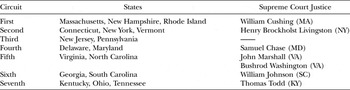
The second feature, prompted by the explicit statement in the Judiciary Act of 1807 that the newly created vacancy on the Court be filled by an individual that would “reside in the seventh circuit,”Footnote 24 required the president to heed concerns about geographical representation when choosing new justices. Congress had raised the matter of residency twice before—allotting circuit assignments based on the residence of the justices in the Judiciary Act of 1802 and again in an amendment to that act in 1803Footnote 25—but it had never explicitly required that an appointed justice hail from a specific state or region.Footnote 26 And, even though the statutory basis for this requirement applied only to the Seventh Circuit justice, once Thomas Jefferson obeyed it by appointing Kentuckian Thomas Todd to the new seat, the pressure exerted via senators chosen by state legislatures on future presidents made geographic representation for other circuits the expectation for other Supreme Court appointments.Footnote 27 (See Table 1 for circuit organization and Supreme Court representation following the Judiciary Act of 1807.)
Circuit Organization and Supreme Court Representation—Judiciary Act of 1807

Note: There was no Third Circuit justice until 1830 due to John Adams's appointment of Virginian Bushrod Washington to replace Pennsylvanian James Wilson in 1799—a geographically “inappropriate” appointment before the post–1807 norm of geographic representation was established.
The effect of these two features on the future of the Supreme Court was twofold. First, by tying population growth to Supreme Court growth such that, provided the former continued, the latter was effectively required to keep pace with it, the connection between circuits and justices infused political considerations about new judicial appointments into an issue that had previously been dictated by apolitical performance concerns. Without such an arrangement, the circuit system could have evolved routinely, uncontroversially, and without broader ramifications for the Court. Under the system inaugurated by the Judiciary Act of 1807, however, circuit reform occurred rarely and only in exceptional circumstances because such reform held the potential for exploitation by a partisan coalition looking to gain new seats on the Court. In that way, the system did not recalibrate the natural partisan politics surrounding appointments so much as it forced their emergence on issues where such politics would have otherwise been absent, a development that greatly increased the stakes of, made perpetual the debates over, and substantially delayed success in changing the size of the Court.
Second, the fact that new states required new circuits, that new circuits required new justices, and, that those new justices were—as a result of the norm of geographically representative appointments—expected to come from one of the new states in the new circuit meant that the composition of the Court was inextricably tied to the politics of regionalism and statehood admission. Which territories were admitted to the Union when and how they—together with existing states—were organized once included in the circuit system suggested who could be appointed to the Court and, in turn, what type of body the Court was likely to be. While this practice of geographically representative appointments was, with the exception of Jefferson's appointment of Todd pursuant to the Judiciary Act of 1807 itself, an informal norm rather than a statutory rule, it nonetheless operated with both consistency and force, successfully limiting the appointment options for and constraining the appointment preferences of presidents for more than five decades. Moreover, with North, South, and West sufficiently divergent in terms of policy preferences and preferred way of life, disparate regional views on the proper scope of federal judicial power should not have been surprising. And just as justices from New Hampshire, Georgia, and Ohio were likely to differ about the place of judicial power in American democracy, so too were they likely to differ about the ends to which—about the policies for which—such power should be used. Thus, to the extent that individuals from different corners of the rapidly expanding nation were influenced by local or regional concerns and values, sectionalism and territorial expansion shaped not only the makeup but also the jurisprudence of the nineteenth-century Court.
With decisions about judicial structure suddenly decisions about the composition and jurisprudence of the Supreme Court, about the force and reach of judicial power, and about the battle between Northern abolition and Southern slavery, circuit organization was transformed from a mundane procedural matter into a substantive issue about the shape of national government and the future of national politics. The Supreme Court did not require expansion at any point in the first four decades of the nineteenth century—the size of the Court caused no problems of judicial performance; the circuit system, however, did require reform and, once the two features were connected, it meant that Supreme Court expansion was inevitable because circuit system reform was inevitable. The only question that remained was one of timing; the only matters left to be determined were when exactly reform would occur and who exactly would stand to benefit from it. As we shall see, the link between circuits and justices—embedded in the framework established by the Judiciary Act of 1807 and inescapable unless and until that framework was jettisoned—dictated the answer to that question, not only making substantial judicial reform in the 1820s and 1830s exceedingly difficult and extremely rare but also delaying it until the potential for exploitation was especially ripe.
Judicial Reform in the Era of Mixed Feelings, 1809–1828
The remedy offered by the Judiciary Act of 1807 solved the immediate problem posed by the exclusion of Kentucky, Tennessee, and Ohio from the circuit system, but it did not solve the recurring problem. That problem, of course, was that, while the nation expanded, the judicial system remained frozen. Indeed, with the admission of five states—Louisiana (1812), Indiana (1816), Mississippi (1817), Illinois (1818), and Alabama (1819)—making the 1810s the single most active decade for statehood admission in American history, the judicial system was under constant strain. If the addition of three new states had previously necessitated one new circuit, then what type of reforms might five—or seven, if we include the admission of Maine (1820) and Missouri (1821)—new states require? In each new state, a judicial district was established, but, without broader reorganization, each of the new districts (except Maine)Footnote 28 remained outside the circuit system and, thus, the judge of each district was granted both district and circuit court jurisdiction.Footnote 29 Encompassing more area than it could reasonably cover and facing more cases than it could reasonably decide, the judiciary was once again ill-equipped to serve the needs of the nation, and geographic expansion was once again the root cause.Footnote 30
Although the federal judiciary itself was active during this period, often considered the “golden age” of John Marshall, it was not active in a way that addressed the structural problems caused by territorial expansion and statehood admission. Rather, it was active as a centrifugal force, interpreting the Constitution and federal statutes so as to create and sustain the broadest possible expanse of central governmental authority. Indeed, most significant judicial decisions of the 1800s, 1810s, and early 1820s—sustaining Jefferson's embargo in 1807Footnote 31; asserting the power to declare state law unconstitutional in Fletcher v. Peck Footnote 32; legitimating statutes passed to prosecute the War of 1812Footnote 33; declaring the federal government supreme in its own sphere in McCulloch v. Maryland Footnote 34; striking down state action in Sturges v. Crowninshield,Footnote 35Dartmouth College v. Woodward,Footnote 36 and Gibbons v. Ogden Footnote 37—were characterized by a steadily increasing and intensifying nationalism.Footnote 38 In other words, these expressions of judicial nationalism were significant not because they represented unilateral judicial action in the service of reform—they did not—but because they altered the strategic environment within which such reform was already occurring.
Even the Court's highly controversial decisions in Martin v. Hunter's Lessee Footnote 39 and Cohens v. Virginia Footnote 40—cases that have been called “the keystone of the whole arch of Federal judicial power”Footnote 41—were important less for the institutional changes that resulted (or failed to result) than for situating the judiciary firmly on the nationalist side of the suddenly resuscitated debate between nationalists and localists. After all, the central question raised in both Martin and Cohens—whether or not Section 25 of the Judiciary Act of 1789, which explicitly authorized federal courts to review state court judgments, was constitutional—was not novel; rather, it was asked (albeit in general more than specific terms) at the Philadelphia Convention and during the First Congress as nationalists and localists fought over what types of power the federal judiciary should have and what type of institution the Supreme Court should be. Nor were the answers offered (in Martin and Cohens) unprecedented.Footnote 42 The Court's rulings did not announce a new doctrine or invent a new power; they merely applied an existing provision, a provision that had been approved by democratic majorities as part of the legislative process. The application of that provision may have been controversial, but the Court's willingness to apply it was not unpredictable and its reasoning for defending it was not unfounded. Since Martin and Cohens occurred within the prevailing stream of congressional action—perhaps doing little more than providing a judicial voice for a legislative enactment—it seems emphatically false to claim that Marshall broadened judicial power on his own, “without the aid of a specific statute.”Footnote 43 Thus, despite a slate of decisions that increased judicial power as part of increasing federal power against the states, there was no decision—nor could there feasibly be—that integrated the West into the circuit system or alleviated the growing caseload pressures on federal judges. In other words, regardless of how the Marshall Court's judicial nationalism may have shaped constitutional jurisprudence, it did not convert the judiciary into an institution that could effectively administer justice in a growing nation.
With the judiciary ill equipped to deal with the defects in its own structure and organization, the task inevitably fell to Congress. Although there was occasional attention to judicial reform during James Madison's presidency and James Monroe's first term,Footnote 44 it was not until a caseload crisis threatened to paralyze the Seventh Circuit in 1823 that legislators began to think seriously about the possibility of reform. By that point, there seemed to be wide agreement that something needed to be done about the judiciary,Footnote 45 but different factions of the Democrat-Republican Party and different regions of the country disagreed about precisely what needed to be done.Footnote 46 As three years of debate over a multitude of proposed bills unfolded, it was precisely this disagreement, filtered through the structure imposed by the Judiciary Act of 1807, that inhibited the campaign to reform the judiciary.
A Factionalized Party and a Multiplicity of Interests
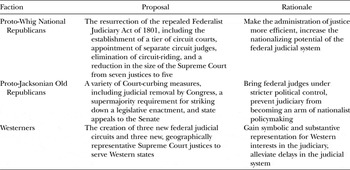
As the dichotomy between Hamiltonianism and Jeffersonianism collapsed and the Democrat-Republican Party fractured in the 1810s,Footnote 47 the distinct motivations for judicial reform multiplied. Indeed, even during an era conventionally known as one of the most ideologically unified and uncontested in American history, three different segments of the Democrat-Republican coalition—proto-Whig “National Republicans,” proto-Jacksonian “Old Republicans,” and Westerners—were each motivated to pursue a different type of judicial reform for a different reason (see Table 2). The existence of three distinct (and, to a great extent, mutually exclusive) reform agendas meant not only that the so-called “era of good feelings” might more appropriately be labeled the “era of mixed feelings”Footnote 48 but also that judicial reform during that era stood as a contested and precarious project, impeded by the clash of interests and constrained by the presence of substantial political opposition.
Judicial Reform Agendas in the Era of Mixed Feelings

First, National Republicans—a combination of Federalists who were disenchanted with the radical secessionist talk at the Hartford Convention and Democrat-Republicans who were increasingly dissatisfied with the party's focus on agrarian economic developmentFootnote 49—sought to resurrect the system established by the Judiciary Act of 1801, which they reasoned was repealed “not from an objection to its structure, but to the mode of its execution.”Footnote 50 Acting primarily to satisfy performance goals jeopardized by increasing caseloads, National Republicans considered the 1801 system—the establishment of an entirely new tier of circuit courts, the appointment of separate circuit judges to staff such courts, the elimination of circuit-riding, and a reduction in the size of the Court from seven members to five—the sweeping change necessary to remedy the continual defects in the administration of justice.Footnote 51 As early as 1816, Madison, in his eighth annual message to Congress, cited “the accruing business which necessarily swells the duties of the Federal courts” and the “great and widening space within which justice is to be dispensed” as reasons to consider “the expediency of a remodification of the judiciary establishment.”Footnote 52 Specifically, he urged “a relief from itinerary fatigues” (circuit-riding) for Supreme Court justicesFootnote 53 and “a more convenient organization of the subordinate tribunals.” Eight years later, Monroe agreed with his predecessor, drawing attention to the effect of territorial expansion on the judicial system and calling again for the abolition of circuit-riding:
The augmentation of our population with the expansion of our Union and increased number of States have produced effects in certain branches of our system which merit the attention of Congress. Some of our arrangements, and particularly the judiciary establishment, were made with a view to the original 13 States only. Since then the United States have acquired a vast extent of territory; eleven new States have been admitted into the Union, and Territories have been laid off for three others, which will likewise be admitted at no distant day.
An organization of the Supreme Court which assigns the judges any portion of the duties which belong to the inferior, requiring their passage over so vast a space under any distribution of the States that may now be made, if not impracticable in the execution, must render it impossible for them to discharge the duties of either branch with advantage to the Union. The duties of the Supreme Court would be of great importance if its decisions were confined to the ordinary limits of other tribunals, but when it is considered that this court decides, and in the last resort, on all the great questions which arise under our Constitution, involving those between the United States individually, between the States and the United States, and between the latter and foreign powers, too high an estimate of their importance can not be formed. The great interests of the nation seem to require that the judges of the Supreme Court should be exempted from every other duty than those which are incident to that high trust. The organization of the inferior courts would of course be adapted to circumstances. It is presumed that such an one might be formed as would secure an able and faithful discharge of their duties, and without any material augmentation of expense.Footnote 54
For National Republicans, then, the plan to replace circuit-riding justices with an entirely new tier of circuit court judges solved two performance problems: it allowed the justices to focus on their growing docket in Washington, and it staffed regional circuit courts with judges whose sole duty would be to dispatch judicial business in those courts. Both of these developments, of course, promised to consolidate national judicial power in ways that skeptics of the federal judiciary were likely to find objectionable.Footnote 55
Second, Old Republicans—that is to say, those who had not been converted to the need for a strong executive by the pressure of war and those who opposed both the rechartering of the Bank of the United States and the Tariff of 1816—pursued a variety of restrictive reform measures, including the removal of judges by a vote of both houses of Congress,Footnote 56 an age limit for federal judges,Footnote 57 restricting admiralty jurisdiction,Footnote 58 requiring a supermajority of the Court to nullify a state or federal law,Footnote 59 increasing the size of the quorum needed for Supreme Court business,Footnote 60 allowing appeals to the Senate in cases where a state was a party,Footnote 61 demanding individual seriatim opinions from each judge (rather than an official “opinion of the Court,” as became the custom under Marshall),Footnote 62 and, most significantly, repealing the Court's appellate jurisdiction over state court decisions as provided by Section 25 of the Judiciary Act of 1789.Footnote 63 Seeking to advance their own policy interests and stunt those of National Republicans, Old Republicans viewed these court-curbing measures as powerful tools to bring judges under stricter political control and limit the reach of federal judicial authority generally.
Third, Westerners in both the House and the Senate, some of whom were either National Republicans or Old Republicans, desired to continue along the path established by the Judiciary Act of 1807 by increasing the number of circuits—and, in turn, the number of Supreme Court justices—from seven to ten. Deeming the way the existing circuit system excluded the six newest Western states and combined the other three into one unmanageable circuit “essentially inadequate”Footnote 64 as well as the cause of “great vexation and distress,”Footnote 65 Westerners—particularly Kentuckians Henry Clay, Richard Buckner, and Richard Johnson—saw the possibility of integrating their states and constituents into the circuit system as a means of satisfying both political and performance goals.Footnote 66 In terms of politics, Westerners, believing that “the principle of representation was not more important in legislation itself, than in the administration of justice,”Footnote 67 longed for “their due representation in the Supreme Court”Footnote 68 and in the judicial system more broadly. Such representation was important because it both offered access to circuit-riding justices who might gain exposure to (and knowledge of) the laws and customs of Western communitiesFootnote 69 and—provided continued presidential obedience to the norm of geographically representative appointments—presented an opportunity for additional Western justices to shape the jurisprudence of the Court.
In terms of performance, inclusion in the circuit system promised more efficient administration of justice for citizens. Additional Western circuits, for instance, offered the possibility of reducing the burden on the Seventh Circuit, which was sufficiently large in areaFootnote 70 and sufficiently heavy in workloadFootnote 71 stemming from complicated litigation involving titles to Western landsFootnote 72 that it was perpetually backed up and delayed in issuing judgments.Footnote 73 Similarly, as “memorials” (formal written complaints and pleas for action) from various Western states illustrated, the lack of a circuit court (and the presence of only a district judge exercising circuit court jurisdiction) caused manifold problems in criminal and civil cases alike.Footnote 74 Among such problems were the fact that, if the district judge was forced to recuse himself or was otherwise unable to hear a case, the only recourse was to plead for a hearing in a neighboring circuit court, a tactic which seldom worked,Footnote 75 and the fact that, if litigants disagreed with the judgment of the district judge, the only option was a costly appeal to the Supreme Court.Footnote 76 Regarding their states and constituents as “deprived of those immunities which every other section of our confederacy has the felicity to share,”Footnote 77 and with “not a case of more crying injustice to be found in the Union,”Footnote 78 Western leaders considered it “time, high time, that something should be done”Footnote 79 about their exclusion from the circuit system.
In sum, National Republicans longed to abolish circuit-riding and establish a new tier of circuit court judges, Old Republicans hoped to cabin the exercise of judicial power with any number of court-curbing measures, and Westerners sought the extension of the circuit system to the new states. Such divergent positions on judicial reform, especially those of the National Republicans and Old Republicans, were largely a function of divergent opinions about the Supreme Court and judicial nationalism. For National Republicans like Madison and Monroe—presidents who had, after all, appointed like-minded individuals to the Marshall CourtFootnote 80—cases like Martin, McCulloch, Cohens, and Gibbons were consistent with their moderate mercantile and thoroughly nationalist policy preferences; for Old Republicans, they were simply proof that judicial power had run amok; for Westerners, they were at best tangential to the structural problems that plagued the judiciary. Accordingly, National Republicans provided the justices with “the political space necessary” to develop constitutional meaning as they saw fit,Footnote 81 demonstrated a willingness to empower them further,Footnote 82 and attended to their institutional needsFootnote 83; Old Republicans helped orchestrate a series of congressional and state attacks on various facets of the Court's authority; and Westerners, though irked by the Court's invalidation of state laws protecting settlers in land disputesFootnote 84 and nullification of state laws that allowed repayment of debts in paper money rather than exclusively gold and silver,Footnote 85 continued to push for reform that might actually ameliorate the ills of the existing system.
Webster, Van Buren, and Bicameral Stalemate
Although the divergent interests of National Republicans, Old Republicans, and Westerners offered a range of reform options (and a range of opinions about the Supreme Court) in the mid-1820s,Footnote 86 the debate over judicial reform largely focused on the Western plan for three new circuits and three new justices, perhaps because Westerners held the greatest personal stake and thus pressed both the issue and their preferred resolution of it continuously. Urging caution against the Western-sponsored planFootnote 87 were assorted non-Westerners—particularly conservative National Republicans from the South—who favored the abolition of circuit-riding, questioned the causes of the caseload increase in the West,Footnote 88 objected to the idea of “judicial representation,”Footnote 89 and opposed the idea of a large CourtFootnote 90 filled with Western justices who might overrule precedents friendly to National Republicans.Footnote 91 In favor of the reform were Westerners and their allies, who saw new circuits (and new justices to attend to those circuits) as the quickest way for the West to gain substantial influence in the federal judiciary and, by extension, in American politics more generally.
Chief among these allies was Massachusetts Representative Daniel Webster,Footnote 92 chairman of the House Judiciary Committee and a leader of what would ultimately become the Whig Party. Though more nationalist than most Western legislators, Webster nonetheless abandoned his previous support of a plan to abolish circuit-ridingFootnote 93 in favor of the plan for Western expansion of the circuit system.Footnote 94 His conversion represented tactical calculations about appointment and sectional politics. First, since the Western plan would result in three new Court vacancies to be filled by John Quincy Adams, it presented an opportunity to cement the Marshall Court's judicial nationalism for years to come. Second, recognizing that the “close union … between the Southern Atlantic and the Western States” had caused “the East much mischief,” Webster agreed with his friend Jeremiah Mason that a “union of sentiment between the East and the West … ought to be carefully cultivated.”Footnote 95 With an influential member and former advocate of abolishing circuit-riding now leading the charge, the Western plan for three new circuits and three new justices earned easy passage in the House (132–59) in 1826.
Unfortunately for Webster and Westerners, however, bicameralism stunted the drive for reform. When the Webster-sponsored bill crossed the Capitol, it was received by New York's Martin Van Buren, chairman of the Senate Judiciary Committee (and future architect of the Democratic Party), who “reported two seemingly harmless amendments.”Footnote 96 The first amendment made a slight alteration to the composition of circuits as proposed by the House, shifting Missouri from the House-proposed Seventh Circuit to the Eighth Circuit and returning Ohio from the House's Eighth Circuit back to the Seventh Circuit.Footnote 97 The second amendment established an 1807-style residency requirement, mandating that each justice reside in the circuit to which he was assigned and thus explicitly continuing the tradition of geographically representative appointments. The full Senate accepted both amendments (32–4)Footnote 98 and, after a week of debate, the entire bill (31–8), but the divergent House and Senate versions of the reform necessitated a compromise that did not emerge. Instead, the House rejected the Senate's amendments, the Senate reiterated its amendments, the House requested a conference, and the Senate refused, prompting Webster to wonder aloud on the House floor whether one chamber had ever before refused to conference with the other.Footnote 99 With no clear end in sight and Ohio representatives displeased with the Senate plan because it combined the two largest Western states (Ohio and Kentucky) in one circuit, the House ultimately voted to postpone the reform bill indefinitely.Footnote 100
The story of judicial reform in the 1820s, then, is a story about how reform did not occur. That story, however, is less about partisanship and more about geography than it might first appear. Indeed, even though the failure to reach a mutually agreeable reform bill was a failure of bicameralism, and even though the two chambers were controlled by different wings of the fraying Democrat-Republican coalition, the stalemate was not solely (or even mostly) caused by differences between Webster's proto-Whigs and Van Buren's proto-Jacksonians. Although it is true that the structure established by the Judiciary Act of 1807 implicated the disparate political goals of the two groups within the otherwise uncontentious performance issue of circuit expansion, it was actually the demands of Westerners and the constraints of geographic representation that prevented reform.
Obviously, on some level, Webster and Van Buren were jockeying over whether proto-Whigs or proto-Jacksonians would benefit from the appointments associated with expansion of the circuit system, but both leaders seemed more than willing to cooperate on what partisan politics would suggest was the most important and most controversial issue—the number of new Supreme Court seats—and both were limited in what they wished to do by geographic forces and considerations. While Webster certainly hoped to secure the vacancies for Adams, both he and Adams actually preferred two new seats on the Court instead of three—actually preferred fewer seats to more—in order to avoid the potential of tie votes on a Court with an even number of justices.Footnote 101 Acknowledging that his opponents “did not wish to give so many important appointments to the President,”Footnote 102 Webster expressed willingness to pass a bill authorizing only two new seats, but the majority of his committee, especially Western representatives John C. Wright of Ohio and James Clark of Kentucky, insisted on three so that two (instead of one) could be allotted to wholly Western circuits.Footnote 103 For his part, Van Buren, while predictably loathe to place one-third of the seats on the Court in the hands of an opposition president that had won the White House under questionable terms,Footnote 104 seemed prepared either to give Adams two appointments or to agree to the circuit composition proposed by Webster's committee but reluctant to yield on both the number of justices and the organization of circuits.
The latter issue proved a particularly thorny question of geographic politics, with the Ohio representatives demanding that Ohio (the most populous Western state) and Kentucky (the most politically powerful Western state, on account of leaders like Henry Clay) be placed in different circuits.Footnote 105 Far from disagreeing with the Ohio delegation, Webster actively desired to facilitate the appointment of an Ohioan—Adams's Postmaster General, John McLean—to one of the proposed new seats on the Court.Footnote 106 Unfortunately for both the Ohio representatives and Webster, though, Ohio, as part of the Seventh Circuit, was already represented on the Court by Kentuckian Robert Trimble. For Webster, McLean's prospective appointment promised twin benefits. On the level of partisan strength, it delicately removed an individual who was increasingly suspected to possess strong Jacksonian tendenciesFootnote 107 from one of the central organs for distributing patronage,Footnote 108 and it did so without alienating potential supporters in the West generally or McLean's important home state of Ohio specifically.Footnote 109 On the level of personal advancement, it allowed Adams to name more moderate Jacksonian Representative Samuel Ingham of Pennsylvania—the chair of the Committee on the Post Office and Post Roads and a potential Speaker of the HouseFootnote 110—as McLean's replacement in the Postmaster General's Office, thus helping to clear the field for Webster himself to become Speaker.Footnote 111 In order both to satisfy the Ohio delegation's wishes and to overcome the geographic restrictions forbidding McLean's appointment to the Court (thus serving his party as well as his own career advancement), Webster attempted to divorce Ohio from Kentucky, a tactic that prompted Van Buren to amend the bill not only to keep the two states together but also explicitly to require circuit residency (so as to prevent Webster and Adams from disregarding the post–1807 norm of geographically representative appointments and appointing McLean anyway).Footnote 112
The intensity and complexity of this “subterranean maneuvering”Footnote 113 suggests that the failure to build the judiciary in the 1820s was not because there was a lack of “powerful, concentrated economic, political, or social interest[s]”Footnote 114 but, rather, because there were too many. Chief among them, it seems, was the emergence of the West and the desire of both parties to court the region's support. Geography was not sole, supreme, and absolute in this episode; there were, of course, partisan imperatives at work. Yet even as Webster and Van Buren may have sought to do what was best for their respective coalitions, the extent to which they were able to accomplish purely partisan motivations was complicated, compromised, and constricted by the influence of the rapidly growing (in population and, thus, in potential political importance as well) West on national politics. Indeed, the actions of both Webster and Van Buren reflect a delicate balance between defeating the partisan opposition and not alienating Western constituencies. By emphasizing the Western desire for circuit expansion (as opposed to the old Federalist-National Republican desire to abolish circuit-riding) and carefully considering how best to manage the popular (but politically dangerous) Westerner McLean, all while remaining open to a compromise with Van Buren's proto-Jacksonians that Westerners might oppose, Webster was perpetually looking for ways to benefit (or, at least, avoid actively antagonizing) both proto-Whigs and Westerners. By first expressing conditional willingness to add new (Western) circuits and new (Western) justices to the Court but later introducing amendments that ultimately killed the reform bill, Van Buren was simultaneously able to triumph over Webster and maintain to Western allies that he had tried to extend the circuit system to their states. The link between circuits and justices and the norm of geographically representative appointments—both products of the Judiciary Act of 1807—had made judicial reform potentially transformative and undoubtedly controversial, but the addition of a veto point independent of partisanship threatened to paralyze the task entirely. Absent a significant event to alter the political environment or a strategic political entrepreneur to navigate the landmines within it, the constraints imposed by the changing sectional politics of antebellum America, by the clash of proto-Whig and proto-Jacksonian political goals, and by the structure of the 1807 system poisoned any real chance of compromise.
The Failure of the 1820s
With much argument but little action, the debate over judicial reform in the early to mid-1820s thus “spent itself in talk.”Footnote 115 By the time John Quincy Adams declared in his third annual message to Congress in 1827 that “the extension of the judicial administration of the Federal Government” to the newly admitted states was a subject “of deep interest to the whole Union,”Footnote 116 even the “talk” had virtually disappeared. Indeed, before Andrew Jackson's election to the presidency in 1828, Congress took three remedial and largely uncontroversial measures to deal with specific problems of judicial administrationFootnote 117—lengthening the session of the Supreme Court by one month,Footnote 118 establishing procedures for taking evidence and issuing subpoenas,Footnote 119 and applying the forms of judicial procedure established in the Judiciary Act of 1789 to all states admitted sinceFootnote 120—but the opportunity for an overhaul, extension, or reorganization of the entire system had evidently passed. Although the pressure placed on the existing system by territorial expansion, on the one hand, and the convergence between the National Republican administrations of Madison, Monroe, and Adams, and the nationalist impulses of Marshall, Story, and their Court brethren, on the other hand, had made substantial reform seem promising for almost a decade, landmark reform found itself doomed by the structural rigidity of the 1807 system.
The failure of reformers to overcome that structural rigidity during the 1820s meant that the judicial system continued to disintegrate under the weight of a growing caseload and the area of a growing nation. The defects of the 1810s and 1820s did not disappear on their own; in fact, they grew worse, and Westerners—having begged for full inclusion in the circuit system for two decades—grew more dissatisfied. Within a decade, the West would finally gain the circuits it long demanded, but the failure to reform the federal judiciary before the Jacksonian ascent meant that the resulting reform would occur at the expense rather than benefit of the nationalist, Northern, and abolitionist interests that appeared so close to victory in 1826.
Democrats, Whigs, and the Possibility of Supreme Court Vacancies, 1829–1835
Like Jefferson's defeat of Adams in 1800, Andrew Jackson's defeat of John Quincy Adams in 1828 fundamentally reshaped the landscape of American politics.Footnote 121 Jackson, of course, had become a powerful figure on the national political stage four years prior, when he won a plurality of both the popular and electoral votes only to see the House vault Adams to the White House instead.Footnote 122 After effectively running against Adams for the latter's entire presidential term, Jackson got his revenge in 1828, trouncing his nemesis by greater than a two-to-one margin in the Electoral College (an institution Jackson had campaigned to abolish since his 1824 defeat). The result was a regime that was unabashedly hostile to most National Republican commitments. Jacksonian Democrats, for instance, favored Indian removal and opposed the Bank of the United States. They generally preferred a strict constitutional reading to a broad one and a narrow sphere of federal government authority to an expansive one. They envisioned a society where the common man had power and respect and an America where Northern financiers held no more influence than Southern or Western farmers and laborers. Unlike John Marshall and the justices of the Supreme Court, they were not especially concerned with protecting private property or the sanctity of contracts; unlike the National Republicans that preceded them and the Whigs that had emerged to oppose them, they were against sweeping internal improvements and Henry Clay's “American System.” In many ways, Jacksonian Democrats renewed and updated the Jeffersonian tradition, shifting it away from the nationalism that had consumed it since the War of 1812 and back toward the small government, agricultural roots of the late 1790s and early 1800s.Footnote 123
As much as the political environment and the likely public policies changed from the Era of Good (or Mixed) Feelings to the Age of Jackson, the plight of the judiciary remained much the same. Although territorial expansion had come to a temporary halt—Missouri's admission in 1821 would be the last until Arkansas joined the Union in 1836—the problems of the 1810s and early to mid-1820s had not gone away. Six Western states remained outside the circuit system, the Seventh Circuit—still the sole Western circuit—remained immense in both landmass and caseload, and Westerners remained indignant at their continued exclusion from the judicial system afforded the rest of the nation. Though the Supreme Court was issuing important decisions and developing constitutional law in areas such as commerce, contracts, business, and bankruptcy, none of these decisions were related to the structural problems faced by the judicial system, so the task of judicial reform fell once again to Congress. As had been the case during the Monroe and Adams administrations, congressional attempts at judicial reform during Jackson's terms were characterized by seeming consensus about the general need for reform but sharp disagreement about the specific type of reform that was most necessary or would be most beneficial. While the source of this disagreement—the prospect of additional seats on the Supreme Court—was familiar, the relevant partisan coalitions had reversed positions from where they had been in the 1820s: the previous Old Republican minority had become the Democratic majority, and the previous National Republican majority had become the Whig minority. Though both Democrats and Whigs sought to satisfy Western demands for circuit expansion and judicial representation, the link between circuits and justices imposed by the Judiciary Act of 1807 meant that the performance-oriented matter of Western justice was intertwined with the politics of Supreme Court appointments. Thus, despite widespread interest in fixing problems afflicting the judicial system and multiple attempts at reform, the continued attachment of political concerns about judicial appointments to the performance issue of circuit expansion left the early to mid-1830s as simply “another decade of legislative sterility.”Footnote 124
The Politics of Prospective Appointments
Having reclaimed the White House in 1828, Democrats were eager to reward supporters and entrench their policy preferences in the judiciary by creating new Court vacancies for Andrew Jackson to fill with Democratic partisans. Jackson himself was a strong supporter of reform, urging legislators to act on the matter in three of his first four annual messages to Congress. In each address, he emphasized the inequity of excluding the West from the benefits of the circuit system, questioned why reform had yet to occur, and exhorted Congress to act. In 1829, he called the organization of the judiciary a “subject of high importance” and encouraged Congress to “extend the circuit courts equally throughout the different parts of the Union.”Footnote 125 Two years later, he reminded legislators that the new states “demand circuit courts as a matter not of concession, but of right.”Footnote 126 “If the existing system be a good one,” he asked in 1832, “why should it not be extended? If it be a bad one, why is it suffered to exist?”Footnote 127 As a Westerner himself,Footnote 128 Jackson desired reform for the West whether or not it meant additional Court appointments,Footnote 129 but he preferred a reform plan that would allow him to pack the Court with like-minded Democrats.
After all, additional Democratic appointees on the Court likely meant more pro-Jacksonian and fewer anti-Jacksonian judicial decisions. With ostensibly pro-Jacksonian decisions in Willson v. Blackbird Creek Marsh Company,Footnote 130Providence Bank v. Billings,Footnote 131 and Barron v. Baltimore,Footnote 132 it was clear that Jackson's defeat of Adams—and the concomitant realization by Marshall Court justices that they were no longer supported by the dominant coalition—had brought the golden age of John Marshall and judicial nationalism to an “abrupt halt,”Footnote 133 but Democrats desired to solidify a true Jacksonian majority. Indeed, far from the impression given by Jackson's hostile (and almost certainly apocryphal) response to the Supreme Court's decision in Worcester v. Georgia Footnote 134—“John Marshall has made his decision, now let him enforce it”—Jacksonians, who lacked a firm view on any public policy issue except Indian removal (hence Jackson's opposition to Worcester), did not oppose judicial power per se.Footnote 135 They had never mentioned restricting federal jurisdiction in their national party platforms, and, once in office, they did not cooperate in the aggressive and repeated attempts to curb judicial power.Footnote 136 In fact, during the Nullification Crisis,Footnote 137 Jacksonians empowered the judiciary by passing the Force Act of 1833Footnote 138 to overcome Southern defiance of the Tariff Acts of 1828 (the “Tariff of Abominations”) and 1832. Although the proximate goal was to suppress state uprising, the willingness to use the judiciary in the propagation of Jacksonian policy aims demonstrates that Jackson and his allies were hardly opposed to the exercise of judicial power or the enhancement of judicial capacity. Jacksonians did, however, object to instances where such power was used to expand or consolidate the power of the federal government. More concerned with limiting national power than with empowering states,Footnote 139 Jacksonians imagined a small sphere of federal authority trumping a larger sphere of state authority. To the extent that they could shift the balance of power on the Court—either by replacing existing National Republican justices with Democratic appointees or by creating new seats to be filled by a Democratic president—the Jacksonian vision of limited federal government could be implemented more quickly.
It was the idea of a Democratic Supreme Court legitimating precisely this Jacksonian vision that prompted Whigs to pursue a different type of judicial reform. Like Democrats, Whigs wanted to improve the administration of justice and satisfy Western demands for the extension of the circuit system. Yet, as much as they wanted to place Western states on equal judicial footing with their Eastern counterparts, Whigs also wished to prevent Andrew Jackson from remaking the Court in his own image. With the 1807 link between circuits and justices still in operation, however, decoupling the performance benefits of Western reform from the political advantage Democrats would gain from a slate of new judicial appointments required expanding the scope of the judicial system and the area covered by it without adding new circuits.
The January 1835 resignation of Justice Gabriel Duvall, a Maryland resident who was responsible for the Fourth Circuit, and Jackson's nomination of Roger Taney, also a Maryland resident, to replace Duvall provided both an opportunity and additional motivation for such a plan. Jackson had, for several years, desired to appoint Taney to the Court as repayment for his Cabinet service, once noting that he owed him “a debt of gratitude and regard which I have not the power to discharge.”Footnote 140 Jackson's “debt” stemmed from Taney's loyalty first in advising the president (as Attorney General) to remove government deposits from the Bank of the United States and then subsequently in carrying out (as Acting Secretary of the Treasury) the president's controversial orders to do so,Footnote 141 two actions that gave rise to Whig accusations that Taney was merely a Jacksonian sycophant.Footnote 142 Regardless of the depth of Jackson's affection for Taney or Whig enmity toward him, the matter of his appointment to the Court had largely been moot while Duvall—a fellow Marylander—remained on the bench. Regarding himself as bound by the post–1807 norm of geographically representative appointments, and reluctant to be accused of pressuring an aged Supreme Court justice to leave the bench, Jackson maneuvered to facilitate Taney's appointment by gently inducing Duvall's retirement. Seizing upon the evidently widespread knowledge that Duvall, who had been deaf for quite some time and had grown increasingly infirm during the 1830s but had delayed his retirement almost a decade out of fear about who might be appointed to replace him, was quite fond of Taney, Jackson seemingly authorized a “careful” leak from the Court's clerk to Duvall that the president was ready to nominate Taney to replace him.Footnote 143 Upon hearing the news, Duvall retired immediately.
Whether or not they were aware of the president's back-channel politicking to enable Taney's nomination, Whigs were determined to forestall the appointment and utilized circuit reorganization—or, more precisely, circuit consolidation—to accomplish the task. The Whig consolidation plan, offered by New Jersey Senator Theodore Frelinghuysen, proposed three changes.Footnote 144 First, it would combine two Eastern circuits—the Third (New Jersey, Pennsylvania) and the Fourth (Delaware, Maryland)—into one circuit. Second, it would establish one new Western circuit to include Louisiana, Mississippi, Illinois, and Missouri. Third, it would annex Alabama to the existing Sixth Circuit (South Carolina, Georgia) and Indiana to the existing Seventh Circuit (Kentucky, Tennessee, Ohio).
Under this plan, all states then admitted to the Union would be incorporated in the circuit system and the vacancy created by Duvall's resignation would be filled with a justice from—and a justice who would ride circuit in—the new Western circuit. With this new circuit effectively replacing the old Fourth Circuit, the number of circuits would remain at seven and, thus, the number of seats on the Court would remain at seven as well. Delaware and Maryland would no longer receive their own justice; rather, they would share one with New JerseyFootnote 145 and Pennsylvania.Footnote 146 Thus, to the extent that Jackson felt bound by the norm of geographically representative appointments, the proposed fusion of the Third and Fourth Circuits effectively prohibited the appointment of a resident of New Jersey, Pennsylvania, Delaware, or Taney's home state of Maryland to the Court.Footnote 147
In sum, Democrats and Whigs each sought judicial reform for both performance and political reasons. On the level of performance, the two parties agreed that the extension of the circuit system to the West and some level of Western representation on the Supreme Court was a necessity. On the level of politics, however, the two parties vigorously disagreed, with Democrats seeking additional Court vacancies for Jackson to fill and Whigs desperately working to thwart the creation of those vacancies. The prospect of additional Court vacancies and the possibility of a Court dominated by Jackson appointees thus dominated debates about judicial reform during the early to mid-1830s. To the extent that Democrats and Whigs expressed any concern about the actual mechanics of the rival reform plans—the number of new circuits or the arrangement of states within those circuits, for instance—they did so largely because such mechanics had potentially transformative effects for the character of the Supreme Court and the future of federal judicial power more generally.
The Whigs' Last Stab
Though Jackson encouraged judicial reform on multiple occasions in the early 1830s, a slim Democratic Senate edge (25–23) in the Twenty-First Congress (1829–1831), a deadlocked Senate (24–24) in the Twenty-Second Congress (1831–1833), and a Whig Senate majority (28–20) in the Twenty-Third Congress (1833–1835) meant that reform authorizing new Jacksonian appointments stood little chance of success.Footnote 148 Indeed, though the Senate Judiciary Committee tackled the issue in 1829Footnote 149 and the House debated a plan offered by Judiciary Committee Chairman James Buchanan in 1830,Footnote 150 the closest Congress came to reform prior to the Twenty-Fourth Congress (1835–1837) was the Whig consolidation plan of February 1835. Offered during the lame-duck session of the Twenty-Third Congress, the plan was debated in the final month of the Whigs' Senate majority and represented their last attempt at forestalling pro-Jacksonian reform. Indeed, two months earlier, in the wake of the 1834 midterm elections, Jackson's sixth annual message suggested that judicial reform was likely to be on the agenda in the Twenty-Fourth Congress:
It is undoubtedly the duty of Congress to place all the States on the same footing in this respect, either by the creation of an additional number of associate judges or by an enlargement of the circuits assigned to those already appointed so as to include the new States. What ever may be the difficulty in a proper organization of the judicial system so as to secure its efficiency and uniformity in all parts of the Union and at the same time to avoid such an increase of judges as would encumber the supreme appellate tribunal, it should not be allowed to weigh against the great injustice which the present operation of the system produces.Footnote 151
To Democrats, Jackson's forceful statement, issued on the first day of the lame-duck session, was a directive to resume the campaign for new vacancies once the Senate returned to Democratic handsFootnote 152; to Whigs, it was a warning that their period of obstructing Democratic reform—and their possibilities for pursuing their own reform—was about to end. Knowing that they were about to be out of power and that Democrats were likely to succeed in packing the Court with new Jacksonian appointments, Whigs offered the consolidation plan as their last stab at judicial reform.
Despite clear political motivations—namely, preventing the creation of several new Supreme Court vacancies and foiling Jackson's appointment of Taney—on the part of the Whigs, Frelinghuysen offered performance arguments in favor of the consolidation plan. Emphasizing that it was the Whig fear of an unwieldy Court, more so than the prospect of a thoroughly Jacksonian Court, that served as the “great and serious obstacle … in the way of the claims of the West,” Frelinghuysen maintained that consolidation circumvented the “difficulties and dangers of enlarging the Court to the number that was desired.”Footnote 153 Moreover, he claimed, the plan not only remained within the structure of the 1807 system but also had the capacity to serve as a long-term corrective to the problems posed by territorial expansion and statehood admission:
Look a little further, sir, in prospect of the Territories becoming States, and requiring further provision. When the fifth circuit shall become vacant, at a far distant day, I trust, then, sir, may the States of Virginia and North Carolina, that compose it, be attached to South Carolina and Georgia; and the Western States receive the judicial labors of three justices of the Supreme Court, while the fifteen on this side of the mountains will have four—a distribution fair, equal, and just.Footnote 154
Avoiding any talk of Taney or the possibility of new Court seats, Frelinghuysen attempted to convince the Senate that he had succeeded where others failed. The consolidation plan, he argued, solved the problems of judicial structure with an eye toward both present and future as well as concessions to both Westerners who demanded judicial representation and non-Westerners who worried about a large and unruly Court. “A door is now opened,” he hopefully remarked, “by which all these dangers are avoided, and a full and healthful operation shall be given to our judicial system.”Footnote 155
Westerners, however, saw more problems than solutions. Even setting aside their most visceral objection of all—that the consolidation plan would provide only one Western circuit (and only one Western justice)Footnote 156—Westerners failed to see Frelinghuysen's plan as either a permanent solution or a quick fix. As one of the West's more prominent politicians, Missouri's Thomas Hart Benton, for instance, objected to the size of the new circuits under Frelinghuysen's plan:
It gave them a judicial circuit which was to extend—where? Why, almost from the Gulf of Mexico to Lake Michigan—from the torrid to the frigid zone; and a term was to be held once a year. The Senator had better at once have proposed that a court should be held once in twenty or thirty years.Footnote 157
With such a sprawling circuit area to cover and not much time to cover it, Benton sarcastically wondered if “the judge might, in his journeys south, be transported by one of those flights of wild geese which periodically emigrate from the north, if he could manage to have his car attached to them.”Footnote 158 In addition, he complained that the senators from Indiana, Illinois, and Alabama—all states affected by Frelinghuysen's plan—were not consulted,Footnote 159 that such an important measure was “brought up here during a short session, and at the eleventh hour,”Footnote 160 and that the plan deprived Louisiana—with its French-inspired civil law system—of having a circuit justice who could understand its laws.Footnote 161 As an alternative, Benton proposed establishing a Southwestern circuit composed of Louisiana, Alabama, and Mississippi; adding an eighth justice to the Court; and waiting until the census of 1840 before attending to the other Western states.Footnote 162
Understanding that the Whig plan was simply a convenient way of disrupting the president's pending nomination of Roger Taney to replace Duvall on the Court and eagerly awaiting their own return to the majority,Footnote 163 non-Western Democrats in the Senate joined their Western colleagues in mobilization against consolidation. Whether genuine or simply masking their desire to create new seats that would be filled by Jackson, Southerners, in particular, were vociferous in their opposition: Louisiana's Alexander Porter seconded Benton's worry about the absence of a justice who understood Louisiana's civil law systemFootnote 164; Alabama's John P. King preferred circuit organization to remain “permanent in character”Footnote 165; Mississippi's John Black threatened to abstain voting for the appointment of judges until the West was fully included in the circuit system.Footnote 166 Following his complaint with a suggestion, Pennsylvania's James Buchanan argued that the proposed Western circuit was “far too extensive” with too many court sessions “very remote from each other” and instead proposed adding one Western circuit and one Southwestern circuit for a total of nine.Footnote 167
In response to Buchanan's plan, Frelinghuysen, fearing the effects of allowing Jackson to fill two new justiceships (in addition to Duvall's vacant seat) and still hoping to preempt Taney's appointment, promptly offered an amendment to fuse his idea for combining the Third and Fourth Circuits with Buchanan's plan for two new circuits.Footnote 168 While still providing a circuit and justice for both the West and the Southwest, this revised plan would have reduced the number of circuits and justices from nine (under Buchanan's plan) to eight, limited Jackson to two (rather than three) new appointments, and prevented Taney's appointment. After passing the Senate with a surprisingly bipartisan 36–10 vote in late February 1835,Footnote 169 the modified consolidation plan moved on to the House with precisely one week left in the Twenty-Third Congress. Following a short debate about whether the measure should be committed to the Judiciary Committee or the Committee of the Whole, the House opted for the latter,Footnote 170 but the bill was not actually debated until March 3—the final day of the session—and, even then, the House was preoccupied with interchamber negotiations over an appropriations bill.Footnote 171 With substantial disagreement about the Senate plan—Kentucky Whig Benjamin Hardin wanted nine circuits rather than eight,Footnote 172 Maryland Democrat Francis Thomas referred to the merger of the Third and Fourth Circuits as a “monstrous injustice” against the people of his state,Footnote 173 New York Democrat Samuel Beardsley suggested constituting his state as its own circuitFootnote 174—and other matters in need of attention, the House simply tabled the reform bill, foreclosing yet another opportunity at substantial judicial reform.Footnote 175
As in the 1820s, then, judicial reform in the early to mid-1830s was characterized by failure; as in the 1820s, the interaction of sectional politics, divided government, and the structure imposed by the Judiciary Act of 1807—a structure that divided reform coalitions between those who were members of the president's party and those who were members of the opposition party—was once again largely responsible for that failure. Seeking to capitalize on their lame-duck majority, Senate Whigs pushed a modified version of judicial reform that would have denied Jackson a handful of new appointments, but House Democrats, realizing that their compatriots would reclaim control of the Senate in just a few weeks, strategically delayed consideration of the Whig plan until the last day of the session before killing it. With Whigs in control of the lame-duck Senate in the Twenty-Third Congress, judicial reform that offered new judicial vacancies for Jackson to fill was improbable; with Democrats in control of the House and set to regain control of the Senate in the Twenty-Fourth Congress, judicial reform that did not offer new judicial vacancies for Jackson to fill was equally improbable. Not least because Westerners remained dissatisfied with their continued exclusion from the circuit system and their lack of adequate representation on the Supreme Court, Whigs and Democrats agreed about the desirability of extending the circuit system to the West, but until they could also agree about the desirability (or lack thereof) of consolidating the Jacksonian majority on the Supreme Court (or until one party controlled the White House and both houses of Congress and thus could overcome partisan disagreement while appealing to Westerners at the same time), judicial reform remained trapped within a debate about the politics of prospective appointments.
The End of an Era and the End of the Stalemate, 1836–1842
By the time Martin Van Buren was set to succeed Andrew Jackson as president in March 1837, the campaign to reform the judiciary had lasted three decades. Precisely thirty years earlier, the Judiciary Act of 1807 had created the first Western judicial circuit and provided for the first Western justice. Four presidents (Madison, Monroe, Adams, and Jackson), a war (the War of 1812), a financial crisis (the Panic of 1819), and a sectional dispute (the Nullification Crisis) later, that system of seven circuits and seven justices remained unchanged, in large part due to the details of the authorizing act. Indeed, by establishing a link between the number of circuits in the judicial system and the number of justices on the Supreme Court as well as a norm of geographic representation on the Court, the 1807 system had obstructed numerous future attempts at modification. Though repeatedly proposed and frequently debated, attempts to extend the circuit system to the West were continuously foiled. With the possibility of new Court appointments dangling in front of political actors and the future character of constitutional jurisprudence in the balance, the issue of judicial reform had seemingly reached a stalemate.
In the midst of this stalemate, in the midst of the series of false starts and close calls that characterized judicial reform throughout the eras of Jeffersonian and Jacksonian democracy, an unexpected thing happened at the close of the Twenty-Fourth Congress in 1837: the House and Senate actually agreed on a plan for judicial reform, the president signed it, and the judicial system was—at long last!—revised and extended to include the Western states. The Judiciary Act of 1837,Footnote 176 the most sweeping reform of the circuit system since 1801, added two new circuits to the federal judicial system and two new justices to the Supreme Court, bringing the total of circuits and justices to nine each. Doing so required slight geographic reorganization of existing circuits,Footnote 177 but the result was that, for the first time since Louisiana joined the Union in 1812, every state—twenty-six in all—was included in the circuit system. Although this reform, or variants of it, had been stalled repeatedly throughout the 1820s and 1830s, a combination of four events—the Democratic Senate victories in the 1834 midterm elections, Van Buren's victory over William Henry Harrison in the 1836 presidential election, the admission of Arkansas to the Union in 1836, and the admission of Michigan to the Union in 1837—finally catalyzed transformative action in 1837. As subsequent decades would demonstrate, the product of that action was nothing less than the creation of the Court that would safeguard slavery, anger Abraham Lincoln, and push the nation ever closer to the brink of Civil War.
Consolidating the Jacksonian Judiciary
While the performance-oriented desire to fix the structural problems that had plagued the federal judiciary since the Jefferson administration was undoubtedly a factor in prompting judicial reform, legislators sought reform when they did because of political concerns. That is to say, while extending the circuit system to the excluded Western states was still on the minds of legislators, judicial reform was pursued in 1837 primarily because Democrats hoped to consolidate the Jacksonian takeover of the Supreme Court. The Court, after all, had gradually grown more Jacksonian during the 1830s as Jackson consistently replaced Federalist and National Republican justices with Democratic ones. Indeed, with four deaths (Robert Trimble in 1828, Bushrod Washington in 1829, William Johnson in 1834, and John Marshall in 1835) and one resignation (Gabriel Duvall in 1835) over the first seven years of his presidency, Jackson had the opportunity to fill five high court vacancies prior to the Judiciary Act of 1837.
On all five occasions, Jackson followed Jefferson's precedent of geographic representation, though it was not always as simple as replacing the departing justice with an individual residing in the same circuit. Trimble, who had filled the “Kentucky seat” previously held by Thomas Todd, was replaced by former Postmaster General John McLean, a resident of Ohio, rather than Kentucky, but a resident of a Seventh Circuit state all the same. Washington, an Adams appointee whose time on the Court exceeded even that of Marshall's, was replaced by Pennsylvania's Henry Baldwin, a supporter of Jackson's 1828 presidential bid and a moderate politician whose appointment corrected a nearly three-decade-old geographic imbalance caused by the appointment of Virginia's Washington to replace Pennsylvania's James Wilson in 1799.Footnote 178 Johnson, the justice who had defied Jefferson in the embargo dispute, was replaced by James Wayne, a congressman and former judge from Georgia. Marshall, the chief spokesman of the Court's nationalism, was replaced in the Court's center chair by Maryland's Roger Taney. Finally, Duvall, who had resigned (with some gentle encouragement from Jackson) due to deafness, and who Jackson had originally tried to replace with Taney only to have the Senate postpone consideration of the nomination (and attempt to eliminate the seat entirely), was replaced by Virginian Philip Barbour, a former Speaker of the House. Demonstrating the strength of the post-1807 norm of geographically representative appointments particularly clearly, Taney and Barbour arrived as a coupling, with Jackson, foiled in his first attempt to place Taney on the Court but determined to succeed on the second try, naming a Virginian (Barbour) to replace a Marylander (Duvall) in order to balance his simultaneous decision to name a Marylander (Taney) to replace a Virginian (Marshall).
With this gradual but consistent replacement of the Court's members, the later Marshall Court and then the Taney Court became more likely to limit the sphere of central government authority, carve out greater room for the exercise of state police power, and shift the emphasis of the Court's work from protecting individual property rights to providing for the welfare of the general community.Footnote 179 Recognizing that Democratic justices could shape the constitutional landscape in a way that advanced their regime goals, Democrats were willing, eager, and suddenly able to guarantee that their appointees remained the majority, to extend the reach of Democratic ideology further into the future, and to make it virtually impossible for their Whig opponents (should they ever regain the majority) to balance the Court by adding more seats. Indeed, by converting a three-member majority (five Democrats out of seven justices) into a five-member majority (seven Democrats out of nine justices), Democrats hoped to ensure that the Court's decisions remained favorable to Jacksonian aims for a prolonged period of time.
Despite the renewed Democratic desire for reform, both pragmatic and political constraints plagued reform. Pragmatically, reform was inhibited by the fact that judicial organization was often left for the end of the legislative session or even the end of a particular Congress. Given the inevitable scramble in the closing days of a session to pass needed appropriations measures, conference over differing versions of bills, and send approved legislation to the president for his signature, the time and attention for judicial reform was limited. Politically, though the party system was still partly in flux, the Whigs had emerged as a potent minority party with a counterargument to Jacksonian and Democratic orthodoxy. With the two parties holding different policy positions on issues ranging from Indian removal to the Bank of the United States, they held different preferences about the types of judges that should be appointed to the Court. And, with the 1807 link between circuits and justices inextricably linking judicial reform to additional Court appointments, Whigs were hesitant to provide Jackson an opportunity to pack the Court with Democrats.Footnote 180 Embroiled in the familiar politics of prospective appointments and against the backdrop of dwindling legislative time, judicial reform remained stalled until the final months of the Twenty-Fourth (1835–1837) Congress.Footnote 181
The Sudden Whig Surrender
When reform ultimately occurred on the last day of Jackson's presidency in 1837, it did so quietly rather than contentiously, with Democrats quickly pushing a bill through both houses of Congress and onto the president's desk with nary an obstacle or even a word of opposition from their Whig rivals.Footnote 182 While the historical record on Whig thinking about and intentions surrounding this episode is remarkably thin, it seems likely, given the Whig political outlook at the time, that some combination of three motivations—resignation, nobility, and strategyFootnote 183—were instrumental in compelling the sudden Whig surrender.Footnote 184
First, having lost control of the Senate in the 1834 midterm elections, there was, in a pragmatic sense, relatively little Whigs could do to obstruct Democratic will. Although Whigs could have engaged in dilatory techniques, the partisan balance was such that even delay would eventually be overcome, regardless of how much, how loudly, or how persuasively they resisted. Besides, by that point, Jackson had already appointed five of the seven justices—only Madison appointee Joseph Story and Monroe appointee Smith Thompson remained from the National Republican epoch—so “there no longer existed the fear that the addition of two new judges would change the complexion of the Court.”Footnote 185 In other words, with or without new appointments, the direction of the Court seemed clear, and there was no longer anything Jackson's opponents could do to stop it. In this line of thinking, Whigs surrendered because there was no sense in fighting when they were almost certainly destined to lose anyway.
Second, with the prospect of Van Buren's defeat of William Henry Harrison in the presidential election of 1836 guaranteeing four more years of Democratic rule (thus dashing Whig hopes of filling any new justiceships themselves), there was some concern that expansion of the circuit system to the West could not be delayed until a Whig occupied the White House,Footnote 186 a point brought into stark relief by the admission to the Union of Arkansas (in June 1836) and Michigan (in January 1837), the seventh and eighth states excluded from the circuit system. In the thirty years that had passed since the creation of the original Seventh Circuit, nine new states had been incorporated into the nation, but only Maine had fully been incorporated into the federal judicial system. In addition to emphasizing the legislative inaction of the 1820s and 1830s, the admission of new states underscored the fact that, though a solution had not yet been found, the problem would not soon go away—indeed, without action, it would only get worse. The previous years had witnessed massive growth in trade, finance, and transportation in the Western states; factories had been built, canals dug, crops planted.Footnote 187 Yet while the need for the administration of justice inevitably grew, the apparatus for administering justice remained as it had been when the nation barely extended into Appalachia. The admission of new states, therefore, brought with it not only a reminder of past failures and renewed calls for reform but also a concrete increase in judicial business that could not be left unaddressed for much longer. In this line of thinking, Whigs surrendered because circuit disparities were sufficiently egregious and Western states sufficiently frustrated that they could not bear to stand in the way of much-needed and long-desired change simply because it would yield two new Supreme Court appointments for a Democratic president.
Third, with Western population steadily rising—increasing almost twelvefold since 1800, a period during which Northern population only tripled and Southern population barely doubled—and the recognition that a “union of sentiment” (as Webster phrased it in 1826) with the West would be desirable in various ways, Whigs no doubt saw strategic value in placating Western politicians. Whether because of the possibility of a Whig rebirth in Western states or because a friendly Western bloc could only serve to advantage the North vis-à-vis the South, Whigs may have seen serving Western interests (even if it also meant satisfying, at least on this particular issue, Democratic and Southern interests) as a short-term sacrifice for the potential of a long-term gain. In this line of thinking, Whigs surrendered because the costs of giving Jackson two new appointments in 1837 were considerably less than the costs of alienating Westerners when their support might be needed in larger battles for years to come.
Whether out of resignation, nobility, or strategy, the Whig surrender in early 1837 enabled landmark reform to overcome the multitude of pragmatic and political constraints upon it. Perhaps under different circumstances, an entrepreneur—a man like then-Senator James Buchanan, who was perhaps uniquely equipped with the knowledge, experience, reputation, affiliations, and networks to usher institutional transformation through a contested political environment—might have emerged to negotiate those constraints, but the two decades of failed reforms that preceded the Judiciary Act of 1837 meant that there were few new ideas to pursue and few new tactics with which to pursue them. Indeed, Buchanan himself had attempted reform on multiple occasionsFootnote 188—actively campaigning for Webster's reform bill as a young House member in 1826, putting forth his own plan as House Judiciary Committee chairman in 1830, and then leading the charge against Frelinghuysen's consolidation plan as a senator in 1836—without much success.Footnote 189 Though characterized by consensus about the need for improvements in the administration of justice, debates about judicial reform in the Jacksonian era were sufficiently replete with clashes over rival political goals that only the arrival of unified Democratic government, the slow erosion of Western patience, and the Whig realization that reform was either inevitable, necessary, or desirable were able to shatter the stalemate that had surrounded the subject for three decades.
Three Decades in the Making
The partisan alignment of both houses of Congress and the president—and the subsequent convergence of legislative and executive preferences about new Supreme Court vacancies—resulted in two new circuits, two new justices, and a wholesale reorganization of the circuit system. Three decades in the making, it was the most significant piece of judicial reform since the repealed Judiciary Act of 1801. Yet, in terms of lasting effects on the exercise of judicial power in antebellum America, the Judiciary Act of 1837 was important less because it extended the circuit system to the West than because it did so in a way that privileged not only Democratic interests but also Southern slaveholding ones heading into the sectional crises of the 1840s and 1850s.
Consider the following: of the twenty-six states in 1837 America, thirteen were slave states and thirteen free states,Footnote 190 but of the nine circuits in the 1837 judicial system and the nine seats on the 1837 Supreme Court, five were allotted to slave states and four to free states (with one each of the slave and free circuits devoted to Western states).Footnote 191 (See Table 3 for circuit organization and Supreme Court representation following the Judiciary Act of 1837.) In fact, of virtually all the circuit arrangements considered in the 1820s and 1830s, the one implemented in 1837 was the single most favorable to slaveholding interests. The only scenario in which slave states would have fully composed more circuits was Daniel Webster's 1826 reform proposal. Under that plan, slave states would have fully composed six circuits, but, with the newly created seats set to be filled by John Quincy Adams, a president decidedly less concerned with Southern sensibilities than Andrew Jackson, the likely appointees may not have proved reliably pro-slavery.
Circuit Organization and Supreme Court Representation—Judiciary Act of 1837

* Indicates a Jackson—or, in the case of McKinley, a Van Buren—appointee.
Instead, with the statutory creation of the Court's eight and ninth seats occurring in 1837, Jackson was given the opportunity to fill the sixth and seventh high court vacancies of his presidency and to buttress the Court's existing Jacksonian majority with two Democratic—and, likely, pro-slavery—appointees. Though he was only able to fill one of these two new seats (appointing John Catron from his own home state of Tennessee),Footnote 192 Jackson's six appointments—the third-most of any president in American historyFootnote 193—served a combined 138 years on the bench, with four of them lasting into the Civil War. Even with the Court's ninth seat still vacant, Jackson left office having appointed six of the Court's eight members. Viewed in these terms, it becomes clear that the Judiciary Act of 1837 marked more than the culmination of the long-standing campaign to reform the circuit system; indeed, it also marked the culmination of the Jacksonian reconstitution of the federal judiciary.
Rather than merely an instance of partisan entrenchment by Democrats, the Jacksonian reconstitution was enabled, first and foremost, by Westerners. It was Western insistence on three (as opposed to two) new justices for the Court and the placement of Ohio and Kentucky in separate circuits, not proto-Jacksonian resistance to granting new seats to Adams, that killed reform in 1826. It was Western opposition to the consolidation plan because it provided for only one additional Western circuit as much as or more than it was Democratic anger about the transparent Whig attempt to keep Taney off the Court that doomed reform in 1835. In both instances, the Western influence suggests that the preappointment politics of antebellum America were more forcefully driven by geography than partisanship, that the debates that occurred over judicial reform were not simply (or even mostly) a matter of one party against the other. By effectively exercising a veto in both 1826 and 1835, Westerners delayed reform until the point when Northern-sympathizing Whigs were no longer in power and no longer able to prevent Southern-sympathizing Democrats from simultaneously providing Westerners with the representation they desired and exploiting the system to their own advantage. Indeed, throughout this period, it is clear that Westerners, a powerful enough constituency to facilitate or forestall legislative action, were simply looking for the plan that promised them the greatest influence and most meaningful representation; as a result, they were willing to support either a Whig plan or a Democratic plan if it satisfied their desires and interests. While which plan (Northern or Southern) Westerners accepted mattered little to the West or its fortunes, the decision did have enormous ramifications for whether the system as a whole would benefit the North, as it later would under Lincoln, or the South, as it imminently would under Jackson.
Judicial reform did not end in 1837. Indeed, as the judicial system transitioned from seven circuits comprising seventeen states to nine circuits comprising twenty-six states, it required further institutional modification,Footnote 194 administrative housekeeping,Footnote 195 and sundry performance reforms.Footnote 196 In response to an increase in both circuit and Supreme Court work and inevitable rumblings about the inadequacy of the existing system,Footnote 197 legislators introduced resolutions about studying the judicial system and proposed bills to revise the circuit system further,Footnote 198 but, as had been the case since 1801, circuit-riding endured. Congress did, however, make two remedial changes related to the practice. First, largely to appease Justice John McKinley (who had complained that the Ninth Circuit—Alabama, Arkansas, Louisiana, Mississippi—was too large for one justice to cover)Footnote 199 and Martin Van Buren (whose third annual message to Congress suggested a remedy for the “great inequality in the amount of labor assigned to each judge”),Footnote 200 it redistributed the delicate circuit organization of states by shifting Fifth Circuit states Virginia and North Carolina into the Fourth and Sixth Circuits, respectively, and establishing Ninth Circuit states Alabama and Louisiana as the new Fifth Circuit.Footnote 201 Although this rearrangement merely shifted the organization of states within wholly slave circuits and thus did nothing to alter the balance of power between free states and slave states in the circuit system more generally, it did leave the Court with two justices (Maryland's Roger Taney and Virginia's Peter Daniel) from the slaveholding Fourth Circuit and no justice from the slaveholding Ninth Circuit, thereby disturbing the post–1807 tradition of one justice—and one justice only—from each circuit.Footnote 202 Each of the six subsequent appointments to the Court in the 1840s and 1850s, however, continued to respect the post–1807 norm by replacing each departing justice with a resident of a state from the same circuit,Footnote 203 thus perpetuating the Southern advantage in the Court's membership into the Civil War. Second, Congress required justices to attend only one term annually of each circuit court in their respective circuits and extended the Court's session by one month, thereby allowing the justices to spend more time disposing of the Court's many backlogged cases in the capital.Footnote 204 Both of these reforms addressed a concrete and specific problem—a geographically sprawling circuit or an overcrowded docket, for instance—but neither induced enduring changes in the character of federal judicial power. That character, of course, had been firmly established by the preappointment politics of the antebellum Supreme Court, and it was fundamentally Jacksonian, disproportionately Southern, and undeniably slaveholding.
From Judicial Representation for Slaveholders to the Constitutional Protection of Slavery
Despite the Southern slaveholding triumph in the fight over judicial organization and the fight for the soul of judicial power, the story of the Southern slaveholding Supreme Court is, notably, not a story about slavery per se. Even though Southern slaveholders undoubtedly wished to preserve their power as population shifted to the abolitionist North (and the divided West) during the first four decades of the nineteenth century,Footnote 205 there is no evidence that they explicitly sought to entrench their power through judicial reform. The debates that occurred over judicial reform may have been oriented around regionalism, sectionalism, and geography, but they were unequivocally not oriented around the protection or extermination of slavery; the leading figures in judicial reform were not (for the most part) known for their defenses or critiques of slavery. Slavery, that is to say, was neither the engine of nor obstacle to judicial reform. But, as has so often been the case in American political development, institutions can serve other purposes, further other interests, and benefit other stakeholders than those for which they were consciously and strategically designed. Any particular institutional arrangement may yield multiple ramifications, even if it was generated by a singular unified logic.Footnote 206 In this case, the most significant of those ramifications was a structural bias in favor of the slaveholding South. Even though such a bias may not have been the goal or even the desired outcome—even though debates about slavery were, at most, lurking around the margins of the individual battles over judicial reform in the first four decades of the nineteenth century—it was the ultimate result.
The fact that the making of the Southern slaveholding Court was more accidental than purposeful renders it no less significant. Indeed, to the extent that my narrative is less about the moment than the future, less about the justices sitting on the Court when Jackson departed the White House than the justices likely to sit on the Court for the twenty-five years that followed, the entrenchment of Southern slaveholding interests on the Court in 1837 defined constitutional jurisprudence into the early 1860s. Even if it is true that the sheer number of Jackson's appointments—six over his two terms—could have (if desired)Footnote 207 already constituted a slaveholding majority on the Court, structural arrangements are usually more influential and almost always more enduring than judicial appointments. After all, even if a president could be assured of justices' ideological commitments (and numerous historical examples—including, most recently, Harry Blackmun and David Souter—suggest the difficulty of certainty on this front), justices come and go—whether by resignation, retirement, or death—and, in the absence of rules or norms governing the filling of their seats, there is no way of forecasting who will replace them. (In fact, to the extent that not all decisions to leave the Court are strategic or even intentional, it is not even possible to know who will have the authority to replace departing justices.)
Since the explicit structural reinforcement of geography in appointment considerations—the introduction, that is to say, of preappointment politics—gave some order to who would replace departing justices by guaranteeing that Southern justices would, regardless of the nominating president and the confirming Senate, be replaced by other Southerners, it actively protected and perpetuated the slaveholding majority. While only two Southern justices (Philip Barbour in 1841 and John McKinley in 1852) departed the Court between 1837 and 1860, both of those justices were replaced by Southerners (Peter Daniel and John Campbell, respectively), when, in the absence of the norm of geographically representative appointments, they might not have been. Indeed, the vacancies occurred during the terms of Northern presidents Martin Van Buren and Franklin Pierce, though Van Buren was obviously a loyal Democrat and Pierce widely considered to harbor Southern sympathies. While it is impossible to know whether Van Buren or Pierce, had they been free of geographic constraints, would have appointed an abolitionist (unlikely) or even a Northerner (somewhat more likely) in place of Daniel or Campbell, thus undermining the Southern slaveholding bias of the 1837 organization, the fact remains that the post–1807 norm foreclosed that possibility entirely.
Regardless of the balance of power between Northern abolition and Southern slavery throughout the 1830s, this particular architectural feature—informal as it may have been—allowed the South to maintain power on the Court even when it lost battles in the political arena. The structure guaranteed to the South that its judicial representation—and, by extension, the constitutional protection of its peculiar institution—would not depend on elections and appointments; in effect, it exploited circuit reorganization and circuit residency (as well as the delay in reforming both) so as to subvert the ordinary appointment process. In this way, regardless of what happened in national politics (short of a wholesale abandonment of one or both of the features of the 1807 system), Northerners would not be able to reconstitute the Court in their image through appointments. Even if the Southern influence on national politics was diminishing (and with population growth in the North and West, that seemed a likely development), the South still had a strong foothold in the Court. As a result, the antebellum Court stood as a potentially potent countermajoritarian player in American politics since not even the democratic pedigree of the president and the Senate mattered when their choices were heavily circumscribed by structures that privileged interests that were at best regional and at worst outright minoritarian.
In the years that would follow, those interests—the interests, that is to say, of Southern slaveholders—would find consistent and repeated expression in the jurisprudence of the Supreme Court. In Prigg v. Pennsylvania (1842), the Court reversed the conviction of Edward Prigg, a slave catcher who had been convicted under a Pennsylvania “personal liberty law” for kidnapping runaway slave Margaret Morgan and her two children from Pennsylvania and returning them to their owner in Maryland, on the grounds that the Pennsylvania law was in conflict with the federal Fugitive Slave Act of 1793. In Dred Scott v. Sandford (1857), the Court denied not only Dred Scott's claims to freedom but also his ability to sue in federal court, infamously declaring that no descendant of a slave could ever be a citizen of the United States and striking down the Missouri Compromise—the 1820 act regulating the extension of slavery in the territories—as beyond the authority of Congress. In Ableman v. Booth (1859), the Court reversed the Wisconsin Supreme Court's release of abolitionist agitator Sherman Booth, who had been arrested by federal authorities in conjunction with his role in the courthouse raid that freed fugitive slave Joshua Glover, treating the lower court's decision as an attack on the supremacy of the federal government and its enactments, specifically the Fugitive Slave Act of 1850. By emphasizing federal supremacy over state laws, Prigg placed slavery beyond the legitimate reach of abolitionist legislatures in the North. By denying Congress the power to forbid slavery in the Western territories, Dred Scott prevented the federal government from reducing the practice to an exclusively Southern relic.Footnote 208 By rejecting state obstruction of federal efforts, Ableman required not only state obedience to the constitutionality of slavery but also active cooperation in enforcing national laws protecting it. In none of the three cases did a single one of the five justices hailing from the Court's five slaveholding circuits (the Fourth, Fifth, Sixth, Eighth, and Ninth) deviate from the pro-slavery position,Footnote 209 not even when, as in both Prigg and Ableman, that position affirmed or extended federal authority in ways that those very justices were otherwise cautious about or opposed to outright.Footnote 210
The claim is not that the five-member slaveholding bloc was decisive in these cases; indeed, since at least one of the four justices hailing from the Court's four free circuits (the First, Second, Third, and Seventh) joined the majority in each case, none was decided by a 5–4 vote. It is rather that the Court was constituted such that, even if each free circuit justice voted the anti-slavery position in every case that came before him, even if a nationalist like Joseph Story (who authored the Court's opinion in Prigg) could be convinced to abandon his principled commitment to federal power and “doughface” Northerners like Samuel Nelson (who was originally set to write the Court's opinion in Dred Scott) and Robert Grier (who voted with the slaveholding majority in both Dred Scott and Ableman) could be replaced by more dependably abolitionist jurists, the pro-slavery position was still likely to emerge victorious. And given the inflexibility of the circuit system and the difficulty—as evidenced by the collection of failed attempts in the 1810s, 1820s, and 1830s—of altering that system, even continued Northern population growth and frequent admission of free states to the Union,Footnote 211 two factors that should theoretically have motivated further reform, did little to mitigate the effects of the 1837 arrangement.
Despite the fact that the inequity of the original 1837 arrangement—where thirteen free states were concentrated in four circuits while thirteen slave states were spread over five circuits, and slave states held one more seat on the Supreme Court even though they had approximately 500,000 fewer residents than free states—only grew wider in subsequent decades, despite the fact that, by 1860, there were three more free states than slave states in the Union and roughly 2.5 million more free state residents than slave state residents, slave states were still allotted one more circuit in the judicial system and, in turn, represented by one more justice on the Supreme Court than free states. Indeed, it was not until the rather extraordinary events of the early 1860s— Congress incorporating new states into and reorganizing existing states within the circuit system to create five free circuits, three slave circuits, and one (free-leaning) “mixed” circuit in the Judiciary Act of 1862Footnote 212; Congress adding a tenth (free) circuit to the system and a tenth justice to the Court to represent that circuit in the Judiciary Act of 1863Footnote 213; Abraham Lincoln strategically delaying his nominations to replace departing justices until Congress had reorganized the circuits so as to allow him to replace two Southerners (Virginia's Peter Daniel, who died in 1860 and whose vacancy Lincoln inherited from James Buchanan, and Alabama's John Campbell, who resigned just after the start of the Civil War in 1861) with two Northerners (Iowa's Samuel Miller and Illinois's David Davis) without violating the post–1807 norm of geographically representative appointments—that the pro-slavery jurisprudence of the 1840s and 1850s finally seemed headed for extinction.Footnote 214 For the twenty-five preceding years, however, the structural bias was unambiguous and unmistakable: with the Judiciary Act of 1837 guaranteeing reliable judicial representation for slaveholders, the Supreme Court provided stable constitutional protection of slavery.
The Architectonic Politics of Institution-Building
For reasons that should be obvious to scholars of American political development, it is difficult to make sweeping generalizable claims about preappointment politics. After all, as attention to institutional and ideational change both within and outside the context of the American experience has repeatedly shown, critical developmental moments have the capacity to transform the political structures, interests, and identities surrounding them in significant, lasting, and manifold ways, often making the debates and concerns of one point in time decidedly less salient and markedly less contested at future points.Footnote 215 In this case, it is virtually impossible to ignore the monumental influence of the Civil War on the importance of sectionalism in America.Footnote 216 Although geography and regionalism were by no means irrelevant political forces in the late nineteenth and twentieth centuries, the peculiar and particularly acute sectionalism that structured American society and defined American government in the antebellum era has long since declined and been abandoned. Though any explanation for the decline of sectionalism generally would no doubt attend to a series of broad-based political, social, and economic changes, the decline—or, at least, dilution—of geographic representation on the Supreme Court specifically was effected chiefly by the creation of circuit judges in 1869,Footnote 217 the establishment of a new tier of circuit courts of appeals in 1891,Footnote 218 and the abolition of circuit-riding in 1911.Footnote 219
There is little doubt that concerns about geographic (to say nothing of race-based or gender-based) representation on the Court may still exist in a looser and somewhat more amorphous form in contemporary politics. But whereas today those concerns, manifested chiefly in the desire to have the Court “look like America” in the broadest sense and in diffuse fears about having too many justices with one regionally inspired point of view (Southwestern libertarianism, bi-coastal cultural liberalism) at once, do not prohibit geographic overlap among the justices, such duplication was extremely rare—the product only of “mistakes” (Adams's appointment of Bushrod Washington in 1798) or desperation (Congress shifting circuits to address serious workload inequities in 1842)—in the antebellum era. Today, the fact that both David Souter and Stephen Breyer, who sat together on the Court for fifteen years, hailed from the First Circuit or that no justice has had any significant connection to or experience with either the Sixth Circuit or the Tenth Circuit since Byron White resigned in 1993, is unremarkable; in the 1830s, it would have been unconscionable. All this to say that the waning salience of sectionalism and geographic representation generally, a dynamic reflected in and reinforced by specific reforms to the institutional judiciary, has made the formal strictures of preappointment politics that existed in the nineteenth century largely unnecessary in the twenty-first century.
Yet, while preappointment politics as they unfolded in the eras of Jeffersonian and Jacksonian democracy may not be broadly generalizable—that is to say, George W. Bush and Barack Obama were not subject to the same constraints as antebellum presidents in appointing Samuel Alito and Sonia Sotomayor, respectively—the phenomenon does fall under a larger rubric of politics that might best be labeled “architectonic.” As political scientists (and sociologists) have recognized since Peter Bachrach and Morton Baratz's seminal 1962 article on the “second face of power,”Footnote 220 the processes that define and the structures that surround institutions determine, in no small part, both what those institutions will look like and what they will do. In the case of preappointment politics, the ability to control who can sit on the Court influences who will sit on the Court and, in turn, the decisions the Court is likely (or unlikely) to make. As the political battles surrounding judicial reform throughout the nineteenth century suggest, the character of an institution—the composition of its personnel, the scope of its agenda, the direction of its action in key policy domains—depends on the institutional rules that surround it. We often see this claim made for other political institutions, especially bureaucratic agencies,Footnote 221 but rarely is it applied to courts.Footnote 222 This is puzzling because courts—including Article III courts generally and the Supreme Court specifically—are designed and built in ways that embody political choice and engender political change. The Judiciary Act of 1789,Footnote 223 which established the basic structure of the federal court system, was imbued with Federalist desires to create a judiciary that would further commercial growth in the early republic. The Habeas Corpus Act of 1867,Footnote 224 which greatly bolstered federal judicial power at the expense of state courts, actively sought to protect Unionists and freedmen in the postbellum South. The Administrative Office of the Courts Act of 1939,Footnote 225 which culminated a series of enactments signaling the emergence of a self-governing judiciary, manifested a growing concern with the centralization of executive authority following the New Deal. Each of these three statutes was motivated by a different set of interests, each produced a different set of ramifications, and each concerned a different feature of the institutional judiciary, yet all three, among many others, were engaged in the architectonic politics of what I call “judicial institution-building.”Footnote 226 With the Judiciary Acts of 1807 and 1837 belonging firmly in that category as well, it is clear that preappointment politics are less a quaint and curious oddity of a bygone historical era than a classic example of a wider and more familiar phenomenon: political actors seeking to shape the structures of government in order to further their own interests. Far from forgotten or forsaken, this dynamic is both endemic and essential to the politics of institutional development.