Introduction
Worldwide an estimated 54–60 million individuals sustain traumatic brain injury (TBI) each year (Feigin et al. Reference Feigin, Theadom, Barker-Collo, Starkey, McPherson, Kahan, Dowell, Brown, Parag, Kydd, Jones, Jones and Ameratunga2013). Children with moderate or severe TBI have persisting neurocognitive impairments (Babikian & Asarnow, Reference Babikian and Asarnow2009), which are thought to contribute to disabling behavior problems (Li & Liu, Reference Li and Liu2013). The ability to utilize feedback on current behavior to shape future behavior (i.e. feedback learning) is a neurocognitive function that is crucially involved in typical behavioral development (Rushworth & Behrens, Reference Rushworth and Behrens2008). Impaired feedback learning may affect the behavioral development of children with TBI, contributing to the increased risk of behavior problems as observed after moderate to severe pediatric TBI (Schwartz et al. Reference Schwartz, Taylor, Drotar, Yeates, Wade and Stancin2003; Li & Liu, Reference Li and Liu2013).
A recent review of 50 studies confirms that children with mild, moderate and severe TBI have increased risks of persisting behavior problems. These behavior problems can both be internalizing (e.g. symptoms of depression and anxiety) and externalizing (e.g. aggression and symptoms of conduct disorder; Li & Liu, Reference Li and Liu2013). Pre-injury factors including pre-morbid behavior problems, young age at injury, male gender and poor family functioning possibly contribute to the existence of behavior problems in children with TBI (Li & Liu, Reference Li and Liu2013), but complicated mild to severe TBI also triples a child's risk of developing post-injury psychiatric disorders associated with personality change and problems of anxiety, depression, inattention, hyperactivity and oppositional behavior (Brown et al. Reference Brown, Chadwick, Shaffer, Rutter and Traud1981; Max et al. Reference Max, Wilde, Bigler, Thompson, MacLeod, Vasquez, Merkley, Hunter, Chu, Yallampalli, Hotz, Chapman, Yang and Levin2012). The reported behavior problems may not manifest until multiple years post-injury, suggesting that TBI affects a mechanism underlying behavioral development (Li & Liu, Reference Li and Liu2013). Importantly, behavior problems after pediatric TBI predict poor academic functioning (Yeates & Taylor, Reference Yeates and Taylor2006), adverse social outcome (Rosema et al. Reference Rosema, Crowe and Anderson2012) and delinquency (Timonen et al. Reference Timonen, Miettunen, Hakko, Zitting, Veijola, von Wendt and Räsänen2002), highlighting the importance of understanding the development of behavior problems after pediatric TBI.
Typical behavioral development importantly relies on feedback learning (Rushworth & Behrens, Reference Rushworth and Behrens2008), which is mediated by a dopamine-driven fronto-striatal network that facilitates the use of positive and negative feedback on current behavior to optimize future behavior (Doya, Reference Doya2008; Hämmerer & Eppinger, Reference Hämmerer and Eppinger2012). Feedback learning in daily life is complex, due to inconsistency in the feedback that children receive on their behavior (Doya, Reference Doya2008) and dynamics in the context that children live in (Stokes & Baer, Reference Stokes and Baer1977). For example, feedback inconsistency may be introduced by differing criteria for feedback between caregivers (e.g. parents, guardians, teachers, etc.) and these criteria may additionally change over time. Furthermore, feedback on behavior is provided in a certain context (e.g. in class), but may also apply to other contexts (e.g. at home, at the playground, in the supermarket, etc.). Successful feedback learning in daily life thus requires the ability to learn from inconsistent feedback (Van Duijvenvoorde et al. Reference Van Duijvenvoorde, Jansen, Griffionen, van der Molen and Huizenga2013) and requires generalization of learning from the learning context to novel contexts (Gershman & Niv, Reference Gershman and Niv2015; Tamminen et al. Reference Tamminen, Davis and Rastle2015).
Relatively few studies have investigated the effects of pediatric TBI on feedback learning. Some studies used the Wisconsin Card Sorting Test to measure the ability to flexibly adapt behavior in response to consistent feedback based on changing rules. These studies showed that (more) severe TBI is associated with impaired task performance (Levin et al. Reference Levin, Song, Scheibel, Fletcher, Harward, Lilly and Goldstein1997; Kizilbash & Donders, Reference Kizilbash and Donders1999; Slomine et al. Reference Slomine, Gerring, Grados, Vasa, Brady, Christensen and Denckla2002; Donders & Wildeboer, Reference Donders and Wildeboer2004), indicating impaired feedback-directed concept formation and set-shifting. Other studies used an adapted version of the Iowa Gambling Task to assess decision making in response to probabilistic feedback, defined by the magnitude of gains and losses in money or points. These studies showed risky decision making favoring short-term gains at the cost of larger long-term losses in children with moderate/severe TBI as compared with trauma controls (TCs) (Schmidt et al. Reference Schmidt, Hanten, Li, Vasquez, Wilde, Chapman and Levin2012) and in children with raised v. normal intracranial pressure after severe TBI (Slawik et al. Reference Slawik, Salmond, Taylor-Tavares, Williams, Sahakian and Tasker2009). The latter study also used a probabilistic reversal learning task to show that children with raised intracranial pressure after severe TBI have impaired rule learning based on inconsistent feedback. An electrophysiological study in adults with severe TBI further provided evidence for impaired neural processing of changing contexts in which feedback is provided (Larson et al. Reference Larson, Kelly, Stigge-Kaufman, Schmalfuss and Perlstein2007). To date, the role of feedback consistency and generalization of learning to novel contexts remain unexplored aspects of feedback learning along the full axis of TBI severity in children, and it is furthermore unclear how feedback learning deficits relate to daily life behavior problems in these children.
This study investigates feedback learning in relation to behavior problems after mild to severe pediatric TBI. Based on the existing literature, we expect that children with TBI will show impairments in the abilities to learn from increasingly inconsistent feedback and to generalize learning from the learning context to novel contexts. Based on the important role of feedback learning for typical behavioral development (Rushworth & Behrens, Reference Rushworth and Behrens2008), we also expect that impaired feedback learning relates to behavior problems after pediatric TBI. We included children with traumatic injury not involving the head in the TC group, accounting for the influence of pre-injury risk factors for trauma and psychological effects of hospitalization (Max et al. Reference Max, Koele, Smith, Sato, Lindgren, Robin and Arndt1998). To our best of our knowledge, this is the first study to investigate the relation between feedback learning and behavioral functioning in children with TBI.
Method
Participants
Sample
This study involved 112 children with TBI and 52 children with TC injury not involving the head. All children were retrospectively recruited from a consecutive cohort of three university-affiliated level I trauma centers and several rehabilitation centers in the Netherlands. Inclusion criteria were: (1) age 6–13 years; (2) proficient in the Dutch language; (3) hospital admission with a clinical diagnosis of TBI for inclusion in the TBI group; (4) hospital admission for traumatic injuries below the clavicles for inclusion in the TC group (American College of Surgeons Committee on Trauma, 2004); and (5) more than 2 months post-injury. Exclusion criteria were: (1) previous TBI; (2) visual disorder interfering with neurocognitive testing; or (3) current condition affecting the central nervous system, other than TBI.
Of all 375 children admitted between October 2009 and October 2013 that were eligible for inclusion (TBI v. TC: n = 232 v. n = 143), 54 were not traced (n = 39 v. n = 15) and 137 declined participation (n = 68 v. n = 69). The main reasons not to participate were: not interested (25% v. 32%), no time (22% v. 22%) or load on child (8% v. 16%). Finally, 18 children were excluded (TBI: n = 6 not proficient in Dutch, n = 5 age exceeding criterion, n = 1 motor retardation; TC: n = 3 not proficient in Dutch, n = 1 previous TBI, n = 1 brain tumor and n = 1 mental retardation). Parents of two children (TBI: n = 1; TC: n = 1) discontinued participation for unclear reasons. The remaining children with TBI (n = 112) and TC (n = 52) did not differ from their respective recruitment cohorts in terms of age or gender (p's ⩾ 0.14).
Injury severity
Information on injury severity was extracted from medical files and included: (1) diagnosed injuries; (2) the lowest score on the Glasgow Coma Scale (GCS) on the day of admission; (3) admission duration; and (4) the presence of risk factors for complicated mild TBI according to the European Federation of Neurological Societies guidelines on mild TBI (Vos et al. Reference Vos, Battistin, Birbamer, Gerstenbrand, Potapov, Prevec, Stepan, Traubner, Twijnstra, Vecsei and von Wild2002). These risk factors included: impaired consciousness (GCS = 14–13), focal neurological deficits, persistent vomiting (⩾3 episodes), post-injury epileptic insults, progressive headache and abnormal head computed tomography (CT) scan. Injury severity was categorized into mild TBI [GCS = 15–13, loss of consciousness (LOC) duration ⩽ 30 min, post-traumatic amnesia (PTA) duration ⩽ 1 h] without risk factors (mildRF− TBI, n = 24), mild TBI with at least one risk factor (mildRF+ TBI, n = 52) and moderate/severe TBI (GCS = 12–3, LOC duration > 30 min, PTA duration > 1 h; n = 37; Teasdale & Jennett, Reference Teasdale and Jennett1976).
Measures
Background information
Data on gender, age, socio-economic status (SES) and clinical diagnoses of psychiatric or learning disorders were collected using a parental questionnaire. SES was defined as the average level of parental education ranging from 1 (no education) to 8 (postdoctoral education) (Statistics Netherlands, 2006). Full-scale intelligence quotient (FSIQ) was estimated using a short form of the Wechsler Intelligence Scale for Children-III (including the subtests Vocabulary, Similarities, Block Design and Picture Arrangement), with excellent validity (r = 0.93) and reliability (r = 0.93) in estimating FSIQ (Kaufman et al. Reference Kaufman, Kaufman and Baijgopal1996).
Probabilistic Learning Test (PLT)
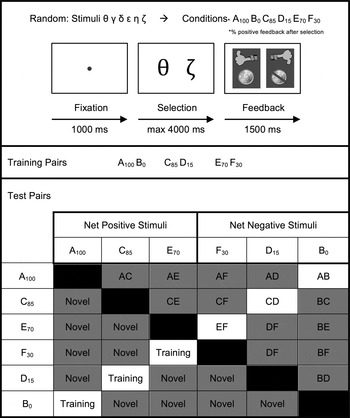
We used a child-friendly version of the extensively validated PLT (Frank et al. Reference Frank, Seeberger and O'Reilly2004) to measure feedback learning, which has successfully been used in typical developing children (van den Bos et al. Reference Van den Bos, Cohen, Kahnt and Crone2012). In the training phase, children were presented two stimuli in each trial and were instructed to select the stimulus with the greatest probability of positive feedback (Fig. 1). Three fixed pairs (AB, CD and EF) comprising six stimuli (A–F) were presented and children had to learn the associations between the stimuli and increasingly inconsistent positive and negative feedback. Feedback was consistent in the AB pair (A: 100% positive feedback; B: 100% negative feedback) and feedback was inconsistent in the CD pair (C: 85% positive and 15% negative feedback; D: 15% positive and 85% negative feedback) and the EF pair (E: 70% positive and 30% negative feedback; F: 30% positive and 70% negative feedback). Consequently, A, C and E are net positive stimuli and B, D and F are net negative stimuli, and it is increasingly difficult to learn that A is better than B, C is better than D and E is better than F. The training phase consisted of learning blocks of 60 trials with a maximum of five blocks, while children that reached above-chance-level performance in any given learning block (AB, CD and EF pair ⩾70, 65 and 60%, respectively) entered the test phase. No feedback is provided in the test phase, during which children have to select the best stimulus from all possible pair configurations of stimuli A–F (AB, AC, AD, AE, AF, BC, BD, BE, BF, CD, CE, CF, DE, DF and EF in 120 trials) based on feedback provided in the training phase.
The Probabilistic Learning Test. Stimuli are randomly assigned to conditions A–F. In the training phase, children were presented two stimuli in each trial and were instructed to select the stimulus with the greatest probability of positive feedback. Three fixed pairs (AB, CD and EF) comprising six stimuli (A–F) were presented and children had to learn the associations between the stimuli and increasingly inconsistent positive and negative feedback. No feedback is provided in the test phase, during which children have to select the best stimulus from all possible pair configurations of stimuli A–F (AB, AC, AD, AE, AF, BC, BD, BE, BF, CD, CE, CF, DE, DF and EF in 120 trials) based on feedback provided in the training phase. Shading refers to test-phase pairs with new combinations of stimuli (i.e. novel-context pairs).

Dependent variables (Table 1)
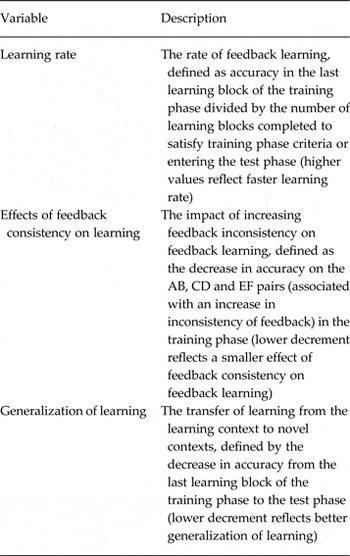
The dependent variable was accuracy defined as the proportion of correct responses (choosing stimuli A, C and E), excluding trials suspected of anticipatory responses (reaction time <200 ms). Learning rate measured the rate of feedback learning, assessed by the accuracy in the last learning block in the training phase divided by the number of learning blocks completed. The effects of feedback consistency on learning were measured by the decrease in accuracy in response to increasing feedback inconsistency in the training phase (i.e. AB, CD and EF pairs). Last, generalization of learning measured the generalization of learning from the learning context (i.e. overall accuracy on AB, CD and EF pairs in the last learning block of the training phase) to novel contexts (i.e. overall accuracy on AC, AD, AE, AF, BC, BD, BE, BF, CE, CF, DE and DF pairs in the test phase).
Overview of variables derived from the feedback learning test

Behavioral functioning
Parent and teacher ratings of behavior were obtained using the Child Behavior Checklist and teacher equivalent, the Teacher Rating Form (Verhulst & van der Ende, Reference Verhulst and van der Ende2013). The broadband scales measuring internalizing (e.g. anxiety) and externalizing problems (e.g. aggression) were used, since these scales are known to have adequate validity and excellent reliability (Cronbach's α > 0.90; Verhulst & van der Ende, Reference Verhulst and van der Ende2013).
Procedure
The families of eligible children were sent an information letter and contacted by telephone 2 weeks later. After written informed consent was provided by parents and children aged >11 years, trained examiners administered the PLT while parents filled out questionnaires in a waiting room. Thereafter, teachers were contacted to fill out questionnaires. During the PLT, children were seated in front of a 15-inch (38-cm) laptop with a 50-cm viewing distance to minimize eye movements. Standardized instructions and practice trials were used to familiarize children with the task. Task duration ranged between 15 and 25 min. This study was approved by the medical ethical committee of the VU University Medical Centre (NL37226.029.11).
Statistical analysis
All analyses were performed using SPSS version 22.0 (SPSS Inc., 2013). Missing values (1–5%) were replaced using multiple imputing (Sterne et al. Reference Sterne, White, Carlin, Spratt, Royston, Kenward, Wood and Carpenter2009; also see online Supplementary material). All dependent variables were screened for outliers (p < 0.001), which were rescaled according Tabachnick & Fidell (Reference Tabachnick and Fidell2012). To investigate group comparability, all TBI severity groups (TC, mildRF− TBI, mildRF+ TBI and moderate/severe TBI) were compared on demographics, injury-related variables, prevalence of clinical diagnoses and FSIQ using analysis of variance (ANOVA) and χ 2 tests, where appropriate.
With regard to PLT performance, we assessed successful feedback learning at the group level by testing the accuracy in all dependent variables against chance-level performance using one-sample t tests in the whole sample (H 0 = 0.5). The effect of TBI on learning rate (defined by the overall accuracy in the last learning block of the training phase divided by the number of learning blocks completed) was assessed with ANOVA, using TBI severity as the between-subject factor (TC, mildRF− TBI, mildRF+ TBI and moderate/severe TBI). We identified children who did not satisfy the training phase criteria to enter the test phase after the maximum of five learning blocks (i.e. chance-level performers) and assessed their distribution across TBI severity groups (TC, mildRF− TBI, mildRF+ TBI and moderate/severe TBI) using χ 2 testing. Chance-level performers were precluded from analyses involving the test phase, to prevent chance-level performances of contaminating analyses on generalization of learning to novel contexts in the test phase.
Two repeated-measures ANOVAs were performed on accuracy with group as the between-subject factor and the following within-subject factors: (1) effects of feedback consistency (feedback consistency with three levels: AB, CD and EF pairs across blocks in the training phase); and (2) generalization of learning (PLT phase with two levels: last learning block of the training phase v. test phase). In these analyses, the main effect of within-subject factors assessed the validity of PLT manipulations, while the interactions between TBI severity and within-subject factors assessed the selective impact of TBI on (1) effects of feedback consistency on learning and (2) generalization of learning. The impact of TBI on ratings of internalizing problems and externalizing problems was assessed using ANOVA. The main effect of TBI severity (TC, mildRF− TBI, mildRF+ TBI and moderate/severe TBI) was assessed by linear contrasts in all described factorial analyses, of which significant effects were followed-up by least significant difference (LSD) post-hoc testing. In repeated-measures analyses with significant interaction effects, the main effect of TBI severity was assessed for each level of the within-subject variable separately.
Last, we investigated the relation between feedback learning and behavior problems in children with TBI. PLT variables for which group differences were obtained were inserted as predictors of parent and teacher ratings of behavior problems for which group differences were obtained, in separate multiple linear regression models while correcting for the demographic variables age, gender and SES. To avoid suppressor effects, we used backward selection to select the most efficient prediction model (entry criterion: F > 0.05, removal criterion: F < 0.10; Field, Reference Field2009). We used receiver-operating characteristic (ROC) analysis to investigate the diagnostic utility of significant predictors for the identification of children with TBI and clinically significant behavior problems (score on relevant scale > mean+2 s.d. of the TC group) amongst all other children. All statistical testing was two-sided at α = 0.05.
Ethical standards
All procedures contributing to this work comply with the ethical standards of the relevant national and institutional committees on human experimentation and with the Helsinki Declaration of 1975, as revised in 2008.
Results
Background information
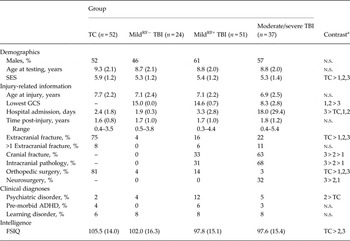
Group characteristics concerning demographics, injury-related information, clinical diagnoses and FSIQ are displayed in Table 2. There were no differences between any of the groups on demographics (p's ⩾ 0.21), except for lower SES in all TBI groups as compared with the TC group (p's < 0.05). The moderate/severe TBI group had longer hospital admission, lower GCS score and more neurosurgery than all other groups (p's ⩽ 0.001). By definition, no cranial fractures or intracranial pathology were present in the mildRF− TBI group, while the mildRF+ TBI and moderate/severe TBI groups had progressively increased prevalence of cranial fractures and intracranial pathology (p's ⩽ 0.01). Differences in the prevalence of psychiatric conditions only reached significance between the mildRF+ TBI group and TC group (p = 0.05). There was found a main effect of TBI severity on FSIQ, reflecting that more severe TBI was associated with lower FSIQ. Post-hoc analysis only revealed lower FSIQ in the mildRF+ TBI and moderate/severe TBI groups as compared with the TC group (p = 0.01, d = −0.53 and p = 0.02, d = −0.55, respectively).
Descriptive statistics of demographics, injury-related information, clinical diagnoses and FSIQ

Data are given as mean (standard deviation) unless otherwise indicated.
FSIQ, Full-scale intelligence quotient; TC, trauma control; RF, risk factor; TBI, traumatic brain injury; n.s., non-significant; SES, socio-economic status; GCS, Glasgow Coma Scale; ADHD, attention-deficit/hyperactivity disorder.
a 1 = mildRF− TBI; 2 = mildRF+ TBI; 3 = moderate/severe TBI.
Feedback learning
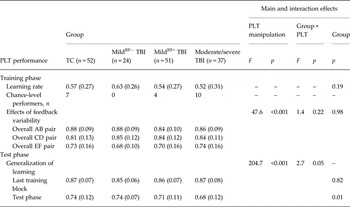
PLT performance is displayed in Table 3. Accuracy was above chance level for all PLT variables (⩾0.57, p's < 0.001), indicating successful feedback learning in the training phase and successful generalization of learning to new contexts in the test phase –at the group level.
Descriptive and inferential statistics of PLT performance

Data are given as mean (standard deviation) unless otherwise indicated.
PLT, Probabilistic Learning Test; TC, trauma control; RF, risk factor; TBI, traumatic brain injury.
Learning rate
The main effect of TBI severity on learning rate (i.e. accuracy in the last training block divided by the number of learning blocks completed in the training phase) was not significant, indicating that TBI does not affect the rate of feedback learning. At the individual level, 21 chance-level performers were identified (i.e. children that did not reach the training phase criteria). Chance-level performers were not more likely to be part of the mildRF− TBI group (n = 0), mildRF+ TBI group (n = 4) or moderate/severe TBI group (n = 10) than the TC group (n = 7; p's ⩾ 0.11). After precluding chance-level performers from subsequent analyses of PLT performance, the resulting sample did not differ from the original sample on demographics, injury-related information or FSIQ (p's ⩾ 0.52).
Effects of feedback consistency on learning
The PLT manipulation measuring the influence of feedback consistency on feedback learning was assessed by the main effect of feedback consistency in the training phase (i.e. increasing inconsistency in AB, CD and EF pairs) on accuracy. As expected, this main effect of feedback consistency was significant, validating that more inconsistent feedback affects learning. The impact of TBI on the effects of feedback consistency on learning was assessed by the interaction between TBI severity and feedback consistency on accuracy, which was not significant. Likewise, there was no main effect of TBI severity on overall accuracy in the training phase. These findings indicate that TBI did not affect feedback learning from inconsistent feedback.
Generalization of learning
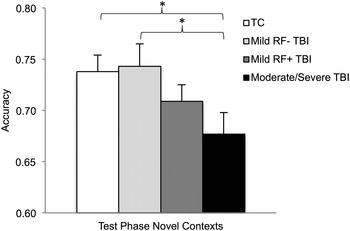
Generalization of learning from the learning context to novel contexts was assessed by the main effect of PLT phase (i.e. last learning block of the training phase v. test phase) on accuracy. According to expectations, the main effect of PLT phase was significant, reflecting a decrease in accuracy from the training phase to the test phase. This finding validates that generalization of learning occurs at the cost of accuracy. The effect of TBI on generalization of learning was assessed by the interaction between TBI severity and PLT phase on accuracy, which was significant. This finding indicates that TBI severity moderates generalization of learning. Follow-up comparisons revealed a linear effect of TBI severity on accuracy in the test phase, reflecting that more severe TBI related to poorer test phase performance. Post-hoc group comparisons (Fig. 2) revealed poorer performance in the moderate/severe TBI group than the TC group (p = 0.03, d = −0.51), and the mildRF− group (p = 0.03, d = −0.65). No effect of TBI severity on accuracy in the last learning block of the training phase was found. Together, these findings indicate that moderate/severe TBI selectively impairs generalization of learning to novel contexts.
Probabilistic Learning Test performance of traumatic brain injury (TBI) severity groups in novel contexts during the test phase. Overall accuracy is shown of TBI severity groups on test pairs with novel combinations of stimuli from the training phase, requiring generalization of learning from the learning context to novel contexts. Values are means, with standard errors represented by vertical bars. * p < 0.05. TC, Trauma control; RF, risk factor.

Behavioral functioning
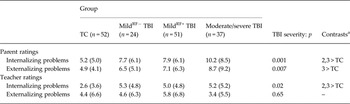
Analyses on behavioral functioning (Table 4) revealed significant linear main effects of TBI severity on parent ratings of internalizing and externalizing problems, and teacher ratings of internalizing problems, indicating that more severe TBI was associated with more behavior problems. Post-hoc group comparisons revealed no differences between the mildRF− TBI group and TC group regarding behavior ratings (p's ⩾ 0.13, d's 0.37–0.46), except for higher teacher ratings of internalizing problems in the mildRF− TBI group (p = 0.02, d = 0.69). Compared with the TC group, the mildRF+ TBI and moderate/severe TBI groups had higher parent ratings of internalizing problems (p = 0.04, d = 0.47 and p < 0.001, d = 0.75) and higher teacher ratings of internalizing problems (p = 0.008, d = 0.58 and p = 0.01, d = 0.58). In addition, the moderate/severe TBI group had higher parent ratings of externalizing problems than the TC group (p = 0.006, d = 0.60), while this difference did not reach conventional levels of significance between the mildRF+ TBI and TC groups (p = 0.08, d = 0.42).
Parent and teacher ratings of behavioral functioning

Data are given as mean (standard deviation).
TC, Trauma control; RF, risk factor; TBI, traumatic brain injury.
a 1 = mildRF− TBI; 2 = mildRF+ TBI; 3 = moderate/severe TBI.
Feedback learning and behavior problems after pediatric TBI
We investigated the predictive value of generalization of learning (i.e. accuracy for novel pairs in the test phase) for ratings of behavior (parent and teacher ratings of internalizing problems and parent ratings of externalizing problems) in the TBI group. Poorer generalization of learning significantly predicted higher parent ratings of externalizing problems (p = 0.03, β = −0.21), while SES (p = 0.003, β = −0.29) was also captured in the prediction model (p < 0.001, R 2 = 0.15). This finding indicates that poorer generalization of learning from the learning context to novel contexts after pediatric TBI relates to more externalizing problems as observed by parents. Prediction models for parent and teacher ratings of internalizing problems and teacher ratings of externalizing problems did not include PLT variables. Last, ROC analysis revealed that generalization of learning has diagnostic utility for the identification of children with TBI and clinically significant parent-rated externalizing behavior problems [mildRF− TBI: n = 1 (4%); mildRF+: n = 7 (15%); moderate/severe: n = 6 (22%)] amongst all other children (area under the curve = 0.77, p = 0.001), with a sensitivity of 86% and a specificity of 72%.
Analysis of confounders
SES was lower in all TBI groups relative to the TC group, while lower SES also related to higher behavior ratings (p's < 0.05). To investigate the influence of SES on the reported effects of mildRF+ and moderate/severe TBI on behavior ratings, we matched the TC group 1:2 to the collapsed mildRF+ TBI and moderate/severe TBI group on SES (±2; age, gender and SES: p's ⩾ 0.16), and reran the relevant analyses, replicating the reported differences (data available from the first author; M.K.).
Discussion
This study investigated feedback learning in children with mild to severe TBI in relation to post-injury behavior problems. The results show that moderate/severe TBI affects generalization of learning, reflecting impaired transfer of learning from the learning context to novel contexts. Generalization of learning further predicted higher parent ratings of externalizing problems in children with TBI, suggesting that impaired generalization of learning may contribute to behavior problems after pediatric TBI. Generalization of learning further showed diagnostic utility to identify children with TBI and clinically significant externalizing behavior problems.
Based on the existing pediatric and adult literature, we expected detrimental effects of pediatric TBI on feedback learning. Partly contrasting our expectations, we found no evidence indicating that pediatric TBI affects learning from increasingly inconsistent feedback. This finding also contradicts a previous report of impaired performance on a probabilistic reversal learning task in children with raised intracranial pressure after severe TBI (Slawik et al. Reference Slawik, Salmond, Taylor-Tavares, Williams, Sahakian and Tasker2009), possibly implicating that only very severe forms of pediatric TBI affect learning from inconsistent feedback. As expected, we found that children with moderate/severe TBI had impaired generalization of learning. This finding adds to the existing literature describing that children with severe TBI have impaired feedback-directed concept formation and set-shifting (Levin et al. Reference Levin, Song, Scheibel, Fletcher, Harward, Lilly and Goldstein1997) and that children with moderate/severe TBI have impaired decision making based on feedback in terms of gains and losses in money or points (Schmidt et al. Reference Schmidt, Hanten, Li, Vasquez, Wilde, Chapman and Levin2012). This study is the first to show that children with moderate/severe TBI have impaired ability to use feedback on behavior in a certain context to direct behavior in a novel context, which is in line with electrophysiological evidence of impaired neural processing of changing feedback contexts in adults with severe TBI (Larson et al. Reference Larson, Kelly, Stigge-Kaufman, Schmalfuss and Perlstein2007).
Analyses of daily life behavior problems revealed that children with mildRF+ TBI or moderate/severe TBI had more internalizing problems as observed by parents as well as teachers. Children with moderate/severe TBI additionally had more externalizing problems as observed by parents. These findings are in line with a recent review (Li & Liu, Reference Li and Liu2013), although it is somewhat surprising that no effects of TBI on teacher ratings of externalizing problems were observed. Possibly, externalizing problems of children with TBI specifically manifest at home, which may represent a relatively unstructured environment as compared with school. Interestingly, our results indicate that increased parent ratings of externalizing problems in children with TBI were predicted by impaired generalization of learning, suggesting that impaired ability to generalize feedback to novel contexts may contribute to the development of conflict-prone behavior (i.e. externalizing problems) after TBI. This idea is supported by the suggested involvement of fronto-striatal networks in both feedback learning (Maia & Frank, Reference Maia and Frank2011; Hämmerer & Eppinger, Reference Hämmerer and Eppinger2012) and the emergence of disturbing behavior after pediatric TBI (Max et al. Reference Max, Wilde, Bigler, Thompson, MacLeod, Vasquez, Merkley, Hunter, Chu, Yallampalli, Hotz, Chapman, Yang and Levin2012; Li & Liu, Reference Li and Liu2013). ROC analyses further revealed that generalization of learning has good sensitivity (86%) and reasonable specificity (72%) to identify children with TBI and clinically significant externalizing behavior problems. This finding suggests that early assessment of feedback learning after TBI may identify children at risk of developing behavior problems later in life, although this hypothesis awaits confirmation in a longitudinal investigation.
The findings from our study suggest that generalization of learning is more vulnerable to the effects of TBI than learning from inconsistent feedback, implicating that differential neural (sub)networks underlie these aspects of feedback learning. This idea is supported by a review suggesting that feedback learning is facilitated by dynamic interplay between feedback information processing in a ventral fronto-striatal network (i.e. the reward loop) and executive processes that translate feedback history into behavior in a dorsal fronto-striatal network (i.e. the executive control loop; Hämmerer & Eppinger, Reference Hämmerer and Eppinger2012). The literature further suggests that learning from inconsistent feedback is mediated by the reward loop (van den Bos et al. Reference Van den Bos, Cohen, Kahnt and Crone2012), while processing of feedback context has been associated with brain areas in the executive control loop (Gläscher et al. Reference Gläscher, Daw, Dayan and O'Doherty2010). We speculate that the observed vulnerability of generalization of learning to the effects of moderate/severe TBI may arise from the relatively late maturation of prefrontal brain areas involved in executive control loop (i.e. in adulthood; Gogtay et al. Reference Gogtay, Giedd, Lusk, Hayashi, Greenstein, Vaituzis, Nugent, Herman, Clasen, Toga, Rapoport and Thompson2004) as compared with the reward loop (i.e. in late childhood; van den Bos et al. Reference Van den Bos, Cohen, Kahnt and Crone2012). The absence of effects of mild TBI on feedback learning in this study, relative to the observed effects of moderate/severe TBI, may be explained by the outcome of two meta-analyses of diffusion tensor imaging studies indicating that frontal white matter damage is not implicated in the neuropathology of mild TBI (Aoki et al. Reference Aoki, Inokuchi, Gunshin, Yahagi and Suwa2012), but is implicated in more severe TBI (Roberts et al. Reference Roberts, Mathias and Rose2014).
This study has some weaknesses. We used a highly standardized computer environment to model feedback learning, which allowed us to isolate the effects of feedback consistency and context on learning, but may not directly translate to feedback learning in daily life. However, we did show that generalization of learning was related to daily life behavior problems as observed by parents. Further, the small sample size of the mildRF− TBI group limited statistical power in comparisons involving this group. Strengths of this study include the recruitment from a multicenter consecutive cohort (increasing the generalizability of the results) and the use of a TC group (controlling for the effects of pre-injury trauma risk factors and psychological effects of hospitalization).
To our best knowledge, this study is the first to report evidence suggesting that impaired generalization of learning may underlie the increased prevalence of externalizing behavior problems after pediatric TBI. This finding is important given that externalizing behavior problems in childhood predict poor academic attainment (Breslau et al. Reference Breslau, Miller, Breslau, Bohnert, Lucia and Schweitzer2009), poor social functioning (Bongers et al. Reference Bongers, Koot, van der Ende and Verhulst2008) and delinquency (Broidy et al. Reference Broidy, Nagin, Tremblay, Bates, Brame, Dodge, Fergusson, Horwood, Loeber, Laird, Lynam, Moffitt, Pettit and Vitaro2003) later in life. Early assessment of feedback learning may have the potential to identify children who could benefit from rehabilitation interventions to prevent the emergence of externalizing behavior problems after TBI.
Supplementary material
For supplementary material accompanying this paper visit http://dx.doi.org/10.1017/S0033291716000106
Acknowledgements
This work was supported by the Netherlands Organization for Scientific Research (NWO), grant number 022.003.010.
We are very grateful to Hugo Heij (M.D., Ph.D.) and Johannes A van der Sluijs (M.D., Ph.D.) for their assistance in the recruitment of participants for this study.
Declaration of Interest
None.