Introduction
The occurrence of a psychiatric disorder at one point in time tends to increase the risk of other disorders at a later point. In a recent Dutch cohort study, for example, behavioral disorders in adolescence were strongly related to substance dependence at 8-year follow-up [hazard ratio = 4.90, 95% confidence interval (CI) 3.32–7.23] (Reference Ormel, Raven, van Oort, Hartman, Reijneveld, Veenstra, Vollebergh, Buitelaar, Verhulst and Oldehinkel b35 Ormel et al. 2015). This general phenomenon is often referred to as heterotypic continuity (Copeland et al. Reference Copeland, Shanahan, Costello and Angold2009, Reference Copeland, Adair, Smetanin, Stiff, Briante, Colman, Fergusson, Horwood, Poulton, Costello and Angold2013; Lahey et al. Reference Lahey, Zald, Hakes, Krueger and Rathouz2014). Despite its intuitive appeal, the concept of heterotypic continuity has been used to describe two distinctly different phenomena. Heterotypic continuity sometimes is used to indicate that the persistence of one disorder tends to increase the probability of a second disorder. On other occasions, however, it is used to indicate that remission of the first disorder is related to the emergence of a second disorder. This second conceptualization is particularly common in the addiction literature where patients are often described who recover from one addiction only to initiate a second or new addiction (Shaffer et al. Reference Shaffer, LaPlante, Labrie, Kidman, Donator and Stanton2004; Sussman & Black, Reference Sussman and Black2008; Peters & Hughes, Reference Peters and Hughes2010). A third possibility, that to our knowledge has never been tested, is that remission of a disorder is unrelated to the probability of new disorder onset.
The distinction between these different concepts of heterotypic continuity is important because the first one suggests that the ongoing presence of one disorder increases vulnerability for other disorders and thus, remission of the first disorder may be associated with lower odds of onset of subsequent disorders. By contrast, the second conceptualization suggests that the two disorders are linked by a shared underlying process and that remission of one disorder is of limited clinical significance because the underlying process will simply become expressed through the new onset (incidence) or new episode (recurrence) of another disorder. The third conceptualization would imply that the course of one disorder is generally unrelated to the course of others.
Testing these three concepts of heterotypic continuity could lead to a greater understanding of whether remission from one psychiatric disorder increases or decreases the probability of new onsets of other disorders and help inform the underlying etiological relationships among disorders, treatment development and clinical management (Insel et al. Reference Insel, Cuthbert, Garvey, Heinssen, Pine, Quinn, Sanislow and Wang2010; National Academy of Sciences, 2011; Cuthbert, Reference Cuthbert2014). If remission of one disorder is associated with new onset of others disorders, common treatment-resistant underlying pathological mechanisms may be operating and clinicians should closely monitor for the emergence of related symptoms, patients should be forewarned of their vulnerability to these new symptoms as they recover from their initial symptoms, and clinical trials should systematically evaluate the emergence of new psychopathology. If remission from one psychiatric disorder is associated with lower odds of new onset disorders, it would broaden interest in research and clinical opportunities to develop, test, and implement trans-diagnostic interventions aimed at the shared treatment-sensitive factors across psychiatric disorders. If remission of one disorder is unrelated to the course of other disorders, this result would challenge current conceptualizations of co-morbidity.
Existing research on heterotypic continuity has focused on using baseline disorders to predict future disorders, but has not compared predictions of the three competing concepts of heterotypic continuity. For example, a recent study examined whether disorders at baseline predicted disorders 3 years later, but did not examine whether the association was due to persistence or remission of disorders (Lahey et al. Reference Lahey, Zald, Hakes, Krueger and Rathouz2014), therefore not testing competing conceptualizations of heterotypic continuity. Longitudinal epidemiological research provides opportunities to test them by examining relationships between disorder remission and risk of new disorder onsets and episodes. In a recent analysis, we found that individuals who remitted as compared with those who did not remit from a substance use disorder (SUD) had a lower risk of new onset SUDs 3 years later (Blanco et al. Reference Blanco, Okuda, Wang, Liu and Olfson2014a ). This study, however, did not test broader patterns of heterotypic continuity, such as whether remission from SUDs was associated with increased, decreased, or no change in risk of new onsets and episodes of mood and anxiety disorders or whether remission from mood or anxiety disorders was associated with increased or decreased risk of new onset and episodes of mood, anxiety or SUDs.
The present study tests competing conceptualizations of heterotypic continuity using data from the National Epidemiologic Survey on Alcohol and Related Conditions (NESARC). Based on our previous work, we hypothesized that over a 3-year period, remission from a mood, anxiety or SUD, compared with persistence of that disorder would tend to: (1) decrease the new onset of disorders within the same class; (2) decrease the incidence of disorders from different classes; and (3) decrease the incidence of disorders within the same class to a greater extent than from different classes.
Method
Sample
Data were drawn from waves 1 and 2 of the NESARC (Ruan et al. Reference Ruan, Goldstein, Chou, Smith, Saha, Pickering, Dawson, Huang, Stinson and Grant2008). The target population of the NESARC was the civilian non-institutionalized population 18 years and older residing in households and group quarters (Grant et al. Reference Grant, Goldstein, Chou, Huang, Stinson, Dawson, Saha, Smith, Pulay, Pickering, Ruan and Compton2009). Blacks, Hispanics and adults 18–24 were oversampled, with data adjusted for oversampling, and household- and person-level non-response. Excluding respondents who were ineligible for the wave 2 interview (e.g. deceased), the wave 2 response rate was 86.7%, resulting in 34 653 completed interviews (Ruan et al. Reference Ruan, Goldstein, Chou, Smith, Saha, Pickering, Dawson, Huang, Stinson and Grant2008). Sample weights were developed to adjust for wave 2 non-response. The mean interval between wave 1 and 2 interviews was 36 (s.e. = 2.6) months (Grant et al. Reference Grant, Goldstein, Chou, Huang, Stinson, Dawson, Saha, Smith, Pulay, Pickering, Ruan and Compton2009).
We divided the study sample into two mutually exclusive groups by psychiatric status at each wave. The first group comprised all individuals with at least one current (past 12 months) psychiatric disorder at wave 1 who did not remit from any disorder at wave 2 (n = 3435), whereas the second group included all individuals with at least one current disorder at wave 1 who had remitted at wave 2 (n = 6719).
Assessment
Sociodemographic measures included sex, race–ethnicity, nativity, marital status and education, measured as categorical variables. Age at the time of the wave 1 interview was measured as a continuous variable.
The Alcohol Use Disorder and Associated Disabilities Interview Schedule-DSM-IV version (AUDADIS-IV) (Grant et al. Reference Grant, Dawson, Stinson, Chou, Kay and Pickering2003), a structured diagnostic interview, was used to generate current (12-month) DSM-IV diagnoses based on computer algorithms. In waves 1 and 2, extensive AUDADIS-IV questions covered DSM-IV SUDs (alcohol abuse and dependence, drug abuse and dependence, and nicotine dependence), mood disorders (major depressive disorder, dysthymia and bipolar disorder) and anxiety disorders (panic disorder, social anxiety disorder, specific phobia and generalized anxiety disorder). The test–retest reliability of AUDADIS-IV measures of DSM-IV diagnoses is good for major depressive disorder (κ = 0.65–0.73) and good to excellent for SUDs (κ > 0.74). Reliability is fair to good for other mood and anxiety disorders (κ = 0.40–0.60) (Grant et al. Reference Grant, Harford, Dawson, Chou and Pickering1995; Chatterji et al. Reference Chatterji, Saunders, Vrasti, Grant, Hasin and Mager1997; Hasin et al. Reference Hasin, Carpenter, McCloud, Smith and Grant1997; Canino et al. Reference Canino, Bravo, Ramirez, Febo, Rubio-Stipec, Fernandez and Hasin1999; Ruan et al. Reference Ruan, Goldstein, Chou, Smith, Saha, Pickering, Dawson, Huang, Stinson and Grant2008). An extensive body of work (reviewed in Hasin & Grant, Reference Hasin and Grant2015) has documented the antecedent (e.g. family history, history of childhood maltreatment), concurrent (e.g. quality of life, co-morbidity) and predictive (e.g. risk of suicide attempt, changes in quality of life) validity of AUDADIS diagnoses.
Remission and new onset of disorders
Individuals were considered to have remitted from a disorder at wave 2 if they met DSM-IV criteria for that disorder in wave 1, but not in wave 2 (Blanco et al. Reference Blanco, Okuda, Wang, Liu and Olfson2014a ). Having a new disorder was defined as having a disorder at wave 2 among individuals who had no lifetime history of that disorder at wave 1 (incidence) while new episodes were defined among individuals who had a lifetime history but no current disorder in wave 1 (recurrence). For SUDs, individuals who met criteria for abuse of one substance at wave 1 and criteria for dependence on that substance at wave 2 were considered to have a new onset SUD, whereas individuals who met criteria for dependence at wave 1 and abuse but not dependence on that substance at wave 2 were not considered to have remitted from dependence.
Statistical analyses
Weighted means, frequencies and odds ratios (ORs) of sociodemographic correlates and prevalence of psychiatric disorders at wave 1 were computed, stratified by remission status at wave 2. ORs are considered significant if their 95% CIs do not include 1. Adjusted ORs (AORs) derived from multiple logistic regressions were used to examine associations of sociodemographic correlates, type of disorder, and number of co-morbid psychiatric disorders at baseline and type and number of lifetime disorders at baseline with the probability of remission of at least one disorder.
To examine whether remission of a disorder was associated with increased risk of new onset of another disorder, we conducted three complementary analyses. We first examined the general question of whether remission of at least one disorder was associated with a change in the odds of new onset of any psychiatric disorder. We next examined the more specific question of whether remission of one disorder (e.g. alcohol dependence) was associated with a change in the odds of new onset of another disorder within the same class (e.g. nicotine dependence) or from another class (e.g. a mood disorder). We examined whether there was a consistent pattern indicating that remissions of disorders in one class were associated with lower odds of new episodes in that same class than in another class. We further examined whether this pattern held also across most individual disorders, suggesting a general phenomenon, or restricted to a limited number of disorders. To examine whether our results varied by age, we repeated our analyses partitioning the sample into those 35 years and younger and those older than 35 years. All standard errors and 95% CIs were estimated using SUDAAN to adjust for design characteristics of the survey (Research Triangle Institute, 2008).
Results
Predictors of remission
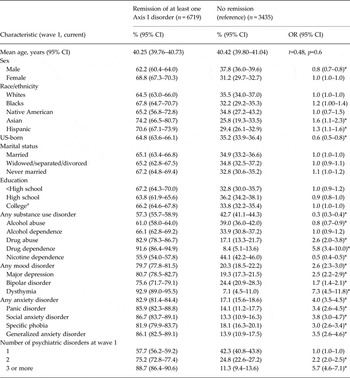
Individuals who were Asian or Hispanic, had drug abuse or dependence, any mood or anxiety disorder and had more than one Axis I diagnoses were more likely to remit from at least one disorder. By contrast, being male or US-born, and having alcohol abuse or nicotine dependence at wave 1 was associated with lower probability of remission of at least one disorder (Table 1).
Sociodemographic characteristics and psychiatric disorders at wave 1 of individuals with and without remission of at least one Axis I disorder at wave 2 of the NESARC

Data are given as percentage or OR (95% CI) unless otherwise indicated.
NESARC, National Epidemiologic Survey on Alcohol and Related Conditions; CI, confidence interval; OR, odds ratio.
a Reference group.
* Results are significant (p < 0.05).
Incidence and recurrence of individual disorders by remission status
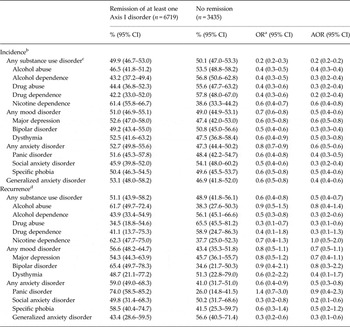
Individuals who remitted from at least one disorder had lower odds of having an incident disorder of all Axis I disorders assessed. These results held after adjusting for age, sex and number of disorders in wave 1. In both the unadjusted and adjusted results, remission from alcohol dependence (OR 0.4, 95% CI 0.3–0.5; AOR = 0.3, 95% CI 0.2–0.4) and drug dependence (OR 0.4, 95% CI 0.3–0.6; AOR = 0.2, 95% CI 0.2–0.4) was associated with the lowest odds of incidence of another disorder (Table 2, top panel). When looking at recurrence, seven out of 15 ORs examined reached statistical significance, but all ORs (except for panic disorder) were numerically below 1. Results did not change after adjusting for age, sex, number of current disorders in wave 1, number of lifetime disorders in wave 1, age of onset of wave disorders and number of episodes of the disorders. Social anxiety disorder was associated with the lowest adjusted odds of recurrence (AOR = 0.2, 95% CI 0.1–0.6) (Table 2, bottom panel).
Incidences of psychiatric disorders at wave 2 of individuals with and without remission of at least one Axis I disorder at wave 2 of the NESARC

NESARC, National Epidemiologic Survey on Alcohol and Related Conditions; CI, confidence interval; OR, odds ratio; AOR, adjusted odds ratio.
a ORs are considered significant at p < 0.05 if their 95% CIs do not include 1.
b AOR for incidence is adjusted for age, sex, number of past-year disorders and number of lifetime disorders at wave 1.
c Results are presented as row percentage.
d AOR for recurrence is adjusted for age, sex, number of wave 1 past-year disorders, number of wave 1 lifetime disorders, age of onset of wave 1 index disorder, and number of episodes of wave 1 index disorder.
Incidence and recurrence of disorders by type of remitted disorder
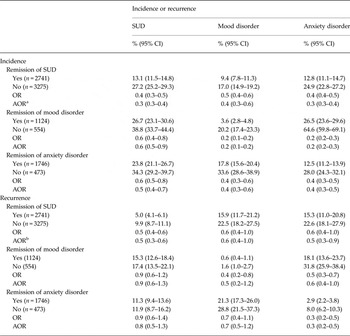
Remission of a mood, anxiety or SUD was associated with the lower odds of incidence and recurrence of all three groups of disorders. For incident disorders, these results held after adjusting for age, sex, number of past-year disorders at wave 1 and number of wave 1 lifetime disorders. For recurrent disorders, they held after additionally adjusting for age of onset of wave 1 disorder and number of wave 1 disorders. In all six comparisons in both the unadjusted and adjusted analyses, there was a clear pattern in which remission of one disorder was associated with lower odds of incidence of disorder within the same group than within the other groups. For example, remission of an SUD was associated with a lower odds of incidence of an SUD (OR 0.4) than with a mood (OR 0.5) or anxiety disorder (OR 0.4). Similarly, remission of an anxiety disorder was associated with lower odds of incidence of an anxiety disorder (OR 0.4) than with an SUD (OR 0.6) or a mood disorder (OR 0.4). When recurrence was the outcome measure in the analysis, in all six comparisons in both the unadjusted and adjusted analyses, remission of one disorder was associated with lower odds of recurrence of disorder within the same group than within the other groups (Table 3).
Incidence and recurrence of classes of disorders at wave 2 of the NESARC by remission status

NESARC, National Epidemiologic Survey on Alcohol and Related Conditions; SUD, substance use disorder; CI, confidence interval; OR, odds ratio; AOR, adjusted odds ratio.
a AOR for incidence is adjusted for age, sex, number of past-year disorders and number of lifetime disorders at wave 1.
b AOR for recurrence is adjusted for age, sex , number of wave 1 past-year disorders, number of wave 1 lifetime disorders, age of onset of wave 1 index disorder, and number of episodes of wave 1 index disorder.
Pairwise associations of remission and incidence of disorders of individual disorders
Examination of the pairwise associations at the individual disorder level (i.e. remission of one individual disorder and incidence of another) revealed an overall pattern similar to the associations at the group level. Of the 126 pairwise associations that could be estimated, 110 had ORs smaller than 1 and 16 had ORs greater than 1. Of the ORs smaller than 1, 61 reached statistical significance, whereas none of the 16 ORs larger than 1 reached statistical significance. This pattern of results remained unchanged after adjusting for age, sex and number of baseline disorders (online Supplementary Table S1). When using recurrence as the outcome measure, 90 of the 121 pairwise comparisons that could be estimated had ORs lower than 1 and, of those 90, 19 were statistically significant. By contrast, only 21 were greater than 1 and only one was significant (online Supplementary Table S2). Among the pairwise associations, the lowest odds were between remission of drug dependence and recurrence of drug abuse (OR 0.01, 95% CI 0.00–0.04), whereas the highest was between remission of drug dependence and recurrence of social anxiety disorder (OR 55.6, 95% CI 1.12–2764.9).
Discussion
In a large, nationally representative sample of adults, remission as compared with persistence of a psychiatric disorder was associated with decreased odds of incidence and, to a lesser extent, recurrence of other disorders. This pattern held for disorders within the same class as well as for disorders within other classes, and at the level of individual disorders even after adjusting for sociodemographic characteristics, number of disorders at baseline, and number of lifetime disorders. Furthermore, remission of a disorder in one class was more strongly associated with decreased incidence of disorders within that class than across other classes. Taken together, these findings suggest conceptualizing heterotypic continuity as a phenomenon in which one disorder replaces or is the consequence of the remission of another may have limited clinical, epidemiological and etiological utility.
To our knowledge, our study is the first to document that remission of a mental disorder tends to decrease the risk of new onset disorders across a broad range of disorders. In a previous study, we showed that individuals who remit from an SUD were at decreased risk for a new SUD (Blanco et al. Reference Blanco, Okuda, Wang, Liu and Olfson2014a ). The current results generalize these findings to a broader range of disorders and demonstrate that the protective effects of remission are not limited to disorders within the same class, but rather extend to psychiatric disorders in other classes. Clinical improvement in one disorder appears to increase the likelihood of improvement in other disorders, rather than lead to new psychiatric vulnerabilities.
Our results are consistent with clinical experience and research suggesting that treatment of one disorder often leads to spill-over improvements in other symptom domains, even when treatments are disorder-specific (Nunes & Levin, Reference Nunes and Levin2004; Hien et al. Reference Hien, Jiang, Campbell, Hu, Miele, Cohen, Brigham, Capstick, Kulaga, Robinson, Suarez-Morales and Nunes2010; Kushner et al. Reference Kushner, Krueger, Wall, Maurer, Menk and Menary2013). From a clinical perspective, our results suggest that the breadth of benefit from existing interventions is easily underestimated. Our findings help discriminate between competing conceptualizations of heterotypic continuity by indicating that disorders are not associated with each other over time because one emerges when the other remits but rather because they often converge in the timing of their clinical presentation (Blanco et al. Reference Blanco, Krueger, Hasin, Liu, Wang, Kerridge, Saha and Olfson2013).
Several possible mechanisms may help to explain why remission from one disorder is associated with decreased likelihood of new onsets of other disorders. First, remission from one disorder may decrease external or interpersonal precipitants that might have otherwise increased the risk of new onset disorders (Hodgins et al. Reference Hodgins, Elguebaly and Armstrong1995; Hasin et al. Reference Hasin, Fenton, Skodol, Krueger, Keyes, Geier, Greenstein, Blanco and Grant2011; Wichers et al. Reference Wichers, Maes, Jacobs, Derom, Thiery and Kendler2012). Second, remission of mood or anxiety disorders may decrease the subjective need of some individuals to consume substances to relieve symptoms of those disorders, leading to lower risk of new onset SUDs (Robinson et al. Reference Robinson, Sareen, Cox, Bolton and Invest2011; Blanco et al. Reference Blanco, Alegría, Liu, Secades-Villa, Sugaya, Davies and Nunes2012; Magidson et al. Reference Magidson, Lejuez, Liu and Blanco2012; Martins et al. Reference Martins, Fenton, Keyes, Blanco, Zhu and Storr2012). Conversely, decreased substance use may lower the likelihood of new onset of substance-induced mood or anxiety disorders (Robinson et al. Reference Robinson, Sareen, Cox, Bolton and Invest2011; Blanco et al. Reference Blanco, Rubio, Wall, Wang, Jiu and Kendler2014b ). Third, reductions in stress levels or adoption of a healthier lifestyle may contribute to remission of one disorder and protect against new onset of other mental disorders (Brady & Sinha, Reference Brady and Sinha2005; Blanco et al. Reference Blanco, Rubio, Wall, Wang, Jiu and Kendler2014b ). Fourth, newly acquired psychological coping skills that contribute to remission from one disorder may reduce the risk of new onsets of other disorders (Breslau et al. Reference Breslau, Peterson, Schultz, Andreski and Chilcoat1996; Agosti & Levin, Reference Agosti and Levin2009). For example, cognitive–behavioral skills learned for one set of cognitions or behaviors can be generalized to others (Dobson, Reference Dobson2013; Hofmann et al. Reference Hofmann, Asmundson and Beck2013). Fifth, studies of the structure of psychiatric disorders suggest that the course of individual disorders is at least partially determined by changes in their overall underlying liabilities. Decreases in those liabilities over time should contribute to remission of disorders decreasing the probability of new onset of other disorders. The fact that our results were stronger for incidence than for recurrence suggests that these mechanisms appear to operate more strongly for incident than for recurrent disorders or that, once individuals have suffered from a disorder, they create specific vulnerabilities for that disorder that increase their chances of relapse.
A second novel finding of our study was that with remission of one disorder, the decreased incidence of other disorders was stronger within than across disorder classes. Factors that account for high co-morbidity within disorder classes (Kendler et al. Reference Kendler, Prescott, Myers and Neale2003, Reference Kendler, Aggen, Knudsen, Roysamb, Neale and Reichborn-Kjennerud2011) may help to account for why remission from one disorder more strongly diminishes the risk of more than less closely related disorders. For example, changes in lifestyles related to remission of drug use disorders have been correlated with decreased onset of nicotine dependence (Hasin et al. Reference Hasin, Fenton, Skodol, Krueger, Keyes, Geier, Greenstein, Blanco and Grant2011; Lopez-Quintero et al. Reference Lopez-Quintero, Perez de los Cobos, Hasin, Okuda, Wang, Grant and Blanco2011). Similarly, cognitive skills that facilitate remission of one anxiety disorder may increase resilience against other anxiety disorders (Dobson, Reference Dobson2013; Hofmann et al. Reference Hofmann, Asmundson and Beck2013).
Although in some cases, such as the association between remission of alcohol abuse and new onset of dysthymia and, conversely, remission of dysthymia and new onset of alcohol abuse, the odds of association were numerically greater than 1, there were no cases in which remission of one disorder was associated with a significantly increased incidence of another disorder. These findings indicate that while anecdotal observations based on individual patients may suggest that remission of one disorder leads to new onset of another disorder, these associations do not hold true at the population level, and thus may not represent true heterotypic continuity. Our results converge with existing recommendations cautioning against drawing general conclusions based on a limited number of selected and uncontrolled cases (Blanco et al. Reference Blanco, Olfson, Goodwin, Ogburn, Liebowitz, Nunes and Hasin2008; Vesga-López et al. Reference Vesga-López, Blanco, Keyes, Olfson, Grant and Hasin2008; Tusahg et al. Reference Tusahg, Tohen and Jones2011) and suggest the need to balance clinical observation and personalized treatment with findings from population-based studies and the provision of evidence-based treatments (National Academy of Sciences, 2011; Mirnezami et al. Reference Mirnezami, Nicholson and Darzi2012).
Our study has several limitations. First, information was based on self-report and did not include corroboration by collateral informants. Second, although the diagnostic assessment was extensive, it was not exhaustive. Third, the follow-up period was limited to an adult sample. Different patterns might emerge in younger samples. Fourth, the study did not collect information on the date of the onset and offset of episodes during the follow-up, which may limit generalizability of these findings to clinical populations. Fifth, two of the 12 disorders examined (alcohol dependence, OR 1.2, 95% CI 1.0–1.4 and dysthymia, OR 1.3, 95% CI 1.0–1.6) were associated with increased probability of wave 2 attrition, which may have partially biased the results. However, the prevalence of wave 2 disorders in this sample was similar in both waves, ranging from a decrease of 0.2% in social anxiety disorder (2.8% v. 2.5%) to an increase of 2.4% in alcohol abuse (18.8 to 21.2%), suggesting that remission did not simply represent a change in response style. Sixth, the follow-up period was limited to 3 years. It is possible that longer follow-up periods might have resulted in different patterns of results, including greater rates of substitution. Finally, we did not distinguish spontaneous from treatment-related remissions which may be associated with different patterns of protecting against new disorder onsets.
In conclusion, our findings indicate that remission of one disorder tends to decrease the risk of new onset of other psychiatric disorders both within and outside the same class of disorders. These findings do not support a conceptualization of heterotypic continuity as the substitution of one disorder for another over time. Although our understanding of the underlying neurobiology remains incomplete, achieving remission of one psychiatric disorder appears to be associated with current and future mental health benefits across a broad range of psychopathological domains. This pattern supports efforts to develop and test interventions that target underlying etiological factors that are shared across related psychiatric disorders.
Supplementary material
The supplementary material for this article can be found at https://doi.org/10.1017/S003329171700054X
Acknowledgements
The NESARC was sponsored by the National Institute on Alcohol Abuse and Alcoholism (NIAAA) and funded, in part, by the Intramural Program, NIAAA, National Institutes of Health. The views and opinions expressed in this report are those of the authors and should not be construed to represent the views of any of the sponsoring organizations, agencies or the US government. Work on this manuscript was supported by Agency for Healthcare Research and Quality Grant U18 HS021112 (M.O.) and the New York State Psychiatric Institute (C.B., M.O. and M.M.W.). The sponsors had no additional role in the design and conduct of the study; collection, management, analysis, and interpretation of the data; and preparation, review, or approval of the manuscript. S.W. had full access to all of the data in the study and takes responsibility for the integrity of the data and the accuracy of the data analysis.
Declaration of Interest
None.