Introduction
Depression has been shown to be an independent risk factor for incident CVD in older adults (Ariyo et al., Reference Ariyo, Haan, Tangen, Rutledge, Cushman, Dobs and Furberg2000). It has been suggested that the unfavorable effect of depression on CVD risk is partly mediated by unhealthy behaviors, such as smoking and low physical activity, that are often present in depressed individuals (Ariyo et al., Reference Ariyo, Haan, Tangen, Rutledge, Cushman, Dobs and Furberg2000, Strine et al., Reference Strine2008). Furthermore, depression has been associated with an increased risk of other cardiovascular risk factors such as hypertension and DM (Mezuk et al., Reference Mezuk, Eaton, Albrecht and Golden2008; Meng et al., Reference Meng, Chen, Yang, Zheng and Hui2012), which may in turn increase the risk of CVD.
The association of depression with vascular disease is consistent with the “vascular depression” hypothesis (Alexopoulos et al., Reference Alexopoulos, Meyers, Young, Campbell, Silbersweig and Charlson1997). Recently, we however found that a separate motivational cluster consisting of apathy-like symptoms, that has been repeatedly identified within the GDS-15 (Mitchell et al., Reference Mitchell, Mathews and Yesavage1993; Ligthart et al., Reference Ligthart2012), strongly increases the risk of incident CVD in community-dwelling older individuals. This was not the case for mood symptoms as assessed by the remaining items of the GDS-15 (Eurelings et al., Reference Eurelings, Ligthart, Van Dalen, Moll van Charante, Van Gool and Richard2014). These findings are in line with the “vascular apathy” hypothesis, which was proposed earlier based on a cross-sectional association of apathy symptoms with a history of CVD and stroke and the finding that individuals with vascular disease were at higher risk of developing apathy but not depression (van der Mast et al., Reference Van der Mast2008). The existence of a separate apathy dimension within the GDS-15, next to a dimension that represents mood symptoms, is congruent with the somatic-affective and cognitive-affective clusters that have been identified within the Beck Depression Inventory (BDI) (Marijnissen et al., Reference Marijnissen2011). Several studies in patients with heart disease have shown that particularly the somatic-affective component of the BDI is associated with adverse cardiovascular outcomes (de Miranda Azevedo et al., Reference De Miranda Azevedo, Roest, Hoen and de Jonge2014). This is in line with our finding of a unique association between the apathy cluster as identified from the GDS-15 and an increased risk of incident CVD (Eurelings et al., Reference Eurelings, Ligthart, Van Dalen, Moll van Charante, Van Gool and Richard2014).
The differential longitudinal effects of apathy and mood symptoms on CVD risk support the notion that the two sets of symptoms need to be distinguished. Although apathy, which is mainly characterized by motivational impairment (Robert et al., Reference Robert2009), can occur in the context of depression, a substantial body of literature suggests that it is distinct from depression and that it can exist as a discrete behavioral syndrome, both in patients with neurodegenerative diseases, as well as in healthy older individuals (Marin et al., Reference Marin, Firinciogullari and Biedrzycki1993; Reference Marin, Firinciogullari and Biedrzycki1994; Levy et al., Reference Levy1998; Landes et al., Reference Landes, Sperry and Strauss2005; Onyike et al., Reference Onyike2007). Apathy can be distinguished from depression by diminished motivation in the absence of concomitant dysphoric symptoms, including feelings of sadness, worthlessness, and hopelessness (Marin et al., Reference Marin, Firinciogullari and Biedrzycki1993; Levy et al., Reference Levy1998). The differentiation between both constructs may not only be important from a conceptual point of view, but also from a clinical perspective, since different treatments and prognosis apply (Levy et al., Reference Levy1998; Landes et al., Reference Landes, Sperry and Strauss2005).
The mechanisms by which apathy symptoms increase CVD risk are not yet understood. Apathy symptoms may, more so than mood symptoms, induce unhealthy behaviors, such as physical inactivity, and other cardiovascular risk factors, given that lack of self-motivation and diminished goal-directed behavior are core features of apathy (Robert et al., Reference Robert2009). These cardiovascular risk factors could mediate the association of apathy symptoms with CVD risk. The present study explores whether apathy symptoms as identified from the GDS-15 and the remaining mood symptoms are differentially associated with cardiovascular risk factors and whether these risk factors act as mediators in the relationship with incident CVD. This way potential targets for CVD prevention could be identified. SEM was used to quantify both the mediating role of cardiovascular risk factors in the relationship of apathy and mood symptoms with incident CVD (indirect effects), as well as the unique contribution of both apathy and mood symptoms to incident CVD over and above what cardiovascular risk factors explain (direct effects) (Figure 1).
Conceptual model for relationships between baseline apathy and mood symptoms, cardiovascular risk factors, and incident cardiovascular disease after two years of follow-up. Age, gender, and level of education are included as covariates for all endogenous variables and are correlated with apathy and mood symptoms (not shown). Error terms of all cardiovascular risk factors are correlated with each other (not shown). BMI: body mass index.

Methods
Participants
The study sample consisted of 1,802 participants of the Prevention of Dementia by Intensive Vascular Care (preDIVA) trial without previous CVD or stroke and who completed the two-year follow-up interview. A complete overview of selection of these participants has been described previously (Eurelings et al., Reference Eurelings, Ligthart, Van Dalen, Moll van Charante, Van Gool and Richard2014). In addition, four participants who did not complete the two-year follow-up interview due to a cardiovascular death within two years after randomization were added to the 1,802 participants, resulting in 1,806 participants for analysis.
The preDIVA study (ISRCTN29711771) is an ongoing, cluster-randomized trial carried out in primary care to assess the efficacy of nurse-led, multi-component intensive vascular care with incident dementia and disability as primary endpoints. Secondary outcomes are mortality, cognitive decline, depression, incident stroke/transient ischemic attack (TIA), and incident CVD (including myocardial infarction, angina pectoris, and peripheral arterial disease). The full details of the preDIVA study design have been published elsewhere (Richard et al., Reference Richard2009). In brief, all individuals in participating general practitioner (GP) practices aged 70–78 years, without dementia and able to visit their primary care practice, were eligible for inclusion. Individuals with a condition assumed to impede a successful long term follow-up (e.g. terminal illness, alcoholism) were excluded by their GP. From May 2006 to March 2009, 3,533 community-dwelling elderly were included, reflecting a participation rate of 53.3%. Follow-up measurements are taken at two, four, and six years. Ethical approval was obtained from the Medical Ethics Committee of the Academic Medical Center, Amsterdam. Participants gave written informed consent before enrollment. For the present analyses the study sample is considered as a cohort, irrespective of randomization group.
Assessment of apathy and mood symptoms
At baseline, demographic characteristics (age, gender, and level of education (<7 years, 7–12 years, and >12 years)) were assessed. Participants were screened for baseline apathy and mood symptoms with the GDS-15 (Lesher and Berryhill, Reference Lesher and Berryhill1994). A principal component analysis of the GDS-15 has shown that a three item apathy sub-domain can be identified (along with a subdomain representing general depressive affect and a subdomain representing life satisfaction) (Mitchell et al., Reference Mitchell, Mathews and Yesavage1993). This apathy factor was replicated in a principal component analysis performed within the preDIVA baseline data (Ligthart et al., Reference Ligthart2012). The apathy items are: (1) Have you dropped many of your activities and interests?; (2) Do you prefer to stay at home, rather than going out and doing new things?; and (3) Do you feel full of energy? (reverse-coded). These items showed a sensitivity of 69% and a specificity of 85% compared with the 14-item Apathy Scale of Starkstein in individuals 85 years or older (van der Mast et al., Reference Van der Mast2008). Face validity was confirmed by an expert team of psychiatrists, behavioral neurologists, and neuropsychologists who were unaware of these factor analyses (van der Mast et al., Reference Van der Mast2008). Based on these findings, an apathy score was calculated by summing the three items (GDS-3 A; range 0–3 points, higher scores indicating more apathy symptoms). The remaining 12 items were considered to represent mood symptoms and a mood score was calculated based on the sum of these items (GDS-12D; range 0–12 points, higher scores indicating more mood symptoms).
Assessment of CVD and cardiovascular risk factors
At baseline, history of CVD (myocardial infarction, angina pectoris, and peripheral arterial disease), stroke/TIA and DM were obtained both by interview with a practice nurse and by consulting the electronic medical records (EMR) of the GP. The mediational risk factors included in the model were DM, BMI, current smoking, physical inactivity, systolic blood pressure, and total cholesterol. BMI was calculated as weight in kilograms divided by height in meters squared and a mean systolic blood pressure was calculated from two separate measurements. Level of physical activity (practicing sports, yes/no) was assessed with the LASA Physical Activity Questionnaire which has been validated in older individuals (Stel et al., Reference Stel, Smit, Pluijm, Visser, Deeg and Lips2004). Smoking status was classified as current smoking versus former and never smoking.
At the two-year follow-up interview, occurrence of incident CVD (myocardial infarction, angina pectoris, and peripheral arterial disease) was again established by interview and by consulting the EMR of the GP. In addition, hospital discharge letters were checked. Fatal incident CVD was assessed by establishing the cause of death of all participants who had died within two years after randomization using the EMR. An expert panel of independent senior specialists (Cardiology, Neurology, Psychiatry, Geriatrics, and General Practice) classified the causes of death by consensus into cardiovascular mortality or mortality due to other causes.
Statistical analysis
Sem
In the current analyses SEM was applied because it permits to evaluate both the mediating role of cardiovascular risk factors in the relationship of apathy and mood symptoms with incident CVD (indirect effects), as well as the unique contribution of both apathy and mood symptoms to incident CVD over and above what cardiovascular risk factors explain (direct effects). Thus, SEM addresses the challenge of collinearity between apathy and mood symptoms when estimating their respective effects on incident CVD. In addition, the use of SEM allowed us to take into account potential bias in estimates of coefficients due to random measurement error. The tested models recognized that other, unmeasured mediators may operate, hence a direct effect of apathy and mood symptoms on incident CVD was modeled (Figure 1).
The proposed conceptual model
The model presented in Figure 1 was fit to the data. Age, gender, and level of education were included as covariates. As a sensitivity analysis, the model was also fit including the treatment status of the preDIVA trial as an additional covariate, since this status may influence both the number of individuals with apathy/mood symptoms at two years follow-up and the outcome incident CVD. Because there are dichotomous endogenous variables, a modified linear probability model (MLPM) was fit (with Huber–White robust maximum likelihood estimation). For the justification of such modeling and a full description of the statistical procedures, including handling of outliers, non-normality, and missing data, tests for specification error and measurement error, and remaining sensitivity analyses see appendix A1 published as supplementary material online attached to the electronic version of this paper at http://journals.cambridge.org/ipg. After applying full information maximum likelihood estimation for missing data, the final study sample consisted of 1,790 participants.
Results
Characteristics of the study sample
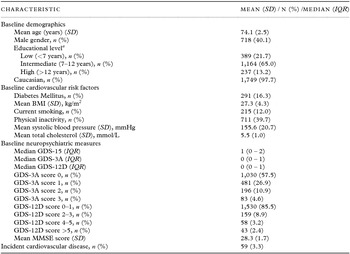
Table 1 shows the characteristics of the 1,790 participants. At baseline, the mean age was 74.1 years (SD 2.5), 59.9% of participants were female, and 97.7% were Caucasian. Most participants (65.0%) had 7–12 years of education. Mean Mini-Mental State Examination score was 28.3 (SD 1.7). Incident CVD occurred in 59 (3.3%) participants during the two-year follow-up. Table S1 (published as supplementary material online attached to the electronic version of this paper at http://journals.cambridge.org/ipg) shows the characteristics of the 1,790 participants separately for the intervention and control group of the preDIVA trial. The two groups appeared to be slightly different with regard to some cardiovascular risk factors. However, there were no considerable differences with regard to severity of apathy and mood symptoms, nor were there any significant differences in other neuropsychiatric measures, demographic characteristics, or number of incident cases of CVD
Characteristics of the study sample (n = 1,790)

SD = standard deviation; IQR = interquartile range; BMI = body mass index; GDS-15 = 15-item Geriatric Depression Scale; GDS-3A = 3-item apathy subscale of the 15-item Geriatric Depression Scale; GDS-12D = 12-item mood subscale of the 15-item Geriatric Depression Scale; MMSE = Mini-Mental State Examination. a Percentages do not add up to 100 because of rounding.
The association of apathy and mood symptoms with cardiovascular risk factors and of cardiovascular risk factors with incident CVD
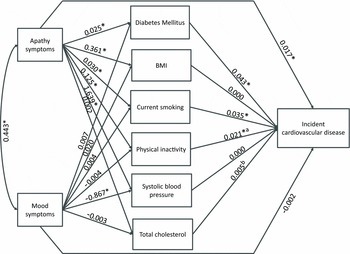
Figure 2 shows the results of the primary SEM analysis of the proposed model. Interpretational heuristics for the path coefficients are presented in the appendix (see appendix A1 published as supplementary material online attached to the electronic version of this paper at http://journals.cambridge.org/ipg). All text references to path coefficients refer to unstandardized path coefficients. Apathy symptoms were significantly associated with the cardiovascular risk factors DM (path coefficient 0.025; p ≤ 0.036), BMI (path coefficient 0.361; p ≤ 0.019), current smoking (path coefficient 0.030; p ≤ 0.005), physical inactivity (path coefficient 0.125; p < 0.001), and systolic blood pressure (path coefficient 1.639; p ≤ 0.011). Mood symptoms were significantly inversely associated with systolic blood pressure (path coefficient −0.867; p ≤ 0.013). No significant associations were found with other cardiovascular risk factors. The cardiovascular risk factors that were significantly associated with incident CVD were DM (path coefficient 0.043; p ≤ 0.007), current smoking (path coefficient 0.035; p ≤ 0.043), and physical inactivity (path coefficient 0.021; p ≤ 0.028). Including the treatment status of the preDIVA trial as a covariate did not affect any of these associations (Figure S2 published as supplementary material online attached to the electronic version of this paper at http://journals.cambridge.org/ipg).
Unstandardized path coefficients for the relationships between baseline apathy and mood symptoms, cardiovascular risk factors, and incident cardiovascular disease after two years of follow-up in the 1,790 study participants. The relation between apathy and mood symptoms is expressed as a correlation. Age, gender, and level of education are included as covariates for all endogenous variables and are correlated with apathy and mood symptoms (not shown). Error terms of all cardiovascular risk factors are correlated with each other (not shown). *Paths significant at the p ≤ 0.05 level. BMI = body mass index.
aPath significant in modified linear probability model (MLPM) and logistic regression sensitivity analysis, but not in probit regression sensitivity analysis. bPath not significant in modified linear probability model (MLPM) and logistic regression sensitivity analysis, but significant in probit regression sensitivity analysis.

The role of cardiovascular risk factors as mediators of the relationship of apathy symptoms, mood symptoms and incident CVD
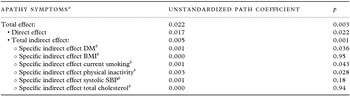
Table 2 presents the unstandardized path coefficients for the total, direct, and indirect effects of apathy symptoms on incident CVD. Apathy symptoms had a significant total effect on incident CVD (total effect 0.022; p ≤ 0.003). For every unit increase in the apathy score, incident CVD was predicted to increase by 0.022 probability units or 2.2%. According to the joint significance test, physical inactivity, DM, and current smoking were significant mediators in the relationship between apathy symptoms and incident CVD since these risk factors were associated with both apathy symptoms and incident CVD. A decompositional analysis showed that of the total effect of apathy symptoms on incident CVD, 22.7% was due to the mediational effect of these cardiovascular risk factors (total indirect effect coefficient: 0.005; (0.005/0.022)(100) = 22.7%; p ≤ 0.001). The coefficients for the indirect effect of each separate mediator were: 0.003 for physical inactivity, 0.001 for DM, and 0.001 for current smoking. Consequently, physical inactivity, DM, and current smoking accounted for respectively 13.6% (0.003/0.022 = 0.136), 4.5% (0.001/0.022 = 0.045), and 4.5% (0.001/0.022 = 0.045) of the total effect of apathy symptoms on incident CVD. The remaining 77.3% of the total effect of apathy symptoms on incident CVD was due to the direct effect of apathy symptoms on incident CVD beyond what cardiovascular risk factors explained (direct effect: 0.017; (0.017/0.022)(100) = 77.3%; p ≤ 0.022). This direct path reflects the effect of other, unexamined mediators. For mood symptoms, no significant direct or indirect effects on incident CVD were found. Similar results were found when the treatment status of the preDIVA trial was included as a covariate (Table S2 published as supplementary material online attached to the electronic version of this paper at http://journals.cambridge.org/ipg).
Unstandardized path coefficients for the total, direct, and indirect effects of apathy symptoms on incident cardiovascular disease in the 1,790 study participants

DM = diabetes mellitus; BMI = body mass index; SBP = systolic blood pressure. a Age, gender, and level of education are included as covariates. b The sum of the specific indirect effects does not equal the total indirect effect due to rounding error. p-values are based on the joint significance test; the largest p-value in the causal chain is reported.
Specification error, measurement error, and remaining sensitivity analyses
No statistically reliable non-linearity and no theoretically meaningful two-way interaction effects between cardiovascular risk factors were observed in the data. With regard to measurement error, only one result that was statistically significant became non-significant when adjusting for unreliability using the strategy and the levels of unreliability described in the appendix (see appendix A1 published as supplementary material online attached to the electronic version of this paper at http://journals.cambridge.org/ipg); the p-value for the path coefficient from physical inactivity to CVD changed from p ≤ 0.028 to p ≤ 0.078. A sensitivity analysis using a logistic regression framework did not change the significance patterns of the paths leading to dichotomous outcomes. However, when a sensitivity analysis using robust probit regression analysis was applied, two differences emerged: (1) the path from physical inactivity to incident CVD lost significance (probit regression: p ≤ 0.10; MLPM: p ≤ 0.028) and (2) the path from cholesterol to incident CVD became significant (probit regression: p ≤ 0.017; MLPM: p ≤ 0.33). The statistical significance of the other path coefficients remained unchanged. The above results for measurement error and probit modeling suggest that some caution should be exercised when drawing conclusions about the impact of physical inactivity on CVD.
Discussion
The present study found that apathy symptoms were significantly associated with incident CVD, and that this was partly mediated by physical inactivity, current smoking, and presence of DM. Together, these risk mediators accounted for 22.7% of the association between apathy symptoms and incident CVD, indicating the importance of assessment and treatment of unfavorable health behaviors and DM in older individuals with apathy symptoms. The majority (77.3%) of this link was however due to other, unmeasured factors. No statistically significant association was found between mood symptoms and incident CVD. This is consistent with our previous results (Eurelings et al., Reference Eurelings, Ligthart, Van Dalen, Moll van Charante, Van Gool and Richard2014) and also with other research (Sugawara et al., Reference Sugawara2011) that found symptoms of apathy, but not depression, to be associated with CVD, and strongly suggests the importance of discriminating the two sets of symptoms. In contrast to previous studies, the present study used a statistical approach (SEM) that allowed to address the problem of collinearity between apathy and mood symptoms and to take into account measurement error. Although the total effect of apathy symptoms on incident CVD (2.2%) may appear small, an increase of apathy score from 0 to 3 (3 units) is associated with 6.6% increase in incident CVD. When this percentage is extrapolated to the number of individuals affected in a large population, the effect size is, in our judgment, substantial.
Apathy symptoms were positively associated with several cardiovascular risk factors. In line with these findings, both the somatic-affective component of depression, as well as atypical depression (which is characterized by hypersomnia, loss of energy, and other motivational symptoms) have been linked with metabolic dysregulations (Lamers et al., Reference Lamers, Vogelzangs, Merikangas, de Jonge, Beekman and Penninx2013; Marijnissen et al., Reference Marijnissen2013). More in particular, regarding the observed association with DM, it is interesting to note that apathy has previously been associated with clinically relevant elevations in HbA1c levels (Bruce et al., 2014). A differential association of apathy and mood symptoms with systolic blood pressure was found, with apathy symptoms being positively and mood symptoms being inversely associated. A similar observation was made by Lamers et al. (Reference Lamers, Vogelzangs, Merikangas, de Jonge, Beekman and Penninx2013), who reported that patients with the mood related melancholic type of depression had a significantly lower blood pressure than controls, whilst this was not the case for persons with atypical depression. We did not find any positive associations between mood symptoms and cardiovascular risk factors, contradictory to the findings of other studies (Mezuk et al., Reference Mezuk, Eaton, Albrecht and Golden2008; Strine et al., Reference Strine2008; Meng et al., Reference Meng, Chen, Yang, Zheng and Hui2012). This discrepancy is difficult to interpret since others studies did not differentiate between apathy and mood symptoms.
No significant associations of BMI, systolic blood pressure, and total cholesterol with incident CVD were found. This is in line with the prevailing notion derived from epidemiologic studies that the predictive value of traditional cardiovascular risk factors diminishes with age (Kannel, Reference Kannel2002). The failure to observe statistically significant interaction effects between these variables also is consistent with this assertion.
It is interesting that the majority of the effect of apathy symptoms on incident CVD could not be explained by the measured cardiovascular risk factors. There are at least two potential explanations for this finding. First, other unmeasured mediating mechanisms, that also have been suggested to operate in the relationship between depression and incident CVD, may apply for apathy symptoms, such as non-compliance with medical recommendations, autonomic imbalance, hypercoagulability, and hypothalamic-pituitary-adrenal axis dysregulations (Joynt et al., Reference Joynt, Whellan and O’Connor2003). Another explanation could be the existence of a shared etiologic mechanism underlying both apathy and CVD, for instance subclinical atherosclerosis caused by cardiovascular risk factors. In that case, the current specified model should be reconsidered in such a way that cardiovascular risk factors precede apathy rather than being a result of it, and apathy symptoms should then be considered as a risk marker, rather than an independent risk factor. This is in line with the finding that the association of depression in general (including apathy symptoms) and incident CVD is markedly attenuated after adjustment for the severity of underlying vascular disease (Meijer et al., Reference Meijer2013). Furthermore, atherosclerosis has been associated with an inflammatory process (Bisoendial et al., Reference Bisoendial, Boekholdt, Vergeer, Stroes and Kastelein2010), which in turn has been linked to the development of so called “sickness behavior” (Dantzer et al., Reference Dantzer, O’Connor, Freund, Johnson and Kelley2008), a condition that is characterized by social withdrawal and closely resembles apathy. In concordance with this, we recently found that apathy symptoms are associated with increased C-reactive protein levels (Eurelings et al., Reference Eurelings, Richard, Eikelenboom, van Gool and Moll van Charante2015). In addition, both the somatic-affective component of depression, as well as atypical depression have been associated with several inflammatory markers (Duivis et al., Reference Duivis, Vogelzangs, Kupper, de Jonge and Penninx2013; Lamers et al., Reference Lamers, Vogelzangs, Merikangas, de Jonge, Beekman and Penninx2013). Taken together, these results may indicate a central combined role for atherosclerosis and inflammatory processes in the development of both apathy symptoms and cardiovascular events.
One of the strengths of this study is the large community-based sample and the limited number of exclusion criteria, thereby reducing potential selection bias and increasing the external validity. Although healthy user bias may have occurred due to the preventive nature of the study, the preDIVA study sample appears to compare well with the general Dutch population (Ligthart et al., Reference Ligthart2012). Another strength is that SEM was used to examine meditational dynamics as well as to take into account random measurement error. A limitation to the study may be that preDIVA was not primarily designed to measure apathy, potentially leading to a less than optimal indicator of the construct and, as yet, no reports are available on the sensitivity and specificity of the GDS-12D. Given these limitations, the intention was not to formally diagnose apathy and depression, but to explore presence of apathy and mood symptoms (rather than discrete states), and to assess their differential association with cardiovascular risk factors and incident CVD. It might be argued that apathy symptoms are in fact symptoms of depression. However, since many studies have shown unique associations of the three-item apathy cluster within the GDS-15, independently of mood symptoms, with several biological correlates (van der Mast et al., Reference Van der Mast2008; Ligthart et al., Reference Ligthart2012; Eurelings et al., Reference Eurelings, Ligthart, Van Dalen, Moll van Charante, Van Gool and Richard2014; Reference Eurelings, Richard, Eikelenboom, van Gool and Moll van Charante2015), we feel that it is unlikely that the apathy symptoms assessed in this study can be considered as lack of activity (e.g. social, physical) in the context of depression. Other limitations may be that the follow-up period of two years in this study was relatively short and that no time-to-event analysis could be performed due to incomplete information on exact dates of incident CVD. In addition, the current study is embedded in a randomized controlled trial involving a multi-component intervention targeted towards cardiovascular risk factors. The treatment status may not only have influenced the outcome incident CVD, but could also have impacted the number of individuals with apathy and mood symptoms that was still available for analysis after two years of follow-up. For example, an intervention as implemented in preDIVA, which requires 4-monthly visits to a practice nurse, may be too burdensome for participants with apathy and/or mood symptoms, resulting in a higher drop-out rate of these participants in the intervention group and a relative overrepresentation of these individuals in the control group. However, repeating the analyses including the treatment status as an additional covariate did not affect any of the conclusions. Furthermore, it was not possible to account for potential reciprocal dynamics of symptoms of apathy and mood with cardiovascular risk factors that may have taken place before baseline assessment. For example, apathy may have led to a decreased level of physical activity which in turn may have further increased apathy. Ignoring these dynamics may lead to overestimation of selected effects. Although not practicing sports appears to be a good proxy for reduced general physical activity, such as walking and cycling, in the elderly (Becker and Zimmermann-Stenzel, Reference Becker and Zimmermann-Stenzel2009), a limitation might be that this dichotomous variable did not fully capture the various levels of physical activity. The same applies for the dichotomous variable current smoking. Finally, nearly all of the study participants were Caucasian, which limits the generalizability of findings towards other ethnicities. Despite these limitations, the present findings are worthy of further investigation and exploration.
In conclusion, the findings of this study provide support for the mediating role of physical inactivity, smoking, and DM in the relationship between apathy symptoms and incident CVD in older individuals without previous CVD or stroke. This may suggest that clinicians should be vigilant of these risk factors, especially since these elderly might be prone to withdraw from clinical care due to the nature of apathy symptoms. The finding that two of the three mediators in the relationship between apathy symptoms and incident CVD were behavioral risk factors, i.e. smoking and physical inactivity, indicates the importance of recognition of these unfavorable health behaviors in older persons with symptoms of apathy, since they are amenable to interventions such as smoking cessation counseling and exercise programs (Cataldo. Reference Cataldo2007; Neidrick et al., Reference Neidrick, Fick and Loeb2012). The results additionally point to the importance of assessment and treatment of DM in these elderly. Furthermore, this study strongly suggests that clinicians should be aware of the necessity of distinguishing between apathy and mood symptoms.
The present work provides a basis for further evaluation of other, yet unexamined, mechanisms through which the majority of the effect of apathy symptoms on incident CVD is effectuated. Insight into those mechanisms will eventually be necessary to develop interventions aimed at reducing CVD risk in older persons with apathy symptoms. Moreover, to test whether apathy symptoms represent a risk marker rather than a risk factor, a longitudinal model could be tested that investigates the primary role of cardiovascular risk factors in the development of CVD via atherosclerosis, inflammatory processes and apathy symptoms. This model should take into account potential reciprocal dynamics of apathy symptoms with existing cardiovascular risk factors and the possibility that apathy symptoms may enhance the development of new cardiovascular risk factors.
Conflict of interest
None.
Description of author's roles
Eurelings had full access to all the data in the study. Eurelings and Jaccard performed the statistical analysis, and Eurelings was responsible for drafting of the manuscript. All authors are responsible for the conception and design of the study, interpretation of data, and critical revision of the manuscript for important intellectual content. All authors approved the final version of the manuscript.
Acknowledgments
The preDIVA trial is supported by the Dutch Ministry of Health, Welfare, and Sports (grant number 50-50110-98-020), the Innovatiefonds Zorgverzekeraars (innovation fund of collaborative health insurances) (grant number 05-234), and ZonMw (The Netherlands Organisation for Health Research and Development) (grant number 62000015). Author L.E. has received an AMC PhD scholarship (2011/1190). The authors wish to thank all study participants, practice nurses, and GPs for taking part in the preDIVA study, Carin Miedema for trial coordination, and Nicole Levitz for her support with the statistical analyses.
Supplementary Material
To view supplementary material for this article, please visit http://dx.doi.org/10.1017/S1041610215001751