Citizens’ trust in the government and its agencies is of great importance to political legitimacy and social stability, especially in China where the political system remains closed despite dramatic socio-economic changes.Footnote 1 In the past four decades or so, the country has experienced remarkable economic growth accompanied by a substantial improvement in most citizens’ living standards, leading to an increase in public support for the government.Footnote 2 However, although most households have benefited significantly from the economic boom in absolute terms, this gain varies considerably between different social groups, and inequalities have increased over time, especially since the mid-1990s. The Gini index, for instance, has increased from 0.33 in 1980 to about 0.45 in recent years.Footnote 3 In light of China's past socialist egalitarianism, many observers are concerned that the sharp rise in income discrepancies may bring widespread social discontent and threaten the political stability in China.
As it becomes increasingly difficult to maintain high rates of economic growth,Footnote 4 the Chinese government has found it necessary to garner political support from citizens who have been “left behind” during the reforms through the provision of public goods and services.Footnote 5 Under the leadership of Hu Jintao 胡锦涛 and Wen Jiabao 温家宝, the Chinese Communist Party (CCP) initiated a series of social policies to promote a harmonious society ranging from the abolition of agriculture tax and school fees for students receiving compulsory education, to the establishment of the Minimum Living Support Scheme (Chengxiang jumin zuidi shenghuo baozhang zhidu 城乡居民最低生活保障制度, hereafter MLSS), the New Rural Co-operative Medical System (Xinxing nongcun hezuo yiliao 新型农村合作医疗), and the New Rural Pension Scheme (Xinxing nongcun yanglao baoxian 新型农村养老保险, hereafter NRPS), among others, in an attempt to redistribute economic benefits and extend the coverage of social security networks to vulnerable social groups.
According to the theory of economic self-interest, policy benefits can influence people's political attitudes.Footnote 6 While those who have benefited from social policies initiated by the central government express more positive attitudes towards the national government, it remains unclear whether the expansion of social expenditure would also increase support for the local government responsible for implementing those policies. Some scholars argue that in a political system with multiple levels of authority, the determinants of perceived governmental legitimacy may differ between the central government and local governments.Footnote 7 The literature suggests that the effects of social policy on people's political attitudes are mixed and conditional on policy characteristics such as programme administration, the size of benefits and the visibility and traceability of benefits.Footnote 8
Empirical findings from China have also been inconclusive, however. For instance, Lü Xiaobo reported that the abolition of school fees under the Compulsory Education Law of the People's Republic of China (Zhonghua renmin gongheguo yiwu jiaoyu fa 中华人民共和国义务教育法) increased Chinese citizens’ trust in the central government but not in local government.Footnote 9 In contrast, Zhonglu Li and Xiaogang Wu found that poor people who received MLSS subsidies had greater political trust in local government officials than those not benefiting from the MLSS.Footnote 10
With the increasing autonomy of local government and the decentralization of public goods provision, the well-being and political trust of Chinese citizens are significantly affected by the performance of their local government.Footnote 11 Empirical studies have shown that while the central government enjoys greater popular support than the governments of many other countries,Footnote 12 Chinese citizens’ political trust in different levels of government varies substantially, and their trust in local government (and at township level in particular) tends to be lower.Footnote 13 However, social policies initiated by the central government to improve people's livelihood need to be implemented by local government. Therefore, the effects of policies on public attitudes towards local government are likely to depend on the efficacy of policy implementation.
To extend our knowledge of the association between social expenditure and public attitudes, this article evaluates the effects of the NRPS, a social policy initiated by the central government in 2009, on public trust in government at different levels. Specifically, it addresses the following questions. First, has the establishment of the NRPS increased public trust in the central and/or local government? If so, what are the specific channels through which the NRPS boosts rural people's political trust in local government?
The article is organized as follows. The next section presents a background to the NRPS. This is followed by a brief review of the literature on government performance and political trust. Then there is a description of the data and measures used, followed by the results of our analysis of the effects of the NRPS on public political trust. Finally, there is a discussion of the findings and conclusions.
Background: China's New Rural Pension Scheme (NRPS)
To deal with the pressures of a rapidly growing population on social and economic development, the Chinese government began implementing the one-child policy in the early 1980s, stipulating that one couple give birth to one child only.Footnote 14 The decline in birth rates and increased life expectancy have meant that the proportion of the older population (defined as those aged 65 and above) has grown substantially over the past decades, from 6.96 per cent in 2000 to 13.26 per cent in 2010.Footnote 15 By 2050, it is expected that a quarter of China's total population will be aged 65 and above.Footnote 16
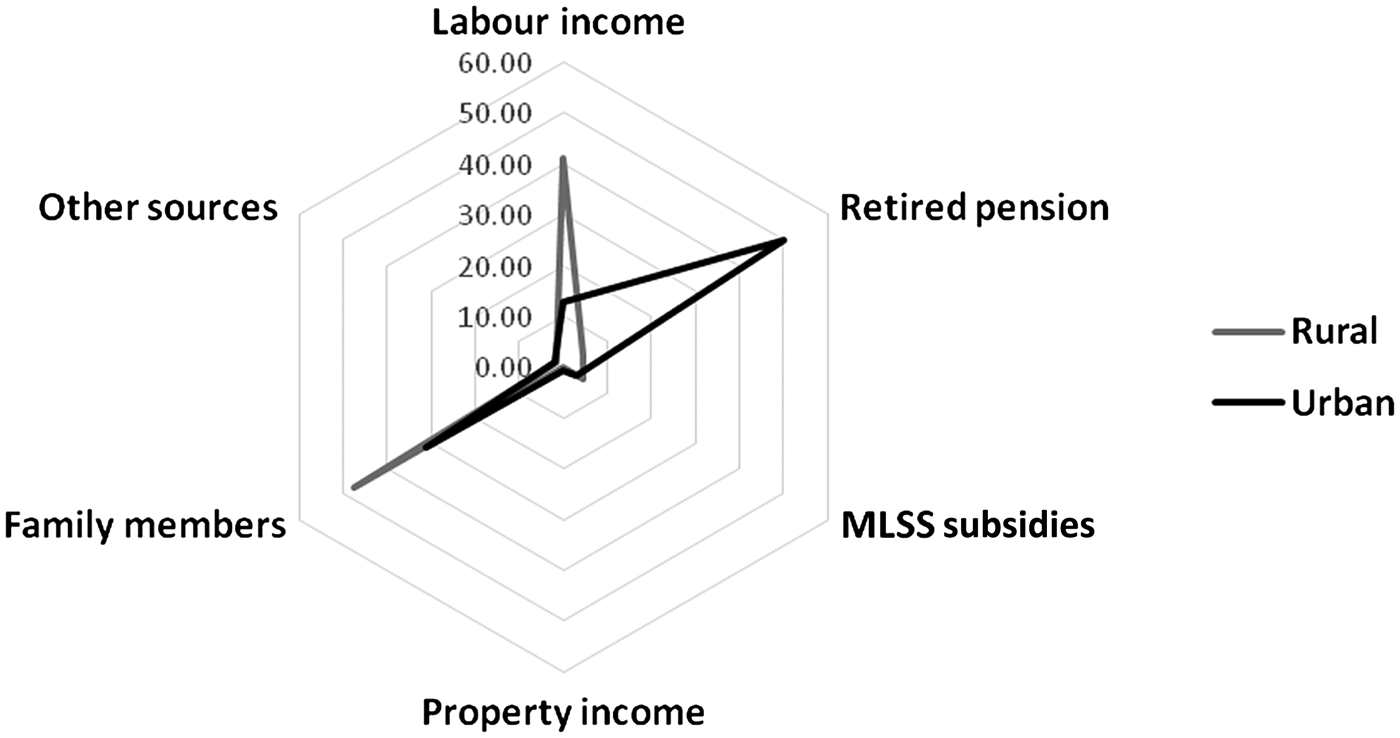
The rapidly aging population poses a major challenge to economic development and the healthcare and pension systems of China. For historical reasons, most rural residents are not covered by social security schemes. Since the late 1970s, when the collective farming system was replaced by the household responsibility system, most rural residents have relied mainly on their own families for old-age support.Footnote 17 According to the 2010 population census, the main sources of income for about 88 per cent of old people in rural areas come from work and family members, and only 4.6 per cent receive a pension from the government (see Figure 1). Even worse, such traditional networks for family support have been undermined by the continuous outflow of rural young migrants. The left-behind rural elderly are often reported to experience loneliness, isolation, depression and hopelessness, and some lack even the most basic economic support.Footnote 18
Chinese Old People's Sources of Income in 2010

To improve the well-being of rural residents and garner political support from the majority of its population, the central government announced guidelines for piloting the NRPS in 2009. All local rural residents aged 16 and above are eligible to participate voluntarily in the NRPS, provided that they are not in school and not covered by any other pension schemes. Participants are required to contribute 100 to 500 yuan annually to individual pension accounts and the local government is required to subsidize the contribution by at least 30 yuan per year, regardless of the amount of an individual’s contribution. The central government fully funds non-contributory pensions in the central and western provinces but only contributes half the funding for pensions in the eastern provinces. Participants who have contributed for 15 years or longer receive a flat rate pension at the age of 60, which includes both a non-contributory basic pension transferred from the government and a monthly payment from their individual accounts. Finally, rural residents over the age of 60 are entitled to receive a basic pension of 55 yuan per month, regardless of whether or not they ever made any contribution.Footnote 19
The NRPS was introduced in 320 counties in 2009, and subsequently rolled out nationwide to cover 838 counties in 2010, 1,914 counties in 2011, and all 2,853 counties by 2012.Footnote 20 By the end of 2011, 326.4 million rural residents had enrolled in the scheme, and 89.2 million elderly people (aged 60 and above) were drawing the basic pension benefit of at least 55 yuan per month.Footnote 21 Empirical studies show that the income from the NRPS has had a significantly positive influence on the physical health, cognitive function and psychological well-being of the rural elderly.Footnote 22 In this study, we focus on whether or not the NRPS has enhanced rural residents’ trust in the government, especially in grassroots (i.e. township-level) governments.
Government Performance and Political Trust
Political trust and its origins
Political trust is defined as citizens’ belief that the political system or government will produce outcomes consistent with their expectations. This multidimensional concept reflects citizens’ trust in the regime, in its agencies, and/or in its incumbents, and it may also be contingent upon the level of government concerned.Footnote 23 As the main link between ordinary people and the political system as well as its agencies, political trust is widely considered to be indicative of the perceived legitimacy of a political regime. A high level of public political trust is believed to result in few protests, a good level of compliance and social stability.Footnote 24 Therefore, securing public political trust is especially important for regimes undergoing massive socio-political transformation.
In general, there are two competing theoretical explanations for the origins of political trust: the institutional one and the cultural one.Footnote 25 According to the institutional explanation, which is based on economic self-interest and the rational-choice perspective,Footnote 26 political trust is contingent upon citizens’ evaluation of government performance and calculation of material gains, both of which are associated with a government's capacity to deliver good policies.Footnote 27 In contrast, cultural theorists argue that political trust originates from outside the political system. Values, attitudes and social trust, which have been learned through people's socialization during early life, all play independent roles in shaping institutional trust.Footnote 28
Political trust in China
In contrast to many democratic countries, which have experienced a “trust crisis” since the 1960s,Footnote 29 survey data gathered in China have consistently indicated a high level of political trust in and support for the Chinese government.Footnote 30 Given the country's mounting economic, political and social problems, this high level of popular support for the government is perplexing, and has triggered numerous studies to identify the sources of political support under China's authoritarian regime.
Empirical studies of political trust in China also follow the two theoretical lines described above. Studies based on the cultural approach tend to emphasize the role of traditional, hierarchically oriented values. For instance, Shi Tianjian concludes that political culture plays an essential role in shaping political trust in both mainland China and Taiwan, while the influence of government performance on political trust is weaker in Taiwan and even less important in the mainland.Footnote 31 Based on surveys conducted in urban Beijing between 1995 and 1999, Chen Jie reported only a weak association between government performance and political support.Footnote 32 Other studies adopting the institutional approach tend to associate economic performance with political trust in China. Citizens’ evaluation of policy performance is an important determinant of political support in China;Footnote 33 and institutional trust in China is predominantly a matter of individual rational choice based primarily on a citizen's evaluation of institutional performance.
Although these studies have shed light on the sources of political support in China, some important issues have not been addressed. First, while the key argument of the institutional approach suggests that an individual's political support is based on calculations of their material gain through the government's performance and social policies, scholars have not provided sufficient empirical evidence to support the claim.Footnote 34 Therefore, it is necessary to consider the extent to which citizens benefit from government performance or social policies when examining the effects of government performance on public political trust. Second, although Chinese people's political trust in different levels of government may vary, there are few studies that investigate the ways in which social policy or government performance has shaped citizens’ trust in central and local government simultaneously.Footnote 35
Social policy and political trust
To link government performance to public attitudes towards the government and its agents, citizens must first presume that whether or not their needs and demands are met is attributable in some way to government performance.Footnote 36 Social welfare policies are one of the most salient indicators of government performance as far as ordinary citizens are concerned, as they often confer direct benefits through redistribution. In the last decade, social policies have become a key strategy used by China's central government to maintain political support, based on the assumption that people who benefit from such policies are likely to hold more positive attitudes towards the government and its officials. However, it remains unclear whether increased social expenditure indeed generates political support among Chinese citizens, especially for the local governments that are primarily responsible for implementing social policies. In a political system with multiple levels of authority, the factors determining perceived governmental legitimacy differ for the central government and local government.Footnote 37 Li Lianjiang shows that most rural residents in China see the state as divided and tend to have trust in the central government's policy intention but distrust local government's capacity to faithfully implement the central policy.Footnote 38 Tang Wenfang reveals that, on an individual level, rural residents’ life dissatisfaction and policy dissatisfaction could increase their dissatisfaction with government at all levels, and especially for the local government; rural residents blame the local government much more than they do the central government for their daily problems.Footnote 39
Empirical studies offer inconclusive evidence as to whether national social policies enhance citizens’ political support for local governments in China. For instance, Lü reported that the scrapping of school fees under the Compulsory Education Law increased citizens’ trust in the central government but not in local government. He further suggested that policy awareness – rather than policy benefits – is responsible for the asymmetry in political trust in the central and local governments. Media reports that highlight both policy benefits and the central government's fiscal contribution increase citizens’ trust in the central government, but they also raise citizens’ expectations of the government's financing of compulsory education. As citizens are aware of the relative contribution of central and local governments, they are likely to credit the central government for good policy outcomes and blame local governments for the ineffective implementation of central government's policies.Footnote 40
Studies on the impact of MLSS, however, show that people who have received MLSS subsidies report a greater trust in local government officials, and that local MLSS coverage also has a significantly positive effect on the political trust of non-targeted groups.Footnote 41 These findings suggest that citizens’ trust in government officials hinges not only upon government performance or individuals’ socio-economic situation but also upon the interaction between these factors, namely, how ordinary people perceive the government's performance and whether they have benefited from government programmes.
Studies in other countries suggest that the effects of social policies on mass political attitudes are mixed and conditional on policy characteristics, such as programme administration, policy expectations, the size of benefits, and the visibility and traceability of benefits.Footnote 42 Therefore, the inconclusive results may be owing to the specific policies examined, thus it is necessary to focus on the characteristics and administration of social policies when examining their impacts on public attitudes. To extend our knowledge in this field, this article investigates the influence of the NRPS on rural residents’ trust in the central government and local governments, and on their expectations of whether the government should provide old-age care.
Data, Measures and Estimation Strategy
Data
The data analysed in this research are drawn from the Chinese General Social Survey (CGSS) of 2010, which surveyed 11,785 respondents from 135 counties in 31 provinces in China.Footnote 43 The CGSS 2010 offers data particularly pertinent to our research objectives, as rural residents in both NRPS pilot areas and non-NRPS pilot areas were surveyed during the rollout of the NRPS, and questions on respondents’ trust in the central and local governments were solicited. As we are mainly interested in the effects of the NRPS on rural residents’ political attitudes, we restrict our sample to individuals holding rural hukou 户口 (household registration) and registered in the surveyed counties (i.e. we rule out cross-county migrants). After deleting cases with missing values for the main variables, the final analytical sample size is 5,073.
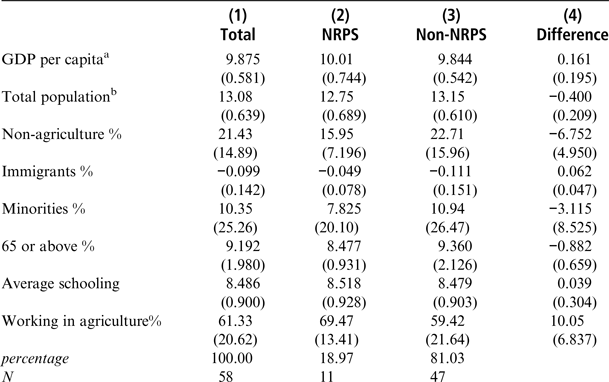
The analytical sample covers 11 counties that had implemented the NRPS and 47 counties that had not implemented the NRPS as of 2010. As shown in Table 1, there are no significant differences between the pilot and non-pilot areas in economic development, the proportion of people working in agriculture, the percentage of people aged 65 and above, etc.
Differences between Counties of the NRPS Pilots and Non-Pilots

Source: GDP per capita of counties is from the CEIC databases: http://library.ust.hk/cgi/db/com.pl?cpd. Other variables come from the Tabulation on the 2010 Population Census of the People's Republic of China by county.
Notes: a the natural logarithm GDP per capita; b the natural logarithm total population; standard deviation or standard errors in parentheses.
Measures
Political trust
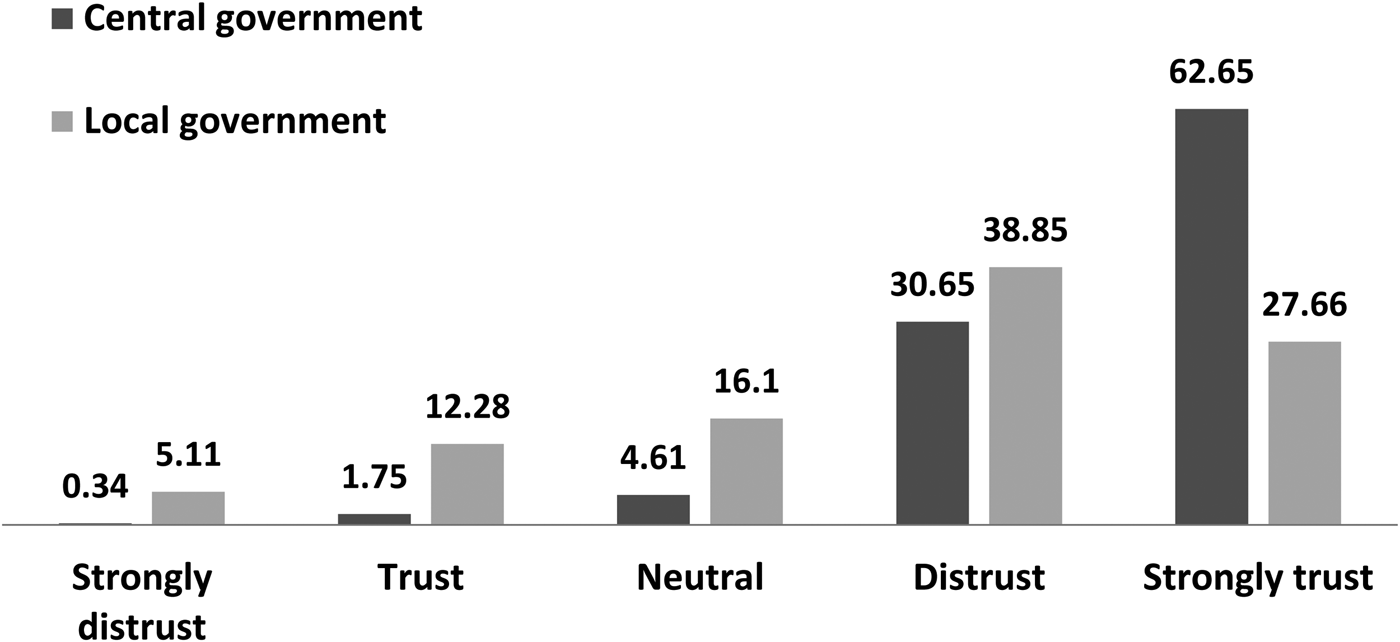
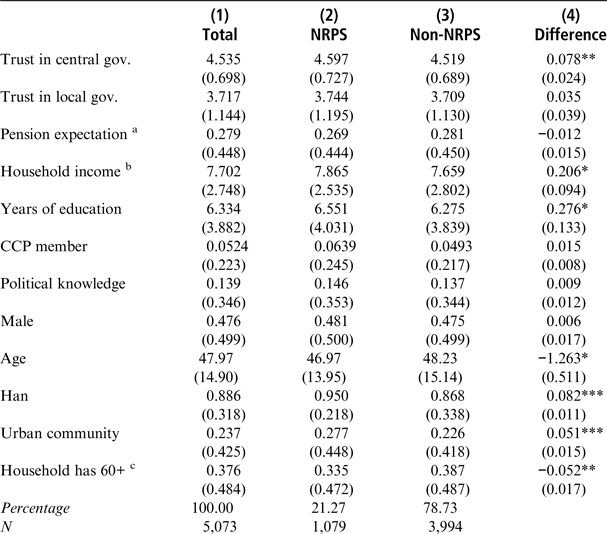
The main variable of our interest is citizens’ political trust in different levels of government. In the CGSS 2010, all respondents were asked, “to what extent do you trust in the following organizations?” The listed organizations included the central government and the local government (referred to as the township-level government in rural areas). There were five ordinal choices from 1 to 5, with 1 meaning “strongly distrust” and 5 meaning “strongly trust.” As shown in Figure 2, the results indicate a discrepancy between rural people's political trusts in the central and local governments. Consistent with other previous studies, they seemed to trust more in the central government than in the local government.Footnote 44 The comparisons in Table 2 further suggest that people living in the NRPS pilot areas showed significantly higher levels of trust in the central government than those from non-pilot areas; however, their trust in local government did not seem to differ significantly.
Rural Residents’ Trust in Central and Local Government

Summary Statistics of Selected Variables in the Analysis
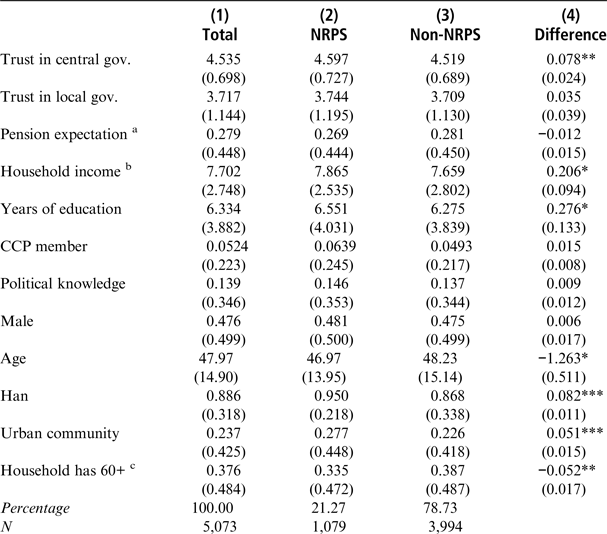
Notes: a Pension expectation is a dichotomies variable, with 1 meaning government should be responsible for old-age support, and 0 meaning family and children should be responsible for endowment; b the natural logarithm of household income per capita; c household has members who are older than 60 years old (including 60). Standard deviation or standard errors are in parentheses. *** p < 0.001, ** p < 0.01, * p < 0.05.
Policy expectations
To determine whether the NRPS raises rural residents’ expectations about the government's responsibility for the care of the elderly, we constructed a variable on policy expectation from the following question: “who should be responsible for elderly people who have children?” There were four choices: “the government should take responsibility”; “their children are responsible”; “the elderly themselves should take the main responsibility”; and “the responsibility should be shared by the government, the elderly people's children, and the elderly themselves.” The responses were recoded into a binary variable: 1 refers to the belief that the government should take at least some responsibility, whereas 0 indicates that the elderly and/or their children bear the main responsibility. It is clear that about 28 per cent of the rural people surveyed thought that the government should provide some support for the elderly. This finding does not differ significantly between the NRPS pilot counties and non-pilot counties.
Policy benefits
Although all rural residents exposed to the NRPS benefit from the scheme in the long term, the most direct beneficiaries are households with members aged 60 or above, as every rural resident over 60 is now entitled to a basic pension of 55 yuan per month, even if they have not contributed to the pension fund. Therefore, we measure policy benefits by determining whether a household has one or more members aged 60 or above. As shown in Table 2, about 33.5 per cent of the households in the pilot areas can be seen as beneficiaries.
NRPS treatment status
As explained in the data section above, 11 counties in our final sample had implemented the NRPS and 47 counties had not implemented the NRPS when the survey was conducted in 2010.Footnote 45 Approximately 21.3 per cent of rural residents in our sample had been exposed to the NRPS (see Table 2).
Controls
Following the literature, we include four sets of control variables in our estimation. The first set includes socio-economic variables: CCP membership, household income per capita, and years of schooling. We also control for the effect of political knowledge, indicated by whether a respondent is able to correctly name the-then president of the National People's Congress. The third set of controls comprises demographic variables, such as gender, age, ethnicity, and place of residence (rural or urban). The last controls are county-level variables, such as gross domestic product (GDP) per capita, residents’ average years of schooling, the percentage of people aged 65 and above, and the proportion of people working in agriculture. Descriptive statistics of these variables are presented in Table 2.
Estimation strategy
As the outcome variables (political trust and policy expectations) are ordered/or binary variables, we use ordered-logit and binary-logit modes to estimate the effects of the NRPS on rural residents’ political trust and their policy expectations. In addition, using households with members aged over 60 as a target group, we implement a general difference-in-difference (DID) model to determine whether the NRPS enhances rural residents’ political trust.Footnote 46 The DID model is specified as follows:
 $$logit \left( {\displaystyle{{{\rm Pr}({\rm Y_i} \le {\rm {_j}} \vert {\rm X_i})} \over {{\rm Pr}({\rm Y_i} \gt {_j} \vert X_i}}} \right) = \alpha T_i + \beta B_i + \delta \left( {T_i \times B_i} \right) + \gamma X_i,$$
in which Yi is an ordinal measure of political trust for individual i; Ti is a dummy coded as 1 for respondents living in the NRPS pilot areas, and 0 for those from non-pilot areas; Bi is a dichotomous measure indicating whether individual i is a potential NRPS beneficiary, i.e. whether i lives with family members aged 60 or above; and Xi is a vector of the control variables. In the DID model, the key parameter of interest is the estimated interaction term δ, which captures the policy–benefit effect after accounting for the difference between NRPS pilots and non-pilots (α) and the difference between policy beneficiaries and non-beneficiaries (β).
Results: Effects of the NRPS on Public Attitudes
NRPS and political trust
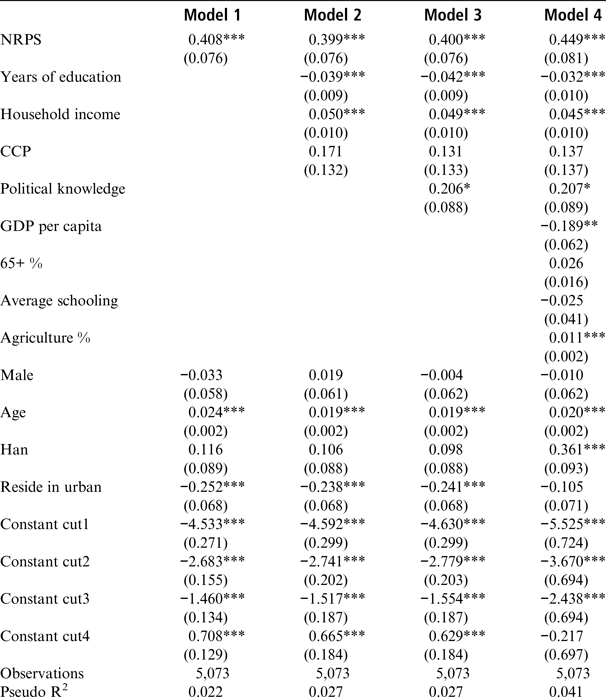
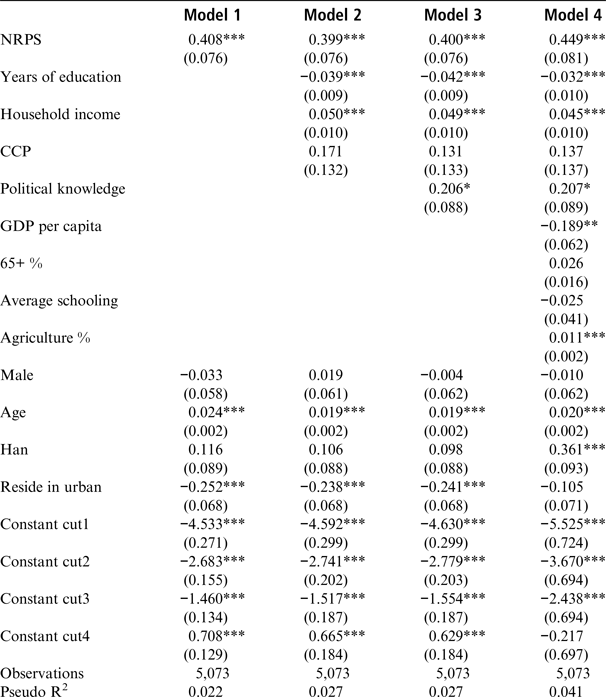
Is the expansion of social expenditure an effective means of obtaining political support? Table 3 presents the impact of the NRPS on rural residents’ trust in the central government, as estimated from the ordered logit models. Model 1 includes only the key independent variable, NPRS treatment status, and the demographic controls. The results show that the NRPS has a significant positive effect on citizens’ trust in the central government. In Model 2, even after adding CCP membership and socio-economic variables, the NRPS still has a significant positive influence on rural people's trust in the central government. Model 3 further introduces rural people's political knowledge to the control variables, and the main result remains unchanged. One concern is that the NRPS pilot areas and the non-pilot areas may be systematically different in their economic development, old-age dependency ratios, and so on. To address the potential bias, in Model 4 we further control for county-level variables such as GDP per capita, the average schooling of residents, the percentage of people aged 65 or above, and the proportion of people working in agriculture. The effect of the NRPS remains significantly positive.
Estimation of Ordered Logit Models on Political Trust in the Central Government
Notes: Robust standard errors in parentheses; *** p < 0.001, ** p < 0.01, * p < 0.05
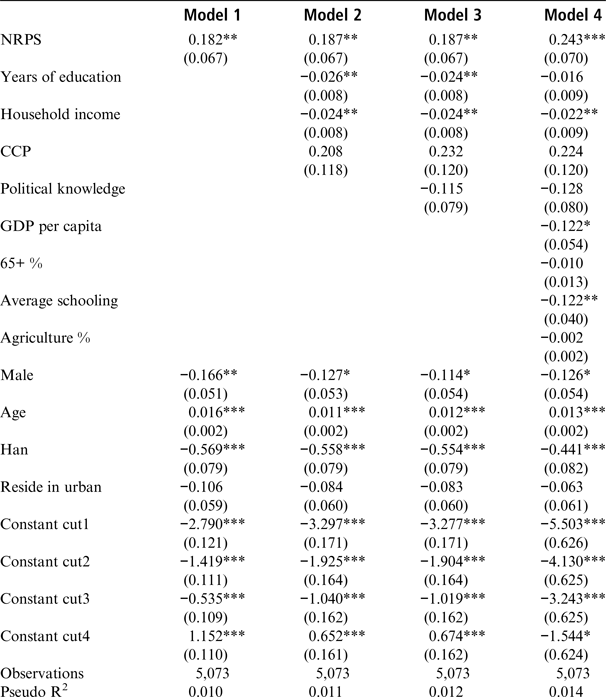
Model 4 is chosen as a baseline estimation of the magnitude of the effect of the NRPS on rural residents’ trust in the central government. All else being equal, the cumulative odds of political trust for people exposed to the NRPS are 70 per cent (e0.499-1) higher than those for people not exposed to the NRPS. The results for the control variables suggest that respondents with more years of schooling tend to express less trust in the central government; that the level of family income is positively correlated with support for the central government; and the aggregate level of economic prosperity (measured by GDP per capita) is negatively related to support for the central government.
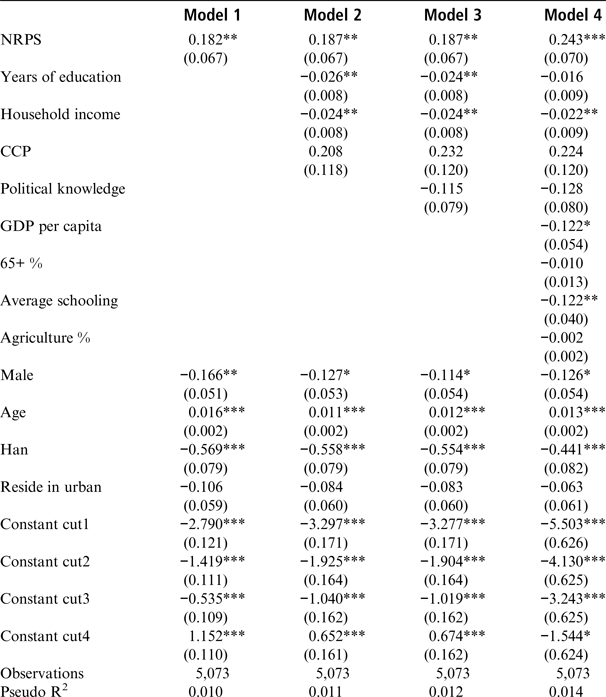
The same procedure is conducted to predict the effects of NRPS on rural residents’ trust in local government (township-level government here). As shown in Table 4, the implementation of the NRPS may also increase rural residents’ trust in township-level government. The cumulative odds of political trust in the local government for people who are exposed to the NRPS are 30 per cent (e0.243-1) greater than those for people not exposed to the NRPS. Although people exposed to the NRPS policy expressed a higher level of political trust in both the central and township-level governments, results suggest that the central government gained more political support from the NRPS policy than the local government (as shown in Tables 3 and 4, the cumulative odds are 1.6 for the central government and 1.3 for the local governments).
Estimation of Ordered Logit Models on Political Trust in the Local Government
Notes: Robust standard errors in parentheses; *** p < 0.001, ** p < 0.01, * p < 0.05
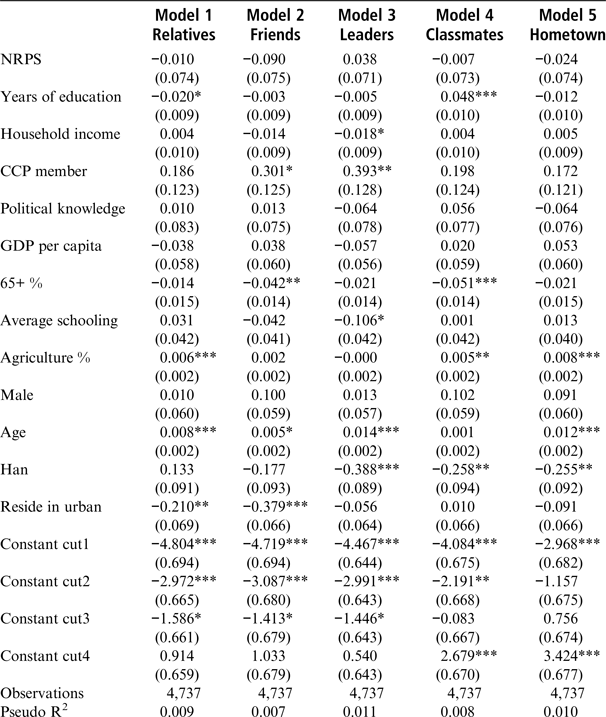
In Table 5, as a placebo test, we report estimates of the effects of the NRPS on respondents’ interpersonal trust. The NRPS, as a predominantly political strategy, is assumed not to have had a significant effect on rural people's interpersonal trust. As expected, we found no significant differences in citizens’ trust in their relatives, their friends, their workplace leaders, their classmates, or people from their hometown between the NRPS pilot and the non-pilot areas. These results lend further support to the main findings that the implementation of the NRPS enhances rural residents’ trust in both central and local governments.
Placebo Test: Estimation of Ordered Logit Models on Interpersonal Trust
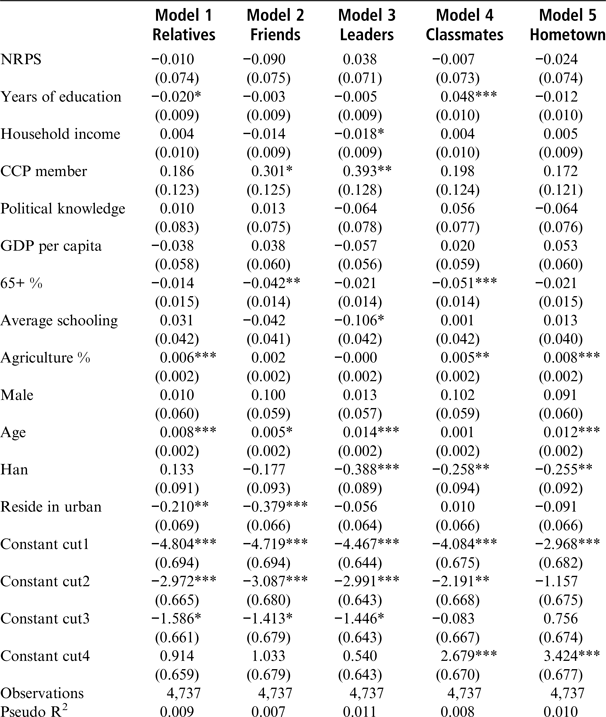
Notes: Robust standard errors in parentheses; *** p < 0.001, ** p < 0.01, * p < 0.05
Policy benefits and political trust
What are the specific channels through which social policies enhance citizens’ political trust? According to the economic self-interest theory, people who benefit more from social policies hold more positive attitudes towards the government and its officials. In this section, we attempt to determine whether people who benefit from the NRPS exhibit greater trust in the central and local governments.
Households with members aged 60 or above are treated as potential beneficiaries, because all rural residents over the age of 60 in an NRPS pilot area are entitled to a basic pension of 55 yuan per month, even if they have not previously contributed to the pension fund. If policy benefits enhance political trust, respondents living in households with members aged over 60 in the NRPS pilot areas are expected to have greater political trust than their counterparts in non-pilot areas.
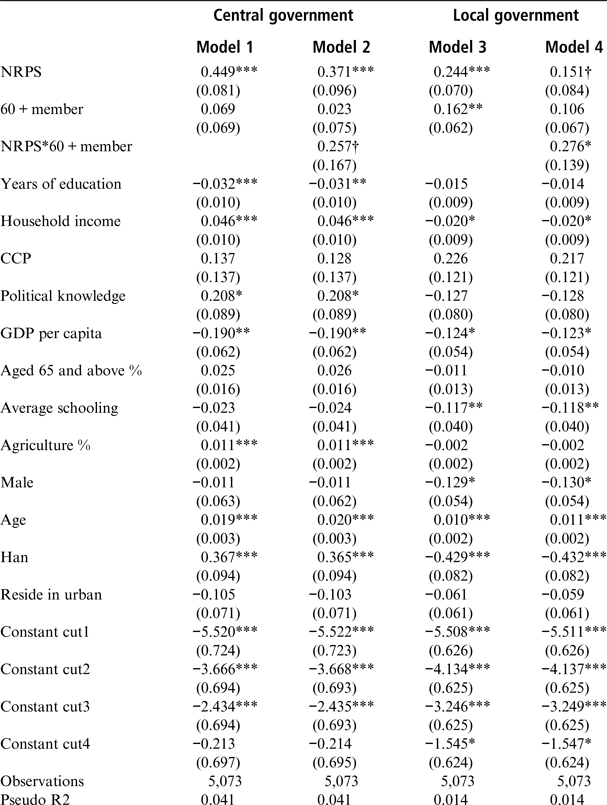
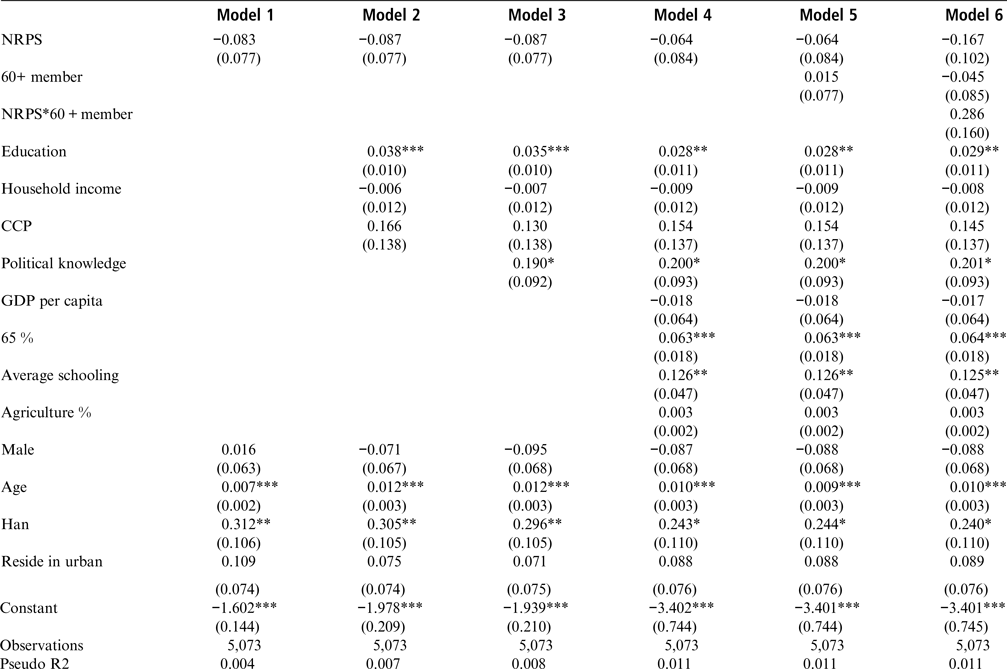
Table 6 displays the results of the analysis of the effects of policy benefits on rural people's political trust in both the central and local governments. In Model 1, we estimate the effects of the NPRS and potential beneficiary status on rural people's trust in the central government, and the results show that potential beneficiary status has no significant effect on rural residents’ trust in the central government. In Model 2, we add the interaction term for NRPS treatment status and potential beneficiary status, and the results suggest that people who directly benefit from the NRPS show greater trust in the central government. The same procedure is used to predict rural people's trust in local government in Models 3 and 4, and the results show that people who have directly benefited from the NRPS also express greater trust in local government. Although the general population exposed to NRPS pilots expressed higher trust in the central government, NRPS beneficiaries expressed a similar level of political trust in both the central and local governments (as shown in Table 6, the cumulative odds are 1.29 for the central government and 1.31 for the local governments). To sum up, unlike Lü’s findings for compulsory education policy, the policy benefits of the NRPS are shown to be a main channel through which the NRPS policy enhances rural residents’ political trust, especially for the local government.Footnote 47
Estimation of Ordered Logit Models on Political Trust
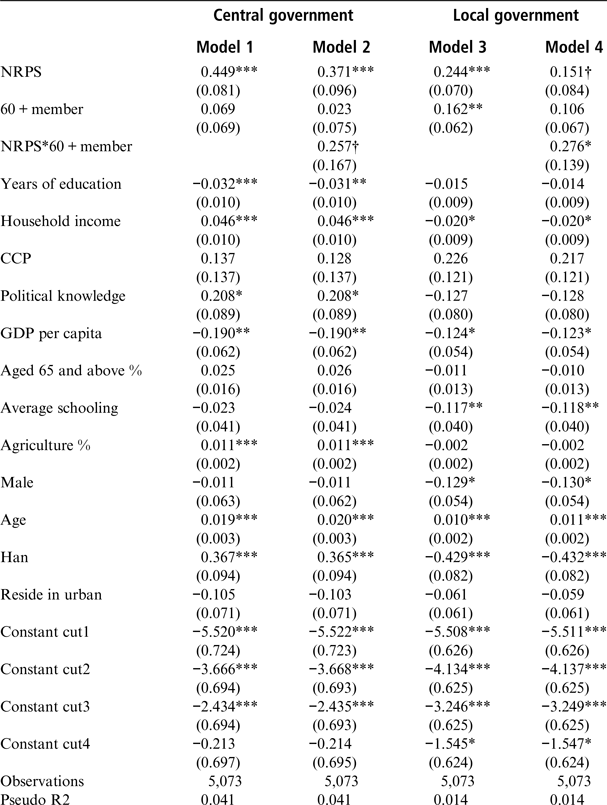
Notes: Robust standard errors in parentheses; *** p < 0.001, ** p < 0.01, * p < 0.05,† p < 0.1
NRPS and policy expectations
In addition to policy benefits, policy awareness may serve as an important alternative mechanism that can shape political trust. Previous studies show little or no relation between financial well-being and political attitudes and behaviour in the US, largely mediated by whether or not people accept personal responsibility for their economic situation.Footnote 48 In China, according to Peter Lorentzen and Suzanne Scoggins, central government policy is a main reason behind the increasing rights consciousness of the Chinese people, and the growth of rights consciousness has become an important explanation for Chinese people's political support and behaviour.Footnote 49 For instance, Lü shows that the policy to scrap school fees has significantly increased Chinese people's demand for greater government responsibility in financing compulsory education, and that the policy awareness, not the benefits, has enhanced their trust in the central government.Footnote 50 Does the implementation of the NRPS raise rural residents’ expectations about the government's responsibility for the elderly? The answer to this question has clear implications for the fiscal burden and efficiency of the NRPS and for our understanding of Chinese people's rights consciousness and political actions.
As shown in Table 7, none of the specified models reveals any significant difference between the NRPS pilot and the non-pilot areas in the belief that the government should provide at least some support for the elderly. This finding suggests that the implementation of the NRPS does not increase rural people's preference for the provision of a government pension for the elderly. The results for the controls indicate that older people, people with more years of schooling, and people with more political knowledge are more likely to demand that the government provide pension support for elderly people.
Estimation of Binary Logit Models on Policy Expectations
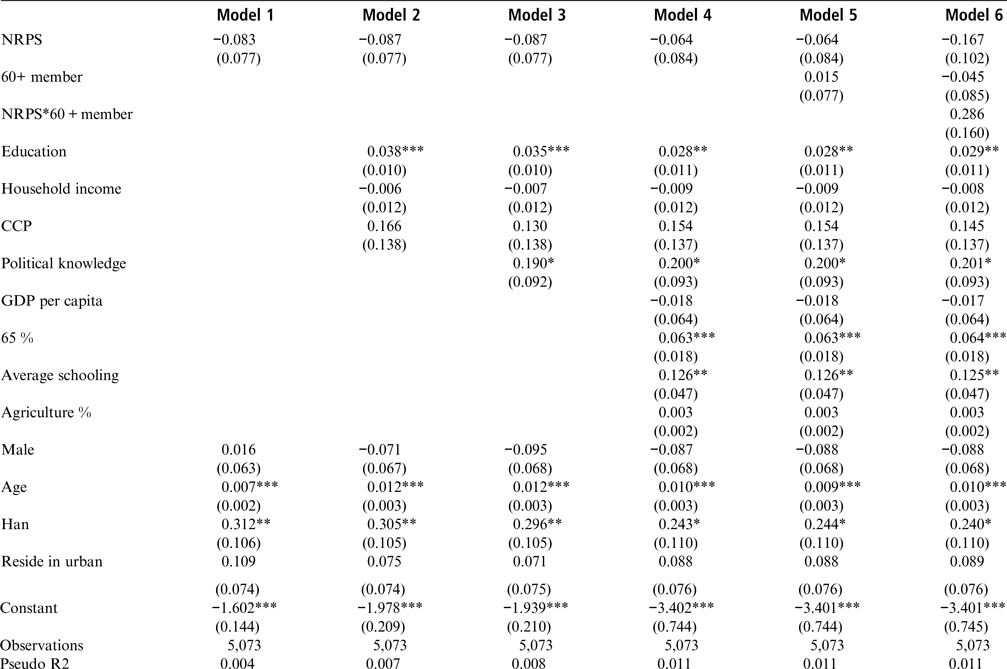
Notes: Robust standard errors in parentheses; *** p < 0.001, ** p < 0.01, * p < 0.05,† p < 0.1
These findings indicate that, contrary to the argument that policy awareness has enhanced Chinese people's trust in the government in the case of the scrapping of school fees,Footnote 51 policy awareness may not be a channel through which the NRPS policy affects Chinese people's political trust in the governments.
Conclusions and Discussion
On the grounds that people who benefit more from social policies report more positive attitudes towards the government and its incumbents, wider social expenditure over the last decade has frequently been used by the Chinese government to garner political support. However, it remains unclear as to whether or not social policies enhance political support, especially for the local governments that are responsible for the implementation of such policies. In this study, we analyse the data from the CGSS 2010 to investigate the effects of the NRPS, initiated by the central government in 2009, on rural people's trust in the central and local governments and their preferences regarding elderly support.
Results show that the implementation of the NRPS significantly enhances rural residents’ political trust in both the central and local governments. Although the central government gained more political support from the general population in NRPS pilots, NRPS beneficiaries expressed similar levels of political trust in both central and local governments, suggesting that material gains from the nationwide public policy could also lend political support for local government. In terms of policy preference, we found that the implementation of the NRPS did not raise rural people's expectations that the government should provide old-age support. Hence, the results suggest that citizens’ political trust is mainly determined by the material benefits they receive, as opposed to a more abstract recognition that the central government is pursuing good policies.
These findings are consistent with those of an empirical study on the implementation of the MLSS, in which citizens who received MLSS subsidies reported a higher level of trust in local government officials.Footnote 52 However, our findings are inconsistent with Lü’s finding that the scrapping of school fees under the Compulsory Education Law increased citizens’ trust in the central government but had little effect on their trust in local government.Footnote 53 Studies on the political consequences of social policy in countries with new democracies have revealed that the economic benefits given to people had little influence on their political trust, and that public opinion of reforms does not always conform to the expectations of the economic voting model.Footnote 54 While these studies have cast doubt on “self-interest” and “rationality” in public opinion and political behaviour,Footnote 55 our findings on the NRPS seem to confirm the conventional wisdom that Chinese citizens are rational and materialistic. This probably is the basis on which the authoritarian regime, without an electoral voting system, can still consolidate its legitimacy through rapid economic development and the provision of public goods. As Andrea Campbell argues, the effects of social policies on political trust may be contingent upon the characteristics of these policies per se, such as the nature of administration, the size of benefits received, the visibility and traceability of benefits, and the concentration/diffusion of beneficiaries.Footnote 56 Therefore, future researchers should investigate and compare the characteristics of social policies and their influence on the efficiency of implementation and subsequently on political support.
Acknowledgements
We would like to thank Cameron Campbell, Raymond Sin-kwok Wong, Yuxiao Wu and Juan Chen for their helpful comments. We are also grateful for financial support from the Research Fund for Junior Faculty in Humanities and Social Science, Shenzhen University (18QNFC42), and the Hong Kong Research Grants Council (RGC) through the General Research Fund (16600615) and the Collaborative Research Fund (C6011-16G).
Biographical notes
Zhonglu Li is an assistant professor at the College of Psychology and Sociology, Shenzhen University. His current research interests include the influence of institutions on people's well-being and attitudes, with a particular focus on education, labour market outcomes and political attitudes in reform-era China.
Xiaogang Wu is a professor at the Division of Social Science, and founding director of the Centre for Applied Social and Economic Research (CASER), at Hong Kong University of Science and Technology. He is also the editor of Chinese Sociological Review. His research interests include social stratification and mobility, labour markets, urban sociology, and quantitative methodology. He has been the principal investigator of the Hong Kong Panel Study of Social Dynamics (HKPSSD) since 2009. In 2017–2018, he was a visiting professor of sociology at New York University, Shanghai, and led a parallel research project in Shanghai entitled “Shanghai Urban Neighbourhood Survey” (SUNS).