INTRODUCTION
Coleoid cephalopods are monocyclic invertebrates that have developed a wide array of reproductive strategies showing a high adaptive flexibility. Current efforts have classified this set of variable reproductive strategies, some only recently described (Hanlon & Messenger, Reference Hanlon and Messenger1996; Nesis, Reference Nesis1996; Rocha et al., Reference Rocha, Guerra and González2001; Nigmatullin, Reference Nigmatullin2002; Boyle & Rodhouse, Reference Boyle and Rodhouse2005).
The jumbo squid Dosidicus gigas (d'Orbigny, 1835) is the largest ommastrephid squid, endemic to the eastern Pacific from California to central Chile over the continental slope and open waters. It is the most primitive and least oceanic representative of the subfamily Ommastrephinae. Jumbo squid shows a very complex population structure with three size reproductive groups, differing in adult squid mantle length (ML). The large-sized group females mature at 550–650 to 1000–1200 mm ML and inhabit the northern and southern periphery of the species range (Nigmatullin et al., Reference Nigmatullin, Nesis and Arkhipkin2001). This form supports a fishery in the Gulf of California originating in 1995 (Markaida & Sosa-Nishizaki, Reference Markaida and Sosa-Nishizaki2001), with mean annual catches of 75 thousand tonnes (t) since then. In the last 5 years this group has formed a significant part of the southern hemisphere fishery, with catches in 2005 of 290 thousand t in both Peru and Chile. Jumbo squid lead the cephalopod landing records since 2004 with an annual worldwide total catch of over 750 thousand t (FAO, 2007).
The fishery biology of jumbo squid has been intensively studied in recent years, but studies on the female reproductive biology on an individual level are lacking. Nesis (Reference Nesis1971, Reference Nesis and Boyle1983) reported a fecundity range from 100,000 to more than 600,000 eggs for the medium-sized form (350–560 mm ML) of female jumbo squid from South American waters. This estimate was correctly written in the abstract and corresponding table, although it was mistakenly reported as an order of magnitude larger in the text (Nesis, Reference Nesis1971, p. 114). The same error is found in the original Russian paper (Nesis, Reference Nesis1970). Ehrhardt et al. (Reference Ehrhardt, Jacquemin, García, González, López, Ortiz, Solís and Caddy1983) ambiguously cited Nesis (Reference Nesis1971) with these erroneous numbers (1 million to more than 6 million eggs). Earlier reviews on squid fecundity (Voss, Reference Voss1983; Mangold, Reference Mangold and Boyle1987; Boyle, Reference Boyle1990) considered this erroneous estimate as an original figure by Ehrhardt et al. (Reference Ehrhardt, Jacquemin, García, González, López, Ortiz, Solís and Caddy1983) for the jumbo squid from the Gulf of California.
In fact, Nesis (Reference Nesis1971, Reference Nesis and Boyle1983) counted only eggs in the oviducts and maturing vitelline oocytes (diameter ~0.8–1 mm) in the ovary. He described mature eggs as amber-yellow, slightly oval, 0.9–1.1 mm in length and weighing on average 0.57 mg. He recognized that his fecundity figure would be an underestimate if the maturation of oocytes was not simultaneous.
Lately it has been found that oceanic ommastrephids (subfamily Ommastrephinae) show the highest potential fecundity among cephalopods with peculiarities in their reproductive strategy such as group asynchronous ovulation, multiple spawning and somatic growth between egg batches (Harman et al., Reference Harman, Young, Reid, Mangold, Suzuki and Hixon1989; Nigmatullin & Laptikhovsky, Reference Nigmatullin and Laptikhovsky1994; Rocha et al., Reference Rocha, Guerra and González2001; Nigmatullin, Reference Nigmatullin2002; Laptikhovsky & Nigmatullin, Reference Laptikhovsky and Nigmatullin2005). Counting oocytes with diameter >0.05 mm in female jumbo squid 150–720 mm ML collected in 1980–1989 from open waters off Nicaragua, equatorial areas and Peru, yielded an estimated potential fecundity of 0.3–13 million eggs (Nigmatullin & Laptikhovsky, Reference Nigmatullin and Laptikhovsky1994). However, these features have never been described in detail for jumbo squid before. The aim of this paper is to describe full oocyte development, ripe egg size variability and different aspects of potential fecundity and its realization during spawning of the large-sized maturing group of jumbo squid.
MATERIALS AND METHODS
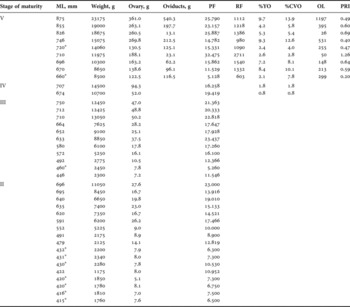
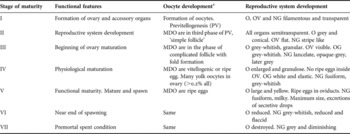
Reproductive systems of 39 females of the large form of jumbo squid of different stages of maturity were analysed. Twenty-nine were collected in the Guaymas Basin, Gulf of California, between 1995 and 1997 (Markaida & Sosa-Nishizaki, Reference Markaida and Sosa-Nishizaki2001) and ten females were taken over the continental slope in Nicaraguan waters during 1988–1989 (Table 1). Dorsal ML was measured to the nearest millimetre, and body weight (BW) to the nearest 15 g with a commercial scale. Stages of maturity were assigned according to Nigmatullin (Reference Nigmatullin1989) (Table 2). The complete reproductive system was stored in 6–8% buffered formaldehyde. Ovary, nidamental glands and oviductal complexes were weighed to the nearest 0.1 g.
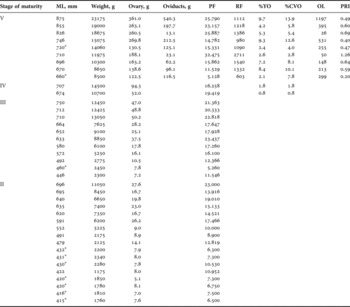
Means of potential fecundity (PF, in millions), relative fecundity (RF), coefficient of viteline oocytes (%CVO), coefficient of yolk oocytes in ovary to total oocyte number in ovary (%YO), oviductal load (OL, in thousands) and index of potential reproductive investment (PRI) of large size maturing Dosidicus gigas females from the Gulf of California and Nicaragua (*) waters.
Maturity stages of the reproductive system of female ommastrephid squids (modified from Nigmatullin, Reference Nigmatullin1989). Most developed oocytes (MDO) in the ovary (O) and development of oviducts (OV), oviductal glands (OG) and nidamental glands (NG) were taken as diagnostic.
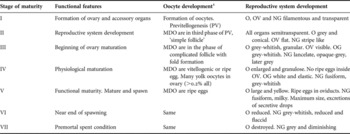
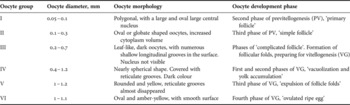
1Oocyte morphological groups related to each development phase are listed in Table 3.
Three subsamples of 1–5 mg were analysed from each part of the ovary (anterior, medial and posterior) of females from II to IV maturity stages. For seven mature (stage V) females of the Gulf of California, five to six subsamples of approximately 15–30 mg each from the aforementioned parts of the ovary were analysed. Each subsample was weighed and then observed in a Bogorov chamber under a binocular microscope (×8–56). All oocytes in the subsample were counted and classified in the six morphological groups described by Laptikhovsky & Nigmatullin (Reference Laptikhovsky and Nigmatullin1992) and Nigmatullin et al. (Reference Nigmatullin, Arkhipkin and Sabirov1995) (Table 3). The major axis of 150 to 250 randomly selected oocytes of each subsample was measured to the nearest 0.01 mm for 13 squid of different maturity stages from the Gulf of California.
Squid oocyte morphological groups found in female Dosidicus gigas (modified from Laptikhovsky & Nigmatullin, Reference Laptikhovsky and Nigmatullin1992; Nigmatullin et al., Reference Nigmatullin, Arkhipkin and Sabirov1995) and their correspondence with the phases of oocyte development (Burukovsky et al., Reference Burukovsky, Zuev, Nigmatullin and Tsymbal1977).
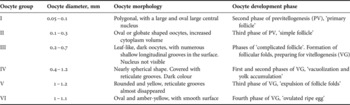
Eggs from the oviducts of 9 mature (stage V) females were analysed (Table 1). Egg number was estimated as the mean egg count between 3 to 6 subsamples of 30–60 mg from different oviduct parts: anterior, medial and posterior. Eggs are oval and thus the shortest and longest diameters, of 3 subsamples of 50 eggs each, from the anterior part of the oviducts of each squid were measured to the nearest 0.05 mm. In addition the casual diameter was measured obviating any selection of the longest or shortest diameter. The micrometer was placed in a horizontal position in the eye-piece and the diameter parallel to the graduation on the micrometer was measured to the nearest 0.1 mm in 3–6 subsamples of 50 eggs from different parts of the oviduct (Laptikhovsky & Nigmatullin, Reference Laptikhovsky and Nigmatullin1993, Reference Laptikhovsky and Nigmatullin1999, Reference Laptikhovsky and Nigmatullin2005).
Potential fecundity (PF) was calculated as the sum of total oocytes (>0.05 mm in diameter) in the ovary and ripe eggs in the oviducts. Relative fecundity (RF) was estimated as the ratio of PF to BW (g). Oviductal load (OL) is the number of eggs in the oviducts. Coefficient of yolk oocytes (%YO) is the number of vitelline oocytes (groups IV, V and VI) in the ovary as a percentage of the total oocyte number in the ovary. Coefficient of vitelline oocytes (%CVO) was calculated as the ratio of the sum of vitelline oocytes in the ovary and eggs in the oviduct to the PF. An index of potential reproductive investment (PRI) was calculated as the product of RF and the weight of an individual ripe egg (Laptikhovsky & Nigmatullin, Reference Laptikhovsky and Nigmatullin1993; Nigmatullin & Laptikhovsky, Reference Nigmatullin and Laptikhovsky1994).
Additionally, the weight of the components of the reproductive system (ovary; both oviductal complexes, OCW; and both nidamental glands, NGW) of 72 mature females (stage of maturity V) from the Gulf of California was taken with an accuracy of 0.1 g (data from Markaida & Sosa-Nishizaki, Reference Markaida and Sosa-Nishizaki2001). The percentage of oviduct fullness (%OF) was calculated for 51 of these females as follows. The maximum value of OCW for all squid in each 25 mm ML interval were taken, and a linear regression was applied to them, without transformation, to estimate the maximum OCW for the ML of any mature female. Subsequently the percentage of oviduct fullness was calculated as the % of each OCW to that maximum weight predicted by the regression for its size (Harman et al., Reference Harman, Young, Reid, Mangold, Suzuki and Hixon1989). The nidamental gland thickness index (NGTI) was calculated as the relationship between the weight, in grams, and length, in mm, of the average of both nidamental glands (modified from Rasero et al., Reference Rasero, Gonzalez and Guerra1995).
To assess the feeding behaviour of mature females, data of stomach fullness index (FI) and stomach fullness weight index (FWI) for 340 females collected in the Guaymas Basin in 1995–1997 were considered (Markaida & Sosa-Nishizaki, Reference Markaida and Sosa-Nishizaki2003). FI is based in a subjective, visual scale, while FWI is the percentage of stomach contents weight related to squid BW. Differences between females of different maturity stage, I to V according to Lipiński & Underhill (Reference Lipiński and Underhill1995), by stomach preservation method (in formalin or frozen) for these indices were tested using a Kruskal–Wallis non-parametric ANOVA.
RESULTS
Oocyte development
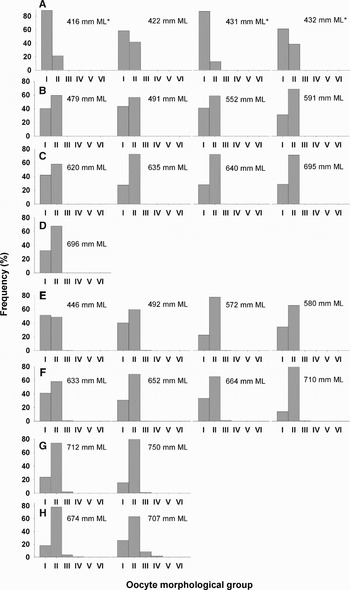
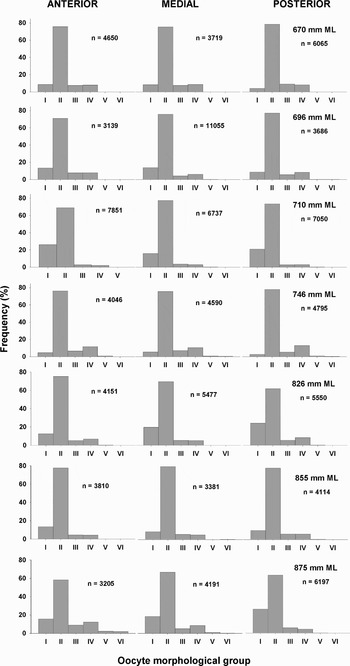
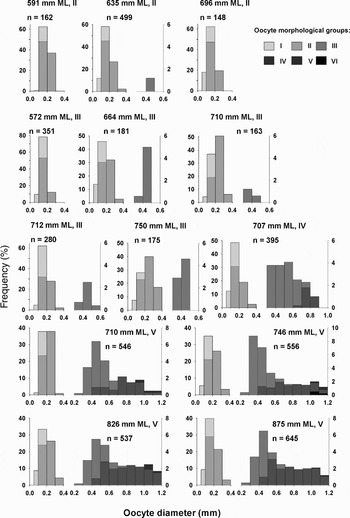
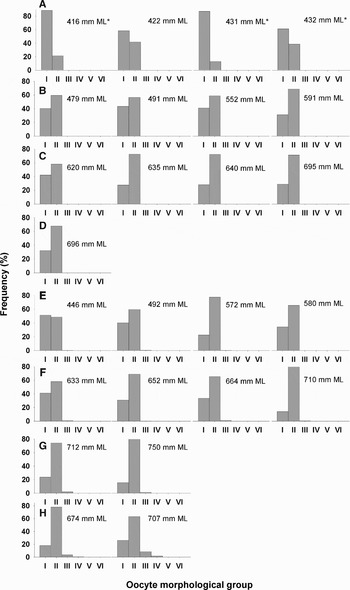
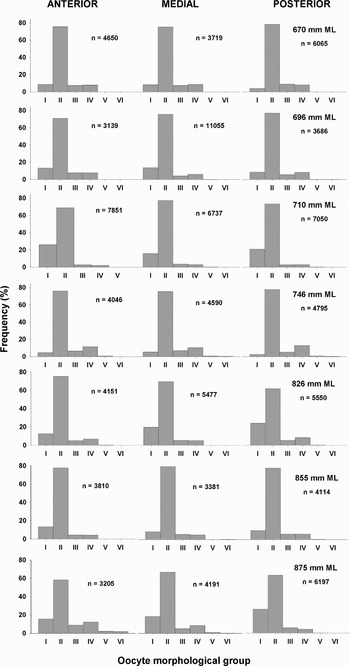
Oocyte group and size distribution in the ovary was unimodal at all maturity stages, with protoplasmic oocytes (groups I and II) predominating in all ovaries. They represent about 90% of total oocyte stock in the ovary (Figures 1–3). No oogonia or oocytes <0.05 mm in diameter were found.
Frequency distribution of oocyte morphological groups in the ovaries of Dosidicus gigas females, related in Table 1. (A, B, C & D) stage of maturity II; (E, F & G) stage III; and (H) stage IV. All individuals are from the Gulf of California, except * from Nicaragua. Stage V females are shown in Figure 2.
Frequency distribution of oocyte morphological groups in the different regions of the ovary (anterior, medial and posterior) of mature females (stage V) of Dosidicus gigas from the Gulf of California, as related in Table 1. n, observed oocyte number.
Size–frequency distribution of oocyte morphological groups found in the ovary of 13 Dosidicus gigas females from the Gulf of California of different stages of maturity, as related in Table 1. Frequency axis for oocyte size-groups III–VI is shown at right. n, observed oocyte number.
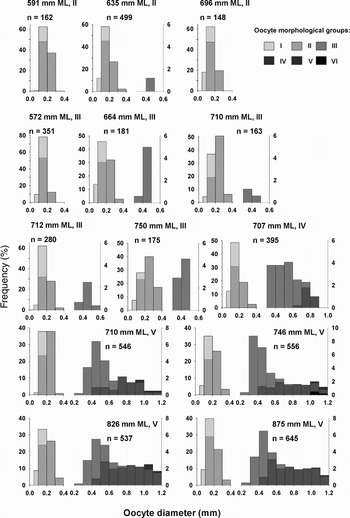
Group I oocytes prevail during maturity stage I and the beginning of stage II (Figure 1). During stage II, oocyte group II dominates (60–70%). In stage III, oocytes preparing to vitellogenesis (group III) comprise up to 2% of all oocytes (Figures 1 & 3). Vitelline oocytes (group IV) first appear in early mature females (stage IV). The number of oocytes of group III increases to 8.6–36%, while vitelline oocytes (YO) range from 0.8–1.8% (Figure 3; Table 1). No oocytes with expulsing follicle or ripe eggs were found in these two females (Figures 1 & 3). In mature females (stage V), vitelline oocytes represent an average of 5.7% of the total intraovaric oocytes, and never more than 10% (Table 1). Mature oocytes (groups V and VI) in the ovary are always rare (0.1–0.5%; Figures 1–3). Oocytes of group V are the largest at 1–1.2 mm, because they are covered by the follicular layer. Resorbed oocytes were not observed and no oocyte resorption is evident.
Oocyte frequency distribution among the six morphological groups significantly differed between the subsamples taken from the three different regions of the ovary (anterior, medial and posterior) in mature females from the Gulf of California (χ2 test, df = 17, P < 0.001 in all cases). However no tendency was observed in oocyte development regarding ovary regions (Figure 2).
Egg size
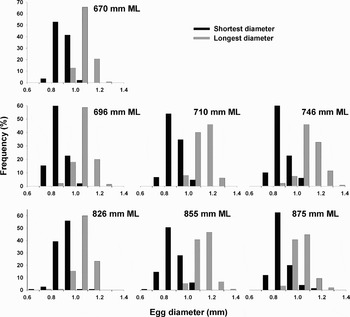
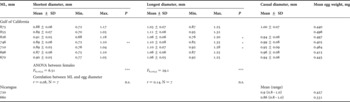
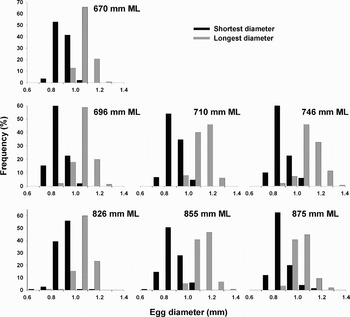
Ripe eggs are pinkish or crimson. Egg shortest diameter in the oviducts of females from the Gulf of California averaged 0.87–0.91 mm and the longest ranged between 1.06 and 1.11 mm (Figure 4). The casual diameter means ranged between 0.94 and 1 mm. Egg weight means ranged between 0.4 and 0.5 mg, with an average of 2350±313 eggs by gram of oviduct (Table 4).
Size–frequency distribution of shortest and longest diameters of the eggs found in the oviducts of mature Dosidicus gigas females (stage V) from the Gulf of California, as related in Table 4.
Mean measures of the diameters and mean weights of the eggs from the oviducts of 11 mature (stage V) females of Dosidicus gigas related in Table 1. For the shortest and longest diameters, 3 subsamples of N = 50 in each case. Significant differences between subsamples of the same female and between females are denoted. For the casual diameters N = 160–325. For the weight of eggs N = 6.
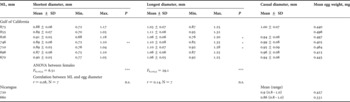
Significant differences: ***, P < 0.001; **, P < 0.01; *, P < 0.05; Min., minimum; Max., maximum; n.s., not significant.
Egg size variability can be very high in the same female. There were significant intraindividual differences in oocyte size (shortest and longest diameters) among subsamples taken from three squid (ANOVA, P < 0.05; Table 4). There were highly significant differences between the shortest and longest diameters among all analysed squid from the Gulf of California (ANOVA, P < 0.001; Table 4). However, there was no correlation between the sizes of these females and the average size of the shortest or of the longest diameter of their eggs (P > 0.05; Table 4).
Potential fecundity
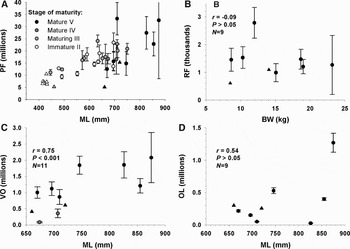
The total number of oocytes in the ovaries and oviducts of studied females ranged from 5.2 million in the maturing female of 460 mm ML to 32 million in a mature female of 710 mm ML (Table 1). A comparison of the PF between immature, maturing and mature animals showed that PF is defined at least at the beginning of stage II. Three immature (stage II) females already had fecundities of 17–23 million oocytes (Table 1). All oocytes may be easily counted in these squid in the late immature stage. The average ±SD PF by stage of maturity for large females from the Gulf of California are: stage II (420–696 mm ML), 15.0±4.6 million; stage III (446–750 mm ML), 18.1±5.0 million; stage IV (674–707 mm ML), 16.6±1.0 million; stage V (670–875 mm ML), 20.9±8.8 million. Larger variances among females of stage V are due to the fact that some eggs have been deposited. There are significant differences in PF values among females of all (II–V) maturity stages (Kruskal–Wallis non-parametric ANOVA, H = 10, df = 3, P < 0.05). The post-hoc Tukey test demonstrated that PF for stage of maturity (V) is larger than stage (II) (P < 0.05). Lack of differences among stages III–V strongly suggests that PF is determined at an early stage of maturity. Immature females from Nicaragua had a significantly lower potential fecundity (7.4±1.4 million) than those from the Gulf of California (15.0±4.6 million: Table 1; Figure 5A) (Mann–Whitney U-test, U = 3.22, P < 0.01).
Relationship between the fecundity and the size of large Dosidicus gigas females. (A) Relationship between the mantle length (ML) and the potential fecundity (PF) of all females; (B) relationship among body weight (BW) and the relative fecundity (RF) of mature V females; (C) all vitelline oocytes (VO) in the ovary of females (IV–V); and (D) oviductal load (OL) of mature (V) females. Circles, squid from the Gulf of California (mean±SD); triangles, squid from Nicaraguan waters (mean).

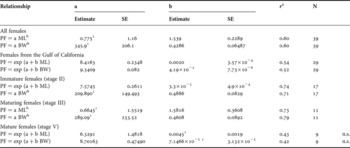
Potential fecundity increased with squid dimensions (Figure 5A) and according to the equations given in Table 5 for females of different maturity stages. In all cases the fecundity is characterized by a negative allometry, both in ML (b < 3) and in weight (b < 1). The mean relative fecundity was 1330±583 eggs/g for mature females (V), ranging between means of 603 and 2711 eggs/g. Relative fecundity is not related to BW in mature females (V) (Figure 5B).
Relationships between potential fecundity (PF, in thousands) and mantle length (ML, in mm) and body weight (BW, in g) for Dosidicus gigas females of different maturing stages.
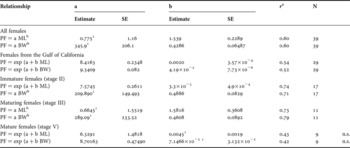
1Parameter statistically not significant; n.s., regression not significant.
The coefficient of vitelline oocytes (%CVO) on average represented 7.8±3.7% of the total oocytes in mature females (V), with a range of 2.8–13.9% (Table 1). The relationship between the total number of the vitelline oocytes in the ovary and the ML of mature females (IV–V) (Figure 5C) was significant. PRI averaged 0.59±0.29 with a range of 0.2–1.26 (Table 1). This index did not correlate with squid BW (r = 0.001, N = 9, P > 0.05).
Oviduct filling
The oviducts of the large-size females contain an average of 346 ± 356 thousand eggs, although the large observed variability is due to different degrees of their fullness. The lowest figures probably reflect situations of beginning of the filling or the end of the emptying of the oviducts after a spawning activity event. The maximum number, 1.2 million eggs (4.6% PF), was observed in the largest female considered in this study, whose totally full oviducts together weighed 540 g (Table 1). Oviductal load represented only 2.27±2% PF in mature females (V) on average, with a maximum of 5.8%. The relationship with squid size (Figure 5D) was not significant.
Relations among the reproductive organs
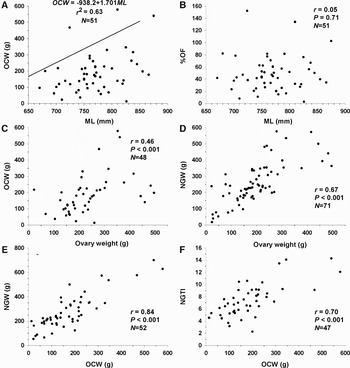
The relationship between the maximum OCW and the ML was significant (Figure 6A; P < 0.05). However, the variability in %OF was very high; there was no correlation between this percentage and squid size (Figure 6B). %OF averaged 46±30% and only 11% of females showed fullness ≥80%.
Relationships among the reproductive organs of mature (stage V) large Dosidicus gigas females from the Gulf of California: relationship among the ML and (A) both oviductal complex weight (OCW) (the regression calculated from the maximum values each 25 mm ML is shown); (B) the coefficient of oviductal fullness (%OF); relationship among the weight of the ovary and (C) the OCW; (D) both nidamental glands weight (NGW); relationship among the OCW and (E) the NGW; and (F) the index of nidamental gland thickness (NGTI).

The relationship between the ovary weight and OCW was weak, although highly significant for mature females, as well for the relationship with the NGW (Figure 6C, D). The correlation between the PF and OL was not significant for mature squid (Table 1; r = 0.22, N = 9, P = 0.53). However, the relationship between the OCW and NGW was high and significant, as well as the relationship between the OCW and the NGTI (Figure 6E, F).
Feeding activity during spawning period
Means of FI by maturity stage ranged 1.2–2.2. They did not show any differences between all maturity stages considered, even testing for stomach samples by formaldehyde and frozen preservation methods together (Kruskal–Wallis non-parametric ANOVA, H = 4.81, df = 4, P > 0.05). FWI values were low, with means by maturity stage ranging 0.01–0.35% of squid body weight. They showed no differences between females of all different maturity stages for formalin preserved stomachs (Kruskal–Wallis non-parametric ANOVA, H = 2.67, df = 4 P > 0.05). Among frozen stomachs, largest FWI values were found in stage V females (H = 14.10, df = 3, P < 0.01).
DISCUSSION
Oocyte morphological groups correspond to consecutive phases of oocyte development already described by histological validation in large D. gigas females (Díaz-Uribe et al., Reference Díaz-Uribe, Hernández-Herrera, Morales-Bojórquez, Martínez-Aguilar, Suárez-Higuera and Hernández-López2006). The development of the oocytes of the jumbo squid is clearly asynchronous, reflected by the predominance of small protoplasmic oocytes in all maturity stages, including mature and spawning ones. The same has been documented for other ommastrephid squid (Burukovsky et al., Reference Burukovsky, Zuev, Nigmatullin and Tsymbal1977; Harman et al., Reference Harman, Young, Reid, Mangold, Suzuki and Hixon1989; Nigmatullin & Laptikhovsky, Reference Nigmatullin and Laptikhovsky1994, Reference Nigmatullin and Laptikhovsky1999). Thus a mature female shows all stages of oocyte development in the ovary (Burukovsky et al., Reference Burukovsky, Zuev, Nigmatullin and Tsymbal1977), while protoplasmic oocytes of about 0.2 mm prevail in the ovary through all the ontogenetic stages, after maturity stage I. However, oogonia and oocytes <0.05 mm were absent from advanced immature stages, reflecting the end of egg production before vitellogenesis and indicating a monocyclic life style, as shown in other ommastrephids (Burukovsky et al., Reference Burukovsky, Zuev, Nigmatullin and Tsymbal1977; Coelho, Reference Coelho1990; Laptikhovsky & Nigmatullin, Reference Laptikhovsky and Nigmatullin1993, Reference Laptikhovsky and Nigmatullin1999). On the other hand, scarcity of mature oocytes in the ovary reflects their rapid passage to the oviducts (Nigmatullin et al., Reference Nigmatullin, Arkhipkin and Sabirov1995). Given the asynchronous character of oocyte development and egg maturation, potential fecundity should be estimated from the total number of oocytes (Nigmatullin, Reference Nigmatullin2002). Fecundity estimates based only on the number of vitelline oocytes and ripe eggs (Nesis, Reference Nesis1970, Reference Nesis1971, Reference Nesis and Boyle1983) underestimate the real fecundity, since they represent no more than 14% PF at any given moment.
The large-size maturing group of jumbo squid presents the maximum values of potential fecundity (up to 32 million eggs) known for any cephalopod, previously assigned to the large form of Sthenoteuthis oualaniensis with 22 million eggs (Nigmatullin & Laptikhovsky, Reference Nigmatullin and Laptikhovsky1994). High productivity in the eastern Pacific waters allows rapid somatic growth to a very large ML in adults. Coupled with highly variable interannual conditions and conservation of small egg size, this can result in a very high fecundity in the large-sized group of jumbo squid. High fecundities of more oceanic ommastrephids (Sthenoteuthis and Ommastrephes) with the same small egg sizes are related to the unpredictability of their habitat (Nigmatullin & Laptikhovsky, Reference Nigmatullin and Laptikhovsky1994). Thus the most important factors contributing to the high PF of D. gigas are large female size and small egg size, close to the smallest of any cephalopod (Mangold, Reference Mangold and Boyle1987). Females of the Gulf of California attain larger fecundity than females from Nicaragua because they reach a larger size. Nicaraguan mature females of the large-sized group range between 550 and 700 mm ML (Nigmatullin, unpublished data), while females from the Gulf of California mature at 750 mm ML (Markaida & Sosa-Nishizaki, Reference Markaida and Sosa-Nishizaki2001). The largest jumbo squid females, known to reach 120 cm ML and 58–65 kg BW off Peru (Clarke & Paliza, Reference Clarke and Paliza2000) may show a much higher fecundity. PF calculated for those maximum dimensions from equations for females in Table 5 yield an estimation of around 42–50 million eggs.
Actual (realized) fecundity (AF, as part of the PF that will be spawned) in jumbo squid is unknown, due to the lack of specimens of spent females with which to estimate remaining non-spawned eggs and oocytes. AF has been estimated in few ommastrephid squid (Illex and Todarodes) ranging 60–80% (Nigmatullin & Laptikhovsky, Reference Nigmatullin and Laptikhovsky1999). Minimum AF of partially spent Sthenoteuthis pteropus was calculated at 35–50% (Laptikhovsky & Nigmatullin, Reference Laptikhovsky and Nigmatullin2005). A rough figure of AF for ommastrephids may be 50–70% PF of pre-spawning females (ranging from minimum to realistic values). Taking a conservative mean PF estimate for large jumbo squid females of 20 million eggs (mean PF for mature stage V females), this would give an AF of 10–14 million eggs.
Jumbo squid egg size is similar to the rest of the Ommastrephinae, with 0.7–1 mm diameter and egg weight of 0.2–0.24 mg. The lack of correlation between egg dimensions and squid size are found in other ommastrephid species (Laptikhovsky & Nigmatullin, Reference Laptikhovsky and Nigmatullin1993, Reference Laptikhovsky and Nigmatullin2005; Nigmatullin & Laptikhovsky, Reference Nigmatullin and Laptikhovsky1994, Reference Nigmatullin and Laptikhovsky1999).
A great individual variability exists in many, if not in all, the parameters related to fecundity. Large differences in the PF of jumbo squid from the same area have been found. This fact may be a reflection of the variability of the habitat, which directly affects the growth and development at early stages, when the potential fecundity is determined. Another reason for this fact could be the significant individual variability of genetic factors that control the fecundity level (Futuyma, Reference Futuyma1986).
A large variability in the oviductal egg size has been also found. The nature of these differences may rely on the varying lengths of time that samples were stored in formalin. This fact precludes comparison of egg size between different localities. In addition, formalin causes eggs to be not symmetrical (Laptikhovsky & Nigmatullin, Reference Laptikhovsky and Nigmatullin1993). In many cases eggs had a polyhedral shape, preventing an accurate measurement of their diameter. A suitable solution to this problem in the future relies on the measurement of fresh, not fixed eggs.
Oviducts are organs of multiple accumulations, storage and discharging of eggs, necessary for the asynchronous character of vitellogenesis, that leads to intermittent spawning, and to realize a high PF (Burukovsky et al., Reference Burukovsky, Zuev, Nigmatullin and Tsymbal1977; Nigmatullin & Laptikhovsky, Reference Nigmatullin and Laptikhovsky1994). In jumbo squid the oviducts of non-spawning females cannot store more than 5% PF. Thus, to complete the actual fecundity, even if it only represents 50–70% of the PF (see above), oviducts should be filled and evacuated several times (Harman et al., Reference Harman, Young, Reid, Mangold, Suzuki and Hixon1989; Nigmatullin & Laptikhovsky, Reference Nigmatullin and Laptikhovsky1994; Rasero et al., Reference Rasero, Gonzalez and Guerra1995). During an individual spawning season other oocytes begin the vitellogenesis process given the asynchronous oocyte stock development, and the amount of vitelline oocytes is being continually renewed (Laptikhovsky & Nigmatullin, Reference Laptikhovsky and Nigmatullin1993, Reference Laptikhovsky and Nigmatullin2005). Jumbo squid, as the rest of ommastrephids, is a monocyclic organism with intermittent spawning (Harman et al., Reference Harman, Young, Reid, Mangold, Suzuki and Hixon1989; Nigmatullin & Laptikhovsky, Reference Nigmatullin and Laptikhovsky1994). As found for other ommastrephids, indirect evidence of intermittent spawning in jumbo squid females include: a high positive relationship between the weight of oviductal eggs and nidamental gland weight (Young & Hixon in Mangold, Reference Mangold and Boyle1987); nidamental gland thickness index (Rasero et al., 1995 ); low correlation among ovary and nidamental glands weights (Young & Hixon in Mangold, Reference Mangold and Boyle1987); and a wide range in the oviduct fullness (Young & Hixon in Mangold, Reference Mangold and Boyle1987) without any relationship with squid size (Harman et al., Reference Harman, Young, Reid, Mangold, Suzuki and Hixon1989; González & Guerra, Reference González and Guerra1996).
The single, terminal spawning stage in ommastrephids is composed of periods of spawning activity (egg laying events and egg batches; Rocha et al., Reference Rocha, Guerra and González2001) interspersed with periods of egg accumulation in the oviducts (Harman et al., Reference Harman, Young, Reid, Mangold, Suzuki and Hixon1989; Laptikhovsky & Nigmatullin, Reference Laptikhovsky and Nigmatullin1993, Reference Laptikhovsky and Nigmatullin2005). The number of eggs spawned in each event (laying one or several egg masses) is determined by the size of the oviducts, which in turn are determined by the size of the female squid (Burukovsky et al., Reference Burukovsky, Zuev, Nigmatullin and Tsymbal1977; Mangold, Reference Mangold and Boyle1987). Maximum oviductal load for jumbo squid in this study was estimated at 1.2 million eggs. Observations of female ommastrephids (Illex and Todarodes) kept in captivity suggest that not all oviductal eggs are released at once (Durward et al., Reference Durward, Vessey, O'Dor and Amaratunga1980; Bower & Sakurai, Reference Bower and Sakurai1996), although medium-size female D. gigas spawning in captivity showed empty oviducts (Staaf et al., Reference Staaf, Camarillo-Coop, Haddock, Nyack, Payne, Ramirez-Rojo, Salinas-Zavala, Seibel, Trueblood, Widmer and Gilly2008). Our observations (Ch. Nigmatullin) on the oviductal load in spawning females of this family suggest that around 80% of all oviductal eggs are released during a period of spawning activity. Thus in the case of large-sized jumbo squid around 1 million eggs could be spawned in each of these events. This fall in the range of egg number (0.6 to 2 million) estimated for the single D. gigas egg mass has been found in nature so far (Staaf et al., Reference Staaf, Camarillo-Coop, Haddock, Nyack, Payne, Ramirez-Rojo, Salinas-Zavala, Seibel, Trueblood, Widmer and Gilly2008). In oceanic ommastrephids (subfamily Ommastrephinae) it is thought that the number of realized eggs in each successive spawning event is quasi-equal (Nigmatullin & Laptikhovsky, Reference Nigmatullin and Laptikhovsky1994, Reference Nigmatullin and Laptikhovsky1999).
A rough estimation of periods of individual spawning activity can be made based on available data for estimated age at maturity and maximum age. Large-sized females in the Gulf of California attain maturity and start spawning at the age of about 12 months and 730 mm ML, while maximum ages for mature females of 810–866 mm ML have been estimated at 15 months (Markaida et al., Reference Markaida, Quiñonez-Velazquez and Sosa-Nishizaki2004). These older females showed good condition of somatic and reproductive organs, without signs of final degenerative changes, being far from spent (Markaida & Sosa-Nishizaki, Reference Markaida and Sosa-Nishizaki2001; U. Markaida, personal observation). Thus, these females may continue to spawn for at least one month more. The duration of their individual complete spawning stage may last about 100–120 days (3–4 months). Considering an actual fecundity of 10–14 millions eggs and that a million eggs are spawned in each event (see above), actual fecundity must be realized during 10–14 egg-laying events (batches). The interlude period in which egg accumulates in the oviducts again, between two periods of spawning activity, may last from 8 to 12 days, on average 10 days.
During these interlude periods jumbo squid females actively feed. Stomach fullness indices suggest that feeding intensity in mature females does not decrease. Large mature jumbo squid are commonly caught jigging in the Gulf of California (Markaida & Sosa-Nishizaki, Reference Markaida and Sosa-Nishizaki2001), an indication that they were actively hunting. Moreover between 8 and 10% of mature females (>800 mm ML) showed evidence of recent cannibalism (although artificial) in their stomachs (Markaida & Sosa-Nishizaki, Reference Markaida and Sosa-Nishizaki2003). Feeding supplies the energy needed for an active and routine metabolism, and generative (active vitellogenesis) and somatic growth (Harman et al., Reference Harman, Young, Reid, Mangold, Suzuki and Hixon1989). According to growth equations calculated by Markaida et al. (Reference Markaida, Quiñonez-Velazquez and Sosa-Nishizaki2004), they could gain at least 115 mm (15%) ML and 5200 g (41%) in body weight during a spawning stage of 3–4 months. Thus feeding of adult females between egg batches is a characteristic feature of the oceanic type of ommastrephid spawning strategy (Nigmatullin & Laptikhovsky, Reference Nigmatullin and Laptikhovsky1994; Laptikhovsky & Nigmatullin, Reference Laptikhovsky and Nigmatullin2005; Nigmatullin, Reference Nigmatullin2007).
The rm index is a measure of the maximum production of a population with exponential growth (Parsons et al., Reference Parsons, Takahashi and Hargrave1977). Supposing that the actual fecundity is 50–80% of the potential fecundity (see above) and the longevity of the four largest females of this study averaged 13 months (Markaida et al., Reference Markaida, Quiñonez-Velazquez and Sosa-Nishizaki2004), monthly rm would range from 1.21–1.29. These values are close to Sthenoteuthis (1.2–1.3) and bigger than those for neritic ommastrephid subfamilies (0.9–1.15) (Nigmatullin & Laptikhovsky, Reference Nigmatullin and Laptikhovsky1999).
In jumbo squid the relation between copulation and egg spawning is unknown. Females start copulating while immature and keep copulating until maturity because fresh spermatangia have been found in the buccal mass during all those maturity stages (Markaida & Sosa-Nishizaki, Reference Markaida and Sosa-Nishizaki2001). The buccal membrane holds 125–225 seminal receptacles with special glands secreting products for sperm immobilization and nourishment (Ch.M. Nigmatullin, personal observation) where viable sperm is kept during a very long time after copulation (Hanlon & Messenger, Reference Hanlon and Messenger1996).
In general the large-sized group of D. gigas can be considered a typical representative of the oceanic reproductive strategy, despite their nerito-oceanic range and close association with shelf waters (Nigmatullin & Laptikhovsky, Reference Nigmatullin and Laptikhovsky1994, Reference Nigmatullin and Laptikhovsky1999; Nigmatullin et al., Reference Nigmatullin, Nesis and Arkhipkin2001). This strategy is characterized by the most evident r-strategy features: small eggs, very high potential and, probably, actual fecundity. A long intermittent spawning stage is composed of 10–14 cycles of egg laying events (egg batches) intercalated with periods of active feeding and somatic growth in which eggs accumulate in oviducts. It is in contrast to the offshore spawning strategy shown by neritic and nerito-oceanic ommastrephids (i.e. Illex, Todaropsis and Todarodes) with large eggs size (1.0 to 1.6–2.4 mm) and a moderate fecundity. Females of these squid cease to feed after the start of the spawning stage and thus the number of spawned eggs in each subsequent egg-laying event decreases (Laptikhovsky & Nigmatullin, Reference Laptikhovsky and Nigmatullin1993; Nigmatullin & Laptikhovsky, Reference Nigmatullin and Laptikhovsky1999; Nigmatullin, Reference Nigmatullin2007).
The oceanic reproductive pattern, along with a large body size, is very similar to reproductive strategy of oceanic scombroid fish, and particularly for tuna of the genus Thunnus. Despite large body size, these fish also show basic r-strategist reproductive characteristics such as asynchronous oocyte development, relatively small eggs (0.9–1.3 mm), high actual fecundity (1–11 million), protracted multiple batch spawning with active feeding and high rates of somatic growth, at least for their first and second years of life (Alekseyev & Alekseyeva, Reference Alekseyev and Alekseyeva1981; Schaefer, Reference Schaefer, Block and Stevens2001). It is important to stress that these similar reproductive strategies in jumbo squid and tuna are formed on a different basis: monocyclia with life cycle within one year in squid, and polycyclia with a long 5–10 years life cycle in tuna. The similarity of the main reproductive traits in ommastrephid squid and tuna fish is an example of a typical functional homoplasy (Futuyma, Reference Futuyma1986, p. 295). It is based on the convergent evolution by both groups during their development toward an oceanic realm from an initial shelf-slope zone (Parin, Reference Parin1970, Nigmatullin, Reference Nigmatullin2007). The convergent formation of this adaptive strategy has mainly been determined by a high level of unpredictable habitat in the oceanic realm.
ACKNOWLEDGEMENTS
We gratefully acknowledge T.A. Simonova, V.V. Laptikhovsky, K.D. Shilin and V.A. Obraztsov for technical help, and A.V. Parfenjuk and Ju.N. Zheronkin for help in collecting samples off the coasts of Nicaragua and Peru. Samples from the Gulf of California were taken with the collaboration of many fishermen, members of the fishing industry, particularly Salvador Lizarraga (Pesquera Selecta, Guaymas) and Manuel Cortez (Pesquera Mexico, Santa Rosalia), and the personnel of CRIP at Guaymas, especially Araceli Ramos. This paper constitutes part of the second author's doctoral thesis and during its completion he received a grant from the Foreign Secretary of Mexico. Support from Oscar Sosa-Nishizaki (CICESE, Ensenada) to this work is also greatly acknowledged. Danna Joy Shulman kindly edited the English and reviewed the manuscript. It greatly benefited from the criticism of V.V. Laptikhovsky and several anonymous referees. This study was supported by the Russian Foundation for Basic Research, project No. 06-04-49806.