In 1968, in Saka Grammatical Studies, R.E. Emmerick assigned all present stems to one of four types according to an inflectional pattern. He wrote, “all Khotanese verbs fall into one of the following categories based on the 3 sg. and 3 pl. pres.:
-
A. -iti, -īndi/ -ite, āre
-
B. -ti, -īndi/ -te, -āre
-
C. -aittä, -aindä
-
D. -aiyä, -aindä/ -aiye, -(i)yāre” (SGS: 177)
It is argued here that the stems subsumed under Emmerick's type D may be synchronically analysed as type A vowel stems. The attested forms may be seen as the result of the addition of ordinary type A endings found with consonant stems (SGS: 190–220) to stems ending in vowels.
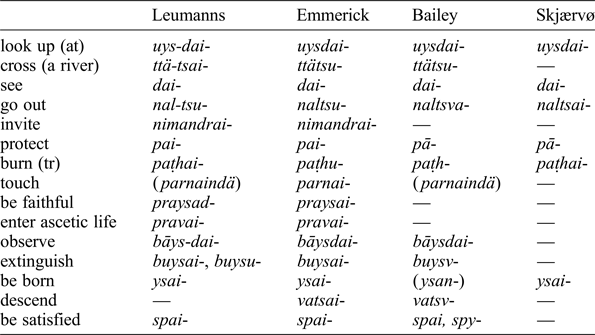
Previous scholarship has generally presented Emmerick's type D stems as vowel-final. Table 1 presents some of the shapes given by the Leumanns (Glossar), Emmerick (SGS), Bailey (DKS) and Skjærvø (Suv).
Type D stem shape uncertainty

The inconsistency in shapes reflects the difficulty these stems pose in analysis. From a synchronic viewpoint, it may be that none of the shapes in the table is correct. For instance, the participle of necessity, paṭhāña- ‘must be burned’, which features the regularFootnote 1 p.nec suffix -āña-, and the 3Sp.a paṭhaiyä ‘it burns (tr)’, cannot both be synchronically derived from any of the stems in the chart. The difficulty in determining stem shape may be because of the reliance on the third person forms. Other suffixed forms of the present stems give more useful information.
Subtypes D1 and D2
Emmerick's type D stems fall into two classes according to the shapes which result from the addition of certain vowel-initial suffixes. For convenience, the temporary labels D1 and D2 are used to distinguish the classes. The distinct behaviour is most clear with suffixes beginning with -ā- where there is direct contrast in three categories:
3Pp.m -āre
D1 vatsāre ‘they go down’ IOL Khot 159/7r2
D2 ysyāre ‘they are born’ Z 3.62; LKh spyārä ‘they abound’ KT3 28.255
1Pp.a -āmä
D1 pāmä ‘we protect’ Suv[Or] 6.1.39
D2 dyāmä ‘we see’ Z 4.54, däyāmä Z 14.56
p.nec -āña
D1 NSm paṭhāñä ‘must be burned’ Suv[Or] 8.23
D2 NAPf uysdyāñe ‘must be observed’ Suv 6.3.22, uysdiyāñe Suv[Or] 6.3.21; NAPm dyāña ‘must be seen’ Z 2.162, diyāña Z 2.153, däyāña Z 2.210
In those three categories, after the last consonant in the stem, D1 shows -ā- while D2 shows -yā-, -äyā-, or -iyā-. This pattern extends to other suffixes beginning in -ā- where just one or the other stem type is attested:
3Psj.a -āro
D1 numąndrāro ‘we should invite’ IOL Khot 147/3v2 Neb pp. 107–9
D2 —
1Pp.m -āmane
D1 —
D2 1Pp.m ysyāmane ‘we are born’ Sgh[17] 253[50]
1Psj.a -āma
D1 —
D2 dyāma ‘we would see’ Sgh[7] 198.4
3Ssj.m -āte
D1 —
D2 ysyāte ‘should be born’ SI P 65.2 + r3
3Psj.m -ānde
D1 —
D2 LKh spyāṃde ‘may they flourish’ KT3 48.13
agent noun -āka-
D1 —
D2 NSm dyākä ‘observer’ Z 5.72, däyākä Z 8.13; NAPm bāysdy[ā]ka ‘watcher’ Z 24.642
abstract noun -āmatā-
D1 —
D2 NSf dyāmata ‘seeing’ IOL Khot 156/7 r3; ASf ysyāmato ‘birth’ Suv[Or] 12.9; IASf bāysdyemäte jsa ‘observation’ IOL Khot 149/1 v6, bāysdiyemetä jsa IOL Khot 148/3.r6
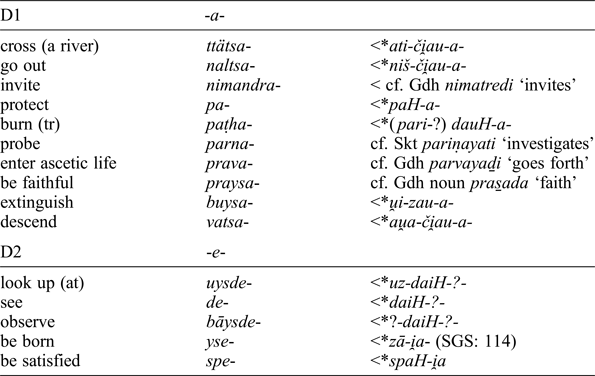
The D1 stems at this point are pV- ‘protect’, nimandrV- ‘invite’, paṭhV- ‘burn (tr)’, and vatsV- ‘go down’. In additon, the stems naltsV- ‘go out’ and ttätsV- ‘cross (a river)’ are etymologically related to vatsV-. All three reflect Proto-Iranian *či̯au-a- Footnote 2 ‘move, go’ (EDIV: 40–1) and all likely belong to the D1 morphological category. Etymological considerations may permit us to place two further stems in the D1 category. The Proto-Iranian etymon for the stem buysV- ‘extinguish’, *u̯i-zau-a- (EDIV: 471–2) has the same final root vowel as the etymon for vatsV- ‘descend’, *au̯a-či̯au-a- (EDIV: 41).
The D2 verbs so far are uysdV- ‘look up (at)’, dV- ‘see’, ysV- ‘be born’, and spV- ‘be satisfied’.Footnote 3 To these may be added bāysdV- ‘observe’, which is related to both dV- and uysdV- (all from *daiH-a- ‘look, see’; EDIV: 48–9).
Three verbs have not yet been assigned to either type: parnV- ‘touch’, praysV- ‘be faithful’, pravV- ‘enter ascetic life’.
D1 stem vowel
As shown above, the D1 stems show a contraction of the stem vowel, V, with a suffixal -ā producing -ā. The contraction may be abbreviated V+ā>ā. The D1 vowel takes part in four attested contractions.Footnote 4 Besides V+ā>ā, there are V+u>o, V+ä>ei >ai, and V+ī>ai. Each process may tell us something about the nature of D1. One example of each stem+suffix combination is listed below to show the range of suffixes.
V+ā>ā
1Pp.a -āmä
pāmä Suv[Or] 6.1.39, [Or]11.9 (-mī, + -ī) • /bāmĕ < bV- + āmĕ/.Footnote 5
3Pp.m -āre
vatsāre IOL Kh 159/7r2 • /watˢāṛē < watˢV- + -āṛē/
3Psj.a -āro
numąndrāro IOL Khot 147/3v2 Neb: 107–9 • /nĕmandṛāṛo < nĕmandṛV- + -āṛu/
p.nec -āña-
NSm paṭhāñä Suv[Or] 8.23 • /baṭʰāñĕ < baṭʰV- + -āñ- + -ĕ/
V+u>(au>)o
2Siv.m -u
naltso Z 5.30 • / naltˢʰō < naltˢʰau̯ < naltˢʰV- + -u/
2Siv.a -u (usually -a but middle -u “is rarely found with act. verbs”; SGS: 212)
buyso Z 5.50 • /βuzō < βuzau̯ < βuzV- + -u/
V+ä>ei>ai
3Sp.m -äte Footnote 6
naltseiye Z 22.202, naltsaiye Z 24.252, naltseiyä Z 24.405 • /naltˢʰai̯ʔē < naltˢʰae̯ʔē < naltˢʰae̯dē < naltˢʰV- + -ĕdē/
3Sp.a -ätä
ttätsaiyi Z 13.27 • /tĕtˢʰai̯ʔi < tĕtˢʰae̯ʔĕ < tĕtˢʰae̯dĕ < tĕtˢʰV- + -ĕdĕ/
nämaṃdraiyä Z 24.465 • /nĕmandṛai̯ʔĕ < nĕmandṛae̯ʔĕ < nĕmandṛae̯dĕ < nĕmandṛV- + -ĕdĕ/
paṭhaiyä Z 2.1752 • /baṭʰai̯ʔĕ < baṭʰae̯ʔĕ < baṭʰae̯dĕ < baṭʰV- + -ĕdĕ/
buysaitä Z 4.95, buysaiyä Z 13.132 • /βuzai̯ʔĕ < βuzae̯ʔĕ < βuzae̯dĕ < βuzV- + -ĕdĕ/
2Piv.a -äta
paiya Z 22.277, Suv[Or] 6.1.57 • /bai̯ʔa < bae̯ʔa < bae̯da < bV- + -ĕda/
3Sop.a -ä
buysai Z 20.24 • /βuzai̯ < βuzae̯ < βuzV- + -ĕ/
3Sij.m -äta
vatseiya Neb 50.30 • /watˢae̯ʔa < watˢae̯da < watˢV- + -ĕda/
infinitive -ä
buysai Sgh 205.1 • /βuzai̯ < βuzae̯ < βuzV- + -ĕ/
V+ī>ai
3Pp.a -īndä
nämandraindä Z 12.61 • /nĕmandṛai̯ndĕ < nĕmandṛV- + -īndĕ/
3Pp.a paindä Z 16.5 • /bai̯ndĕ < bV- + -īndĕ/
1Sp.a -īmä
nimandraimä Z 2.50 • /nĕmandṛai̯mĕ < nĕmandṛV- + -īmĕ/
buysaimä Z 20.23, 24 • /βuzai̯mä < βuzV- + -īmĕ/
3Pop.a -īru
buysairu Z 4.63 • /βuzai̯ṛu < βuzV- + -īṛu/
The contraction processes among the nominals are better understood than those involving the present stems. By comparing all four of the D1 contractions with nominal contractions a strong candidate for the D1 vowel emerges. There are parallel contractions for all four where short a is the first vowel. All of the evidence comes from the nominal stems ending in /-a-/, that is, from the stems in the aa- and aā-declensions (evidence from the latter attested only from adjectives).
a+ā>ā
The process a+ā>ā Footnote 7 is seen in the GDPmFootnote 8 of the aa-decl in a+ānu>ānu:
āchānu Z 24.222 < āchaa- ‘disease’ + -ānu • /āčʰānu < āčʰa- + -ānu/
ṣṣāvānu Z 3.120 < ṣṣāvaa- ‘śrāvaka’ + -ānu • /ṣāwānu < ṣāwa- + -ānu/
balysūñavūysānu Śgs 3.6v1 < balysūñavūysaa- ‘Bodhisattva’ + -ānu • /βalzūñawūzānu < βalzūñawūza- + -ānu/
a+u>au>o
The contraction a+u>au>o is seen in the ASm of the aa-declension. In the oldest texts, such as the Śūraṅgamasamādhisūtra and manuscript 1 of the Saṅghāṭasūtra, we find the most conservative morphophonology. In these ‘archaic’ texts the ASm of the aa-nominals is always a+u>au.
archaic a+u>au ASm
ttuśau ‘empty’ Śgs 2.7v2 < ttuśaa- + -u • /tušau̯ < tuša- + -u/
spät[ai]nau ‘of flowers’ Śgs 3.11r3 < spätainaa- + -u • /spĕdai̯nau̯ < spĕdai̯na- + -u/
hālau Sgh[1] 35.1 ‘side’ < hālaa- + -u • /hālau̯ < hala- + -u/
hvanau Sgh[1] 34.15, Śgs 2.5r2 ‘speech’ hvanaa- + -u • /hʷanau̯ < hʷana- + -u/
bvāmatīnau IOL Khot 188/3v2 (Śgs 4.67.8) ‘of knowledge’ < bvāmatīnaa- + -u • /βwāmadīnau̯ < βwāmadīna- + -u/
In later texts, here represented by the main manuscript of Z, and by later manuscripts of Sgh, we can find a+u giving o alongside au.
later a+u>au>o ASm
hālo ‘side’ Z 23.143, Sgh[17] 22.2, halau Sgh[10] 22.2 < hālaa- + -u • /hālō < hālau̯ < hāla- + -u/
hvano ‘speech’ Z 1.188, hvanau Z 15.133 < hvanaa- + -u • /hʷanō <hʷanau̯ < hʷana- + -u/
dātīno ‘of law’ Z 11.72, dātīnau Z 22.216 < dātīnaa- + -u • /δādīnō < δādīnau̯ < δādīna- + -u/
kṣuṃdo ‘husband’ Z 24.448, kṣundau Z 19.74 < kṣundaa- + -u • /ṭṣundō < ṭṣundau̯ < ṭṣunda- + -u/
a+ä>ei > ai
The vowels ä /ĕ/ and i /i/ merge in Old Khotanese some time after the archaic period. Probably at around the same time the diphthongs ei /ae̯/Footnote 9 and ai /ai̯/ also merge. In the archaic texts, we clearly have a+ä>ei distinct from a+i>ai. The examples below are from the Śūraṅgamasamādhisūtra, from manuscript 1 of the Saṅghāṭasūtra and from the short but clearly archaicFootnote 10 fragment IOL Khot 155/3. The NSm ending -ä and the IASm -äna both contract with the preceding -a- to give -ei and -eina respectively, e.g.:
archaic a+ä>ei NSm
alysānei ‘prince’ Śgs 2.1r4 < alysānaa- + -ä • /alzānae̯ < alzāna- + -ĕ/
gyastaṣei ‘devaputra’ Śgs 3.5v3 < gyastaṣaa- + -ä • /gʸastaṣae̯ < gʸastaṣa- + -ĕ/
balysūñavūysei ‘Bodhisattva’ Sgh[1] 35.1 < balysūñavūysa- + -ä • /βalzūñawūzae̯ < βalzūñawūza- + -ĕ/
baśdainei ‘of sin(s)’ Sgh[1] 36.3–4 < baśdainaa- + -ä • /βaždai̯nae̯ < βaždai̯na- + -ĕ < βažda- + -īna- + -ĕ/
byehandei ‘obtainer’ IOL Kh 190/5a-b.r5 (Śgs 4.48?) < byehandaa- + -ä • /βyehandae̯ > βyehanda- + -ĕ/
horāmatīnei ‘connected with giving’ Śgs 3.14r3 horāmatīnaa- + -ä • /hoṛāmadīnae̯ < hoṛāmadīna- + -ĕ < hoṛ- + -āmad- + -īna- + -ĕ/
archaic a+äna>eina IASm
matīneina ‘characterized by thought’ IOL Khot 190/2v4 (Śgs 4.58.4) matīnaa- + -äna • /madīnae̯na < madīna- + -ĕna/
rräjseina ‘sharp’ Sgh[1] 39.1 < rräjsaa- + -äna • /ɹĕdᶻae̯ < ɹĕdᶻa- + -ĕna/
balysūñavūyseina ‘Bodhisattva’ Śgs 3.1v4 < balysūñavūysa- + -äna • /βalzūñawūzae̯na < βalzūñawūza- + -ĕna/
kūśāneina ‘seeking’ IOL Khot 155/3 < kūśānaa- + -äna • /kūžānae̯na < kūž- + -āna- + -ĕna/
In later Old Khotanese, here represented by the main manuscript of Z, the two contractions, a+ä>ei and a + i > ai have merged, and the preference is to write ai:Footnote 11
later a+ä>ei>ai NSm
āchai ‘disease’ Z 5.18 < āchaa- + -ä • /āčʰae̯ < āčʰa- + -ĕ/
pīsai ‘teacher’ Z 11.42 < pīsaa- + -äna • /bīsae̯ < bīsa- + -ĕ/
bārrai ‘carpenter’ Z 2.91 < bārraa- + -ä • /βāɹae̯ < βāɹa- + -ĕ/
later a+äna>eina>aina IASm
āchaina ‘disease’ Z 7.37 < āchaa- + -äna • /āčʰae̯na < āčʰa- + -ĕna/
āstaina ‘bone’ Z 5.8 < āstaa- + -äna • /āstae̯na < āsta- + -ĕna/
Maittraina ‘Maitreya’ Z 13.8 < Maittraa- + -äna • /Mai̯tṛae̯na < Mai̯tṛa- + -ĕna/
a+ī>ai (ei)
There is no instance of a+ī within any nominal declension since there is no case suffix beginning with -ī-. However, there are derivational morphemes beginning with -ī- which attach to a stem ending in /a/ and produce -ai- (-ei-). These are the denominal adjective suffixes -īña- (KhSuf: 129b, 131b) and -īnaa- (KhSuf: 135):
NAPm muḍaiña ‘of the dead’ Z 2.48 < muḍaa- ‘corpse’ + -īña- + -a • /muḍai̯ña < muḍa- + -īñ- + -a/
GDSm ācheinai ‘diseased’ Suv[Or] 6.1.9 < āchaa- ‘disease’ + -īnaa- + -i • /āčʰai̯nai̯ < āčʰa- + -īna- + -i/
NSm spätainai ‘of flowers’ Z 23.155 < spätaa- ‘flower’ + -īnaa- + -ä • / sbĕdai̯nai̯ < sbĕdai̯nae̯ < sbĕda- + -īna- + -ĕ/
NSm baśdainei ‘of sin’ Sgh[1,17] 36.3–4 < baśdaā- ‘sin’ + -īnaa- + -ä • /βaždai̯nae̯ < βažda- + -īna- + -ĕ/
NSm śśandeinei ‘earth’ Suv[Or] 5.13 < śśandaā- ‘earth’+ -īnaa- + -ä • /šandai̯nae̯ < šanda- + -īna- + -ĕ/
D1 is not ā
Emmerick's treatment of the āa-declension in SGS divides forms into monosyllabic and polysyllabic stems (SGS: 305–8). While historical and comparative evidence may suggest that the monosyllabic stems should end in /ā/, synchronically they behave no differently from stems in the aa-declension. Both share NS -ei, -ai, AS -au, -o, GDS -ai, -ei, IAS -eina, -aina, NAP -ā, and GDP -ānu (SGS: 297–9, 302–8). Emmerick's monosyllabic āa-stems synchronically belong in the aa-declension. GDSm dai ‘fire’ Z 2.14 does not show *ā+i>ai but a+i>ai. There are three additional inflectional forms from this group that merit comment: LS, IAP, and LP.
The LS dāña ‘fire’ Z 2.43 shows daa- plus the LS ending -aña attested in a-declension nouns and adjectives (SGS: 262, 283) /δāña < δa- + -aña/. The long ā in dāña is not from the stem, but from the a+a>ā contraction.
The IAP päyau jsa ‘foot’ Z 22.148 shows two processes. As shown in Hitch 2016b: 14–5, the oblique plural suffixes, IAP, LP, VP and possibly GDP, delete a stem final /a/. For example, the IAP morpheme -yau deletes the stem vowel /a/ in the aa- and aā-declensions as in spätyau Z 3.60 < spätaa- ‘flower’ + -yau, baśdyau jsa Z 6.22 < baśdaā-‘sin’ + -yau. With päyau jsa, the /a/ is deleted in paa- /ba-/ giving underlying *pyau jsa (cf. IAP pyau SI M13.14v3) which then undergoes glide resolution /bĕyau̯ dᶻa < byau̯ dᶻa < ba- + -yau̯ dᶻa/ (see below and Hitch Reference Hitch2016b: 23, fn. 29).
The LP for foot is variously spelled päto’ Z 3.5, po’ Z 2.132, pau’ Z 5.105, pvo’ Z 5.40. The shape päto’ shows final /a/ deletion and a spelling variant of the archaic LP suffix -äṣo Footnote 12 /bĕō < bĕẓō < ba- + -ĕẓō/ with -ä- instead of later usual -u- (cf. SGS: 270). The shape pvo’ reflects the usual LP -uvo’ /buō < buẓō < ba- + -uẓō/. It is not clear which of the two suffixes is reflected in the shapes po’ and pau’.
While Emmerick's monosyllabic āa-stems are synchronically aa-stems, his polysyllabic āa-stems are in fact synchronically āa-stems. Here we can look for the contraction behaviour of stem final /ā/. An -ā- /ā/ is retained in almost all endings: NS -ā, AS -ā, NAP -ā, IAS -āna, LS -āya, LP -āvo’ (SGS: 305). The exception is that some instances of the GDS of haḍāa- ‘day’ show -ai, but these are alongside uncontracted -āyä, -āyi, e.g. haḍāyi Z 11.17~haḍai Z 11.18.Footnote 13 It seems that -āyä is original and -ai a later development in this common word, perhaps showing transfer to the aa-declension. The alternate haḍai does not provide proof for *ā+i > ai.
The NS and IAS of the polysyllabic āa-stems show ā+ä>ā, not *ā+ä>ei > ai. E.g.:
NS biśā ‘tongue’ Z 8.36 < biśāa- + -ä • /βižā < βižā- + -ĕ/
NS nitā ‘river’ Z 23.109 < nätāa- + ä • /nädā < nädā- + -ĕ/
IAS biśāna ‘tongue’ Z 5.44 < biśāa- + -äna • /βižāna < βižā- + -ĕna/
IAS haḍāna ‘day’ Suv[Or] 10.55 < haḍāa- + -äna • /haḍāna < haḍā- + -ĕna/
Similarly, the AS forms show ā+u>ā, not *ā+u > au > o:Footnote 14
AS nitā ‘river’ Z 13.27 < nätāa- + u • /nädā < nädā- + -u/
biśā ‘tongue’ Z 13.113 < biśāa- + -u • /βižā < βižā- + -u/
haḍā ‘day’ Z 13.88 < haḍāa- + -u • /haḍā < haḍā- + -u/
The D1 stem-final vowel cannot be -ā-. We thus have the synchronic D1 stems ttätsa- ‘cross (a river)’, naltsa- ‘go out’, nimandra- ‘invite’, pa- ‘protect’, paṭha- ‘burn (tr)’, buysa- ‘extinguish’, and vatsa- ‘go down’.
ai in D1
The synchronic derivations in the D1 verbs showing -ai- may now be described. There are two distinct contractions. The first, a+ī >ai is phonologically simple with a low and a high vowel combining to give a low-to-high diphthong, /ai̯ < a + ī/.
a+ī>ai
1Sp.a: -a- + -īmä > -aimä
nimandraimä ‘I invite’ Z 2.50 • /nĕmandrai̯mĕ < nĕmandra- + -īmĕ/
p[ai]m[ä] Suv[Or] 11.14 • /bai̯mĕ < ba- + īmĕ/
buysaimä Z 20.23, 24 • /βuzai̯mä < βuza- + -īmĕ/
3Pp.a: -a- + īndä > -aindä
nämandraindä ‘they invite’ Z 12.61 •/nĕmandrai̯ndĕ < nĕmandra- + -īndĕ/
paindä ‘they protect’ Z 16.5 • /bai̯ndĕ < ba- + -īndĕ/
3Pop.a: -a- + īru > -airu
buysairu ‘they would extinguish’ Z 4.63 • /βuzai̯ru < βuza- + -īru/
The second contraction giving -ai- is more complex; it involves two historical stages. As outlined above, in the older, or archaic, stage, the low vowel a combines with a mid vowel ä to give the low-to-mid diphthong ei /ae̯ < a + ĕ/. This is kept distinct from a+ī>ai. Some time within Old Khotanese the dipthongs ai and ei merged and the spellings interchanged with a preference for ai. Both archaic contracted diphthongs may be seen in NSm baśdainei ‘of sin’ Sgh[1] 36.3, 4 < baśdaā- ‘sin’ + -īnaa- + -ä. In a later copy of this same text passage the diphthongs are no longer distinct in this word: baśdainai Sgh[17] 36.3, 4.
With the D1 verbs there is one example of a+ä>ei in an archaic text, 3Sij.m vatseiya Neb 50.30Footnote 15 • / watˢae̯ʔa < watˢae̯da < watˢa- + -ĕda/. There are two examples from Z, 3Sp.m naltseiye Z 22.202, naltseiyä Z 24.405 • /naltˢʰae̯ʔē < naltˢʰae̯dē < naltˢʰa- + -ĕdē/. Elsewhere ai has replaced ei.
a+ä>ei>ai
3Sp.a: -a- + -ätä > *-eitä, -aitä, -aiyä
buysaitä ‘he extinguishes’ Z 4.5, buysaiyä Z 13.132, 158 • /βuzai̯ʔĕ < βuzae̯ʔĕ < βuzae̯dĕ < βuza- + -ĕdĕ/
ttätsaiyi ‘he crosses’ Z 13.27 • /tĕtˢai̯ʔĕ < tĕtˢae̯ʔĕ < tĕtˢae̯dĕ < tĕtˢa- + -ĕdĕ/
nämaṃdraiyä ‘he invites’ Z 24.465 • /nĕmandrai̯ʔĕ < nĕmandrae̯ʔĕ < nĕmandrae̯dĕ < nĕmandra- + -ĕdĕ/
paṭhaiyä ‘he burns (tr)’ Z 2.175 • /baṭʰai̯ʔĕ < baṭʰae̯ʔĕ < baṭʰae̯dĕ < baṭʰa- + -ĕdĕ/
3Sp.m: -a- + -äte > *-eite, -eiye, -aite, -aiye
naltseiye ‘he goes out’ Z 22.202, naltsaiye Z 24.252, naltseiyä Z 24.405 ‘he goes out’ • /naltˢʰai̯ʔē < naltˢʰae̯ʔē < naltˢʰae̯dē < naltˢʰa- + -ĕdē/
3Sop.a: -a- + -ä > *-ei, -ai
buysai ‘he may extinguish (it)’ Z 20.24 • /βuzae̯ < βuza- + -ĕ/
2Piv.a: -a- + -äta > *-eita, -aiya
paiya ‘you all protect’ Z 22.277 • /bai̯ʔa < bae̯ʔa < bae̯da < ba- + -ĕda/
3Sij.m: -a- + -äta > *-eita, -eiya
vatseiya ‘may he go down’ Neb 50.30 • /watˢai̯ʔa < watˢae̯ʔa < watˢae̯da < watˢa- + -ĕda/
ä-infinitive: -a- + -ä > *-ei, -ai
buysai ‘extinguish’ Sgh[10] 205.1 • /βuzai̯ < βuzae̯ < βuza- + -ĕ/
pāmä: a+ā>ā
It is worth pointing out that 1Pp.a pāmä Suv[Or] 6.1.39, pāmī (+ -i) Suv[Or] 11.9 shows ordinary a+ā>ā • /bāmĕ < ba- + -āmĕ/. Compare this regular formation with Emmerick's derivation from pai-: “*payāmä > * päyāmä > *pyāmä (cf. däyāmä, dyāmä < *dayāmä < dai- p. 47) > pāmä” (SGS: 86).
D2 stem vowel
The identity of the D2 stem vowel is not obvious. It occurs in five contractions. Some examples follow.
V+ā>yā>äyā~iyā
1Pp.a -āmä
dyāmä Z 4.54, däyāmä Z 14.56 ‘we see’ • /δĕyāmĕ < δyāmĕ < δV- + -āmĕ/
3Pp.m -āre
ysyāre Z 3.62, ysiyāre Z 13.59 ‘they are born’ • /zĕyāṛē < zyāṛē < zV- + -āṛē/
LKh spyārä KT3 28.255 ‘they are satisfied’ • /sbyāṛē < zbV- + -āṛē/
3Psj.m -ānde
LKh spyāṃde KT3 48.13 ‘may they flourish’ • /sbyāndē < sbV- -āndē/
abstract noun -āmatā-
NSf dyāmata ‘seeing’ IOL Khot 156/7 r3, dyāmata Sgh[10] 205.4 • /δyāmada < δV- + -āmad- + -a/
p.nec -āña-
NAPf uysdyāñe ‘they should be looked up at’ Suv[Or] 6.3.21 (unnecessarily emended to uysdiyāñe by Skjærvø) • /uzδyāñē < uzδV- + -āñ- + -ē/
V+a>ya>äya
2Siv.a -a
dya Z 24.324, däya Z 24.120 ‘look!’ • /δĕya < δi̯a < δV- + -a/
uysdya SI A 18v4, uysdäya Z 2.84 ‘look up!’ • /uzdĕya < uzdi̯a < uzδV- + -a/
V+ī>ai (ei)
1Sp.a -īmä
daimä Z 6.7 ‘I see’ • /δai̯mĕ < δV- + +īmĕ/
3Pop.a: -īru
daira ‘they would see’ Z 5.72 • /δai̯ra < δai̯ru < δV- + -īru/.Footnote 16
3Pop.m -īru
ysairo Z 8.25 ‘they would be born’ • /zai̯ru < zV- + -īru/
3Pp.a -īndä
uysdaindi Z 3.6, 20.17, 20 ‘they look up’ • /uzδai̯ndĕ < uzδV- + -īndĕ/
daindä Sgh 51[2] ‘they see’ • /δai̯ndĕ < δV- + -īndĕ/
bāysdaindä Z 3.17 ‘they observe’ • /βāzδai̯ndĕ < βāzδV- + -īndĕ/
V+ä>ei>ai
2Sp.a -ⁱä (-ⁱi), or 2Sop.a -ä (see below ‘Type A verbs in -e-’)
dai Sgh[4, 10] 53.4, [10] 216.3, [22] 256.13 ‘you see’ • /δai̯ < δae̯ < δV- + -ⁱĕ/
3Pp.a -ändä
deindä Z 4.91 ‘they see’ • /δae̯ndĕ < δV- + -ĕndĕ/
3Sp.m -äte
ysaite Z 2.212, yseiye Sgh[4] 56.5 ‘he is born’ • /zai̯ʔē < zae̯ʔē < zae̯dē < zV- + -ĕdē/
spaite Or. 12637/71.1a2, spaiye Z 2.201, 20.64, IOL Khot 155/3v4, Or. 12637/71.1b3, spaiyä Z 19.18 ‘it is satisfied’ • /sbai̯ʔē < sbae̯ʔē < sbae̯dē < sbV- + -ĕdē/
3Sij.m -äta
ysaiya Z 24.121 ‘let one be born’ • /zai̯ʔa < zae̯ʔa < zae̯da < zV- + -ĕda/
2Pp.a -äta
daiya Sgh[22] 253[78], Z 20.59, 67 ‘you (pl) see’ • /δai̯ʔa < δae̯ʔa < δae̯da < δV- + -ĕda/
bāysdaiya Z 23.8 ‘you (pl) observe’ • /βāzδai̯ʔa < βāzδae̯ʔa < βāzδae̯da < βāzδV- + -ĕda/
V+e>ye>iye
2Ssj.a -e
diye Footnote 17 SI M14.1v4 ‘you would see’ • /δiyē < δyē < δē- + -ē/.
There is no known set of contractions which enable easy identification of the D2 vowel, as there is with the D1. Instead, it is necessary to compare the behaviour of the D2 in particular environments with the behaviour of all vowels in similar environments. Through a process of elimination, it is feasible to shorten the list of possibilities to one. The first contraction of D2 listed above, V+ā>yā, tells us that the D2 cannot be -a- because that contracts with ā as a+ā>ā (see above). It also tells us that D2 becomes -y- when followed by -ā-.
D2 behaves partly like i
With the contraction V+ā>yā the D2 vowel behaves like i /i/. In Hitch Reference Hitch2016b: 29–31 I show how several verb stems ending in -i- show i+ā>yā. These are ji- ‘cease, be destroyed’, kṣi- ‘be troubled, disturbed’, hävi-~hävi- ‘appropriate’, āri- ‘mix, meet (intr)’, pari- ‘order’:
CV+ā>Cyā>Ciya~Cäya:
3Pp.a -āre: -i- + -āre > -yāre, -iyāre
jyāre Z 3.144, Śgs 3.13r3~jiyāre Z 6.1 ‘they cease’ • /ǰiyāṛē < ǰyāṛē < ǰi- + -āṛē/
kṣyāre Z 21.23~kṣiyāre Z 2.43 ‘they are troubled’ • /ṭṣiyāṛē < ṭṣyāṛē < ṭṣi- + -āṛē/
hävyāre Z 4.68 ‘they appropriate’ • /hĕwyāṛē < hĕwi- + -āṛē/
3Ssj.m -āte: i+āte > yāte~iyāte
hīvyāte Suv[Or] 6.1.37 ‘may he appropriate’ • /hīwyāʔē < hīwi- + -ādē/
jyāte Z 3.63~ jiyāte Z 7.7 ‘may it disappear’ • /ǰiyāʔē < ǰyāʔē < ǰi- + -ādē/
3Psj.m -āro: i+āro > yāro
āryāro Suv[Or] 6.2.57 ‘they may mix’ • /āṛyāṛō < āṛi- + -āṛō/
3Psj.m -ānde: i+ānde > yānde
jyānde Sgh 99[20] ‘may they be destroyed’ • /ǰyāndē < ǰi- + -āndē/
p.nec -āña-: i+āñ>yañ
NAPm paryāña ‘should be ordered’ Suv[Or] 6.3.23 • /baṛyāña < baṛi- + -āñ- + -a/
abstract noun -āmatā-: i+āmat > yāmat > iyāmat
NAPf āriyāmate Z 6.20 < āri- ‘mix, meet (intr)’ + -āmatā- + -e • /āṛiyāmaʔē < āṛyāmaʔē < āṛi- + -āmad- + -ē/
The same pattern is found with the nominals. When the GDP suffix -ānu attaches to an iā̆-stem, the result is -yānu, -iyānu:
GDPf aśyānu < aśiā- ‘nun’ Z 22.310, Suv[Or] 6.1.63, 10.33 • /ažyānu < aži- + -ānu/
GDPm Jaṃbutīvyānu < Jaṃbutīvia- ‘of Jambudvīpa’ Suv[Or] 6.2.48 • /ǰambudīwyānu < ǰambudīwi- + -ānu/
GDPm indriyānu < indria- ‘sense’ Vim 3.39.3, Suv[Or] 5.8 • /indriyānu < indryānu < indri- + -ānu/
GDPm paḍāṃjsyānu < paḍāṃjsia- ‘former’ + -ānu (7×Footnote 18 ) ~ paḍāṃjsiyānu< paḍāṃjsia- ‘former’ + -ānu Śgs 3.7r5 • /baḍāndᶻiyānu < baḍāndᶻyānu < baḍāndᶻi- + -ānu/
With the contraction V+a>ya the D2 vowel again behaves like i /i/. The attested examples are restricted to the 2Siv.a, which also show the resolved forms.
CV+a>Cya>Cäya:
2Siv.a -a
dya Z 24.324, däya Z 24.120 ‘look!’ • /δĕya < δi̯a < δV- + -a/
uysdya SI A 18v4, uysdäya Z 2.84 ‘look up!’ • /uzdĕya < uzdi̯a < uzδV- + -a/
This process has the same result as the contraction i+a>ya known from both verbs and nouns. Two examples with verbs in -i- are known:
2Siv.a -a
parya Z 23.52 < pari- ‘order!’ • /βaṛi̯a < βaṛi- + -a/
present participle -andaa-
ASm jyandau ‘disappearing’ Sgh 65.1 < ji- ‘be destroyed’ • /ǰi̯andau̯ < ǰi- + -anda- + -u/
More examples are found with the iā̆-nominals with several suffixes of the shape -a:
VSm brya < bria- ‘dear’ Z 2.177 • /βɹi̯a < βɹi- + -a/
NAPm indrya < indria- ‘sense’ Z 1.85 • /indṛi̯a < indṛi- + -a/
NSf lovya < loviā- ‘worldly’ Z 13.125 • /lowi̯a < lowi- + -a/
NAPm iśvarya < iśvaria- ‘dominion’ Z 20.10 • /išwaṛi̯a < išwaṛi- + -a/
NSf haṃdrauysya < haṃdrauysiā- ‘sky-borne’ Z 23.166 • /handɹau̯zi̯a < handɹau̯zi- + -a/
Orthographically this contraction is i+a>ya, but phonemically the result of this contraction is a diphthong /i̯a/, not a glide + vowel /ya/. This is clear from the meter of Z where orthographic ya arising from contraction is two moras long while orthographic ya not from contraction is a single mora. The last syllable of LSf brītya Z 2.169 < brītiā- ‘love’ + -ⁱa, and of NAP indrya Z 1.85 < indria- ‘sense’ + -a is two moras long, while the last syllable of NAPm banhya Z 2.45 < banhya- ‘tree’ + -a, and of NSf karya Z 2.15 < karyā- ‘effort’ + -a, is one mora long. This is because underlyingly these pairs are respectively /i+a>i̯a/ and /y+a>ya/ (Hitch Reference Hitch2015b: 304–6). Another difference is that Cya reflecting the two-mora diphthong /i̯a/ may resolve to the two syllables Ciya~Cäya, while Cya reflecting a stem final glide+a /ya/ appears never to resolve. Beside indrya there is indriya (19× in Z) and beside brītya there is brītiya IOL Khot 155/1v3, while banhya never resolves to *banhiya and karya never to *kariya (Hitch Reference Hitch2015b: 296).
There is one example of the D2 vowel in the contraction V+a>ya in Z. In the hemistich below, 2Siv.a dya < dV- + -a counts as two moras /δi̯a/ in the final five-mora segment:
24.324bd o⎕holañä vaṃña ⎕| hälysdä ttṛṣ|ṭhandä dya (C: 7+5+5)
Elsewhere now standing present, behold …
The evidence of the two contractions V+ā>yā and V+a>ya suggests that i /i/ might be a candidate for the D2 vowel. However, other D2 contractions show that the vowel cannot be i /i/.
D2 is not i
When suffixes beginning with -ä- attach to a D2 stem, there is contraction resulting in -ai-, that is, V+ä>ai: dV- + -ätä > 3Sp.a daitä Z 24.416; ysV- + -äte > 3Sp.m ysaite Z 2.212; bāysdV- + -äta > 2Pp.a bāysdaiya Z 23.8. This contraction, V+ä>ai, is not attested where V=i. At the same time, the contraction i+ä is well attested with the iā̆-nominals where the result is ī, that is, i+ä>ī.Footnote 19
i+ä>ī in the ia-noun declension
NSm -ä
āśirī Z 2.91 < āśiria- ‘teacher’ + -ä • /āžiṛī < āžiṛi- + -ĕ/
indrī Z 15.2 < indria- ‘senses’ + -ä • /indṛī < indṛi- + -ĕ/
kṛtañī Z 22.111 < kṛtañia- ‘gratitude’ + -ä • /kṛĕdañī < kṛĕdañi- + -ĕ/
IASm -äna
gyaḍīna Z 5.56 < gyaḍia- ‘folly’ + -äna • /gʸaḍīna < gʸaḍi- + -ĕna/
padīna Z 13.29 < padia- ‘way, manner’ + -äna • /baδīna < baδi- + -ĕna/
narīṇa Suv[Or] 10.58 < naria- ‘hell’ + -äna • /naṛīṇa < naṛi- + -ĕna/
That the D2 stem vowel cannot be i is also evident with suffixes beginning with -ī-. 3Pp.a forms like uysdaindi Z 20.20 ‘look up (at)’, daindä Sgh 51[2] ‘see’, and bāysdaindä ‘observe’ Z 3.17 cannot derive from *-i- + -īndä, nor can 1Sp.a daimä Z 6.7 from *di- + -īmä, because elsewhere in the grammar i+ī results in ī, not ai. The contraction i+ī>ī is attested among the iā̆-nominals with denominal adjective suffixes beginning with -ī-(KhSuf: 136 §21.5.6, 143a):
i+ī>ī with derivational suffixes
NSm jaḍīnai Z 2.173 < jaḍīnaa- ‘of ignorance’ < jaḍia- ‘folly’ + -īnaa- • /gʸaḍīna- < gʸaḍi- + -īna-/
NSf jaḍīgya Z 7.45 < jaḍīṃgyā- ‘of ignorance’ < jaḍia- ‘folly’ + -īṃgyā- • /gʸaḍīgʸa- < gʸaḍi- + -īñgʸ-/
NSm narīyä Z 4.62, NAPm narīya Sgh[22] 256.19 < narīya- ‘of hell’ < naria- + -īya- • /naṛīy- < naṛi- + -īy-/
D2 cannot be i, but should have a value enough like i to be able to become y when an ā or a is suffixed. Phonemically, /yā < D2+ā/ and /i̯a < D2+a/.
D2 is not ī
As argued recently there are no nominal or (known) verbal stems ending in /ī/ (Hitch Reference Hitch2015b: 297, fn.9; Hitch Reference Hitch2016b: 26–32). But there may be other places to look for the behaviour of ī as the first vowel in contraction.
The 3S enclitic pronoun has two forms. After phoneticallyFootnote 20 short vowels it most often has the form -i (earlier given as -ī Footnote 21 ) and contracts with the vowel to a diphthong: a+i>ai, e+i>ai, ä+i>ī, u+i>vī~uī /u̯i/, o+i>vei~vai (cf. Glossar: 398b–400a). After phonetically long vowels and rarely after short it has the form yä (ye, yi) and there is no contraction: -ā yä, -e yä, -ī yä, -o yä, -ū ye, -ai yä, -au yä (cf. Glossar 488a–b). After long -ī the form is yä: uvī yä ‘one's senses’ Z 3.30; khvī yä pratäbibau yīndi ‘indeed, how does one make an image of him’ Z 23.39. Final -ī does not contract with the 3S enclitic -i.
Another place with potentially relevant information is the behaviour of long vowels and diphthongs at the end of nominal and verbal stems. These do not contract in inflection or declension. Instead, there is epenthesis of y Footnote 22 between the two vowels.
ā+i>āyi GDSm nätāyi Z 13.51 < nätāa- ‘river’ + -i
ū+ā>ūyā 3Pp.m nūyāre Z 24.168 < nū-Footnote 23 ‘lie down’ + -āre
au+ā>auyā p.nec NAPm prahauyāña Suv 1.21 < prahau- ‘put on clothing’ + -āña- + -a; 3Ssj.m skauyāte Z 22.148 < skau- ‘touch’ + -āte
au+ī>auyī 1Ssj.a skauy[īñä] Suv[C] 3.97
Presumably there would also be epenthesis after a stem-final long ī. The evidence of these two phenomena suggests that D2 cannot be ī.
D2 is not u, ū, o, au
The rounded vowels u, ū, o and au could probably be eliminated as D2 vowel candidates on general phonological grounds alone. None would likely semivocalize or diphthongize to y. There is some specific evidence. The ua-declension of nouns and the uā̆-declension of adjectives given by Emmerick show a rounded element, either ū, u, v, or uv, after contraction in all forms (SGS: 322–8). Similarly, all au-declension nouns show a rounded element, either au, u or v, after suffixation (SGS: 328–30). Verb stems in -au also retain a rounded element in all forms (skau- ‘touch’ SGS: 134, vanau- ‘become inactive’ SGS: 118; byau- ‘be’ SGS: 107) . There is similarly a rounded element regularlyFootnote 24 after the contraction of the 3S enclitic pronoun -i with -u and -o:
u+i>uī, vī
ku ‘when’ + -i > kvī rre bvaittä ‘when the king mounts it’ Z 22.150
ASm biśśu ‘all’ + -i > biśvī haysāndu ‘everything is known to him’ Z 17.24
aysu ‘I’ + -i > aysvī auṣṭaimä ‘I have angered him’ Z 12.82
ASm ysāru ‘thousand’ + -i > ysāruī pūra ‘he will have a thousand sons’ Z 22.142
o+i>vei, vai
LSm uṣṇīro ‘top-knot’ + -i > uṣṇīrvai vā puṣṣu trande ‘They entered right into his uṣṇīṣa’ Z 2.233
kho ‘how’ + -i > khvei biśā śśando ni pīttä ‘How does his tongue not fall to the ground?’ Z 13.131
puṣṣo ‘completely’ + -i > puṣṣvai käḍäyānä jyārä ‘His evil deeds will completely disappear.’ Z 15.11
D2 cannot be a rounded vowel.
D2 is not ei or ai
No noun stems end in either -ei or -ai. There is no synchronic evidence requiring any verb stem to end in -ai and no verb stem has been suggested as ending in -ei. Stems do end in -au, as mentioned above. One might expect, on the basis of symmetry, to find stems in -ai also. As shown above, when a vowel V is added to a stem ending in au, the result is -auyV, with both au and V staying distinct and with no loss of syllables. The same might be expected with an -ai stem, that is, *ai+V>aiyV, but there is no hint of such epentheses in the language. The D2 stems show V+ā>yā, with semivocalization of the first vowel, and a loss of a syllable. as in dV- + -āmä > 3Pp.a dyāmä ‘we see’. The alternate form, däyāmä, arises from the well-attested process of glide resolution (Hitch Reference Hitch2016b), not from a stem *dai-. It is unlikely that the D2 vowel could be a diphthong ei or ai. dyāmä > däyāmä ‘we see’, may subsequently restore a syllable and a mora. Synchronically the first stage is contraction with semivocalization. It is unlikely that the D2 vowel could be a diphthong ei or ai.
D2 is not ä
The D2 vowel contracts with ī giving ai (ei), e.g., 1Sp. daimä < dV- + -īmä. There are instances of ä+ī>ī elsewhere in the grammar (Hitch Reference Hitch2016a:4.4, 4.5.5). These involve type B stems in -ä-: dä- (SGS did-) ‘appear’, nä- (SGS näd-) ‘sit down’, and pajä- (SGS pajäd-) ‘ask for’.Footnote 25 These stems show ä+ī>ī not ai, implying that D2 cannot be ä.Footnote 26
3Pop.m dīru Z 11.73, 21.25 • /δīru < δĕ- + -īru/
2Ssj.a dīñi Z 2.100 • /δīñi < δĕ- + -īñĕ/
3Pp.a nīndä Z 3.60 • /nīndĕ < nĕ- + -īndĕ/
3Sop.a pajīyi Z 11.19 • /baǰīʔi < baǰīdĕ < baǰĕ- + -īdĕ /
3Pp.a pajīndä Z 2.190 • /baǰīndĕ < baǰĕ- + -īndä/
The D2 vowel also contracts with ä giving ei>ai. I find no examples of a contraction ä+ä.Footnote 27 However, we do have ä+i, which might be expected to have similar results. The 3S enclitic pronoun -i contracts with a final -ä producing -ī not ei > ai.
ä+i>ī
NSm aśśä ‘horse’ + -i > aśśī ‘his horse’ Z 22.145
NSm kamalä ‘head’ + -i > kamalī ‘its head’ 22.145
NAPf tcei'mañä ‘eye’ + -i > tcei'mañī ‘his eyes’ Z 22.169
p.ptc NSm māñandä ‘resembling’ + -i > māñandī haṃdarä niśti ‘there is no other resembling him’ Z 2.4
1Pp.a pāmä ‘protect’ + -i > pāmī ‘we shall protect him’ Suv[Or]11.9
NSm p.nec haurāñä ‘must be given’ + -i > haurāñī saṃvarä ‘Should the saṃvara be given to him?’ SI P 50r4
There are two other enclitics with the shape traditionally given as -ī. The deictic -ī appears to reinforce pronouns (Glossar 400). There is no extensive list of examples available so no analysis of the contractions is given here. The 2Sp.a of the copula and auxiliary verb ‘be’ is observed only in contracted forms. I find no evidence allowing us to determine a different shape,Footnote 28 so I tentatively keep the traditional -ī. This enclitic also contracts with final -ä giving -ī:
ä+ī>ī
NSm uspurrä + -ī > uspurrī ‘you are fully endowed’ Śgs 3.3r4
NSm kṣämovä ‘forgiving’ + -ī > tterä kṣamovī ‘you are so forgiving’ Z 2.177
NSm balysä ‘Buddha’ + -ī > thu balysī ‘you are a Buddha’ Z 22.258
NSm ṣṣadä ‘faithful’ + -ī > käḍe hāḍe ṣṣadī badra ‘but you are very faithful, Bhadra’ Z 2.92
NSm nyānarthä ‘informed’ + ī- > thu vara nyānarthī ‘you are informed about that’ Suv[Or] 11.18
NSm tvāyākä ‘leader’ + ī- > tvāyākī ‘you are a leader’ Suv[L] 19.30
NSm ṣä ‘this; he’ + -ī > ṣī kye ‘you are the one who’ Sgh[17] 31.9
The evidence of the type B stems in -ä- and of the enclitics -i or -ī show that D2 cannot be ä.
D2 is e
By a process of elimination, the last candidate for D2 is e. This would be an abstract or underlying shape. There is no e on the surface in any inflected or derived D2 present stem.Footnote 29 But there is contraction evidence. The two enclitcs with the shape -i or -ī offer confirmation of e as the D2 vowel. They show a contraction e+i>ai or e+ī> (ei).
3S enclitic pronoun -i
e+i>ai
ne ‘not’ + -i > nai ne mara ramäte satsera ‘it will not please him here in saṃsāra’ Z 22.172
ce ‘who’ + -i > cai nämalśa barāre ‘who will ride behind him’ Z 22.202
NAP ysāre ‘thousand’ + -i > satä-ysārai hīna ‘a hundred-thousand is his army’ Z 24.404
3Spf.tr.m ākṣutte ‘begin’ + -i > ākṣuttai buljse hvāñi ‘he began to proclaim his virtues’ Z 2.171
1Pp.m hīvyāmane ‘appropriate’ + -i > hīvyāmanai ‘we shall appropriate him’ Suv[Or] 11.9
2S enclitic verb -ī ‘be’
e+ī >ai (ei)
NSm päte ‘father’ + -ī > thu vā mamä pätai ‘you are my father’ Z 5.91
3Spf.tr paśśāte ‘he gave up’ + -ī > 2Spf.tr paśśātei ‘you have given up’ Z 19.21
3Spf.tr jäte ‘he removed’ Z 24.267 + -ī > 2Spf.tr jitai ‘you have removed’ Z 22.285
Three other enclitics lend support to the identification of -e- as the D2 stem vowel. The conjunction u ‘and’ has an enclitic form -u. The 2P pronoun uhu has an enclitic form which is traditionally given as -ū. The emphatic enclitic particle is similarly traditionally given as -ū. These latter two enclitics may have a short vowel but as there is no decisive evidence on that point -ū is retained here. The conjunctive -u is attested after -a, -u, -ä and -e.
Conjunctive enclitic -u ‘and’
The conjunction -u contracts with -a to -au, -o, and with both -u and -ä to -ū-:
a+u>au, o
3Ssj.a āya + -u > āyau Z 12.74 ‘it might be … and’
NAPm kīraṃggara + -u > kīraṃggarau Suv[Or] 12.54 ‘evil doers and’
ggäṣa’ + -u > ggäṣo’ Z 5.34 ‘troop and’
pracaina + -u > pracaino Z 13.124 ‘because of … and’
u+u>ū
2Siv.m panamu + -u > panamū Z 12.15 ‘arise and’
ASf rruśtu + -u > rruśtū Z 14.8 ‘royalty and’
ä+u>ū, o
3Sop.a tsīyä + -u > tsīyū Z 2.51 ‘he should come and’
3Pp.a valjīndä + -u > valjīndū Z 6.66 ‘they are deceived and’
As far as I can discern, the enclitic conjunction -u is attested only one or two times with final -e:
e+u>au
3Sp.m ṣṭe + -u > ṣṭau Z 23.96 ‘there is … and’
ne ‘not’ + u > no SI P3.5v3 no jä nä vara byąmā tcera ‘And there must be no doubt about that’Footnote 30
2P enclitic pronoun -ū
The 2P enclitic pronoun -ū ‘you (pl)’ is similarly attested after -a, -u, -ä, and -e. The results of contraction are identical after -a, -u and -ä with those for the conjunctive enclitic -u:
a+ū>au, o
NAPm haṃbaḍa ‘filled’ + -ū > haṃbaḍau ātama pūri ‘Fulfilled are the wishes of your son’ Z 5.23
NAPm nūvara ‘new’ + -ū > nūvarau puña ni pätālyāre ‘Recent merits do not accrue to you’ Z 23.94
IASm ttäna ‘by this’ + -ū > ttänau jäta harbiśśä ysaṃtha ‘Therefore have all births been removed for you’ Z 22.220
ku ṣṭa ‘where’ + -ū > ku ṣṭo purro[ṣca] ‘where [would there] be victory for you?’ SI P67.19.27v2
u+ū>ū
aysu ‘I’ + -ū > aysū trāyämä bäśśä ‘I will save you all’ Z 12.1
cu ‘since’ + -ū > cū balysä sarvañi sastä ‘since the Buddha has appeared all-knowing to you!’ Z 2.96
ttrāmu ‘so’ + -ū > ttrāmū bendä ‘so much is upon you’ Z 13.118
ä+ū>ū
NSm arātä ‘envy’ + -ū > arātū nuṣṭhura nāste ‘terrible envy takes hold of you’ Z 23.97
1Spf.tr.m hvataimä ‘I have told’ + -ū > hvataimū ‘I have told you’ Z 22.332
3Sp.a heḍä ‘he gives’ + -ū > heḍū khīṣṭe ‘he will give you to drink’ Z 24.214
But with final -e we have two behaviours. Sometimes there is e+ū>au (o), which is parallel to e+ī>ai, but sometimes with the negative adverb ne ‘not’ there is e+ū>yau (yo) which may show a process similar to the semivocalization characteristic of the D2 stem vowel.
e+ū>au, o
kye ‘who’ + -ū > kyau tcei'mañi heḍä ‘who will give you eyes’ Z 24.209; cau rraṣṭo pando nijsaṣḍe ‘who shows you the right path,’ Z 22.275.
käḍe ‘very’ + -ū jsa > käḍau jsa duṣkaru kā’ñu ‘It must be considered a very difficult feat by you’ Z 22.233
e+ū>yau, yo
ne ‘not’ + -ū > nyau ju suha trāst[u] tanīndi ‘Pleasures can by no means save you’ Z 23.95; nyau ju ye yuḍu yīndä dukhauttu ‘No one can afflict you!’ Z 24.474; nyo ju ye yīndä ‘One will not do anything to you’ Z 24.265.
Emphatic enclitic particle -ū
Emmerick (St. III: 27) was agnostic about whether the shape is -ū or -u. He offered examples of this particle suffixed to ne:
ne ‘not’ + -ū > ño ‘surely not’ Z 13.81, 15.38, 23.7.
He also noted, “when it contracts with ce the result is cau or co”, without references. I can only find the starred reading *kyau Sgh[10]53.2. The instances in Z of these spellings reflect the 2P enclitic. But, if ño = nyau, the patterns are consistent with the conjunctive -u and 2P -ū enclitics.
The contractions e+u>au>o and e+ū>au>o are parallel to the D2 contractions e+ä>ei > ai and e+ī>ai. In both sets there is e + high vowel > low-to-high diphthong.
Type A verbs in -e-
With the stem vowel of the D2 verbs identified, the attested forms of uysde- ‘look up (at)’, de- ‘see’, bāysde- ‘observe’ and yse- ‘be born’ may now be described. They exhibit several processes. There are contractions e+ī>ai and e+ä>ei > ai, and there are actually three environments producing orthographic y. There are many examples of semivocalization e+ā>yā, two of diphthongization e+a > ya, and one of diphthongization e+e>ye.
The contraction e+ī>ai phonemically involves dissimilation. A mid + high vowel sequence becomes a low-to-high diphthong /ē + ī > ai̯/. Phonetically, non-final e is [ǣ]Footnote 31 and the development [ǣ+ī>ai̯] involves less phonetic change of vowel quality than one might assume from the orthographic or phonemic transcription.
e+ī>ai
1Sp.a: -e- + -īmä > -aimä
daimä ‘I see’ Z 6.7 • /δai̯mĕ < δē- + +īmĕ/
3Pp.a: -e- + īndä > -aindä
uysdaindä ‘they look up (at)’ Z variant 12 to 20.20 • /uzδai̯ndĕ < uzδē- + -īndĕ/
daindä ‘they see’ Śgs 3.4r2 • /δai̯ndĕ < δē- + -īndĕ/
bāysdaindä ‘they observe’ Z 3.17 • /βāzδai̯ndĕ < βāzδē- + -īndĕ/
1Ssj.a:Footnote 32 -e- + -īñä > -aiñä
daiñä ‘may I see’ SI P62.1a6 • /δai̯ñĕ < δē- + -īñĕ/
3Pop.a: -e- + -īru > -airu
daira ‘they would see’ Z 5.72 • /δai̯ra < δai̯ru < δē- + -īru/.Footnote 33
ysairo ‘they would be born’ Z 8.25 • /zai̯ru < zē- + -īru/
e+ä>ei>ai
The contraction e+ä>ai is less straightforward. Phonologically /ai̯/ results ultimately from /ē+ĕ/. In contraction the first vowel appears to lower, and the second appears to rise. However, as mentioned above, the first vowel was phonetically [ǣ]. Further, as regards the second vowel, there is evidence suggesting that in the oldest period the contraction was e+ä>ei /ē+ĕ>ae̯/, with the second vowel not changing height as it became an offglide. Manuscript 4 of the Saṅghāṭasūtra has 3Sp.m yseiye ‘he is born’ Sgh[4] 56.5.Footnote 34 That manuscript is described by Canevascini as having the ‘old orthography’. It also appears to have older morphophonology, cf. NSm bal[ys]ūñavūysei ‘Bodhisattva’ Sgh[4] 54.3 and āchänei ‘ill’ Sgh[4] 55.2 showing a+ä>ei. The history of this D2 contraction appears to be that it originally was e+ä>ei, that is, mid vowel + mid vowel > low-mid diphthong, phonetically [ǣ+ε>aε̯]. After the merger of ei with ai, the contraction was e+ä>ei > ai. The 3Pp.a spellings deindä ‘they see’ in Z (4.91, 9.11, 21.32) may reflect the suffix -ändä, i.e. de- + -ändä > deindä. This word in Śgs is daindä (3.4r2) which would reflect instead the more common -īndä, i.e. de- + -īndä > daindä.
A point of discussion involves the 2S form dai. It occurs three times in the Saṅghāṭasūtra. There is agreement that two of the instances, Sgh[10] 216.3 and Sgh[22] 256.13 dai thu? ‘Do you see?’, are indicative (SGS 47; Sgh 267a). Emmerick considered optative as a possibility for the third instance, Sgh[4, 10] 53.4 ku buro gyastānu gyasta balysa dai ‘wherever you see Lord Buddhas’. He listed a suffix -ä < OIr *aiš and suggested a derivation < *dayä (SGS 207). The position here is that Emmerick was correct both that the form of the 2Sop.a suffix is -ä, and that the third instance of 2S dai is optative, though his derivation needs to be rewritten synchronically. In the synchronic analysis 2S dai is formally ambiguous deriving either as 2Sp.a dai < de- + -ⁱä, or as 2Sop.a dai < de- + -ä.
2Sp.a: -e- + -ⁱä (-ⁱi) > -ai
dai Sgh[10] 216.3, [22] 256.13 • /δai̯ < δae̯ < δē + -ⁱĕ/
3Sp.a: -e- +-ätä > *-eitä, -aitä, -aiyä
daitä Z 24.416, daiyä Z 2.11, deiyä Z 5.77 ‘he sees’ • /δai̯ʔĕ < δae̯ʔĕ < δae̯dĕ < δē- + -ĕdĕ/
bāysdaiyä Z 3.149 ‘he observes’ • /βāzδai̯ʔĕ < βāzδae̯ʔĕ < βāzδae̯dĕ < βāzδē- + -ĕdĕ/
2Pp.a: -e- + -äta > *-eita, -aiya
daiya Sgh[22] 253[78] ‘you all see’ • /δai̯ʔa < δae̯ʔa < δae̯da < δa- + -ĕda/
bāysdaiya Z 23.8 ‘you all observe’ • /βāzδai̯ʔa < βāzδae̯ʔa < βāzδae̯da < βāzδē- + -ĕda/
3Pp.a: -e- + -ändä > -eindä
deindä Z 4.91, 9.11, 21.32 ‘they see’• /δae̯ndĕ < δē- + -ĕndĕ/
3Sp.m: -e- + -äte > *-eite, -eiye, -aite, -aiye
yseiye Sgh[4] 56.5, ysaite Z 2.212, ysaiye Z 4.115, ‘he is born’ • /zai̯ʔē < zae̯ʔē < zae̯dē < zē- + -ĕdē/
2Piv.a: -e- + -äta > *-eita, -aiya
daiya Z 14.58 ‘you all see!’ • /δai̯ʔa < δae̯ʔa < δae̯da < δē- + -ĕda/
2Sop.a: -e- + -ä > *-ei, -ai
dai Sgh[4, 10] 53.4 • /δai̯ < δae̯ < δē- + -ĕ/.
3Sop.a: -e- + -ä > *-ei, -ai
dai Z 2.226, 5.58, 8.13, 14 (ndai), 9.8, 19.13 ‘he may see’ • /δai̯ < δae̯ < δē- + -ĕ/
3Sij.a: -e- + -äta > *-eita, -aiya
daiya SI P65.3r3 ‘he would look’ • /δai̯ʔa < δae̯ʔa < δae̯da < δē- + -ĕda/
3Sij.m: -e- + -äta > *-eita, -aiya
ysaiya Z 24.121 ‘may he be born’ • /zai̯ʔa < zae̯ʔa < zae̯da < zē- + -ĕda/
Semivocalization
The semivocalization of e+ā>yā /ē+ā>yā/ was the pattern originally used above to separate the D2 from the D1 verbs. These forms may also show glide resolution to iyā, äyā. Here also are included the āmatā-nouns showing -ye- in the GDS and IAS (like ysyemate) since they undergo e+ā>yā before undergoing umlaut of ā>e.
e+ā>yā>iyā, äyā
1Pp.m: -āmane
ysyāmane Sgh[17] 253[50] ‘we are born’ • /zyāmanē < zē- + -āmanē/
3Pp.m: -āre
ysyāre Z 3.62, ysiyāre Z 13.59 ‘they are born’ • /zĕyāṛē < zyāṛē < zē- + -āṛē/
LKh spyārä KT3 28.255 ‘they are satisfied’ • /sbyāṛē < zbē- + -āṛē/
1Pp.a: -āmä
dyāmä Z 4.54, däyāmä Z 14.56 ‘we see’ • /δĕyāmĕ < δyāmĕ < δē- + -āmĕ/
3Piv.a: -āndu
dyāṃdu Z 14.58 ‘let them see’ • /δyāndu < δē- + -āndu/
1Psj.a: -āma
dyāma Sgh[7] 198.4 ‘may we see’ •/δyāma < δē- + -āma/
3Ssj.m: -āte
ysyāte SI P 65.2+ r3 ‘may he be born’ • /zyādē < zē- + -ādē/
3Psj.m -ānde
LKh spyāṃde KT3 48.13 ‘may they flourish’ • /sbyāndē < sbē- -āndē/
āka-agent noun: -āka-
NSm dyākä Z 5.72, däyākä Z 8.13 ‘seer’• /δĕyākä < δyākä < δē- + -āk- + -ĕ/
NAPm bāysdy[ā]ka ‘watchers’ Z 24.642 • /βāzδyāka < βāzδē- + -āk- + -a/
āña-p.nec: -āña
NAPf uysdyāñe Suv[Or] 6.3.22, uysdiyāñe Suv[Or] 6.3.21 ‘must be looked up at’ • /uzδiyāñē < uzδyāñē < uzδē- + -āñ- + -ē/
NAPm dyāña Z 24.441, diyāña Z 2.153, däyāña Z 2.210 ‘must be seen’ • /δiyāña < δyāña < δē- + -āñ- + -a/
āna-p.ptc.m: -āna-
NAPm [uysdy]āna Z 23.151 ‘looking up’ • /uzδē- + -ān- + -a/
ānaa-p.ptc.a: -ānaa-
NSm dyānai Rk 94.7 ‘visible’ • /δyānai̯ < δyānae̯ < δē- + -āna- + -ĕ/
NSm adyānei Rk 94.7 ‘invisible’ • /aδyānae̯ < a- + δē- + -āna- + -ĕ/
GDSm *adyānai (MS ādyānai) Rk 25(20) • /aδyānai̯ < a- + δē- + -āna- + -i/
āmatā-noun: -āmatā-
NSf dyāmata IOL Khot 156/7 r3 ‘seeing’ • /δyāmada < δē- + -āmad- + -a/
ASf ysyāmato Sgh[8] 226.3 ‘birth’ • /zyāmadō < zē- + -āmad- + -ō/
GDSf ysyemate Z 24.222 ‘birth’ • /zyēmadē < zyāmad- + -ⁱē < zē- + -āmad- + -ⁱē/
IASf bāysdyemäte jsa IOL Khot 149/1 v6, bāysdiyemetä jsa IOL Khot 148/3.r6 ‘observance’ • /βazδiyēmadē dᶻa < βazδyēmadē dᶻa < βazδyāmad- + -ⁱē dᶻa < βāzdē- + āmad- + -ⁱē dᶻa/
IASf ysyemate ‘birth’ Z 24.165, y[sy]emäte jsa Sgh[25] 241.5 • /zyēmadē < zyāmad- + -ⁱē < zē- + -āmad- + -ⁱē/
āmatīṃgyā-adjective: -āmatā- + -īṃgyā-
IASf adyematīje Z 6.7 ‘unseeing’ • /aδyēmadīǰē < aδyāmadīñgʸ- + -ⁱē < a- + δē- + -āmad- + -īñgʸ- +-ⁱē/Footnote 35
NAPm ysyāmatīgya Z 24.238 ‘birth’ • /zyāmatīgʸa- < zē- + -āmad- + -īñgʸ- + -a/
āñ-causative: -āñ
3Sp.m ysyāñäte Suv[Or] 6.2.72 ‘he produces’ • /zyāñĕdē < zē- + -āñ- + -ĕdē/
Diphthongization
There are two cases of the diphthongization of e+a>ya /ē+a>i̯a/ as well as one case of e+e> ye /ē+ē>i̯ē/ which is only attested in a diphthong resolved form, i.e., e+e>*ye>iye /ē+ē>*i̯ē>iyē/.
-e- + -a > -ya > -äya
2Siv.a uysdya SI A 18v4, uysdäya Z 2.84 • /uzδĕya < uzδi̯a < uzδē- + -a/
2Siv.a dya Z 24.324, Sgh 216.5, 260.5, Suv 6.16, däya Z 24.120 • /δĕya < δi̯a < δē- + -a/
-e- + -e > -ye > -iye
2Ssj.a diye Footnote 36 SI M14.1v4 ‘you would see’ •/δiyē < δi̯ē < δē- + -ē/
Type A vowel stems without synchronically identified stem vowel
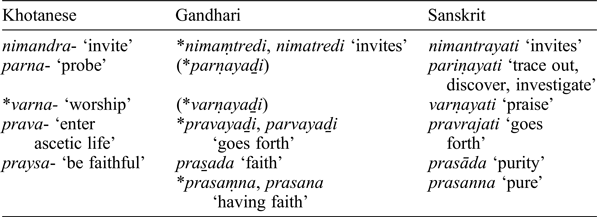
Three of Emmerick's type D verbs cannot be assigned a stem vowel based on the synchronic behaviour of the attested forms. In an earlier version of this paper I did not assign them stem vowels. M. Maggi (p.c.) has offered convincing rationale to assign them final -a-. My interpretation of the rationale is below. The verbs all appear to be borrowed from Prakrit. Table 2 compares these three as well as nimandra- ‘invite’ and *varna- ‘worship’ with Gandhari and Sanskrit cognates (Baums and Glass Reference Baums and Glassongoing: s.vv.).
Khotanese type A stems in -a- of Indian origin

For parnaindä the Leumanns gave Skt ‘pari-ṇayanti’ as gloss (Glossar 459b). Emmerick listed parnai- as ‘touch’ (SGS 75) and Bailey gave parnaindä as ‘they touch’ (DKS 218b). Emmerick and Bailey proposed Iranian etymologies. Maggi sees an Indian loanword and notes that pariṇayati, besides the usual ‘lead around’, can also mean ‘trace out, discover, investigate’ (Monier-Williams Reference Monier-Williams1899s.v. pariṇī), a meaning which fits the three examples of parna-. In Z 2.122 hastu parnaindä hana refers to the story of the blind men (hana) and the elephant (hastu). The subject of Z 2.228 is also hanä ‘blind men’. The blind in both cases are investigating by touch. The LKh example, KBT 47.56 nāsi pūra ce ṣe’ tcāramphi ttyena paḍā panā is translated by Bailey as ‘take, my son, what is this staff, with it feel in front’ (DKS: 281b). Again the action is investigating by touch, hence the translation here of parna- as ‘probe’. A Prakrit *parṇayaḏi could be the source of parna-. For Indian rṇ > Khotanese rn Maggi compares the ppp varnäta- ‘worshipped’ Z 2.63,23.125, 169, 171 with Skt varṇita-. This ppp varnäta- has the same morphology as numandräta- ‘invite’ and so plausibly reflects *varna-, another Type A in -a- Indian loan. Finally, the LKh 2Siv.a panā may imply OKh *parnā < parna- + -a with regular a+a>ā contraction.
The comparison Skt nimantrayati : Kh nimandra- :: Skt pariṇayati : Kh parna- may be extended to include Gdh parvayaḏi : Kh prava-.
The last verb, praysa- ‘be faithful’ has semantics reflected in Gdh pras̱ada ‘faith’ and prasana ‘having faith’. There is no Prakrit verb attested which could be the source of the Khotanese. Either there was such a verb, or else Kh praysa- is a back-formation derived from the noun praysāta- ‘faith’ after the pattern in the present:past stem pair pa-:pāta- ‘protect’ (cf. also haysñ-:haysñāta- ‘bathe’, huṣṣ-:huṣṣāta- ‘grow’, etc.).
D1 and D2 as type A vowel stems
Table 3 summarizes the preferred synchronic stem shapes of the verbs categorized as type D by Emmerick. These are all type A vowel stems and take the regular type A endings with regular morphophonological adjustments (contractions) between stem-final vowel and suffix-initial vowel.
Type A vowel stems

Two other verbs in -e
Emmerick gives the present stems of his type C verbs as ending in -ad- or -ah-. My view is that these are type B vowel stems, mostly ending in -a- (Hitch Reference Hitch2016a: 158 and chapter 4). When a suffix beginning with -ā- is attached to most of these, there is coalescence a+ā>ā, e.g. NSf pähāmata Z 7.22 ‘striking’ < päha-Footnote 37 + -āmatā- + -a, NSm puvā’ñi Z 18.35 ‘it must be feared’ < puva’- ‘fear’ + -āña- + -ä. This coalescence is well known from type A stems in -a- (D1 stems) as shown above. But two of Emmerick's type C stems show semivocalization V+ā>yā in this context. Compare NSf syāmata Z 4.85 ‘appearance’ < sV- ‘appear’ + -āmatā- +-a, and NSm p.nec āvyāñi Z 12.23 ‘must be acquired’ < āvV- + -āña- + -ä. All attested forms of these stems can be synchronically explained if the stems end in -e. Confirmation of the shape se- may be seen in Sogdian sy- (Manichean syy-) ‘appear’. As Yakubovich points out, the latter has no obvious Iranian etymology. He derives Sogdian sy- and possibly Parthian sy- ‘seem, appear’ from Indo-European *sk̯eih 2 ‘shine’, which is attested in Germanic (Gothic skeinan ‘shine’) and Slavic (*sьjati ‘shine’). He suggests the semantic development in Sogdian was like German scheinen ‘shine’ > erscheinen ‘appear’ (Yakubovich Reference Yakubovich2002: 548). The existence of Khotanese se- ‘appear’ possibly confirms his suggestions. But the 3Sp.a saittä would reflect a historical stem with a final consonant. Yakubovich also mentions the existence of a stem syδ- of the same meaning in the Turfan documents noted by Sims-Williams, which is the regular reflex of OIr *sadaya- (ibid.). It is plausible that the two similar shapes of the same meaning merged in Khotanese.Footnote 38
se- : SGS, DKS sad- ‘appear, seem’, Suv say- ‘appear’. Now type B. Of the contractions below, e+ī >ai (ei) in the 1Sp.a, 3Pp.a, and 3Sop.a, as well as e+ā>yā with the abstract noun suffix -āmatā- are well known. The only new contraction is in the 3Sp.a where the umlaut potential ⁱ is phonetically realized as part of the diphthong ai, se- + -ⁱttä > saittä.Footnote 39
1Sp.a saimä Z 13.60 • /sai̯mĕ < sē- + -īmĕ/
3Sp.a saittä Z 1.35 (+more than 50× in Z), Sgh[10,24] 91.1, Suv 18.166, IOL Khot 155/3 v2, 149/2 v4 (sai[ttä]), 17/1 r4, seittä Z 4.83, 5.38, 15.6, 22.240, 24.327, IOL Khot 173/8 b2 • /sai̯ttĕ < sē- + -ⁱttĕ/
3Pp.a saindä Z 3.116 (+20× in Z), IOL Khot 7/7.r4, 141/6.r2, r3, r4 (2×), v1, 29/8.a4, 20/15.v2, 189/5v1 (Śgs), seindä Z 3.108, saindi Z 2.227 (+ 6× in Z) • /sai̯ndĕ < sē- + -īndĕ/
3Sop.a saiyä Z 7.26, 10.35, saiyi Z 13.107 • /sai̯yĕ < sai̯dĕ < sē- + -īdĕ/
āmatā-noun ‘appearance’
NSf syāmata Z 4.85, 5.77, 9.7, IOL Khot 163/1.r4 (Rk 94.12) • /syāmada < sē- + -āmad- + -a/
IASf syemäte Z 9.10 2×, SI M 38.v3, syemate Z 2.210 • /syēmadē < syāmad- + -ⁱē < sē- + -āmad- + -ⁱē/
āve-: ‘accumulate’ < *ā-u̯aid-a-. SGS āvad- ‘obtain’, DKS āvya- ‘gather’, EDIV *ā-Hu̯ad. The etymology proposed here, from the root *u̯aid ‘find’ rather than from *Hu̯ad ‘lead’ may be both semantically and formally preferable. Cf. Av vaēd- ‘find’, Skt ved- ‘find’, Manichean Middle Persian w(y)nd-, Book Pahlavi wnd- /wind-/ ‘to find obtain, gain’; Parthian w(y)nd- ‘to find’; (+*pati-) Manichean Sogdian ptwyδ, Christian Sogdian ptwyd ‘offer’; (+ *pari-) Buddhist Sogdian prwyδ-, Christian Sogdian prwyd- ‘seek, look for’ (EDIV: 409–10). The synchronic evidence does not permit assignment of stem type. Emmerick assigned it to C likely on the basis of final *-d in the etymology.
3Sop.a āvaiyä Z 18.3 • / āwai̯ʔĕ < āwai̯tĕ < āwē- + -ītĕ/
āña-p.nec:
NSm āvyāñi Z 12.23 • /āwyāñĕ < āwē- + -āñ- + -ĕ/
Summary
It is not necessary to maintain a separate type D category of present stems. All of Emmerick's type D may be analysed as Type A vowel stems. All attested inflected forms are produced by adding the regular Type A suffixes to these stems. The synchronic morphophonological processes which occur when the two vowels meet in the derivation are regular and essentially all are attested elsewhere in the grammar. The characteristic -ai- seen in the paradigms is the result of the contraction of stem and suffix vowels. Most stems end in -a-and some end abstractly in -e-. No stems end in -ai-. The stems showing final e+V >yV undergo semivocalization or diphthongization. Those stems may further undergo glide resolution or diphthong resolution to Cäy- or Ciy-. Two further verbs from outside of Emmerick's D category, se- ‘appear’ and āve- ‘accumulate’ are also shown to end in -e-.
This study simplifies the descriptive grammar of Old Khotanese and lays the groundwork for further simplifications.
Technical abbreviations
- ab, ac, bd, cd
-
Spread of hemistich across orthographic columns
- A, B
-
1) meter types A and B; 2) SGS present stem types A and B
- C
-
1) any consonant; 2) meter type C; 3) SGS present stem type C
- D
-
SGS present stem type D
- D1, D2
-
Temporary labels to distinguish subclasses of Emmerick's present stem type D
- V
-
Any vowel, short, long or diphthong
- 1S, 2S, 3S
-
First, second, third person singular
- 1P, 2P, 3P
-
First, second, third person plural
- p, iv, op, sj, ij
-
Present indicative, imperative, optative, subjunctive, injunctive
- a, m
-
Active, middle
- tr, intr
-
Transitive, intransitive
- p.nec
-
Participle of necessity
- NS, VS, AS, GDS, IAS, LS
-
Nominative, vocative, accusative, genitive-dative, instrumental-ablative, locative singular
- NAP, VP, GDP, IAP, LP
-
Nominative-accusative, vocative, genitive-dative, instrumental-ablative, locative plural
- m, f, n
-
Masculine, feminine, neuter
- H, L
-
Heavy, Light moraic count
- ⎕
-
Space between orthographic columns
- |
-
Metrical segment boundary
- OKh, LKh, OIr, Skt, Gdh, Av
-
Old Khotanese, Late Khotanese, Old Iranian, Sanskrit, Gāndhārī, Avestan
Bibliographic abbreviations
- DKS
-
Bailey Reference Bailey1979
- EDIV
-
Cheung Reference Cheung2007
- Glossar
-
E. and M Leumann Reference Leumann and Leumann1933–36, pp. 385–530
- IOL Khot
-
Skjærvø Reference Skjærvø2002
- KhSuf
-
Degener Reference Degener1989
- KT3
-
Bailey Reference Bailey1969
- Neb
-
E. Leumann Reference Leumann1920
- Rk
-
§23–25 = Maggi Reference Maggi2015; §94–157 = Skjærvø Reference Skjærvø, Cereti, Maggi and Provasi2003
- Sgh
-
Canevascini Reference Canevascini1993, square brackets [ ] contain manuscript numbers
- SGS
-
Emmerick Reference Emmerick1968a
- SI
-
Emmerick and Vorob'ëva-Desjatovskaja Reference Emmerick and Vorob’ëva-Desjatovskaja1995
- St.III
-
Emmerick and Skjærvø Reference Emmerick and Skjærvø1997
- Suv
-
Skjærvø Reference Skjærvø2004a and Reference Skjærvøb, square brackets [ ] contain manuscript abbreviations
- Śgs
-
Emmerick Reference Emmerick1970
- Vim
-
Skjærvø Reference Skjærvø1986
- Z
-
Emmerick Reference Emmerick1968b