Many ecological relationships that are inherently reciprocal are often studied from one perspective only (Agrawal et al. Reference AGRAWAL, ACKERLY, ADLER, ARNOLD, CÁCERES, DOAK, POST, HUDSON, MARON, MOONEY, POWER, SCHEMSKE, STACHOWICZ, STRAUSS, TURNER and WERNER2007). One example is the interaction between tropical forests and nearctic-neotropical migratory songbirds (hereafter migrants). Several studies have determined that some migrant populations are limited by conditions at their tropical wintering grounds in Central America, South America and the Caribbean (Marra et al. Reference MARRA, HOBSON and HOLMES1998, Mills Reference MILLS2006); however, the ecological role of migrants in these tropical forests is poorly understood.
Various studies suggest that some migrants may represent a guild of potential seed dispersers in early successional tropical forests (Blake & Loiselle Reference BLAKE and LOISELLE1992, Greenberg Reference GREENBERG1981). Though most migrants are insectivorous in North America, in the tropics many migratory warblers (Parulidae; e.g. Dendroica, Vermivora), thrushes (Turdidae; Catharus), vireos (Vireonidae; Vireo), tanagers (Thraupidae; Piranga), and flycatchers (Tyrannidae; e.g. Empidonax, Tyrannus) shift to a diet consisting partly or entirely of fruits, especially during the late dry season prior to and during pre-breeding migration (Blake & Loiselle Reference BLAKE and LOISELLE1992, Morton Reference MORTON1971). In western Mexico and Panama, migrant abundance was higher in secondary forest habitats than in primary forest (Hutto Reference HUTTO, Keast and Morton1980, Karr Reference KARR1976, Martin Reference MARTIN1985), and this preference is likely due in part to a greater abundance of small fruits in secondary habitats (Martin Reference MARTIN1985). Further evidence for this potential relationship is that some tropical trees may time fruit maturation to coincide with nearctic-neotropical migrations (Howe & De Steven Reference HOWE and DE STEVEN1979, Levey Reference LEVEY1988, Morton Reference MORTON1971).
The importance of birds (and bats) as seed dispersers in regenerating pastures has been generally established (Galindo-González et al. Reference GALINDO-GONZÁLEZ, GUEVARA and SOSA2000, Medellín & Gaona Reference MEDELLÍN and GAONA1999); however, it is unknown precisely which guilds of birds are most effective. If present and abundant in forest restoration sites, migrants could provide important ecological services such as seed dispersal, a limiting factor in the restoration of degraded land in Central America (Holl Reference HOLL1999). Currently, the extent to which migrants enter and utilize restoration areas can only be inferred from studies of bird communities in secondary forests (Hutto Reference HUTTO, Keast and Morton1980, Karr Reference KARR1976, Martin Reference MARTIN1985). The objectives of this study were (1) to determine if migrants constituted a large proportion of the birds in a tropical restoration site and (2) to determine distributional patterns of migrants within the restoration site relative to forest structure.
We quantified migrant abundance during late March 2005 in a restoration site near the Las Cruces Biological Station in Coto Brus County in southern Costa Rica (8°47'N, 82°58'W; rainfall ≈ 4 m y−1; elevation 1100 m). Melissa's Meadow (MM) is a 31-ha regenerating pasture which was actively grazed by cattle until 1998. During 2000–2001, 12 ha were reforested with seedlings of 15 native tree species, and by 2005 an early successional secondary forest dominated by Cecropia spp. and Heliocarpus appendiculatus Turcz. had developed.
We conducted 300 10-min point counts evenly distributed amongst 18 stations within the reforested area (n = 50 h total). All birds detected visually within a 10-m fixed-radius were counted. Stations were located at least 33 m apart to reduce the probability of recording the same individual at different stations. Stations were evenly distributed at six distances from the adjacent primary forest (33, 66, 133, 166, 233, 266 m). For each station we measured canopy height and canopy cover. Canopy height was determined by taking the average of four representative canopy trees using a laser range finder (Opti-logic Corporation, Tullahoma, Tennessee, USA). Canopy cover was estimated using a spherical densiometer.
Forward stepwise multiple regressions were used to determine the extent to which migrant species richness, abundance (total detections), and true diversity (Jost Reference JOST2006) at each point count station were explained by distance from primary forest, canopy height and canopy cover. True diversity was used because it possesses a uniform set of mathematical properties that are more consistent with the concept of biological diversity – contrasted to entropies (indices of diversity) such as the Shannon–Weiner Index (Jost Reference JOST2006). Analyses were conducted with JMP 5.1.2 (SAS Institute, Cary, North Carolina, USA).
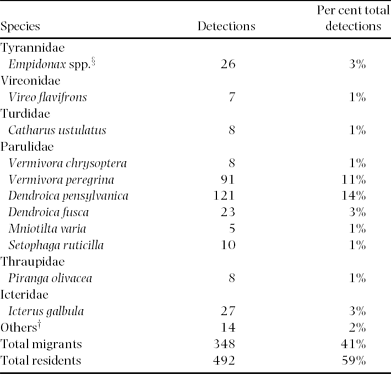
We recorded a total of 83 species from 24 families. Eighteen species of neotropical migrant (22% of all species) from seven families, primarily Parulidae, were detected within the restoration area (Table 1). Migrants were a large component of the bird community in MM; of 840 detections, 348 (41%) were neotropical migrants. No non-passerine migrants were recorded, and migrants accounted for 44% of all detected passerines. Dendroica pensylvanica (see Table 1 for bird families and Dickinson (Reference DICKINSON2003) for species authorities) was the most commonly detected species and accounted for 14% of all detections. Vermivora peregrina and Thraupis episcopus were also abundant, accounting for 11% and 6% of detections, respectively.
Migratory songbird species detected in a 4-y-old forest restoration site (Melissa's Meadow) in Coto Brus County, Costa Rica, March 2005 (in order of total detections). Not represented in this table are species with less than five detections (<1% total detections).

§mostly E. flaviventris, also E. traillii and E. alnorum, †Hylocichla mustelina (Turdidae), Dendroica petechia (Parulidae), Helmitheros vermivorum (Parulidae), Oporornis formosus (Parulidae), Wilsonia pusilla (Parulidae), Piranga rubra (Thraupidae) and Pheucticus ludovicianus (Cardinalidae).
Migrant abundance (R2 = 0.590) in MM was explained by three factors: canopy cover (P = 0.198), canopy height (P = 0.047) and distance to primary forest (P = 0.168). Distance from primary forest was the only factor explaining species richness (R2 = 0.411, P = 0.004) or true diversity (R2 = 0.345, P = 0.010). Higher abundance of migrants at stations with greater canopy cover and canopy height suggests that some migrants prefer more mature secondary growth to younger early successional habitats. That distance from primary forest was the only factor explaining species richness and true diversity of migrants suggests that some species are less likely than others to use habitat far from primary forest or edge habitat adjacent to pasture. Several species in MM, including Setophaga ruticilla, Oporornis formosus, Pheucticus ludovicianus, Piranga rubra and Wilsonia pusilla, were only recorded at stations less than 100 m from primary forest.
The high abundance of migrants (nearly half of all detections) in MM demonstrates that these birds formed a significant proportion of the bird community in the restoration site during pre-breeding migration. This result is consistent with several studies that have found similar abundance of migrants in secondary tropical forests in Mexico (Hutto Reference HUTTO, Keast and Morton1980, Smith et al. Reference SMITH, ORTIZ and ROBERTSON2001), Panama (Karr Reference KARR1976, Martin Reference MARTIN1985), and Costa Rica (Werner Reference WERNER2004). Given this abundance, any interactions, such as seed dispersal, between migrants and plants in the restoration site could affect the trajectory of forest regeneration. A high density of migrants may be particularly important in this regard as abundance of birds – rather than richness – was the best predictor of bird-dispersed seed richness in the landscape around MM (Pejchar et al. in press).
For effective seed dispersal by nearctic-neotropical migrants to occur in a forest restoration area, potential seed dispersers would need to consume fruit and seeds from outside of the restoration area, enter the site, and pass or regurgitate viable seeds within the restoration area. Nearly all migrants detected in MM are known to eat fruit in the tropics (Stiles & Skutch Reference STILES and SKUTCH1989). Blake & Loiselle (Reference BLAKE and LOISELLE1992) found that 18% of faecal samples collected from Dendroica pensylvanica wintering in the La Selva Biological Station in Costa Rica contained fruit seeds or pulp. They found even higher frugivory (per cent of individuals with fruit in their faecal samples in parentheses) in other species that were detected in this study including Piranga olivacea (100%), Catharus ustulatus (98%), Empidonax traillii/alnorum (67%), Piranga rubra (56%), Dendroica fusca (50%) and Helmitheros vermivorum (21%). Both Dendroica pensylvanica and Vermivora peregrina are also among the most frequent visitors to fruiting trees on Barro Colorado Island (BCI) including Miconia argentea (Sw.) DC. (Melastomataceae) and Lindackeria laurina Presl (Flacourtiaceae) (Greenberg Reference GREENBERG1981).
These studies are limited in their application to forest restoration because visitation rates (rather than consumption rates) and seeds or pulp (rather than viable seeds only) were quantified. However, Howe & De Steven (Reference HOWE and DE STEVEN1979) found that Vermivora peregrina accounted for 19% of seeds removed from Guarea glabra Vahl (Meliaceae) on BCI. Although behavioural observations were not incorporated in this study, it is likely that some of the detected birds were passing viable seeds. In a prior study in MM, Werner (Reference WERNER2004) recovered viable seeds from faecal samples of all three of the most frequently detected species in this study. At least some seeds are likely to have come from outside of the restoration area, as these birds may be prone to more long-distance movements between habitat patches during pre-breeding migration (Blake & Loiselle Reference BLAKE and LOISELLE1992).
The sheer number of seasonally frugivorous migrants observed in MM suggests that some of these birds are potential seed dispersers in this restoration area, however the implications of this study are limited. Although the small fixed-radius counts in this study reduce the probability that individuals were counted more than once, it is possible that some species were over-counted. This bias may be somewhat mitigated since detection probability was likely <1.0. More importantly, this study was conducted over a short period of time. Further observations and behavioural studies, especially during southward migration and the non-breeding season (August–February), are needed to elucidate the interactions of plants and migrants in tropical forest restoration areas (Lindell Reference LINDELL2008).
Despite efforts to conserve migrants and their breeding grounds in North America, many species such as Contopus cooperi (Tyrannidae), Vermivora chrysoptera, and Dendroica cerulea (Parulidae) continue to decline (BirdLife International 2006). Populations of these species are likely limited by habitat loss in the tropics (Jones et al. Reference JONES, BARG, SILLETT, VEIT and ROBERTSON2004, Robbins et al. Reference ROBBINS, SAUER, GREENBERG and DROEGE1989). In turn, if migrants are potentially important for restoration, as this study suggests, then a reduction in migrants resulting from habitat loss could ultimately result in decreased regeneration rates of tropical forests or a shift in forest species composition. Accordingly, restoration projects should tailor efforts to encourage visitation by migrants. Planting tree species with fruits that are preferred by migrants, such as Guarea glabra (Howe & De Steven Reference HOWE and DE STEVEN1979), or species with fruiting periods coincident with pre-breeding migration would likely increase seed rain in abandoned pastures and accelerate forest recovery. Planned reforestation projects may further attract migrants if they are situated adjacent to remnant forest. Viewing migrant abundance and tropical forest regeneration as reciprocally linked will improve efforts to protect and restore biodiversity in the tropics.
ACKNOWLEDGEMENTS
We thank J. Zook for sharing his expertise on the local avifauna, M. García-C. and E. Lindquist for initial feedback on the study, C. Lindell, J. Reid, two anonymous reviewers and A. Wright for excellent comments and editing on an earlier version of the manuscript and the Las Cruces Biological Station staff for their help throughout.