





The current definition of homelessness includes both rough sleeping and severely inadequate or insecure accommodation. It is estimated that approximately 150 million people worldwide experience homelessness. 1 In 2023, the United Nations General Assembly 2 defined homelessness as a condition in which people lack habitable space with security of tenure, rights and the ability to enjoy social relations. It is important to consider homelessness as a multidimensional health and social phenomenon that encompasses the absence of a habitable and secure living environment and the erosion of social relations and safety. Internationally, the European Typology of Homelessness and Housing Exclusion categorises homelessness as rooflessness (rough sleeping), houselessness (temporary accommodation or institutions), insecure housing and inadequate housing. 3 In Ireland, statutory guidance derives from the Housing Act 1988, under which a person is considered to be experiencing homelessness where no accommodation is available that they can reasonably occupy, or where they cannot secure reasonable accommodation without recourse to local authority assistance. 4 These frameworks demonstrate that the term ‘people experiencing homelessness’ (PEH) is inclusive of those in emergency or short-term accommodation as well as those sleeping rough.
PEH are shown to be disproportionately affected by mental ill health, with severe mental illness over-represented in this population. When Global Burden of Disease data are filtered to include only World Bank-classified high-income nations, the prevalence of schizophrenia is approximately 0.5% and depression approximately 3.7% among the general adult population. 5 In contrast, a recent meta-analysis estimated that 12.4% of PEH from high-income nations have schizophrenia spectrum disorders and 12.6% have major depression. Reference Gutwinski, Schreiter, Deutscher and Fazel6 PEH also experience a higher prevalence of substance use disorders and co-occurring physical morbidities. Reference Chilman, Schofield, Laporte, Ronaldson and Das-Munshi7 Because PEH also experience a higher burden of poverty, victimisation, stigma and structural barriers, they present to crisis services more frequently and are more highly associated with premature mortality. Reference Aldridge, Story, Hwang, Nordentoft, Luchenski and Hartwell8
International literature indicates that PEH make heavy use of unscheduled care (e.g. emergency departments), often with worse outcomes. Studies have found that PEH are more likely to leave before treatment is complete and have higher repeat attendance rates. Reference Vohra, Paudyal and Price9 International studies report that, despite high clinical complexity, crisis presentations by PEH frequently end in discharge without treatment or follow-up, rather than admission. Reference Moss, Anselmi and Sutton10
Ireland mirrors this global picture of homelessness. Recent national data recorded high levels of homelessness, with 11 851 adults accessing emergency accommodation in February 2026. 11 Focusing on the burden of mental illness on the PEH population of Dublin, the Dublin Simon Community Annual Review 2013 reported 11% with schizophrenia and 63% with depression among clients, and a study using diagnostic tools in a Dublin homeless hostel identified past-month major depressive disorder in 18.4% of residents. 12,Reference Prinsloo, Parr and Fenton13 These are service-based snapshots, not population-representative censuses, and may inflate prevalence relative to community-based samples. Nonetheless, they underscore the heavy burden of mental illness among PEH in Dublin.
Irish research has shown that emergency department use among those experiencing homelessness is higher than in the housed population, and that PEH can often present with more complex psychiatric and social needs. Reference Ni Cheallaigh, Cullivan, Sears, Lawlee, Browne and Kieran14 Qualitative work in Dublin highlights barriers such as stigma, discrimination, competing survival priorities, addiction/withdrawal management challenges and fragmented pathways as being among contributors to unmet needs driving the use of unscheduled care. Reference O’Carroll and Wainwright15
Clinical decision-making in emergency psychiatric care often prioritises immediate clinical risk, which may not map onto homelessness-related vulnerabilities; this may disadvantage PEH when admission thresholds are applied. It is not well characterised in the academic literature to what extent emergency psychiatric decision-making incorporates homelessness-related needs alongside its focus on acute risk and psychopathology.
There is limited and methodologically heterogeneous evidence that experiencing homelessness is associated with varying rates of in-patient psychiatric admission once clinical severity is measured and adjusted for. Much of the existing work reports higher service use or readmission among PEH, but seldom incorporates severity measures at the emergency department decision point. Reference Ni Cheallaigh, Cullivan, Sears, Lawlee, Browne and Kieran14,Reference Russolillo, Moniruzzaman, Carter, Raudzus and Somers16 It is unclear whether any observed disparities are explained by differences in acute psychopathology or through homelessness-related needs (e.g. survival/basic needs, social functioning), or whether any difference persists after accounting for these domains.
In Ireland there is a lack of emergency department-based studies that (a) compare psychiatric admission outcomes between PEH and housed patients; (b) utilise a validated global severity measure; (c) adjust for confounders; or (d) interrogate domain-level severity to separate acute psychopathology from homelessness-related vulnerabilities. There is a need to investigate this gap to inform equitable crisis pathways and guide service development.
Triage and severity assessment are therefore pivotal. The Threshold Assessment Grid (TAG) is a brief, validated and reliable instrument designed to assess the severity of mental illness using a total score across seven domains. Reference Slade, Powell, Rosen and Strathdee17,Reference Slade, Cahill, Kelsey, Powell and Strathdee18 This measure can be used to compare severity of illness across a range of diagnoses and psychosocial factors. TAG has been used in a variety of settings, both for routine practice and for service evaluation. Although TAG is not designed with a cut-off score to define severe mental illness, a total TAG score of ≥5 identifies those who are considered suitable for referral to a community mental health team. Reference Slade, Cahill, Kelsey, Leese, Powell and Strathdee19 Despite high emergency department utilisation by PEH and a robust evidence base for TAG use in community and referral contexts, we found no prior studies validating TAG specifically in emergency department presentations, or among PEH. To our knowledge, TAG has been validated neither in emergency department populations nor in PEH, despite broad validation in non-emergency department mental health settings. Reference Slade, Powell, Rosen and Strathdee17 – Reference Slade, Cahill, Kelsey, Powell, Strathdee and Valiakalayil20
Our primary objective is to test whether housing status predicts admission following psychiatry assessment, after adjusting for severity and demographics. Our secondary objectives are to (a) compare baseline demographic and clinical characteristics of PEH and housed patients referred to emergency department-based psychiatry services; (b) compare severity of mental illness by housing status; and (c) compare admission rates by housing status.
Method
This was a retrospective cohort study of emergency department referrals to psychiatry at a large urban hospital, conducted from January to December 2020. This hospital is in an inner-city area with high rates of social adversity and homelessness. During working hours, psychiatry cover to the emergency department is provided by the Liaison Psychiatry team, and out of hours it is provided by the on-call service.
We compared baseline characteristics, TAG severity (total and domains) and admission rates, and tested whether housing status predicted admission after adjusting for severity and demographics. Recognising that, due to the design of the TAG scale, homelessness can independently elevate certain TAG domains related to stability of their living situation and social functioning (e.g. the domains of survival and social), we also fitted a model including all domains simultaneously to evaluate whether any observed disparity persisted after accounting for domain-specific severity.
The log of referrals to psychiatry in the electronic patient record (EPR) was used to identify all consecutive referrals for psychiatric assessment in the emergency department during the study period (January–December 2020). This referral cohort constituted the study population. The data-set was derived from a referral log rather than a patient register, and some individuals may have contributed more than one referral during the study period. Therefore, the unit of analysis was the individual emergency department referral. Housing status was treated as the exposure variable. The primary outcome was hospital admission following psychiatric assessment in the emergency department. TAG scores were retrospectively derived from clinical documentation in EPR. Scoring was performed by two members of the research team (A.M. and M.S.), with cases divided between raters and each case scored by a single rater using the standardised scoring guidance provided with the TAG instrument. Prior to data collection, the raters agreed on the scoring approach and completed an initial calibration exercise by scoring a sample case with a senior clinician (A.M.D. or K.K.). Each TAG domain was rated based on the information documented in the clinical notes at the time of the emergency department psychiatric assessment. Recorded variables included age, gender, housing status at presentation, TAG score (including total score and domain-specific score) and outcome following assessment (admission or discharge).
TAG is a one-page, clinician-rated scale comprising seven domains (intentional self-harm, unintentional self-harm, risk from others, risk to others, survival/basic needs, psychological, social). Items are rated 0–4, with higher scores reflecting greater severity. The total score of 0–24 summarises global severity. Development and psychometrics demonstrate content, construct and concurrent validity, acceptable interrater/test–retest reliability and practical utility in triage and outcome assessment. Reference Slade, Powell, Rosen and Strathdee17,Reference Slade, Cahill, Kelsey, Powell and Strathdee18
Housing status was identified from EPR, where it is routinely recorded as part of the demographic information in the patient administration system. Where this information was absent or inconsistent, housing status was determined from the psychiatric consultation note documented in EPR.
Although no universal definition of homelessness exists, for the purposes of our study patients were classified as experiencing homelessness if they were recorded as being of no fixed abode and residing in temporary hostel accommodation or sleeping rough. This aligns with the United Nations General Assembly definition, which covers people living in severely inadequate and insecure accommodation and not just those who are rough sleeping. 2
Power calculation
The power calculation was informed by the effect size observed in the study by Laliberté et al; Reference Laliberté, Stergiopoulos, Jacob and Kurdyak21 however, we anticipated a more conservative between-group difference. We estimated that admission rates in the PEH group would be 8% lower than in the housed group, corresponding to a small effect size of 0.25 (Cohen’s d). At a power of 90% and two-sided significance level of 0.05, a minimum sample size of 235 per group was required for comparing proportions in both groups.
Statistical analysis
In line with our secondary objectives, we first compared baseline characteristics and severity by housing status. We compared groups using t-tests (continuous variables) and χ 2 tests (categorical). To address our primary objective, we then tested whether housing status predicted admission after adjusting for severity. To achieve this, we set our primary outcome and dependent variable as hospital admission from emergency department. We then modelled admission using logistic regression. Our first regression model (model 1) included TAG total score (per point), housing status (PEH versus housed), age (years) and gender (female versus male) as covariates. To address the possibility that homelessness inflates certain TAG domains (e.g. survival, social), and to test whether any housing status effect persisted after adjusting for domain-specific severity, we completed a second regression model (model 2) which entered the seven TAG domains simultaneously, plus age, gender and housing status as covariates. Variance inflation factors (VIFs) were examined for model 2 to assess multicollinearity among the TAG domains; all VIFs were <3 (range 1.16–2.76), indicating that collinearity did not substantially affect coefficient estimates. There were no missing data for variables included in the analyses. All participants were included in the regression models. All statistical analyses were performed using IBM SPSS Statistics for Windows, version 29 (IBM Corp., Armonk, New York, USA; https://www.ibm.com/products/spss-statistics).
Ethical standards
The authors assert that all procedures contributing to this work comply with the ethical standards of the relevant national and institutional committees on human experimentation, and with the Declaration of Helsinki of 1975 as revised in 2013. All procedures involving human subjects/patients were approved by the Mater Misericordiae University Hospital Institutional Review Board (IRB ref: 1/378/2220 TMR, 5 March 2021).
Consent statement
This study involved a retrospective, anonymised review of clinical records. Individual patient consent was not required, as confirmed by the Mater Misericordiae University Hospital Institutional Review Board (Ref: 1/378/2220 TMR, 5 March 2021).
Results
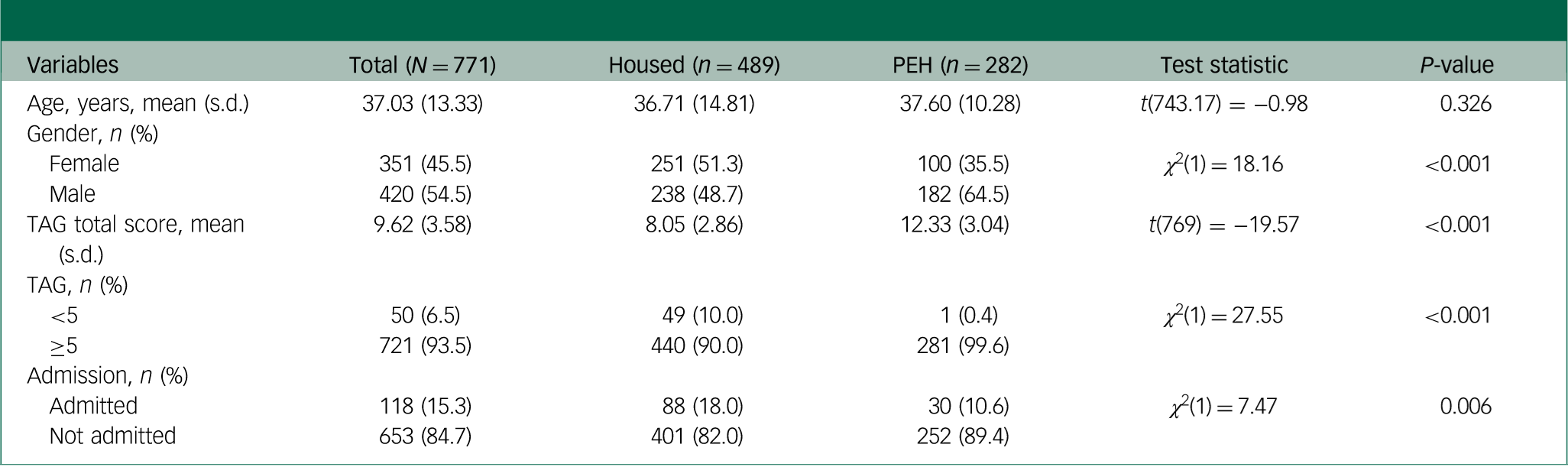
Baseline characteristics of patients referred for psychiatric assessment were identified, as shown in Table 1. From a total of 771 emergency department referrals, 282 (36.6%) were identified as PEH and the remaining 489 (63.4%) as housed. Overall, the mean age was 37.0 years (s.d. 13.3). There was a higher proportion of male patients (54.5%) in the cohort. In terms of clinical severity, 93.5% of those referred to psychiatry in the emergency department had TAG ≥5 and the mean TAG total score was 9.6 (s.d. 3.6). TAG scores were higher in PEH than in housed patients (12.3 [3.0] v. 8.1 [2.9], t(769) = −19.6, p < 0.001), indicating greater need in the PEH group.
Baseline characteristics of patients referred for psychiatry assessment, by housing status

Table 1 Long description
A table comparing baseline characteristics of patients referred for psychiatry assessment by housing status. The table has 6 rows and 5 columns. The columns are labeled Variables, Total (N = 771), Housed (n = 489), PEH (n = 282), Test statistic, and P-value. The rows are labeled with different variables such as Age, Gender, TAG total score, TAG, and Admission. Each row provides specific data for each variable across the different housing statuses. For example, the mean age is 37.03 years for the total group, 36.71 years for the housed group, and 37.60 years for the PEH group. The table also includes test statistics and P-values for each variable, indicating the significance of the differences observed. Notable trends include a higher proportion of male patients in the PEH group and higher TAG scores in the PEH group compared to the housed group.
Group comparisons use independent-samples t-tests for continuous variables and χ 2 tests for categorical variables. PEH, people experiencing homelessness; TAG, Threshold Assessment Grid.
We did not find a significant age difference between housed patients and PEH (mean 36.7 [s.d. 14.8] v. 37.6 [s.d. 10.3] years, p = 0.326). However, gender distribution differed significantly, with a significantly higher proportion of men among PEH (64.5 v. 48.7%, p < 0.001).
Our results indicated that the PEH group presented with significantly higher clinical severity, with mean TAG scores almost 4 points higher than in housed patients (12.3 v. 8.1, p < 0.001). Nearly all PEH (99.6%) and most housed patients (90.0%) had TAG scores ≥5, indicating marked need across both groups (p < 0.001). Despite this higher severity, our analysis shows that PEH were significantly less likely to be admitted following emergency department assessment compared with housed patients (10.6 v. 18.0%, p = 0.006).
TAG domain-level analysis is shown in Table 2. PEH had statistically significantly higher scores than housed patients across all seven TAG domains. The largest disparity was in the survival/basic needs domain (mean 2.8 v. 0.8, p < 0.001, Cohen’s d = 2.6), followed by risk from others (1.2 v. 0.6, p < 0.001, Cohen’s d = 0.8) and social functioning (2.0 v. 1.5, p < 0.001, Cohen’s d = 0.7). Moderate differences were also seen for risk to others (1.0 v. 0.5, p < 0.001, Cohen’s d = 0.7) and unintentional self-harm (1.4 v. 1.0, p < 0.001, Cohen’s d = 0.4). Smaller but statistically significant differences were observed for intentional self-harm (1.8 v. 1.7, p = 0.019, Cohen’s d = 0.2) and psychological symptoms (2.2 v. 2.1, p = 0.012, Cohen’s d = 0.2). These findings demonstrate that acute psychopathology contributed to elevated severity among PEH, but the most pronounced differences were in domains directly related to social adversity and vulnerability.
Mean differences in TAG domain scores, by housing status

Table 2 Long description
A table with seven rows and eight columns comparing TAG domain scores between housed and PEH groups. The columns are labeled TAG domains, Housed (n = 489), mean (s.d.), PEH (n = 282), mean (s.d.), t(d.f.), P-value, and Cohen’s d. The rows are labeled with different TAG domains: intentional self-harm, unintentional self-harm, risk from others, risk to others, survival (basic needs), psychological, and social. Each row provides mean scores and standard deviations for both housed and PEH groups, along with t-values, P-values, and Cohen’s d values. Notable trends include higher scores for PEH across all domains, with the largest disparities in the survival/basic needs domain, risk from others, and social functioning.
Cohen’s d indicates effect size (positive values reflect higher scores among people experiencing homelessness (PEH); TAG, Threshold Assessment Grid.
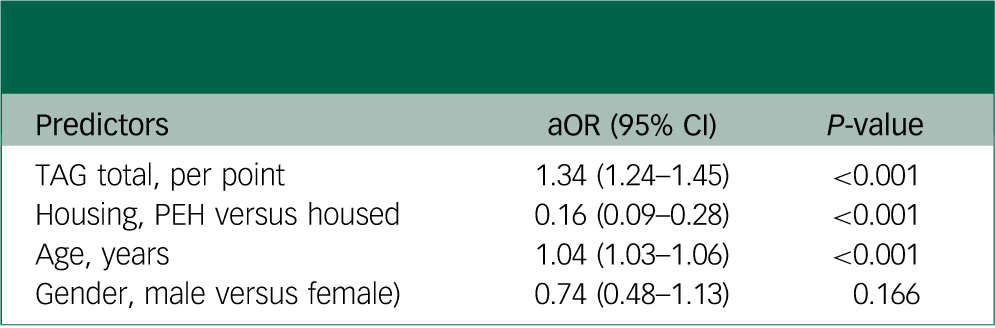
Multivariable logistic regression results are shown in Tables 3 and 4. Our regression models tested whether housing status predicts admission following emergency psychiatry assessment, adjusting for severity and demographics.
Model 1: logistic regression predicting admission, from TAG total, housing status, age and gender

Table 3 Long description
A table with four rows and four columns showing the results of a logistic regression model predicting admission. The columns are labeled ‘Predictors’, ‘aOR (95% CI)’, and ‘P-value’. The rows list the predictors and their corresponding adjusted odds ratios (aOR) with 95% confidence intervals (CI) and p-values. Row 1: Predictor is ‘TAG total, per point’ with an aOR of 1.34 (1.24–1.45) and a p-value of less than 0.001. Row 2: Predictor is ‘Housing, PEH versus housed’ with an aOR of 0.16 (0.09–0.28) and a p-value of less than 0.001. Row 3: Predictor is ‘Age, years’ with an aOR of 1.04 (1.03–1.06) and a p-value of less than 0.001. Row 4: Predictor is ‘Gender, male versus female’ with an aOR of 0.74 (0.48–1.13) and a p-value of 0.166.
TAG, Threshold Assessment Grid; aOR, adjusted odds ratio; PEH, people experiencing homelessness. Model fit, N = 771; Nagelkerke R 2 = 0.197.
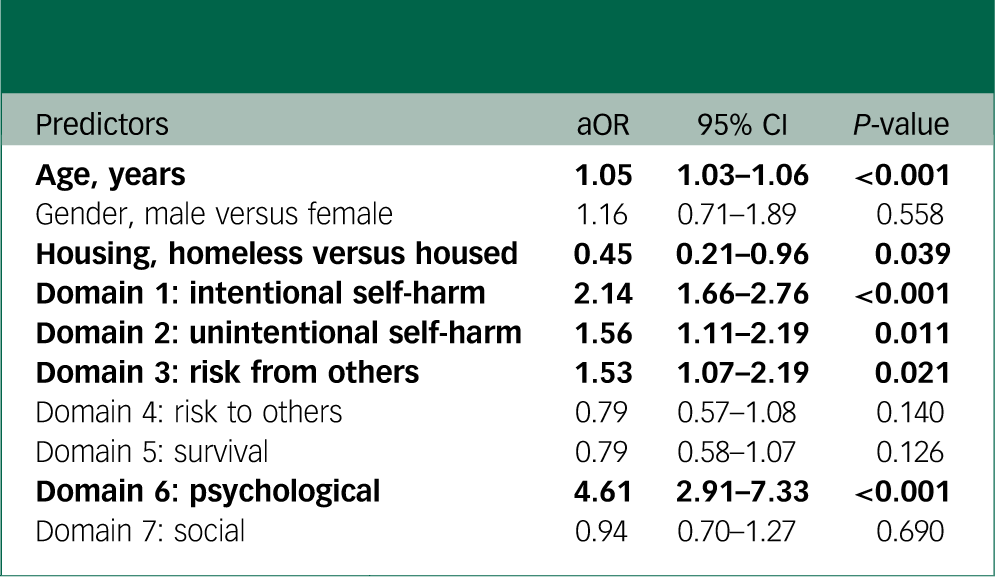
Model 2: logistic regression including all seven TAG domains (plus age, gender and housing)

Table 4 Long description
A table with six rows and four columns. The columns are labeled ‘Predictors’, ‘aOR’, ‘95% CI’, and ‘P-value’. The table presents data on various predictors and their association with a certain outcome. The predictors include age, gender, housing status, and several domains of self-harm and risk. Each predictor is listed with its adjusted odds ratio (aOR), 95% confidence interval (CI), and p-value. Notable entries include ‘Age, years’ with an aOR of 1.05 and a p-value of less than 0.001, ‘Housing, homeless versus housed’ with an aOR of 0.45 and a p-value of 0.039, and ‘Domain 6: psychological’ with an aOR of 4.61 and a p-value of less than 0.001. The table highlights significant predictors with bold entries, indicating their importance in the model.
TAG, Threshold Assessment Grid; aOR, adjusted odds ratio. Model fit, N = 771; events 118 (15.3%); Nagelkerke R 2 = 0.348. Bold values indicate statistically significant associations (p < 0.05).
The first regression model, shown in Table 3, or model 1, adjusted for overall severity, age and gender. The results showed that higher TAG scores and older age predicted psychiatric admission (adjusted odds ratio (aOR) 1.34, 95% CI 1.24–1.45, p < 0.001 and aOR 1.04, 95% CI 1.03–1.06, p < 0.001, respectively), with homelessness being associated with significantly lower odds of admission (aOR 0.16, 95% CI 0.09–0.28, p < 0.001). Gender was not significantly associated with psychiatric admission.
Table 4 shows model 2, a domain-specific regression model that entered all seven TAG domains separately, plus age, gender and housing. Domains associated with higher odds of admission were intentional self-harm (aOR 2.1, p < 0.001), unintentional self-harm (aOR 1.6, p = 0.011), psychological symptoms (aOR 4.6, p < 0.001) and risk from others (aOR 1.5, p = 0.021). Social, survival and risk to others were not associated with admission.
After adjusting for all domains, homelessness still predicted lower admission odds (aOR 0.5, 95% CI 0.2–1.0, p = 0.039), suggesting that the disparity could not be explained solely by elevated clinical severity in any single domain.
Discussion
When comparing severity of illness across 771 referrals for psychiatry assessment in 2020, PEH were recorded as having significantly higher severity scores than those who were housed, yet had lower odds of admission. This difference persisted following adjustment for age and gender, and after controlling for domain-specific severity, which indicates that housing status independently predicts likelihood of admission following emergency department-based psychiatric assessment. Our findings are consistent with previous research which found that PEH attend the emergency department more frequently, often have complex needs and experience different outcomes to the housed population. Reference Vohra, Paudyal and Price9 Data from an Irish study in 2015 demonstrated 18.8-fold higher rate of emergency department attendance among PEH, and also found that PEH were 2.6 times more likely to leave the emergency department prior to completion of assessment. Reference Ni Cheallaigh, Cullivan, Sears, Lawlee, Browne and Kieran14
Our study also reflects high levels of service utilisation and a high level of clinical need but a lower rate of psychiatric in-patient admission, suggesting that outcome following emergency department assessment may be influenced by factors beyond clinical severity. Admission decisions in emergency psychiatric settings typically prioritise acute clinical risk and immediate psychopathology. It is therefore possible that admission thresholds reflect service remit and risk management priorities rather than broader social vulnerabilities alone. It is also possible that lower admission rates among PEH partly reflect factors such as patient refusal of admission, premature departure from the emergency department prior to completion of assessment, service capacity constraints or the availability of alternative care pathways, rather than differences in clinical decision-making alone. Although our findings raise questions about how homelessness-related needs are addressed in emergency pathways, these should be interpreted within the context of the clinical decision-making frameworks that guide emergency psychiatric care.
PEH face several barriers to accessing care that may result in early departure from emergency department or declining an admission, including difficulties with addiction management, perceived stigma, ‘conversations of exclusion’, competing survival needs (e.g. securing shelter or belongings) and shame or low self-esteem. Reference O’Carroll and Wainwright15,22 As a population that often rely on unscheduled rather than scheduled care, these barriers may partly explain lower admission rates and challenges engaging with routine out-patient care. At the same time, for many PEH, the emergency department is the most accessible avenue for healthcare and, for some, the only access point.
It is worth noting that, in our domain-level model, acute psychopathology (high scores in the self-harm and psychological domains) resulted in increased likelihood of admission whereas high scores in the survival and social domains (which were those with the largest gap between housed and PEH) did not independently predict admission. Because TAG has been validated as a brief triage instrument rather than a diagnostic tool, these domain-level associations should be interpreted cautiously since they may reflect acute presentation or contextual risk rather than underlying psychopathology. This reflects the purpose of admission being for the treatment of acute illness rather than social problems. This pattern is consistent with decision-making in emergency department-based psychiatric assessment prioritising short-term clinical risk over homelessness-related vulnerabilities when determining the need for hospital admission. This means that an acutely suicidal or psychotic presentation prompts admission, whereas severe social adversity alone (no matter how high the TAG score) is more likely to be addressed via out-patient or social routes rather than by in-patient care. This probably reflects the remit of emergency psychiatry, which is focused on immediate safety and acute escalation of risk rather than on long-term resolution of social problems.
It is important to note that admission versus discharge is an imperfect proxy for care quality. This study identified that PEH are less likely to be admitted than housed peers, but admission is not necessarily the ‘best’ outcome. In many crises, a timely, well-supported discharge to robust community treatment is preferable for patients. 22
We acknowledge that homelessness can directly increase TAG total scores through higher scores in the survival and social domains, meaning that elevated TAG totals among PEH may partly reflect housing-related adversity rather than independent psychiatric severity, which was the rationale for conducting a second regression model including all seven TAG domains. Although the effect size was smaller, the association between housing status and admission persisted following domain-level adjustment. This suggests that additional unmeasured or contextual factors related to homelessness may influence admission outcomes.
Our study coincided with substantial pandemic-related service disruption. Internationally, emergency department attendances fell sharply in early 2020, with mental health presentations declining alongside overall volumes before rebounding, often with higher acuity and a shift in case mix. Reference Hartnett, Kite-Powell, DeVies, Coletta, Boehmer and Adjemian23–Reference Mukadam, Sommerlad, Wright, Smith, Szczap and Solomou26 In Ireland, overall emergency department activity contracted during the first wave but mental health-related presentations rose in several centres during the first pandemic year, with changes in out-of-hours presentations and local self-harm patterns. Reference Sless, Hayward, Ryan, Deasy and Dasari24,Reference Hartnett, Alshurafa, McAndrew, Daly, Alsaffar and Cotter25 The COVID-19 pandemic necessitated reconfiguration of liaison psychiatry and emergency mental health pathways, including changes to referral processes and assessment practices and a shift towards virtual consultations, with potential downstream effects on admission decision-making. Reference Kelleher, Geary, Tawfik, Ní Mhuircheartaigh, Gavin and Wall27,Reference Barry, Doherty, Clancy, Moore and MacHale28 These changes may have posed additional barriers for PEH, who often have limited access to technology and reliable connectivity, and may have further complicated access for those experiencing homelessness without severe mental illness. Reference Kelleher, Geary, Tawfik, Ní Mhuircheartaigh, Gavin and Wall27–Reference Ingram, MacNamara, Buggy and Perrotta30
Implications for practice and services
We used admission as the primary outcome because it is observable and comparable, but future research should evaluate the quality and appropriateness of the full spectrum of care pathways: crisis stabilisation, community linkage, case management and other alternatives to admission, in combination with patient-centred outcomes (engagement with services, symptom improvement, unplanned returns and patient-reported experience), to avoid equating bed access with quality of care.
Current guidelines call for the inclusion of health initiatives that can provide support to those presenting with high survival and social needs when admission is not indicated. 22 Integrated and assertive pathways, case management and inter-agency working have been identified as strategies for unmet health and social needs. 29
There is a need to consider integrated pathways across primary care, community mental health, addiction and housing services to identify and manage homelessness-related issues. Community experts have called for a housing-first approach, better inter-agency collaboration and dedicated care coordination to tackle health–housing gaps. Reference Ingram, MacNamara, Buggy and Perrotta30 Housing-first is an approach that provides immediate access to permanent housing without preconditions for treatment or sobriety, paired with supportive services. Reference Goering, Veldhuizen, Watson, Adair, Kopp and Latimer31 Housing-first programmes have a strong evidence base, with randomised controlled trial evidence finding that this approach results in greater patient autonomy, improved quality of life, increased housing stability, improvements in community functioning and fewer in-patient days. Reference Stergiopoulos, Hwang, Gozdzik, Nisenbaum, Latimer and Rabouin32,Reference Sadowski, Kee, VanderWeele and Buchanan33 Although the evidence did not find that housing-first resulted in a change in psychiatric symptoms or substance use, a large systematic review supported reduced use of unscheduled care. Reference Ponka, Agbata, Kendall, Stergiopoulos, Mendonca and Magwood34
Our findings reflect a need for person-centred, trauma-informed, inclusion-health pathways for psychiatric emergencies involving homelessness. These pathways will largely sit outside the emergency department, but emergency department encounters represent important contact points for identification and signposting. Our data therefore highlight gaps in the wider system of community and housing provision rather than suggesting that emergency departments should assume a primary role in delivering homelessness services. This aligns with national guidance that emphasises integrated health and social care, rapid linkage and stigma-free practice. 22,29
Both international and Irish evidence demonstrates that PEH disproportionately rely on unscheduled care and face access barriers such as stigma, unmanaged withdrawal and competing survival needs. These factors often drive PEH to leave emergency departments before treatment completion. This pattern underlies the need for proactive, coordinated alternatives to in-patient admission. Reference Vohra, Paudyal and Price9,Reference Ni Cheallaigh, Cullivan, Sears, Lawlee, Browne and Kieran14,Reference O’Carroll and Wainwright15,Reference Ingram, MacNamara, Buggy and Perrotta30
The use of standardised tools such as TAG can ensure that severity is recognised; however, because TAG was validated outside emergency department/PEH contexts, it should function as a trigger for actionable care plans rather than as an end-point. Reference Slade, Powell, Rosen and Strathdee17–Reference Slade, Cahill, Kelsey, Powell, Strathdee and Valiakalayil20 In situations where psychiatric admission is not warranted, emergency department-based psychiatric assessment offers an opportunity to initiate a brief management plan and address key risk factors, which may be primarily psychosocial. A role of the emergency department assessment is to facilitate stabilisation and make onward referral to community mental health teams, addiction services or housing-first/outreach programmes that can follow up with the patient following their discharge from the emergency department. This reinforces the need for clear transfer-of-care pathways for PEH, including early discharge planning and coordinated follow-up. 35 These approaches are supported by systematic reviews and trials demonstrating improved housing stability and reductions in the use of emergency care. Reference Stergiopoulos, Hwang, Gozdzik, Nisenbaum, Latimer and Rabouin32,Reference Sadowski, Kee, VanderWeele and Buchanan33 There is a need for emergency department services to build capacity for prematurely terminated assessments and acute withdrawal management, and to establish clear referral pathways into social care and housing services, supported by wider system investment, to reduce disparities in outcomes for PEH. Reference Vohra, Paudyal and Price9,Reference Ingram, MacNamara, Buggy and Perrotta30,Reference Goering, Veldhuizen, Watson, Adair, Kopp and Latimer31
At a national and policy level, our results give weight to the integration of health and housing support to better serve our vulnerable populations. Current Health Service Executive and National Institute for Health and Care Excellence guidance 22,29 call for joint initiatives among mental health services, local councils and third-sector organisations supporting those experiencing homelessness. Improved links among such services supporting PEH (e.g. involving key workers during emergency department assessment and shared care plans) may help to reduce reliance on emergency departments for crisis management. There are opportunities for preventative measures, such as expansion of the housing-first programme and assertive outreach at primary care and the community mental health team level. Reference Goering, Veldhuizen, Watson, Adair, Kopp and Latimer31,Reference Stergiopoulos, Hwang, Gozdzik, Nisenbaum, Latimer and Rabouin32,Reference Ponka, Agbata, Kendall, Stergiopoulos, Mendonca and Magwood34
Strengths and limitations
The strengths of this study include a large real-world cohort, systematic severity measurement using a validated tool, and complementary regression analyses exploring both total and domain-specific effects.
Limitations include the single-centre design and reliance on an administrative definition of homelessness (potentially misclassifying housing status). TAG ratings were completed retrospectively from clinical notes by two raters without formal interrater reliability testing. Although the raters used standardised TAG scoring guidance and completed an initial calibration exercise prior to data collection, no independent double-scoring of cases was undertaken. As a result, some variability in scoring between raters may have occurred, which could have influenced severity estimates.
Several important factors that may influence admission decisions were not captured in this analysis. Key unmeasured confounders include primary psychiatric diagnosis, substance use, level of behavioural disturbance at presentation and availability of community or social supports. These factors are likely to influence admission decisions independently of TAG severity and housing status, and may therefore have contributed to residual confounding within the regression models.
It is also important to recognise that PEH are not a homogeneous group. Factors such as ethnicity, migration status and country of origin were not captured in this data-set but may influence both clinical presentation and admission outcomes. The observed gender imbalance in our PEH cohort (64.5% male) is consistent with national data, 11 but means that the experiences of women and gender minorities experiencing homelessness may be underrepresented in these findings. Given 118 admission events, our models met conventional events-per-variable guidance with model 1 ≈ 29.5 events per variable (EPV) and model 2 ≈ 11.8 EPV. The data used for this study were collected in 2020 during the COVID-19 pandemic when crisis mental health presentations differed, which may limit the generalisability of the study. Reference Sless, Hayward, Ryan, Deasy and Dasari24,Reference Hartnett, Alshurafa, McAndrew, Daly, Alsaffar and Cotter25 We were unable to identify repeat presentations by the same individual or account for clustering of referrals within individuals, which may have introduced some non-independence between observations. We were unable to capture cases where patients left before completing the psychiatric assessment or refused admission.
These findings highlight the importance of ensuring that emergency mental health pathways are equipped to respond to the complex clinical and social needs of PEH, including clear pathways for follow-up care and coordination with community and social support services.
There are several directions for future research in this area. Qualitative studies could be useful to explore unmeasured confounders and examine clinical decision-making processes in emergency psychiatric settings. A qualitative approach to interviewing PEH could reveal perceived barriers to accessing healthcare in a crisis. Another priority could be the introduction of pilot programmes aimed at addressing the equity gap between PEH and housed patients. This could include evaluation of whether a specialist homeless mental health team embedded in the emergency department increases engagement and improves outcomes for PEH. It would be useful to expand this research to track longitudinal outcomes of those discharged from emergency departments to quantify the rate of adverse events, repeat attendances and adherence to follow-up, and the causes underlying these outcomes.
In conclusion, in this inner-city cohort, PEH presented in crisis with higher severity of need and were less likely to be admitted than those who were housed. This disparity persisted after adjusting for overall and domain-specific TAG scores. Our findings raise the possibility of inequities in how vulnerable groups experience crisis care, engage with scheduled and unscheduled services and receive support. There appears to be a higher threshold of psychosocial distress (but not necessarily psychopathology) for psychiatric admission for PEH. This may reflect a need to reconsider care and decision-making pathways to better meet the needs of vulnerable groups. Improving healthcare inequalities for vulnerable populations requires a coordinated approach across health- and social care services. Continued integration of health- and social care through inclusion health initiatives has the potential to reduce unnecessary hospital admissions and repeat emergency presentations, and has been shown to be cost-effective. There is a need for further work to better understand the barriers to scheduled care, and the factors that influence the seeking of unscheduled care in PEH.
Data availability
The data that support the findings of this study are available from the corresponding author, A.B., upon reasonable request, and following additional ethical approval regarding data provision to individual institutions.
Acknowledgements
The authors made use of ChatGPT (GPT-5, OpenAI, San Francisco, California, USA; https://chatgpt.com), accessed via the Windows web application, to assist with the drafting and editing of this article. The tool was accessed via the OpenAI platform and used with modification of generated text during manuscript preparation in 2025. All final content was reviewed and approved by the authors.
Author contributions
A.B. conducted the statistical analysis, drafted the manuscript and gave final approval of the version to be published. A.M. contributed to study design, assisted with data collection, supported data interpretation, critically revised the manuscript and gave final approval of the version to be published. M.S. assisted with data collection, reviewed manuscript drafts and gave final approval of the version to be published. K.K. conceived the research question, critically reviewed the manuscript and gave final approval of the version to be published. A.M.D. provided senior oversight, conceived the research question, designed the study, contributed to study design and interpretation, critically reviewed the manuscript and gave final approval of the version to be published.
Funding
This research received no specific grant from any funding agency, commercial or not-for-profit sectors.
Declaration of interest
A.M.D. is a member of the BJPsych Open editorial board and had no involvement in the peer review or decision-making process for this manuscript. The other authors declare no conflicts of interest.
Transparency declaration
We affirm that this manuscript is an honest, accurate and transparent account of the study being reported; that no important aspects of the study have been omitted; and that there have been no discrepancies from the study as planned.


 Open access


eLetters
No eLetters have been published for this article.