



When promoting important and difficult policies, how does the state strengthen its implementation capacity through institutional or organizational reshaping? The case of water management in China provides an interesting reference. Since Xi Jinping 习近平 came to power, China's decision-making system has become more centralized. Xi has reinforced the Party centre's control over the bureaucracy through a system of leading groups (lingdao xiaozu 领导小组) and other mechanisms.Footnote 1 Kjeld Erik Brødsgaard has described this augmentation of central control as “integrated fragmentation.”Footnote 2 Another feature of Xi's decision making is “top-level design” (dingceng sheji 顶层设计), as noted by Gunter Schubert and Björn Alpermann, which means that all policies advanced at local level must be in line with those of the Party centre.Footnote 3 Sebastian Heilmann has noted that “planning” (guihua 规划) is playing an increasingly important role in Chinese policymaking.Footnote 4
It is within this scholarly context that we discuss the issue of the “politics of water.” China's water governance system lacks public supervision, meaning that the effectiveness of water-related policies remains questionable.Footnote 5 The Chinese Communist Party (CCP) has a history of establishing water governance institutions; parochialism and conflicting economic interests, however, have always got in the way of collective action by local governments in this area. In 1999, China set up water conservancy commissions (shuili weiyuanhui 水利委员会) to manage six of China's main river basins – those of the Yangtze (Changjiang 长江), the Yellow River (Huanghe 黄河), the Huaihe 淮河, the Haihe 海河, the Pearl River (Zhujiang 珠江) and the Songliao 松辽 – as well as one authority (guanliju 管理局) to manage the Taihu Basin 太湖流域.Footnote 6 These bodies all came under the jurisdiction of the Ministry of Water Resources. However, at that time, the division of responsibility between central and local authorities in relation to water governance was by no means clearly defined. The water conservancy commissions had limited ability to influence the policies of local governments, which tended to prioritize economic development above environmental considerations. These conflicts of interest were encapsulated in a popular saying, “there are nine dragons governing water” (jiulong zhi shui 九龙治水).Footnote 7
How has the CCP under Xi Jinping sought to remove the barriers to collective action by local governments on water governance? Because of their competition in terms of economic development, local governments had become what Mancur Olson terms “exclusive groups” that were reluctant to act collectively to promote the central government's water policy.Footnote 8 Under these circumstances, the central leaders found it difficult to coordinate the actions of the leaders of China's 34 individual provinces and administrative regions. As Olson has pointed out in his work on the theory of groups, collective action is easier to achieve with a smaller number of group members.Footnote 9 Since taking office, Xi Jinping has emphasized “coordinated regional development” (quyu xietiao fazhan 区域协调发展, CRD hereafter),Footnote 10 and “regions” have been defined differently, depending on the issue, with each region covering several provinces. In this study, for example, each of China's water governance regions based on river basins – what we term “riverine macroregions” – covers several provinces. In this way, when implementing its policy on water governance, the Party centre only has to deal with a limited number of provincial leaders at one time.Footnote 11 For instance, only three provincial-level leaders are involved in the Haihe River system – those of Beijing, Tianjin and Hebei. This is also consistent with Olson's argument that the smaller the size of the group, the easier it is for members to act collectively. It can be inferred that, with this setup, the provincial leaders in each riverine macroregion would be more willing to cooperate in promoting the central government's water governance policy. However, we do not intend in this article to focus on the effectiveness of the CCP's water governance policies under Xi Jinping but rather to examine how the way these policies are being implemented has strengthened the CCP centre's control over local governments.
The CRD strategy requires the establishment of new types of leading group.Footnote 12 These are top-level design groups (in charge of central strategic planning), riverine macroregion groups (responsible for interprovincial policy integration) and implementation groups (in the case of water governance, formed by the Ministry of Water Resources and the provinces). This entire setup may be described as one of “intergroup politics” (zuji zhengzhi 组际政治). In this article, the governance of water will be used to illustrate the operation of intergroup politics in contemporary China and to analyse how the CCP promotes collective action by local governments in line with central policies.
The data we use to illustrate our argument were mainly collected from in-depth interviews conducted between November 2019 and June 2022 with nine department-level cadres from the central authorities, three local department-level cadres and five government researchers. One of the co-authors was introduced to interviewees through colleagues and students, all of whom were serving central and local-level cadres, through snowball sampling.Footnote 13 These interviewees all worked in departments related to water governance, so their responses may be considered to be reasonably professional and credible. The interviews were conducted in a semi-structured manner. We probed interesting issues that we had not previously considered and gradually gained a clearer understanding of water governance and the relationship between central and local governments during the Xi period. This yielded insights that went beyond the clichés of official Chinese propaganda.
Our main case study concerns the Haihe Basin. Most of our interviewees work in the cities near or within that basin. Initially, our questions focused on the effectiveness of water governance of the Haihe region, but in subsequent interviews, we found that water governance under Xi Jinping appeared to have important political implications. We concluded that the CCP is using the intergroup politics of riverine macroregions to enhance the Party centre's control over Beijing, Tianjin and Hebei. To collect more evidence in support of this argument, we revised our interview questions to focus on how the centre has used water governance to reinforce its control over local personnel and finances. We argue that our findings on the governance structure of the Haihe Basin can be extended to China's other water systems.Footnote 14
In order to demonstrate our argument, the content of this paper is arranged as follows. In the next section, we discuss the concept of riverine macroregions and their functions. We then describe how China has been divided into six macroregions based on the governance and development requirements of each of these river basins. We go on to discuss the intergroup politics of these macroregions – that is, how they work. We follow up by showing how the politics of the macroregions has been used by the centre to augment its control over local governments.
Riverine Macroregions as a Solution to the Problem of Collective Action
Most existing studies of the CCP's water governance policies take one specific administrative region as their unit of analysis. For example, Sabrina Habich-Sobiegalla uses a case study of two counties in Yunnan province in her analysis of why some parts of Yunnan are prone to water shortages. She finds that the “project mechanism” (xiangmu zhi 项目制) was flawed, making it difficult to direct centrally allocated funds for water works to places that really needed them.Footnote 15 Other studies point to China's system of vertical (tiao 条) and horizontal (kuai 块) chains of command as hampering attempts to mitigate conflicts of interest between localities. Scott Moore points out that the lack of an effective mechanism to address horizontal collective action problems in cross-administrative regional water governance has made it impossible for local leaders to coordinate their efforts with each other or with the centre.Footnote 16
Environment-related governance under Xi Jinping has enhanced the centre's control over local governments. It is widely recognized that under Xi's predecessor, Hu Jintao 胡锦涛, the relationship between the centre and the local governments underwent a process of “soft centralization,” as the localities still had a degree of autonomy where personnel arrangements and finances were concerned.Footnote 17 However, Genia Kostka and Jonas Nahm have observed that the new water governance arrangements involve recentralization, something that they describe as “bringing the centre back.”Footnote 18 In this paper, we further argue that Xi Jinping has weakened the power of local governments at the provincial level and below through intergroup politics and manipulation of the riverine macroregions and so our examination of Xi's water governance policies pays particular attention to the formation and operation of the riverine macroregions and their interaction with the centre.
In developing the concept of the riverine macroregion, we draw upon the work of G. William Skinner. In his study of the influence of regional development on Chinese politics in late-Qing China, Skinner proposes the concept of “physiographic macroregions,” dividing China into several large blocs based on geographical, economic and cultural characteristics.Footnote 19 In this article, we use the term riverine macroregions for large blocs based on river basins that the CCP has established to direct water governance and national development and, at the same time, to enhance central control over local governments. Because the riverine macroregions are based on geographical features, each macroregion embraces several provinces, and one province may fall into more than one macroregion.
From the perspective of Party history, the CCP has in the past divided China into “great administrative regions” (daqu 大区) to reinforce the centre's control over the localities. As early as the War of Liberation (1945–1950), the CCP established a regional system, with military agencies responsible for coordinating both military and civilian affairs in each region. After the founding of the People's Republic of China, this system was continued with the establishment of six daqu: North China, North-west China, North-east China, East China, Central Southern China, and South-west China. However, the daqu system was abolished in 1954 and local governments were given more autonomy in an effort to boost economic development. From then onwards, the province was the highest administrative unit below the central government.Footnote 20
However, the CCP did not completely abandon the idea of daqu. When the centre has wanted to push forward a particular policy, it has often sought to strengthen its control over the provinces through the establishment of collaborative bodies. One notable example is the formation in 1958 of seven “cooperation zones” (xiezuoqu 协作区), each containing several provinces and headed by the Party secretary of one of the provinces.Footnote 21
Under Mao Zedong, a daqu often covered several provinces. However, as reform and opening-up has developed, this division into regions has tended to be based on geography, economic sectors or other considerations, rather than general administration. For example, under Hu Jintao, the CCP sought to solve the problem of uneven development by means of what it referred to as a “scientific outlook on development” (kexue fazhan guan 科学发展观).Footnote 22 Hu also began laying the foundations of the CRD system. In 2011, the State Council issued the “National principal function zoning plan” (quanguo zhuti gongnengqu guihua 全国主体功能区规划), which divided China into “optimized development areas,” “key development areas,” “restricted development areas” and “prohibited development areas.”Footnote 23
The riverine macroregions, based on China's river basins, may be seen as a daqu system for the Xi Jinping era. Previously, water governance was usually province-based, with the centre issuing demands and assigning responsibilities to each of the 34 provincial-level authorities. The CCP has often adopted a “territorial principle” (shudiyuanze 属地原则) for cadres, meaning that local leaders were held responsible for any problems that arose within their localities. However, since rivers have a habit of flowing through several provinces, it is difficult, for example, to identify and assign responsibility for a source of pollution. In addition, variations in levels of economic development and political status among the provinces mean that the more powerful and developed coastal provinces have tended to respond in a perfunctory manner to the centre's demands, thus creating an agency problem.Footnote 24 This is why, under Xi Jinping, the CCP has sought to achieve collective action on water governance through the operation of riverine macroregions, as it has calculated that these multi-provincial blocs are more likely to be subservient to the Party centre.
National Development and Riverine Macroregions
This article focuses on five of China's most important water systems, those of the Songliao (the Songhua 松花江 and Liao 辽河 rivers), the Yellow River, the Yangtze, the Haihe and the Pearl River. River basins are important areas for economic development in China. They are favoured locations for urbanization and magnets for investment.Footnote 25 Since most industries require a plentiful supply of water and drainage, industrial zones are usually built in river basins. Under Xi Jinping, the CCP regime has formulated six regional development strategies for the governance of these five river basins, which we term riverine macroregions (see Figure 1).Footnote 26
China's Main Water Systems and Riverine Macroregions under Xi Jinping
Notes: For reasons of simplicity, tributaries have been excluded from the figure. The dashed circles represent the approximate boundaries of regions in which specific national strategies are in force. The map does not show China's other territorial waters and small islands, such as those in the South China Sea.
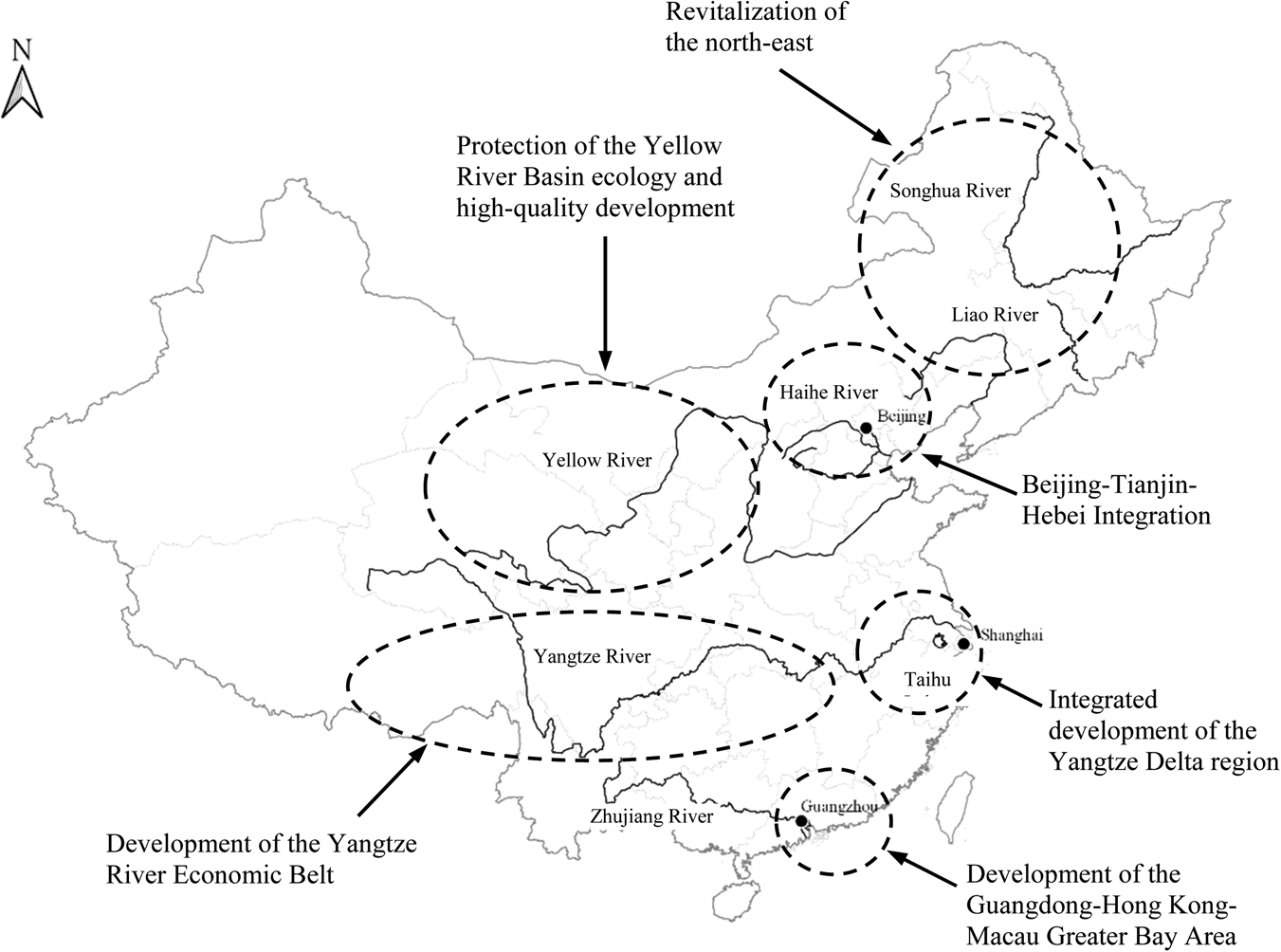
The Songliao Basin suffers from a serious pollution problem caused by industrial wastewater generated in China's north-east. The pollutants in this basin mainly originate from the traditional industries of the region which produce coal, petroleum, steel, paper, chemicals, etc. Their equipment is outdated, their technology is obsolete and their facilities are insufficient to clean up their wastewater.Footnote 27 As part of the revitalization of the north-east (zhenxing dongbei 振兴东北) strategy, these firms are being urged to upgrade as soon as possible but a lack of funding has hindered progress on this front.
The Yellow River Basin covers a vast territory in central and western China. In 2021, the CCP introduced a new strategy for protecting the ecology of the Yellow River Basin and promoting high-quality development (Huanghe liuyu shengtai baohu he gaopin zhiliang fazhan 黄河流域生态保护和高质量发展) and began to improve water governance in this river basin. Furthermore, those parts of the Yellow River Basin that lie in Qinghai, Sichuan, Gansu, Ningxia and Inner Mongolia are closely associated with Beijing's Belt and Road (yidai yilu 一带一路) initiative, so effective water governance there has the potential to reinforce the existing cooperation between these provinces and China's neighbours in western and Central Asia in the areas of water conservation, wind and sand control, and agriculture.Footnote 28
The most seriously polluted parts of the Yangtze River Basin are the lower reaches of the river in the Yangtze Delta Industrial Zone. The Taihu Lake Basin is the hardest-hit area because it is downstream from Shanghai, Zhejiang and Jiangsu. In addition, local governments have shirked their responsibilities where improving water quality is concerned. Under the 2018 strategy of promoting integrated development in the Yangtze River Delta region (Changsanjiao diqu yitihua fazhan 长三角地区一体化发展), local governments in the Taihu Lake Basin were supposed to coordinate their operations.Footnote 29
There is also a significant water pollution problem in the upper and middle reaches of the Yangtze River, which may be attributed in part to the fact that, in 2012, there were nearly 120,000 cargo and fishing vessels active on the Yangtze and its tributaries. In 2014, the CCP formulated a strategy to promote the development of the Yangtze River Economic Belt (tuidong Changjiang jingjidai fazhan 推动长江经济带发展), which included thorough remediation of the river. Managing the middle and upper reaches of the Yangtze is a complex task. The Yangtze River is known as China's golden waterway because of its importance for shipping. Xi Jinping has also called it the “mother river” (母亲河 muqin he) of the Chinese nation and regards it as an important national symbol.Footnote 30 For these reasons, the remediation of the Yangtze River has great significance in terms of national honour.
Pollution of the Haihe River Basin is mainly the result of urbanization, as this water system includes the two municipalities of Beijing and Tianjin. Owing to the narrow river channel and the large volume of wastewater discharged from the municipalities, the river basin has been seriously polluted. In 2015, the CCP unveiled a coordinated development plan for Beijing-Tianjin-Hebei (JingJinJi yitihua 京津冀一体化), which included the comprehensive management of the Haihe River Basin and the restoration of its ecology.Footnote 31
Industrial development in Guangdong has had an enormous impact on water quality in the Pearl River Basin. Lying as it does at the heart of the “world's factory,” Guangdong hosts a massive manufacturing sector which is the source of serious environmental pollution. In 2015, the CCP proposed a strategy for the Guangdong-Hong Kong-Macau Greater Bay Area which was designed to coordinate and regulate economic development in the Pearl River Basin and promote industrial upgrading.Footnote 32 Management of the Pearl River system also involves dredging the river, which has played a role in flood control and drainage in southern China, a region known for its heavy rainfall.Footnote 33
Intergroup Politics
The operation of the riverine macroregions is based on intergroup politics – that is, coordination and integration by means of leading groups. Top-level design involves the establishment of one large central leading group to guide the subordinate groups.Footnote 34 Three levels of leading groups have been set up to manage important water systems in China, and we refer to them here as the top-level design group, the riverine macroregion groups and the implementation groups.
With the exception of the Songliao system, the water systems listed in Table 1 are all managed personally by Xi Jinping and senior vice-premier, Han Zheng 韩正, and several new leading groups have been established to handle related business. Remediation of the Songliao water system remains the responsibility of the Songliao Water Resources Commission under the Ministry of Water Resources, while the revitalization of the north-east programme is the responsibility of the premier, Li Keqiang 李克强. The fact that the Songliao system is still under the old leadership while the other water systems have new leaders who report directly to Xi Jinping is a source of discontent among the Songliao officials, who complain that their work is not being taken seriously. What is more, industrial upgrading in the north-east has achieved only limited results.Footnote 35 This situation has the potential to trigger a power struggle among the senior leadership, as Xi has left the “awful mess” (lantanzi 烂摊子) in the north-east to Li without providing him with the necessary support, and lack of progress in that region could damage Li's prestige.Footnote 36
National Strategies and Water Governance in the Riverine Macroregions

Since the Songliao is managed under the old system and excluded from intergroup politics, we will focus here on the other four water systems. For the sake of simplicity, we will base our analysis of the operation of intergroup politics in the governance of the Haihe River Basin. This is illustrated in Figure 2.
Intergroup Politics in the Governance of the Haihe River System
Note: There may be extensive changes in the central leadership at the 2023 NPC. The cadres in the positions shown in the chart are mainly those in office between 2018 and 2023.

Figure 2 shows that the top-level design group most closely involved with national strategic development and water governance is the Central Commission for Comprehensively Deepening Reform (zhongyang quanmian shenhua gaige weiyuanhui 中央全面深化改革委员会). The Commission is chaired by Xi Jinping and water governance is just one of its responsibilities; it is in charge of drawing up the strategy for overall national development. Xi Jinping takes a very hands-on approach to water governance.Footnote 37
The Central Commission for Comprehensively Deepening Reform has its office in the Central Policy Research Office (zhongyang zhengce yanjiushi 中央政策研究室), and its former and current office chiefs are Wang Huning 王沪宁 and Jiang Jinquan 江金权, both close associates of Xi Jinping. Wang and Jiang have undertaken several field trips to investigate and supervise the progress of river basin governance.Footnote 38 It is important to note that the Commission's office often requests updates on progress and challenges in water governance from the Ministry of Water Resources, other relevant departments and local governments, thus bypassing the State Council and indirectly weakening Li Keqiang's authority over water governance and national development in general.Footnote 39
The Commission has three deputy directors, one of whom, Han Zheng, is the leader in charge of development and reform. Since 2016, Xi Jinping himself has inspected more rivers and lakes across the country and attended more local water governance symposiums than any other leader, which is a sign of how seriously he takes the issue of water governance.
The second level of intergroup politics consists of riverine macroregion leading groups. Five groups of this kind were established between 2014 and 2021 and tasked with overseeing the strategic plans for four of the water systems listed in Table 1. These were the Beijing-Tianjin-Hebei Coordinated Development Leading Group, the Leading Group for Promoting the Development of the Yangtze River, the Leading Group for Promoting the Integrated Development of the Yangtze River Delta, the Leading Group for Promoting Ecological Protection and High-quality Development in the Yellow River Basin, and the Leading Group for the Development of the Guangdong-Hong Kong-Macau Greater Bay Area. Xi decreed that the groups would be directly accountable to the Central Commission for Comprehensively Deepening Reform and that they would submit regular progress reports.Footnote 40 Han Zheng is the director of all five of these riverine macroregion leading groups and is responsible for coordinating water governance in those areas. Clearly, Xi Jinping and Han are the main central leaders in charge of this area of work.
The function of the riverine macroregion leading groups is to carry out water governance work under the guidance of the top-level design group. Tasks include implementing the strategy laid down by the Party centre, coordinating the work of regions and departments, and supervising and inspecting the implementation of water governance. We observe that this system design allows the Party centre to avoid having to deal with the leaders of each province individually. And, as noted above, according to Olson, the fewer members a group has, the more likely it is that they will act collectively. We can see from Table 1 that under the riverine macroregion system, the Party centre only has to deal with three provincial-level leaders in the Taihu Lake Basin, nine leaders in the Yellow River Basin, and three each in the Haihe and Pearl River basins. Under the previous system, the centre had to negotiate with 34 provincial leaders at the same time when it was coordinating water governance work.
As the director of the five riverine macroregion leading groups, Han Zheng has a heavy workload and has “subcontracted” water governance to provincial leaders.Footnote 41 The five riverine macroregion groups hold occasional meetings, and Han Zheng meets with individual leading members of the groups, including provincial Party secretaries and provincial or municipal governors, so these officials can explain the challenges they are facing. When necessary, Han will submit local problems to the Commission for discussion and ask for Xi's assistance.Footnote 42 The offices of these five riverine macroregion groups are housed in the headquarters of the National Development and Reform Commission, through which the Ministry of Finance controls their budgets. The important role of the National Development and Reform Commission and the Ministry of Finance in controlling local government funding is discussed below.
The lowest level of leading group involved in this area of intergroup politics comprises the implementation groups, part of the “river chief” system (hezhangzhi 河长制), established by the Ministry of Water Resources and the provinces. An implementation group is headed by the “top leader” (yibashou 一把手) at that level. For example, the minister is the river chief of the Ministry of Water Resources and is responsible for directing and supervising the work of local river chiefs. Provincial or municipal Party secretaries or governors are in charge of the local river chief groups and are responsible for water governance in their respective river basins. Under this system, everyone has clearly defined roles and responsibilities. The hope is that the local yibashou will be able to bring all the local departments and units together to manage rivers in their area.Footnote 43
This new system has greatly enhanced the authority of the Ministry of Water Resources. Previously, the State Council was expected to deal with local officials who violated central policies; however, because the State Council lacked the personnel with the authority to deal with these matters, the central government often passed the buck. According to Ministry cadres, reports submitted to a premier or vice-premier, as well as documents distributed to provinces and municipalities, often received no response, and Ministry officials did not dare to ask further questions to avoid getting into trouble.Footnote 44
Today, officials of the Ministry of Water Resources report directly to Han Zheng, so local leaders are forced to accord the Ministry more respect. Under the previous system, Ministry officials on inspection tours would be received by cadres from the local water resources department, or at best by a deputy provincial or municipal governor. Now, these officials will often be accompanied on their tours by the local Party secretary or the head of the local government. Local cadres are now very wary of offending officials from the Ministry.Footnote 45 Over the period 2018–2021, the Ministry of Water Resources received one of the highest performance ratings among all departments of the State Council. This suggests that water governance in China has indeed made progress.Footnote 46
With regards to the Haihe River Basin, governance plans for this basin have been drawn up by the Beijing-Tianjin-Hebei Coordinated Development Leading Group. Under this leading group system, the Ministry of Water Resources has sufficient authority to order local governments in that region to improve water governance. If they fail to do so, the local river chief (yibashou) is called to account. This has had a positive impact on the governance of the Haihe River system.Footnote 47 Similar riverine macroregion leading groups operate in other river basins and, through them, Han Zheng directs the Ministry of Water Resources and local authorities to promote water governance in line with central policies.
We argue that this system of riverine macroregions and intergroup politics makes it easier for the centre to direct and coordinate the actions of local cadres in the area of water governance. This approach to water governance seems to facilitate a greater degree of control by the centre over local personnel and finances, as discussed below.
Solving the Problem of Potential Nomenklatura Failure
The operation of the riverine macroregions and intergroup politics has enabled central leaders to promote river basin governance without dealing directly with individual provincial or municipal leaders, as each regional group is responsible for managing several provinces and municipalities. The clear assignment of roles and responsibilities increases the effectiveness of the centre's governance, reduces the information asymmetry between the central leadership and local officials,Footnote 48 and encourages cadres to cooperate with each other.
For example, following the establishment of the Beijing-Tianjin-Hebei Coordinated Development Leading Group, Beijing, Tianjin and Hebei began to unify regulations and monitoring standards and to implement joint enforcement. In response to Han Zheng's emphatic request, Tianjin and Hebei proposed to make the Haihe the “moat” of Beijing – that is, to make a clean Haihe a symbol of Beijing, the capital city. This means that Tianjin and Hebei will have to close a large number of factories for water governance, which may lead to a slowdown in economic growth in both areas; however, since this policy is headed by Xi Jinping and Han Zheng, officials in Tianjin and Hebei will not be held accountable if their economies do not grow as much as Beijing's.Footnote 49
Under the previous system, local leaders would often seek to protect their own local interests through various forms of “soft confrontation,” collusion with other leaders, deception or by passing the buck. Information asymmetry between the central leadership and the localities meant that the centre was often unaware of local officials’ negligence or noncompliance. So, despite the centre having the power to hire and fire, local officials were able to find ways of resisting the orders of their superiors.
For example, when Zhu Rongji 朱镕基, the “iron-fisted premier” (tiewan zongli 铁腕总理), was attempting to implement a tax-sharing system in the 1990s, he had to negotiate with local leaders individually. Jiang Yonghua 姜永华, a former Ministry of Finance official, recalled that from 9 September to 21 November 1993, Zhu, who at that time was a vice-premier, led a working group of more than 60 cadres from various departments of the State Council on a tour of 17 provinces, municipalities and autonomous regions to negotiate with each local head. Local leaders would claim that their region's finances were in poor shape and the new tax-sharing system would likely trigger an economic downturn and lead to social instability. After two months of negotiation, the central authorities were forced to bow to local demands and make concessions, allowing local governments to retain some power over taxation.Footnote 50
This is an example of nomenklatura failure. It did not cause the CCP to abandon the nomenklatura system, only to recognize that it was an inadequate structure for ensuring policy compliance among local leaders. Zhu was already a member of the Politburo Standing Committee when he tried to introduce the tax-sharing system and as such had the power to veto (yipiao foujue 一票否决) the appointment of provincial leaders. It was generally accepted at that time that “if provincial leaders dare to go against Zhu Rongji, they will likely be ousted or forgo future promotion.” Footnote 51 If this was the case, why did he have to work so hard to get his tax-sharing policy accepted?
We argue that when the principal (the central leader) must deal with a multiplicity of agents (local officials), the principal is more likely to face a situation of moral hazard, as agents will seek to deceive the principal and deploy various ways to protect their own interests.Footnote 52 This is particularly the case in areas where central policies may conflict with regional development goals – for instance, in river basin governance. The power to hire and fire provincial officials is not sufficient to ensure their compliance with central-level directives. Sometimes, to avoid harming economic development in their province and to protect the interests of local officials and enterprises, local leaders will declare that they “resolutely support the central policy” (jianjue yonghu zhongyang zhengce 坚决拥护中央政策) while covertly working against it (yangfeng yinwei 阳奉阴违).Footnote 53 Localities may also collude with each other to deceive the Party centre or the government.Footnote 54
By setting up riverine macroregion leading groups, the central authorities have greatly reduced the number of provincial-level administrative units they have to contend with when promoting regional development strategies. Indeed, this is similar to the daqu system of the early years of the People's Republic of China, when each daqu comprised several provinces. As Mao Zedong said at the time, “Without the daqu system, the Party centre would be faced with more than 50 provincial-level units, and I might not be able to fully control and manage all regions.”Footnote 55
Through the operation of intergroup politics, local leaders are “reorganized into groups” (chongxin bianzu 重新编组), making it easier for the centre to exercise tight control and forcing local officials to take responsibility for their actions. This may be an effective way of avoiding nomenklatura failure. Meetings of the riverine macroregion groups give central officials an opportunity to gather more local information. Local governments also have clearer roles and responsibilities, which reduces the likelihood of moral hazard and could also reduce agency problems.
Restricting the Development of Fiscal Federalism
Through the operation of riverine macroregions and intergroup politics, the Party centre can govern the behaviour of cadres more effectively and exercise more direct control over local finances. The relationship between the centre and the localities in China today may be described as one of “fiscal federalism” – that is, while the centre controls the appointment of local leaders, local governments are given a certain degree of financial autonomy so they have more incentive to boost local economic development. In other words, the centre only exercises “soft” budget constraints over local governments.Footnote 56 However, under Xi Jinping, it appears that the centre is reducing local fiscal autonomy as part of its water governance and regional development measures.
Previously, local governments’ economic development and tax revenue policies were hard indicators used for bargaining with the central government on various issues. Under the new water governance setup, many heavily polluting local enterprises have been shut down. However, these plants were an important source of local government revenue, and tax revenues in many places within the five riverine macroregions decreased by about 30 per cent, and in some cases by as much as 70 per cent.Footnote 57 As a result, local governments are finding it difficult to fund public services and social welfare or even pay civil servants’ salaries. These local governments also have the added burden of having to hire more personnel to enforce the water control policies set by the centre and the added costs of expanding their inventory of equipment. A shortage of funds is forcing local governments to depend more heavily on subsidies from the central authorities, which has in turn adversely affected their ability to bargain with the centre.Footnote 58
The National Development and Reform Commission and the Ministry of Finance play a very important role in issuing the central government's financial subsidies. The five riverine macroregion groups under Han Zheng, whose offices are housed within the Commission, can arrange with the Ministry for the payment of special subsidies.Footnote 59 This is an important way for the central government to exercise control over the localities. The centre draws up a list of special environmental protection or water control projects that qualify for subsidies and specifies the application criteria. To qualify for a subsidy, a local government must have already completed a certain environmental protection or water governance project in line with central government instructions, and that project must pass a National Development and Reform Commission inspection. The CCP calls this mode of fiscal subsidy “promoting governance through supplements” (yi bu cu zhi 以补促治).Footnote 60 For example, if a city or county's implementation of the river chief system passes the National Development and Reform Commission inspection, the city will receive a subsidy of 20 million yuan or the county will receive 10 million yuan.Footnote 61
The “promoting governance through supplements” is a project-based system (xiangmuzhi 项目制) in which local governments must apply and be vetted to receive funding. For the Haihe River Basin, for example, an agreement was signed in November 2018 between Hebei province and Beijing, headed by the office of the Beijing-Tianjin-Hebei Coordinated Development Leading Group. Beijing would provide financial subsidies for ecological protection to the cities of Chengde 承德市 and Zhangjiakou 张家口市 in Hebei province for the period from 2018 to 2020. The agreement stipulated that Hebei province must meet the water governance standards set by the central government in order to receive the subsidy. In August 2020, the province was supposed to receive a 950 million-yuan subsidy from Beijing. One local official said, “At first, we had doubts about whether we would be able to achieve the pollution control, but the ‘blood transfusion’ [meaning financial subsidies] from the central government, Beijing and Tianjin did enable us to deal with the closure of factories and highly polluting enterprises, and to provide subsistence allowances for unemployed employees and counselling for job changes.”Footnote 62
The central government uses its control of the purse strings to persuade local governments to carry out water governance and environmental protection measures. This control can also be achieved through financial transfer orders under which more developed regions are ordered by the centre to transfer funds to more impoverished areas to compensate them for the loss of revenues caused by the closure of their polluting industries. For example, in the first half of 2021 alone, one province in the west of China received about 3 billion yuan in fiscal transfers for environmental protection and water governance.Footnote 63 In this way, the central government not only boosts the resources of poorer areas but also restrains the financial power of wealthy localities. In the name of water governance, the centre is curbing local financial autonomy, thereby inhibiting the development of fiscal federalism.
Conclusion
Xi Jinping has concentrated power at the centre by means of a governance model based on large leading groups, which he himself heads. While previous studies have focused on the operation of a single leading group, we focus on the interaction of different leading groups, which is known as intergroup politics. In this article, we discuss intergroup politics in relation to water governance and argue that the operation of intergroup politics in China today has been refined. The linkages between the top-level design group, the riverine macroregion groups and the implementation groups make it easier for local cadres to take collective action to implement central policy. In the field of water governance, Han Zheng has divided the territory of China into riverine macroregions in such a way as to ensure that provincial leaders in each macroregion are persuaded to follow the instructions of the central authorities. This approach avoids potential nomenklatura failure, restricts the development of fiscal federalism and reduces the agency problem between the centre and local leaders.
As mentioned at the outset, it was not our intention to examine the effectiveness of the CCP's water control policies under Xi Jinping. Instead, we have investigated how, in the name of environmental protection, the central authorities have substantially tightened their hold over the localities. Figure 1 shows how China's five largest river systems form the “ropes” that link the provinces and municipalities through which they flow. We refer to these groups as riverine macroregions. The state has formulated a development strategy for each of the macroregions, and Xi Jinping is using the issues of water governance and environmental protection as an excuse to reinforce central control over local personnel and local finances through the operation of intergroup politics.
However, it is likely that this macroregion system and intergroup politics can only operate effectively under a charismatic leader like Xi Jinping. Since 1949, the CCP regime has shifted between periods of centralization and decentralization.Footnote 64 Under centralization, the centre concentrates power in its own hands and seeks to dominate the regions, while under decentralization, there is devolution of power and local autonomy is increased in such a way as to promote local developmentalism.Footnote 65 The current regime is concentrating power at the centre and increasing the centre's control over local governments by means of an almost completely new system. Since Xi Jinping came to power, the CCP has sought to strengthen its ability to implement policies by reshaping or adjusting its political system. The macroregion system and intergroup politics is an evolving initiative whose future evolution and implications are worthy of further observation.
Acknowledgements
The authors gratefully acknowledge the research funding received from the National Science and Technology Council (No. 111-2410-H-001-066-MY2) and National Social Science Foundation (No. 21BZZ021).
Competing interests
None.
Wang ZHOU is an associate professor in the Zhou Enlai School of Government, Nankai University, Tianjin, China. His main research interests include China's government and politics, and policy process.
Wen-Hsuan TSAI is a research fellow in the Institute of Political Science, Academia Sinica, Taipei, Taiwan. His main research interests include the CCP's political development, comparative politics and comparative authoritarian regimes.



