Introduction
Neuroticism is a well-established risk factor for depression and anxiety, including both current symptom intensity and subsequent symptom increases (Vink et al. Reference Vink, Aartsen and Schoevers2008; Kotov et al. Reference Kotov, Gamez, Schmidt and Watson2010; Hakulinen et al. Reference Hakulinen, Elovainio, Pulkki-Råback, Virtanen, Kivimäki and Jokela2015). Persons scoring high on measures of the neuroticism trait dimension [also termed negative affectivity/emotionality, negative temperament, and (low) emotional stability] are easily upset, irritable and nervous, whereas persons low in neuroticism are relatively calm, relaxed and free of distress when facing challenges and stressors (Lahey, Reference Lahey2009). Although neuroticism is a partly heritable personality component and shows considerable retest stability, average neuroticism scores decrease gradually during adulthood and more quickly during some treatments for depression and anxiety (Barlow et al. Reference Barlow, Sauer-Zavala, Carl, Bullis and Ellard2014b ; Ilieva, Reference Ilieva2015). In environments of limited resources, treatment efficiency can be increased by targeting groups most needing or most likely to benefit from treatment (Shoham & Insel, Reference Shoham and Insel2011). The current analyses clarified whether neuroticism's risks are shared equally, or whether some adults ‘pay a higher price’ for elevated neuroticism in terms of subsequent increases in depression and anxiety symptoms.
Theory and past research suggest that risks from neuroticism may not be shared equally. Stress–diathesis models of psychopathology posit broadly that negative life events and poor environmental conditions (stressors) activate or amplify vulnerabilities (diatheses) to produce symptomatology and illness (Monroe & Simons, Reference Monroe and Simons1991). High neuroticism has been conceptualized as a diathesis for emotional disorders, including depression and anxiety (Barlow et al. Reference Barlow, Ellard, Sauer-Zavala, Bullis and Carl2014a ). Stressors, including negative life events, chronically adverse circumstances and low social support have often (Kendler et al. Reference Kendler, Kuhn and Prescott2004; Cox et al. Reference Cox, Taylor, Clara, Roberts and Enns2008; Brown & Rosellini, Reference Brown and Rosellini2011; Caska & Renshaw, Reference Caska and Renshaw2013) but not always (de Beurs et al. Reference de Beurs, Comijs, Twisk, Sonnenberg, Beekman and Deeg2005) interacted with high neuroticism to predict depression and anxiety. Neuroticism and stressors are not necessarily inert until they interact. Instead, stressors and neuroticism have predicted depression and anxiety directly (as statistical main effects), as well as via their interactions (Kendler et al. Reference Kendler, Kuhn and Prescott2004; Oddone et al. Reference Oddone, Hybels, McQuoid and Steffens2011; Caska & Renshaw, Reference Caska and Renshaw2013). Persons with high neuroticism may also produce or worsen stressors in their lives (e.g. through avoidance behavior or ineffective social interactions; Lahey, Reference Lahey2009; Barlow et al. Reference Barlow, Sauer-Zavala, Carl, Bullis and Ellard2014b ).
Additional risks for depression and anxiety may amplify neuroticism's effects through stress–diathesis interactions but have not been tested rigorously. It is important to note that depression and anxiety often share risks (Vink et al. Reference Vink, Aartsen and Schoevers2008), consistent with the substantial correlation between many depression and anxiety measures (Clark & Watson, Reference Clark and Watson1991). In addition to stressful life events and low social support, risks for depression and/or anxiety include little education, limited income, smoking, physical illnesses and disability, and obesity (Cole & Dendukuri, Reference Cole and Dendukuri2003; Vink et al. Reference Vink, Aartsen and Schoevers2008; Luppino et al. Reference Luppino, de Wit, Bouvy, Stijnen, Cuijpers, Penninx and Zitman2010; Luger et al. Reference Luger, Suls and Weg2014; Moreno-Peral et al. Reference Moreno-Peral, Conejo-Cerón, Motrico, Rodríguez-Morejón, Fernández and Ángel Bellón2014). This wide range of biopsychosocial variables overlaps substantially (Blanco et al. Reference Blanco, Rubio, Wall, Wang, Jiu and Kendler2014) and may share immune system-mediated pathways to depression and perhaps anxiety (Slavich & Irwin, Reference Slavich and Irwin2014). Consequently, interventions that reduce any of a range of risks (stressors) or neuroticism could yield both additive and multiplicative benefits by reducing the variables’ direct effects, plus stress–diathesis interaction effects, on depression and anxiety.
High neuroticism is an emerging target for treatment and prevention of depression and anxiety (Barlow et al. Reference Barlow, Sauer-Zavala, Carl, Bullis and Ellard2014b ; Lengel et al. Reference Lengel, Helle, DeShong, Meyer and Mullins-Sweatt2016). Research suggests that some antidepressant medications, particularly selective serotonin reuptake inhibitors, decrease neuroticism (Ilieva, Reference Ilieva2015). Moreover, initial research suggests that the unified protocol for transdiagnostic treatment of emotional disorders (a psychotherapy based in cognitive–behavioral interventions emphasizing emotional regulation) reduces symptoms partly by acting on neuroticism (Barlow et al. Reference Barlow, Sauer-Zavala, Carl, Bullis and Ellard2014b ). Finally, the National Institute of Mental Health's Research Domain Criteria identified negative valence systems marked by neuroticism as a priority for assessment and treatment research (Cuthbert & Insel, Reference Cuthbert and Insel2013).
In this context, the current analyses predicted longitudinal changes in depression and anxiety from neuroticism and risks from personal disadvantages. Data were drawn from a diverse sample of midlife adults in the USA (n = 7108), with subsamples reassessed roughly 9 and 18 years later (Ryff et al. Reference Ryff, Almeida, Ayanian, Binkley, Carr and Williams2016). Structured interviews and questionnaires measured neuroticism; depression and anxiety symptoms; and individual differences in education, income, social support, social strain, discrimination, physical functioning, chronic illness, smoking, exercise and waist circumference at each time point. The hypothesis was that physical, social and socio-economic disadvantages independently amplified risks from neuroticism for subsequent increases in depression and anxiety symptoms. In time-lagged models of symptom changes, the analyses tested both main effects plus hypothesized interactions of neuroticism with disadvantages. These analyses aimed to identify subpopulations of adults more vulnerable to high neuroticism who may benefit from prevention and treatment efforts.
Method
Participants and procedure
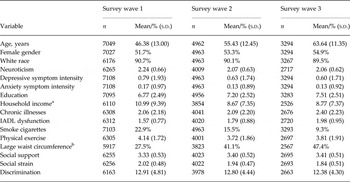
Data were drawn from three waves of the Midlife Development in the United States (MIDUS) Survey, a national study of health and well-being conducted in three waves in the years 1995–1996 (n = 7108), 2004–2006 (n = 4963) and 2013–2014 (n = 3294) (Brim et al. Reference Brim, Baltes, Bumpass, Cleary, Featherman and Shweder2010; Ryff et al. Reference Ryff, Almeida, Ayanian, Carr, Cleary and Williams2012, Reference Ryff, Almeida, Ayanian, Binkley, Carr and Williams2016). Four wave 1 subsamples were pooled in the current analyses. The first subsample (n = 3487) was recruited through random digit dialing of working telephone banks in the coterminous USA. Among English-speaking persons aged 25–74 years in each household, one person was selected randomly. The second subsample (n = 950) was obtained by contacting a random sample of siblings reported by the first subsample. The third subsample (n = 757) was recruited by random digit dialing in metropolitan areas to increase diversity. The fourth subsample (n = 1914) included twin pairs identified in a national survey of households. Pooling these subsamples created a large and diverse, although not fully nationally representative, dataset. Waves 2 and 3 attempted to reassess all living participants from the prior wave. At each wave, participants completed a telephone survey and mail-in questionnaire. The measures analysed in this report were completed at each survey wave. Table 1 shows characteristics of participants. Additional detail about the MIDUS study is available (Brim et al. Reference Brim, Baltes, Bumpass, Cleary, Featherman and Shweder2010; Ryff et al. Reference Ryff, Almeida, Ayanian, Carr, Cleary and Williams2012, Reference Ryff, Almeida, Ayanian, Binkley, Carr and Williams2016).
Descriptive statistics for study variables

s.d., Standard deviation; IADL, Instrumental Activities of Daily Living.
a Household income is in $10 000s and adjusted for inflation to the year 2015.
b Large waist circumference is >40 inches (101.6 cm) for men or >35 inches (88.9 cm) for women.
Measures
Demographics
Age, gender, race, ethnicity, education and household income were self-reported. Race/ethnicity was collapsed to a dichotomy (white v. non-white) for analysis. Education was assessed on a 1–12 scale (1 = no school/some grade school…5 = graduated from high school…9 = bachelor's degree…12 = doctoral degree) and treated as a continuous variable. Household income included all sources (e.g. earned, pension, government assistance), was capped at $300 000 in the surveys, and was adjusted for inflation to year 2015 US dollars for analysis.
Neuroticism
On a four-point scale from ‘not at all’ to ‘a lot’, participants rated the extent to which a series of adjectives described themselves (Lachman & Weaver, Reference Lachman and Weaver1997). Candidate neuroticism items were selected based on a review of the five-factor model literature, and the four items retained for the MIDUS neuroticism scale accounted for more than 90% of the variance in longer neuroticism scales in a development sample (Lachman & Weaver, Reference Lachman and Weaver1997). Neuroticism was scored as the average of ‘moody’, ‘worrying’, ‘nervous’ and ‘calm’ (reverse-keyed) ratings, with moderate α internal consistency across survey waves (0.71–0.75).
Depression and anxiety symptoms
Symptom intensity scales were based on Diagnostic and Statistical Manual of Mental Disorders, third edition, revised (DSM-III-R) criteria for major depressive disorder and generalized anxiety disorder (American Psychiatric Association, 1987), measured with the Composite International Interview short-form (Kessler et al. Reference Kessler, Andrews, Mroczek, Ustun and Wittchen1998). At each survey wave, symptom assessments focused on the past year. Positive screens for 2 weeks of depressed mood and/or anhedonia were followed by assessment of the presence of six additional symptoms (e.g. fatigue, appetite changes, thoughts of death), yielding a seven-point scale of depression. Positive screens for 6 months of unrealistic or excessive worry about two or more life circumstances were followed by assessment of the presence on most days of 10 consequences of worry (e.g. sleep disturbance, irritability, poor memory), yielding a 10-point scale of anxiety. The hierarchical nature of the symptom scales precluded computation of internal consistency estimates, but reliability of this interview has been good in past research (Kessler et al. Reference Kessler, Andrews, Mroczek, Ustun and Wittchen1998).
Instrumental Activities of Daily Living (IADL)
On a four-point scale from ‘not at all’ to ‘a lot’, participants rated how much their health limited seven types of behaviors (e.g. lifting or carrying groceries; bending, kneeling, or stooping; walking several blocks). Higher average scores reflect greater dysfunction (Lawton & Brody, Reference Lawton and Brody1969). Across survey waves, α internal consistency for this scale was high (0.93–0.94).
Chronic illness
Participants self-reported the presence or absence of 25 chronic illnesses (e.g. respiratory problems, autoimmune disorders, high blood pressure, stroke, ulcers) during the past year. Emotional, neurological and substance use disorders, plus sleep problems overlapping with depression and anxiety symptoms, were excluded. Positive responses were summed to form a count of illnesses. Across survey waves, α internal consistency for the chronic illness scale was only moderate (0.63–0.66), probably because a wide range of illnesses was assessed.
Smoking
Regular smoking of cigarettes (‘at least a few cigarettes every day’) was scored as present or absent. Smoking was also coded as absent if participants reported never smoking cigarettes.
Exercise
Physical exercise was scored as the frequency of vigorous activity (i.e. of sufficient duration and intensity to produce sweating, such as running, digging, lifting, playing sports) rated on a six-point scale from ‘never’ to ‘several times a week or more’ and averaged over summer and winter seasons. Survey wave 1 included global ratings for summer and winter. Survey waves 2 and 3 included summer and winter ratings in three contexts (job, chores, leisure), and the context with the most activity in each season contributed to the exercise scale. Across survey waves, α internal consistency for the two-item exercise scale was high (0.90–0.96).
Large waist circumference
Participants received standardized instructions, measured their waists using a tape included with the questionnaire materials, and recorded the circumference. Waist size was coded as normal or large [>40 inches (101.6 cm) for men, >35 inches (88.9 cm) for women] when it exceeded thresholds associated with obesity and increased risk for metabolic complications (World Health Organization, 2008).
Social support and strain
Social support and strain items were based on prior research (Schuster et al. Reference Schuster, Kessler and Aseltine1990). The social support scale included four questions (‘really care about you’, ‘rely on them for help’, ‘understand the way you feel’, ‘open up to them if you need to talk’) rated separately for friends and family on a four-point scale from ‘not at all’ to ‘a lot’. The social strain scale included four questions (‘make too many demands on you’, ‘criticize you’, ‘let you down’, ‘get on your nerves’) rated separately for friends and family on a four-point scale from ‘never’ to ‘often’. The eight-item social support (0.85) and strain (0.82–0.84) scales showed moderately high internal consistency across survey waves.
Discrimination
Discrimination was measured by nine items (e.g. ‘you are treated with less courtesy than other people’, ‘you are called names or insulted’, ‘people act as if they are afraid of you’) rated on a four-point scale from ‘never’ to ‘often’ on ‘a day-to-day basis’. Items were drawn from prior research (Williams et al. Reference Williams, Yan, Jackson and Anderson1997). The perceived discrimination scale showed high internal consistency across survey waves (0.91–0.93).
Statistical analyses
Preliminary analyses
Concurrent correlations between anxiety and depression symptoms (0.30, 0.30 and 0.34 in survey waves 1, 2 and 3, respectively) were moderate, and concurrent correlations of depression (0.27, 0.28 and 0.24) and anxiety (0.24, 0.24 and 0.17) with neuroticism were small to moderate. The 9-year retest stability of the neuroticism scale (0.64 and 0.66 from waves 1–2 and 2–3, respectively) was notably higher than the retest stability of the depression (0.32, 0.34) and anxiety (0.34, 0.42) measures. Moreover, in time-lagged models described following, predictions of changes in depression (β = 0.11) and anxiety (β = 0.08) from prior neuroticism were stronger than predictions of changes in neuroticism from prior depression (β = 0.03) and anxiety (β = 0.02). Thus, consistent with theory that neuroticism contributes to emotional disorders (e.g. Barlow et al. Reference Barlow, Sauer-Zavala, Carl, Bullis and Ellard2014b ), the current hypothesis tests examined prediction of changes in depression and anxiety from neuroticism rather than vice versa.
Hypothesis tests
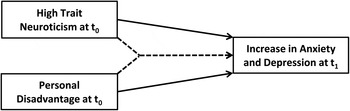
The hypothesis was tested in a series of time-lagged multilevel linear models computed with PROC HPMIXED in SAS software version 9.3 (SAS Institute, Inc., USA) using restricted maximum likelihood estimation. Multilevel models retain cases with some missing data (e.g. due to attrition) to provide unbiased hypothesis tests when data are missing completely at random or missing due to effects included in the models (e.g. neuroticism in the current analyses; Schafer & Graham, Reference Schafer and Graham2002). Because depression and anxiety symptoms correlated moderately and produced similar patterns of results (see online Supplementary Table S1), the primary analyses used a standardized composite of depression and anxiety symptoms. The depression/anxiety composite was analysed as a continuous variable, as were continuous predictors (e.g. neuroticism, age, social support). Symptoms at each survey wave (t 1) were predicted from symptoms at the prior survey wave (t 0), so that the models captured symptom changes, plus main effects and interactions of neuroticism and risk variables at t 0 (see Fig. 1). Main effects and interactions were tested as fixed effects. Models controlled the random effects of participant (repeated measures) and family (some participants had siblings in the sample). Variables were standardized (mean = 0, s.d. = 1) before analysis to minimize collinearity of main effects and interactions and so that regression coefficients were on the effect size r metric.
In addition to main effects (solid arrows), interactions of neuroticism with physical, social and socio-economic disadvantage (dashed arrows) were tested as predictors of changes in depression and anxiety symptoms over intervals of 9 years, from t 0 to t 1 (prior survey wave to target survey wave).

To illustrate interactions, simple slopes (relationships between neuroticism and symptom changes) were estimated at selected values of variables interacting with neuroticism. Selected values were the two categories for dichotomous variables (e.g. smokers v. non-smokers), 1 s.d. above and below the mean for continuous variables (e.g. high and low income), or other values that were more clinically relevant (e.g. zero chronic illnesses). Variables not involved in interactions were held constant at their means in follow-up computations.
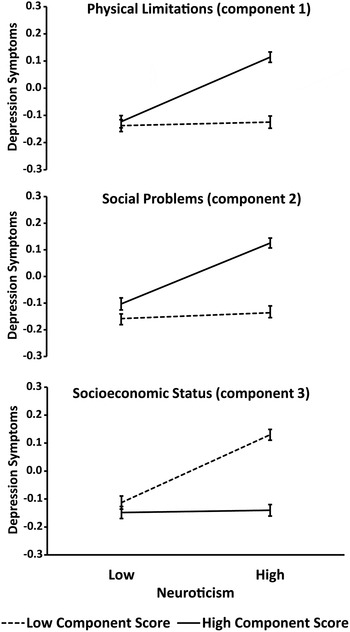
‘Additional risk from high neuroticism’ was also computed to illustrate the magnitude of interactions. Using the multilevel model coefficients, symptom levels at t 1 were estimated by inputting lower v. higher neuroticism scores (1 s.d. below and above the sample mean, respectively) crossed with the selected values of interacting variables at t 0. Differences among the four resulting symptom change estimates clarified additional risk from high (v. low) neuroticism between the test-variable values. For example, in the top panel of Fig. 2, the estimated symptom change was +0.114 s.d. for persons with high physical limitations and high neuroticism, −0.125 for low physical limitations and high neuroticism, −0.123 for high physical limitations and low neuroticism, and −0.138 for low physical limitations and low neuroticism. The additional risk from high (v. low) neuroticism for persons with high (v. low) physical limitations was (0.114 – −0.125) – (−0.123 – −0.138) ≈ 0.22 s.d. increase in symptoms.
Interactions of neuroticism with physical limitations, social problems and socio-economic status component scores predicted changes in depression and anxiety symptoms 9 years later. Symptom intensity scores are a standardized composite. Vertical bars represent ±1 s.e. Low and high values for neuroticism and component scores are 1 s.d. below and above the sample means, respectively.

The 10 physical, social and socio-economic risk variables were first tested individually. Statistical tests of these variables’ hypothesized interactions with neuroticism included a Bonferroni correction. Because these variables overlapped empirically, principal components analysis was employed as a data reduction technique (Tabachnick & Fidell, Reference Tabachnick and Fidell2013). The varimax-rotated components accounted for large, independent portions of the variance in the individual variables and supported a simultaneous test of quasi-independent risk dimensions’ interactions with neuroticism.
Ethical standards
All procedures contributing to this work complied with the ethical standards of the relevant national and institutional committees on human experimentation and with the Helsinki Declaration of 1975, as revised in 2008.
Results
Neuroticism and demographic predictors of symptom increases
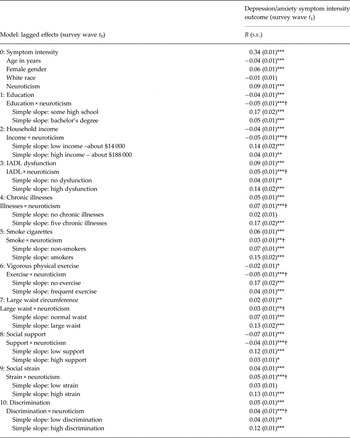
Main effects of basic demographic variables and neuroticism on increases in the depression/anxiety symptom composite were examined first in a series of time-lagged multilevel modelsFootnote 1 Footnote †. Younger age and female gender (but not race), as well as higher neuroticism, significantly predicted increases in depression and anxiety symptoms across 9-year retest intervals (see model 0 in Table 2). Age, gender and race were controlled in hypothesis tests.
Modeling symptom changes from neuroticism, physical, social and socio-economic variables a

s.e., Standard error; IADL, Instrumental Activities of Daily Living.
a n = 6063–6301 adults who participated in up to three survey waves. Variables were standardized before analysis with repeated-measures multilevel models. All tabled effects are lagged; i.e. observations from the prior survey wave (t 0) were used to predict the target survey wave (t 1). Models 1–10 controlled the effects from model 0. Model intercepts and random effects of participant and family are not shown. Simple slopes reflect relationships between neuroticism and symptom changes at selected levels of interacting variables.
* p < 0.05, ** p < 0.01, *** p < 0.001 (two-tailed).
† Hypothesized interaction effects with Bonferroni-corrected p < 0.05.
Physical, social and socio-economic moderators of symptom increases
The hypothesis was that physical, social and socio-economic disadvantages would amplify risks from neuroticism for increases in depression/anxiety symptoms. Disadvantage variables were added as predictors (main effects) and hypothesized moderators (interactions with neuroticism) to the time-lagged multilevel models (see models 1–10 in Table 2). In support of the hypothesis, relationships between neuroticism and increases in depression and anxiety symptoms were stronger for persons with a broad range of disadvantages, as detailed nextFootnote 2 .
Education
Less education predicted increases in depression/anxiety symptoms. Moreover, less education amplified risks from neuroticism, based on simple slopes analyses (see Table 2). Additional risk from high neuroticism for persons with some high school v. a bachelor's degree was 0.23 [95% confidence interval (CI) 0.14–0.32] s.d. increase in symptoms.
Income
Lower household income predicted increases in depression/anxiety symptoms and multiplied risks from neuroticism for increases in symptoms. Additional risk from high neuroticism for persons with lower (about $14 000) v. higher (about $188 000) household income was 0.20 (95% CI 0.13–0.28) s.d. increase in symptoms.
IADL dysfunction
Dysfunction predicted increases in depression/anxiety symptoms. Moreover, dysfunction interacted with neuroticism to amplify these risks. Additional risk from high neuroticism for persons with high dysfunction (1 s.d. above the mean) v. no dysfunction was 0.22 (95% CI 0.14–0.29) s.d. increase in symptoms.
Chronic illness
Chronic illness predicted increases in depression/anxiety symptoms and amplified risk from neuroticism for increases in symptoms. Additional risk from high neuroticism for persons with 5 (roughly 1 s.d. above the mean) v. 0 chronic illnesses was 0.31 (95% CI 0.22–0.40) s.d. increase in symptoms.
Smoking
Smoking predicted increases in depression/anxiety symptoms. Smoking also amplified risks from neuroticism for increases in symptoms. Additional risk from high neuroticism for smokers v. non-smokers was 0.16 (95% CI 0.06–0.26) s.d. increase in symptoms.
Exercise
Less physical exercise predicted increases in depression/anxiety symptoms and multiplied risk from neuroticism for increases in symptoms. Additional risk from high neuroticism for persons reporting no exercise v. frequent exercise (1 s.d. above the mean) was 0.25 (95% CI 0.14–0.35) s.d. increase in symptoms.
Large waist
Large waist circumference predicted increases in depression/anxiety symptoms. Further, a large waist amplified risk from neuroticism for increases in symptoms. Additional risk from high neuroticism for persons with a large v. normal waist was 0.13 (95% CI 0.05–0.21) s.d. increase in symptoms.
Social support
Low social support predicted increases in depression/anxiety symptoms and amplified risk from neuroticism for increases in symptoms. Additional risk from high neuroticism for persons with low v. high social support (1 s.d. below and above the mean, respectively) was 0.17 (95% CI 0.09–0.24) s.d. increase in symptoms.
Social strain
High social strain predicted increases in depression/anxiety symptoms. High social strain also multiplied risk from neuroticism for increases in symptoms. Additional risk from high neuroticism for persons with high v. low social strain (1 s.d. above and below the mean, respectively) was 0.20 (95% CI 0.13–0.28) s.d. increase in symptoms.
Discrimination
Greater perceived discrimination predicted increases in depression/anxiety symptoms and multiplied risk from neuroticism for increases in symptoms. Additional risk from high neuroticism for persons reporting high v. low discrimination (1 s.d. above and below the mean, respectively) was 0.16 (95% CI 0.09–0.24) s.d. increase in symptoms.
Independent moderators of symptom increases
The 10 variables moderating neuroticism's relationships with increases in depression/anxiety overlapped empirically (e.g. at wave 1, median |r| = 0.09, range 0.00–0.44). Principal components analysis clarified relationships among these variables. Then, to facilitate broader conclusions, orthogonal component scores summarizing independent dimensions of risk were tested as simultaneous moderators of symptom changes.
The wave 1 sample (which was largest) showed a three-component solution, based on a scree plot (e.g. eigenvalues of 2.24, 1.53, 1.23, 0.92 and 0.83 for the first five components), eigenvalues >1, each component accounting for ⩾10% of the variance, and interpretability of the varimax-rotated structure (see online Supplementary Table S3). The components comprised ‘physical limitations’ (IADL dysfunction, chronic illness, large waist, little exercise), ‘social problems’ (social strain, discrimination, little social support) and ‘socio-economic status’ (high education and income, and not smoking). The component structure at survey wave 2 was very similar (Tucker congruence coefficients 0.97–0.99; Lorenzo-Seva & ten Berge, Reference Lorenzo-Seva and ten Berge2006). Consequently, the wave 1 solution was used to score components at both waves 1 and 2. Component scores were then used to model subsequent symptom changes.
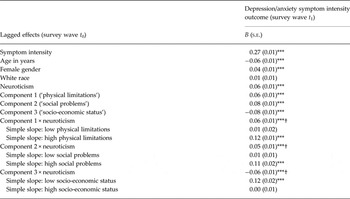
Each component (physical limitations, social problems, socio-economic status) plus high neuroticism simultaneously predicted increases in depression/anxiety symptoms across retest intervals (see Table 3). Each component also multiplied risk from neuroticism for increases in symptoms. Controlling the other components, additional symptom increases from high neuroticism for persons with high v. low disadvantages (1 s.d. above and below the mean, respectively) was 0.22 (95% CI 0.15–0.30) s.d. for physical limitations, 0.21 (95% CI 0.13–0.28) s.d. for social problems and 0.23 (95% CI 0.15–0.31) s.d. for low socio-economic status. Fig. 2 displays relationships of neuroticism and the three components with increases in depression/anxiety symptomsFootnote 3 .
Composite moderators of increases in symptoms a

a n = 5822 adults who participated in up to three survey waves. Variables were standardized before analysis with repeated-measures multilevel models. All tabled effects are lagged; i.e. observations from the prior survey wave (t 0) were used to predict the target survey wave (t 1). Model intercepts and random effects of participant and family are not shown. Simple slopes reflect relationships between neuroticism and symptom changes at selected levels of interacting variables.
* p < 0.05, ** p < 0.01, *** p < 0.001 (two-tailed).
† Hypothesized interaction effects with Bonferroni-corrected p < 0.05.
For persons with the unfortunate triad of high physical limitations, high social problems and low socio-economic status, the additional risk from high neuroticism was 0.67 (95% CI 0.53–0.80) s.d. for increases in depression/anxiety symptoms. In contrast, for persons with few physical limitations, few social problems or high socio-economic status, neuroticism was not a significant risk for increases in symptoms (see simple slopes in Table 3).
Discussion
The current analyses revealed that disadvantaged persons ‘paid a higher price’ for elevated neuroticism with long-term increases in depression and anxiety symptoms, whereas advantaged persons were relatively immune from these neuroticism-linked outcomes. In a large sample of mid-life adults in the USA, 10 disadvantage variables comprised three dimensions, physical limitations (e.g. chronic illness, impaired functioning), social problems (e.g. less social support, more social strain) and low socio-economic status (e.g. less education, lower income). Across 9-year intervals, high neuroticism and the three disadvantage dimensions predicted increases in a depression/anxiety symptom composite. In support of the hypothesis, physical limitations, social problems and low socio-economic status each amplified risks from high neuroticism for subsequent increases in symptoms. Collectively, the three disadvantage dimensions amplified depression/anxiety increases attributable to high neuroticism by 0.67 s.d.
Because neuroticism's risks were greater among disadvantaged persons, prevention and treatment efforts might be effectively targeted toward, or dosed for, more vulnerable groups. For example, routine screening for social needs (e.g. housing, food security, interpersonal safety) in healthcare environments may support reduction in health disparities (Alley et al. Reference Alley, Asomugha, Conway and Sanghavi2016). However, positive screens must be met with sufficient resources to yield benefits, which may be especially challenging for low socio-economic status (Garg et al. Reference Garg, Boynton-Jarrett and Dworkin2016). Regarding interventions intended to prevent or treat depression or anxiety via neuroticism, assessment of physical, social and socio-economic disadvantages might highlight populations with more risk, and therefore more to gain from effective interventions. Whether treatments reducing depression and anxiety via neuroticism should be more intense (e.g. more frequent psychotherapy sessions, high medication doses, longer duration of treatment) for vulnerable persons is unknown but warrants testing. For example, past research suggests that some treatments for depression and anxiety (e.g. cognitive–behavioral therapy, antidepressant medications) yield lower response rates for patients with lower education, less income, less social support and poorer physical functioning (Jain et al. Reference Jain, Hunter, Brooks and Leuchter2013; Kelly et al. Reference Kelly, Jakubovski and Bloch2015; Stiles-Shields et al. Reference Stiles-Shields, Corden, Kwasny, Schueller and Mohr2015).
Another way of conceptualizing the current findings is that good physical, social and socio-economic functioning both (1) predicts relative decreases in symptoms (main effects in statistical models), and (2) reduces risks from high neuroticism for symptom increases (interactions in statistical models). Thus, at least among potentially modifiable behaviors and circumstances (e.g. smoking, exercise, education, social strain), successful interventions may have two-fold advantages. For example, for persons with physical, social or socio-economic functioning 1 s.d. above the mean (at roughly the 85th percentile), estimated relationships of neuroticism with depression/anxiety (simple slopes) were not statistically significant. Consequently, fostering favorable (v. adverse) personal circumstances has the potential to ‘neutralize’ some consequences of high neuroticism.
Previous research demonstrates that both medications (selective serotonin reuptake inhibitors; Ilieva, Reference Ilieva2015) and cognitive–behavioral interventions (the unified protocol for transdiagnostic treatment, Barlow et al. Reference Barlow, Sauer-Zavala, Carl, Bullis and Ellard2014b ; exposure training for parents of anxious children, Kennedy et al. Reference Kennedy, Rapee and Edwards2009) reduce neuroticism (or the related construct of behavior inhibition) to treat depression or anxiety. These findings from randomized clinical trials converge with the current main effects connecting neuroticism with subsequent increases in symptoms observed in a large community sample. In this context, the current results highlight potential treatment moderators worth testing in future research. The current results additionally suggest that patients with social, physical and socio-economic disadvantages may benefit more from treatments acting on neuroticism, whereas relatively advantaged persons may not realize symptom reductions via changes in neuroticism.
The current analyses and conclusions have important limitations. First, mechanisms of risk attributed to neuroticism were not identifiable. Possible mechanisms include stress generation, stress avoidance, stress-sensitivity and deficits in mindfulness for persons with high neuroticism (Lahey, Reference Lahey2009; Barlow et al. Reference Barlow, Sauer-Zavala, Carl, Bullis and Ellard2014b ). Mechanisms may also change over time (e.g. as persons experience more depressive episodes; Kendler & Gardner, Reference Kendler and Gardner2016). Second, time-lagged interactions with neuroticism were small for single disadvantage variables (0.13–0.31 s.d. symptom increases) and moderate for their aggregate (0.67 s.d.), which may be attributable to the long retest lag. The public health impact of interventions ameliorating these stress–diathesis interactions (by reducing neuroticism, disadvantages, or both) could be greater if the interventions were scalable to benefit large groups efficiently (Kazdin & Blase, Reference Kazdin and Blase2011). Third, the brief neuroticism measure was designed to capture the core of the construct but did not tap some of the broader trait's facets (e.g. hostility, anger), which may show different interactions with personal disadvantages relevant to symptom changes. Fourth, the community sample was large and socio-economically diverse, but clinical samples or samples with greater racial diversity may yield different results. Finally, future analyses might also usefully estimate changes in neuroticism or disadvantages (e.g. social, health) from prior anxiety and depression.
As etiology, prevention and treatment research target neuroticism (Cuthbert & Insel, Reference Cuthbert and Insel2013; Barlow et al. Reference Barlow, Sauer-Zavala, Carl, Bullis and Ellard2014b ; Lengel et al. Reference Lengel, Helle, DeShong, Meyer and Mullins-Sweatt2016), it is important to clarify individual differences moderating neuroticism's relationships with development of depression and anxiety symptomatology and the magnitude of these moderator effects. The current analyses suggested that a broad range of adverse circumstances and states comprised quasi-independent dimensions of physical, social and socio-economic disadvantages. Each dimension independently moderated neuroticism's relationships with increases in depression/anxiety symptoms 9 years later. Additional symptom increases attributable to high neuroticism were 0.67 s.d. for multiply-disadvantaged persons. These results may inform estimates of the potential long-term efficacy of interventions aiming to prevent or treat depression or anxiety via neuroticism. Similarly, the current results support targeting neuroticism interventions toward vulnerable groups of adults. Finally, the results highlight the potential value of reducing physical, social and socio-economic disadvantages to prevent depression and anxiety.
Supplementary material
The supplementary material for this article can be found at https://doi.org/10.1017/S0033291717000253
Acknowledgements
Preparation of the current report was not externally funded. The MIDUS 1 study was supported by the John D. and Catherine T. MacArthur Foundation Research Network on Successful Midlife Development. The MIDUS 2 and 3 research was supported by a grant from the National Institute on Aging (P01-AG020166) to conduct longitudinal follow-ups of the MIDUS 1 investigation. The content of this report is solely the responsibility of the author and may not represent official views of the study funders.
Declaration of Interest
None.