Introduction
Unprotected premarital sex amongst adolescents in Nigeria, exposing girls to unintended pregnancy, has been widely documented (Ogundele & Oluwasanmi, Reference Ogundele and Oluwasanmi1999; Arowojolu & Adekunle, Reference Arowojolu and Adekunle1999; Uwakwe et al., Reference Uwakwe, Moronkola and Ogundiran2001; Nigeria Demographic & Health Survey, 2003). Several studies (e.g. Oladepo, Reference Oladepo1999; Adegbenro, Reference Adegbenro1999; Moronkola & Idris, Reference Moronkola and Idris2000) have found that unintended pregnancy has been a major cause of school drop-out for girls in Nigeria, thereby limiting their education, economic opportunities and career choices. In Nigeria, as in most parts of Africa, abortion laws are so restrictive that women have limited access to safe abortion (Okonofua, Reference Okonofua1994), leading in effect to increased risk of ectopic pregnancy (Olatunbosun & Okonofua, Reference Olatunbosun and Okonofua1986; Orhue et al., Reference Orhue, Unuigbe and Ogbeide1989), secondary infertility (Okonofua et al., Reference Okonofua and Snow1995), mid-trimester spontaneous abortions and chronic pelvic inflammatory disease (Ladipo, 1989), perforated uterus, cervical laceration and haemorrhage.
Most parents in Owerri do not disseminate sex education to their children. They instead leave it to the schools, where sex education has not yet been introduced into the curriculum. Thus adolescents in Nigeria seek information about sex and reproduction from a variety of informal sources such as peers and pornography.
It has been argued that reproductive health facilities in Nigeria are inaccessible for adolescents (Barker, Reference Barker1992; Mamdani et al., Reference Mamdani, Garner and Harpharm1993; McCauley et al, Reference McCauley, Salter and Kiragu1995; Bongaarts & Cohen, Reference Bongaarts and Cohen1998). However, contraceptives, particularly condoms and pills, are affordable and widely available, even from provision shops in Owerri and other urban centres in Nigeria, but their usage is low despite numerous contraceptive campaigns. The explanation for this appears to be cultural, one that people could not openly repudiate and whose exposition has three possible dimensions.
First, sex in Nigeria is still perceived as the preserve of the married, and pre-marital sex as a sub-culture for deviants. Sexual tools, especially condoms amongst adolescents, are taboo. Second, the artificiality of the condom reduces sexual enjoyment, so those who want the naturalness of coitus will not use condoms, even if available. Third, ‘transactional sex’, deriving from gender inequality and patriarchal structures, could result in poor contraceptive use in order to secure material benefits (money, physical assets, assistance in passing examinations, getting a job, etc.), to enhance trust or to secure marriage.
If sexually active female adolescents are to evade unintended pregnancy, they need to be provided with adequate information. Kebede (Reference Kebede1992) identified the importance of using different media properly and wisely to strengthen communication support to health projects in Ethiopia. Bosompra (Reference Bosompra1987) found the use of communication channels such as conversation, the town crier, the market place, churches, schools, health officers and radio very useful in creating and sustaining awareness of health needs and heath-care delivery in Ghana. In Nigeria, a number of mass enlightenment programmes have been initiated by various governments to create awareness about reproductive health problems, including unintended pregnancy, abortion and abortion complications, but the results have not been far-reaching. Specifically, there is a lack of empirical research on unintended pregnancy and induced abortions. This study therefore focuses on assessing the prevalence and determinants of adolescents' unintended pregnancy and induced abortion in Nigeria, using Owerri as a reference.
Methods
The study area
Owerri, in southern Nigeria, was the colonial era administrative capital of Old Owerri Province, which encompassed Umuahia and Port Harcourt. At present, Owerri is the capital of Imo State, one of five predominant Igbo-speaking south-eastern states of Nigeria. It was mapped and planned immediately after the creation of Imo State in 1976 by a firm of planners from Switzerland, and is a transit town for the South-South States (Rivers, Cross Rivers and Bayelsa) to other parts of Nigeria.
Owerri is a built-up area with basic infrastructure. It is bounded to the east by Naze, to the west by Amakohia and Irete, to the north by Orji and Egbu and to the south by Obinze. It has a plain topography and most of its inhabitants are non-indigenes working in public and private organizations in the area. It is largely perceived as a ‘civil service’ town with Christianity as the predominant religion, particularly the Catholic denomination. The notable landmarks include Imo State University (IMSU), Alvan Ikoku Federal College of Education (AIFCE), Garden Park Business Centre, Ama J. K. Recreation Park, Modotel Hotel, Imo Hotels, Concorde Hotels, World Bank Housing Estate, Aladinma, Ikenegbu and Federal Housing Estates and Courts (Magistrate and High Courts). Recently, there has been a proliferation of banks, hotels and eating houses (Mr Biggs, Crunchies, Mr Fans, Rennies, Chicken Republic, De St Simeon), with some having two or three branches in the area.
The study population and sampling technique
The study population consists of both in-school and out-of-school adolescents from Owerri aged 10–19 years. The sampling frame was obtained from the Ministry of Education, Imo State, and consisted of fifteen secondary schools in Owerri, of which three were all-girl and seven co-educational (mixed) schools. Students were stratified into classes (e.g. JS1, 2, 3; SS1, 2, 3), and one sub-class (e.g. JS1A) was randomly selected in the assumption that this had characteristics representative of all sub-classes. The average number of students in each sub-class was 30. A quasi-random sampling typified in systematic sampling technique was used to establish the ratio (k) of the number of students in a sub-class (N) to the survey population (n), which was six students from each sub-class in each of the selected ten secondary schools that had female adolescents. Thereafter, a number was selected randomly from 1–5 inclusive (j) to obtain the first person in the survey population (using the serial number in the class register), with subsequent members selected by additions to the number k. For the co-educational schools, the same method was applied except that males and females were in different sub-populations listed serially with the cooperation of the class teachers and six female students selected from the female sub-population. In all, 36 students were selected from each of the ten schools, making a total of 360 students, using their class registers and without recourse to their ethno/tribal and religious background and without consideration for their place of residence.
From each of the localities where ten schools were selected, eighteen female adolescents who were out-of-school were selected through convenience non-random sampling due to the lack of sampling frame containing a list of such adolescents. Out-of-school, in this context, refers to persons that were not in secondary school or in any tertiary educational institution. They had either dropped out of secondary school, had not entered secondary school (but excluding primary school pupils), had completed secondary school and were waiting for admission into a tertiary educational institution, learning a craft or trade or were unemployed.
The research instruments
A pre-coded questionnaire was used to obtain information from 540 female adolescents on their sexual behaviour and sexual outcomes. Other information sought included demographic characteristics of the respondents (age, sex, current school attendance, the person they live with and religion/denomination). The instrument was pre-tested before the fieldwork on 45 randomly selected adolescents. This was to ascertain the explanatory potential of the questionnaire, particularly in terms of its reliability, clarify any ambiguities and to ensure the respondents understood the questions. All necessary corrections were effected before administration to the study population. In addition, four focus group discussions (FGDs) were held with female adolescents in selected localities where the researcher had easy access to the adolescents. The FGDs aimed to capture the local context of sexual behaviour and perceived sexual outcomes of the adolescents and, in essence, enabled a true picture of social reality.
Each FGD consisted of 8–12 female adolescents (some in secondary school, and some not in secondary school). Out-of-school adolescents were identified at their workplaces and invited to a rendezvous. They eventually assisted in the recruitment of the in-school adolescents (students).The researcher introduced the topic and gave the adolescents leeway to express themselves. Their responses were recorded verbatim. In-depth interviews were held with fifteen key informants who were reproductive health service providers in Owerri (consisting of five medical doctors and ten paramedical personnel). A list of hospitals/clinics in Owerri was obtained from the Owerri Municipal Secretariat, from which five were randomly selected. There is dearth of records on paramedical facilities in Owerri, just as in most urban areas in Nigeria. For this, convenience (accidental) sampling was employed to obtain information from ten paramedical personnel (involving pharmacists, patent medicine operators and midwives). Interviews with health-care providers were held to obtain information about adolescents' reproductive health, as they constantly interact with adolescents during provision of health care. The fieldwork was conducted from 3–25th June 2009.
In the following section, information obtained from the questionnaires, FGDs and in-depth interviews has been amalgamated into a single report.
Results and Discussion
Socioeconomic characteristics of the female adolescents
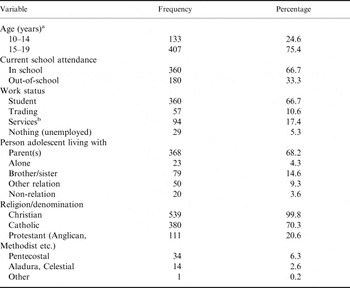
Table 1 shows that of the female adolescent respondents in Owerri, with mean age 15.8 years, 75.4% were aged 15–19 years, with 24.6% aged 10–14 years. Data reveal that 66.7% of them were students (in secondary schools) and 33.3% were out-of-school (that is, not in secondary school, but either learning a trade/vocation, awaiting admission into higher tertiary educational institution or unemployed). Most of the adolescents were Christians (99.8%), a considerable population being Catholics (70.3%), and a large percentage (68.2%) lived with their parents.
Socioeconomic characteristics of the female adolescent respondents in Owerri (N=540)

a Average age 15.8 years.
b Hairdressing, barbers salon, house help, shop assistant, assistant in restaurant etc.
Access of female adolescents to reproductive health care
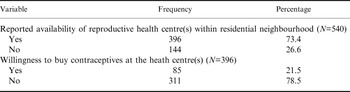
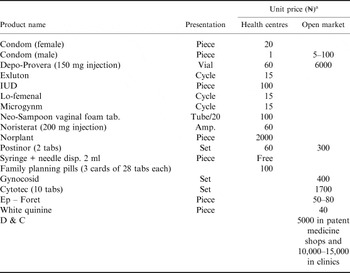
Table 2 show that close to three-quarters (73.4%) of the adolescents affirmed the availability of reproductive health centre(s) within their residential neighbourhood, but only 21.5% were willing to purchase the contraceptives offered at these centres. The contraceptives offered included family planning pills, condoms, intra-uterine device (IUDs), cervical caps and gels, vaginal suppositories and foams and tubal ligation. This unwillingness of adolescents in Owerri to buy contraceptives is puzzling, although it is corroborated by other researchers' findings that adolescents in Africa have a relatively low rate of contraceptive use (Lema et al., Reference Lema, Makokha, Sanghui and Wanjala1991; Persaud, Reference Persaud1994). This is not directly related to poverty as the cost of the contraceptives offered at the health centres is subsidized, so they are cheaper than those sold on the open market (Table 3).
Access of female adolescents in Owerri to reproductive health centre(s)

Price list of contraceptives offered at health centres in Owerri and on the open market

a Exchange rate at time of study: $US1=₦142.
Source: Federal Ministry of Health Price List 2009.
The contraceptives are mostly imported by the United Nations Population Fund (UNFPA), Pathfinder and notable pharmaceutical companies including Wellcome, and stocked by small pharmacists or are sold on the open markets. The Reproductive Health Unit of the Federal Ministry of Health receives contraceptives from donor agencies and sends them to the health centres. The contraceptives are usually subjected to clinical trial by the National Agency for Food and Drug Administration Control (NAFDAC) (the government's agency licensing drugs in Nigeria) to ascertain their potency, consummability and shelf life. A NAFDAC number is then given to certified contraceptives, which have a trade name and expiry date printed on their packet to distinguish them from fakes.
Users' perception of the efficacy of contraceptives is contingent on a number of things: (a) if the user does not become pregnant she assumes that it is efficacious; (b) when the contraceptive was not used as prescribed, the user might be exposed to pregnancy and thus, say that the contraceptive is not efficacious; (c) the use of some contraceptives can result in bleeding as they alter the hormonal balance. In this situation, the user might describe the contraceptive as being ineffective.
Concerns about the side-effects of contraceptive methods are widespread and significant (Johnson-Hanks, Reference Johnson-Hanks2002) among women in Owerri. According to Fieldman-Savelberg et al. (Reference Fieldman-Savelberg2000), hormonal and barrier methods, as well as the IUD, are seen as invasive, disruptive of the body's natural rhythm and deadly. Johnson-Hanks (Reference Johnson-Hanks2002) found that women in his study reported that ‘…condoms can come off and get stuck in a woman's body, shutting off her reproductive system or clogging the valves of her heart’. One respondent in his study said that ‘…the IUD could make one bleed uncontrollably, and that pills could damage the skin, causing it to peel and turn white’. These findings correspond with those of Levin (Reference Levin1996) on West African societies, as well as the general beliefs among women in Owerri.
Bongaarts & Cohen (Reference Bongaarts and Cohen1998) and Blanc & Way (Reference Blanc and Way1998) have pointed out the relative inaccessibility of adolescents to family planning services, due to maternal and child health/family planning services mainly being targeted at older married women. However, family planning services in Owerri and in other urban centres in Nigeria do not discriminate against the unmarried youth. The problem is that adolescents rarely go to the centres for reproductive health services, for cultural reasons that they could not readily explain.
Sexual activity is generally perceived as the preserve of the married, with premarital sex a sub-culture for deviants. This fossilized idea haunts adolescents and prevents them from going to the centres, although there is no documented evidence that adolescents are refused reproductive health services at the centres, except for induced abortion, which is outlawed in Nigeria. Also, Catholicism is predominant in Owerri, and it is not implausible that adolescents in Owerri who are Catholics would refrain from contraceptive use. Indeed, McQuillan (Reference McQuillan2004) argues that Catholic countries are, in most instances, laggards in the demographic transition, especially when religious institutions have the means to communicate values to their members and to institute mechanisms to promote compliance and punish non-conformity.
In spite of the numerous programmes and action plans initiated by various governments in Nigeria to create awareness about the catastrophic consequences of unprotected sexual activity, including unmarried adolescents' unintended pregnancy, abortion and abortion complications, through the media (radio, television and the print), there exists clear evidence that this has not achieved the desired impact. Table 2 shows that 78.5% of the sub-population that affirmed the existence of reproductive health centres in their neighbourhood were unwilling to buy contraceptives at the centres. A likely explanation for this is that inappropriate channels have been used to dissemination information about unintended pregnancy amongst unmarried adolescents. Due to the high levels of poverty and illiteracy in Owerri there is a need for more acceptable, convenient, familiar and cost-effective methods of information dissemination that could enhance understanding of the consequences of unprotected sex, including unmarried adolescents' unintended pregnancy, abortion and abortion complications. The use of local vernacular and an institutional framework involving traditional/local opinion leaders that are readily available and accessible might be a panacea.
The unwillingness of the adolescents in Owerri to buy contraceptives offered at the reproductive health centres prima facie suggests the presence of a deep-seated issue that inhibits their demand for contraceptives. There is therefore a need to re-orientate adolescents to erase their fossilized prejudice against contraceptives.
Adolescents in Owerri seeking an abortion by means of D & C (dilation and curettage) often do so for social reasons. These include: to avoid disruption of the girl's education, as unmarried pregnant girls in Owerri are usually expelled from school; where there is no established paternity of the fetus; to avoid putting off a prospective husband; when the girl and the fetus's father are in different caste groups that are traditionally forbidden to marry (there is an invidious distinction between the diala (freeborn) and osu (slave cult) in Owerri). Abortions for these reasons are ‘induced’ and done secretly in patent medicine shops and clinics. As induced abortion is illegal in Nigeria, they are styled ‘criminal abortions’ and providers of the services are liable to prosecution. The police are most likely to prosecute in the following circumstances: (a) when the parent(s) of the girl report the abortion case to the police; (b) when, in the case of a teenager, her parent(s) want to compel the young man responsible for the pregnancy to marry the girl; (c) when the abortion process caused a perforated uterus or vesico-vaginal fistula (VVF), which has implications for urine incontinence; (d) when the abortion threatens or resulted in the death of the abortion seeker.
Perceived reproductive health problems of adolescents
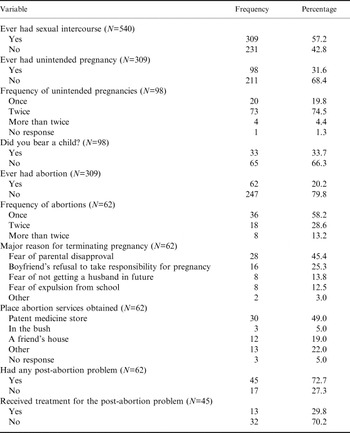
Table 4 shows that 57.2% of the adolescents in the study had had sex. In the words of a key informant:
…so many of the female adolescents in Owerri start early to have sexual sensations. They accommodate any person they feel they can move with. (In-depth interview, medical doctor, Owerri)
Perceived reproductive health problems of female adolescents in Owerri

This supports the assertion of Oloko & Omoboye (Reference Oloko and Omoboye1993), that sexual activity in Nigeria is particularly high among unmarried youth, but contrasts with tradition. Most anthropological and historical records of culture in Nigeria have shown that premarital sexual activity was very low, as young girls were under pressure to marry as soon as possible after reaching puberty (Basden, Reference Basden1938; Talbot, Reference Talbot1967; Fadipe, Reference Fadipe1970; Olusanya, Reference Olusanya1971; Echeruo & Obiechina, Reference Echeruo and Obiechina1971; UNICEF, 2001; Mensah et al., Reference Mensah, Grant and Blanc2006). Traditionally, sexual activity was negotiated within marriage, and the concept of virgo intacta (remaining a virgin until marriage) was a cherished norm. More recently, however, the value of virginity has been disregarded, especially by young people. They perceive that a woman who has reached the age of 18–24 and still a virgin must be uncivilized and ugly or possess repulsive characteristics that nauseate men. Sexual activeness is construed as an eloquent portrayal of civilization and an indication of being adequately socialized. Delay in marriage arising from the demands for formal education in the modern economy is partly responsible for the high prevalence of premarital sexual activity in Nigeria, especially when associated with the relaxation in social mores.
The sexual behaviour of the adolescents in this study appears to be associated with the current socioeconomic context of Owerri. The total fertility rate (TFR) for Imo State, of which Owerri is the capital, was 6.7 children per woman in the 1991 census exercise (National Population Commission, 1998), and in the absence of any specific current official information it probably hasn't changed much since then. This high TFR limits the capacity of families to save and invest, resulting in low economic productivity and low incomes, which encourage a ‘vicious cycle’ of poverty. As summarized by a key informant:
By the very nature of the economic environment of Owerri, a lot of the inhabitants are poor. The marginal propensity to indulge in illicit sex is heightened by low socioeconomic status. Some of the female adolescents use sexual practice as a means of acquiring certain material assets. Unfortunately, the sexual practices are unprotected. (In-depth interview, medical doctor, Owerri)
The low use of contraceptives by the adolescents in Owerri is subsumed in their unwillingness to buy contraceptives from their local reproductive health centres. Young women rarely demand condoms over the counter; men themselves, both married and unmarried, and irrespective of their education and social status, are usually shy about asking for condoms over the counter in patent medicine stores and pharmacy shops in Owerri. This is especially so when the seller is someone of the opposite sex and of comparable age to their mother, or if there are other people present in the shop. In addition, the premarital sexual activities of female adolescents contradict their religious doctrine, which rejects the use of modern contraceptives.
Table 4 shows that one-third (31.6%) of the female adolescents in Owerri who had ever had sex had had an unintended pregnancy, amongst whom 78.9% had recurrent pregnancies. In the words of a key informant:
Female adolescent pregnancy is common. The ages of the adolescents range from 14 to 17 years. In some cases, their babies weigh between 3.2 and 3.5 kg. Due to their young ages, they might not deliver smoothly except with some assistance. Such assistance includes the use of episiotomy forceps, the administration of drip and the use of pressure. (In-depth interview, midwife, Owerri)
Similarly, another key informant spoke thus:
In instances where the pregnancy is carried to term, pregnant disasters among pregnant female adolescents are rare. Although they come for antenatals late, they seem stronger and more determined to bear the child than older women [20 years and above]. Paradoxically, their babies weigh at least 3.2 kg. On a few occasions, Caesarean section was arranged for pregnant female adolescents, particularly due to their inadequate pelvises. (In-depth interview, medical doctor, Owerri)
The foregoing corroborates CEPED (1997) and Senanayake (Reference Senanayake, Wallace and Giri1990) in that pregnant female adolescents are vulnerable to difficult deliveries, but contrasts with popular opinion that pregnant female adolescents experience a greater risk of low birth weight (<2.5 kg) (Bledsoe & Cohen, Reference Bledsoe and Cohen1993; Boult & Cunningham, Reference Boult and Cunnigham1995; Hof & Richters, Reference Hof and Richters1999). Of significance also is information about the period of exposure to unintended pregnancies. As summarized by a key informant:
Female adolescents in Owerri are constantly having unwanted pregnancies. This is commonly seen within January and February each year and also few weeks after major festivals. (In-depth Interview, medical doctor, Owerri)
The celebration of Christmas in December and notable Owerri festivals such as Oru Owerre, Ita Oka and Ita Ukazi, are usually associated with displays of wealth by the rich, to the astonishment of poor. Poor young women are easily wooed to sex by the rich who lavish, or promise to lavish, money on them. In the context of low contraceptive use, unintended pregnancy is the natural consequence. A notable consequence of the rise in pre-marital sex is increase in unintended pregnancy (National Research Council, 1993; Zabin & Kiragu, Reference Zabin and Kiragu1998) and increase in induced abortion (Clark, Reference Clark2004), which is illegal and unsafe in Owerri. However, only 33.7% of those with an unintended pregnancy bore their child, as against 66.3% who presumably aborted their baby (Table 4). Furthermore, about one-fifth (20.2%) of the female respondents who ever had sex had an abortion, of whom 41.8% had a recurrent abortion. In the words of a FGD participant:
I have had four unwanted pregnancies. When I missed my period, it occurred to me that it could be pregnancy. I went to a patent chemist dealer and was given white quinine injection. On two occasions, I went for a D & C in a clinic. This was after I went to a chemist and the pregnancy did not abort. (FGD, female adolescent, 15–19 years, Owerri)
I have been pregnant twice. The first time was rape and the second time my Sugar Daddy. When I waited for my menses which couldn't come, it occurred to me that it might be pregnancy. I had D & C on each occasion. (FGD, female adolescent, 15–19 years, Owerri)
Also, another discussant surmised thus:
I have had three unwanted pregnancies. Whenever I suspect pregnancy after the first month I go to the patent chemist for white quinine and from two months D & C in a clinic. Well, I wish I could stop this. Abortion is not good, but I have to do it since I am not married. (FGD, female adolescent, 15–19 years, Owerri)
There is consensus amongst key informants about the high rate of involvement of female adolescents in Owerri in abortion practices. According to a key informant:
…abortions requiring D & C are rampant. In fact, recurrent abortions are prevalent. For example, a woman brought her daughter for D & C. After 4 months, the same girl came for another D & C. (In-depth interview, medical doctor, Owerri)
Explicitly, another key informant summarized the views of his colleagues thus:
…an appreciable percentage of the premarital pregnancies end in abortion. Abortion procurement is most common among adolescents aged 15–19 years. They became pregnant during major festivals such as Christmas and Easter periods. Most of the times, they are accompanied by friends and sexual partners for the procurement of abortion. (In-depth interview, medical doctor, Owerri)
The preponderant reason (45.4%) for the abortion was the fear of parental disapproval of the pregnancy and possible humiliation, followed by lack of established paternity of the fetus (25.3%), apprehension that the pregnancy would hinder the prospects of getting a husband (13.8%) and the least was fear of expulsion from school (12.5%). In the words of a key informant:
In some cases where we have recurrent abortions, the female adolescents often plead for their parents, brothers and sisters not to know about it, to avoid punishment for it. (In-depth interview, patent medicine operator, Owerri)
Consistently and more explicitly, another key informant summarized thus:
Unwanted pregnancy among female adolescents in Owerri is not strange. In some cases, one observes that about 85.5% of the patients on a given day are abortion seekers. The abortion seekers come with their female friend or their sex partner and in some cases, they come with their mother. The reason for procurement of abortion is to avoid interference with their studentship, lack of established paternity over the pregnancy, parental disapproval of the pregnancy etc. (In-depth interview, medical doctor, Owerri)
According to Table 4, almost half (49.0%) of the abortion seekers in Owerri obtained abortion services from patent medicine operators, with 72.7% of them having had a post-abortion problem. As expressed by key informants:
I have seen just a few post-abortion complications. Most of them were uterine perforations and intraperitoneal abscess. (In-depth interview, medical doctor, Owerri)
There are abortion complications, such as those coming at about the 5th or 6th month of pregnancy. There are cases of septic abortions, which I refer to hospitals if they show no evidence of improvement after giving them antibiotics such as Ampiclox 500mg one capsule four times daily for 14 days. (In-depth interview, patent medicine operator, Owerri)
…there were some female adolescents who came to me for cases of incomplete abortion. I referred them to hospitals. In fact, I do not handle complicated pregnancy cases such as much bleeding. Minor cases of bleeding are easily treated with giving them Vitamins K and C, plus multivitamins (In-depth interview, midwife, Owerri)
The patent medicine operators are not trained in medicine and drug administration as most of them are traders that learnt to sell medicine from apprenticeship. However, most of the abortion seekers in Owerri trust the credibility of the medicine operators and confide in them, sometimes through whispers in the hope of getting adequate treatment. It is worrying that amongst those who had a post-abortion problem, a considerable proportion (70.2%) did not receive treatment, due perhaps to poverty and shame. This has implications of infertility and sub-fertility for these female adolescents later in life.
Conclusion
Most female adolescents in Owerri are Catholics, which is a Christian religious denomination that conspicuously denounces contraceptive use in order to discourage immoral practice. However, premarital sexual activity is common among the adolescents of Owerri. The contradiction between religious doctrine and the sexual practices of the adolescents is the Achilles Heel; the Missing Link in adequately meeting the reproductive health needs and choices of the adolescents.
The interaction of the premarital sexual activity of the adolescents with a deep-seated religious doctrine and, perhaps, socio-cultural values exposes them to reproductive health problems, in particular unintended pregnancy and abortion. These, together with the socioeconomic circumstances (poverty) of the adolescents, by which they often seek health-care services from patent medicine operators, is probably further complicating their reproductive health problems.
The fact that a considerable percentage (68.2%) of the adolescents live with their parents and yet are highly exposed to unintended pregnancy prima facie suggests that the parents might not be oblivious of the sexual behaviour and sexual outcomes of their children. What have they done in the circumstance to discourage the sexual behaviour of their children? The large percentage of the female adolescents with abortion complications and also the substantial percentage who have never sought treatment are at risk of infertility and sub-fertility later in life.