Exposure to divorce or the residential separation of (nonmarried) parents is a common experience of children growing up in the Western, industrialized world (Amato, Reference Amato2010). Although it is difficult to establish exact numbers because of a variety of complicating reporting factors (Amato, Reference Amato2010), it is estimated that at the end of the 20th century between 43% and 46% of marriages ended in dissolution in the United States (Schoen & Canudas-Romo, Reference Schoen and Canudas-Romo2006). Note that although the “crude divorce rate” rose from 2.2/1,000 in 1960 to 5.2 in 1980, representing an increase of 136%, it declined gradually by 31% to 3.6 in 2006 (US Census Bureau, 2008, table 77). In The Netherlands, from where the data used in this report derive, divorce rates are even higher. Crude divorce rates rose from 3.0 in 1950 to 9.8 in 2000, with a small decline to 8.9 in 2009 (Centraal Bureau voor de Statistiek, 2010).
The issue of how exposure to marital/partner dissolution might affect children's development is a long-standing one that has concerned parents, practitioners, and policymakers alike (Amato, Reference Amato2010). The current inquiry, which addresses this issue and focuses upon externalizing behavior, one of the most common correlates of divorce exposure (Amato, Reference Amato2001; Lansford, Reference Lansford2009), considers two distinct levels of analysis: the family environment and the biology of the child. Thus, it evaluates the proposition that the effects of divorce may vary as a function of children's genetic makeup. We focus specifically on a set of dopamine genes because dopamine function has been linked to externalizing behavior through behavioral activation (e.g., Cloninger, Reference Cloninger1987) and shown to moderate a variety of environmental effects (e.g., Bakermans-Kranenburg & van IJzendoorn, Reference Bakermans-Kranenburg and van IJzendoorn2011). We further seek to determine whether any discerned Gene × Environment (G × E) interactions reflect diathesis–stress or differential-susceptibility modes of environmental action (Belsky & Pluess, Reference Belsky and Pluess2009).
Effects of Divorce on Children
Although it would be ideal to be able to draw some straightforward conclusions about the effects of divorce on children based on the voluminous literature on the subject, the truth is that this is rather difficult to do. This is because it is rather easy to challenge virtually any conclusion that one scholar might draw from the assembled evidence by citing results inconsistent with the conclusion or wielding criticisms against the designs of cited studies (Lansford, Reference Lansford2009). Obviously, divorce/marital dissolution is not something that can be randomly assigned and subject to experimental manipulation, thereby affording the drawing of strong causal inferences.
Even though scholars are not of a single mind regarding the effects of divorce on children, it is possible to highlight some apparently consistent trends in the literature. As Amato (Reference Amato2010) points out in a recent survey of the last decade's research on the subject, children from divorced families, relative to those whose parents remain married, perform more poorly, on average, on a variety of emotional, behavioral, social, health, and academic outcomes (e.g., Frisco, Muller, & Frank, Reference Frisco, Muller and Frank2007; Hango & Houseknecht, Reference Hango and Houseknecht2005; Sun & Li, Reference Sun and Li2002). It is also the case that once they have grown up and become adults themselves, those with a divorce legacy tend to obtain less education, have lower levels of psychological well-being, report more problems in their own marriages, and are at greater risk of seeing their own marriages break down and end in divorce (e.g., Amato & Sobolewski, Reference Amato and Sobolewski2001; Barrett & Turner, Reference Barrett and Turner2005; Teachman, Reference Teachman2002; Wolfinger, Kowaleski-Jones, & Smith, Reference Wolfinger, Kowaleski-Jones and Smith2003). According to Amato (Reference Amato2010, p. 653, emphasis added), these “findings indicate that, for at least some individuals, the effects of divorce appear to persist …”
Because most research on the effects of divorce is not genetically informed, meaning that the putative effects of divorce could be the result of biological inheritance rather than environmental causation, a series of studies by D'Onofrio and colleagues is noteworthy (D'Onofrio et al., Reference D'Onofrio, Turkheimer, Emery, Slutske, Heath and Madden2005, Reference D'Onofrio, Turkheimer, Emery, Slutske, Heath and Madden2006; D'Onofrio, Turkheimer, Emery, Harden, et al., Reference D'Onofrio, Turkheimer, Emery, Harden, Slutske and Heath2007; D'Onofrio, Turkheimer, Emery, Hermine, et al., Reference D'Onofrio, Turkheimer, Emery, Maes and Eaves2007). Using a design that compares the effects of divorce on cousins whose mothers are identical or fraternal twins, these studies reveal little genetic influence on drug and alcohol abuse and externalizing behavior problems, but mixed evidence in the case of internalizing problems in terms of whether the apparent effects of divorce are genetically or environmentally mediated. Genetically informative designs comparing children with biological and adoptive parents who divorce also provide evidence that is mostly consistent with the view that divorce effects are not simply a function of passive genetic inheritance (Amato, Reference Amato2010), particularly in the case of substance abuse and internalizing and externalizing behavior problems (Amato & Cheadle, Reference Amato and Cheadle2008; Brodzinsky, Hitt, & Smith, Reference Brodzinsky, Hitt and Smith1993; O'Connor, Caspi, DeFries, & Plomin, Reference O'Connor, Caspi, DeFries and Plomin2000, Reference O'Connor, Caspi, DeFries and Plomin2003).
Although behavior–geneticists approach the issue of environmental causation one way, sociologists tend to adopt a different strategy, trying to control for nonrandom selection vis-à-vis exposure to divorce using fixed effects models based on difference scores; these eliminate unobserved sources of heterogeneity that are time invariant, such as gender, race, birth cohort, parents' personality, some genetic effects, and other selection factors. One way this is done is by considering the same child's functioning at two points in time, with one measurement obtained before divorce and the other after, along with matching measurements for the comparison group (child fixed effects). Another analytic strategy involves comparing children to their siblings (sibling fixed effects), given that brothers and sisters of different ages will be differentially exposed to divorce, but otherwise (presumably) share the same family experiences. Findings from such studies remain mixed (Amato, Reference Amato2010), with some chronicling the apparent effects of divorce (Cherlin, Chase-Lansdale, & McRae, Reference Cherlin, Chase-Lansdale and McRae1998; Ermisch & Francesconi, Reference Ermisch and Francesconi2001; Gennetian, Reference Gennetian2005), but others failing to do so (Aughinbaugh, Pierret, & Rothstein, Reference Aughinbaugh, Pierret and Rothstein2005; Bjorklund & Sundstrom, Reference Bjorklund and Sundstrom2006; Powers, Reference Powers2005).
Heterogeneity of Divorce Effects
Above we underscored a critical point about virtually all findings pertaining to divorce, even those that fail to chronicle any apparent divorce effects on children, whether they are over the short or long term: there is variability in whether and how divorce influences children's development. Because this has been long appreciated, numerous factors that might explain the variation in divorce effects have been extensively studied. Thus, evidence suggests that the well-being of children exposed to divorce is most likely to be undermined when marital disruption results in declines in household income, the poor emotional and behavioral functioning of the custodial parent, ineffective parenting, loss of contact with the noncustodial parent, and continuing conflict between spouses along with the general absence of cooperative coparenting (e.g., Carlson & Corcoran, Reference Carlson and Corcoran2001; Cavanagh, Reference Cavanagh2008; Fabricius & Luecken, Reference Fabricius and Luecken2007; King & Sobolewski, Reference King and Sobolewski2006; Martinez & Forgatch, Reference Martinez and Forgatch2002; Pruett, Williams, Insabella, & Little, Reference Pruett, Williams, Insabella and Little2003; Tein, Sandler, & Zautra, Reference Tein, Sandler and Zautra2000). Such observations highlight the importance of considering divorce as a process, especially following marital separation, rather than as an event, at least when it comes to understanding its effects on children (Amato, Reference Amato2000; Hetherington, Reference Hetherington, Clarke-Stewart and Dunn2006).
Gender is another factor that has figured prominently in efforts to gain greater insight into the variability in divorce effects and one that figures importantly in the current report. In a comprehensive review of 27 studies of the effects of divorce on children's social and emotional well-being, Zaslow (Reference Zaslow1988) found that boys were more negatively affected than girls in 16 studies and girls were worse off in only 5. Subsequent work revealed school-age boys were worse off in terms of emotional distress and academic difficulties (Simons, Reference Simons1996), divorce adjustment and self-esteem (Howell, Portes, & Brown, Reference Howell, Portes and Brown1997), and behavior problems (Jenkins & Smith, Reference Jenkins and Smith1993; Mott, Kowaleski-Jones, & Meneghan, Reference Mott, Kowaleski-Jones and Meneghan1997; Simons, Reference Simons1996). Some have observed, however, that whereas boys during childhood and adolescence are more likely to respond to divorce with conduct problems and acting out at home and in school, girls are more likely to respond with depression and “overcontrolled” behavior (Hetherington, Cox, & Cox, Reference Hetherington, Cox, Cox and Lamb1982; Emery, Hetheringon, & DiLalla, Reference Emery, Hetherington, DiLalla, Stevenson and Sigal1985). Yet such gender-moderated effects of divorce are by no means universally documented (Allison & Furstenburg, Reference Allison and Furstenberg1989). Amato (Reference Amato2010) observed that whereas some studies conducted over the preceding decade discerned stronger effects in the case of one gender rather than another (e.g., Hill, Yeung, & Duncan, Reference Hill, Yeung and Duncan2001), most recent work has generally failed to document gender moderation of divorce effects or has done so inconsistently (Hetherington, Reference Hetherington, Clarke-Stewart and Dunn2006; Painter & Levine, Reference Painter and Levine2000; Sun, Reference Sun2001; Sun & Li, Reference Sun and Li2002; Woodward & Fergusson, Reference Woodward and Fergusson2000). This is perhaps surprising with respect to externalizing problems, given that males are more prone to engage in externalizing behavior than females (e.g., Crijnen, Achenbach, & Verhulst, Reference Crijnen, Achenbach and Verhulst1997).
G × E Interaction
Consideration of child gender among factors that might account for some of the heterogeneity in divorce effects emphasizes that the attributes of children themselves may make them differentially susceptible to the effects of divorce. It seems plausible that child attributes other than gender could account not only for the general heterogeneity of divorce effects but also for the heterogeneity of gender-moderated ones.
Genetic attributes have emerged in recent years as important for illuminating the conditions under which any of a variety of environmental exposures affects human functioning. In addition, there is some recent evidence that the same may be true with respect to the effects of divorce on children. Guo, Roettger, and Cai (Reference Guo, Roettger and Cai2008) found that adolescents with a genetic polymorphism associated with antisocial behavior (DRD2*178/304) were more likely than other adolescents to engage in delinquent behavior if they lived with a single parent but not if they lived with two married parents. In addition, Waldman (Reference Waldman2007) observed that children's attention-deficit/hyperactivity disorder (ADHD) diagnoses could be accounted for by interactions between dopamine receptor D2 (DRD2) genotypes and mother's marital status and number of marriages or cohabiting relations. More specifically, ADHD diagnosis was more likely for children homozygous for the long allele (A1), but only if their mothers were divorced, separated, or never married. Of note is that neither of these studies suggestive of the genetic moderation of divorce effects were truly studies of marital or partner separation, because children were also included if they had grown up in single-parent homes from birth. In the current inquiry, investigation is restricted to children who lived in two-parent families, some of which dissolved because of partner separation.
In the current investigation we seek to further research on the moderating effects of dopamine genes vis-à-vis divorce effects. Dopamine genes are an appropriate focus not only because they have figured prominently in the two existing G × E studies pertaining to family structure just cited but also because dopamine function has been associated with behavioral activation (Cloninger, Reference Cloninger1987), a personality trait associated with externalizing behavior, especially if combined with low conscientiousness (e.g., Caspi, Reference Caspi, Damon and Eisenberg1998; Oldehinkel, Hartman, De Winter, Veenstra, & Ormel, Reference Oldehinkel, Hartman, De Winter, Veenstra and Ormel2004; Van Lieshout, Reference Van Lieshout2000). In addition, dopamine related genes have been observed to moderate the effects of other environmental factors as well on a variety of phenotypes (for a meta-analysis, see Bakermans-Kranenburg & van IJzendoorn, Reference Bakermans-Kranenburg and van IJzendoorn2011).
The immediately preceding observations highlight that there are at least two ways to think about gene–environment interaction. The more traditional is to conceptualize certain genes as being biologically linked to particular phenotypes because of their causal association with particular neurotransmitters. From this perspective, a kind of “reverse” engineering leads to the identification of “candidate” genes: identify the phenotype of interest, identify neurotransmitters linked to that phenotype, and then identify candidate genes linked to the neurotransmitters (Moffitt, Reference Moffitt2005). However, an alternative approach is to think about certain genes as not necessarily being tied to this or that particular phenotype via some hypothesized biological pathway, but as reflecting, through still unknown mechanisms, sensitivity to environmental experiences (Belsky & Pluess, Reference Belsky and Pluess2009). These distinctive approaches to thinking about genes, the environment, and development inform two different models of environmental action regarding G × E interaction.
Models of Environmental Action
Most research to date on G × E interaction has been based not only on the kind of reverse engineering just delineated but also informed, implicitly if not explicitly, by the diathesis–stress model of environmental action (Zuckerman, Reference Zuckerman1999), almost irrespective of the environmental exposure under consideration (e.g., child maltreatment, negative life events, family structure; Belsky & Pluess, Reference Belsky and Pluess2009). This widely embraced perspective presumes that some individuals carry a genetic liability that predisposes them to problematic functioning (e.g., antisocial behavior, depression) when confronted with a contextual stressor. Those lacking such a liability are presumed to be more or less immune from the anticipated adverse effect of the stressor or at least less likely to be negatively affected by it. Consider in this regard Waldman's (Reference Waldman2007) aforementioned study showing that children whose mothers were divorced, separated, or never married were more likely to be diagnosed as having ADHD than age mates from two-parent families if and only if they were homozygous for the long allele (A1) of the DRD2 polymorphism.
Belsky and associates (Belsky, Bakermans-Kranenburg, & van IJzendoorn, Reference Belsky, Bakermans-Kranenburg and van IJzendoorn2007; Belsky et al., Reference Belsky, Jonassaint, Pluess, Stanton, Brummett and Williams2009; Belsky & Pluess, Reference Belsky and Pluess2009) recently hypothesized that the diathesis–stress perspective may not fully account for the results of many G × E studies, and this is because even findings interpreted as being consistent with such thinking often reveal something else that Belsky (Reference Belsky1997, Reference Belsky, Ellis and Bjorklund2005) theoretically anticipated based on evolutionary reasoning (see also Boyce & Ellis, Reference Boyce and Ellis2005; Ellis, Boyce, Belsky, Bakermans-Kranenburg, & van IJzendoorn, Reference Bakermans-Kranenburg and van IJzendoorn2011). This was that some individuals would not simply be more susceptible to the negative effects of contextual adversity, such as divorce exposure, but also more likely to benefit from exposure to environmental enrichment and support, or even just the absence of adversity. As the reports cited above reveal, as do more recent empirical studies not available when these reviews were published (e.g., Mileva-Seitz et al., Reference Mileva-Seitz, Kennedy, Atkinson, Stteiner, Levitan and Matthews2011; Nederhof et al., Reference Nederhof, Bouma, Riese, Laceulle, Ormel and Oldehinkel2010), many findings from G × E studies fit this differential-susceptibility model of environmental action. Several of these were included in the Special Section of this Journal's February 2011 issue devoted to the topic of differential susceptibility (Ellis et al., Reference Ellis, Boyce, Belsky, Bakermans-Kranenburg and van IJzendoorn2011). Consider in this regard Bakermans-Kranenburg and van IJzendoorn's (Reference Bakermans-Kranenburg and van IJzendoorn2006) findings showing that whereas maternal sensitivity proved related to fewer behavior problems and maternal insensitivity more behavior problems in the case of toddlers carrying the 7+ repeat dopamine receptor D4 (DRD4) allele, no such (apparent) effect of parenting on externalizing problems emerged in those lacking this allele. As it turns out, a recent meta-analysis of G × E studies involving dopamine genes not only indicates that findings fit a differential-susceptibility model better than a diathesis–stress one but also that the positive effects of environmental supports in those carrying what appear to be “plasticity” rather than just “vulnerability” genes (Belsky et al., Reference Belsky, Jonassaint, Pluess, Stanton, Brummett and Williams2009) prove larger than the negative effects of contextual adversities (Bakermans-Kranenburg & van IJzendoorn, Reference Bakermans-Kranenburg and van IJzendoorn2011).
Even though both diathesis–stress and differential-susceptibility models of environmental action raise the prospect that children will vary in their susceptibility to the effects of divorce, the contrast between the two raises questions about the form such moderation might take. Whereas the former model would predict that divorce exposure could promote behavior problems in children carrying putative “risk alleles,” the latter would anticipate the same finding but also predict that those carrying putative “plasticity genes” would also manifest better functioning than age mates with similar family experiences and not carrying these genes when not exposed to divorce.
Methods
Sample
Data from the first and third wave of the Tracking Adolescents' Individual Lives Survey (TRAILS) were used. TRAILS is a prospective cohort study of Dutch adolescents, who will be measured biennially at least until they are 24 years old. The first wave ran from March 2001 to July 2002, and the third wave ran from September 2005 to December 2007. The key objective of TRAILS is to chart and explain the development of mental health from preadolescence into adulthood, both at the level of psychopathology and the levels of underlying vulnerability and environmental risk. A detailed description of the sampling procedure and methods can be found elsewhere (De Winter et al., Reference De Winter, Oldehinkel, Veenstra, Brunnekreef, Verhulst and Ormel2005; Huisman et al., Reference Huisman, Oldehinkel, De Winter, Minderaa, De Bildt and Huizink2008). Briefly, the TRAILS target sample involved 10- to 12-year-olds living in five municipalities in the northern region of The Netherlands, including both urban and rural areas.
Sample selection involved two steps. First, the municipalities selected were requested to give names and addresses of all inhabitants born between October 1, 1989, and September 30, 1990 (first two municipalities) or October 1, 1990, and September 30, 1991 (last three municipalities), yielding 3,483 names. Simultaneously, primary schools (including schools for special education) within these municipalities were approached with the request to participate in TRAILS at school (i.e., share students' names, provide information on children's behavior and academic performance, and allow class administration of questionnaires and individual testing [neurocognitive, intelligence, and physical]). School participation was a prerequisite for eligible children and their parents to be approached by the TRAILS staff. Of the 135 primary schools within the municipalities, 122 agreed to participate in the study, that is, 90.4% of the schools accommodating 90.3% of the children.
If schools agreed to participate, parents (or guardians) received two brochures, one for themselves and one for their children, with information about the study; and a TRAILS staff member visited the school to inform eligible children about the study. Approximately 1 week later, a TRAILS interviewer contacted families by telephone to provide additional information, answer questions, and determine whether parents and their son or daughter were willing to participate in the study. Respondents with an unlisted telephone number were mailed a letter requesting their phone number so that they could be called. If they reacted neither to that letter nor to a reminder letter sent a few weeks later, staff members paid personal visits to their house. Parents who refused to participate were asked for permission to call back in about 2 months to minimize the number of refusals due to temporary impediments to participation.
If parents agreed to participate, an interview was scheduled, during which they were requested to provide informed consent. Children were excluded from the study if they were incapable of participating because of mental retardation or a serious physical illness or handicap or if no Dutch-speaking parent or parent surrogate was available, and it was not feasible to administer part of the measurements in the parent's language. Of all children approached for enrollment in the study (i.e., selected by the municipalities and attending a school that was willing to participate, N = 3,145), 6.7% were excluded because of disability or language problems precluding participation. Of the remaining 2,935 children, 76.0% (n = 2,230, mean age = 11.09, SD = 0.55, 50.8% girls) were enrolled in the study (i.e., both child and parent agreed to participate). Responders and nonresponders did not differ with respect to gender, parental education, proportion of single-parent families, teacher-rated problem behavior, or school absence; but children in the nonresponse group more frequently needed additional help because of learning difficulties (De Winter et al., Reference De Winter, Oldehinkel, Veenstra, Brunnekreef, Verhulst and Ormel2005). At Wave 3 the response rate was 81.4% (n = 1,838, mean age = 16.13, SD = 0.59, 52% girls).
Measures
Externalizing problems
Externalizing problem behaviors at age 16 were assessed with the Youth Self-Report (YSR; Achenbach, Reference Achenbach1991). The YSR is a commonly used questionnaire in current child and adolescent psychiatric research. It contains a list of 120 behavioral and emotional problems, which participants can rate as 0 = not true, 1 = somewhat or sometimes true, or 2 = very or often true in the past 6 months. The externalizing domain consists of the highly correlated aggressive behavior and rule-breaking behavior syndrome scales and contains 32 items (Cronbach α = 0.87). The good reliability and validity of the YSR was confirmed for the Dutch translation (Verhulst, van der Ende, & Koot, Reference Verhulst, van der Ende and Koot1997). We chose to use self-reports of externalizing behaviors because the 16-year-old adolescent is more likely to have complete information about such behaviors than either parents or teachers.
Parental separation
Parental separation before the age of 11 was captured during the TRAILS Family History Interview. Well-trained interviewers visited one of the parents or guardians (preferably the mother, 95.6%) at their homes to administer an interview at the first assessment wave. Parental separation between age 11 and age 16 was captured using the Event History Calendar, a data collection method for obtaining retrospective data about life events and activities (Caspi et al., Reference Caspi, Moffitt, Thornton, Freedman, Amell and Harrington1996). For the present study the calendar as developed by Caspi and coworkers was adapted into an interview on several life domains. Participants were asked about events that occurred since the first assessment (i.e., between ages 11 and 16), including parental separation.
DNA extraction
DNA was extracted from blood samples (n = 1,190) or buccal swabs with a Cytobrush® (n = 275) using a manual salting out procedure as described by Miller, Dykes, and Polesky (Reference Miller, Dykes and Polesky1988). In 1,460 subjects at least 80% of all single nucleotide polymorphisms (SNPs) could be genotyped and length polymorphisms were successfully determined in 1,465 subjects.
Genotyping length polymorphism DRD4
The 48 base pair direct repeat polymorphism in exon 3 of DRD4 was genotyped as follows: from 10 ng of genomic DNA a fragment was amplified in a 10-μl volume with 0.5 µM fluorescently labeled forward primer (Vic-5′-GCGACTACGTGGTCTACT CG-3′) and reverse primer (5′-AGGACCCTCATGGCCTTG-3′), 0.4 mM deoxynucleotide triphosphates, and 0.5 U La Taq (Takara, Lonza Verviers Sprl, Verviers, Belgium) in GC I buffer (Takara, Lonza Verviers Sprl) with 1 M betaine. The cycling conditions for amplification involved 1 min at 94°C, followed by 35 cycles of 30 s at 94°C, 30 s at 58°C, 1 min 72°C, and an extra 5 min at 72°C.
The genotyping assay was carried out in a CCKL quality-certified laboratory (Research Lab for Multifactorial Diseases, Human Genetics Department, Radboud University Nijmegen Medical Centre) and was validated earlier. Three percent blanks as well as duplicates between plates were taken along as quality controls during genotyping. Determination of the length of the alleles was performed by direct analysis on an automated capillary sequencer (ABI3730, Applied Biosystems, Nieuwerkerk, The Netherlands) using standard conditions. Concordance between DNA duplicates (n = 78) showed an accuracy of 99.5%. Call rate was 98.9%, and allelic distribution was within Hardy–Weinberg equilibrium.
Genotyping SNPs DRD2 and catechol-O-methyltransferase (COMT)
Genotyping of DRD2 TaqIA (rs1800497) and COMT val158met (rs4680) was performed on a Golden Gate Illumina BeadStation 500 platform (Illumina Inc., San Diego, CA) according to the manufacturers protocol by laboratory personnel blinded to the true identity of the individual samples. We used an assay that was designed within the framework of various research questions of the TRAILS study. Genotyping was done at the Genetics Department, University Medical Center Groningen. Genotyping data and clustering was performed in BeadStudio 3.0 (Illumina Inc.). We successfully genotyped 742 SNPs with call rates varying from 95% to 100%. All DNA samples could be amplified, and concordance between DNA replicates (n = 53) showed 100% genotyping accuracy. Data cleaning was in line with procedures recommended by Nolte, McCaffery, and Snieder (Reference Nolte, McCaffery, Snieder and Steptoe2010). Call rates were 100% for both SNPs, and both were well within Hardy–Weinberg equilibrium.
Statistical analyses
Statistical analyses were done on complete cases (n = 1,134). Participants not from Dutch ancestry as well as one randomly selected participant from each sibling pair were excluded from analysis. Genotype effects were analyzed as recessive homozygotes versus dominant allele carriers. We calculated correlations between all of the study variables, mainly to check for gene–environment correlations (rGE). In the case of a significant rGE, we performed a linear regression with the genotype predicting divorce and saving the residuals for inclusion in subsequent (G × E) analyses. Next, we performed a series of multiple regression analyses with main effects of sex, divorce (or the residual in case of rGE), and genotype in the first step. In the second step, we added the two-way interaction between divorce (or residual) and genotype. In the third step, two-way interactions between sex and divorce and sex and genotype as well as the three-way interaction among sex, divorce, and genotype were added. If the third step did not improve the model, the second model was presented as the final model. If a significant G × E effect was found, the effects were followed up by planned t tests comparing children from intact homes who differed genotypically and, separately, children from divorced families who differed genotypically in an effort to distinguish differential susceptibility from diathesis–stress. Evidence for differential susceptibility would emerge if children carrying the putative plasticity alleles manifested fewer externalizing problems if raised in intact families and more if raised in divorced households than children not carrying the putative plasticity alleles. Evidence for diathesis–stress susceptibility would emerge if children carrying the putative plasticity alleles manifested more externalizing problems than those not carrying such alleles, but only under divorced-family conditions. Effects were marked as significant if p ≤ .05 (two tailed, despite directional hypotheses).
Results
Descriptive statistics
The mean self-rating of boys' externalizing problems was 0.33 (SD = 0.22); the mean self-rating of girls' externalizing problems was 0.30 (SD = 0.21). This difference was statistically significant (t = 2.99, p < .05). Complete cases were not different from the whole sample on externalizing problem behavior. Correlations between the variables are shown in Table 1. Adolescents who experienced a parental divorce had more externalizing problems. The DRD4 genotype was correlated with externalizing problems in both boys and girls, but opposite effects were observed. Boys carrying two short DRD4 alleles had more externalizing problems whereas girls carrying two short DRD4 alleles had fewer externalizing problems. The DRD4 genotype was associated with parental divorce in boys. Parents of boys carrying a 7+ repeat DRD4 allele were more likely to be divorced. Population stratification analyses with 768 SNPs showed that participants with or without parental divorce were not different genetic populations. No ethnic outliers were identified.
Partial and bivariate correlations between dependent and all independent variables for boys (above diagonal) and girls (below diagonal)

Note: DRD2, dopamine receptor D2; DRD4, dopamine receptor D4; COMT, catechol-O-methyltransferase.
*p < .05.
Regression equations
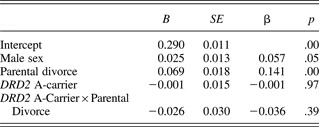
Parental divorce had a main effect on externalizing problems in all regression models. This is consistent with the aforementioned results from the descriptive statistics. The DRD2 genotype did not moderate the effect of parental divorce (Table 2), nor were there any sex differences.
Regression coefficients for male sex, parental divorce, and DRD2 genotype including the coefficient for the moderation effects of DRD2 genotype on parental divorce with child rated externalizing behavior as the outcome

Note: DRD2, dopamine receptor D2.
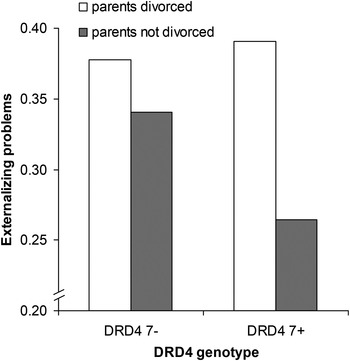
Because the DRD4 genotype was significantly correlated with parental divorce in boys but not in girls (Table 1), the unstandardized residual from divorce on DRD4 was used in the regression equation for boys. This insured that the gene/environment correlation did not masquerade as G × E interaction in the analysis. Results showed that carrying one or two DRD4 7+ repeat alleles moderated the effects of divorce on externalizing problems in boys (Table 3). Planned follow-up t tests showed that externalizing problems did not differ between boys who varied on DRD4 genotypes if their parents divorced or separated (t = 0.34, p = .74), but they did differ between these boys if their parents were together (t = 3.21, p < .01). Inspection of Figure 1 shows that among boys growing up in intact families, those carrying the DRD4 7+ repeat allele manifested fewer externalizing problems than those not carrying such alleles, but not more problems when parents divorced or separated. Although such data are completely at odds with diathesis stress, they are consistent with the positive, “for-better” side of the differential-susceptibility model of environmental action.
Externalizing problems for boys whose parents have divorced or have not divorced by dopamine receptor D4 (DRD4) genotype (DRD4 7− homozygotes vs. DRD4 7+ carriers).

Regression coefficients for parental divorce (using residuals uncorrelated with DRD4 genotype) and DRD4 genotype in boys with child rated externalizing behavior as the outcome
Note: DRD4, dopamine receptor D4.
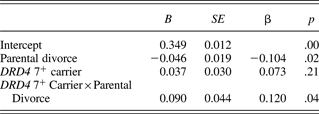
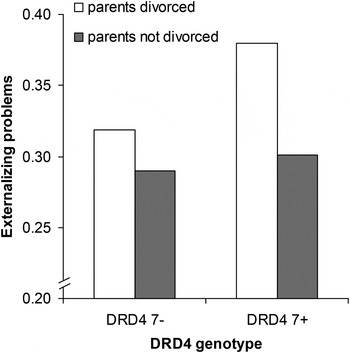
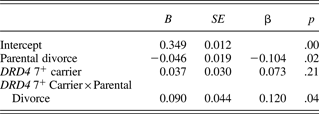
Although the DRD4 genotype did not significantly moderate the effect of divorce on externalizing problems in girls, it seemed noteworthy that the main effect of divorce on externalizing problems in girls decreased after including the moderating effect of the DRD4 genotype (Table 4). This led us to conduct the same follow-up comparisons for girls as just reported for boys. As Figure 2 indicates, these t tests showed that girls carrying a DRD4 7+ repeat allele whose parents divorced or separated had more externalizing problems compared to girls not carrying this allele whose parents divorced (t = 2.51, p = .01), whereas externalizing problems did not differ between the DRD4 genotypes in girls if their parents were together (t = 0.66, p = .51). This pattern is perfectly consistent with diathesis–stress and the exact opposite of what was discerned in the boys (Figure 1).
Externalizing problems in girls whose parents have divorced or have not divorced by dopamine receptor D4 (DRD4) genotype (DRD4 7− homozygotes vs. DRD4 7+ carriers).

Regression coefficients for parental divorce and DRD4 genotype in girls with child rated externalizing behavior as the outcome

Note: DRD4, dopamine receptor D4.
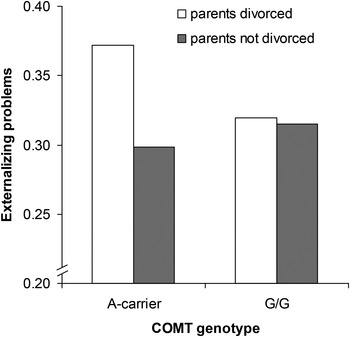
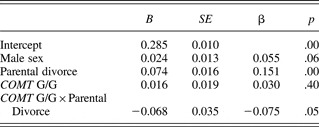
The regression equation with the COMT genotype (A-carriers vs. G/G genotype or methionine carriers vs. the val/val genotype) clearly revealed a pattern that was seemingly consistent with differential susceptibility to divorce (Table 5). Adolescents carrying one or two COMT A-alleles reported the most externalizing problems of all children if their parents divorced or separated, but the least if they did not (Figure 3). The planned follow-up comparison t tests did not show significant differences in externalizing problems between the COMT genotypes if parents were together (t = 1.05, p = .29), however, only if parents had divorced or separated (t = 2.25, p = 0.03). These results are exactly what would be predicted on the basis of the diathesis–stress model.
Externalizing problems of boys and girls for adolescents whose parents have divorced and have not divorced by catechol-O-methyltransferase (COMT) genotype (A or met carriers vs. G/G or val/val genotype).

Regression coefficients for male sex, parental divorce, and COMT genotype including the coefficient for the moderation effects of COMT G/G (val/val) genotype on parental divorce with child rated externalizing behavior as the outcome

Note: COMT, catechol-O-methyltransferase.
Discussion
The primary purpose of the research reported herein was to extend the investigation of divorce effects on children's externalizing behavior problems by taking into consideration two distinctive levels of analysis: the family environment, as reflected in exposure to divorce, and the child's biology, as reflected in his or her genotype. We found that the detected main effect of divorce on externalizing problems was moderated by DRD4 and COMT genotypes, but not by the DRD2 genotype. To our knowledge, this is the first study of this kind ever conducted, because the two “divorce-related” G × E investigations cited in the introductory section did not strictly include comparisons of children who were and were not exposed to their parents' relationship dissolution (Guo et al., Reference Guo, Roettger and Cai2008; Waldman, Reference Waldman2007); this is because they also included children whose entire lives were spent in single-parent families, not just those whose families transitioned from two parent to single parent. This may actually be one reason why the findings reported herein proved inconsistent with prior findings chronicling DRD2 interacting with the family structure (Guo et al., Reference Guo, Roettger and Cai2008; Waldman, Reference Waldman2007).
As made clear in the introductory section, it is difficult to draw definitive conclusions regarding the effects of divorce, even on externalizing behavior problems, and for a variety of reasons. One is that true experimental manipulation is thankfully not possible, thereby limiting causal inference. However, another is that, as widely appreciated, divorce effects have proven heterogeneous (Amato, Reference Amato2010; Lansford, Reference Lansford2009). Whereas most investigations of such variation in divorce effects call attention to the importance of parental well-being (e.g., maternal depression) and family dynamics (e.g., coparenting, ex-spousal conflict), here we considered several dopamine-related genes as plausible moderators of divorce effects. The candidate genes selected for consideration were chosen for two distinct, but not necessarily mutually exclusive reasons: they have been implicated in the development of behavior problems and antisocial behavior (Cloninger, Reference Cloninger1987) and they have been found to function as “for better and for worse indicators of sensitivity to environmental experience” (Bakermans-Kranenburg & van IJzendoorn, Reference Bakermans-Kranenburg and van IJzendoorn2011; Belsky et al., Reference Belsky, Jonassaint, Pluess, Stanton, Brummett and Williams2009; Belsky & Pluess, Reference Belsky and Pluess2009).
In this investigation we not only sought to determine whether G × E interaction might characterize the effects of divorce on externalizing problems but also whether, should this prove to be the case, the effects would prove consistent with the traditional diathesis–stress model of environmental action (Zuckerman, Reference Zuckerman1999) or the more recent differential-susceptibility framework (Belsky, Reference Belsky1997; Belsky et al., Reference Belsky, Bakermans-Kranenburg and van IJzendoorn2007, Reference Belsky, Jonassaint, Pluess, Stanton, Brummett and Williams2009; Belsky & Pluess, Reference Belsky and Pluess2009; Boyce & Ellis, Reference Boyce and Ellis2005; Ellis et al., Reference Ellis, Boyce, Belsky, Bakermans-Kranenburg and van IJzendoorn2011). When one considers the three G × E interactions detected in this inquiry, it is clear that the data proved more consistent with the former than the latter, while also showing that these two models do not completely capture the myriad ways in which genes and the environment can interact to predict developmental functioning (Belsky et al., Reference Belsky, Bakermans-Kranenburg and van IJzendoorn2007).
Even though the interaction involving the COMT genotype visually appeared to reflect differential susceptibility (see Figure 3), in that adolescents carrying one or two COMT A-alleles reported the most externalizing problems of all children if their parents divorced or separated but the least if they did not, a planned comparison failed to substantiate this “eyeball” evaluation. Recall that planned follow-up tests indicated that the valine carriers only manifest significantly more externalizing problems than met/met carriers if their parents had divorced, but not significantly fewer if their parents had not divorced. In other words, only the “for worse” side of the differential-susceptibility equation received empirical support, not the “for better” side. This is exactly what a diathesis–stress model of environmental action stipulates. Just as noteworthy was that this G × E interaction applied to boys and girls, thereby proving consistent with some evidence cited in the introductory section that divorce effects are not gender moderated (e.g., Allison & Furstenburg, Reference Allison and Furstenberg1989).
Is is also notable that, in the present study, the A-carrier of the COMT gene rather than the G/G genotype proved susceptible to the environmental experience of divorce or separation under investigation. Although this is in line with several other gene–environment investigations (Doornbos et al., Reference Doornbos, Dijck-Brouwer, Kema, Tanke, Van Goor and Muskiet2009; Van Winkel et al., Reference Van Winkel, Henquet, Rosa, Papiol, Fananas and De Hert2008; Wichers et al., Reference Wichers, Aguilera, Kenis, Krabbendam, Myin-Germeys and Jacobs2008), we would be remiss if we did not point out that other G × E work chronicles higher susceptibility of the G or valine allele (e.g., Caspi et al., Reference Caspi, Moffitt, Cannon, McClay, Murray and Harrington2005; Conway, Hammen, Brennan, Lind, & Najman, Reference Conway, Hammen, Brennan, Lind and Najman2010; Nijmijer et al., Reference Nijmeijer, Hartman, Rommelse, Altink, Buschgens and Fliers2010). This suggests perhaps that it may not so much be the case that different genotypes are generally more and less sensitive to environmental experience, because some genotypes are more sensitive to some contextual exposures and others are more sensitive to others (Obradovic, Bush, & Boyce, Reference Obradovic, Bush and Boyce2011).
The diathesis–stress model also received empirical support in the case of girls carrying the 7+ repeat allele, in that they reported more externalizing problems than those not carrying such DRD4 alleles, but only if their parents divorced (see Figure 2). At least with regard to this inquiry, then, the DRD4 7+ repeat allele for girls, like the COMT A alleles in the case of boys and girls, functioned as “vulnerability genes” rather than “plasticity genes” (Belsky et al., Reference Belsky, Jonassaint, Pluess, Stanton, Brummett and Williams2009; Belsky & Pluess, Reference Belsky and Pluess2009). Needless to say, discovering in the case of this G × E that it was girls who proved more susceptible to divorce effects on externalizing behavior is somewhat surprising, given repeated, even if not universally endorsed, claims that it is boys acting out behavior that is fostered by divorce (Jenkins & Smith, Reference Jenkins and Smith1993; Mott et al., Reference Mott, Kowaleski-Jones and Meneghan1997; Simons, Reference Simons1996). Such work, however, did not consider genetic moderation of divorce effects as the current inquiry has.
Perhaps even more of interest, though, were the G × E findings pertaining to boys carrying and not carrying the DRD4 7+ repeat allele because they proved only partially consistent with the differential-susceptibility framework and exactly the opposite of the diathesis–stress one (see Figure 1). That is, only the for better side of the differential-susceptibility equation received empirical support in that boys growing up in intact families and carrying the DRD4 7+ repeat allele manifested fewer externalizing problems than those not carrying such alleles while growing up in the same kinds of households. It is critical to note that this pattern does not suggest a “protective” effect but an enhancing one. That is, it was not the case that boys with the 7+ repeat allele proved resilient to an adverse effect of divorce, as would be required for “protection” to be documented, but that they functioned better than other boys not carrying these DRD4 alleles when they grew up in intact households. Perhaps because it is difficult to find a vernacular term to use to describe this situation (Belsky & Pluess, Reference Belsky and Pluess2009), which is the opposite of vulnerability in that the focus is on individuals disproportionately benefiting from supportive conditions rather than being negatively affected by adverse circumstances, Manuck (Reference Manuck2011) recently coined the term vantage sensitivity. Individuals like boys carrying DRD4 7+ repeat alleles who function best under good conditions and thus sensitive to advantage would seem to be genetically positioned to take advantage of a benign if not supportive environment.
In light of the findings just summarized, one must wonder whether the absence of more support for differential susceptibility, at least relative to diathesis–stress, might have been a function of a core limit of this inquiry. Belsky et al. (Reference Belsky, Bakermans-Kranenburg and van IJzendoorn2007; Belsky & Pluess, Reference Belsky and Pluess2009) and Ellis et al. (Reference Ellis, Boyce, Belsky, Bakermans-Kranenburg and van IJzendoorn2011) have highlighted the need to assess a full range of environments when seeking to contrast the two G × E models of environmental action that are the focus of this investigation. More specifically, the for better side of the differential-susceptibility model stipulates that those carrying plasticity genes will actually function better under good environmental conditions, as well as more poorly, just like the diathesis–stress framework stipulates, under bad conditions than those not carrying the putative plasticity genes, not just vulnerability genes. Yet in this inquiry, a putatively supportive rearing milieu was operationalized simply as one in which parents remained together and did not divorce or separate. Clearly there are better and worse functioning intact families; at the same time, some divorces result in more emotionally supportive environments for children than their intact-family predecessors. Therefore, treating divorce as an adverse condition and an intact parental relationship as a supportive one in this inquiry is not without limitation, perhaps undermining the capacity to detect differential susceptibility.
This analysis suggests that future G × E investigations would do well to move beyond the “social address” of family structure, divorce or not, and consider the emotional climate and family dynamics of the home. That is, future G × E related divorce research should focus on how families actually function, not just whether they comprised one or two parents. Are partner relationships in two-parent families and ex-partner relationships in divorced ones harmonious, distant, or hostile? In addition, what about parenting and coparenting? Are they authoritative and cooperative or permissive (or authoritarian) and conflicted, respectively? Growing up in well-functioning intact households should not be presumed to be equivalent to growing up in poorer functioning ones any more than having two divorced parents who amicably coparent in a supportive manner should be presumed to influence children in the same way as does having two parents who get along as poorly after divorce as before.
Even though such considerations were beyond the scope of this first genetically moderated study of the effects of divorce, it seems noteworthy that more than just one pattern of G × E interaction emerged. This should alert all that diathesis–stress, which is certainly one important model of genetically moderated environmental action, is unlikely to accurately portray how all environmental exposures and genotypes interact in the inducement of all phenotypes. The same, of course, goes for the differential-susceptibility framework (Belsky et al., Reference Belsky, Bakermans-Kranenburg and van IJzendoorn2007). Others have observed in their G × E inquiries that some outcomes are best explained in terms of diathesis–stress thinking and others in terms of differential-susceptibility thinking (Kochanska, Kim, Barry, & Philibert, Reference Kochanska, Kim, Barry and Philibert2011). It looks, at least from the G × E interaction involving DRD4 in this inquiry, that some may also be best explained by a vantage-sensitivity model.