





1. Introduction
The present paper studies the structural properties of ultrapowers of models of set theory constructed with the help of normal ultrafilters on measurable cardinals. Two of the most fundamental properties of these ultrapowers are that these models do not contain the ultrafilter utilized in their construction and that they are closed under sequences of length equal to the relevant measurable cardinal. In the following, we want to further analyze the closure and non-closure properties of measurable ultrapowers through the following notion introduced by Hamkins in [Reference Hamkins8].
Definition 1.1 (Hamkins)
Given a class M, a set A of ordinals is fresh over M if
 $A\notin M$
and
 $A\cap \alpha \in M$
for all
 $\alpha <{\mathrm {lub}}(A)$
.Footnote
1
Given a normal ultrafilter U on a measurable cardinal, we let
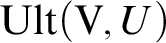
 ${\mathrm {Ult}}({{\mathrm {V}}},{U})$
denote the (transitive collapse of the) induced ultrapower and we let
 ${j_U}:{{\mathrm {V}}}\longrightarrow {{\mathrm {Ult}}({{\mathrm {V}}},{U})}$
denote the corresponding elementary embedding. For notational simplicity, we confuse
 ${\mathrm {Ult}}({{\mathrm {V}}},{U})$
and its elements with their transitive collapses. In this paper, for a given normal ultrafilter U, we aim to determine the class of limit ordinals containing an unbounded subset that is fresh over the ultrapower
 ${\mathrm {Ult}}({{\mathrm {V}}},{U})$
. For the images of regular cardinals under the embedding
 $j_U$
, this question was already studied by Shani in [Reference Shani25]. Moreover, Sakai investigated closure properties of measurable ultrapowers that imply the non-existence of unbounded fresh subsets at many ordinals in [Reference Sakai20].
The following proposition lists the obvious closure properties of measurable ultrapowers with respect to the non-existence of fresh subsets. Note that the second part of the second statement also follows directly from [Reference Sakai20, Corollary 3.3]. The proof of this proposition and the next one will be given in §2.
Proposition 1.2. Let U be a normal ultrafilter on a measurable cardinal
 $\delta $
and let
 $\lambda $
be a limit ordinal.
-
(i) If the cardinal
 ${{\mathrm {cof}}(\lambda )}$
is either smaller than
$\delta ^+$
or weakly compact, then no unbounded subset of
$\lambda $
is fresh over
${\mathrm {Ult}}({{\mathrm {V}}},{U})$
.
-
(ii) If there exists a
${<}(2^\delta )^+$
-closed ultrafilter on
$\lambda $
that contains all cobounded subsets of
$\lambda $
, then no unbounded subset of
$\lambda $
is fresh over
${\mathrm {Ult}}({{\mathrm {V}}},{U})$
. In particular, if there exists a strongly compact cardinal
$\kappa $
with the property that
$\delta <\kappa \leq {{\mathrm {cof}}(\lambda )}$
, then no unbounded subset of
$\lambda $
is fresh over
${\mathrm {Ult}}({{\mathrm {V}}},{U})$
.


In the other direction, the fact that normal ultrafilters are not contained in the corresponding ultrapowers directly yields the following non-closure properties of these ultrapowers.
Proposition 1.3. Let U be a normal ultrafilter on a measurable cardinal
 $\delta $
.
-
(i) If
$\kappa>\delta $
is the minimal cardinal with
${\mathcal {P}}({\kappa })\nsubseteq {\mathrm {Ult}}({{\mathrm {V}}},{U})$
, then there is an unbounded subset of
$\kappa $
that is fresh over
${\mathrm {Ult}}({{\mathrm {V}}},{U})$
. -
(ii) If
$\lambda $
is a limit ordinal with
${{\mathrm {cof}}(\lambda )}^{{\mathrm {Ult}}({{\mathrm {V}}},{U})}=j_U(\delta ^+)$
, then there is an unbounded subset of
$\lambda $
that is fresh over
${\mathrm {Ult}}({{\mathrm {V}}},{U})$
. -
(iii) If
$2^\delta =\delta ^+$
holds and
$\lambda $
is a limit ordinal with
${{\mathrm {cof}}(\lambda )}=\delta ^+$
, then there is an unbounded subset of
$\lambda $
that is fresh over
${\mathrm {Ult}}({{\mathrm {V}}},{U})$
.


In the following, we will present results that show that the above propositions already cover all provable closure and non-closure properties of measurable ultrapowers, in the sense that there are models of set theory in which fresh subsets exist at all limit ordinals that are not ruled out by Proposition 1.2 and models in which fresh subsets only exist at limit ordinals, where their existence is guaranteed by Proposition 1.3.
Results of Sakai on the approximation properties of measurable ultrapowers in [Reference Sakai20] can directly be used to prove the following result that shows that models with minimal non-closure properties can be constructed by collapsing a strongly compact cardinal to become the double successor of a measurable cardinal. Note that we phrase the following result in a non-standard way to clearly distinguish between the ground model of the forcing extension and the model used in the corresponding ultrapower construction.
Theorem 1.4. Let
 $\delta $
be a measurable cardinal and let
 ${\mathrm {W}}$
be an inner model such that the
 ${\mathrm {GCH}}$
holds in
 ${\mathrm {W}}$
,
 ${\mathrm {V}}$
is a
 ${\mathrm {Col}}({(\delta ^+)^{\mathrm {V}}},{{<}(\delta ^{++})^{\mathrm {V}}})^{\mathrm {W}}$
-generic extension of
 ${\mathrm {W}}$
and
 $(\delta ^{++})^{\mathrm {V}}$
is strongly compact in
 ${\mathrm {W}}$
. Given a normal ultrafilter U on
 $\delta $
, the following statements are equivalent for every limit ordinal
 $\lambda $
:
-
(i) There is an unbounded subset of
$\lambda $
that is fresh over
${\mathrm {Ult}}({{\mathrm {V}}},{U})$
. -
(ii)
${{\mathrm {cof}}(\lambda )}=\delta ^+$
.


Proof For one direction, our assumptions directly imply that the
 ${\mathrm {GCH}}$
holds and therefore Proposition 1.3 shows that for every limit ordinal
 $\lambda $
with
 ${{\mathrm {cof}}(\lambda )}=\delta ^+$
, there exists an unbounded subset of
 $\lambda $
that is fresh over
 ${\mathrm {Ult}}({{\mathrm {V}}},{U})$
. For the other direction, assume, towards a contradiction, that
 $\lambda $
is a limit ordinal with
 ${{\mathrm {cof}}(\lambda )}\neq \delta ^+$
and the property that some unbounded subset A of
 $\lambda $
is fresh over
 ${\mathrm {Ult}}({{\mathrm {V}}},{U})$
. Then Proposition 1.2 implies that
 ${{\mathrm {cof}}(\lambda )}>\delta ^+$
. By our assumption, [Reference Sakai20, Corollary 3.3] directly implies that
 ${\mathrm {Ult}}({{\mathrm {V}}},{U})$
has the
 $\delta ^{++}$
-approximation property, i.e., we have
 $X\in {\mathrm {Ult}}({{\mathrm {V}}},{U})$
whenever a set X of ordinals has the property that
 $X\cap a\in {\mathrm {Ult}}({{\mathrm {V}}},{U})$
holds for all
 $a\in {\mathrm {Ult}}({{\mathrm {V}}},{U})$
with
 $\vert {a}\vert ^{{\mathrm {Ult}}({{\mathrm {V}}},{U})}<\delta ^{++}$
. In particular, there exists some
 $a\in {\mathrm {Ult}}({{\mathrm {V}}},{U})$
with
 $\vert {a}\vert ^{{\mathrm {Ult}}({{\mathrm {V}}},{U})}<\delta ^{++}$
and
 $A\cap a\notin {\mathrm {Ult}}({{\mathrm {V}}},{U})$
. But then the fact that
 ${{\mathrm {cof}}(\lambda )}\geq \delta ^{++}>\vert {a}\vert ^{{\mathrm {Ult}}({{\mathrm {V}}},{U})}\geq \vert {A\cap a}\vert $
implies that
 $A\cap a$
is bounded in
 $\lambda $
and hence the assumption that A is fresh over
 ${\mathrm {Ult}}({{\mathrm {V}}},{U})$
allows us to conclude that
 $A\cap a$
is an element of
 ${\mathrm {Ult}}({{\mathrm {V}}},{U})$
, a contradiction.⊣
For the other direction, we will prove results that show that canonical inner models provide measurable ultrapowers with closure properties that are minimal in the above sense. These arguments make use of the validity of various combinatorial principles in these models. In particular, they heavily rely on the existence of suitable square sequences. For specific types of cardinals, similar constructions have already been done in [Reference Sakai20, Section 3.3] and [Reference Shani25, Section 3].
-
(i) Given an uncountable regular cardinal
$\kappa $
, a sequence
$\langle {C_\gamma }~\vert ~{\gamma \in {\mathrm {Lim}}\cap \kappa }\rangle $
is a
$\square (\kappa )$
-sequence if the following statements hold:-
(a)
$C_\gamma $
is a closed unbounded subset of
$\gamma $
for all
$\gamma \in {\mathrm {Lim}}\cap \kappa $
. -
(b) If
$\gamma \in {\mathrm {Lim}}\cap \kappa $
and
$\beta \in {\mathrm {Lim}}(C_\gamma )$
, then
$C_\beta =C_\gamma \cap \beta $
. -
(c) There is no closed unbounded subset C of
$\kappa $
with
$C\cap \gamma =C_\gamma $
for all
$\gamma \in {\mathrm {Lim}}(C)$
.
-
-
(ii) Given an infinite cardinal
$\kappa $
, a
$\square (\kappa ^+)$
-sequence
$\langle {C_\gamma }~\vert ~{\gamma \in {\mathrm {Lim}}\cap \kappa ^+}\rangle $
is a
$\square _\kappa $
-sequence if
${{\mathrm {otp}}\left (C_\gamma \right )}\leq \kappa $
holds for all
$\gamma \in {\mathrm {Lim}}\cap \kappa ^+$
.


The next result shows that, in certain models of set theory, fresh subsets for measurable ultrapowers exist at all limit ordinals that are not ruled out by the conclusions of Proposition 1.2.
Theorem 1.6. Let U be a normal ultrafilter on a measurable cardinal
 $\delta $
. Assume that the following statements hold:
-
(a) The
${\mathrm {GCH}}$
holds at all cardinals greater than or equal to
$\delta $
. -
(b) If
$\kappa>\delta ^+$
is a regular cardinal that is not weakly compact, then there exists a
$\square (\kappa )$
-sequence. -
(c) If
$\kappa>\delta $
is a singular cardinal, then there exists a
$\square _\kappa $
-sequence.


Then the following statements are equivalent for every limit ordinal
 $\lambda $
:
-
(i) There is an unbounded subset of
$\lambda $
that is fresh over
${\mathrm {Ult}}({{\mathrm {V}}},{U})$
. -
(ii) The cardinal
${{\mathrm {cof}}(\lambda )}$
is greater than
$\delta $
and not weakly compact.


With the help of results of Schimmerling and Zeman in [Reference Schimmerling and Zeman24, Reference Zeman28], the above result will allow us to show that measurable ultrapowers of a large class of canonical inner models, so called Jensen-style extender models, possess the minimal amount of closure properties with respect to freshness. These inner models go back to Jensen in [Reference Jensen12], following a suggestion of Friedman, and can have various large cardinals below supercompact cardinals. As for example in [Reference Zeman28], we demand that they satisfy classical consequences of iterability such as solidity and condensation. The theorem below holds for Mitchell–Steel extender models with the same properties constructed as in [Reference Mitchell and Steel19] as well. But it turned out that Jensen-style constructions are more natural in the proof of
 $\square $
-principles in canonical inner models, so this is what Schimmerling and Zeman use in [Reference Schimmerling and Zeman24, Reference Zeman28], and we decided to follow their notation.
Theorem 1.7. Assume that
 ${\mathrm {V}}$
is a Jensen-style extender model that does not have a subcompact cardinal. Then the statements (i) and (ii) listed in Theorem 1.6 are equivalent for every normal ultrafilter U on a measurable cardinal
 $\delta $
and every limit ordinal
 $\lambda $
.
We restrict ourselves to inner models without subcompact cardinals in the statement of Theorem 1.7, as the non-existence of
 $\square _\kappa $
-sequences in Jensen-style extender models is equivalent to
 $\kappa $
being subcompact (see [Reference Schimmerling and Zeman24]). Results of Kypriotakis and Zeman in [Reference Kypriotakis and Zeman15] show that
 $\square (\kappa ^+)$
-sequences can exist even if
 $\kappa $
is subcompact, but we decided to not discuss this further here.
The techniques developed in the proof of Theorem 1.6 also allows us to derive large lower bounds for the consistency strength of the conclusion of Theorem 1.4.
Theorem 1.8. Let U be a normal ultrafilter on a measurable cardinal
 $\delta $
and let
 $\kappa>\delta $
be a regular cardinal. If there exists a
 $\square (\kappa )$
-sequence, then there is a closed unbounded subset of
 $j_U(\kappa )$
that is fresh over
 ${\mathrm {Ult}}({{\mathrm {V}}},{U})$
.
Note that, in the situation of the above theorem, the regularity of
 $\kappa $
implies that
 $j_U[\kappa ]$
is cofinal in
 $j_U(\kappa )$
and hence
 ${{\mathrm {cof}}(j_U(\kappa ))}=\kappa $
holds. In particular, if U is a normal ultrafilter on a measurable cardinal
 $\delta $
with the property that for every limit ordinal
 $\lambda $
with
 ${{\mathrm {cof}}(\lambda )}\in \{\delta ^{++},\ \delta ^{+++}\}$
, no unbounded subset of
 $\lambda $
is fresh over
 ${\mathrm {Ult}}({{\mathrm {V}}},{U})$
, then the above theorem shows that
 $\kappa =\delta ^{++}$
is a countably closedFootnote
2
regular cardinal that is greater than
 $\max \{2^{\aleph _0},\ \aleph _3\}$
and has the property that there are no
 $\square (\kappa )$
- and no
 $\square _\kappa $
-sequences. By [Reference Schimmerling22, Theorem 5.6], the existence of such a cardinal implies Projective Determinacy. In addition, [Reference Jensen, Schimmerling, Schindler and Steel13, Theorem 0.1] derives the existence of a sharp for a proper class model with a proper class of strong cardinals and a proper class of Woodin cardinals from the existence of such a cardinal. Next, if U is a normal ultrafilter on a measurable cardinal
 $\delta $
and
 $\kappa>\delta $
is a singular strong limit cardinal with the property that unbounded subsets of limit ordinals of cofinality
 $\kappa ^+$
are not fresh over
 ${\mathrm {Ult}}({{\mathrm {V}}},{U})$
, then Theorem 1.8 implies that there are no
 $\square _\kappa $
-sequences and therefore the results of [Reference Steel26] show that
 $\mathrm {AD}$
holds in
 ${\mathrm {L}}({\mathbb {R}})$
. Even stronger consequences of this conclusion can be derived with the help of the results of [Reference Sargsyan21].
Finally, our techniques also allow us to determine the exact consistency strength of the existence of a measurable ultrapower that has the property that no unbounded subsets of the double successor of the corresponding measurable cardinal are fresh over it. This result is motivated by results of Cummings in [Reference Cummings1] that determine the exact consistency strength of the existence of a measurable ultrapower that contains the power set of the successor of the corresponding measurable cardinal. In our setting, Cummings’ results can be rephrased in the following way:
Theorem 1.9. The following statements are equiconsistent over the theory
 ${\mathrm {ZFC}}$
:
-
(i) There exists a
$(\delta +2)$
-strong cardinal
$\delta $
. -
(ii) There exists a normal ultrafilter U on a measurable cardinal
$\delta $
with the property that no unbounded subset of
$\delta ^+$
is fresh over
${\mathrm {Ult}}({{\mathrm {V}}},{U})$
.


Proof In one direction, [Reference Cummings1, Theorem 1] shows that, starting with a model of
 ${\mathrm {ZFC}}$
containing a
 $(\delta +2)$
-strong cardinal
 $\delta $
, it is possible to construct a model in which there exists a normal ultrafilter U on
 $\delta $
satisfying
 ${\mathcal {P}}({\delta ^+})\subseteq {\mathrm {Ult}}({{\mathrm {V}}},{U})$
. In particular, no subset of
 $\delta ^+$
is fresh over
 ${\mathrm {Ult}}({{\mathrm {V}}},{U})$
in this model. In the other direction, if U is a normal ultrafilter on a measurable cardinal
 $\delta $
with the property that no unbounded subset of
 $\delta ^+$
is fresh over
 ${\mathrm {Ult}}({{\mathrm {V}}},{U})$
, then the closure of
 ${\mathrm {Ult}}({{\mathrm {V}}},{U})$
under
 $\kappa $
-sequences implies that
 ${\mathcal {P}}({\delta ^+})\subseteq {\mathrm {Ult}}({{\mathrm {V}}},{U})$
holds and hence [Reference Cummings1, Theorem 2] yields an inner model with a
 $(\delta +2)$
-strong cardinal
 $\delta $
.⊣
The following theorem determines the exact consistency strength of the corresponding statement for double successors of measurable cardinals:
Theorem 1.10. The following statements are equiconsistent over the theory
 ${\mathrm {ZFC}}$
:
-
(i) There exists a weakly compact cardinal above a measurable cardinal.
-
(ii) There exists a normal ultrafilter U on a measurable cardinal
$\delta $
with the property that no unbounded subset of
$\delta ^{++}$
is fresh over
${\mathrm {Ult}}({{\mathrm {V}}},{U})$
.


2. Simple closure and non-closure properties
In this section, we prove the two propositions stated in the introduction.
Proof of Proposition 1.2 (i) If
 ${{\mathrm {cof}}(\lambda )}\leq \delta $
, then the desired statement follows directly from the closure of
 ${\mathrm {Ult}}({{\mathrm {V}}},{U})$
under
 $\delta $
-sequences. Hence, we may assume that
 $\kappa ={{\mathrm {cof}}(\lambda )}$
is a weakly compact cardinal greater than
 $\delta $
. Pick a cofinal sequence
 $\langle {\gamma _\alpha }~\vert ~{\alpha <\kappa }\rangle $
in
 $\lambda $
and fix an unbounded subset A of
 $\lambda $
such that
 $A\cap \gamma \in {\mathrm {Ult}}({{\mathrm {V}}},{U})$
for all
 $\gamma <\lambda $
. Given
 $\alpha <\kappa $
, fix functions
 $f_\alpha $
and
 $g_\alpha $
with domain
 $\delta $
such that
 $[f_\alpha ]_U=\gamma _\alpha $
and
 $[g_\alpha ]_U = A\cap \gamma _\alpha $
(recall that we are identifying
 ${\mathrm {Ult}}({{\mathrm {V}}},{U})$
with its transitive collapse). Let
 ${c}:{[\kappa ]^2}\longrightarrow {U}$
denote the unique function with the property that
 $$ \begin{align*}c(\{\alpha,\beta\}) ~ = ~ \{{\xi<\delta}~\vert~{f_\alpha(\xi)<f_\beta(\xi), ~ g_\alpha(\xi)=f_\alpha(\xi)\cap g_\beta(\xi)}\}\end{align*} $$
holds for all
 $\alpha <\beta <\kappa $
. In this situation, since
 $\kappa>\delta $
is weakly compact, we know that
 $\vert {U}\vert =2^\delta <\kappa $
and hence the weak compactness of
 $\kappa $
yields an unbounded subset H of
 $\kappa $
and an element X of U with the property that
 $c[H]^2=\{X\}$
. Pick a function g with domain
 $\delta $
and the property that
 $g(\xi )=\bigcup \{{g_\alpha (\xi )}~\vert ~{\alpha \in H}\}$
holds for all
 $\xi \in X$
. This construction ensures that
 $[g]_U\cap \gamma _\alpha =[g_\alpha ]_U$
holds for every
 $\alpha \in H$
and we can conclude that
 $[g]_U=A$
. In particular, the set A is not fresh over
 ${\mathrm {Ult}}({{\mathrm {V}}},{U})$
.
(ii) Fix a
 ${<}(2^\delta )^+$
-closed ultrafilter F on
 $\lambda $
that contains all cobounded subsets of
 $\lambda $
and assume, towards a contradiction, that A is an unbounded subset of
 $\lambda $
that is fresh over
 ${\mathrm {Ult}}({{\mathrm {V}}},{U})$
. Given
 $\eta <\lambda $
, fix functions
 $f_\eta $
and
 $g_\eta $
with domain
 $\delta $
that satisfy
 $[f_\eta ]_U=\eta $
and
 $[g_\eta ]_U=A\cap \eta $
. Moreover, given
 $\eta <\lambda $
and
 $X\in U$
, we set
 $$ \begin{align*}A_{\eta,X} ~ = ~ \{{\zeta\in(\eta,\lambda)}~\vert~{X=\{{\xi<\delta}~\vert~{f_\eta(\xi)<f_\zeta(\xi), ~ g_\eta(\xi)=g_\zeta(\xi)\cap f_\eta(\xi)}\}}\}.\end{align*} $$
Then
 $$ \begin{align*}\bigcup\{{A_{\eta,X}}~\vert~{X\in U}\} ~ = ~ (\eta,\lambda)\end{align*} $$
holds for every
 $\eta <\lambda $
. By our assumptions on F, there exists a sequence
 $\langle {X_\eta }~\vert ~{\eta <\lambda }\rangle $
of elements of U with the property that
 $A_{\eta ,X_\eta }\in F$
holds for all
 $\eta <\lambda $
. Given
 $X\in U$
, we now define
 $$ \begin{align*}E_X ~ = ~ \{{\eta<\lambda}~\vert~{X_\eta=X}\}.\end{align*} $$
Since we now have
 $$ \begin{align*}\bigcup\{{E_X}~\vert~{X\in U}\} ~ = ~ \lambda,\end{align*} $$
our assumptions on F yield an element
 $X_*$
of U with
 $E_{X_*}\in F$
.
Claim. If
 $\eta ,\zeta \in E_{X_*}$
,
 $\xi \in X_*$
and
 $\alpha =\min (f_\eta (\xi ),f_\zeta (\xi ))$
, then
 $g_\eta (\xi )\cap \alpha = g_\zeta (\xi )\cap \alpha $
.
Proof of the Claim Pick
 $\rho \in A_{\eta ,X_*}\cap A_{\zeta ,X_*}\in F$
. Then
 $\alpha <f_\rho (\xi )$
and
 $$ \begin{align*} g_\eta(\xi)\cap\alpha ~ = ~ g_\rho(\xi)\cap\alpha ~ = ~ g_\zeta(\xi)\cap\alpha. \end{align*} $$
⊣
Pick a function g with domain
 $\delta $
and
 $$ \begin{align*}g(\xi) ~ = ~ \bigcup\{{g_\eta(\xi)}~\vert~{\eta\in E_{X_*}}\}\end{align*} $$
for all
 $\xi \in X_*$
. By the above claim, we now know that
 $g(\xi )\cap f_\eta (\xi )=g_\eta (\xi )$
holds for all
 $\eta \in E_{X_*}$
and all
 $\xi \in X_*\in U$
. But this directly implies that
 $$ \begin{align*}[g]_U\cap\eta ~ = ~ [g_\eta]_U ~ = ~ A\cap\eta\end{align*} $$
for all
 $\eta \in E_{X_*}$
. Hence, we can conclude that
 $[g]_U = A\in {\mathrm {Ult}}({{\mathrm {V}}},{U})$
, a contradiction.
Now, assume that there is a strongly compact cardinal
 $\kappa $
with
 $\delta <\kappa \leq {{\mathrm {cof}}(\lambda )}$
. Then
 $2^\delta <\kappa $
and the cobounded filter on
 $\lambda $
is
 ${<}\kappa $
-closed. Since the filter extension property of strongly compact cardinals (see [Reference Kanamori14, Proposition 4.1]) ensures the existence of a
 ${<}\kappa $
-closed ultrafilter F on
 $\lambda $
that contains all cobounded subsets of
 $\lambda $
, the above computations directly yield the desired conclusion.⊣
Proof of Proposition 1.3 (i) If
 $\kappa>\delta $
is the minimal cardinal with
 ${\mathcal {P}}({\kappa })\nsubseteq {\mathrm {Ult}}({{\mathrm {V}}},{U})$
, then every element of
 ${\mathcal {P}}({\kappa })\setminus {\mathrm {Ult}}({{\mathrm {V}}},{U})$
is unbounded in
 $\kappa $
and fresh over
 ${\mathrm {Ult}}({{\mathrm {V}}},{U})$
.
(ii) Fix a limit ordinal
 $\lambda $
with
 ${{\mathrm {cof}}(\lambda )}^{{\mathrm {Ult}}({{\mathrm {V}}},{U})}=j_U(\delta ^+)$
and pick a strictly increasing, cofinal function
 ${c}:{j_U(\delta ^+)}\longrightarrow {\lambda }$
in
 ${\mathrm {Ult}}({{\mathrm {V}}},{U})$
. Since
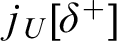 $j_U[\delta ^+]$
is a cofinal subset of
 $j_U(\delta ^+)$
of order-type
 $\delta ^+$
, we know that
 $(c\circ j_U)[\delta ^+]$
is a cofinal subset of
 $\lambda $
of order-type
 $\delta ^+$
. In particular, the closure of
 ${\mathrm {Ult}}({{\mathrm {V}}},{U})$
under
 $\delta $
-sequences implies that every proper initial segment of
 $(c\circ j_U)[\delta ^+]$
is an element of
 ${\mathrm {Ult}}({{\mathrm {V}}},{U})$
. Finally, since [Reference Kanamori14, Proposition 22.4] shows that
 $j_U[\delta ^+]\notin {\mathrm {Ult}}({{\mathrm {V}}},{U})$
, we can conclude that the set
 $(c\circ j_U)[\delta ^+]$
is fresh over
 ${\mathrm {Ult}}({{\mathrm {V}}},{U})$
.
(iii) First, assume that
 ${{\mathrm {cof}}(\lambda )}^{{\mathrm {Ult}}({{\mathrm {V}}},{U})}=\delta ^+$
. Since
 $2^\delta = \delta ^+$
and
 $U \notin {\mathrm {Ult}}({{\mathrm {V}}},{U})$
, we have
 ${\mathcal {P}}({\delta ^+})\nsubseteq {\mathrm {Ult}}({{\mathrm {V}}},{U})$
, and we can use (i) to find an unbounded subset A of
 $\delta ^+$
that is fresh over
 ${\mathrm {Ult}}({{\mathrm {V}}},{U})$
. Let
 $\langle {\gamma _\alpha }~\vert ~{\alpha <\delta ^+}\rangle $
be the monotone enumeration of an unbounded subset of
 $\lambda $
of order-type
 $\delta ^+$
in
 ${\mathrm {Ult}}({{\mathrm {V}}},{U})$
. Set
 $B=\{{\gamma _\alpha }~\vert ~{\alpha \in A}\}$
. Then B is unbounded in
 $\lambda $
and it is easy to see that B is fresh over
 ${\mathrm {Ult}}({{\mathrm {V}}},{U})$
.
Now, assume that
 ${{\mathrm {cof}}(\lambda )}^{{\mathrm {Ult}}({{\mathrm {V}}},{U})}>\delta ^+$
and fix an unbounded subset A of
 $\lambda $
of order-type
 $\delta ^+$
. Then the closure of
 ${\mathrm {Ult}}({{\mathrm {V}}},{U})$
under
 $\delta $
-sequences implies that A is fresh over
 ${\mathrm {Ult}}({{\mathrm {V}}},{U})$
.⊣
Note that, in the situation of Proposition 1.3, we have
 ${{\mathrm {cof}}(\lambda )}=\delta ^+$
for every limit ordinal
 $\lambda $
with
 ${{\mathrm {cof}}(\lambda )}^{{\mathrm {Ult}}({{\mathrm {V}}},{U})}=j_U(\delta ^+)$
. In particular, if
 $\kappa $
is a strong limit cardinal of cofinality
 $\delta ^+$
, then the fact that
 $j_U(\kappa )=\kappa $
holds allows us to use the second part of the above proposition to conclude that there is an unbounded subset of
 $\kappa $
that is fresh over
 ${\mathrm {Ult}}({{\mathrm {V}}},{U})$
. Moreover, the results of Cummings in [Reference Cummings1] discussed in the first section show that the cardinal arithmetic assumption in the third part of the proposition cannot, in general, be omitted.
3. Fresh subsets at image points of ultrapower embeddings
In this section, we will use a modified square principle introduced in [Reference Lambie-Hanson16] to prove Theorem 1.8 by showing that the existence of a
 $\square (\kappa )$
-sequence allows us to construct a fresh subset of
 $j_U(\kappa )$
. The principle introduced in the next definition is a variation of the indexed square principles studied in [Reference Cummings, Foreman and Magidor4, Reference Cummings and Schimmerling5].
Definition 3.1 (Lambie–Hanson)
Let
 $\delta < \kappa $
be infinite regular cardinals. A
 $\square ^{\mathrm {ind}}(\kappa , \delta )$
-sequence is a matrix
 $$ \begin{align*}\langle{C_{\gamma,\xi}}~\vert~{\gamma < \kappa, ~ i(\gamma) \leq \xi < \delta}\rangle\end{align*} $$
satisfying the following statements:
-
(i) If
$\gamma \in {\mathrm {Lim}}\cap \kappa $
, then
$i(\gamma ) < \delta $
. -
(ii) If
$\gamma \in {\mathrm {Lim}}\cap \kappa $
and
$i(\gamma ) \leq \xi < \delta $
, then
$C_{\gamma ,\xi }$
is a closed unbounded subset of
$\gamma $
. -
(iii) If
$\gamma \in {\mathrm {Lim}}\cap \kappa $
and
$i(\gamma ) \leq \xi _0 < \xi _1 < \delta $
, then
$C_{\gamma ,\xi _0} \subseteq C_{\gamma ,\xi _1}$
. -
(iv) If
$\beta ,\gamma \in {\mathrm {Lim}}\cap \kappa $
and
$i(\gamma ) \leq \xi < \delta $
with
$\beta \in {\mathrm {Lim}}(C_{\gamma ,\xi })$
, then
$\xi \geq i(\beta )$
and
$ C_{\beta ,\xi }=C_{\gamma ,\xi } \cap \beta $
. -
(v) If
$\beta ,\gamma \in {\mathrm {Lim}}\cap \kappa $
with
$\beta < \gamma $
, then there is an
$i(\gamma )\leq \xi < \delta $
such that
$\beta \in {\mathrm {Lim}}(C_{\gamma ,\xi })$
. -
(vi) There is no closed unbounded subset C of
$\kappa $
with the property that, for all
$\gamma \in {\mathrm {Lim}}(C)$
, there is
$\xi < \delta $
such that
$C_{\gamma ,\xi }=C \cap \gamma $
holds.


The main result of [Reference Lambie-Hanson and Lücke17] now shows that for all infinite regular cardinals
 $\delta <\kappa $
, the existence of a
 $\square (\kappa )$
-sequence implies the existence of a
 $\square ^{\mathrm {ind}}(\kappa , \delta )$
-sequence. The proof of Theorem 1.8 is based on this implication.
Proof of Theorem 1.8 By [Reference Lambie-Hanson and Lücke17, Theorem 3.4], our assumptions allow us to fix a
 $\square ^{\mathrm {ind}}(\kappa , \delta )$
-sequence
 $$ \begin{align*}\langle{C_{\gamma,\xi}}~\vert~{\gamma < \kappa, ~ i(\gamma) \leq \xi < \delta}\rangle.\end{align*} $$
Given
 $\gamma \in {\mathrm {Lim}}\cap \kappa $
, let
 ${f_\gamma }:{\delta }\longrightarrow {{\mathcal {P}}({\gamma })}$
denote the unique function with
 $f_{\gamma }(\xi )=\emptyset $
for all
 $\xi <i(\gamma )$
and
 $f_\gamma (\xi )=C_{\gamma ,\xi }$
for all
 $i(\gamma )\leq \xi <\delta $
. In this situation, Łos’ Theorem directly implies that for all
 $\beta ,\gamma \in {\mathrm {Lim}}\cap \kappa $
with
 $\beta \leq \gamma $
, the set
 $[f_\gamma ]_U$
is closed unbounded in
 $j_U(\gamma )$
and
 $[f_\beta ]_U=[f_\gamma ]_U\cap j_U(\beta )$
holds. Define
 $$ \begin{align*}A ~ = ~ \bigcup\{{[f_\gamma]_U}~\vert~{\gamma \in {\text{Lim}} \cap \kappa}\}.\end{align*} $$
By our assumptions on
 $\kappa $
, we know that
 $j_U(\kappa )=\sup (j_U[\kappa ])$
and therefore A is a closed unbounded subset of
 $j_U(\kappa )$
with
 $A\cap j_U(\gamma )=[f_\gamma ]_U$
for all
 $\gamma \in {\mathrm {Lim}} \cap \kappa $
.
Assume, towards a contradiction, that A is an element of
 ${\mathrm {Ult}}({{\mathrm {V}}},{U})$
. Then there is
 ${f}:{\delta }\longrightarrow {{\mathcal {P}}({\kappa })}$
with
 $[f]_U=A$
and the property that
 $f(\xi )$
is a closed unbounded subset of
 $\kappa $
for all
 $\xi <\delta $
. Since we have
 $$ \begin{align*}\{{\xi<\delta}~\vert~{f_\gamma(\xi)=f(\xi)\cap\gamma\neq\emptyset}\} ~ \in ~ U\end{align*} $$
for all
 $\gamma \in {\mathrm {Lim}} \cap \kappa $
, we can find
 $\xi <\delta $
with the property that
 $\xi \geq i(\gamma )$
and
 $f(\xi )\cap \gamma =C_{\gamma ,\xi }$
holds for unboundedly many
 $\gamma $
below
 $\kappa $
. Pick
 $\beta \in {\mathrm {Lim}}(f(\xi ))$
and
 $\beta <\gamma <\kappa $
with
 $\xi \geq i(\gamma )$
and
 $f(\xi )\cap \gamma =C_{\gamma ,\xi }$
. Then
 $\beta \in {\mathrm {Lim}}(C_{\gamma ,\xi })$
and this implies that
 $\xi \geq i(\beta )$
and
 $C_{\beta ,\xi }=C_{\gamma ,\xi }\cap \beta =f(\xi )\cap \beta $
. These computations show that there is a closed unbounded subset C of
 $\kappa $
and
 $\xi <\delta $
such that
 $\xi \geq i(\beta )$
and
 $C\cap \beta =C_{\beta ,\xi }$
holds for all
 $\beta \in {\mathrm {Lim}}(C)$
. But this contradicts 6 in Definition 3.1.⊣
4. Fresh subsets of successors of singular cardinals
We now aim to construct fresh subsets of cardinals that are not contained in the image of the corresponding ultrapower embedding, e.g., successors of singular cardinals whose cofinality is equal to the relevant measurable cardinal. Our arguments will rely on two standard observations about measurable ultrapowers and
 $\square _\kappa $
-sequences that we present first. A proof of the following lemma is contained in the proof of [Reference Lücke and Schlicht18, Lemma 1.3].
Lemma 4.1. Let U be a normal ultrafilter on a measurable cardinal
 $\delta $
. If
 $\nu>\delta $
is a cardinal with
 ${{\mathrm {cof}}(\nu )}\neq \delta $
and
 $\lambda ^\delta <\nu $
for all
 $\lambda <\nu $
, then
 $j_U(\nu )=\nu $
and
 $j_U(\nu ^+)=\nu ^+$
.
The next lemma contains a well-known construction (see [Reference Cummings2, Section 4]) that shows that, in the situations relevant for our proofs, the existence of some
 $\square _\kappa $
-sequence already implies the existence of such a sequence with certain additional structural properties.
Lemma 4.2. Let
 $\kappa $
be a singular cardinal and let S be a stationary subset of
 $\kappa ^+$
. If there exists a
 $\square _\kappa $
-sequence, then there exists a
 $\square _\kappa $
-sequence
 $\langle {C_\gamma }~\vert ~{\gamma \in {\mathrm {Lim}}\cap \kappa ^+}\rangle $
and a stationary subset E of S such that
 ${{\mathrm {otp}}\left (C_\gamma \right )}<\kappa $
and
 ${\mathrm {Lim}}(C_\gamma )\cap E=\emptyset $
for all
 $\gamma \in {\mathrm {Lim}}\cap \kappa ^+$
.
Proof Fix a
 $\square _\kappa $
-sequence
 $\langle {A_\gamma }~\vert ~{\gamma \in {\mathrm {Lim}}\cap \kappa ^+}\rangle $
and a closed unbounded subset C of
 $\kappa $
of order-type
 ${{\mathrm {cof}}(\kappa )}$
. Given
 $\gamma \in {\mathrm {Lim}}\cap \kappa ^+$
, let
 $\lambda _\gamma ={{\mathrm {otp}}\left (A_\gamma \right )}\leq \kappa $
and let
 $\langle {\beta ^\gamma _\alpha }~\vert ~{\alpha <\lambda _\gamma }\rangle $
denote the monotone enumeration of
 $A_\gamma $
. Given
 $\gamma \in {\mathrm {Lim}}\cap \kappa ^+$
with
 $\lambda _\gamma \in {\mathrm {Lim}}(C)\cup \{\kappa \}$
, let
 $B_\gamma =\{{\beta \in A_\gamma }~\vert ~{{{\mathrm {otp}}\left (A_\gamma \cap \beta \right )}\in C}\}$
. Next, if
 $\gamma \in {\mathrm {Lim}}\cap \kappa ^+$
with
 $\lambda _\gamma \notin {\mathrm {Lim}}(C)\cup \{\kappa \}$
and
 ${\mathrm {Lim}}(C)\cap \lambda _\gamma =\emptyset $
, then we define
 $B_\gamma =A_\gamma $
. Finally, if
 $\gamma \in {\mathrm {Lim}}\cap \kappa ^+$
with
 $\lambda _\gamma \notin {\mathrm {Lim}}(C)\cup \{\kappa \}$
and
 ${\mathrm {Lim}}(C)\cap \lambda _\gamma \neq \emptyset $
, then we set
 $\alpha =\max ({\mathrm {Lim}}(C)\cap \lambda _\gamma )<\lambda _\gamma $
and we define
 $B_\gamma =B_{\beta ^\gamma _\alpha }\cup (A_\gamma \setminus B_{\beta ^\gamma _\alpha })$
.
Claim. The sequence
 $\langle {B_\gamma }~\vert ~{\gamma \in {\mathrm {Lim}}\cap \kappa ^+}\rangle $
is a
 $\square _\kappa $
-sequence with
 ${{\mathrm {otp}}\left (B_\gamma \right )}<\kappa $
for all
 $\gamma \in {\mathrm {Lim}}\cap \kappa ^+$
.⊣
With the help of Fodor’s Lemma, we can now find a stationary subset E of S and
 $\lambda <\kappa $
with
 ${{\mathrm {otp}}\left (B_\gamma \right )}=\lambda $
for all
 $\gamma \in E$
. Then we have
 $\vert {{\mathrm {Lim}}(B_\gamma )\cap E}\vert \leq 1$
for all
 $\gamma \in {\mathrm {Lim}}\cap \kappa ^+$
. Given
 $\gamma \in {\mathrm {Lim}}\cap \kappa ^+$
, define
 $C_\gamma =B_\gamma $
if
 ${{\mathrm {otp}}\left (B_\gamma \right )}\leq \lambda $
and let
 $C_\gamma =\{{\beta \in B_\gamma }~\vert ~{{{\mathrm {otp}}\left (B_\gamma \cap \beta \right )}>\lambda }\}$
if
 ${{\mathrm {otp}}\left (B_\gamma \right )}>\lambda $
.
Claim. The sequence
 $\langle {C_\gamma }~\vert ~{\gamma \in {\mathrm {Lim}}\cap \kappa ^+}\rangle $
is a
 $\square _\kappa $
-sequence with
 ${{\mathrm {otp}}\left (C_\gamma \right )}<\kappa $
and
 ${\mathrm {Lim}}(C_\gamma )\cap E=\emptyset $
for all
 $\gamma \in {\mathrm {Lim}}\cap \kappa ^+$
.⊣
This completes the proof of the lemma.⊣
We are now ready to prove the main result of this section that will allow us to handle successors of singular cardinals of measurable cofinality in the proof of Theorem 1.6.
Theorem 4.3. Let U be a normal ultrafilter on a measurable cardinal
 $\delta $
and let
 $\kappa $
be a singular cardinal of cofinality
 $\delta $
with
 $2^\kappa =\kappa ^+$
and the property that
 $\lambda ^\delta <\kappa $
holds for all
 $\lambda <\kappa $
. If there exists a
 $\square _\kappa $
-sequence, then there is a closed unbounded subset of
 $\kappa ^+$
that is fresh over
 ${\mathrm {Ult}}({{\mathrm {V}}},{U})$
.
Proof By our assumptions, we can apply Lemma 4.2 to obtain a
 $\square _\kappa $
-sequence
 $\langle {C_\gamma }~\vert ~{\gamma \in {\mathrm {Lim}}\cap \kappa ^+}\rangle $
and a stationary subset E of
 $S^{\kappa ^+}_\delta $
such that
 ${{\mathrm {otp}}\left (C_\gamma \right )}<\kappa $
and
 ${\mathrm {Lim}}(C_\gamma )\cap E=\emptyset $
for all
 $\gamma \in {\mathrm {Lim}}\cap \kappa ^+$
. Next, note that Lemma 4.1 implies that
 $j_U((\nu ^\delta )^+)=(\nu ^\delta )^+<\kappa $
holds for all cardinals
 $\nu <\kappa $
. This allows us to fix the monotone enumeration
 $\langle {\kappa _\xi }~\vert ~{\xi <\delta }\rangle $
of a closed unbounded set of uncountable cardinals smaller than
 $\kappa $
of order-type
 $\delta $
with the property that
 $j_U(\kappa _\xi )=\kappa _\xi $
holds for all
 $\xi <\delta $
. In this situation, the normality of U implies that
 $[\xi \mapsto \kappa _\xi ]_U=\kappa $
and
 $[\xi \mapsto \kappa _\xi ^+]_U\leq \kappa ^+$
. Given
 $\gamma \in {\mathrm {Lim}}\cap \kappa ^+$
, let
 $\xi _\gamma $
denote the minimal element
 $\xi $
of
 $\delta $
with
 $\kappa _\xi ^+>{{\mathrm {otp}}\left (C_\gamma \right )}$
. Note that
 $\xi _\gamma \geq \xi _\beta $
holds for all
 $\gamma \in {\mathrm {Lim}}\cap \kappa ^+$
and
 $\beta \in {\mathrm {Lim}}(C_\gamma )$
.
In the following, we inductively construct a sequence
 $$ \begin{align*}\langle{f_\gamma\in\prod_{\xi<\delta}\kappa_\xi^+}~\vert~{\gamma<\kappa^+}\rangle.\end{align*} $$
The idea behind this construction is that these functions represent a cofinal subset of
 $\kappa ^+$
and thereby in particular witness that
 $[\xi \mapsto \kappa _\xi ^+]_U = \kappa ^+$
. We identify each
 $f_\gamma \in \prod _{\xi <\delta }\kappa _\xi ^+$
with a function with domain
 $\delta $
in the obvious way and define:
-
•
$f_0(\xi )=0$
for all
$\xi <\delta $
. -
•
$f_{\gamma +1}(\xi )=f_\gamma (\xi )+1$
for all
$\gamma <\kappa ^+$
and
$\xi <\delta $
. -
• If
$\gamma \in {\mathrm {Lim}}\cap \kappa ^+$
with
${\mathrm {Lim}}(C_\gamma )$
bounded in
$\gamma $
and
$\xi <\delta $
, then
$$ \begin{align*}f_\gamma(\xi) ~ = ~ \min\{{\rho\in{\text{Lim}}}~\vert~{\rho>f_\beta(\xi) \textit{ for all }\beta\in C_\gamma\setminus\max({\text{Lim}}(C_\gamma))}\}.\end{align*} $$
-
• If
$\gamma \in {\mathrm {Lim}}\cap \kappa ^+$
with
${\mathrm {Lim}}(C_\gamma )$
unbounded in
$\gamma $
and
$\xi <\xi _\gamma $
, then
$f_\gamma (\xi )=\omega $
. -
• If
$\gamma \in {\mathrm {Lim}}\cap \kappa ^+$
with
${\mathrm {Lim}}(C_\gamma )$
unbounded in
$\gamma $
and
$\xi _\gamma \leq \xi <\delta $
, then
$$ \begin{align*}f_\gamma(\xi) ~ = ~ \sup\{{f_\beta(\xi)}~\vert~{\beta\in{\text{Lim}}(C_\gamma)}\}.\end{align*} $$


-
(i) If
$\beta <\gamma <\kappa ^+$
, then
$f_\beta (\xi )<f_\gamma (\xi )$
for coboundedly many
$\xi <\delta $
. -
(ii) If
$\gamma \in {\mathrm {Lim}}\cap \kappa ^+$
,
$\beta \in {\mathrm {Lim}}(C_\gamma )$
and
$\xi _\gamma \leq \xi <\delta $
, then
$f_\beta (\xi )<f_\gamma (\xi )$
. -
(iii) If
$\gamma \in {\mathrm {Lim}}\cap \kappa ^+$
, then
$f_\gamma (\xi )\in {\mathrm {Lim}}$
for all
$\xi <\delta $
.


Proof of the Claim (i) We prove the statement by induction on
 $0<\gamma <\kappa ^+$
, where the successor step follows trivially from our induction hypothesis. Now, assume that
 $\gamma \in {\mathrm {Lim}}\cap \kappa ^+$
with
 ${\mathrm {Lim}}(C_\gamma )$
bounded in
 $\gamma $
. Since
 $\delta $
is an uncountable regular cardinal, our induction hypothesis allows us to find
 $\zeta <\delta $
with the property that
 $f_{\beta _0}(\xi )<f_{\beta _1}(\xi )$
holds for all
 $\beta _0,\beta _1\in C_\gamma \setminus \max ({\mathrm {Lim}}(C_\gamma ))$
with
 $\beta _0<\beta _1$
and all
 $\zeta \leq \xi <\delta $
. By definition, we now have
 $$ \begin{align*}f_\gamma(\xi) ~ = ~ \sup\{{f_\beta(\xi)}~\vert~{\beta\in C_\gamma\setminus\max({\text{Lim}}(C_\gamma))}\}\end{align*} $$
for all
 $\zeta \leq \xi <\delta $
. Since
 $C_\gamma \setminus \max ({\mathrm {Lim}}(C_\gamma ))$
is a cofinal subset of
 $\gamma $
, the desired statement for
 $\gamma $
now follows directly from our induction hypothesis. Finally, if
 $\gamma \in {\mathrm {Lim}}\cap \kappa ^+$
with
 ${\mathrm {Lim}}(C_\gamma )$
unbounded in
 $\gamma $
, then the desired statement for
 $\gamma $
follows directly from the definition of
 $f_\gamma $
and our induction hypothesis.
(ii) We prove the claim by induction on
 $\gamma \in {\mathrm {Lim}}\cap \kappa ^+$
. First, if
 $\gamma \in {\mathrm {Lim}}\cap \kappa ^+$
with
 ${\mathrm {Lim}}(C_\gamma )$
bounded in
 $\gamma $
and
 $\beta =\max ({\mathrm {Lim}}(C_\gamma ))$
, then our definition ensures that
 $f_\beta (\xi )<f_\gamma (\xi )$
holds for all
 $\xi <\delta $
and hence the desired statement follows directly from our induction hypothesis. Next, if
 $\gamma \in {\mathrm {Lim}}\cap \kappa ^+$
with
 ${\mathrm {Lim}}(C_\gamma )$
unbounded in
 $\gamma $
, then our induction hypothesis implies that
 $f_{\beta _0}(\xi )<f_{\beta _1}(\xi )$
holds for all
 $\beta _0,\beta _1\in {\mathrm {Lim}}(C_\gamma )$
with
 $\beta _0<\beta _1$
and all
 $\xi _{\beta _1}\leq \xi <\delta $
. Since
 $\xi _\gamma \geq \xi _\beta $
holds for all
 $\beta \in {\mathrm {Lim}}(C_\gamma )$
, this fact together with our definition yields the desired statement for
 $\gamma $
.
(iii) This statement is a direct consequence of the definition of the sequence
 $\langle {f_\gamma }~\vert ~{\gamma < \kappa ^+}\rangle $
and statement (ii).⊣
Note that the first part of the above claim in particular shows that we have
 $[f_\beta ]_U<[f_\gamma ]_U<[\xi \mapsto \kappa _\xi ^+]_U$
for all
 $\beta <\gamma <\kappa ^+$
. Since we already observed that
 $[\xi \mapsto \kappa _\xi ^+]_U=(\kappa ^+)^{{\mathrm {Ult}}({{\mathrm {V}}},{U})}\leq \kappa ^+$
holds, we can conclude that
 $[\xi \mapsto \kappa _\xi ^+]_U=\kappa ^+$
.
Next, notice that the fact that
 $2^\kappa =\kappa ^+$
holds allows us to fix an enumeration
 $\langle {h_\alpha }~\vert ~{\alpha <\kappa ^+}\rangle $
of
 $\prod _{\xi <\delta }{\mathcal {P}}({\kappa _\xi ^+})$
of order-type
 $\kappa ^+$
. In addition, let
 $\langle {\gamma _\alpha }~\vert ~{\alpha <\kappa ^+}\rangle $
denote the monotone enumeration of E. We now inductively define a sequence
 $$ \begin{align*}\langle{c_\gamma}~\vert~{\gamma\in{\text{Lim}}\cap\kappa^+}\rangle\end{align*} $$
of functions with domain
 $\delta $
satisfying the following statements for all
 $\gamma \in {\mathrm {Lim}}\cap \kappa ^+$
:
-
(a)
$c_\gamma (\xi )$
is a closed unbounded subset of
$f_\gamma (\xi )$
for all
$\xi <\delta $
. -
(b) If
$\beta \in {\mathrm {Lim}}\cap \gamma $
, then
$f_\beta (\xi )<f_\gamma (\xi )$
and
$c_\beta (\xi )=c_\gamma (\xi )\cap f_\beta (\xi )$
for coboundedly many
$\xi <\delta $
. -
(c) If
$\gamma \notin E$
, then
$c_\beta (\xi )=c_\gamma (\xi )\cap f_\beta (\xi )$
for all
$\beta \in {\mathrm {Lim}}(C_\gamma )$
and
$\xi _\gamma \leq \xi <\delta $
. -
(d) If
$\gamma \in E$
and
$\alpha <\kappa ^+$
with
$\gamma =\gamma _\alpha $
, then
$c_\gamma (\xi )\neq h_\alpha (\xi )\cap f_\gamma (\xi )$
for all
$\xi _\gamma \leq \xi <\delta $
.


The idea behind this definition is to use the fact that the sequence
 $\langle {[f_\gamma ]_U}~\vert ~{\gamma <\kappa ^+}\rangle $
is not continuous at ordinals of cofinality
 $\delta $
to diagonalize against the sequence
 $\langle {[h_\alpha ]_U}~\vert ~{\alpha <\kappa ^+}\rangle $
of subsets of
 $\kappa ^+$
in
 ${\mathrm {Ult}}({{\mathrm {V}}},{U})$
in d. The inductive definition of this sequence is straightforward, but we decided to give the details to convince the reader that it works. We distinguish between the following cases:
Case 1.
 $\gamma \in {\mathrm {Lim}}\cap \kappa ^+$
with
 ${\mathrm {Lim}}\cap \gamma $
bounded in
 $\gamma $
.
First, we set
 $\beta _0=0$
if
 ${\mathrm {Lim}}(C_\gamma )=\emptyset $
and
 $\beta _0=\max ({\mathrm {Lim}}(C_\gamma ))$
otherwise. Next, we set
 $\beta _1=0$
if
 $\gamma =\omega $
and
 $\beta _1=\max ({\mathrm {Lim}}\cap \gamma )$
otherwise. We then have
 $\beta _0\leq \beta _1<\gamma $
and
 $f_{\beta _0}(\xi )<f_\gamma (\xi )$
for all
 $\xi <\delta $
. Using our induction hypothesis, we can find
 $\xi _\gamma \leq \zeta <\delta $
with the property that
 $f_{\beta _0}(\xi )\leq f_{\beta _1}(\xi )<f_\gamma (\xi )$
holds for all
 $\zeta \leq \xi <\delta $
and, if
 $\beta _0>0$
, then
 $c_{\beta _0}(\xi )=c_{\beta _1}(\xi )\cap f_{\beta _0}(\xi )$
for all
 $\zeta \leq \xi <\delta $
. Note that our assumptions imply that
 ${\mathrm {Lim}}(C_\gamma )$
is bounded in
 $\gamma $
and hence the definition of
 $f_\gamma (\xi )$
ensures that
 ${{\mathrm {cof}}(f_\gamma (\xi ))}=\omega $
holds for every
 $\xi <\delta $
. Therefore, we can fix a sequence of strictly increasing functions
 $\langle {{k_\xi }:{\omega }\longrightarrow {f_\gamma (\xi )}}~\vert ~{\xi <\delta }\rangle $
with the property that
 $k_\xi $
is cofinal in
 $f_\gamma (\xi )$
for all
 $\xi <\delta $
,
 $k_\xi (0)=f_{\beta _0}(\xi )$
for all
 $\xi <\zeta $
, and
 $k_\xi (0)=f_{\beta _1}(\xi )$
for all
 $\zeta \leq \xi <\delta $
. Define
 $$ \begin{align*} c_\gamma(\xi) ~ = ~ \begin{cases} \{{k_\xi(n)}~\vert~{n<\omega}\}, & \textit{for all }\xi<\zeta,\textit{ if }\beta_0=0, \\ c_{\beta_0}(\xi) ~ \cup ~ \{{k_\xi(n)}~\vert~{n<\omega}\}, & \textit{for all }\xi<\zeta,\textit{ if }\beta_0>0, \\ \{{k_\xi(n)}~\vert~{n<\omega}\}, & \textit{for all }\zeta\leq\xi<\delta,\textit{ if }\beta_1=0, \\ c_{\beta_1}(\xi) ~ \cup ~ \{{k_\xi(n)}~\vert~{n<\omega}\}, & \textit{for all }\zeta\leq\xi<\delta,\textit{ if }\beta_1>0. \end{cases} \end{align*} $$
These definitions ensure that
 $c_\gamma (\xi )$
is a closed unbounded subset of
 $f_\gamma (\xi )$
for all
 $\xi <\delta $
. Moreover, if
 $\beta _0>0$
, then
 $c_\gamma (\xi )\cap f_{\beta _0}(\xi )=c_{\beta _0}(\xi )$
holds for all
 $\xi <\delta $
. This inductively implies that
 $c_\gamma (\xi )\cap f_\beta (\xi )=c_\beta (\xi )$
holds for all
 $\beta \in {\mathrm {Lim}}(C_\gamma )$
and all
 $\xi _\gamma \leq \xi <\delta $
. Next, if
 $\beta _1>0$
and
 $\zeta \leq \xi <\delta $
, then
 $f_{\beta _1}(\xi )<f_\gamma (\xi )$
and
 $c_\gamma (\xi )\cap f_{\beta _1}(\xi )=c_{\beta _1}(\xi )$
. This allows us to conclude that for all
 $\beta \in {\mathrm {Lim}}\cap \gamma $
, we have
 $f_\beta (\xi )<f_\gamma (\xi )$
and
 $c_\beta (\xi )=c_\gamma (\xi )\cap f_\beta (\xi )$
for coboundedly many
 $\xi <\delta $
.
Case 2.
 $\gamma \in {\mathrm {Lim}}\cap \kappa ^+$
with
 ${\mathrm {Lim}}\cap \gamma $
unbounded in
 $\gamma $
and
 ${\mathrm {Lim}}(C_\gamma )$
bounded in
 $\gamma $
.
Since our assumptions imply that
 ${{\mathrm {cof}}(\gamma )}=\omega $
, there is a strictly increasing sequence
 $\langle {\beta _n}~\vert ~{n<\omega }\rangle $
cofinal in
 $\gamma $
such that
 $\beta _n\in {\mathrm {Lim}}\cap \gamma $
for all
 $0<n<\omega $
,
 $\beta _0=0$
in case
 ${\mathrm {Lim}}(C_\gamma )=\emptyset $
, and
 $\beta _0=\max ({\mathrm {Lim}}(C_\gamma ))$
in case
 ${\mathrm {Lim}}(C_\gamma )\neq \emptyset $
. By the regularity of
 $\delta $
, we can find
 $\xi _\gamma \leq \zeta <\delta $
such that
 $f_{\beta _n}(\xi )<f_{\beta _{n+1}}(\xi )<f_\gamma (\xi )$
and
 $c_{\beta _{n+2}}(\xi )\cap f_{\beta _{n+1}}(\xi )=c_{\beta _{n+1}}(\xi )$
for all
 $\zeta \leq \xi <\delta $
and all
 $n<\omega $
and, if
 $\beta _0>0$
, then
 $c_{\beta _1}(\xi )\cap f_{\beta _0}(\xi )=c_{\beta _0}(\xi )$
for all
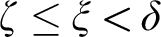 $\zeta \leq \xi <\delta $
. By the definition of
 $f_\gamma $
, we then have
 $f_\gamma (\xi )=\sup \{{f_{\beta _n}(\xi )}~\vert ~{n<\omega }\}$
for all
 $\zeta \leq \xi <\delta $
. Since the definition of
 $f_\gamma $
also implies that
 ${{\mathrm {cof}}(f_\gamma (\xi ))}=\omega $
and
 $f_{\beta _0}(\xi )<f_\gamma (\xi )$
for all
 $\xi <\delta $
, we can fix a sequence of strictly increasing functions
 $\langle {{k_\xi }:{\omega }\longrightarrow {f_\gamma (\xi )}}~\vert ~{\xi <\zeta }\rangle $
with the property that
 $k_\xi $
is cofinal in
 $f_\gamma (\xi )$
for all
 $\xi <\zeta $
and
 $k_\xi (0)=f_{\beta _0}(\xi )$
for all
 $\xi <\zeta $
. Define
 $$ \begin{align*} c_\gamma(\xi) ~ = ~ \begin{cases} \{{k_\xi(n)}~\vert~{n<\omega}\}, & \textit{for all }\xi<\zeta,\textit{ if }\beta_0=0,\\ c_{\beta_0}(\xi) ~ \cup ~ \{{k_\xi(n)}~\vert~{n<\omega}\}, & \textit{for all }\xi<\zeta,\textit{ if }\beta_0>0,\\ \bigcup\{{c_{\beta_n}(\xi)}~\vert~{0<n<\omega}\}, & \textit{for all }\zeta\leq\xi<\delta,\textit{ if }\beta_0=0,\\ \bigcup\{{c_{\beta_n}(\xi)}~\vert~{n<\omega}\}, & \textit{for all }\zeta\leq\xi<\delta,\textit{ if }\beta_0>0. \end{cases} \end{align*} $$
Then the set
 $c_\gamma (\xi )$
is closed and unbounded in
 $f_\gamma (\xi )$
for all
 $\xi <\delta $
. In addition, if
 $\beta _0>0$
, then
 $c_\gamma (\xi )\cap f_{\beta _0}(\xi )=c_{\beta _0}(\xi )$
for all
 $\xi <\delta $
. In particular, we have
 $c_\gamma (\xi )\cap f_\beta (\xi )=c_\beta (\xi )$
for all
 $\beta \in {\mathrm {Lim}}(C_\gamma )$
and all
 $\xi _\gamma \leq \xi <\delta $
. Next, if
 $0<n<\omega $
and
 $\zeta \leq \xi <\delta $
, then
 $f_{\beta _n}(\xi )<f_\gamma (\xi )$
and
 $c_\gamma (\xi )\cap f_{\beta _n}(\xi )=c_{\beta _n}(\xi )$
. This directly implies that for all
 $\beta \in {\mathrm {Lim}}\cap \gamma $
, we have
 $f_\beta (\xi )<f_\gamma (\xi )$
and
 $c_\gamma (\xi )\cap f_\beta (\xi )=c_\beta (\xi )$
for coboundedly many
 $\xi <\delta $
.
Case 3.
 $\gamma \in {\mathrm {Lim}}\cap \kappa ^+$
with
 $\gamma \notin E$
and
 ${\mathrm {Lim}}(C_\gamma )$
unbounded in
 $\gamma $
.
Let
 $$ \begin{align*} c_\gamma(\xi) ~ = ~ \begin{cases} \omega, & \textit{for all }\xi<\xi_\gamma,\\ \bigcup\{{c_\beta(\xi)}~\vert~{\beta\in{\text{Lim}}(C_\gamma)}\}, & \textit{for all }\xi_\gamma\leq\xi<\delta. \end{cases} \end{align*} $$
Fix
 $\beta _0,\beta _1\in {\mathrm {Lim}}(C_\gamma )$
with
 $\beta _0<\beta _1$
. Then
 $\beta _0\in {\mathrm {Lim}}(C_{\beta _1})$
and
 $\beta _1\notin E$
by the choice of the
 $\square _\kappa $
-sequence and the stationary set E, because we have
 $\beta _1 \in {\mathrm {Lim}}(C_\gamma )$
. Moreover, if
 $\xi _\gamma \leq \xi <\delta $
, then the set
 $c_{\beta _1}(\xi )$
is unbounded in
 $f_{\beta _1}(\xi )$
,
 $\xi \geq \xi _{\beta _1}$
,
 $f_{\beta _0}(\xi )<f_{\beta _1}(\xi )$
and
 $c_{\beta _0}(\xi )=c_{\beta _1}(\xi )\cap f_{\beta _0}(\xi )$
. Since
 $c_\gamma (\xi )=\omega =f_\gamma (\xi )$
holds for all
 $\xi <\xi _\gamma $
, this shows that
 $c_\gamma (\xi )$
is a closed unbounded subset of
 $f_\gamma (\xi )$
for all
 $\xi <\delta $
, and
 $c_\gamma (\xi )\cap f_\beta (\xi )=c_\beta (\xi )$
holds for all
 $\beta \in {\mathrm {Lim}}(C_\gamma )$
and all
 $\xi _\gamma \leq \xi <\delta $
. Moreover, if
 $\beta _0\in {\mathrm {Lim}}\cap \gamma $
and
 $\beta _1\in {\mathrm {Lim}}(C_\gamma )$
with
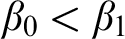 $\beta _0<\beta _1$
, then there is
 $\xi _\gamma \leq \zeta <\delta $
with
 $f_{\beta _0}(\xi )<f_{\beta _1}(\xi )$
and
 $c_{\beta _0}(\xi )=c_{\beta _1}(\xi )\cap f_{\beta _0}(\xi )$
for all
 $\zeta \leq \xi <\delta $
and hence we have
 $f_{\beta _0}(\xi )<f_\gamma (\xi )$
and
 $c_{\beta _0}(\xi )=c_\gamma (\xi )\cap f_{\beta _0}(\xi )$
for all
 $\zeta \leq \xi <\delta $
.
Case 4.
 $\gamma \in E$
.
Fix
 $\alpha <\kappa ^+$
with
 $\gamma =\gamma _\alpha $
. Let
 $\langle {\beta _\xi }~\vert ~{\xi <\delta }\rangle $
be the monotone enumeration of a subset of
 ${\mathrm {Lim}}(C_\gamma )$
of order-type
 $\delta $
that is closed unbounded in
 $\gamma $
. Given
 $\xi _\gamma \leq \xi <\delta $
, we have
 $f_{\beta _\xi }(\xi )<f_\gamma (\xi )$
and we can therefore pick a closed unbounded subset
 $C^\gamma _\xi $
of
 $f_\gamma (\xi )$
with
 $\min (C^\gamma _\xi )=f_{\beta _\xi }(\xi )$
and
 $C^\gamma _\xi \neq h_\alpha (\xi )\cap [f_{\beta _\xi }(\xi ),f_\gamma (\xi ))$
. Now, define
 $$ \begin{align*} c_\gamma(\xi) ~ = ~ \begin{cases} \omega, & \textit{for all }\xi<\xi_\gamma, \\ c_{\beta_\xi}(\xi) ~ \cup ~ C^\gamma_\xi, & \textit{for all }\xi_\gamma\leq\xi<\delta. \end{cases} \end{align*} $$
Then
 $c_\gamma (\xi )$
is a closed unbounded subset of
 $f_\gamma (\xi )$
for all
 $\xi <\delta $
and, if
 $\xi _\gamma \leq \xi <\delta $
, then
 $c_\gamma (\xi )\neq h_\alpha (\xi )\cap f_\gamma (\xi )$
. Moreover, if
 $\xi _\gamma \leq \zeta <\xi <\delta $
, then
 $\beta _\zeta \in {\mathrm {Lim}}(C_{\beta _\xi })$
,
 $\beta _\xi \notin E$
,
 $\xi>\xi _{\beta _\xi }$
,
 $f_{\beta _\zeta }(\xi )<f_{\beta _\xi }(\xi )<f_\gamma (\xi )$
and
 $$ \begin{align*}c_{\beta_\zeta}(\xi) ~ = ~ c_{\beta_\xi}(\xi)\cap f_{\beta_\zeta}(\xi) ~ = ~ f_\gamma(\xi)\cap f_{\beta_\zeta}(\xi).\end{align*} $$
In particular, this shows that for all
 $\beta \in {\mathrm {Lim}}\cap \gamma $
, we have
 $f_\beta (\xi )<f_\gamma (\xi )$
and
 $c_\beta (\xi )=c_\gamma (\xi )\cap f_\beta (\xi )$
for coboundedly many
 $\xi <\delta $
.
The above construction ensures that
 $[c_\gamma ]_U$
is a closed unbounded subset of
 $[f_\gamma ]_U$
for all
 $\gamma \in {\mathrm {Lim}}\cap \kappa ^+$
. Moreover, we have
 $[c_\beta ]_U=[c_\gamma ]_U\cap [f_\beta ]_U$
for all
 $\beta ,\gamma \in {\mathrm {Lim}}\cap \kappa ^+$
with
 $\beta <\gamma $
. In particular, there is a closed unbounded subset C of
 $\kappa ^+$
with
 $C\cap [f_\gamma ]_U=[c_\gamma ]_U$
for all
 $\gamma \in {\mathrm {Lim}}\cap \kappa ^+$
.
Claim. The set C is fresh over
 ${\mathrm {Ult}}({{\mathrm {V}}},{U})$
.
Proof of the Claim First, if
 $\beta <\kappa ^+$
, then there is
 $\gamma \in {\mathrm {Lim}}\cap \kappa ^+$
with
 $[f_\gamma ]_U>\beta $
and
 $$ \begin{align*}C\cap\beta ~ = ~ (C\cap[f_\gamma]_U)\cap\beta ~ = ~ [c_\gamma]_U\cap\beta ~ \in ~ {\mathrm{Ult}}({{\text{V}}},{U}).\end{align*} $$
Next, assume, towards a contradiction, that C is an element of
 ${\mathrm {Ult}}({{\mathrm {V}}},{U})$
. Then there is an
 $\alpha <\kappa ^+$
with
 $C=[h_\alpha ]_U$
. Since we have
 $$ \begin{align*}[h_\alpha]_U\cap[f_{\gamma_\alpha}]_U ~ = ~ C\cap[f_{\gamma_\alpha}]_U ~ = ~ [c_{\gamma_\alpha}]_U,\end{align*} $$
we know that the set
 $\{{\xi <\delta }~\vert ~{h_\alpha (\xi )\cap f_{\gamma _\alpha }(\xi )=c_{\gamma _\alpha }(\xi )}\}$
is an element of U. In particular, we can find
 $\xi _{\gamma _\alpha }\leq \xi <\delta $
with
 $h_\alpha (\xi )\cap f_{\gamma _\alpha }(\xi )=c_{\gamma _\alpha }(\xi )$
, contradicting the definition of
 $c_{\gamma _\alpha }$
.⊣
This completes the proof of the theorem.⊣
5. Regular cardinals in Ult
$({{\mathrm {V}}},{U})$

We now turn to the construction of fresh subsets of limit ordinals that are not cardinals in
 ${\mathrm {V}}$
. We first observe that we can restrict ourselves to ordinals that are regular cardinals in the corresponding ultrapower.
Proposition 5.1. Let U be a normal ultrafilter on a measurable cardinal
 $\delta $
and let
 $\lambda $
be a limit ordinal. If there is an unbounded subset of
 ${{\mathrm {cof}}(\lambda )}^{{\mathrm {Ult}}({{\mathrm {V}}},{U})}$
that is fresh over
 ${\mathrm {Ult}}({{\mathrm {V}}},{U})$
, then there is an unbounded subset of
 $\lambda $
that is fresh over
 ${\mathrm {Ult}}({{\mathrm {V}}},{U})$
.
Proof Set
 $\lambda _0={{\mathrm {cof}}(\lambda )}^{{\mathrm {Ult}}({{\mathrm {V}}},{U})}$
. Let A be an unbounded subset of
 $\lambda _0$
that is fresh over
 ${\mathrm {Ult}}({{\mathrm {V}}},{U})$
and let
 $\langle {\gamma _\eta }~\vert ~{\eta <\lambda _0}\rangle $
be a strictly increasing sequence that is cofinal in
 $\lambda $
and an element of
 ${\mathrm {Ult}}({{\mathrm {V}}},{U})$
. In this situation, the set
 $\{{\gamma _\eta }~\vert ~{\eta \in A}\}$
is unbounded in
 $\lambda $
and fresh over
 ${\mathrm {Ult}}({{\mathrm {V}}},{U})$
.⊣
In the proof of the following result, we modify techniques from the proof of Theorem 4.3 to cover the non-cardinal case in Theorem 1.6.
Theorem 5.2. Let U be a normal ultrafilter on a measurable cardinal
 $\delta $
, let
 $\kappa $
be a singular cardinal of cofinality
 $\delta $
with the property that
 $\mu ^\delta <\kappa $
holds for all
 $\mu <\kappa $
and let
 $\kappa ^+<\lambda <j_U(\kappa )$
be a limit ordinal of cofinality
 $\kappa ^+$
that is a regular cardinal in
 ${\mathrm {Ult}}({{\mathrm {V}}},{U})$
. If there is a
 $\square _\kappa $
-sequence, then there is an unbounded subset of
 $\lambda $
that is fresh over
 ${\mathrm {Ult}}({{\mathrm {V}}},{U})$
.
Proof As in the proof of Theorem 4.3, we can apply Lemma 4.1 to find the monotone enumeration
 $\langle {\kappa _\xi }~\vert ~{\xi <\delta }\rangle $
of a closed unbounded set of uncountable cardinals smaller than
 $\kappa $
of order-type
 $\delta $
with the property that
 $j_U(\kappa _\xi )=\kappa _\xi $
holds for all
 $\xi <\delta $
. Then normality implies that
 $[\xi \mapsto \kappa _\xi ]_U=\kappa $
and we can repeat arguments from the first part of the proof of Theorem 4.3 to see that
 $[\xi \mapsto \kappa _\xi ^+]_U=\kappa ^+$
. By our assumptions, there is a function h with domain
 $\delta $
,
 $[h]_U=\lambda $
and the property that
 $h(\xi )$
is a regular cardinal in the interval
 $(\kappa _\xi ^+,\kappa )$
for all
 $\xi <\delta $
. Fix a sequence
 $\langle {h_\gamma \in \prod _{\xi <\delta }h(\xi )}~\vert ~{\gamma <\kappa ^+}\rangle $
such that the sequence
 $\langle {[h_\gamma ]_U}~\vert ~{\gamma <\kappa ^+}\rangle $
is strictly increasing and cofinal in
 $\lambda $
.
Pick a
 $\square _\kappa $
-sequence
 $\langle {C_\gamma }~\vert ~{\gamma \in {\mathrm {Lim}}\cap \kappa ^+}\rangle $
with
 ${{\mathrm {otp}}\left (C_\gamma \right )}<\kappa $
for all
 $\gamma \in {\mathrm {Lim}}\cap \kappa ^+$
. Given
 $\gamma \in {\mathrm {Lim}}\cap \kappa ^+$
, we let
 $\xi _\gamma $
denote the minimal element
 $\xi $
of
 $\delta $
with
 $\kappa _\xi ^+>{{\mathrm {otp}}\left (C_\gamma \right )}$
.
We now inductively construct a sequence
 $$ \begin{align*}\langle{f_\gamma\in\prod_{\xi<\delta}h(\xi)}~\vert~{\gamma<\kappa^+}\rangle\end{align*} $$
by setting:
-
•
$f_0(\xi )=0$
for all
$\xi <\delta $
. -
•
$f_{\gamma +1}(\xi )=\max (f_\gamma (\xi ),h_\gamma (\xi ))+1$
for all
$\gamma <\kappa ^+$
and
$\xi <\delta $
. -
• If
$\gamma \in {\mathrm {Lim}}\cap \kappa ^+$
with
${\mathrm {Lim}}(C_\gamma )$
bounded in
$\gamma $
and
$\xi <\delta $
, then
$$ \begin{align*}f_\gamma(\xi) ~ = ~ \min\{{\rho\in{\text{Lim}}}~\vert~{\rho>f_\beta(\xi)\textit{ for all }\beta\in C_\gamma\setminus\max({\text{Lim}}(C_\gamma))}\}.\end{align*} $$
-
• If
$\gamma \in {\mathrm {Lim}}\cap \kappa ^+$
with
${\mathrm {Lim}}(C_\gamma )$
unbounded in
$\gamma $
and
$\xi <\xi _\gamma $
, then
$f_\gamma (\xi )=\omega $
. -
• If
$\gamma \in {\mathrm {Lim}}\cap \kappa ^+$
with
${\mathrm {Lim}}(C_\gamma )$
unbounded in
$\gamma $
and
$\xi _\gamma \leq \xi <\delta $
, then
$$ \begin{align*}f_\gamma(\xi) ~ = ~ \sup\{{f_\beta(\xi)}~\vert~{\beta\in{\text{Lim}}(C_\gamma)}\}.\end{align*} $$





As in the proof of Theorem 4.3, we have the following claim.
-
(i) If
$\beta <\gamma <\kappa ^+$
, then
$f_\beta (\xi )<f_\gamma (\xi )$
for coboundedly many
$\xi <\delta $
. -
(ii) If
$\gamma \in {\mathrm {Lim}}\cap \kappa ^+$
, then
$f_\gamma (\xi )\in {\mathrm {Lim}}$
for all
$\xi <\delta $
. -
(iii) If
$\gamma \in {\mathrm {Lim}}\cap \kappa ^+$
,
$\beta \in {\mathrm {Lim}}(C_\gamma )$
and
$\xi _\gamma \leq \xi <\delta $
, then
$f_\beta (\xi )<f_\gamma (\xi )$
.⊣


In particular, this shows that the sequence
 $\langle {[f_\gamma ]_U}~\vert ~{\gamma <\kappa ^+}\rangle $
is strictly increasing. Since the above definition ensures that
 $[h_\gamma ]_U<[f_{\gamma +1}]_U<[h]_U$
holds for all
 $\gamma <\kappa ^+$
, we also know that this sequence is cofinal in
 $\lambda $
.
Next, we inductively define a sequence
 $\langle {c_\gamma }~\vert ~{\gamma \in {\mathrm {Lim}}\cap \kappa ^+}\rangle $
of functions with domain
 $\delta $
such that the following statements hold for all
 $\gamma \in {\mathrm {Lim}}\cap \kappa ^+$
:
-
(a)
$c_\gamma (\xi )$
is a closed unbounded subset of
$f_\gamma (\xi )$
with
${{\mathrm {otp}}\left (c_\gamma (\xi )\right )}<\kappa _\xi ^+$
for all
$\xi <\delta $
. -
(b) If
$\beta \in {\mathrm {Lim}}\cap \gamma $
, then
$f_\beta (\xi )<f_\gamma (\xi )$
and
$c_\beta (\xi )=c_\gamma (\xi )\cap f_\beta (\xi )$
for coboundedly many
$\xi <\delta $
. -
(c) If
$\beta \in {\mathrm {Lim}}(C_\gamma )$
and
$\xi _\gamma \leq \xi <\delta $
, then
$c_\beta (\xi )=c_\gamma (\xi )\cap f_\beta (\xi )$
.


Our inductive construction distinguishes between the following cases:
Case 1.
 $\gamma \in {\mathrm {Lim}}\cap \kappa ^+$
with
 ${\mathrm {Lim}}\cap \gamma $
bounded in
 $\gamma $
.
We set
 $\beta _0=0$
if
 ${\mathrm {Lim}}(C_\gamma )=\emptyset $
and
 $\beta _0=\max ({\mathrm {Lim}}(C_\gamma ))$
otherwise. Moreover, we set
 $\beta _1=0$
if
 $\gamma =\omega $
and
 $\beta _1=\max ({\mathrm {Lim}}\cap \gamma )$
otherwise. This definition ensures that
 $\beta _0\leq \beta _1<\gamma $
and
 $f_{\beta _0}(\xi )<f_\gamma (\xi )$
for all
 $\xi <\delta $
. We can now find
 $\xi _\gamma \leq \zeta <\delta $
with the property that
 $f_{\beta _0}(\xi )\leq f_{\beta _1}(\xi )<f_\gamma (\xi )$
for all
 $\zeta \leq \xi <\delta $
and, if
 $\beta _0>0$
, then
 $c_{\beta _0}(\xi )=c_{\beta _1}(\xi )\cap f_{\beta _0}(\xi )$
for all
 $\zeta \leq \xi <\delta $
. Since the definition of
 $f_\gamma $
implies that
 ${{\mathrm {cof}}(f_\gamma (\xi ))}=\omega $
holds for all
 $\xi <\delta $
, we can pick a sequence of strictly increasing functions
 $\langle {{k_\xi }:{\omega }\longrightarrow {f_\gamma (\xi )}}~\vert ~{\xi <\delta }\rangle $
with the property that
 $k_\xi $
is cofinal in
 $f_\gamma (\xi )$
for all
 $\xi <\delta $
,
 $k_\xi (0)=f_{\beta _0}(\xi )$
for all
 $\xi <\zeta $
, and
 $k_\xi (0)=f_{\beta _1}(\xi )$
for all
 $\zeta \leq \xi <\delta $
. Let
 $$ \begin{align*} c_\gamma(\xi) ~ = ~ \begin{cases} \{{k_\xi(n)}~\vert~{n<\omega}\}, & \textit{for all }\xi<\zeta,\textit{ if }\beta_0=0,\\ c_{\beta_0}(\xi) ~ \cup ~ \{{k_\xi(n)}~\vert~{n<\omega}\}, & \textit{for all }\xi<\zeta,\textit{ if }\beta_0>0,\\ \{{k_\xi(n)}~\vert~{n<\omega}\}, & \textit{for all }\zeta\leq\xi<\delta,\textit{ if }\beta_1=0,\\ c_{\beta_1}(\xi) ~ \cup ~ \{{k_\xi(n)}~\vert~{n<\omega}\}, & \textit{for all }\zeta\leq\xi<\delta,\textit{ if }\beta_1>0. \end{cases} \end{align*} $$
Then
 $c_\gamma (\xi )$
is a closed unbounded subset of
 $f_\gamma (\xi )$
of order-type less than
 $\kappa _\xi ^+$
for all
 $\xi <\delta $
and, if
 $\beta _0>0$
, then
 $c_\gamma (\xi )\cap f_{\beta _0}(\xi )=c_{\beta _0}(\xi )$
for all
 $\xi <\delta $
. In particular, we know that
 $c_\gamma (\xi )\cap f_\beta (\xi )=c_\beta (\xi )$
for all
 $\beta \in {\mathrm {Lim}}(C_\gamma )$
and all
 $\xi _\gamma \leq \xi <\delta $
. Finally, notice that
 $\beta _1>0$
implies that
 $f_{\beta _1}(\xi )<f_\gamma (\xi )$
and
 $c_\gamma (\xi )\cap f_{\beta _1}(\xi )=c_{\beta _1}(\xi )$
hold for all
 $\zeta \leq \xi <\delta $
. This shows that for all
 $\beta \in {\mathrm {Lim}}\cap \gamma $
, we have
 $f_\beta (\xi )<f_\gamma (\xi )$
and
 $c_\beta (\xi )=c_\gamma (\xi )\cap f_\beta (\xi )$
for coboundedly many
 $\xi <\delta $
.
Case 2.
 $\gamma \in {\mathrm {Lim}}\cap \kappa ^+$
with
 ${\mathrm {Lim}}\cap \gamma $
unbounded in
 $\gamma $
and
 ${\mathrm {Lim}}(C_\gamma )$
bounded in
 $\gamma $
.
Since the limit points of
 $C_\gamma $
are bounded in
 $\gamma $
, we have
 ${{\mathrm {cof}}(\gamma )}=\omega $
and we can pick a strictly increasing sequence
 $\langle {\beta _n}~\vert ~{n<\omega }\rangle $
cofinal in
 $\gamma $
such that
 $\beta _n\in {\mathrm {Lim}}\cap \gamma $
for all
 $0<n<\omega $
,
 $\beta _0=0$
in case
 ${\mathrm {Lim}}(C_\gamma )=\emptyset $
, and
 $\beta _0=\max ({\mathrm {Lim}}(C_\gamma ))$
in case
 ${\mathrm {Lim}}(C_\gamma )\neq \emptyset $
. Fix
 $\xi _\gamma \leq \zeta <\delta $
such that
 $f_{\beta _n}(\xi )<f_{\beta _{n+1}}(\xi )<f_\gamma (\xi )$
and
 $c_{\beta _{n+2}}(\xi )\cap f_{\beta _{n+1}}(\xi )=c_{\beta _{n+1}}(\xi )$
for all
 $\zeta \leq \xi <\delta $
and all
 $n<\omega $
, and, if
 $\beta _0>0$
,
 $c_{\beta _1}(\xi )\cap f_{\beta _0}(\xi )=c_{\beta _0}(\xi )$
for all
 $\zeta \leq \xi <\delta $
. Then the definition of
 $f_\gamma $
ensures that
 ${{\mathrm {cof}}(f_\gamma (\xi ))}=\omega $
and
 $f_{\beta _0}(\xi )<f_\gamma (\xi )$
for all
 $\xi <\delta $
. Moreover, it also directly implies that
 $f_\gamma (\xi )=\sup \{{f_{\beta _n}(\xi )}~\vert ~{n<\omega }\}$
holds for all
 $\zeta \leq \xi <\delta $
. Fix a sequence of strictly increasing functions
 $\langle {{k_\xi }:{\omega }\longrightarrow {f_\gamma (\xi )}}~\vert ~{\xi <\zeta }\rangle $
such that
 $k_\xi (0)=f_{\beta _0}(\xi )$
and
 $k_\xi $
is cofinal in
 $f_\gamma (\xi )$
for all
 $\xi <\zeta $
. Define
 $$ \begin{align*} c_\gamma(\xi) ~ = ~ \begin{cases} \{{k_\xi(n)}~\vert~{n<\omega}\}, & \textit{for all }\xi<\zeta,\textit{ if }\beta_0=0,\\ c_{\beta_0}(\xi) ~ \cup ~ \{{k_\xi(n)}~\vert~{n<\omega}\}, & \textit{for all }\xi<\zeta,\textit{ if }\beta_0>0,\\ \bigcup\{{c_{\beta_n}(\xi)}~\vert~{0<n<\omega}\}, & \textit{for all }\zeta\leq\xi<\delta,\textit{ if }\beta_0=0,\\ \bigcup\{{c_{\beta_n}(\xi)}~\vert~{n<\omega}\}, & \textit{for all }\zeta\leq\xi<\delta,\textit{ if }\beta_0>0. \end{cases} \end{align*} $$
Given
 $\xi <\delta $
, the set
 $c_\gamma (\xi )$
is closed and unbounded in
 $f_\gamma (\xi )$
and the regularity of
 $\kappa _\xi ^+$
implies that
 ${{\mathrm {otp}}\left (c_\gamma (\xi )\right )}<\kappa _\xi ^+$
. Next,
 $\beta _0>0$
implies that
 $c_\gamma (\xi )\cap f_{\beta _0}(\xi )=c_{\beta _0}(\xi )$
for all
 $\xi <\delta $
, and therefore
 $c_\gamma (\xi )\cap f_\beta (\xi )=c_\beta (\xi )$
for all
 $\beta \in {\mathrm {Lim}}(C_\gamma )$
and all
 $\xi _\gamma \leq \xi <\delta $
. Finally, we have
 $f_{\beta _n}(\xi )<f_\gamma (\xi )$
and
 $c_\gamma (\xi )\cap f_{\beta _n}(\xi )=c_{\beta _n}(\xi )$
for all
 $0<n<\omega $
and
 $\zeta \leq \xi <\delta $
, and hence for all
 $\beta \in {\mathrm {Lim}}\cap \gamma $
, we have
 $f_\beta (\xi )<f_\gamma (\xi )$
and
 $c_\gamma (\xi )\cap f_\beta (\xi )=c_\beta (\xi )$
for coboundedly many
 $\xi <\delta $
.
Case 3.
 $\gamma \in {\mathrm {Lim}}\cap \kappa ^+$
with
 ${\mathrm {Lim}}(C_\gamma )$
unbounded in
 $\gamma $
.
Let
 $$ \begin{align*} c_\gamma(\xi) ~ = ~ \begin{cases} \omega, & \textit{for all }\xi<\xi_\gamma,\\ \bigcup\{{c_\beta(\xi)}~\vert~{\beta\in{\text{Lim}}(C_\gamma)}\}, & \textit{for all }\xi_\gamma\leq\xi<\delta. \end{cases} \end{align*} $$
Given
 $\beta _0,\beta _1\in {\mathrm {Lim}}(C_\gamma )$
with
 $\beta _0<\beta _1$
and
 $\xi _\gamma \leq \xi <\delta $
, the above definition ensures that
 $f_{\beta _0}(\xi )<f_{\beta _1}(\xi )$
and
 $c_{\beta _0}(\xi )=c_{\beta _1}(\xi )\cap f_{\beta _0}(\xi )$
. Since
 $c_\gamma (\xi )=\omega =f_\gamma (\xi )$
holds for all
 $\xi <\xi _\gamma $
and we have
 $f_\gamma (\xi )=\sup \{{f_\beta (\xi )}~\vert ~{\beta \in {\mathrm {Lim}}(C_\gamma )}\}$
and
 ${{\mathrm {otp}}\left (C_\gamma \right )}<\kappa _\xi ^+$
for all
 $\xi _\gamma \leq \xi <\delta $
, we can conclude that
 $c_\gamma (\xi )$
is a closed unbounded subset of
 $f_\gamma (\xi )$
of order-type less than
 $\kappa _\xi ^+$
for all
 $\xi <\delta $
, and, if
 $\beta \in {\mathrm {Lim}}(C_\gamma )$
and
 $\xi _\gamma \leq \xi <\delta $
, then
 $c_\gamma (\xi )\cap f_\beta (\xi )=c_\beta (\xi )$
holds. Finally, given
 $\beta _0\in {\mathrm {Lim}}\cap \gamma $
and
 $\beta _1\in {\mathrm {Lim}}(C_\gamma )$
with
 $\beta _0<\beta _1$
, our induction hypothesis yields
 $\xi _\gamma \leq \zeta <\delta $
with
 $f_{\beta _0}(\xi )<f_{\beta _1}(\xi )$
and
 $c_{\beta _0}(\xi )=c_{\beta _1}(\xi )\cap f_{\beta _0}(\xi )$
for all
 $\zeta \leq \xi <\delta $
, and this ensures that
 $f_{\beta _0}(\xi )<f_\gamma (\xi )$
and
 $c_{\beta _0}(\xi )=c_\gamma (\xi )\cap f_{\beta _0}(\xi )$
for all
 $\zeta \leq \xi <\delta $
.
Given
 $\gamma \in {\mathrm {Lim}}\cap \kappa ^+$
, the properties listed above ensure that
 $[c_\gamma ]_U$
is a closed unbounded subset of
 $[f_\gamma ]_U$
of order-type less than
 $\kappa ^+$
. Moreover, if
 $\beta ,\gamma \in {\mathrm {Lim}}\cap \kappa ^+$
with
 $\beta <\gamma $
, then
 $[c_\beta ]_U=[c_\gamma ]_U\cap [f_\beta ]_U$
. These observations show that there is a closed unbounded subset C of
 $\lambda $
with
 $C\cap [f_\gamma ]_U=[c_\gamma ]_U$
for all
 $\gamma \in {\mathrm {Lim}}\cap \kappa ^+$
and this property directly implies that
 ${{\mathrm {otp}}\left (C\right )}=\kappa ^+<\lambda $
. Since
 $\lambda $
is a regular cardinal in
 ${\mathrm {Ult}}({{\mathrm {V}}},{U})$
, this allows us to conclude that the set C is not contained in
 ${\mathrm {Ult}}({{\mathrm {V}}},{U})$
and hence it is fresh over
 ${\mathrm {Ult}}({{\mathrm {V}}},{U})$
.⊣
6. Ultrapowers of canonical inner models
With the help of the results of the previous sections, we are now ready to prove the main result of this paper.
Proof of Theorem 1.6 Fix a normal ultrafilter U on a measurable cardinal
 $\delta $
that satisfies the three assumptions listed in the statement of the theorem. By Proposition 1.2, if
 $\lambda $
is a limit ordinal with the property that the cardinal
 ${{\mathrm {cof}}(\lambda )}$
is either smaller than
 $\delta ^+$
or weakly compact, then no unbounded subset of
 $\lambda $
is fresh over
 ${\mathrm {Ult}}({{\mathrm {V}}},{U})$
. In the proof of the converse implication, we first consider two special cases.
Claim. If
 $\kappa $
is a cardinal with the property that the cardinal
 ${{\mathrm {cof}}(\kappa )}$
is greater than
 $\delta $
and not weakly compact, then there is an unbounded subset of
 $\kappa $
that is fresh over
 ${\mathrm {Ult}}({{\mathrm {V}}},{U})$
.
Proof of the Claim We start by noting that, if
 ${{\mathrm {cof}}(\kappa )}=\delta ^+$
, then the fact that our assumptions imply that
 $2^\delta =\delta ^+$
holds allows us to use Proposition 1.3 find a subset of
 $\kappa $
with the desired properties. Therefore, in the following, we may assume that
 $\delta ^+<{{\mathrm {cof}}(\kappa )}\leq \kappa $
. Let
 $\nu \leq \kappa $
be minimal with
 $\nu ^\delta \geq \kappa $
. By the minimality of
 $\nu $
, we then have
 $\mu ^\delta <\nu $
for all
 $\mu <\nu $
. In particular, the fact that
 $2^\delta =\delta ^+<\kappa $
implies that
 $\nu>2^\delta >\delta $
and therefore we know that
 $\nu ^+=\nu ^\nu \geq \nu ^\delta \geq \kappa \geq \nu $
. These computations show that either
 ${{\mathrm {cof}}(\nu )}>\delta $
and
 $\kappa =\nu $
, or
 ${{\mathrm {cof}}(\nu )}\leq \delta $
and
 $\kappa =\nu ^+$
.
First, assume that either
 ${{\mathrm {cof}}(\nu )}>\delta $
and
 $\kappa =\nu $
, or
 ${{\mathrm {cof}}(\nu )}<\delta $
and
 $\kappa =\nu ^+$
. Then Lemma 4.1 shows that
 $j_U(\kappa )=\kappa $
holds in both cases. Moreover, since
 ${{\mathrm {cof}}(\kappa )}$
is a regular cardinal greater than
 $\delta ^+$
and
 $$ \begin{align*}j_U({{\text{cof}}(\kappa)}) ~ = ~ {{\text{cof}}(j_U(\kappa))}^{{\mathrm{Ult}}({{\text{V}}},{U})} ~ = ~ {{\text{cof}}(\kappa)}^{{\mathrm{Ult}}({{\text{V}}},{U})},\end{align*} $$
the fact that
 ${{\mathrm {cof}}(\kappa )}$
is not weakly compact allows us to use Theorem 1.8 to find an unbounded subset of
 ${{\mathrm {cof}}(\kappa )}^{{\mathrm {Ult}}({{\mathrm {V}}},{U})}$
that is fresh over
 ${\mathrm {Ult}}({{\mathrm {V}}},{U})$
. In this situation, we can then apply Proposition 5.1 to obtain an unbounded subset of
 $\kappa $
that is fresh over
 ${\mathrm {Ult}}({{\mathrm {V}}},{U})$
.
Finally, assume that
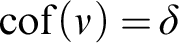 ${{\mathrm {cof}}(\nu )}=\delta $
and
 $\kappa =\nu ^+$
. In this situation, we know that
 $\nu $
is a singular cardinal of cofinality
 $\delta $
with
 $2^\nu =\nu ^+$
and the property that
 $\mu ^\delta <\nu $
holds for all
 $\mu <\nu $
. Since the assumptions of the theorem guarantee the existence of a
 $\square _\nu $
-sequence, we can apply Theorem 4.3 to find an unbounded subset of
 $\kappa $
that is fresh over
 ${\mathrm {Ult}}({{\mathrm {V}}},{U})$
.⊣
Claim. Let
 $\lambda $
be a limit ordinal with the property that the cardinal
 ${{\mathrm {cof}}(\lambda )}$
is greater than
 $\delta $
and not weakly compact. If
 $\lambda $
is a regular cardinal in
 ${\mathrm {Ult}}({{\mathrm {V}}},{U})$
, then there is an unbounded subset of
 $\lambda $
that is fresh over
 ${\mathrm {Ult}}({{\mathrm {V}}},{U})$
.
Proof of the Claim First, if
 $\lambda $
is a cardinal, then we can use the above claim to directly derive the desired conclusion. Hence, we may assume that
 $\lambda $
is not a cardinal.⊣
Subclaim. There is a cardinal
 $\kappa $
of cofinality
 $\delta $
such that
 $$ \begin{align*}\lambda ~ \in ~ (\kappa^+,j_U(\kappa)] ~ \cup ~ \{j_U(\kappa^+)\}\end{align*} $$
and
 $\kappa>\delta $
implies that
 $\mu ^\delta <\kappa $
for all
 $\mu <\kappa $
.
Proof of the Subclaim Let
 $\theta = |\lambda |$
. Then our assumptions imply that
 $$ \begin{align*}\delta ~ < ~ {{\text{cof}}(\lambda)} ~ \leq ~ \theta ~ < ~ \lambda ~ < ~ \theta^+.\end{align*} $$
Moreover, we have
 ${{\mathrm {cof}}(\theta )}\neq \delta $
, because otherwise
 $\theta $
would be a singular strong limit cardinal of cofinality
 $\delta $
and our assumptions would allow us to repeat the argument from the first part of the proof of Theorem 4.3 to show that
 $\theta ^+=(\theta ^+)^{{\mathrm {Ult}}({{\mathrm {V}}},{U})}$
, contradict our assumption that
 $\lambda $
is a cardinal in
 ${\mathrm {Ult}}({{\mathrm {V}}},{U})$
. In addition, we know that there is some
 $\nu <\theta $
satisfying
 $\nu ^\delta \geq \theta $
, because otherwise Lemma 4.1 would imply that
 $$ \begin{align*}j_U(\theta) ~ = ~ \theta ~ < ~ \lambda ~ < ~ \theta^+ ~ = ~ j_U(\theta^+) ~ = ~ (j_U(\theta)^+)^{{\mathrm{Ult}}({{\text{V}}},{U})},\end{align*} $$
which again contradicts the assumption that
 $\lambda $
is a cardinal in
 ${\mathrm {Ult}}({{\mathrm {V}}},{U})$
. Let
 $\rho <\theta $
be the minimal cardinal with the property that
 $\rho ^\delta \geq \theta $
holds. Then the minimality of
 $\rho $
implies that
 $\mu ^\delta <\kappa $
holds for all
 $\mu <\rho $
.
First, assume that
 $\rho =2$
. Then
 $\delta <\theta \leq 2^\delta =\delta ^+$
and therefore
 $\theta = \delta ^+$
. Since Lemma 4.1 implies that
 $j_U(\delta ^{++})=\delta ^{++}$
, we know that
 $j_U(\delta ^{++})=\delta ^{++}=\theta ^+>\lambda $
and, as above, we can conclude that
 $\lambda $
is not contained in the interval
 $(j_U(\delta ^+),\delta ^{++})$
. Moreover, since our assumptions on
 $\lambda $
directly imply that
 $\lambda $
is not contained in the interval
 $(j_U(\delta ),j_U(\delta ^+))$
, we can conclude that
 $\lambda $
is an element of the set
 $(\delta ^+,j_U(\delta )]\cup \{j_U(\delta ^+)\}$
in this case. In particular, this shows that the statement of the subclaim holds for
 $\kappa =\delta $
.
Next, assume that
 $\rho>2^\delta $
. Then our cardinal arithmetic assumptions and the minimality of
 $\rho $
imply that
 ${{\mathrm {cof}}(\rho )}\leq \delta $
and
 $\theta =\rho ^+$
. But then we already know that
 ${{\mathrm {cof}}(\rho )}=\delta $
, because otherwise we could apply Lemma 4.1 to conclude that
 $j_U(\theta ) = \theta < \lambda < \theta ^+ = j_U(\theta ^+)$
. Since our assumptions imply that
 $(\rho ^+)^\delta =\rho ^+$
, Lemma 4.1 implies that
 $j_U(\rho ^{++})=\rho ^{++}=\theta ^+$
and this shows that
 $\lambda $
is not contained in the interval
 $(j_U(\rho ^+),\rho ^{++})$
. Since
 $\lambda $
is also not contained in the interval
 $(j_U(\rho ),j_U(\rho ^+))$
, we can conclude that
 $\lambda $
is contained in the set
 $(\rho ^+,j_U(\rho )]\cup \{j_U(\rho ^+)\}$
. This allows us to conclude that the statement of the subclaim holds for
 $\kappa =\rho $
in this case.⊣
First, assume that
 $\kappa =\delta $
holds. By our assumptions, Lemma 4.1 shows that
 $\delta ^{++}=j_U(\delta ^{++})>j_U(\delta ^+)$
. Since we know that
 $\delta ^+<\lambda \leq j_U(\delta ^+)$
and
 ${{\mathrm {cof}}(\lambda )}> \delta $
, this implies that
 ${{\mathrm {cof}}(\lambda )}=\delta ^+$
, and hence we can use Proposition 1.3 to find an unbounded subset of
 $\lambda $
that is fresh over
 ${\mathrm {Ult}}({{\mathrm {V}}},{U})$
.
Next, assume that
 $\kappa>\delta $
and
 $\lambda =j_U(\kappa )$
. Then
 $$ \begin{align*}\delta ~ < ~ {{\text{cof}}(\lambda)} ~ \leq ~ {{\text{cof}}(\lambda)}^{{\mathrm{Ult}}({{\text{V}}},{U})} ~ = ~ j_U({{\text{cof}}(\kappa)}) ~ = ~ j_U(\delta) ~ < ~ \delta^{++}\end{align*} $$
and we can conclude that
 ${{\mathrm {cof}}(\lambda )}=\delta ^+$
. Another application of Proposition 1.3 now yields the desired subset of
 $\lambda $
.
Now, assume that
 $\kappa>\delta $
and
 $\lambda =j_U(\kappa ^+)$
. Then our assumptions ensure the existence a
 $\square (\kappa ^+)$
-sequence and therefore we can apply Theorem 1.8 to find an unbounded subset of
 $\lambda $
that is fresh over
 ${\mathrm {Ult}}({{\mathrm {V}}},{U})$
.
Finally, we assume that
 $\kappa>\delta $
and
 $\kappa ^+<\lambda <j_U(\kappa )$
. Then we know that
 $\mu ^\delta <\kappa $
holds for all
 $\mu <\kappa $
.
Subclaim.
 ${{\mathrm {cof}}(\lambda )}=\kappa ^+$
.
Proof of the Subclaim Assume, towards a contradiction, that
 ${{\mathrm {cof}}(\lambda )}\neq \kappa ^+$
. Since
 $\kappa $
is singular and
 ${{\mathrm {cof}}(\lambda )}<\lambda <j_U(\kappa )<\kappa ^{++}$
, this implies that
 ${{\mathrm {cof}}(\lambda )}<\kappa $
. In this situation, we can repeat an argument from the first part of the proof of Theorem 4.3 to find a monotone enumeration
 $\langle {\kappa _\xi }~\vert ~{\xi <\delta }\rangle $
of a closed unbounded subset of
 $\kappa $
of order-type
 $\delta $
such that
 $\kappa _0>{{\mathrm {cof}}(\lambda )}$
,
 $[\xi \mapsto \kappa _\xi ]_U=\kappa $
and
 $[\xi \mapsto \kappa _\xi ^+]_U=\kappa ^+$
. Fix a function f with domain
 $\delta $
such that
 $[f]_U=\lambda $
holds and
 $f(\xi )$
is a regular cardinal in the interval
 $(\kappa _\xi ^+,\kappa )$
for all
 $\xi <\delta $
. Pick a sequence
 $\langle {f_\alpha }~\vert ~{\alpha <{{\mathrm {cof}}(\lambda )}}\rangle $
of functions with domain
 $\delta $
such that
 $f_\alpha (\xi )<f(\xi )$
holds for all
 $\alpha <{{\mathrm {cof}}(\lambda )}$
and all
 $\xi <\delta $
, and the induced sequence
 $\langle {[f_\alpha ]_U}~\vert ~{\alpha <{{\mathrm {cof}}(\lambda )}}\rangle $
is strictly increasing and cofinal in
 $\lambda $
. Given
 $\xi <\delta $
, the fact that
 $f(\xi )$
is a regular cardinal greater than
 ${{\mathrm {cof}}(\lambda )}$
then yields an ordinal
 $\gamma _\xi <f(\xi )$
with
 $f_\alpha (\xi )<\gamma _\xi $
for all
 $\alpha <{{\mathrm {cof}}(\lambda )}$
. But then
 $[f_\alpha ]_U<[\xi \mapsto \gamma _\xi ]_U<\lambda $
for all
 $\alpha <{{\mathrm {cof}}(\lambda )}$
, a contradiction.⊣
By the above computations, we now know that
 $\kappa $
is a singular cardinal of cofinality
 $\delta $
with the property that
 $\mu ^\delta <\kappa $
holds for all
 $\mu <\kappa $
, and
 $\lambda $
is a limit ordinal of cofinality
 $\kappa ^+$
with
 $\kappa ^+<\lambda <j_U(\kappa )$
that is a regular cardinal in
 ${\mathrm {Ult}}({{\mathrm {V}}},{U})$
. Since our assumptions guarantee the existence of a
 $\square _\kappa $
-sequence, we can use Theorem 5.2 to show that there also exists an unbounded subset of
 $\lambda $
that is fresh over
 ${\mathrm {Ult}}({{\mathrm {V}}},{U})$
in this case.⊣
To conclude the proof of the theorem, fix a limit ordinal
 $\lambda $
with the property that the cardinal
 ${{\mathrm {cof}}(\lambda )}$
is greater than
 $\delta $
and not weakly compact. Set
 $\lambda _0={{\mathrm {cof}}(\lambda )}^{{\mathrm {Ult}}({{\mathrm {V}}},{U})}$
. By [Reference Jech10, Lemma 3.7.(ii)], we then have
 ${{\mathrm {cof}}(\lambda _0)}={{\mathrm {cof}}(\lambda )}$
. Hence, we can use the previous claim to find an unbounded subset of
 $\lambda _0$
that is fresh over
 ${\mathrm {Ult}}({{\mathrm {V}}},{U})$
. Using Proposition 5.1, we can conclude that there is an unbounded subset of
 $\lambda $
that is fresh over
 ${\mathrm {Ult}}({{\mathrm {V}}},{U})$
.⊣
We end this section by using famous results of Schimmerling and Zeman to show that, in canonical inner models, the assumptions of Theorem 1.6 are satisfied for all measurable cardinals.
Proof of Theorem 1.7 We argue that Jensen-style extender models without subcompact cardinals satisfy the statements (a)–(c) listed in Theorem 1.6. First, notice that the
 ${\mathrm {GCH}}$
holds in all of these models and hence statement (a) is satisfied. Next, recall that [Reference Schimmerling and Zeman24, Theorem 15]Footnote
3
shows that, in Jensen-style extender models, a
 $\square _\nu $
-sequence exists if and only if
 $\nu $
is not a subcompact cardinal. In particular, we know that, in Jensen-style extender models without subcompact cardinals,
 $\square (\nu ^+)$
-sequences exist for all infinite cardinals
 $\nu $
. Since [Reference Zeman28, Theorem 0.1] yields the existence of
 $\square (\kappa )$
-sequences for inaccessible cardinals
 $\kappa $
that are not weakly compact in the relevant models, we can conclude that statement (b) holds in these models. Finally, the validity of statement (c) in Jensen-style extender models without subcompact cardinals again follows from [Reference Schimmerling and Zeman24, Theorem 15].⊣
7. Consistency strength
We end this paper by establishing the equiconsistency stated in Theorem 1.10. We start by showing that the existence of a weakly compact cardinal above a measurable cardinal is a lower bound for the consistency of the corresponding statement.
Theorem 7.1. Assume that there is no inner model with a weakly compact cardinal above a measurable cardinal. If U is a normal ultrafilter on a measurable cardinal
 $\delta $
, then there is an unbounded subset of
 $\delta ^{++}$
that is fresh over
 ${\mathrm {Ult}}({{\mathrm {V}}},{U})$
.
Proof By our assumptions, we can use the results of [Reference Gitik6] to show that
 $2^\delta =\delta ^+$
holds. Set
 $\kappa =\delta ^{++}$
. Then our assumptions imply that
 $\kappa $
is not weakly compact in
 ${\mathrm {L}}[U]$
. In this situation, we can construct a tail of a
 $\square (\kappa )$
-sequence
 $\langle {C_\nu }~\vert ~{\xi < \nu < \kappa , ~ \nu \in {\mathrm {Lim}}}\rangle $
in
 ${\mathrm {L}}[U]$
above some ordinal
 $\xi> \delta ^+$
with
 $\xi < \kappa $
, using the argument in [Reference Jensen11, Section 6] for
 ${\mathrm {L}}$
. A consequence of this proof, published by Todorčević in [Reference Todorčević27, 1.10], but probably first noticed by Jensen (see [Reference Schimmerling22, Theorem 2.5] for a modern account), is that the sequence
 $\langle {C_\nu }~\vert ~{\xi < \nu < \kappa , ~ \nu \in {\mathrm {Lim}}}\rangle $
remains a tail of a
 $\square (\kappa )$
-sequence in
 ${\mathrm {V}}$
. We can now easily extend this sequence to a
 $\square (\kappa )$
-sequence
 $\langle {C_\nu }~\vert ~{\nu \in {\mathrm {Lim}} \cap \kappa }\rangle $
in
 ${\mathrm {V}}$
. Since
 $2^\delta =\delta ^+$
holds, Lemma 4.1 shows that
 $j_U(\kappa )=\kappa $
and hence we can use Theorem 1.8 to find an unbounded subset of
 $\kappa $
that is fresh over
 ${\mathrm {Ult}}({{\mathrm {V}}},{U})$
.⊣
We now use forcing to show that the above large cardinal assumption is also an upper bound for the consistency strength of the non-existence of fresh subsets at the double successor of a measurable cardinal. The following lemma is a reformulation and slight strengthening of [Reference Sakai20, Lemma 3.5]. The notion of
 $\lambda $
-strategically closed partial orders and the corresponding game
 $G_\lambda ({\mathbb {P}})$
are introduced in [Reference Cummings, Foreman and Kanamori3, Definition 5.15].
Lemma 7.2. Let U be a normal ultrafilter on a measurable cardinal
 $\delta $
, let
 $\lambda $
be a limit ordinal with
 ${{\mathrm {cof}}(\lambda )}>\delta $
and let A be an unbounded subset of
 $\lambda $
that is fresh over
 ${\mathrm {Ult}}({{\mathrm {V}}},{U})$
. If
 ${\mathbb {P}}$
is a
 $(\delta +1)$
-strategically closed partial order, then

Proof Assume, towards a contradiction, that there is a condition p in
 ${\mathbb {P}}$
and a
 ${\mathbb {P}}$
-name
 $\dot {f}$
for a function with domain
 $\delta $
with the property that, whenever G is
 ${\mathbb {P}}$
-generic over
 ${\mathrm {V}}$
with
 $p\in G$
, then
 $[\dot {f}^G]_U=A$
holds in
 ${\mathrm {V}}[G]$
. As
 ${\mathbb {P}}$
is
 $(\delta +1)$
-strategically closed, there is a condition
 $p_1$
in
 ${\mathbb {P}}$
below p and a subset X of
 $\delta $
with the property that, whenever G is
 ${\mathbb {P}}$
-generic over
 ${\mathrm {V}}$
with
 $p_1\in G$
, then
 $X=\{{\xi <\delta }~\vert ~{\dot {f}^G(\xi )\in {\mathrm {V}}}\}$
.
Claim. If
 $\xi \in \delta \setminus X$
and
 $q\leq _{\mathbb {P}} p_1$
, then there is
 $\gamma <\lambda $
and conditions
 $r_0$
and
 $r_1$
in
 ${\mathbb {P}}$
below q such that
 and

Proof of the Claim If such a pair of conditions does not exist, then it is easy to check that the condition q forces
 $\dot {f}(\check {\xi })$
to be equal to the set

contradicting our assumption that
 $\xi $
is not an element of X.⊣
Claim.
 $X\in U$
.
Proof of the Claim Assume, towards a contradiction, that X is not an element of U. Fix a winning strategy
 $\sigma $
for Player Even in the game
 $G_{\delta +1}({\mathbb {P}})$
, some sufficiently large regular cardinal
 $\theta $
and an elementary submodel M of
 ${\mathrm {H}}(\theta )$
of cardinality
 $\delta $
satisfying
 $(\delta +1)\cup \{\lambda ,\sigma ,\dot {f},p_1,A,U,X,{\mathbb {P}}\}\subseteq M$
and
 ${}^{{<}\delta }M\subseteq M$
. We define
 $\eta =\sup (\lambda \cap M)<\lambda $
and fix a function h with domain
 $\delta $
such that
 $[h]_U=A\cap \eta $
.
Note that, given a partial run of
 $G_{\delta +1}({\mathbb {P}})$
of even length less than
 $\delta $
that consists of conditions in M and was played according to
 $\sigma $
by Player Even, the given sequence is an element of M and Player Even responds to it with a move in M. Therefore, if
 $\tau $
is a strategy for Player Odd in
 $G_{\delta +1}({\mathbb {P}})$
that answers to sequences of conditions in M by playing a condition in M and
 $\langle {p_\xi }~\vert ~{\xi \leq \delta }\rangle $
is a run of
 $G_{\delta +1}({\mathbb {P}})$
played according to
 $\sigma $
and
 $\tau $
, then
 $p_\xi \in M$
for all
 $\xi <\delta $
. Moreover, the previous claim allows us to use elementarity to show for every
 $\xi \in \delta \setminus X$
and every condition
 $q\in M\cap {\mathbb {P}}$
with
 $q\leq _{\mathbb {P}} p_1$
, there is
 $\gamma \in M\cap \lambda $
and a condition
 $r\in M\cap {\mathbb {P}}$
with
 $r\leq _{\mathbb {P}} q$
and

Now, pick a strategy
 $\tau $
for Player Odd in
 $G_{\delta +1}({\mathbb {P}})$
with the following properties:
-
•
$\tau $
plays the condition
$p_1$
in move
$1$
. -
• Given
$\xi \in X$
, if Player Even played a condition
$q\in M\cap {\mathbb {P}}$
in move
$(2+2\cdot \xi )$
, then
$\tau $
responds by also playing the condition q in the next move. -
• Given
$\xi \in \delta \setminus X$
, if Player Even played a condition
$q\in M\cap {\mathbb {P}}$
in move
$(2+2\cdot \xi )$
, then
$\tau $
responds by playing a condition
$r\in M\cap {\mathbb {P}}$
with
$r\leq _{\mathbb {P}} q$
such that the equivalences of (1) hold true for some
$\gamma \in M\cap \lambda $
.


Let
 $\langle {p_\xi }~\vert ~{\xi \leq \delta }\rangle $
be the run of
 $G_{\delta +1}({\mathbb {P}})$
played according to
 $\sigma $
and
 $\tau $
. By the above remarks, we then have
 $p_\xi \in M$
for all
 $\xi <\delta $
. In particular, for every
 $\xi \in \delta \setminus X$
, there exists
 $\gamma _\xi <\lambda $
with

Let G be
 ${\mathbb {P}}$
-generic over
 ${\mathrm {V}}$
with
 $p_\delta \in G$
. Then the closure properties of
 ${\mathbb {P}}$
imply that
 $[h]_U=A\cap \eta $
holds in
 ${\mathrm {V}}[G]$
. Since
 $A=[\dot {f}^G]_U$
holds in
 ${\mathrm {V}}[G]$
, we know that the set
 $$ \begin{align*}Y ~ = ~ \{{\xi<\delta}~\vert~{h(\xi)\textit{ is an initial segment of }\dot{f}^G(\xi)}\}\end{align*} $$
is an element of U. But then there is some
 $\xi \in Y\setminus X = Y \cap (\delta \setminus X)$
and our construction ensures that the ordinal
 $\gamma _\xi $
is contained in the symmetric difference of
 $h(\xi )$
and
 $\dot {f}^G(\xi )$
, a contradiction.⊣
Now, let G be
 ${\mathbb {P}}$
-generic over
 ${\mathrm {V}}$
with
 $p_1\in G$
. By the previous claim and the closure properties of
 ${\mathbb {P}}$
, we can find a function f with domain
 $\delta $
in
 ${\mathrm {V}}$
such that
 $[f]_U=[\dot {f}^G]_U=A$
holds in
 ${\mathrm {V}}[G]$
. Since forcing with
 ${\mathbb {P}}$
adds no new functions from
 $\delta $
to the ordinals, we can conclude that
 $[f]_U=A$
also holds in
 ${\mathrm {V}}$
, a contradiction as A was chosen to be fresh over
 ${\mathrm {Ult}}({{\mathrm {V}}},{U})$
.⊣
The previous lemma now allows us to prove the following results that can be used to complete the proof of Theorem 1.10 by considering the case
 $\mu =\delta ^+$
.
Theorem 7.3. Let U be a normal ultrafilter on a measurable cardinal
 $\delta $
, let
 $\mu>\delta $
be a regular cardinal, let
 ${\mathrm {W}}$
be an inner model containing U and let
 $\kappa>\mu $
be weakly compact in
 ${\mathrm {W}}$
. If
 ${\mathrm {V}}$
is a
 ${\mathrm {Col}}({\mu },{{<}\kappa })^{\mathrm {W}}$
-generic extension of
 ${\mathrm {W}}$
, then no unbounded subset of
 $\kappa $
is fresh over
 ${\mathrm {Ult}}({{\mathrm {V}}},{U})$
.
Proof Assume, towards a contradiction, that there is an unbounded subset A of
 $\kappa $
that is fresh over
 ${\mathrm {Ult}}({{\mathrm {V}}},{U})$
. Note that, in
 ${\mathrm {V}}$
, our assumptions imply that
 $\mu ^\delta =\mu $
and hence Lemma 4.1 implies that
 $j_U(\kappa )=\kappa $
. In particular, for every
 $\gamma <\kappa $
, there is a function
 $f\in {\mathrm {H}}(\kappa )$
with domain
 $\delta $
and
 $[f]_U=\gamma $
. By our assumptions, there exists
 $G {\mathrm {Col}}({\mu },{{<}\kappa })^{\mathrm {W}}$
-generic over
 ${\mathrm {W}}$
with
 ${\mathrm {V}}={\mathrm {W}}[G]$
and hence we know that
 ${}^{{<}\mu }{\mathrm {W}}\subseteq {\mathrm {W}}$
. Moreover, since
 ${\mathrm {Col}}({\mu },{{<}\kappa })$
satisfies the
 $\kappa $
-chain condition in
 ${\mathrm {W}}$
, there exist
 ${\mathrm {Col}}({\mu },{{<}\kappa })$
-nice names
 $\dot {A}$
and
 $\dot {F}$
in
 ${\mathrm {W}}$
such that
 $\dot {A}^G=A$
and
 $\dot {F}^G$
is a function with domain
 $\kappa $
and the property that for all
 $\gamma <\kappa $
, the set
 ${\dot {F}^G(\gamma )}:{\delta }\longrightarrow {{\mathrm {H}}(\kappa )\cap {\mathcal {P}}({\kappa })}$
is a function with
 $[\dot {F}^G(\gamma )]_U=A\cap \gamma $
.
Work in
 ${\mathrm {W}}$
and pick an elementary submodel M of
 ${\mathrm {H}}(\kappa ^+)$
of cardinality
 $\kappa $
such that
 ${}^{{<}\kappa }M\subseteq M$
and
 $(\kappa +1)\cup \{\dot {A},\dot {F},U\}\subseteq M$
. In this situation, the weak compactness of
 $\kappa $
yields a transitive set N with
 ${}^{{<}\kappa }N\subseteq N$
and an elementary embedding
 ${j}:{M}\longrightarrow {N}$
with critical point
 $\kappa $
(see [Reference Hauser9, Theorem 1.3]).
Now, let
 $H_0$
be
 ${\mathrm {Col}}({\mu },{[\kappa ,j(\kappa ))})$
-generic over
 ${\mathrm {V}}$
. Then there is
 $H\in {\mathrm {V}}[H_0]$
that is
 ${\mathrm {Col}}({\mu },{{<}j(\kappa )})$
-generic over
 ${\mathrm {W}}$
with
 ${\mathrm {V}}[H_0]={\mathrm {W}}[H]$
and
 $G\subseteq H$
. In this situation, standard arguments (see [Reference Cummings, Foreman and Kanamori3, Proposition 9.1]) allow us to find an elementary embedding
 ${j_*}:{M[G]}\longrightarrow {N[H]}$
with
 $j_*\restriction M=j$
. Set
 $f=j_*(\dot {F}^G)(\kappa )$
. For any
 $\gamma < \gamma ^\prime < \kappa $
,
 $$ \begin{align*}\{{\xi<\delta}~\vert~{\dot{F}^G(\gamma)(\xi)\textit{ is an initial segment of } \dot{F}^G(\gamma^\prime)(\xi)}\}\in U.\end{align*} $$
So, given
 $\gamma <\kappa $
, elementarity implies that the set
 $$ \begin{align*}\{{\xi<\delta}~\vert~{\dot{F}^G(\gamma)(\xi)\textit{ is an initial segment of }f(\xi)}\}\end{align*} $$
is an element of U since
 $j_*(\dot {F}^G(\gamma ))=\dot {F}^G(\gamma )$
. But this implies that A is an initial segment of
 $[f]_U$
in
 ${\mathrm {V}}[H_0]$
and hence A is not fresh over
 ${\mathrm {Ult}}({{\mathrm {V}}},{U})$
in
 ${\mathrm {V}}[H_0]$
, contradicting Lemma 7.2.⊣
8. Concluding remarks and open questions
We end this paper by discussing questions raised by the above results.
First, note that our proof of Theorem 4.3 heavily makes use of the assumption that the
 ${\mathrm {GCH}}$
holds at the given singular cardinal. Therefore, it is not possible to use Theorem 4.3 to derive additional consistency strength from the existence of a normal ultrafilter U on a measurable cardinal
 $\delta $
and a singular cardinal
 $\kappa $
of cofinality
 $\delta $
with the property that no unbounded subset of
 $\kappa ^+$
is fresh over
 ${\mathrm {Ult}}({{\mathrm {V}}},{U})$
, because the existence of a cardinal
 $\delta <\mu <\kappa $
with
 $2^\mu>\kappa ^+$
might prevent us from applying Theorem 4.3, and this constellation can be realized by forcing over a model containing a measurable cardinal. In contrast, if it were possible to remove the
 ${\mathrm {GCH}}$
assumption from Theorem 4.3, then this would show that the above hypothesis implies that at least one of the following statements holds true:
-
• The
${\mathrm {GCH}}$
fails at a measurable cardinal. -
• The
${\mathrm {SCH}}$
fails. -
• There exists a countably closed singular cardinal
$\kappa $
with the property that there are no
$\square _\kappa $
-sequences.


Note that a combination of the main result of [Reference Gitik6], [Reference Gitik7, Theorem 1.4] and [Reference Schimmerling and Zeman23, Corollary 6] shows that the disjunction of the above statements implies the existence of a measurable cardinal
 $\kappa $
with
 $o(\kappa )=\kappa ^{++}$
in an inner model. These considerations motivate the following question:
Question 8.1. Let U be a normal ultrafilter on a measurable cardinal
 $\delta $
and let
 $\kappa $
be a singular cardinal of cofinality
 $\delta $
such that
 $\lambda ^\delta <\kappa $
holds for all
 $\lambda <\kappa $
. Assume that there exists a
 $\square _\kappa $
-sequence. Is there an unbounded subset of
 $\kappa ^+$
that is fresh over
 ${\mathrm {Ult}}({{\mathrm {V}}},{U})$
?
Next, note that, in the models of set theory studied in Theorems 1.4 and 1.7, the existence of fresh subsets only depends on the corresponding measurable cardinal and the cofinality of the given limit ordinal, but not on the specific normal ultrafilter used in the construction of the ultrapower. In an earlier version of this paper, we asked whether this is always the case. More specifically, we asked if it is consistent there exist normal ultrafilters
 $U_0$
and
 $U_1$
on a measurable cardinal
 $\delta $
such that there is a limit ordinal
 $\lambda $
with the property that no unbounded subset of
 $\lambda $
is fresh over
 ${\mathrm {Ult}}({{\mathrm {V}}},{U_0})$
and there exists an unbounded subset of
 $\lambda $
that is fresh over
 ${\mathrm {Ult}}({{\mathrm {V}}},{U_1})$
. In private communication, Moti Gitik presented an affirmative answer to this question to us. His argument shows that it is possible to start with a model of the
 ${\mathrm {GCH}}$
containing a
 $(\delta +2)$
-strong cardinal
 $\delta $
to construct a model of set theory containing normal ultrafilters
 $U_0$
and
 $U_1$
on a measurable cardinal
 $\delta $
with the property that
 ${\mathcal {P}}({\delta ^+})\subseteq {\mathrm {Ult}}({{\mathrm {V}}},{U_0})$
and
 ${\mathcal {P}}({\delta ^+})\nsubseteq {\mathrm {Ult}}({{\mathrm {V}}},{U_1})$
. In this situation, there exists an unbounded subset of
 $\delta ^+$
that is fresh over
 ${\mathrm {Ult}}({{\mathrm {V}}},{U_1})$
, while no unbounded subset of
 $\delta ^+$
is fresh over
 ${\mathrm {Ult}}({{\mathrm {V}}},{U_0})$
.
Acknowledgments
The authors are thankful to Peter Koepke for a discussion that motivated the work presented in this paper. In addition, the authors would like to thank Moti Gitik for a helpful discussion on an earlier version of this paper. Finally, the authors are indebted to the anonymous referee for the detailed reading of the manuscript and several helpful comments. This project has received funding from the European Union’s Horizon 2020 research and innovation programme under the Marie Skłodowska-Curie grant agreement No 842082 of the first author (Project SAIFIA: Strong Axioms of Infinity—Frameworks, Interactions and Applications). During the preparation of this paper, the first author was partially supported by the Deutsche Forschungsgemeinschaft (DFG, German Research Foundation) under Germany’s Excellence Strategy—EXC-2047/1—390685813. The second author gratefully acknowledges funding from L’ORÉAL Austria, in collaboration with the Austrian UNESCO Commission and in cooperation with the Austrian Academy of Sciences—Fellowship Determinacy and Large Cardinals. Furthermore, the second author was partially supported by FWF Elise Richter grant number V844.


 Open access

