Introduction
Learning goals and strategies in instrumental performance practice: a brief overview
There has been considerable research interest in recent years in the development of expertise in musicians and the contribution that instrumental practice makes to this (for reviews see Barry & Hallam, Reference BARRY, HALLAM, Parncutt and McPherson2002; Jørgensen, Reference JØRGENSEN and Williamon2004; Jørgensen & Hallam, Reference JØRGENSEN, HALLAM, Hallam, Cross and Thaut2009). One focus of this kind of research has been the quality of practice and the types of practising strategies that learners adopt. For example, Jørgensen (Reference JØRGENSEN and Williamon2004) has proposed four strategy types, i.e. planning strategies; strategies for the conduct (execution) of practice; strategies to evaluate practice; and meta-strategies. A similar conception is that of practice as self-regulated learning (McPherson & Zimmerman, Reference MCPHERSON, ZIMMERMAN, Colwell and Richardson2002), where the learner is recommended to engage in forethought, performance/volitional control, and self reflection. Accumulated evidence has demonstrated that as students develop expertise their practising strategies become more effective, focusing on identifying and rehearsing difficult sections (Gruson, Reference GRUSON and Sloboda1988; Williamon & Valentine, Reference WILLIAMON and VALENTINE2000; Hallam, Reference HALLAM2001a, Reference HALLAM2001b; Duke et al., Reference DUKE, SIMMONS and CASH2009) and they develop more effective strategies for planning, evaluation and managing learning (Hallam, Reference HALLAM2001a, Reference HALLAM2001b; McPherson, Reference MCPHERSON2005). Nielsen (Reference NIELSEN1999), in a study with two organ students, classified the learning strategies used as ‘selection strategies’ (selection of relevant parts), ‘organising strategies’ (to join parts of the piece as a whole, to form relations in the learning material) and ‘integration strategies’ (strategies to relate the learning material to existing knowledge). She included, from a review of previous research on this topic, another group of strategies, which she called ‘support strategies’, related to other psychological processes involved in learning (attention, self-regulation, etc.).
Another strand of research has explored the approaches that students adopt when practising and the focus of their learning, which, following the terminology used firstly by Entwistle (Reference ENTWISTLE1987), were categorised as deep or surface and identified in the musical field by Cantwell and Millard (Reference CANTWELL and MILLARD1994), and Hallam (Reference HALLAM1995a). Students adopting a deep approach were focused mainly on musical issues, as opposed to those focused on technical issues (surface approach). Linking this kind of research with that concerning learning strategies, Sullivan and Cantwell (Reference SULLIVAN and CANTWELL1999), in a study with 53 Australian undergraduate music students using two different musical scores (traditional and graphic), identified and classified planning strategies in learning a new piece of music into three levels: low level (rote learning, trial-and-error and sight-reading), mid level (speed alteration, linking of elements) and high-level strategies (interpretation, patterning, prioritising and monitoring). They found, for the traditional score, that the mid-level strategies were significantly related to reference to high-level strategies and to the reported use of a deep approach to learning. Reference to low-level strategies was unrelated to any other variable.
Certainly, musicians recognise the importance of expressive performance (Lindstrom et al., Reference LINDSTROM, JUSLIN, BRESIN and WILLIAMON2003; Laukka, Reference LAUKKA2004), the outstanding performer being perceived as one who can play expressively and communicate emotion (Davidson & Coimbra, Reference DAVIDSON and COIMBRA2001). Studies related to the development of interpretation suggest that some musicians plan interpretation at the outset, based on a study of the score or from ideas gleaned from listening to a wide range of music and different interpretations of the same piece (Hallam, Reference HALLAM1995b; Lisboa et al., Reference LISBOA, WILLIAMON, ZICARI and EIHOLZER2005), primarily letting the expressive ideas guide the technical work (Chaffin et al., Reference CHAFFIN, IMREH, LEMIEUX and CHEN2003). In contrast, other musicians develop a performance plan after mastering most of the technical challenges (Nielsen, Reference NIELSEN2001). Hultberg (Reference HULTBERG2008) found that conservatoire students developed interpretations characterised by complex strategies, based on individual familiarity with conventions of expression. Participants negotiated with each other, the printed score and tradition, in order to develop a personal and at the same time well-based vision of the piece.
In relation to that, teachers have been shown to perceive ‘competent’ instrumental performance in terms of technical proficiency, ‘good’ performance in terms of technical security with attention to emotion, fluency and style, while at the ‘exceptional’ level, technique and accuracy are taken for granted with greater emphasis on communication with the audience, expression of emotion, inspiration, style and fluency (Prince & Hallam, Reference PRINCE and HALLAM1996). Young musicians seem to share these perceptions, considering it more important to be able to play expressively than to demonstrate technical perfection in performance (Prince & Hallam, Reference PRINCE and HALLAM1996). Students also report spending considerable amounts of practice time in working on expressivity (Lindstrom et al., Reference LINDSTROM, JUSLIN, BRESIN and WILLIAMON2003), although Woody (Reference WOODY2000) found that 48% of the interviewed students (from a total of 46 participants) reported that they did not become seriously concerned with developing expressivity until they were well into high school or even at college.
The musical score as a learning tool
Whereas most of the research analysed above has been focused on practice and performance, in this paper we will pay particular attention to musical notation, considering it as a representational system. Musical scores have a key role in the process of learning music. They act as a mediator between the performer and the music itself. What role do scores play in the instrumental learning processes? Do students at different levels of expertise use the musical score in different ways?
The role of the printed score has been researched recently. Hultberg (Reference HULTBERG2002), in a study of the use of it as a mediator of meaning, found two approaches to music notation: in the ‘reproductive approach’, the musical score is used as an explicitly normative document, which prescribes how to play. In the ‘explorative approach’, the printed score works as a tool through which the student looks for implicit meaning according to his/her individual judgement and within a frame of interpretation based on the musical period and composer's style, which is shared with other musicians from the Western tonal music tradition.
The musical score is a mediator through which students reach their final aim, which is to learn and play music. Like texts, graphs, maps or numbers, musical notation is a representational and semiotic system. Many human activities are mediated by these kinds of systems, which constitute one of the most powerful cultural tools for the human being. Through them we are capable of communicating and accumulating knowledge in a lasting medium (known as the ‘pragmatic function’, see Martí, Reference MARTÍ2003; Nelson, Reference NELSON, Andersen, Scheuer, Pérez Echeverría and Teubal2009; Pérez Echeverría & Scheuer, Reference PÉREZ ECHEVERRÍA, SCHEUER, Andersen, Scheuer, Pérez Echeverría and Teubal2009), and can also develop new knowledge using these systems as a starting point (‘epistemic function’). These functions are only achievable through formal processes of teaching and learning (Martí & Pozo, Reference MARTÍ and POZO2000; Pérez Echeverría & Scheuer, Reference PÉREZ ECHEVERRÍA, SCHEUER, Andersen, Scheuer, Pérez Echeverría and Teubal2009), because, in order to achieve those functions, students previously need to know the system, its symbols and rules. This is a complex process itself. There are some common elements among these different representational systems, which suggest that overall they belong to the same group of learning tools. As Nielsen explains, ‘the theory of learning strategies developed in reading, mathematics and similar learning areas where the cognitive aspects predominate, can be used in a learning area where motor performance is crucial’ (Nielsen, Reference NIELSEN1999, p. 289).
Following this approach, we take the printed score as an external representational system, as explained above, in that it has some characteristics in common with the other systems. Besides the difference between pragmatic and epistemic function, there are different levels of comprehension and use that a music learner can take from a concrete musical score, from the most simple (which includes fewer elements and relationships among them) to the most sophisticated (where the learner takes into account not only what appears on the paper, but also prior knowledge about music style, composer, music history, etc.). These different levels of comprehension have been described by researchers from different fields (also by music-education authors), relating to a range of representational systems.
Early work related to this was Kintsch and van Dijk's classic paper ‘Towards a model of text comprehension and production’ (Reference KINTSCH and VAN DIJK1978), where levels of text comprehension were defined. More recent research has used levels of comprehension based on those from Kintsch and van Dijk to provide a framework for studying other representational systems and their application as learning tools (see Pérez Echeverría & Scheuer, Reference PÉREZ ECHEVERRÍA, SCHEUER, Andersen, Scheuer, Pérez Echeverría and Teubal2009), including maps (Postigo & Pozo, Reference POSTIGO and POZO2004), the use of graphs in learning contexts (Friel et al., Reference FRIEL, CURCIO and BRIGHT2001; Pérez Echeverría et al., Reference PÉREZ ECHEVERRÍA, POSTIGO and MARÍN2009) and musical scores (Casas & Pozo, Reference CASAS and POZO2008; Bautista et al., Reference BAUTISTA, PÉREZ ECHEVERRÍA, POZO and BRIZUELA2009).
In this latter group of works, levels of comprehension were considered as hierarchical with increasing cognitive complexity, characteristics related to those of the levels of the representational redescription process defined by Karmiloff-Smith (Reference KARMILOFF-SMITH1992). We started from that classification in this paper to organise the learning objects related to the musical score proposed by the participants (i.e. notes, rhythm, melody, structure, musical meaning, style, . . .). Three levels were identified in that group of works. The first, called ‘notational level’, includes every symbol noted on the musical score: notes, dynamics, rhythms, accents, etc.; the second, called ‘syntactic level’, includes those elements which imply a relationship between two or more notational elements: melody, accompaniment, chord, phrase, cadence, global structure, etc.; while the third, called ‘artistic level’, includes the use of elements which are not present directly on the musical score, but are important to develop a contextualised version of the music: knowledge about the composer, the style and the musical period of the piece, which are related to elements from the lower levels, such as structure, phrasing, rhythm, etc. In a study using this taxonomy, Bautista et al. (Reference BAUTISTA, PÉREZ ECHEVERRÍA, POZO and BRIZUELA2009) analysed the activities that piano students (from three different levels of expertise) reported when learning a new piece, as a way to explore which conceptions of learning music they held. Results showed that the least experienced group referred significantly more often to basic processing activities, like decoding symbols; the next group to syntactic processing (phrasing, structures) and psychomotor dimensions; and the most expert group, to activities related to the characteristics of sound, as well as to syntactic and artistic processing (relation with the composer and the style, etc.).
Other works relating to musical learning and practice have presented similar taxonomies. For example, Sullivan and Cantwell (Reference SULLIVAN and CANTWELL1999) developed a seven-level taxonomy of planning foci in learning new musical scores, from a focus on discrete elements (notes, dynamics, rhythms) to that relating to the meaning and communication of music, where the notation is more than something to reproduce, constituting a starting point for personal interpretation. These levels move from the pragmatic to the epistemic function of musical notation, regarded as a representational system.
Another example is a study by Chaffin and Imreh (Reference CHAFFIN and IMREH2001), where they used ten dimensions to categorise verbal reports made during practice. Although these are related to actions and not only to elements from the musical score, they start from the technical elements, moving later to activities in which ‘syntactic’ processing is needed, where the performer has to integrate more elements (like phrasing, use of dynamics and musical structure).
Aims of the study
The principal aim of the research reported here was to extend previous research exploring how Spanish higher education flute students at two different levels of expertise used the musical score during their normal learning practices. The following issues are considered:
(a) The nature of the activities they undertook in order to learn a piece of music. We expected not only a range of different activities, but also different frequencies of them depending on the stage of practice. Due to this, we considered three stages: the beginning (first sessions of study of the new piece), the middle of the process (the student continues practising) and the end (the sessions before the performance).
(b) The level of processing the musical score as the participants worked with it in lessons (with the teacher) and outside lessons (during personal practice).
As we worked with two different levels of expertise, we expected differences between them in relation to the activities they reported. Taking into account the studies presented in this introduction, we expected a deeper processing of the musical score by the more expert students, as they paid more attention to artistic issues and less to notational elements.
Method
Participants
Sixteen flute students from five different conservatoires in Madrid (four Intermediate and one Tertiary) took part voluntarily in the study. There were two groups at different levels, each comprising eight students. The Intermediate group, from now on, ‘I’ group (mean age = 21.1; five females, three males) was in its 10th year in the Spanish specialised musical education system, which is the last year before entering a music college to study a Degree on Performance. The Tertiary group, ‘T’ group (mean age = 24.4; five females, three males) was composed of flautists from the two last years on the Performance Degree at the Royal Higher Conservatoire of Music of Madrid. In order to contact the participants, first we got in touch with the flute teachers from several conservatoires, so that they informed their students from those levels about this research and gave them the opportunity of taking part in it.
Materials
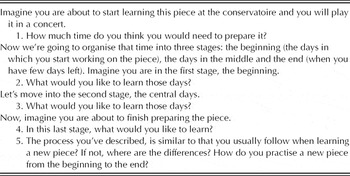
Each student participated in an individual semi-structured interview and completed a rating-scale questionnaire. In the first task participants were asked to describe the usual study process adopted when learning new pieces of music, dividing it into the three stages explained above. The interview outline served as a framework facilitating the students in providing the information. In order to give them a context to explain the process, we used a piece as an example. It was ‘An Evening in the Village’, composed by Béla Bartók as a piano piece and later arranged by H. Pröhle for flute and piano. This piece was selected because it is short and technically easy. This was important as the students had only 10–15 minutes to work on it. In addition, the piece has characteristics which are easily identifiable relating to Nationalism and Bartók's style: it is modal with no key signature; it has a title related to a country motif; it has a melody using a pentatonic minor scale related to Hungarian folksongs; and rhythms and accents typical of Bartók's work. Also, it is not commonly used by flute teachers in Spain in their lessons as it was not originally written for flute, so it was unlikely to be known by the students. The outline of the interview is presented in Table 1. This outline, as well as definitions of categories, statements and quotations presented in this paper, has been translated from their original Spanish version.
Interview outline

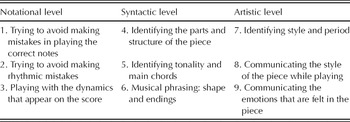
In addition to the interview, participants completed two rating-scale questionnaires. Statements were the same in both but one referred to activities carried out with the musical score in flute lessons with the teacher (from now on, ‘CLASS’), the other in personal study (‘PRACTICE’). The statements were based on the three levels of comprehension or processing described in the introduction, which had been derived from research using external representational systems, for instance, graphs (see, for example, Postigo & Pozo, 2000) and musical scores (see Bautista et al., 2009). Nine statements were developed, three corresponding to each level (see Table 2). Although students from these grades are used to working with both the flute and the piano part, activities proposed for the syntactic and the artistic levels can be carried out with just the flute score in a simpler way. The participants responded on a four point scale to the statements indicating that activities were undertaken never (1 point), sometimes (2), often (3) or almost always (4).
Statements from the rating-scale questionnaires and levels of processing

Procedure
Participants were asked to study Bartók's piece for approximately 10 minutes, in order to get an overview of it. Following this they were personally interviewed by the first author. The average length of the interviews was 20 minutes. The rating-scale questionnaires were given to the participants at the end of the session and were completed individually. These were later collected by the first author from the conservatoires.
Coding and analysis
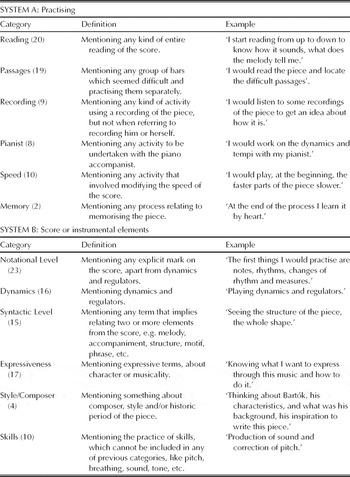
The interviews were audio recorded, transcribed and the data coded into themes using an iterative process described by Tesch (Reference TESCH1990) as empirical phenomenology, since it treats the participants’ accounts and thoughts about their own experience as data. We categorised each of the statements and sentences of the interviews, from which we developed two post-hoc category systems, used for the three stages of practice. The first six categories (system A) were related to activities carried out when practising a piece; the remaining six (system B) referred to elements from the musical score or to the instrument. Dynamics are reported separately from the notational level, as this enabled analysis of the possible relationships between dynamics and expressivity (Woody, Reference WOODY2000). Three independent judges categorised 20% of the total responses. To calculate the inter-rater agreement level a K Cohen coefficient was used. Agreement ranged from 0.75 to 1.00. The judge who reached the highest agreement level with the others categorised all the data. Statistic Chi-square was calculated to analyse differences between both groups for each category at each stage of practice.
In relation to the rating-scale questionnaires, we calculate the internal consistency for each level of comprehension, by using Cronbach Alpha measures, as explained below. After that, descriptive statistics, correlation coefficients, significance tests and analysis of variance were carried out in order to describe and analyse differences between both groups of participants in both questionnaires (‘CLASS’ and ‘PRACTICE’).
Findings
Processes in each stage of learning in normal practice
The categories derived from the interviews are set out in Table 3. The figures in parentheses indicate the number of students making a response in each category, taking together the three stages of practice. Across the sample the key strategies adopted in relation to practising were Reading and identifying and practising difficult sections (Passages). Less frequently mentioned were the use of recordings to learn the music (Recording), modifying the speed of playing (Speed), and working with the accompanist (Pianist). Only one participant referred to processes relating to memorising the music, in two different stages of practice. The highest number of responses, overall, referred to attending to playing the music as notated (Notational Level), although Dynamics, Expressiveness and issues relating to motif, structure and phrasing (Syntactic Level) were all mentioned by most participants. Specific technical skills required (Skills) were mentioned by 10 participants and specific reference to Style/Composer was made by only four participants.
Categories developed for the analysis of the interviews

NB The figures in parentheses indicate the number of students making a response in each category, taking together the three stages of practice.
Beginning stage
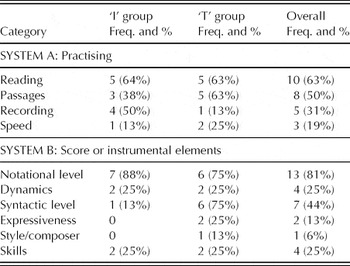
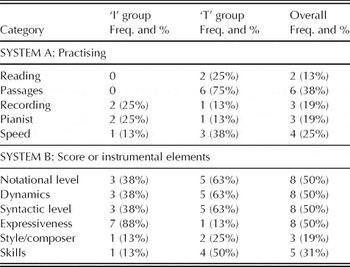
Table 4 sets out the responses of the students to the questions about their activities in the early stages of learning a new piece of music based on the categories presented in Table 3. Please note that any category which was not mentioned in some of the stages is not included in the corresponding Table (4, 5 and 6). In the beginning stage the Intermediate level students reported being mainly focused on reading activities, followed by listening to recordings and working on specific passages. From system B, the most mentioned issues were those from the ‘Notational Level’: notes, rhythms and indications about tempi.
Processes reported in the early stages of learning a new piece

Note: Percentages have been rounded to the nearest whole number.
Processes reported in the middle stage of learning a new piece

Note: Percentages have been rounded to the nearest whole number.
Processes reported in the end stage of learning a new piece

Note: Percentages have been rounded to the nearest whole number.
Students from the Tertiary group referred to reading processes and to selecting and working on difficult passages. Activities with the musical score (system B) were mainly related to understanding the notational symbols, but, in contrast to the ‘I’ group, these students spoke about activities from the ‘Syntactic Level’ such as identifying melody and accompaniment, structure of the piece and main themes. This difference between groups was statistically significant (X 2 = 6.35, df = 1, p = 0.012).
Only two participants spoke about expressivity at this stage, both of them from the Tertiary group. One referred to establishing a relationship between expressivity and the characteristics of the composer: ‘first I would enquire about the characteristics of Bartók and those present in this piece, in order to play expressing the character he wanted for it’ (E., 24 years old).
Middle stage
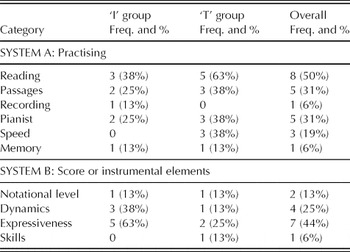
Table 5 sets out the responses from students in relation to the middle stage of learning. The data show that the ‘I’ group reported a great change in their activities in comparison with the first stage. Almost all of the students in this group (88%) mentioned expressivity, where there was a statistically significant difference between groups (X 2 = 9, df = 1, p = 0.003). In addition, there was an increasing focus on the syntactic level.
The Tertiary group also demonstrated a change from the beginning stage, but it was less marked than for the ‘I’ group. Reading activities decreased, and a greater emphasis on working at different speeds, developing skills, and focusing on specific passages and dynamics were found. They continued focusing on the syntactic level, as well as on notational elements and dynamics. Only one student spoke about expressivity but in a more complex way, putting it in relation to the composer and the dynamics: ‘I would work to give to it the character, which means mainly to me whatever the composer wanted to express. That idea would help me as well to make decisions about dynamics and phrasing’ (L., 25 years old).
End stage
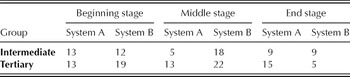
In the end stage (see Table 6) the Intermediate students continued to focus on expressivity and dynamics. They did not mention any syntactic element. The Tertiary group referred to more categories from system A − 15 statements − than levels of processing of the score at this stage − 5 statements − (see Table 7), most of them mentioning processes of reading the whole piece. Whereas for both groups there was a greater focus on issues relating to the score and instrument in the middle stage, at the end of the process the ‘T’ group seemed to return to a consideration of the piece as a whole as they drew nearer to performance with a focus on specific practising strategies, while the ‘I’ students did not.
Number of categories mentioned

Responses to the rating-scale questionnaires
We used Cronbach Alpha measures in order to calculate the internal consistency of each of the three levels of statements used in the questionnaire. For the responses for working with the teacher the alphas were: Notational level, α = 0.64; Syntactic level, α = 0.81; and Artistic level, α = 0.79. For studying alone the Cronbach Alphas were: Notational level, α = 0.42; Syntactic level, α = 0.62; and Artistic level, α = 0.78. Considering the classification of activities in relation to the levels of comprehension used in research with graphs or with maps (notational, syntactic and artistic, in our case), these findings suggest that the activities carried out with the teacher in lessons are more consistent than when the students are practising independently at home.
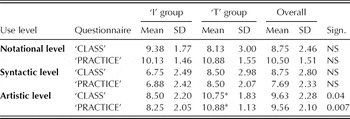
Analysis of the overall scores for each subcategory (see Table 8) revealed statistically significant differences relating to the Artistic level, in which the ‘T’ group scored higher than the ‘I’ group in both questionnaires: ‘CLASS’ (t = −2.22, df = 14, two-tailed p = 0.04) and ‘PRACTICE’ (t = −3.17, df = 14, two-tailed p = 0.007).
Means and standard deviations for the levels of understanding adopted by Intermediate and Tertiary groups

*Significantly higher mean score
A repeated measures analysis of variance (ANOVA) was undertaken to see if there were differences between the three levels of processing in both learning scenarios. In the ‘CLASS’ questionnaire, the mean scores for the three levels differed significantly (F = 5.59, p = 0.01, partial eta squared = 0.29). With regard to the ‘PRACTICE’ questionnaire, ANOVA revealed a significant difference among the three levels of comprehension (F = 10.6, p = 0.00, Partial eta squared = 0.43). A positive and significant correlation was found between the syntactic and the artistic level in the ‘CLASS’ questionnaire (r = 0.77, p = 0.001) (which means that both scores go in the same direction), as well as another between the artistic level from the ‘CLASS’ questionnaire and the same level from the ‘PRACTICE’ one (r = 0.564, p = 0.023).
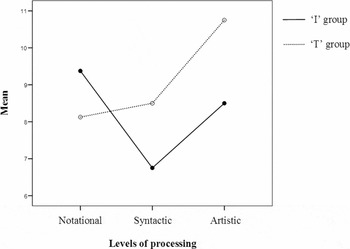
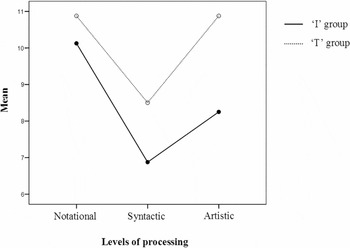
When interactions were considered there was a statistically significant one between ‘I’ and ‘T’ groups in relation to the levels of processing addressed in the lesson (F 2, 28 = 4.99, p = 0.014, partial eta squared = 0.26) (see Fig. 1). A similar interaction was not found in relation to personal study time (see Fig. 2). This reveals that the level of instruction has influenced how the students processed and used the musical score, in formal one-to-one learning contexts.
Levels of processing when working with the teacher

Levels of processing when practising alone

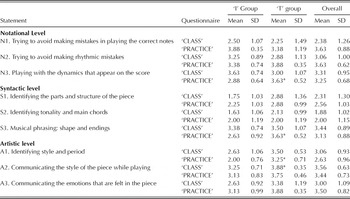
Table 9 sets out the means and standard deviations for responses to each of the statements in the questionnaires for the Intermediate and Tertiary level students. In relation to working with teachers (questionnaire ‘CLASS’) the only statistically significant difference in the reported approaches of both groups was in item A2, ‘Communicating the style of the piece while playing’, where the mean score of the ‘T’ group is significantly higher than that of the ‘I’ group (t = −2.24, df = 14, two-tailed p = 0.042). Item A1 (‘Identifying style and period of the music’) approached statistical significance (t = −2.08, df = 14, two-tailed p = 0.056), in the same direction as A2. In relation to personal practice (questionnaire ‘PRACTICE’) there was a statistically significant difference between groups in three items, the mean score of the ‘T’ group was always higher than that of the ‘I’ group. These items were N3, ‘Playing with dynamics that are on the score’ (t = −2.575, df = 14, two-tailed p = 0.022); S3, ‘Musical phrasing: shape and endings’ (t = 2.69, df = 14, two-tailed p = 0.018); and A1, ‘Identifying style and period of the music’ (t = −3.42, df = 14, two-tailed p = 0.004).
Means and standard deviations for rating-scale items for ‘I’ and ‘T’ groups

*Significantly higher mean score.
Discussion
In this paper we have proposed an analysis of the process of learning new music taking into account both the procedures and the elements to which students pay attention. These two dimensions of practice were analysed through the category systems derived from the first task (interview focusing on the three stages of learning a new piece), and the second task of completing two rating-scale questionnaires. The idea of separating these dimensions into two different systems has already been proposed by Sullivan and Cantwell (Reference SULLIVAN and CANTWELL1999), who identified strategy use and planning foci when learning different types of notated scores. Some of the categories established in that study are similar to those emerging in this paper. The adoption of two different systems might be explained from the particular characteristics of instrumental learning, where the student has to engage with two elements at the same time: the external representational system (musical notation), which demands the acquisition of specific processes, and the instrument, as a tool to communicate and express the music.
Taking into account the division of the process into three stages we found similarities with other studies where learning periods have been considered, for instance, Nielsen's study of learning strategies in instrumental practice (1999). Some of the categories from system A (activities when practising) were also identified in that study, including Passages, which is similar to to divide the piece into ‘working areas’ (larger sections) that are focused separately, and Speed, which is similar to to play segments in different tempi. Just as Nielsen found variations in learning strategies between learning periods, we also identified differences in the use and frequency of the reported strategies (coded in system A). It may be interesting for future research to take into account such learning stages, in order to identify further strategies and foci of attention.
The findings from the interviews supported those from earlier research demonstrating changes in conceptual understanding and the use of practising strategies as expertise develops (Gruson, 1988; Hallam, Reference HALLAM2001b; Lane, Reference LANE2006). Although the results from both levels of expertise did not differ significantly in most of the categories relating to the process of learning, those from the Tertiary group approached the pattern of learning which has been reported by professional musicians in other studies: getting an initial overview of the work; taking into account the structure of the piece (Reading, Syntactic Level); identifying difficult passages and focusing on them (Passages); as performance nears, focusing on the piece as a whole (Reading at the end of the process, Pianist) (Miklaszewski, Reference MIKLASZEWSKI1989; Hallam, Reference HALLAM1995a; Chaffin et al., Reference CHAFFIN, IMREH, LEMIEUX and CHEN2003). Lane (Reference LANE2006) conceptualises this as moving from macro to micro returning to macro. Young musicians, as their expertise develops, pay greater attention to musical expression and begin to include this in their daily practice. We can see this emerging in the Intermediate group (category Expressiveness) and more clearly in the Tertiary group. Similarities between the two groups can be explained by the fact that neither the Intermediate nor the Tertiary students are novices. The ‘I’ group is made up of flautists with ten years’ experience. However, there was greater consistency in the responses of the ‘T’ group supporting the findings from earlier research.
One of the aims of this paper was to compare and contrast the categories created post hoc from the interviews with the levels established by the rating-scale questionnaires. As described earlier, through the interviews we classified responses which referred to elements related to the musical score or to the instrument, whereas the rating-scale questionnaire comprised those elements defined a priori, stemming from other theoretical frameworks and adapted to musical learning. The ‘PRACTICE’ questionnaire was most appropriate for this comparison, since it referred to the same processes described in the interviews: the process of learning pieces during practice time, without the teacher.
Initially, we compared the category Notational Level (see Tables 3, 4, 5 and 6) with that from the questionnaire (see Fig. 2). It seems that students from both groups worked on activities at this level mainly at the beginning of the learning process. The category Dynamics, although related to notation, was created separately from the Notational Level in order to provide a more detailed account of the learning process. It appears less often at the beginning of the process, and more so in the middle.
Regarding the Syntactic Level, the higher scores by the ‘T’ group in ‘PRACTICE’ and particularly in relation to item S3 (‘Musical phrasing: shape and endings’), seemed to occur mainly in the middle of the process and significantly less often than the Notational and Artistic levels. The Syntactic category is likely to draw on automated knowledge held by musicians, which is not explicitly open to conscious awareness but which is used in learning to play an instrument. These processes do not need to be verbalised, in the same way that speakers of language do not need to explain phrases and pauses in speech and are unaware of their key role. It is also relevant to note that in previous studies regarding the processing of other representational systems, for instance, graphs or maps (see for example Postigo & Pozo, Reference POSTIGO and POZO2000, Reference POSTIGO and POZO2004) the Syntactic Level was called the Implicit Level, indicating the kind of processes, implicit and non-conscious, implicated.
The categories Expressiveness and Style/Composer relate to information concerned with an artistic level of comprehension of the musical score, so can be compared with the Artistic Level from the questionnaire data. Although the ‘T’ group had high scores on the Artistic Level, they mentioned the category Expressiveness less often than the ‘I’ group. Since we were interested in exploring this, we asked the students who had not mentioned it earlier about it at the end of the interview, many of them from the ‘T’ group. Most of them (six out of the eight) thought that the musical ideas and the character of the piece should be worked on immediately, at the same time as they learned to play the piece and practise difficult sections. The Tertiary level students integrated the different dimensions of learning more frequently than the other group. This is consistent with findings from previous research (for example, Chaffin et al., Reference CHAFFIN, IMREH, LEMIEUX and CHEN2003) that, for expert musicians, expression and interpretation are a focus from the beginning of the learning process. Considering the musical score as a representational system, it is important to note that activities at an artistic level reflect an epistemic use of the notation. This constitutes a relevant aim in educational contexts.
Some of the differences in the questionnaire responses between the groups were related to the level of expertise. In addition to the significantly higher score of the ‘T’ group on the Artistic Level in both questionnaires, these participants also scored significantly higher on particular items (related to dynamics, phrasing and style), revealing a complex relationship between the responses and students’ prior knowledge.
Another dimension was the difference in the activities reported between learning in lessons and personal practice, which were investigated through both rating-scale questionnaires. In lessons, the Intermediate level students reported the greatest emphasis on the notational level of processing, with little reference to the syntactic category and moderate reference to the artistic. For the Tertiary students there was an increasing level of focus from notational, through syntactic to artistic. However, the pattern of behaviour in learning in personal practice for the two groups was very similar, although at a lower level for the ‘I’ group. There could be a number of explanations for this. It may be that the aims of personal practice require a focus on developing an accurate representation of the music with conscious consideration of interpretation, focusing on artistic elements while syntactic elements are tacit and addressed through automatic processes. The evidence from the reports of lesson activity differs from this, suggesting that teachers may be overtly initiating consideration of syntactic processing and conceptualisation. In addition, they appear to do this more with Tertiary students than with Intermediate level students. This leads to questions about the nature of activities in instrumental lessons. On the one hand, we know from other studies that novice students and the teachers working with them are more focused on notational elements than on musical issues. On the other hand, there are some authors who consider the development of expression and communication as the main purpose of musical education systems (Davidson et al., Reference DAVIDSON, PITTS and SALGADO CORREIA2001; Juslin, Reference JUSLIN, Juslin and Sloboda2001). Is there a specific point in time when learners and teachers should start working on expressivity? Or should it be a focus from the outset? Participants in this study were not novices, however, students from the Intermediate group and presumably their teachers spend much of their time in working on notational issues. While they may have automated many musical skills there are still issues in learning to play particular pieces of music which require conscious attention to notation and practice to turn the written material into sound. Also relevant is the way in which students will be evaluated and valued in the conservatoire. What is the final outcome that they must attain? Is it to understand and express the music or just to play exactly what appears on the manuscript? And again, is there a specific moment to start thinking on expression?
Of course, there are limitations in the extent to which the findings from this study can be generalised. It was a study based on a small sample of students, representing expertise on a single instrument, the flute, who had undertaken their studies in a specific learning environment, the Spanish music conservatoire. In addition, the findings are based on self-report rather than direct observation of behaviour itself. However, there is no reason to suppose that the strategies that the students reported adopting as well as the ways of understanding the musical score are not similar to those of students from other western conservatoires.
Acknowledgements
This study has been developed within the research project ‘Learning of external representational systems and representational change in different domains of knowledge’ (EDU2010-21995-C02-01), whose main researcher is Juan Ignacio Pozo. The project is funded by the Spanish Ministry for Science and Innovation.
We also would like to thank all the participants of this study and their teachers, as well as Alfredo Bautista and Guadalupe López for their participation in the inter-rater agreement, Juan Ignacio Pozo, and the members of the ‘music teaching and learning’ research group of the Autonomous University of Madrid.