Introduction
The US National Park Service (NPS; Washington, DC USA) is responsible for maintaining the country’s public national parks and monuments across the 50 states, the District of Columbia, and the US territories. From 2016-2020, these public parks attracted an average of 309 million visitors per year from around the globe.1–5 The NPS is comprised of a variety of officially designated units, ranging from historical sites, to recreational areas, to preserves, among many others.6 Of these units, those designated as “national parks” attract the most visitors overall on an annual basis. In 2018, a total of 84,122,421 recreation visits were recorded solely for national parks, which comprised of 26% of all visits to the NPS’s 418 total units.3
Visitors to national parks engage in a variety of recreational wilderness activities, which can result in injuries ranging from mild to severe. These incidents may require transport to the nearest emergency department (ED) or trauma center. Prior studies have found that incidents of injury in national parks involve proportionately more trauma incidents than the national average. From 2012 through 2013, while trauma cases comprised of only four percent of Emergency Medical Services (EMS) responses nationally, 49% of EMS responses in NPS units had a traumatic mechanism, and traumatic fatalities were also found to occur twice as frequently as non-traumatic fatalities.Reference Lane, Taylor, Smith and Wheeler7 Reviews of EMS calls in numerous individual parks have additionally found a high incidence of traumatic injury and fatality.Reference Heggie and Heggie8–Reference Young, Kim and Lessard10
Trauma care is highly time-sensitive, and studies have found that the risk of death becomes significantly lower when care is provided in a trauma center than in a non-trauma center.Reference MacKenzie, Rivara and Jurkovich11 Among adult and senior populations, distance to Level I and Level II trauma centers was found to be inversely associated with patient outcomes such as mortality rate.Reference Dodson, Braswell and David12 Furthermore, prehospital deaths were found to be greater in states with more limited access to trauma centers within 45 to 60 minutes of travel by ground or air.Reference Hashmi, Jarman and Uribe-Leitz13 Considering the relatively higher incidence of trauma injury in national parks compared to the national average, an understanding of the accessibility of trauma center services and expertise from these parks is critical in assuring that a timely response can be expected for the tens of millions of visitors that attend these parks each year.
While prior studies have investigated the accessibility of trauma care for the general US populationReference Branas, MacKenzie and Williams14 and select subpopulations,Reference Dodson, Braswell and David12,Reference Carr, Bowman and Wolff15,Reference Carr and Nance16 none have specifically examined access to trauma centers from national parks. This study sought to address this knowledge gap by calculating the travel time from each US national park to its nearest trauma center. Using this information, the study aimed to determine the percentage of national parks by US region with timely access to a trauma center, which was defined as access within a 60-minute travel time. For national parks without timely access to any trauma center, the percent of parks that at least had timely access to a general ED was also determined.
Methods
Study Design
This was a cross-sectional evaluation of national park and trauma center locations. The Mass General Brigham Human Research Committee (Boston, Massachusetts USA; 2005P000015) has reviewed this project and classified it as exempt.
Data Sources
A full list of US national parks in 2018 was compiled using the 2018 Statistical Abstract from the NPS’s Natural Resource Data Series.3 Eligibility criteria included only NPS units formally designated as national parks and those located within the 50 states and the District of Columbia. Due to the geographical scale of national parks, a primary location and coordinates were assigned to each park based on its main visitor center. This was identified using information provided on each national park’s website. If more than one visitor center was listed for a single national park, coordinates were assigned based on the visitor center that was identified on the national park website as the primary location. When the primary visitor center was not explicitly stated, the address of the visitor center that was open to visitors for the greatest amount of time throughout the year was used. In the case that no visitor center was open throughout the year, primary location was assigned to the national park’s headquarters. National park locations were grouped by US census region.17 Collection of national park location data was conducted in 2021.
An ED’s trauma center designation status was identified using the 2018 National Emergency Department Inventory (NEDI)-USA database. This database includes all non-federal, non-specialty EDs in the 50 states and the District of Columbia that were open 24/7/365 in 2018.Reference Sullivan, Richman and Ahn18 As NEDI-USA does not include data on EDs located in US territories, the geographic analysis excluded any national parks located in any US territories such as the US Virgin Islands and American Samoa. The NEDI-USA database is updated annually and includes a comprehensive list of US EDs co-located in an adult and/or pediatric trauma center, sourced from both the American College of Surgeons (ACS; Chicago, Illinois USA) and state registries.Reference Bedell, Boggs and Espinola19 Data for 2018 NEDI-USA was collected in 2019. A current up-to-date list of all open US EDs, their locations, and their basic characteristics sourced from this database can be found in the free smartphone application findERnow (Massachusetts General Hospital; Boston, Massachusetts USA).20 To standardize the capabilities of state-designated and ACS-verified trauma centers in this database, all state-designated trauma centers equivalent to ACS Level I and Level II trauma centers were categorized as advanced trauma centers (ATCs), while all other state-designated trauma centers were categorized as basic. This descriptive, cross-sectional study analyzed the distance in time by ground and air transport from a national park to its nearest adult ATC using this data from 2018 NEDI-USA.
Routing Calculations
To assess the proximity of national parks to their nearest adult ATC, the study examined both driving time and air transport time. Driving time was determined using Google Maps (Version 3.48; Alphabet Inc.; Mountain View, California USA) based on usual driving travel time at noon on a Saturday, and the route with the shortest travel time by car between national park to ATC was selected for analysis. If driving times between the national park and two different adult ATCs were equivalent, the route with the shortest driving distance was selected. In selecting the shortest route, the study placed no restrictions on crossing state lines. These calculations did not account for response or scene time—ie, the time it would take for an ambulance to reach the patient and prepare for transport. In the case that national parks did not have access to any adult ATC within 60 minutes by ground transport, these calculations were repeated for a park’s closest general ED.
To calculate air transport times, the geodesic distance (ie, “as the crow flies,” accounting for the curvature of the Earth) from national park to the nearest adult ATC was used. Geodesic distance was calculated using ArcGIS Desktop (Version 10.3; ESRI; Redlands, California USA). The approximate flight time was then calculated based on geodesic distance, assuming a helicopter’s average speed was 229.5 kilometers per hour.Reference Carr, Caplan, Pryor and Branas21 These calculations did not account for take-off, landing, response, or scene time. As with the ground analysis, these calculations were repeated for a national park’s closest general ED in the case that parks did not have access to any adult ATC within 60 minutes by air transport.
Statistical Analysis
The study calculated the median time and interquartile range overall and by US census region for ground and air transport from each national park to its nearest adult ATC. The study also determined the percentage of national parks with timely access to the nearest adult ATC by ground and air, defined as access within a 60-minute travel time. While this benchmark has colloquially been known as the “golden hour” of trauma,Reference Lerner and Moscati22 there exists mixed empirical evidence to support this.Reference Lerner and Moscati22–Reference Dinh, Bein, Roncal, Byrne, Petchell and Brennan24 Nevertheless, 60 minutes has continued to be used in prior investigations assessing trauma center accessibility at a national level.Reference Branas, MacKenzie and Williams14–Reference Carr and Nance16,Reference Carr, Caplan, Pryor and Branas21,Reference Hsia and Shen25
The same calculations were repeated to assess the percentage of national parks with timely access to the general ED by ground and air to compare against the accessibility of adult ATCs. Statistical analyses were conducted using Stata SE (Version 15.1; StataCorp LLC; College Station, Texas USA).
Results
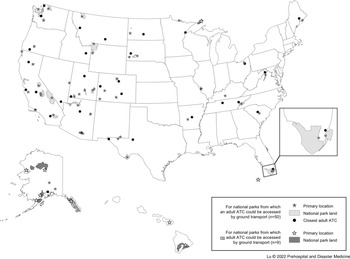
In 2018, 60 individual NPS units were designated as national parks, spanning 26 states and two US territories. The two national parks located in US territories—National Park of American Samoa and Virgin Islands National Park—were excluded from the analysis as the NEDI-USA database only includes ED data from the 50 states and the District of Columbia. Furthermore, since Saguaro National Park is physically divided into an East and West region by the city of Tucson, Arizona, two separate primary locations were assigned for the two divisions of the park. This resulted in a total of 59 national park primary locations considered for the transport analyses, which are mapped in Figure 1. A flowchart mapping the selection of national parks for the ground and air transport analysis is available as supplemental content (Figure S1; available online only).
US National Parks and their Nearest Trauma Center via Ground Transport in 2018.
Note: Map of US national parks and their nearest adult advanced trauma center (ATC) via ground transport in 2018. Stars indicate a national park’s primary location, which were assigned based on the park’s primary visitor center or park headquarters. Gray stars mark national parks from which an adult ATC could be accessed by ground transport (n = 50), and black circles mark the nearest adult ATC to these parks by ground transport time. White stars mark national parks from which an adult ATC could not be accessed solely via ground transport (n = 9).

For the ground transport analysis, nine additional national parks were unable to be included as it is impossible to travel from these parks to an adult ATC exclusively by ground (Figure S1). Seven of these parks—Lake Clark, Katmai, Isle Royale, Glacier Bay, Dry Tortugas, Gates of the Arctic, and Kobuk Valley—either lacked a road system entirely or had a small, isolated road system that could only be accessed by air or watercraft, with rare seasonal exceptions (ie, construction of temporary winter ice roads). Two additional parks— Hawai‘i Volcanoes and Haleakala National Park—were located on islands with a road system but no adult ATC accessible without a combination of ground and air/water transport. Of these nine inaccessible parks, seven were located in the West US census region, one was located in the South, and one was located in the Midwest.
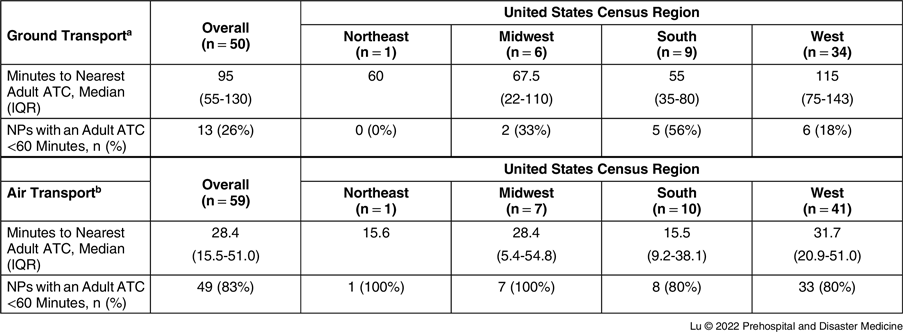
For the remaining 50 national park primary locations from which an adult ATC could be accessed exclusively by ground transport, their closest adult ATCs based on ground transport times were identified. The locations of these adult ATCs are mapped in Figure 1. The overall median ground transport time was 95 minutes from national park to the closest adult ATC. Of these 50 parks, only 13 (26%) had timely access (<60 minutes) by ground transport to an adult ATC (Table 1). By region, the South had the shortest median ground transport time to an adult ATC (55 minutes), while the West had the greatest median transport time (115 minutes). Only six (18%) national parks in the West had timely access to an adult ATC, the second-lowest proportion of all four regions (Table 1).
Median Travel Times and Timely Access to Nearest Adult ATC from US National Parks in 2018

Abbreviations: ATC, advanced trauma center; IQR, interquartile range; NP, national park.
a Ground transport times were calculated using Google Maps by determining the driving distance and usual travel time from a national park’s assigned primary location on a Saturday at noon. See Methods for additional details.
b Air transport times were calculated using the geodesic distance from the national park’s assigned primary location. See Methods for additional details.
The study additionally examined the 46 national parks with no timely access to an adult ATC by ground to determine whether they at least had access to an ED, and found that 25 (54%) of these 46 parks could access a general ED within 60 minutes of ground transport. Overall, of the 51 national parks that had access to a general ED by ground, 38 (75%) could access their nearest ED within 60 minutes of ground transport. Notably, Haleakala National Park did have access to a general ED on the island it is located on exclusively by ground, despite not having exclusive ground access to an adult ATC.
For the air transport analysis, all 59 national park primary locations were included (Figure S1). The overall median air transport time from national park to the closest adult ATC was calculated to be 28.4 minutes. Of these national parks, 49 (83%) had timely access (<60 minutes) to an adult ATC by air transport (Table 1). All national parks in the Northeast and Midwest had access to an adult ATC by air transport within 60 minutes, while 80% of national parks in both the South and the West had timely access by air (Table 1). The ten national parks with no access to an adult ATC by air within 60 minutes were also examined, and it was found that nine (90%) of these parks had timely access to a general ED by air.
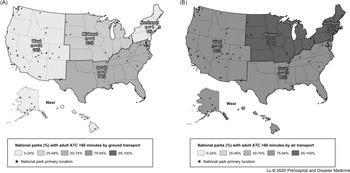
The proportion of national parks by region with timely access to an adult ATC by ground transport versus air transport is mapped in Figure 2. An additional figure that compares the proportion of national parks with timely access to any general ED by ground versus air transport is available as supplemental content (Figure S2; available online only), accompanied by a summary table of ED-specific results (Table S1; available online only).
Percentage of US National Parks by Census Region with <60-Minute Access to a Trauma Center by Ground Transport versus Air Transport in 2018.
Note: Map of the percentage of US national park primary locations by census region with timely access (<60 minutes) to an adult advanced trauma center (ATC) by (A) ground transport and (B) air transport. Stars indicate a national park’s primary location, which were assigned based on the park’s primary visitor center or park headquarters.

Discussion
The results of this study demonstrate that there is variability in travel time and access to trauma care from national parks by census region. Via ground transport, only approximately one-quarter of all national parks had timely access to an adult ATC. In contrast, the vast majority of national parks had timely access to an adult ATC by air transport. Among all four regions, median transport times between national park to the nearest adult ATC were the highest in the West for both ground and air transport. The West also had the second-lowest proportion of national parks with timely access by air or ground to an adult ATC among all regions.
The finding that the West ranks low in transport time and timely access to a trauma center for both ground and air transport is concerning, as the West houses the most national parks of the four census regions. Of the 59 national park primary locations included in the analysis, 41 (70%) were located in the West. Furthermore, the West also includes seven of the nine national parks that were not entirely accessible by ground and thus excluded from the ground transport analysis. The relatively lower accessibility of trauma centers among national parks in the West may be a reflection of the larger average size of its parks, and thus their more remote and isolated nature. In 2018, national parks in the West averaged 1.18 million acres in gross area, which was greater than the national average of 0.90 million acres.26 Furthermore, among the top ten largest national parks by gross area acres in 2018, nine were located in the West.26 The large size and remote nature of many of the West’s national parks highlights the importance of further investigating this disparity and filling these gaps in timely access to trauma center expertise in this region.
In general, the much higher proportion of national parks with timely access to trauma centers by air is reassuring. A 2005 investigation determined that 84% of the general US population had access to an ACS-verified Level I or Level II trauma center by either ground or air within 60 minutes,Reference Branas, MacKenzie and Williams14 a proportion that is consistent with the study’s finding that 83% of national parks had timely access to an adult ATC by air. The same study determined that a total of 28% of US residents could only access a Level I or Level II trauma center within 60 minutes if they were flown by helicopter.Reference Branas, MacKenzie and Williams14 In contrast, this investigation found that in comparison to just ground transport, 36 more national park primary locations could access an adult ATC within 60 minutes of travel by air, which was 61% of all examined national park locations. Such a disparity suggests that there is much less access to higher level trauma care by ground from national parks compared to the US population as a whole. While access by air was comparable, the significantly lower accessibility of these services via ground transport is still a cause for concern.
A review of NPS EMS responses found that ambulance transport accounted for 90% of all NPS patient transports from 2012-2013 compared to only two percent by aircraft; the remaining eight percent of transports included those by watercraft (5%) and by non-ambulance vehicles such as patrol cars (3%).Reference Lane, Taylor, Smith and Wheeler7 These non-ambulance transports were claimed to represent backcountry responses where road access via ambulance was not possible,Reference Lane, Taylor, Smith and Wheeler7 which implies that national park terrain was the primary determinant of transport type as opposed to the severity of the event itself. Furthermore, while EMS air transport allows for increased speed compared to ground transport, this mode of transportation comes with its disadvantages, including significantly greater costs, increased susceptibility to weather conditions, and the more dangerous nature of air transport compared to ground transport.Reference Steenhoff, Siddiqui and Zohn27 When considering these disadvantages, ground transport may be preferable over air transport in a variety of situations when accessible. As a result, increasing the number of national parks with timely access to advanced trauma care by ground remains an important public health goal.
To fill these gaps in timely access to trauma care from national parks, the designation of new ATCs in closer proximity to parks with low access would be the most direct method of expanding the accessibility of trauma care expertise. However, the establishment of new trauma centers is a highly costly and resource-intensive process.Reference Taheri, Butz, Lottenberg, Clawson and Flint28 A viable alternative could instead be the further expansion of trauma telehealth in existing EDs. These services can improve trauma patient care within EDs not co-located in trauma centers by providing timely access to the expert evaluation and resources of an ATC, as well as positively influencing clinical and transport decisions.Reference Latifi, Weinstein and Porter29 Prior studies have found that implementation of telehealth has been successful in improving the evaluation and management of trauma patients in rural hospitals,Reference Duchesne, Kyle and Simmons30 and also in lowering total hospital costs.Reference Duchesne, Kyle and Simmons30,Reference Wesson and Kupperschmidt31 While there is room to improve timely ground access to general EDs from national parks, it remains that dramatically more parks had timely access to a general ED than an adult ATC. As a result, encouraging trauma telehealth use in EDs in closer proximity to national parks is likely to be a more cost-effective and feasible alternative to direct ATC expansion. Supporting the growth and implementation of telehealth use in smaller EDs would contribute to improving timely access to higher level trauma care for EMS events regardless of which national park they may originate in.
Limitations
This study has several limitations. Regarding the ground transport analysis, one limitation was the exclusion of nine national parks from this analysis as it was impossible to travel from these parks to an adult ATC exclusively by ground. As a result, the results of the ground transport analysis do not fully represent the level of ground access to trauma centers from all US national parks. Additionally, in order to streamline the study’s ground travel time calculations, the study did not account for the time it takes to reach and extricate a patient from within national parks. The study additionally did not account for take-off or landing times for helicopters, nor the impact of flight conditions on flight time. Despite this, the addition of EMS response and scene times would necessarily increase the overall time from incident to arrival at an adult ATC. Even with these limitations, this analysis still reveals gaps in access to timely care that exist even under the best-case scenario where these additional times are omitted.
Another limitation was the fact that the study assigned each national park a particular primary location which the study used to determine distance to the nearest ED. This standardization of national park locations was intended to minimize the information bias introduced by the variable location of injury, but it remains that the actual site of trauma injury would not necessarily be at this singular location. Ultimately, actual travel times will vary based on the location of the emergency itself due to the large size of many national parks. Finally, as the results of this study are based on US data only, these findings may not be directly applicable to other countries. Nevertheless, there is potential to repeat similar analyses to assess trauma center accessibility in other settings.
Conclusion
While most US national parks had timely access to an adult ATC by air transport in 2018, significant gaps in ATC access remain when limited to ground transport, which comprised the vast majority of EMS transports out of these parks. By region, one of the greatest gaps in timely access from national park to ATC by ground was in the West, which also housed the largest number of national parks of all four census regions.
As many more national parks had timely access to a general ED compared to an ATC, there is an opportunity to expand the reach of ATC expertise in a cost-effective and resource-conscious way by encouraging the implementation of trauma telehealth in these EDs. Further expansion of telehealth capacity could additionally extend significant benefits to trauma care in the field, even before transport and arrival in an ED itself. Such benefits might include improved support for direct care and training of advanced first responders in these remote areas. While the ability to access ATC expertise over telehealth is certainly not equivalent to direct care within an ATC itself, expanding these options is an important step towards improving timely access to trauma care expertise from any of the country’s many national parks, regardless of where they might be located.
Conflicts of interest
The authors declare none. This study was supported, in part, by a grant from R Baby Foundation (New York, New York USA). The content of this manuscript is solely the responsibility of the authors and does not necessarily represent the official views of R Baby Foundation.
Supplementary Materials
To view supplementary material for this article, please visit https://doi.org/10.1017/S1049023X22001431.