Covin and Slevin (Reference Covin and Slevin1989) reported that entrepreneurial orientation (EO) encourages firms to direct their strategic decisions and practices toward the pursuit of new opportunities. Accordingly, a firm’s internationalization can be considered a natural form of entrepreneurial activity (Schweizer, Vahlne, & Johanson, Reference Runyan, Droge and Swinney2010). A firm’s cross-border activities are triggered by an entrepreneur’s ability to discover international market opportunities (McDougall & Oviatt, Reference Luo2000). Previous empirical studies indicated that there is a positive association between EO and a firm’s international performance (Covin & Miller, Reference Covin, Green and Slevin2014); however, several research reported that the expected association was not observed (e.g., Frishammar & Andersson, Reference Fletcher2009), indicating the need for further examination of its various contingencies. As a result, researchers have begun to focus on the role of internal factors (Wales, Gupta, & Moussa, Reference Wales, Gupta and Moussa2013). As such, the present study aimed to determine if the relationship between EO and international performance is contingent upon cultural intelligence (CQ) of top managers.
It is thought that firms that possess an EO achieve better performance in the global arena than those without an EO (Covin & Miller, Reference Covin, Green and Slevin2014). In the present study we posited that an influential factor in the implementation of EO is the CQ of top managers – a specific managerial capability necessary to effectively compete in the international marketplace. This view is consistent with the notion that CQ constitutes capabilities necessary to function and manage effectively in situations characterized by cultural diversity in order to meet organizational goals (Earley & Ang, Reference Earley and Ang2003), as well as the capacity to conduct commercial relations with several actors in other countries, such as businesses, governments, and trade associations (Ang & Inkpen, Reference Ang and Inkpen2008). CQ is an important competency that helps top managers conduct business activities across borders, because it contributes to the development of effective relationships with foreign customers, suppliers, and competitors (Charoensukmongkol, Reference Charoensukmongkol2015). Specifically, EO efforts can fail when organizations lack the managerial capability necessary to position a firm effectively in the complex international environment. In the current study, we follow Earley and Ang’s (Reference Earley and Ang2003) model in examining four factors of CQ, each of which were expected to have a contingency effect on the relationship between EO and international performance. Moreover, in line with the configurational perspective (Meyer, Tsui, & Hinnings, Reference McDougall and Oviatt1993; Dess, Lumpkin, & Covin, Reference Dess, Lumpkin and Covin1997), we argue that a configuration indicating the concurrent existence of high levels of the four CQ dimensions appears best for the successful implementation of entrepreneurial opportunities. We test the research model depicted in Figure 1.
Conceptual model of the moderating impact of the four dimensions cultural intelligence (CQ) on the relationship between entrepreneurial orientation and international performance

In this research, we draw on the resource-based view (Barney, Reference Barney1991) and upper echelons theory (Hambrick & Mason, Reference Hambrick1984; Hambrick, Reference Hair, Anderson, Tatham and Black2007) to examine the moderating effect of CQ of top managers in the relationship between EO and international performance. Most studies in the entrepreneurship context use these views to predict outcomes on the organizational level (Covin & Miller, Reference Covin, Green and Slevin2014). The resource-based view considers human capital characteristics such as experience and competence as resources (Barney, Wright, & Ketchen, Reference Barney, Wright and Ketchen2001). On the other hand, the upper echelons perspective discuses the impact of top manager characteristics on organizational outcomes (Hambrick, Reference Hair, Anderson, Tatham and Black2007). Previous upper echelons research indicated that managerial characteristics such as experience and competence are relevant to performance of the firm (Carpenter, Geletkanycz, & Sanders, Reference Carpenter, Geletkanycz and Sanders2004). Thus, upper echelons theory links top managers’ variables (resources) to the nature of managerial processes and organizational outcomes.
The present study has its own contextual characteristics and should further increase its usefulness. The focus of this study is on Turkish small- and medium-sized enterprises (SMEs). Turkey has the 18th largest gross domestic product in the world and is considered as an emerging market (Garten, Reference Frishammar and Andersson1996). Since the emerging markets are expected to become global economic engines in the next decade (The Economist, Reference Tabachnik and Fidell2010), this study is of high importance and interest not only for academics, but also for business practitioners and policy makers. Therefore, we believe that prior literature’s focus on SMEs from developed countries, such as European countries and the United States of America, needs to be supplemented with studies conducted in developing countries.
In our view, the present study adds to the literature in two ways. First, to the best of our knowledge, this is the first study particularly focus on the CQ of top managers as a moderating variable on the relationship between EO and international performance. Although examining the role of this moderator variable explains the conditions under which EO is effective, previous studies primarily focused on external factors (e.g., dynamism and hostility) thought to affect an EO’s effectiveness (Wales, Gupta, & Moussa, Reference Wales, Gupta and Moussa2013). Few studies have examined internal factors as moderators to determine the conditions under which an EO is more effective (e.g., Engelen, Gupta, Strenger, & Bretter, 2015; Deligianni, Dimitratos, Petrou, & Aharoni, Reference Deligianni, Dimitratos, Petrou and Aharoni2016). Moreover, there is a consensus among researchers that further study on the internal moderators that facilitate or inhibit the EO–international performance relationship is warranted. The present examination of top managers’ CQ seeks to determine how an internal factor affects the EO–international performance relationship. Second, we contribute to the broader literature on the effects of top managers on organizational outcomes. In their review of the upper echelons stream, Carpenter, Geletkanycz, and Sanders (Reference Carpenter, Geletkanycz and Sanders2004) urge researchers to regard top managers as a ‘bundle’ of attributes and study the interactions or configuration of various characteristics and competences in order to understand their combined and cumulative effects on organizational outcomes. We try to show that the effect of EO on international performance of SMEs largely depends on top manager’s CQ.
The paper proceeds as follows: First, the relevant literature on the EO–international performance relationship is reviewed and hypotheses are described; next, the methodology for the study is described, after which the findings are reported; the final section consists of a discussion, including the implications of the findings.
LITERATURE REVIEW AND HYPOTHESIS DEVELOPMENT
Entrepreneurial orientation, international performance, and contingencies
The concept of EO can be traced back to the strategy formulation literature (Mintzberg, Reference Meyer, Tsui and Hinnings1978) and is associated with a firm’s innovation strategy (Miller & Friesen, Reference Miller and Friesen1982). According to Rauch, Wiklund, Lumpkin, and Frese (Reference Ragin2009), EO is the entrepreneurial strategy-making processes that top management utilizes to ‘enact their firm’s organizational purpose, sustain its vision, and create competitive advantage’ (p. 763). Firms that are entrepreneurially oriented are those that engage in product-market innovation, undertake somewhat risky ventures, and are the first to come up with ‘proactive’ innovations for outperforming their competitors (Miller, Reference Miller1983). Conceptually, EO is a multidimensional construct (Miller, Reference Miller1983; Covin & Slevin, Reference Covin and Slevin1989) usually defined by three dimensions, including innovativeness, risk taking, and proactiveness (Covin & Slevin, Reference Covin and Miller1986). Overwhelmingly, researchers have posited the conceptual argument that performance benefits emanate from EO (i.e., risk taking, proactiveness, and innovation). A number of studies support the existence of a positive relationship between EO and firm performance (Covin & Slevin, Reference Covin and Miller1986; Wiklund, Reference Wiklund1998; Luo, Reference Lumpkin, Wales and Ensley1999; Lumpkin & Dess, Reference Lumpkin and Dess2001). A meta-analysis of 51 studies conducted by Rauch et al. (Reference Ragin2009) reported that there is generally a positive relationship between EO and above-average firm performance.
Evidence of the effect of EO on internationalization is also noted in several studies (e.g., Dimitratos, Lioukas, & Carter, Reference Dimitratos, Lioukas and Carter2004; Kuivalainen, Sundqvist, & Servais, Reference Kreiser, Marino and Weaver2007; Ripollés-Meliá, Menguzzato-Boulard, & Sánchez-Peinado, Reference Ripollés-Meliá, Blesa and Monferrer2007; Zhou, Reference Zhou2007; Zhang, Tansuhaj, & McCullough, Reference Zhang, Tansuhaj and McCullough2009; Dimitratos, Plakoyiannaki, Pitsoulaki, & Tüselmann, Reference Dimitratos, Plakoyiannaki, Pitsoulaki and Tüselmann2010; Li, Wei, & Liu, Reference Leung, Ang and Tan2010; Liu, Li, & Xue, Reference Li, Wei and Liu2011; Ripollés-Meliá, Blesa, & Monferrer, Reference Rehg, Gundlach and Grigorian2012). In contrast, some studies report that there is an insignificant relationship between EO (or specific dimensions of EO) and international performance (e.g., Kuivalainen, Sundqvist, Puumalainen, & Cadogan, Reference Kuivalainen, Sundqvist, Puumalainen and Cadogan2004; Frishammar & Andersson, Reference Fletcher2009). Although few studies fail to confirm an overall tendency for EO to have a positive effect on a firm’s international performance, the inconsistency in findings might be due to firm-specific idiosyncrasies, market context, and general environmental factors (Covin & Miller, Reference Covin, Green and Slevin2014). Employing the contingency perspective of organizational effectiveness (e.g., Venkatraman, Reference Venkatraman1989; Donaldson, Reference Donaldson2001), researchers posit that there is a wide variety of internal and external conditions with the potential to either strengthen or weaken the relationship between EO and performance (e.g., Covin & Slevin, Reference Covin and Slevin1991; Lumpkin & Dess, Reference Livermore1996). The contingency approach provides the context with which organizational entrepreneurial behavior is manifest (Lumpkin, Wales, & Ensley, Reference Lumpkin and Dess2006). For example, in their meta-analysis, Rauch et al. (Reference Ragin2009) found that the size of business (EO–performance relationship is stronger in small firms) and industry type (EO–performance relationship is stronger in high-tech industries) are moderators of the EO–performance relationship. In addition, resource availability (e.g., Wiklund & Shepherd, Reference Williams and Chaston2005), environmental characteristics (e.g., Lumpkin & Dess, Reference Lumpkin and Dess2001; Wiklund & Shepherd, Reference Williams and Chaston2005; Moreno & Casillas, Reference Mintzberg2008), strategic process variables (Covin, Green, & Slevin, Reference Covin and Slevin2006), longevity (Runyan, Droge, & Swinney, Reference Rogers2008), the stage of industry life cycle (Lumpkin & Dess, Reference Lumpkin and Dess2001) are widely used moderators in EO–performance relationship. Previous studies indicated that externally focused variables which are commonly thought to affect EO’s influence have received considerable attention.
Researchers have begun to focus on various internal influencers of EO, including managerial resource (Miller, Reference Miller2011; Wales, Monsen, & McKelvie, Reference Wales, Monsen and McKelvie2011). Although earlier studies indicated that EO positively affects a firm’s international performance, it remains unclear how internal resources affect the EO–international performance relationship (Muchiri & McMurray, Reference Morgan, Vorhies and Schlegelmilch2015). In addition, several researchers suggest that internal resources can facilitate or inhibit the performance impact of EO (e.g., Wales, Gupta, & Moussa, Reference Wales, Gupta and Moussa2013; Covin & Miller, Reference Covin, Green and Slevin2014). There is scarce research that examines internally focused moderators that affect the relationship between EO and a firm’s performance. For example, internal social exchange process (De Clercq, Dimov, & Thongpapanl, Reference De Clercq, Dimov and Thongpapanl2010), transformational leadership behaviors (Engelen et al., 2015), and decision-making rationality (Deligianni et al., Reference Deligianni, Dimitratos, Petrou and Aharoni2016) are internally focused variables which were found to affect EO’s influence. In the present paper, we meet the needs of previous calls by investigating CQ of top managers in SMEs as an internal moderator that affects the relationship between EO and international performance. We believe that this is important because implementation of EO requires substantial and consistent investment of organizational resources (Covin & Slevin, Reference Covin and Slevin1991), and if there is a lack of CQ, a firm’s EO can be ineffective for international performance. In the following section, we introduce CQ as a moderating variable in the EO–international performance relationship in SMEs.
Cultural intelligence as a moderator
Drawing on the resource-based view (Barney, Reference Barney1991) and upper echelons theory (Hambrick & Mason, Reference Hambrick1984; Hambrick, Reference Hair, Anderson, Tatham and Black2007), we posit that CQ of top managers can be specifically relevant as a contingency that facilitates or impedes the impact of EO on a firm’s international performance. The resource-based view (Barney, Reference Barney1991) proposes that resources that are rare, valuable, inimitable, and unique enable a firm to improve its efficiency. As firm resources are its assets and influence the decision-making process, Miller (Reference Miller2011) calls for empirical research on the role of managerial resources as a reasonable contingency that can affect the EO–international performance relationship. Moreover, it is possible that intangible resources and strategic posture interact, affecting firm performance differently than each alone does (Newbert, Reference Muchiri and McMurray2007). Accordingly, CQ of top managers can be considered a managerial resource, as it is directly related to human capital that can affect the implementation of EO. On the other hand, upper echelons theory (Hambrick & Mason, Reference Hambrick1984; Hambrick, Reference Hair, Anderson, Tatham and Black2007) proposes that top executives play an important role in shaping an organization’s major strategies and performance. Hambrick stated that, ‘the experiences, values, and personalities of top executives have prevalent influences on their field of vision (the directions they look and listen), selective perception (what they actually see and hear) and interpretation (how they attach meaning to what they see and hear)’ (Reference Hair, Anderson, Tatham and Black2007, p. 337). Researchers have been frequently used the upper echelons theory as a theoretical lens to examine the effect of top executives on the process of strategic choice and resultant performance outcomes. Moreover, Carpenter, Geletkanycz, and Sanders (Reference Carpenter, Geletkanycz and Sanders2004) call for future research to study the interactions or configuration of various characteristics and competences of top managers in relation to organizational outcomes.
CQ is an individual’s capability to deal effectively in culturally diverse situations (Earley & Ang, Reference Earley and Ang2003; Earley & Peterson, 2004). It is indicative of a capacity to secure and manipulate information, draw inferences, and effectively respond to a new cultural setting (Earley & Ang, Reference Earley and Ang2003; Ang & Van Dyne, Reference Ang and Van Dyne2008). Addressing skill sets that support an individual’s effectiveness transferring social skills from one cultural context to another, CQ facilitates cross-cultural respect, recognition and reconciliation, and adaptation (Brislin, Nab, & Worthley, Reference Brislin, Nab and Worthley2006). CQ is conceptualized as a multidimensional construct consisting of four components: Mental (metacognitive and cognitive), motivational, and behavioral CQ. Metacognitive CQ reflects an individual’s consciousness and awareness during intercultural interactions, as well as the processes used to acquire and understand cultural knowledge. Cognitive CQ is a general knowledge and knowledge structures (i.e., norms, practices, and conventions) of a culture and cultural differences. Motivational CQ is the capability to direct attention and energy toward learning about and functioning in culturally diverse situations. Finally, behavioral CQ is the ability to exhibit situationally appropriate verbal and nonverbal behavior during intercultural interactions (Earley & Peterson, Reference Earley and Peterson2004; Ng & Earley, Reference Newbert2006; Ang & Van Dyne, Reference Ang and Van Dyne2008; Van Dyne, Ang, Ng, Rockstuhl, Tan, & Koh, Reference Van Dyne, Ang, Ng, Rockstuhl, Tan and Koh2012).
Despite its important effect on work attitudes and behaviors at individual level (e.g., Leung, Ang, & Tan, Reference Leonidou, Katsikeas, Palihawadana and Spyropoulou2014), the role of top manager’s CQ in a firm’s international performance is becoming a more common topic of research. For example, previous studies on CQ at the firm level indicated that it is associated with nonfinancial performance, including corporate reputation and employee commitment (de la Garcia Carranza & Egri, Reference de la Garcia Carranza and Egri2010), export performance (Magnusson, Westjohn, Semenov, Randrianasolo, & Zdravkovic, Reference Magnusson, Westjohn, Semenov, Randrianasolo and Zdravkovic2013), strategic alliance ability and contracting performance (Yitmen, Reference Yitmen2013), and the quality of the relationship between entrepreneurs in small business and foreign customers, suppliers, and competitors (Charoensukmongkol, Reference Charoensukmongkol2015). De la Garcia Carranza and Egri (Reference de la Garcia Carranza and Egri2010) also reported that a level of top manager’s CQ was higher in internationalized small businesses than in domestic-only small businesses.
As applied in the present study, we suggest that CQ of top managers can be conceptualized as a specific type of managerial resource that is expected to be positively correlated with a firm’s international performance. The present study examined the four dimensions of CQ individually, as earlier research indicated that each dimension represents a unique aspect of an individual’s capability with specific consequences (Leung, Ang, & Tan, Reference Leonidou, Katsikeas, Palihawadana and Spyropoulou2014). For example, Van Dyne et al. (Reference Van Dyne, Ang, Ng, Rockstuhl, Tan and Koh2012) suggested that some CQ profiles are more widespread than others (e.g., some individuals score high on all factors, some score high only on cognitive factors, some score high on motivational factors, and some score high on a combination of the factors.). Accordingly, we argue the individual moderating effects of the four CQ dimensions before considering how collective configurations of these dimensions further augment the effects of EO (Meyer, Tsui, & Hinnings, Reference McDougall and Oviatt1993; Dess, Lumpkin, & Covin, Reference Dess, Lumpkin and Covin1997).
Contingency perspective
Metacognitive CQ is a higher order level of cognitive processing in which individuals are consciously aware of cultural differences during cross-cultural interactions (Ang & Van Dyne, Reference Ang and Van Dyne2008). It is indicative of the processes individuals use to acquire and understand cultural knowledge. Individuals with a high level of metacognitive CQ have knowledge and control over their thought processes during cross-cultural interactions, and are able to make adjustments when necessary (Triandis, Reference Triandis2006; Ang et al., Reference Ang, Van Dyne, Koh, Ng, Templer, Tay and Chandrasekar2007). In terms of metacognitive CQ of top managers, questioning, monitoring, and revising mental models based on their own cultural assumptions are important for international business conduct, as the use of these mechanisms for coping with cultural challenges reduces the uncertainty inherent in EO–related activities. International performance literature shows that cultural compatibility between foreign partners is a major factor for the maintenance of a global partnership (e.g., Lane & Beamish, Reference Landis and Dunlap1990). Without an appreciation of and adjustment to foreign cultures, no firm can engage in culturally effective exchange with foreign partners (Skarmeas & Robson, Reference ahin, Gürbüz and Köksal2008). Moreover, Chua, Morris, and Mor (Reference Chua, Morris and Mor2012) observed that managers with a high level of metacognitive CQ were rated as more effective at intercultural creative collaboration by managers from cultures other than their own. In short, managers with a high level of metacognitive CQ are more likely to conduct effective international business activities that can be result in a firm’s improved international performance. Therefore,
Hypothesis 1a: The positive relationship between EO and international performance is moderated by the level of metacognitive CQ of managers, such that this positive relationship is stronger at higher levels of metacognitive CQ.
Cognitive CQ is an individual’s level of both culture-general and culture-specific knowledge (Van Dyne et al., Reference Van Dyne, Ang, Ng, Rockstuhl, Tan and Koh2012). It is indicative an individual’s knowledge of norms, practices, and conventions specific to different cultures that has been acquired via educational and personal experiences (Ang et al., Reference Ang, Van Dyne, Koh, Ng, Templer, Tay and Chandrasekar2007; Ang & Van Dyne, Reference Ang and Van Dyne2008). When a top manager has information concerning customers, competitors, and channels in a target foreign market, he or she will have insights into which international business activities their firm should undertake (Day, Reference Day1994; Souchon & Diamantopoulos, Reference ahin, Gürbüz, Köksal and Ercan1996). We argue that this dimension of CQ is especially important for facilitation of the EO–international performance relationship, because a top manager’s specific knowledge of a country’s market helps the firm to adapt its products to the needs of that market and to overcome competitive challenges (Athanassiou & Nigh, Reference Athanassiou and Nigh2000). Entrepreneurial activities such as proactive market introductions result in effective conversion of EO into superior international performance. Therefore, we hypothesize:
Hypothesis 1b: The positive relationship between EO and international performance is moderated by the level of cognitive CQ of managers, such that this positive relationship is stronger at higher levels of cognitive CQ.
Motivational CQ reflects the ability and desire of individuals’ toward effectively applying their cultural knowledge across culturally diverse situations (Ang & Van Dyne, Reference Ang and Van Dyne2008; Van Dyne et al., Reference Van Dyne, Ang, Ng, Rockstuhl, Tan and Koh2012). It encompasses the intrinsic value an individual places on cross-cultural interactions as well as a sense of confidence that they can function effectively in settings characterized by cultural diversity (Earley & Mosakowski, Reference Earley and Mosakowski2004). Zahra, Korri, and Yu (Reference Zahra, Korri and Yu2005) noted that top managers have multiple motives for internationalizing their operations, and highlight the necessity for research on internationalization to include cognitive aspects of a manager motivation. Managerial interest and motivation are important drivers of internationalization (Leonidou, Katsikeas, Palihawadana, & Spyropoulou, Reference Lane and Beamish2007). For example, Chen, Liu, and Portnoy (Reference Chen, Liu and Portnoy2012) showed that motivational CQ is the sole factor correlated with cross-cultural sales performance. We argue that as the level of top manager’s motivational CQ increases the strength of the relationship between EO and international performance increases, since entrepreneurial activities are likely to be governed by their motivations and perceptions (Zahra, Korri, & Yu, Reference Zahra, Korri and Yu2005). When top managers with a high level of motivational CQ are willing to deploy the necessary resources for internationalization efforts, they are likely to be ahead of the competition in terms of speed to market (Lumpkin & Dess, Reference Livermore1996). Therefore:
Hypothesis 1c: The positive relationship between EO and international performance is moderated by the level of motivational CQ of managers, such that this positive relationship is stronger at higher levels of motivational CQ.
Behavioral CQ focuses on the individuals’ ability to perform overt actions rather than what individuals think and feel. Behavioral CQ is the indicative of the ability to exhibit situationally appropriate verbal and nonverbal behavior while interacting with people from different cultures (Ang & Van Dyne, Reference Ang and Van Dyne2008; Van Dyne et al., Reference Van Dyne, Ang, Ng, Rockstuhl, Tan and Koh2012). We argue that top manager that exhibit appropriate verbal and nonverbal behavior in cross-cultural situations are more likely to develop international network ties (Charoensukmongkol, Reference Charoensukmongkol2015). From the standpoint of communication, displaying appropriate verbal and nonverbal behaviors is important (e.g., Williams & Chaston, Reference Wiklund and Shepherd2004), as they decrease the probability of misunderstandings and cross-cultural conflicts. Moreover, it was reported that this type of ability helps individuals accurately interpret verbal and nonverbal cues (Earley & Ang, Reference Earley and Ang2003), which in turn makes it easy for top managers to collect important information about foreign market opportunities, facilitating the EO–international performance relationship. Therefore:
Hypothesis 1d: The positive relationship between EO and international performance is moderated by the level of behavioral CQ of managers, such that this positive relationship is stronger at higher levels of behavioral CQ.
Configurational perspective
Hypotheses 1a–1d relate to the individual moderating effects of CQ on the relationship between EO and international performance, without considering that the effect of one dimension of CQ may not be optimal if any of the other dimensions is inadequate (Livermore, Reference Liu, Li and Xue2010; Van Dyne et al., Reference Van Dyne, Ang, Ng, Rockstuhl, Tan and Koh2012). Based on Sternberg and Detterman’s (Reference Skarmeas and Robson1986) framework of the multiple foci of intelligence and rooted in differential biological bases (Rockstuhl, Hong, Ng, Ang, & Chiu, Reference Rockstuhl, Hong, Ng, Ang and Chiu2011), CQ is a multidimensional construct that includes distinct capabilities (Ang & Van Dyne, Reference Ang and Van Dyne2008; Van Dyne et al., Reference Van Dyne, Ang, Ng, Rockstuhl, Tan and Koh2012). Accordingly, these capabilities form a higher level overall CQ construct. The configurational perspective is an indicative of a holistic viewpoint, which suggests that firms that more closely align multiple performance-enhancing factors enjoy much better performance than those that do not (Meyer, Tsui, & Hinnings, Reference McDougall and Oviatt1993; Dess, Lumpkin, & Covin, Reference Dess, Lumpkin and Covin1997). As such, examining a configuration of contingencies can increase our understanding of the simultaneous effect of the four dimensions of CQ on the EO–international performance relationship.
We posit that the full potential of EO is realized when top managers have a high level of all four dimensions of CQ. According to the resource-based view (Barney, Reference Barney1991), human resources (i.e., an individual’s knowledge, abilities, experience, and behavior) are a source of competitive advantage, as they raise the barrier to imitation from competitors – at least in the short term. A firm with top managers that possess a high level of CQ is difficult for competitors to imitate for multiple reasons. First, if top manager has a high level of all four dimensions of CQ, it is difficult to discern which dimension of CQ is enhancing the relationship between EO and international performance, which can generate casual ambiguity (Reed & Defilippi, Reference Rauch, Wiklund, Lumpkin and Frese1990). Second, connections between individually valuable resources can inhibit competitive imitation (Collis, Reference Collis1991; Morgan, Vorhies, & Schlegelmilch, Reference Moreno and Casillas2006). We developed hypotheses 1a–1d to illustrate that four dimensions of CQ each facilitate the EO–international performance relationship differently; therefore, connections between the dimensions of CQ are applicable to strengthening the relationship between EO and international performance. We contend that the four dimensions of CQ reinforce each another, enable top managers to function effectively in cross-cultural situations, and thus translate EO into successful international performance.
Several explanations are offered to support this claim. CQ is conceptualized as a multidimensional construct, including mental (metacognitive and cognitive), motivational, and behavioral dimensions (Ang & Van Dyne, Reference Ang and Van Dyne2008; Van Dyne et al., Reference Van Dyne, Ang, Ng, Rockstuhl, Tan and Koh2012). Each dimension influences the others, and helps an individual function effectively in diverse cultural contexts (Earley & Ang, Reference Earley and Ang2003). All four dimensions of CQ are essential for top managers to benefit from CQ. Motivational CQ is the extent to which an individual has the interest and drive to adapt to new cultural surroundings. This dimension of CQ plays a critical role in how top managers approach cross-cultural situations. More importantly, by having ample motivation and curiosity, a top manager is likely to acquire much cultural knowledge or knowledge of the cultural environment (cognitive CQ). The cognitive dimension of CQ is essential, as it is indicative of the level of cultural knowledge that shapes how business is conducted. By understanding and acknowledging cultural knowledge, top managers can actively plan and strategize their cross-cultural interactions, monitor their behavior, and modify these strategies as cultural situations change (metacognitive CQ). A high level of metacognitive CQ helps top managers assimilate new information quickly and rapidly adjust to new cultural environments. Finally, the behavioral dimension of CQ is an indicative of the ability of top managers to exhibit appropriate behavior (both verbally and nonverbally) in cross-cultural situations. A top manager with a high level of behavioral CQ is flexible and can adjust his or her behaviors to the specifics of each cultural interaction (Earley & Ang, Reference Earley and Ang2003; Earley & Peterson, Reference Earley and Peterson2004; Ng & Earley, Reference Newbert2006; Ang & Van Dyne, Reference Ang and Van Dyne2008; Livermore, Reference Liu, Li and Xue2010; Van Dyne et al., Reference Van Dyne, Ang, Ng, Rockstuhl, Tan and Koh2012).
In the absence of one dimension of CQ, entrepreneurial activities of top managers in foreign markets can be inconsistent and not in accordance with a firm’s strategy. A configuration characterized by the concurrent existence of a high level of all four dimensions of CQ would be best for international expansion, which can influence the implementation of EO. As mentioned earlier, all four dimensions CQ aid such implementation efforts; therefore, this configuration appears theoretically ‘ideal’ for converting EO into successful international performance. Consistent with the configurational perspective (Meyer, Tsui, & Hinnings, Reference McDougall and Oviatt1993; Dess, Lumpkin, & Covin, Reference Dess, Lumpkin and Covin1997), we posit that the more closely a top manager’s capacity reflects the ‘ideal’ configuration of CQ, the more able he or she can convert EO into successful international performance. Therefore, we hypothesize:
Hypothesis 2: The similarity of the top manager capacity to the ‘ideal’ configuration of CQ positively moderates the relationship between EO and international performance, such that the relationship is stronger when the similarity is higher.
Method
Sample and procedure
Data were collected from small firms in the central Anatolia region of Turkey. A list of SMEs with 1–250 employees that were conducting international business activities (i.e., exporting, joint venture, or wholly owned subsidiary modes) was obtained with the support of provincial Chambers of Commerce and various national trade associations. The SMEs were active across Turkey’s provinces and represented wide range of the sectors of Turkey’s economy. This study included a randomly selected sample of these Turkish SMEs. SME’s were initially contacted by telephone and the subject of the research was described to each firm’s CEO, who then agreed or declined to participate in the study. For each firm that agreed to participate, the CEO provided the contact information of the member of the top management team that would complete the study survey. Then, a survey instrument was sent to one member of the top management team (chief executive officer, owner, or administrator) per firm. The survey was conducted between September 2015 and March 2016. The survey was sent with a cover letter explaining the purpose of the study and guaranteeing the anonymity of responses. Participation in the study was voluntary. We sent two reminder letters during that period, the first letter 1 month after and the other 2 months after the initial invitation to participate in the study. Totally, 413 individuals were invited to participate in the present study.
We received 206 completed surveys, representing a response rate of 49.8%. The SMEs that participated in the study operated in a wide variety of sectors, including manufacturing (40.7%), food (16.0%), mining (10.0%), wholesale and retail (6.7%), construction (4.7%), agriculture and forestry (2.7%), education (0.7%), social work (0.7%), and others (17.8%). Analysis of the respondents’ profiles showed that that of the 206 respondents 190 were chief executives (92.2%), and the remaining were members of the top management team (7.8%).
To check for nonresponse bias, early respondents were compared with late respondents across the variables used in the study, namely, EO, CQ, and international performance. The results indicated that there were not any significant differences, as the p-values were above .24 (Armstrong & Overton, Reference Armstrong and Overton1977), which indicates that nonresponse bias was not likely an issue.
Measures
Entrepreneurial orientation
The EO of the SMEs was measured using the Entrepreneurial Orientation Questionnaire (Covin & Slevin, Reference Covin and Slevin1989), which included nine items answered on a 7-point Likert-type scale. The questionnaire includes three items that measure a firm’s inclination towards innovation, three items that measure a firm’s proactiveness, and three items that measure a firm’s risk-taking. Although research has indicated that the questionnaire has good reliability and validity (Covin & Slevin, Reference Covin and Miller1986; Kreiser, Marino, & Weaver, Reference Knight2002), several scholars have raised concerns pertaining to the dimensionality of the questionnaire (Zahra, Reference Zahra1993; Lumpkin & Dess, Reference Livermore1996; Knight, Reference Harman1997). Confirmatory factor analysis (CFA) was conducted to determine the validity of the EO construct. Moreover, we compared relative fit of the three-factor model with one-factor model. The three-factor model (innovativeness, proactiveness, and risk taking) of EO yielded a poor fit with the data: χ2(24, N=206)=125.02, p<.001; goodness-of-fit index (GFI)=0.86; (Bentler’s) comparative fit index (CFI)=0.91; non-normed fit index (NNFI)=0.90; root mean square error of approximation (RMSEA)=0.10. The results of the unidimensional EO construct demonstrated good fit with the data: χ2 (27, N=206)=54.34, p<.001; GFI=0.90; CFI=0.96; NNFI=0.91; RMSEA=0.076. Given the results, the present study operationalized EO as a unidimensional construct. All nine items of the scale’s three dimensions (innovativeness, proactiveness, and risk taking) were averaged to measure EO (Rauch et al., Reference Ragin2009). Cronbach’s α yielded a 0.84 reliability coefficient.
Cultural intelligence
The four-factor, 20-item Cultural Intelligence Scale (CQS) (Ang et al., Reference Ang, Van Dyne, Koh, Ng, Templer, Tay and Chandrasekar2007) was used to measure and identify factors related to the top managers’ cross-cultural competencies that were the focus of this study. Since its development, the CQS has been validated and demonstrated to have strong psychometric characteristics and a stable four-factor structure (ahin, Gürbüz, Köksal, & Ercan, Reference Souchon and Diamantopoulos2013; Leung, Ang, & Tan, Reference Leonidou, Katsikeas, Palihawadana and Spyropoulou2014). Each CQS item is answered using a 7-point Likert-type scale, ranging from 1=‘totally disagree’ to 7=‘totally agree’. The CQS includes four items for the metacognitive dimension of CQ (e.g., ‘I am conscious of the cultural knowledge I use when interacting with people with different cultural backgrounds’), six items for the cognitive dimension of CQ (e.g., ‘I know the cultural values and religious beliefs of other cultures’), five items for the motivational dimension of CQ (e.g., ‘I enjoy living in cultures that are unfamiliar to me’), and five items for the behavioral dimension of CQ (e.g., ‘I change my verbal behavior (accent, tone) when a cross-cultural interaction requires it’). The CQS’s confirmatory factor analysis fit indices were good (χ2 [164, N=206]=234.38, p<.001; GFI=0.94; CFI=0.97; NNFI=0.94; RMSEA=0.057) and supported the four-factor structure. The reliability of the CQS subdimensions (Cronbach’s α) was 0.85 for metacognitive CQ, 0.77 for cognitive CQ, 0.86 for motivational CQ, and 0.89 for behavioral CQ.
Similarity to the ideal configuration
Consistent with earlier works on operationalization of ‘ideal configuration’ (Drazin &Van de Ven, Reference Drazin and Van de Ven1985; Govindarajan, Reference Giles, Coupland and Coupland1988; Doty, Glick, & Huber, Reference Doty, Glick and Huber1993; Vorhies & Morgan, Reference Vorhies and Morgan2003; De Clercq, Dimov, & Thongpapanl, Reference De Clercq, Dimov and Thongpapanl2010; Engelen et al., 2015), a deviation score was calculated to specify the ideal configuration of metacognitive, cognitive, motivational, and behavioral CQ. These subdimensions of CQ were measured using the same 7-point Likert-type scale; therefore, the ‘ideal configuration’ was considered the combination in which all four subdimensions of CQ had the highest value (7). To do so, the Euclidean distance of each firm from this ideal configuration was calculated. Then, each deviation score was transformed into its opposite using a multiplicative factor of −1; so higher values reflect higher similarity to the ideal configuration, whereas lower values show significant deviation from the ideal configuration. The following formula was used to measure the similarity to the ‘ideal configuration’ for each firm:  ${\rm Similarity}\,{\rm (}i{\rm )}\,{\equals}\,{\minus}\sqrt {\mathop{\sum}{\left( {X_{{ij}} \,{\minus}\,X_{{mj}} } \right)} ^{2} } $, where X ij is the value of attribute j (the four subdimensions of CQ) for firm i and X mj the maximum (i.e., ideal) value for that attribute.
International performance
Due to the difficulty accessing SME objective performance data (Escriba-Esteve, Sanchez-Peinado, & Sanchez-Peinado, Reference Engelen, Gupta, Strenger and Bretter2008; Deligianni et al., Reference Deligianni, Dimitratos, Petrou and Aharoni2016), each firm’s international performance was measured using a five-item scale designed specifically for this study. The scale included items on sales level, market share, return on investment, profitability, and overall satisfaction with performance. Respondents also self-rated their firm’s international performance relative to their competitors during the previous 3 years using a 7-point Likert-type scale, ranging from 1=‘low performance’ to 7=‘high performance’. In contrast to financial indicators, subjective assessment of firm performance can accurately indicate the multidimensional structure of performance (Venkatraman & Ramanujam, Reference Venkatraman and Ramanujam1986, Reference Venkatraman and Ramanujam1987). In an effort to validate the subjective measure of performance, international sales data for 72 firms included in the study were obtained from the databases of the provincial Chambers of Commerce. There was a significant positive association (r=0.56, p<.01) between the subjective assessment of international sales growth and the objective measure. This finding is consistent with previous studies that examined correlation between objective and subjective measures of the firm (e.g., Wall et al., Reference Wall, Michie, Patterson, Wood, Sheehan, Clegg and West2004; Deligianni et al., Reference Deligianni, Dimitratos, Petrou and Aharoni2016). Moreover, Cronbach’s α yielded a 0.84 reliability coefficient.
Control variables
Following the recommendations of several researchers (e.g., Wiklund & Shepherd, Reference Williams and Chaston2005), firm size (number of employees), firm age (years since the firm was established), and industry type (manufacturing coded as one) were used as control variables.
ANALYSIS AND RESULTS
Evaluating the validity of measures
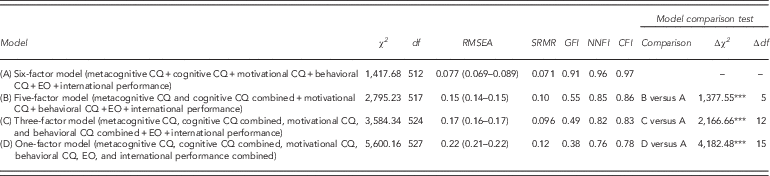
To determine if the scale items were adequate indicators of their underlying constructs, a measurement model with six latent factors (i.e., EO, the four dimensions of CQ, and international performance) was tested. Confirmatory factor analysis was conducted using covariance matrix and maximum likelihood estimation. The measurement model provided an acceptable fit to the data: χ2(512, N=206)=1,417.68, p<.001; GFI=0.91; CFI=0.97; NNFI=0.96; RMSEA=0.077. All of the standardized factor loadings were significant and greater than 0.40. The results showed that normalized residuals were less than 2.58, and modification indices were less than 3.84 (Anderson & Gerbing, Reference Anderson and Gerbing1988). Moreover, we found that the average variances extracted was greater than 0.50 for all constructs, and the composite reliability measures were all greater than 0.70. In addition, we compared relative fit of the six-factor model with alternative models. First, a five-factor model in which the metacognitive and cognitive factors were combined yielded a relatively poor fit: χ2(517, N=206)=2,795.23, p<.01; GFI=0.55; CFI=0.86; NNFI=0.85; RMSEA=0.15. Second, a three-factor model in which the metacognitive, cognitive, motivational, and behavioral factors of CQ were combined resulted in a relatively poor fit: χ2(524, N=206)=3,584.34, p<.01; GFI=0.49; CFI=0.83; NNFI=0.82; RMSEA=0.17. Finally, one-factor model with all items loading on a single factor provided the worst fit: χ2(527, N=206)=5,600.16, p<.001; GFI=0.38; CFI=0.78; NNFI=0.76; RMSEA=0.22. The findings supported that the hypothesized six-factor model provided the best fit compared with the other three models (Anderson & Gerbing, Reference Anderson and Gerbing1988). Taken together, the fit indices of the nested models showed that EO, the four dimensions of CQ, and international performance were distinct constructs (see Table 1).
To account for common method bias problem, we followed the suggestions of Podsakoff, MacKenzie, Lee, and Podsakoff (Reference Ng, Van Dyne and Ang2003) and used procedural remedies to ensure that this problem is minimized or reduced. For example, we assured anonymity to the respondents; we used the questionnaire items which were based on previously developed scales; and we placed the questions that belong to study variables in different sections of the questionnaire so that the respondents could not establish a linkage between the variables. Moreover, since our study model considers interaction effects, the respondents hardly make any connection between the variables (Chang, van Witteloostuijn, & Eden, Reference Chang, van Witteloostuijn and Eden2010). We employed a post hoc investigation, Harman’s (Reference Hambrick and Mason1976) single factor test. The results indicated that all items used to measure the constructs did not load on a single factor. They loaded on their expected factors each with an eigenvalue greater than 1.0. The initial eigenvalues indicated that the first factor explained 17% of the variance, the second factor 16% of the variance, the third factor 11% of the variance, the fourth factor 11% of the variance, the fifth factor 10% of the variance, and the sixth factor 6% of the variance. The sixth factor solution, which explained 71% of the variance, indicated construct validity for the study measures. We believe that common method bias was unlikely to be a serious concern of the current study (Podsakoff et al., Reference Ng, Van Dyne and Ang2003).
Comparing the fit of alternative nested models for the study variables

Note. CFI=comparative fit index; CQ=cultural intelligence; EO=entrepreneurial orientation; GFI=goodness-of-fit index; NNFI=non-normed fit index; RMSEA=root mean square error of approximation with 90% confidence interval; SRMR=standardized root mean square of residuals.
***p<.001. n=206.
Descriptive and correlation statistics, and hypothesis testing
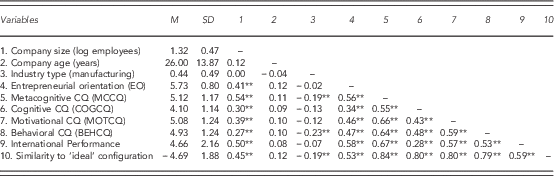
Table 2 shows the means, standard deviations, and correlation coefficient estimates for all the study variables. Firm size (r=0.50, p<.01), EO (r=0.58, p<.01), metacognitive CQ (r=0.67, p<.01), cognitive CQ (r=0.28, p<.01), motivational CQ (r=0.57, p<.01), and behavioral CQ (r=0.53, p<.01) were positively and significantly correlated with international performance.
Means, standard deviations, and correlations between the study variables

Note. CQ=cultural intelligence.
**p<.01. n=206.
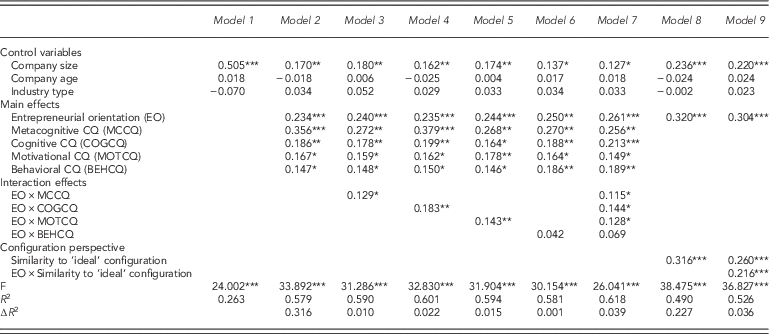
Hierarchical moderated regression analysis was used to test the study’s hypotheses (Cohen & Cohen, Reference Cohen and Cohen1983). The independent and moderating variables were mean centered prior to inclusion in the regression model, so as to minimize multicollinearity (Aiken & West, Reference Aiken and West1991). Given that all variance inflation factor values in estimated models were below the threshold of 10, multicollinearity was not an issue in the present study (Tabachnik & Fidell, Reference Sternberg and Detterman1996; Hair, Anderson, Tatham, & Black, Reference Govindarajan1998). Hierarchical moderated regression analysis results are shown in Table 3.
Regression analysis results

Note. Unstandardized coefficients (two-tailed p-values).
*p<.05; **p<.01; ***p<.001.
In the first model control variables were included. In the second model the main effects of the independent and moderating variables were added. As shown in Model 2 (Table 3), the results indicated that EO had a significant positive main effect on international performance (b=0.23, SEb=0.05, β=0.23, t(197)=4.010, p<.001), which is in line with previous research on EO–performance relationship. Moreover, international performance was positively affected by metacognitive CQ (b=0.35, SEb=0.08, β=0.35, t(197)=4.418, p<.001), cognitive CQ (b=0.18, SEb=0.05, β=0.18, t(197)=3.266, p<.01), motivational CQ (b=0.16, SEb=0.06, β=0.16, t(197)=2.554, p<.05), and behavioral CQ (b=0.14, SEb=0.06, β=0.14, t(197)=2.217, p<.05). These variables in Model 2 explained additional variance (∆R 2=0.316, p<.001).
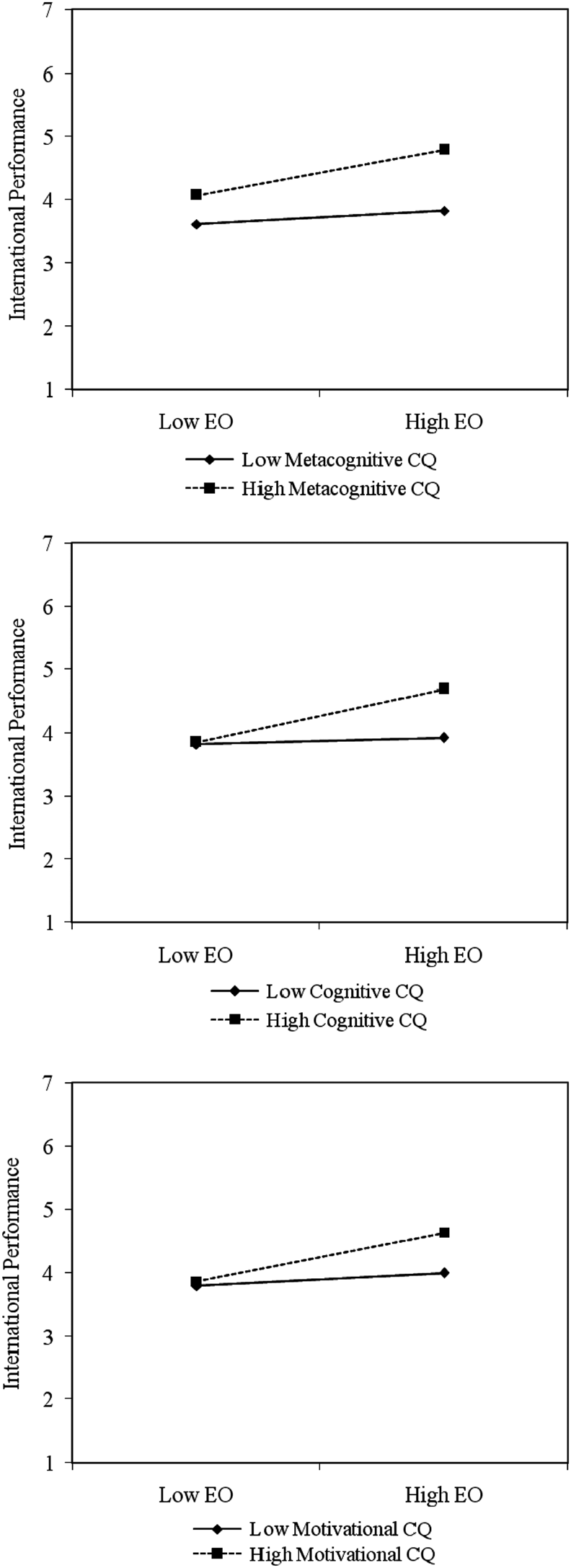
Hypotheses 1a–1d predicted that the four dimensions of CQ would moderate the positive relationship between EO and international performance, such that these positive relationships would be stronger at higher level of the four dimensions of CQ. To test these hypotheses, we included the two-way interactions formed by crossing independent and moderating variables in Models 3–6, and all two-way interactions simultaneously in Model 7. Results (Table 3) indicate that the interaction between EO and metacognitive CQ (EO×MCCQ) on international performance was significant and, as predicted by Hypothesis 1a, in the positive direction (Model 3: b=0.12, SEb=0.05, β=0.13, t(196)=2.230, p<.05). Simple slope analysis (Aiken & West, Reference Aiken and West1991) showed that the effect of EO on international performance was contingent upon a high level of metacognitive CQ of top managers (sb=0.42, SEb=0.08, β=0.43, t=4.948, p<.001), whereas it was ineffective in top managers with a low level of metacognitive CQ (sb=0.13, SEb=0.08, β=0.14, t=1.614, p=.107). The significant interaction between EO and metacognitive CQ predicting international performance is shown in Figure 2. In total, the findings provide strong support for Hypothesis 1a.
Moderation of the relationship between the entrepreneurial orientation (EO) and international performance by the dimensions of cultural intelligence (CQ)

The interaction between EO and cognitive CQ (EO×COGCQ) on international performance was positive and significant (Model 4: b=0.18, SEb=0.05, β=0.17, t(196)=3.289, p<.01), as predicted by Hypothesis 1b. Simple slope analysis showed that the effect of EO on international performance was contingent upon a high level of cognitive CQ of top managers (sb=0.46, SEb=0.08, β=0.45, t=7.141, p<.001), whereas it was ineffective in top managers with a low level of cognitive CQ (sb=0.06, SEb=0.08, β=0.04, t=0.808, p=.419). Figure 2 shows the significant interaction between EO and cognitive CQ predicting international performance. In sum, the findings provide strong support for Hypothesis 1b.
The interaction between EO and motivational CQ (EO×MOTCQ) on international performance was positive and significant (Model 5: b=0.14, SEb=0.05, β=0.14, t(196)=2.704, p<.01), as predicted by Hypothesis 1c. Simple slope analysis showed that the effect of EO on international performance was contingent upon a high level of motivational CQ of top managers (sb=0.54, SEb=0.07, β=0.53, t=7.366, p<.001), whereas it was ineffective in top managers with a low level of motivational CQ (sb=0.09, SEb=0.07, β=0.09, t=1.220, p=.223). The significant interaction between EO and motivational CQ predicting international performance is shown in Figure 2. In sum, the findings provide strong support for Hypothesis 1c.
Hypothesis 1d was not supported, as the interaction between EO and behavioral CQ did not affect international performance (Model 6: b=0.04, SEb=0.05, β=0.04, t(196)=0.826, p=.410). When all two-way interactions were introduced simultaneously in Model 7 the findings remained largely the same. The results indicated that significant two-way interactions in Model 3–5, as well as all two-way interactions in Model 7 accounted for a significant proportion of the variance in international performance.
Hypothesis 2 stated that the similarity of top manager capacity to the ‘ideal’ configuration of CQ would moderate the positive relationship between EO and international performance, such that the relationship would be stronger when the similarity is higher. In Model 8, we added the main effects of EO and the similarity to the ideal configuration. The addition of EO and the similarity to the ideal configuration in Model 8 increased the explained variance significantly for international performance (ΔR 2=0.227, p<.001). The results indicated a significant and positive main effect for the similarity to the ideal configuration on international performance (b=0.31, SEb=0.06, β=0.30, t(200)=4.909, p<.001). Finally, Model 9 included the two-way interactions formed by crossing EO and the similarity to the ideal configuration. The interaction was positive and significant (Model 9: b=0.21, SEb=0.05, β=0.20, t(199)=3.881, p<.001), lending support to Hypothesis 2. Furthermore, the interaction term accounted for a significant proportion of the variance in international performance (ΔR 2=0.036, p<.001). Examination of the interaction plot (Figure 3) shows that as EO and the similarity to the ideal configuration increased, international performance increased. When similarity to the ideal configuration was high, the relationship between EO and international performance was positive (sb=0.52, SEb=0.07, β=0.53, t=6.609, p<.001) and when the similarity was low the relationship between EO and international performance was not significant (sb=0.08, SEb=0.08, β=0.07, t=1.045, p=.297). In sum, Hypothesis 2 was supported by the results.
The moderating effect of the degree of similarity to the ideal configuration of cultural intelligence (CQ) on the relationship between entrepreneurial orientation (EO) and international performance

Alternative analyses
To determine the robustness of the present results, additional analyses were conducted. First, regression models were estimated with the inclusion of different subsets of control variables, such as manager’s age, level of educational, international experience (work, education, and travel), and foreign language ability. The inclusion or exclusion of specific control variables did not alter the direction or significance of the focal interaction coefficients. In all cases the results remained stable and significant.
Next, using the mean of the each four moderator variables, the sample divided into two parts and regression models were run for each part. The relationship between EO and international performance was positive and significant in the top managers with a high level of metacognitive CQ (b=0.45, p<.001), cognitive CQ (b=0.70, p<.001), motivational CQ (b=0.34, p<.001), and behavioral CQ (b=0.23, p<.05). At low levels, the relationship between EO and international performance was significant only for cognitive CQ (b=0.28, p<.001), but was not significant for metacognitive, motivational, and behavioral CQ.
Finally, following the approach recommended by Landis and Dunlap (Reference Kuivalainen, Sundqvist and Servais2000), the direction of causality between EO and international performance was assessed. A cross-sectional study design, as used in the present study, can be prone to reverse causation. International performance was used as the independent variable and EO was the dependent variable. The interaction between the new independent variable (international performance) and the moderating variable (CQ) was tested. The findings show that none of the interaction effects were significant. The effect of the interaction between international performance and metacognitive CQ (b=−0.04, p=.471), cognitive CQ (b=−0.07, p=.256), motivational CQ (b=−0.06, p=.354), and behavioral CQ (b=−0.07, p=.267) on EO was not significant. These results yielded minimal concern for reverse causality (Landis & Dunlap, Reference Kuivalainen, Sundqvist and Servais2000). In total, these findings are very consistent with the earlier findings of the present study, suggesting that the results are quite robust.
DISCUSSION
The present study aimed to determine whether the relationship between EO and international performance is contingent upon top manager’s CQ. The present findings show that the effect of EO on international performance of SMEs largely depends on top manager’s CQ, which is conceptualized as a complementary form of intelligence indicative of an individual’s capability to function effectively in settings characterized by cultural diversity (Earley & Ang, Reference Earley and Ang2003; Earley & Peterson, 2004). As expected, it was observed that some dimensions of top manager’s CQ, as well as the ideal configuration of CQ moderate the relationship between EO and a firm’s international performance.
Two major theoretical perspectives were adapted in an effort to explain the role of CQ in strengthening the relationship between EO and international performance. First, drawing upon the resource-based view (Barney, Reference Barney1991) the present findings show that three of the four dimensions of CQ (metacognitive, cognitive, and motivational) are individual key capabilities associated with human capital, each of which strengthens the EO–international performance relationship. CQ of top managers can be considered a managerial resource, as it correlates directly to human capital that can affect the implementation of EO.
In addition, the present study’s ideal configurational perspective indicates that when top manager possesses high levels of all four CQ capabilities, the EO–international performance relationship is stronger. These findings are consistent with the resource-based notion that resources that are rare, valuable, inimitable, and original enable a firm to improve its efficiency. Following several researchers’ call for how internal resources affect the EO–international performance relationship (Wales, Gupta, & Moussa, Reference Wales, Gupta and Moussa2013; Covin & Miller, Reference Covin, Green and Slevin2014; Muchiri & McMurray, Reference Morgan, Vorhies and Schlegelmilch2015), this paper empirically tests top manager’s CQ as a moderator of the EO–international performance relationship. The present findings are also in line with the upper echelons tenet (Hambrick, Reference Hair, Anderson, Tatham and Black2007), which posits that top managers play an important role in shaping an organization’s major strategies and performance. Previous studies have identified the influence of top managers’ demographic and managerial attributes on organizational outcomes. Moreover, in their review of the upper echelons research, Carpenter, Geletkanycz, and Sanders (Reference Carpenter, Geletkanycz and Sanders2004) call for future research to examine how top managers’ variables interact to predict organizational outcomes. This paper shows how EO and CQ of top managers interact to predict international performance. However, not all entrepreneurial activities lead to internationalization of SMEs (Fletcher, Reference Fiss2004). Therefore, future upper echelon studies might include several executive level variables to examine and compare the configuration of several characteristics and competencies of top managers of SMEs operating in domestic and international markets. For example, Rockstuhl, Seiler, Ang, Van Dyne, and Annen (Reference Ripollés-Meliá, Menguzzato-Boulard and Sánchez-Peinado2011) found that emotional intelligence (EQ) is a stronger predictor of domestic leadership effectiveness, and CQ is a stronger predictor of cross-border leadership effectiveness. This finding is important because it shows the value of the competency requirements of the situation. To provide additional insight into upper echelons theory and entrepreneurship studies, we recommend future research on within-culture capabilities (such as EQ) and cross-cultural capabilities (such as CQ) that may moderate the association between EO and firm performance.
The present findings also advance the notion that managerial attributes and internal factors affect the relationship between EO and international performance (e.g., Covin, Green, & Slevin, Reference Covin and Slevin2006). For example, Engelen et al. (2015) reported that four of six transformational leadership behaviors positively influence the relationship between EO and a firm’s performance, based on the same configurational perspectives. De Clercq, Dimov, and Thongpapanl (Reference De Clercq, Dimov and Thongpapanl2010) observed that social processes (i.e., procedural justice, trust, and organizational commitment) can enhance or diminish the relationship between EO and a firm’s performance, according to a social exchange theory perspective. The present study extends this line of research, as the findings indicate that CQ of top managers can strengthen the relationship between EO and international performance.
In contrast to our expectation, behavioral CQ of top managers was not a moderator of the EO–international performance relationship. There is no doubt that language skill is important for behavioral CQ, specifically to exhibit culturally appropriate verbal and nonverbal expressions when interacting with people from different cultural backgrounds (Earley & Ang, Reference Earley and Ang2003). Though English has become the language of business (Babcock & Du-Babcock, Reference Babcock and Du-Babcock2001), individuals from different countries use various varieties of the English language. Communication accommodation theory discusses how people change their linguistic patterns when interacting with people from a different cultural background and language abilities (Giles, Coupland, & Coupland, Reference Garten1991). However, it is not always easy to accommodate toward the partners culture and their language skills, since individuals from different countries have varying levels of English language proficiency which makes a critical challenge that behavioral CQ presents for intercultural communication (Rogers, Reference Rockstuhl, Seiler, Ang, Van Dyne and Annen2008). In our research, most of the surveyed Turkish SMEs have business interactions with non-native English speaking counterparts from various countries (i.e., European, Asian, and African countries). English is the second language for most of the business partners from different countries, including Turkey. Behavioral CQ refers to the extent to which an individual displays situationally appropriate verbal and nonverbal behaviors in cross-cultural situations (Ang & Van Dyne, Reference Ang and Van Dyne2008; Van Dyne et al., Reference Van Dyne, Ang, Ng, Rockstuhl, Tan and Koh2012). Examining the average scores of CQ dimensions indicates that top managers rated themselves relatively high in behavioral CQ (M=4.93). Perhaps they perceived that they act appropriately (both verbally and nonverbally) in cross-cultural situations, but in fact they may have low levels of language proficiency which is important for behavioral CQ (Rogers, Reference Rockstuhl, Seiler, Ang, Van Dyne and Annen2008). The lack of significant interaction of behavioral CQ and EO may be due to the difference between the perception of behavior or ability and the actual behavior or ability. Surely, additional research is needed to measure the actual behavioral CQ and perceived behavioral CQ, which may explain why this study failed to find moderator effect for behavioral CQ.
The present study also advances works on CQ literature. Earlier studies have disaggregated CQ into its dimensions (e.g., Ang & Van Dyne, Reference Ang and Van Dyne2008). Absent from the CQ literature is a consideration of a configurational perspective (Meyer, Tsui, & Hinnings, Reference McDougall and Oviatt1993; Dess, Lumpkin, & Covin, Reference Dess, Lumpkin and Covin1997). The present findings preliminarily indicate that use of a configurational perspective while studying CQ could improve our understanding of the relationship between EO and international performance.
Limitations and avenues for further research
The present study has several limitations which may also offer opportunities for research. First, the sample was based on Turkish SMEs, which limits the generalizability of the findings. Previous works (e.g., Steenkamp & De Jong, Reference Schweizer, Vahlne and Johanson2010) suggest that some cultures (e.g., American) have lower global identity indicating that motivational CQ might be weaker in the American and similar cultures. As such, we think further research should seek to determine whether the moderating role of CQ is a uniquely Turkish phenomenon or whether it exists in other cultures using a multi-country samples. Second, as the present study analyzed cross-sectional data, it is difficult to claim causal inferences among the variables; therefore, future studies that use a longitudinal design might yield more reliable results.
Third, to examine the configurational perspective, we used the deviation scores that indicate the difference between ideal profiles of CQ dimensions and the empirical profiles of SMEs in our sample. However, this method may provide limited understanding of the black box of configurations. A set-theoretic approach of organizational configurations is more promising since it examines how different firm characteristics combine rather than compete to produce an outcome (Fiss, Reference Evans2007). This approach based on fuzzy set qualitative comparative analysis looks for the effect of essential configurations and adequate explanatory characteristics rather than for the impact of each particular characteristic holding equal the other characteristics (Ragin, Reference Podsakoff, MacKenzie, Lee and Podsakoff2000; Fiss, Reference Fiss2011). Thus, we recommend that future studies attempt to use fuzzy set qualitative comparative analysis for identifying managerial characteristics in organizational settings that are associated with successful outcomes, such as firm performance.
Fourth, following the recommendations of the related literature, we controlled for firm-related variables (firm size, firm age, and industry type). Further, to test the robustness of the present study’s findings, we controlled for manager-related variables (age, level of educational, international experience [work, education, and travel], and foreign language ability). Nevertheless, we limited the number of constructs included in our research. We recommend that future research consider additional control variables in examining CQ as a contingency of the relationship between EO and international performance. For example future research could include manager-related variables, such as general mental ability and personality. Since, CQ relates to but is distinct from general mental ability and personality traits (Ang & Van Dyne, Reference Ang and Van Dyne2008), future studies controlling for these variables could provide additional insights into the incremental value of the moderator variable CQ.
Finally, the present study employed subjective measures of international performance. Even though subjective evaluation has been widely used in EO research, it might not accurately measure actual performance. Additional research that objectively measures international performance of SMEs would yield more accurate findings. Similarly, all variables were measured via self-report, which another way that common method variance may have affected the results, perhaps inflating the correlations (Podsakoff et al., 2003). Nonetheless, Evans conducted a Monte Carlo simulation and reported that ‘artifactual interactions cannot be created; true interactions can be attenuated’ (Reference Escriba-Esteve, Sanchez-Peinado and Sanchez-Peinado1985, p. 305). This finding suggests that the existence of interactions between the study variables tends to rule out the possibility of the results being an artifact of common method variance. Nevertheless, this issue could be addressing in subsequent studies.
Managerial implications
Several important practical implications can be derived from the present study’s findings. First, the present findings clearly show that EO is a significant predictor of international performance, as previously reported (e.g., Covin, Green, & Slevin, Reference Covin and Slevin2006); however, in order to convert EO into superior international performance top managers must have a high level of CQ. Organizations should strive to ensure that their top managers possess a high level of CQ, with a particular emphasis on its metacognitive, cognitive, and motivational dimensions. Thus, enhancing CQ of top manager is one method that can be used to improve the international performance of SMEs. As the literature indicates that CQ can be learned, developed, and enhanced (Earley & Mosakowski, Reference Earley and Mosakowski2004; Ng, Van Dyne, & Ang, Reference Ng and Earley2012), organizations can use several tools, including, cultural training in a lecture format (Rehg, Gundlach, & Grigorian, Reference Reed and Defilippi2012) and direct involvement in cross-cultural experience (Şahin, Gürbüz, & Köksal, Reference Steenkamp and de Jong2014), to improve the dimensions of CQ. Second, SMEs are considered pivotal drivers of economic development in most countries; therefore, we also suggest that organizations or governmental agencies that want to improve the international business performance of SMEs should emphasize CQ training as a key policy. Third, because the link between EO and international performance is contingent upon CQ of top managers, SMEs should seek to hire top level managers with a high level of CQ to ensure success in today’s integrated economy.
Conclusion
On the basis of resource-based view (Barney, Reference Barney1991) and upper echelons theory (Hambrick & Mason, Reference Hambrick1984), the present study integrates the concepts of EO and CQ of top managers to illustrate that top manager’s CQ moderates the relationship between EO and international performance. Despite the extant research on the positive link between EO and performance, CQ of top managers has remained underrepresented within the EO–international performance framework. To the best of our knowledge the present study is the first to advance our understanding of the role of CQ of top managers in the relationship between EO and a firm’s international performance. The present study provides empirical evidence that CQ of top managers may provide a boost to the effect of EO on international performance of the Turkish SMEs. We encouraged research efforts directed at expanding and testing the present study’s findings and predictions in varied contexts and larger firms.
Acknowledgement
The authors thank the editor and anonymous reviewers for their constructive comments and suggestions. This work was supported by the Scientific and Technological Research Council of Turkey (TÜBITAK), grant number SOBAG 114K864. The authors are grateful for financial support from the TÜBITAK.