INTRODUCTION
Individuals with dementia experience difficulty with everyday tasks, such as meal preparation and grooming (American Psychiatric Association, 2000; Giovannetti et al., Reference Giovannetti, Libon, Buxbaum and Schwartz2002). To circumvent these difficulties, clinicians often recommend that caregivers reduce or eliminate clutter in patients’ workspaces. However, studies of distractor interference in everyday action have reported inconsistent findings, with some suggesting that distractors do not influence error rates. For instance, Schwartz and colleagues (Reference Schwartz, Montgomery, Buxbaum, Lee, Carew and Coslett1998) reported that individuals with closed head injury committed a comparable number of errors on everyday tasks (e.g., wrap a gift) whether or not functionally related (and often visually similar) distractor objects were presented along with target objects (e.g., garden shears as a distractor for scissors). This observation was replicated in two subsequent group studies of people with right (Schwartz et al., Reference Schwartz, Buxbaum, Montgomery, Fitzpatrick-DeSalme, Hart and Ferraro1999) or left (Buxbaum, Schwartz, & Montgomery, Reference Buxbaum, Schwartz and Montgomery1998) hemisphere stroke. These studies were not designed specifically to investigate the impact of distracting objects on action performance; thus the same everyday tasks were not administered both with and without distractor objects. In fact, the task conditions differed on multiple parameters, including the number of task steps, the number of tasks goals, and so on. It is possible that these task differences may have masked the impact of distractors. However, consistent with these negative findings, Humphreys and Forde (Reference Humphreys and Forde1998) reported no impact of distractors on everyday action performance in detailed case reports of two patients with marked everyday action impairment and diffuse brain damage from carbon monoxide poisoning (F.K.) or stroke (H.G.). F.K. and H.G. were administered the same tasks (e.g., wrap a present, make tea, etc.) both with and without semantically similar distractor objects (e.g., knife for scissors).
On the other hand, Humphreys and Forde (Reference Humphreys and Forde1998) reported a third participant (D.S.) in the same paper who made twice as many errors on everyday tasks in the face of distractor objects. D.S. had relatively circumscribed damage to the prefrontal cortex, impairment on only tests of executive control, and mild difficulties with everyday tasks. Niki, Maruyama, Muragaki, and Kumada (Reference Niki, Maruyama, Muragaki and Kumada2009) also recently described three individuals with right frontal brain lesions who showed high error rates when performing everyday tasks in the presence of distractors; virtually no errors were committed without distractors. The methodology of Niki et al. (Reference Niki, Maruyama, Muragaki and Kumada2009) differed from prior experiments, such that a set of distractors that could be used together to perform a secondary, nontarget task were presented. Distractor sets were either related (e.g., objects used to make tea) or unrelated (e.g., objects used to write a letter) to the target task (e.g., coffee making).
In addition to inconsistencies surrounding whether or not distractors impact performance, investigators have posited competing accounts regarding the mechanism by which distractor objects may perturb everyday action. Detailed analysis of D.S.’ action errors showed an isolated increase in semantic substitutions, suggesting target-related distractors exerted a relatively specific effect on object selection processes (Humphreys & Forde, Reference Humphreys and Forde1998). We have reported a similar finding in a heterogeneous sample of dementia patients (Giovannetti et al., Reference Giovannetti, Libon, Buxbaum and Schwartz2002). Overall error rates were comparable, but object substitution errors occurred significantly more often when salient distractor objects were present than when distractors were absent or were dissimilar to the target objects. Although this finding held even after controlling for opportunities for substitution errors across tasks, like the studies of Schwartz and colleagues (Reference Schwartz, Montgomery, Buxbaum, Lee, Carew and Coslett1998, Reference Schwartz, Buxbaum, Montgomery, Fitzpatrick-DeSalme, Hart and Ferraro1999) described above, the same tasks were not administered across distractor conditions.
Others have shown that related distractor objects are incorporated into the task in a novel manner (e.g., crumpling writing paper for use as packing material when wrapping a gift; Niki et al., Reference Niki, Maruyama, Muragaki and Kumada2009). Here, interference effects are observed in the form of additional, sometimes tangential, task steps. Another group of studies have suggested that distractor objects may have a more diffuse effect on action performance. Schwartz et al. (Reference Schwartz, Montgomery, Buxbaum, Lee, Carew and Coslett1998) reported a nonsignificant trend for more omission errors when participants with closed head injury completed tasks in the presence of distractor objects, even though there were no significant differences in total errors and omission rates were standardized for differences in error opportunities. This same nonsignificant trend was reported among participants with right-hemisphere stroke (Schwartz et al., Reference Schwartz, Buxbaum, Montgomery, Fitzpatrick-DeSalme, Hart and Ferraro1999). Schwartz & colleagues (Reference Schwartz, Montgomery, Buxbaum, Lee, Carew and Coslett1998, Reference Schwartz, Buxbaum, Montgomery, Fitzpatrick-DeSalme, Hart and Ferraro1999) proposed that distractors increase task complexity, thereby imposing greater demands on the attentional resources necessary for the multitude of processes associated with everyday tasks (Schwartz et al., Reference Schwartz, Montgomery, Buxbaum, Lee, Carew and Coslett1998).
Finally, little is known regarding which distractor features are most strongly associated with interference effects. According to studies of visual search, distractor familiarity and similarity to targets are known to modulate interference (Bichot & Schall, Reference Bichot and Schall1999; Greene & Rayner, Reference Greene and Rayner2001). We have demonstrated that substitution errors made by healthy controls on a complex coffee-making task (e.g., using sugar when instructed to use artificial sweetener) were influenced by the visual and functional similarity between the target and nontarget object (Giovannetti, Schwartz & Buxbaum, Reference Giovannetti, Libon, Brennan, Bettcher, Sestito and Kessler2007). This pattern was not observed in a patient with alien hand syndrome due to a lesion of the medial frontal lobe (Giovannetti et al., Reference Giovannetti, Buxbaum, Biran and Chatterjee2005). Bickerton, Humphreys, & Riddoch (Reference Bickerton, Humphreys and Riddoch2007) examined the impact of object familiarity on object selection/use in everyday action and found that individuals with action difficulties made more errors when using unfamiliar target objects than more familiar/prototypical target objects. Although object familiarity has not been evaluated in studies of distractors, the findings of Bickerton et al. (Reference Bickerton, Humphreys and Riddoch2007) suggest that unfamiliar distractors might elicit weaker interference effects than familiar distractors. These distractor features (i.e., visual & functional similarity to targets; familiarity) were evaluated in the present study.
Many questions regarding distractor interference effects on everyday action remain unanswered. This is due partly to variability in methodology, with some studies using paradigms that were not optimal for addressing specific questions regarding distractor interference effects. For example, the same tasks often were not administered across conditions, and performance with distractors was typically compared with performance without distractors, which confounds the influence of distractors and task complexity (Humphreys & Forde, Reference Humphreys and Forde1998). Virtually nothing is known regarding everyday distractor interference in dementia. We know of no prospective research that has directly examined this issue in dementia, a population that faces serious negative outcomes associated with ubiquitous everyday action difficulties.
The overarching aim of this study was to evaluate three important theoretical issues regarding distractor effects using rigorous, performance-based methods in a population with significant clinical need for information on functional deficits and therapeutic strategies. We first evaluated whether distractor objects that were functionally and visually similar to target objects interfered with everyday action. We predicted that participants would exhibit greater interference (i.e., higher error rates) when performing everyday tasks in the presence of target-related distractors as compared to unrelated distractors. Unlike previous studies, this manipulation afforded the possibility to evaluate the effect of target-related distractors while controlling for task demands and complexity (i.e., number of objects in the array). Second, we investigated the nature of interference effects from highly salient distractors through detailed analyses of performance. If interference effects pervasively disrupted task performance, then we would observe differences on multiple variables across the distractor conditions (i.e., completion of task steps, task sequencing, etc). However, if interference effects were circumscribed to target selection, then we would observe a specific effect on object substitution errors (e.g., selecting salt instead of sugar when making coffee). Third, we evaluated the distractor properties that influenced interference effects, and based on the visual search literature, we predicted that visual similarity to the target, functional similarity to the target, and distractor familiarity would be related to distractor errors in everyday action.
METHODS
Participants
Twenty participants were recruited from an outpatient dementia program that included examination by a neurologist, neuropsychologist, geriatrician, and a social worker; neuroimaging and diagnostic laboratory studies; and an interdisciplinary team conference for diagnosis. Participants met DSM-IV criteria for dementia (American Psychiatric Association, 2000) and exhibited mild-moderate impairment (Mini Mental-State Exam = 12-26; Folstein, Folstein, & McHugh, Reference Folstein, Folstein and McHugh1975). Individuals with any dementia subtype were recruited to include participants with a variety of cognitive deficits and for our conclusions to generalize to a general clinic population. Exclusion criteria included cortical stroke, insufficient attention to tolerate testing, motor/sensory deficits precluding object grasping, and/or history of head injury, epilepsy, premorbid neurological illness, or long-standing psychiatric illness.
Procedure
Participants signed IRB-approved informed consent forms and were compensated $30.00 for their participation ($15 per session).
Everyday action performance
A modified version of the Naturalistic Action Test (NAT; Schwartz, Segal, Veramonti, Ferraro, & Buxbaum, Reference Schwartz, Segal, Veramonti, Ferraro and Buxbaum2002; Schwartz, Buxbaum, Ferraro, Veramonti, & Segal, Reference Schwartz, Buxbaum, Ferraro, Veramonti and Segal2003), called Distractor-NAT, was administered. A single task from each of the three original NAT items was administered: Item 1, prepare a cup of instant coffee with cream and sugar; Item 2, wrap a gift for a small childFootnote 1; Item 3, pack a lunch box with a sandwich, drink, and snack. As described in the NAT manual, instructions included verbal direction of the task objectives as well as a line drawing depicting the end product of each task (e.g., wrapped gift box). The examiner offered little guidance during the task; assistance only on steps requiring motor strength (e.g., opening jars) or dexterity (e.g., removing the adhesive backing from the decorative bow) was permitted if the participant independently initiated an action or specifically requested help with motor actsFootnote 2. Nondirective cues were administered when the participant stopped working or was not making progress (e.g., Are you finished?). Objects for each task were placed in a designated location on a U-shaped tabletop at the start of each item. Participants were told that they should use only what they needed for each task. Before beginning each item, participants were asked to repeat the task directions.
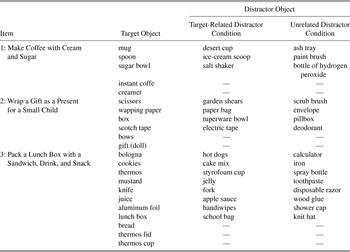
The Distractor-NAT was administered under two conditions: (1) Target-Related Distractors and (2) Unrelated Distractors. These conditions were counterbalanced across participants and administered across two test sessions. Test sessions were separated by at least one week but no more than 4 weeks, to minimize the effects of disease progression and practice. In the Target-Related Distractors condition, distractors that were functionally and visually similar to target objects were included in the array. In the Unrelated Distractors condition, distractors were not similar to the target but care was taken to select objects that could be used in place of the target object. Thus, we could rule out the possibility that unrelated distractor objects were not selected because their use was not possible. As shown in Table 1, the unrelated distractor for the coffee mug (i.e., ashtray) could contain the coffee, cream, and sugar. Similarly, the hydrogen peroxide, the unrelated distractor for the sugar, could be added to the coffee; the paintbrush, which was the unrelated distractor for the spoon, was small enough so that it could be used to stir the contents of the mug or ashtray. Table 1 lists all of the targets and distractors for each item and condition.
Target and Distractor Objects per Modified NAT Item and Condition

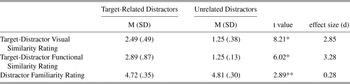
Ratings pertaining to the visual and functional similarity between target objects and distractor objects were obtained from healthy older adults as a manipulation check and to evaluate the influence of these variables on Distractor-NAT performance. Controls also were asked to rate all distractors for their familiarity (e.g., the frequency with which an object is viewed or used). Details regarding ratings are provided in the Appendix. In brief, control ratings confirmed that the distractors in each condition significantly differed in terms of their functional and visual similarity to targets. Control familiarity ratings for unrelated distractor objects were somewhat higher than the distractor objects used in the Target-Related condition, which might have biased participants to select unrelated distractor objects (Bickerton et al., Reference Bickerton, Humphreys and Riddoch2007). Because this potential bias works against the selection of target-related distractor objects, we were not concerned by its effect, but we considered this finding when interpreting our results (see the Discussion section).
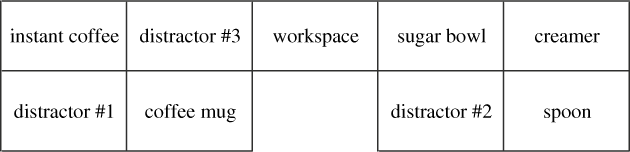
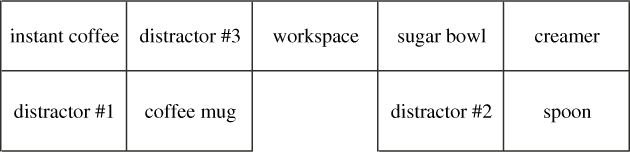
Target and distractor objects for each item were evenly distributed to the right and left of the participant on the U-shaped table, but the objects were not grouped or ordered in any meaningful manner. The location of targets and distractors was identical across conditions. See Figure 1 for an example of the object arrangement for Item 1.
Schematic showing target object and distractor placement for modified NAT Item 1 (coffee with cream and sugar). Distractor 1, desert cup/ashtray; distractor 2, ice-cream scoop/paintbrush; distractor 3, salt shaker/hydrogen peroxide.
Scoring procedures
Performance was videotaped for subsequent scoring. Novel scoring procedures to assess the impact of distractors on performance were developed for the present study. These scores were collected for both the Target-Related and Unrelated conditions:
Distractor scores. The number of distractors that were touched by participants was tallied for each condition (Distractor Touch; maximum = 15 per condition). A distractor was considered “touched” when a participant’s hand made contact with the object, even if he were simply moving the distractors to another location on the table. This score was collected to estimate the extent to which participants attended to distractors. The number of distractors that were used by participants also was tallied (Distractor Use; maximum = 15 per condition). Distractor Use was coded when a distractor object was used in any way (i.e., substitution, in place of a target object; addition, in an extra step tangential to the task goal, etc.).
Distractor Scores were summed for each distractor across the 20 participants (i.e., Total Distractor Touch & Total Distractor Use for ice-cream scoop, paintbrush, etc.). The maximum Distractor Score per object was 20. These scores were used in correlation analyses with distractor ratings (Target-Distractor Functional Similarity, Target-Distractor Visual Similarity; Distractor Familiarity) to evaluate which features influenced distractor selection and use.
Scores reflecting overall performance also were collected as described in previous publications (e.g., Schwartz et al., Reference Schwartz, Segal, Veramonti, Ferraro and Buxbaum2002, Reference Schwartz, Buxbaum, Ferraro, Veramonti and Segal2003):
Accomplishment score. The percentage of task steps completed. The maximum possible score was 100%, assigned for completion of 23 steps. Accomplishment points were assigned even for steps that were performed inaccurately or with distractors. For example, if on Item 1 a participant used the ice-cream scoop to add coffee to the mug, she was assigned credit for the step “add coffee.”
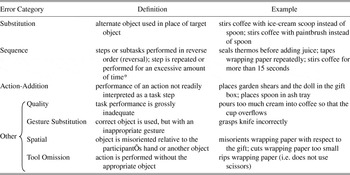
Commission errors. The total number of errors made on the NAT, excluding omissions, which were captured by the Accomplishment Score. Commission error categories were similar to those described in the NAT manual (i.e., Comprehensive Error Score; Schwartz et al., Reference Schwartz, Segal, Veramonti, Ferraro and Buxbaum2002; see also Buxbaum et al., Reference Buxbaum, Schwartz and Montgomery1998; Giovannetti et al., Reference Giovannetti, Libon, Buxbaum and Schwartz2002; Schwartz et al., Reference Schwartz, Montgomery, Buxbaum, Lee, Carew and Coslett1998, Reference Schwartz, Buxbaum, Montgomery, Fitzpatrick-DeSalme, Hart and Ferraro1999, Reference Schwartz, Segal, Veramonti, Ferraro and Buxbaum2002). For this study, we simplified the coding of sequence errors such that anticipation/omission errors (i.e., step anticipations that entail an omission; seal thermos without fill thermos) were considered omissions and captured on the Accomplishment Score. For this study, a sequence error was coded only when both steps in the series were performed in the reverse order (i.e., seal thermos before filling thermos at a later point in the task) or when a task step was repeated or performed for an excessive amount of time (i.e., perseveration). All error categories are defined in Table 2. Infrequent error types (i.e., tool omission, gesture, etc.) were collapsed into a single “other” category. Total Commission errors were tallied for each condition. In addition, the number of commission errors that did not involve distractor objects was tallied separately per condition (i.e., Non-Distractor Commissions).
Commission Error Categories

* “Excessive time” was defined according to normative data on healthy older adults. The cut point was defined as s 2 SD greater than the control M time spent on a task step (e.g., srirring, spreading mustard, etc.). Time spent on task steps was timed using videotapes of performance.
Completion time. The number of seconds participants spent working on the tasks. Time data were collected from videotape counters. Timing began when participants initiated the first step of each item and ended when they indicated that they had finished the item. Time scores were summed across items for each condition.
Inter-rater reliability
Inter-rater reliability between two coders was assessed for the Distractor Touch and Distractor Use scores that were developed for this study. Ten Distractor-NAT performances were randomly selected for reliability analysis. Inter-rater reliability for all other scores have been reported in previous publications (see Schwartz et al., Reference Schwartz, Montgomery, Buxbaum, Lee, Carew and Coslett1998, Reference Schwartz, Segal, Veramonti, Ferraro and Buxbaum2002, Reference Schwartz, Buxbaum, Ferraro, Veramonti and Segal2003).
Data analysis
Differences between the Target-Related and Unrelated conditions were examined using paired-sample t tests (Distractor-Touch; Total Commissions; Time to Completion). Variables that were not normally distributed were analyzed using Wilcoxon Signed Ranks tests (positively skewed, Distractor-Use; Commission subtypes; negatively skewed, Accomplishment Score). Both means and mean ranks were reported for all variables analyzed with Wilcoxon tests. For small samples, the power efficiency of the Wilcoxon is nearly 95 percent of the paired-sample t test (Siegal & Castellan, Reference Siegal and Castellan1998). Therefore, effect sizes for all Target-Related versus Unrelated analyses were estimated by Cohen’s d calculations (.2 = small; .5 = medium; .8 = large; Cohen, Reference Cohen1988). Finally, we performed correlations between each object’s Distractor Score and its mean Visual Similarity, Functional Similarity, and Familiarity Ratings.
RESULTS
Demographic Information
On average, dementia participants were 79 (±5.68) years old with 12 (±2.48) years of education. The sample was comprised of 11 women (55%) and 9 men (45%) with mild to moderate dementia (MMMSE = 22.75 [±2.71]) and no major depression (MGDS = 4.47 [±4.32]). Twelve participants (60%) met NINCDS-ADRDA criteria for Alzheimer’s disease (AD; McKhann, Drachman, Folstein, Katzman, Price, & Stadlan, Reference McKhann, Drachman, Folstein, Katzman, Price and Stadlan1984), 8 (40%) met the California Criteria (Chui, Victoroff, Margolin, Jagust, Shankle, & Katzman, Reference Chui, Victoroff, Margolin, Jagust, Shankle and Katzman1992) for probable/ possible ischemic vascular dementia (VaD).
Inter-rater Reliability for Distractor Scores
Raters demonstrated 95% agreement for Distractor Touch scores (Cohen’s kappa = .87) and 100% agreement for Distractor Use scores (Cohen’s kappa = 1.0).
Distractor Scores (Distractor Touch & Distractor Use)
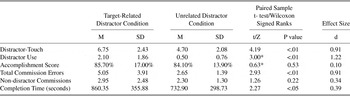
As shown in Table 3, participants touched significantly more distractors in the Target-Related Condition than the Unrelated Condition. Participants also used significantly more distractors in the Target-Related Condition (MRanks = 7.33 vs. 3.00).
Performance Variables on the Target-Related Distractor Condition vs. Target Unrelated Distractor Condition

* Z Score
Accomplishment Scores
On average, participants accomplished over 80% of task steps across both conditions. As shown in Table 3, mean Accomplishment Scores did not differ across conditions (MRanks: Target Related = 7.75; Unrelated = 5.88). Recall that steps performed with distractors were assigned accomplishment points.
Commission Errors
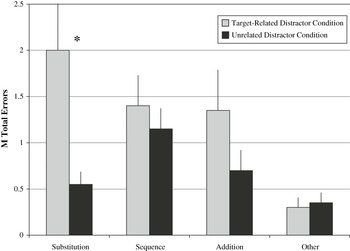
Participants made significantly more Total Commission errors in the Target-Related versus the Unrelated condition (see Table 3). The distribution of commission error types across conditions is shown in Figure 2. Participants made more Substitution, Sequence, and Addition errors in the Target-Related condition, but only the difference for Substitutions was significant (MRanks 8.35 vs. 2.50; z = 2.67; p < .01; d = 1.02). There was a small-medium (d = .44) effect for Additions, but the difference was nonsignificant (MRanks: Target-Related = 5.93, Unrelated = 4.50; z = 1.51; p = .13). The differences for Sequence and Other errors were small (d < .20) and nonsignificant (z < .84; p > .40 for both).
The M total errors by error type and condition. Error bars reflect +1 standard error. *Indicates a significant difference between the Target-Related and Unrelated conditions.

The two error types that were most different across the Target-Related and Unrelated conditions (Substitutions & Additions) often involve the selection and use of distractors. In fact, when commissions involving only target objects were analyzed (i.e., Non-Distractor Commissions), the difference between the conditions was weak and nonsignificant (see Table 3).
Time to Completion
Participants took significantly longer to complete the tasks in the Target-Related condition than the Unrelated condition (i.e., 14.34 vs. 12.22 min; see Table 3).
Distractor Object Analysis: Correlations between Distractor Scores and Control Ratings
When Distractor Scores were summed per object, the highest Distractor Use scores were obtained for distractors in the Target-Related Condition (Item 3, handiwipes = 8; Item 3, applesauce = 4; Item 1, ice-cream scoop = 4). The highest Distractor Touch scores were observed across both conditions (Item 3, shower cap = 19; Item 3, handiwipes = 18; Item 3, jelly = 15; Item 2, deodorant = 15). Only the iron (Item 3) was never touched by any of the participants, but there were 13 distractor objects that were never used (Item 1, hydrogen peroxide, paintbrush; Item 2, pill box, scrub brush, envelope, Tupperware; Item 3, iron, wood glue, hat, razor, cake mix, spray bottle). Correlations between Distractor Scores and Control Ratings showed that distractor objects that were more visually and functionally similar to target objects were used more often (see Table 4). However, this association was not observed for Distractor Touch scores, suggesting that the similarity to the target did not influence whether attention was directed to a distractor. Familiarity ratings were unrelated to Distractor Scores, even when correlations were run separately for Related and Unrelated distractors.
Spearman Rank Order Correlation Coefficients for Distractor Scores x Control Ratings of Distractor Objects

N = 30. *p = .01,**p < .01
DISCUSSION
To our knowledge, this was the first prospective study to directly examine everyday distractor interference in dementia. We observed greater interference when distractor objects were visually and functionally similar to targets than when distractors were unrelated to targets. Interference was relatively circumscribed to target selection, as participants touched and used significantly more distractors, made more distractor errors, and took longer to complete everyday tasks when distractors were visually and functionally similar to target objects than when distractors were unrelated to targets. Both visual and functional similarity to target objects influenced distractor interference effects. Familiarity did not influence whether distractors were used or touched; however, all distractors were very familiar and familiarity ratings were relatively constant.
Our findings are inconsistent with reports that distractor objects have little to no impact on everyday action (Buxbaum et al., Reference Buxbaum, Schwartz and Montgomery1998; Schwartz et al., Reference Schwartz, Montgomery, Buxbaum, Lee, Carew and Coslett1998, Reference Schwartz, Buxbaum, Montgomery, Fitzpatrick-DeSalme, Hart and Ferraro1999). At least three methodological differences between our study and past reports may have contributed to the discrepancy across studies. First, past studies did not include individuals with dementia. It is possible that the particular neurocognitive deficits that are most strongly associated with dementia (i.e., episodic memory impairment, progressive decline, etc.) make these individuals more vulnerable to interference effects (see Giovannetti et al., Reference Giovannetti, Libon, Buxbaum and Schwartz2002)Footnote 3. Second, the present study compared performance with different types of distractors (similar vs. unrelated), whereas past studies compared performance with distractors to performance without distractors in the array of task objects. Although intuition suggests that the latter experimental design might emphasize distractor effects, there is some evidence to suggest the possibility that tasks without distractors may not have sufficiently challenged participants to work to their optimal potential. For example, Schwartz et al. (Reference Schwartz, Montgomery, Buxbaum, Lee, Carew and Coslett1998) demonstrated that after controlling for differences in error opportunities, healthy participants made more errors on easier task conditions that required the completion of a single task as compared to more difficult conditions that required the completion of tasks with distractors and completion of more than one task at a time. It was postulated that under easy task conditions, participants may not exert sufficient resources to perform everyday tasks (see also Kahneman, Reference Kahneman1973; Locke, Saari, Shaw, & Latham, Reference Locke, Saari, Shaw and Latham1981). However, another drawback to past studies is that the same tasks were not administered across distractor conditions, which confounds the influence of distractors and task demands. Third, distractor-target similarity was empirically validated with ratings from healthy controls in the present study (see also Giovannetti, Schwartz, & Buxbaum, Reference Giovannetti, Schwartz and Buxbaum2007). Past studies have not consistently quantified distractor properties, making it difficult to conclude that distractors were sufficiently related to targets to elicit interference (see Schwartz et al., Reference Schwartz, Montgomery, Buxbaum, Lee, Carew and Coslett1998, p. 22). In summary, the methodological differences and inconsistent findings across studies underscore the need to carefully consider task complexity, the number of objects (i.e., targets & distractors) presented to participants, and other task parameters when investigating distractor interference in everyday action.
Detailed performance analyses between the experimental conditions of this study showed target-related distractors imposed a relatively circumscribed effect on object selection processes. This finding is consistent with previous reports of distractor interference effects in dementia (Giovannettti et al., 2002). It also comports well with the computational model of everyday action proposed by Cooper and colleagues (Cooper & Shallice, Reference Cooper and Shallice2000; Cooper, Reference Cooper2007; Cooper, Schwartz, Yule, & Shallice, Reference Cooper, Schwartz, Yule and Shallice2005). The model posits a schema network that specifies the sequence of task subgoals (i.e., task steps) and a separate object representation network that encodes the objects present in the environment (i.e., targets & distractors). When a particular schema is activated, object representations are differentially weighted to insure accurate object selection of schema-congruent objects. Cooper (Reference Cooper2007) has described these components as follows, “Schemas thus have ‘argument slots’ that must be filled or bound for any instance of the schema. This situation parallels that of linguistic phrase structure, where syntactic constraints specify a certain grammatical structure, but where the slots in that structure are filled with specific words to convey specific meanings” (p. 323). We conclude that target-similar distractors in the task environment may have increased competition for the selection of “arguments” within the object representation network. Task sequencing and task accomplishment did not differ across the experimental conditions, suggesting that the integrity of the schema network was not differentially impacted by target-related distractors.
It follows that distractor interference effects may be most prominent among individuals with executive control deficits, possibly due to poor or impulsive selection among competing objects. This interpretation has been suggested in past studies (Humphreys & Forde, Reference Humphreys and Forde1998; Giovannetti et al., Reference Giovannetti, Schmidt, Sestito, Libon and Gallo2006) and it is consistent with accounts that stress the role of executive functions in efficient, goal-directed action (Buxbaum, Schwartz, & Carew, Reference Buxbaum, Schwartz and Carew1997; Duncan, Reference Duncan1986; Fuster, Reference Fuster1989; Luria, Reference Luria1966; Norman & Shallice, Reference Norman and Shallice1980; Sirigu, Zalla, Pillon, Grafman, Agid, & Dubois, Reference Sirigu, Zalla, Pillon, Grafman, Agid and Dubois1995). Theoretically, it also is conceivable that degradation of object representations would lead to interference for object selection in the face of semantically related distractors; however, there is no evidence in the literature to support this notion (Buxbaum et al., Reference Buxbaum, Schwartz and Carew1997). Although the present study did not directly evaluate this issue, future studies must further explicate the mechanisms that contribute to distractor interference to identify patients and patient populations who may be most vulnerable to distractor errors in everyday life.
Correlation analyses between control ratings of target-distractor similarity and the use of distractor objects corroborate the effect of the experimental condition and demonstrate that target-distractor similarity significantly influenced whether distractor objects were incorporated into the task at hand. Control ratings were unrelated to whether a distractor was touched or physically examined during the course of the task. These results suggest that even unrelated distractors elicited some degree of interference, such that attention was drawn to these objects. However, only distractors that shared visual or functional features with target objects were sufficiently compelling to be incorporated into the task performance. Recall that we took care to ensure the possibility that unrelated distractors could be used in each task; therefore, we can confidently conclude that unrelated distractors were not incorporated into the task because it was impossible to do so. When selecting objects in reaching/grasping tasks, investigators have shown differential interference of visual versus functional features based on search criteria. Visual overlap between targets and distractors elicits greater interference when targets are defined by perceptual attributes and functional overlap drives interference when targets are identified by an action goal (Botvinick, Buxbaum, Bylsma, & Jax, Reference Botvinick, Buxbaum, Bylsma and Jax2009; Pavese & Buxbaum, Reference Pavese and Buxbaum2002). In the present study, distractor objects were both visually and functionally similar to the targets, and Visual and Functional Similarity Ratings were strongly correlated. Therefore, it is difficult to know whether participants searched for targets on the basis of visual features, functional features, or both. Visual and functional features of objects often overlap in similar everyday objects; to tease apart these effects future studies may require the use of novel objects and tasks.
Contrary to prediction, we found no meaningful relations between familiarity ratings and distractor scores. Although familiarity ratings differed across the study conditions, correlation coefficients were nonsignificant even when evaluating Related and Unrelated distractors separately. Admittedly separate correlations by condition were underpowered; however, more problematic was the fact that our familiarity ratings were near ceiling (lowest Mrating = 4.30 of 5). Using the same scale as the present study, Bickerton and colleagues (Reference Bickerton, Humphreys and Riddoch2007) reported markedly lower familiarity ratings for “unfamiliar” target objects in their study (Mrating = 2.22 ± .65). Thus, we presume that our distractors did not vary sufficiently on the dimension of familiarity to evaluate the relevance of this feature on interference effects.
We acknowledge that our sample size was small; the power to detect small effects was limited. However, it is likely that small effects have little clinical significance with respect to everyday action. Our sample included a heterogeneous sample of dementia patients. Work from our lab has shown that people diagnosed with VaD accomplished significantly fewer steps than those with AD on a task that included distractor objects that were functionally and visually similar to target objects (Giovannetti et al., Reference Giovannetti, Schmidt, Sestito, Libon and Gallo2006); detailed error analyses were not performed. In the present study, we did not observe differences between AD and VaD participants on any of the performance variables, and AD and VaD participants demonstrated comparable distractor interference effects. However, our sample size was not large enough to reliably evaluate differences between these dementia groups, and this should be the focus of future studies. This study also did not include a control group, and we cannot rule out the possibility that the effect of distractors among dementia patients is similar to that of healthy controls. We suspect that healthy individuals would, in fact, experience greater interference from target-related distractors than unrelated distractors. However, on the NAT, a measure that is comparable to but arguably more complex than the Distractor-NAT, healthy older adults perform near ceiling. For example, on the standard NAT, healthy older adults obtain accomplishment scores close to 100% and make very few errors across all tasks (i.e., Merrors = 2.1; SD = 1.0; Giovannetti, Libon, Hart, Reference Giovannetti, Libon and Hart2002). Future studies may include control groups assessed under more challenging everyday tasks to address ceiling effects and evaluate distractor interference in healthy people (see Bickerton et al., Reference Bickerton, Humphreys and Riddoch2007).
Despite the aforementioned limitations, this study is the first to directly examine distractor interference on everyday tasks in people with dementia. The findings demonstrate that target-related as well as target-unrelated distractor objects elicit interference in everyday action. However, distractor objects that are visually and functionally similar to targets elicit greater interference that specifically perturbs object selection processes. Thus, strategic efforts to avoid clutter (Giovannetti, Libon, Brennan, Bettcher, Sestito, & Kessler, Reference Giovannetti, Libon, Brennan, Bettcher, Sestito and Kessler2007), specifically by removing target-similar distractor objects, may facilitate everyday functioning in people with dementia.
ACKNOWLEDGMENTS
This study was funded by a New Investigator Research Grant (NIRG 1059) from the Alzheimer’s Association awarded to Tania Giovannetti. This study has not been previously published. A portion of this study was presented at the 2010 annual meeting of the International Neuropsychological Society (Acapulco, Mexico). The authors are grateful to the study participants and their family members for their time and cooperation. None of the study authors had any conflicts of interest related to the research in this study.
APPENDIX:
TARGET-DISTRACTOR SIMILARITY AND FAMILIARITY RATINGS
Ratings pertaining to the visual and functional similarity between target objects and distractor objects were obtained from healthy older adults as a manipulation check to confirm that objects selected for each experimental condition (i.e., Unrelated Distractor & Target-Related Distractor) differed significantly on these parameters. Healthy controls also were asked to rate all distractor objects for their familiarity. All control ratings were used to evaluate the features of distractors that were strongly and significantly related to distractor interference scores on the Distractor NAT.
Participants
Ten healthy older adults (Mage = 73.7, SD = 6.18; Meducation = 15.4, SD = 2.96; MMMSE = 28.89, SD = 1.45) were recruited from the community for a separate study on healthy aging. For this study, healthy controls were administered 3 rating tasks: Target-Distractor Functional Similarity Rating, Target-Distractor Visual Similarity Rating, and Distractor Familiarity Rating. The order of the tasks was counterbalanced across participants. Control ratings were obtained after the Distractor-NAT study with dementia participants was completed.
Rating Tasks
The Target-Distractor Visual Similarity Rating task required participants to rate the visual similarity between each of the distractor-target object pairs on a scale from 1 (not at all similar) to 5 (very similar). Participants were explicitly told, “objects look alike if they are the same size, shape, color, and made of the same material.” They also were provided with a very dissimilar example (shoe & clock) and a very similar example (small TV & small microwave). Then, they were asked to rate the extent to which each target-distractor pair “look alike.” The order of presentation of the target-distractor object pairs was randomized and then administered to all participants in the same random order.
The Target-Distractor Functional Similarity Rating task was administered using the same general task format as the Similarity Rating Task described above. For this task, participants were asked to rate the functional similarity between targets and distractors using the same rating scale as described above. Before starting the task, they were told, “objects that have the same function are used for the same purpose.” Participants also were shown a very dissimilar example (eyeglasses & water pitcher) and a very similar example (comb & hairbrush). The order of presentation of the target-distractor object pairs was randomized and then administered to all participants in the same random order.
Participants also were asked to rate all of the distractor objects in terms of their familiarity. Participants were told “an object is familiar if you frequently see and use it and you know a lot about how it is used.” They were asked to rate each distractor object on a scale from 1 (very unfamiliar) to 5 (very familiar). Before beginning the task, they were shown a very familiar object (umbrella) and a very unfamiliar object (tool used for glassblowing).
Results
As shown in Table A1, mean Visual and Functional Similarity ratings were significantly lower for the Unrelated Distractor and target pairs than the Target-Related Distractors and target pairs. The data in Table A1 also show that distractor objects in both conditions were rated as highly familiar; however, the mean familiarity rating for the Unrelated distractor objects was significantly higher than the mean rating for the Related Distractor objects.
Mean Distractor Ratings from Healthy Older Adults

Note
T values are the results of paired sample t-tests. Df = 9 for all comparisons. *p < .01; **p < .05
Discussion
As expected, the distractor objects in each of the experimental conditions differed significantly in terms of their visual and functional similarity to target objects. This confirms that the target-distractor similarity manipulation was effective. The familiarity ratings showed that distractor objects in both conditions were highly familiar. The familiarity ratings for distractors in the Unrelated Distractor condition were significantly higher, suggesting that the unrelated distractor objects may be more salient and more likely to disrupt task performance. However, this potential bias works against our hypothesis that Related Distractors will be selected more often than Unrelated Distractors.