Introduction
Dactylopius tomentosus (Lamarck) is one of nine species belonging to the monogeneric family, Dactylopiidae (De Lotto, Reference De Lotto1974) which is part of the superfamily Coccoidea, within the Hemiptera. The coccoids are commonly known as scale insects and are characterized by distinct sexual dimorphism and a high degree of specialization to their parasitic lifestyle (Miller & Kosztarab, Reference Miller and Kosztarab1979; Gullan & Kosztarab, Reference Gullan and Kosztarab1997; Gullan & Martin, Reference Gullan, Martin, Resh and Cardé2003). Scale insects are economically important in that some are serious pests of crops, whereas others are beneficial and are utilized for the commercial production of natural dyes and resins, or for the biological control of weeds (Claps & de Haro, Reference Claps and de Haro2001). For example, carminic acid, naturally used for protection by cochineal insects (Eisner et al., Reference Eisner, Nowicki, Goetz and Meinwald1980, Reference Eisner, Ziegler, McCormick, Eisner, Hoebeke and Meinwald1994), has been exploited for carmine dye production (Baranyovits, Reference Baranyovits1978; Guerra & Kosztarab, Reference Guerra and Kosztarab1992). In addition, host specialization of Dactylopius species on cacti (Moran, Reference Moran1980) has rendered them useful in the biological control of invasive cactus weeds in many parts of the world (Moran & Zimmermann, Reference Moran and Zimmermann1984; Julien & Griffiths, Reference Julien and Griffiths1998).
The biology of several Dactylopius species has been studied, namely, D. austrinus De Lotto (Gunn, Reference Gunn1978; Moran & Cobby, Reference Moran and Cobby1979; Hosking, Reference Hosking1984), D. ceylonicus Green (Sullivan, Reference Sullivan1990), D. coccus Costa (Guerra & Kosztarab, Reference Guerra and Kosztarab1992), D. confusus (Cockerell) (Gilreath & Smith, Reference Gilreath and Smith1987) and D. opuntiae Cockerell (Karny, Reference Karny1972; Flores-Hernández et al., Reference Flores-Hernández, Murillo-Amador, Rueda-Puente, Salazar-Torres, García-Hernández and Troyo-Diéguez2006). The biologies of all these Dactylopius species, particularly their life history characteristics and general morphology, are similar. For these species, eggs are laid singly and hatch within a day into mobile, first instar crawlers. The crawler is the dispersal stage and has behavioural and morphological adaptations for dispersal (Gunn, Reference Gunn1978; Moran et al., Reference Moran, Gunn and Walter1982; Washburn & Washburn, Reference Washburn and Washburn1984). Sexual dimorphism is exhibited from the late first-instar stage onwards, resulting in distinct morphological differences between males and females. Females undergo hemimetabolous metamorphosis in which the eggs hatch into crawlers and, after the first moult, they retain their nymphal characteristics, only growing in size into a globular, sedentary stage. The males, however, undergo complete metamorphosis during which the second instar crawlers spin a white, silky cocoon inside which they undergo their subsequent three moults and develop into white-winged adults. The adult male is short-lived and a weak flier that moves predominantly by walking. In addition, the numerical paucity of adult males, relative to females and crawlers in a colony, led to the conclusion by Mann (Reference Mann1969) that, like many scale insects (Miller & Kosztarab, Reference Miller and Kosztarab1979; Gullan & Kosztarab, Reference Gullan and Kosztarab1997), cochineal insects are parthenogenetic. However, no parthenogenesis was found in D. austrinus (Moran & Cobby, Reference Moran and Cobby1979), D. ceylonicus (Sullivan, Reference Sullivan1990) and D. coccus (Guerra & Kosztarab, Reference Guerra and Kosztarab1992), and there are conflicting reports of its occurrence in D. opuntiae (Karny, Reference Karny1972; Flores-Hernández et al., Reference Flores-Hernández, Murillo-Amador, Rueda-Puente, Salazar-Torres, García-Hernández and Troyo-Diéguez2006). Therefore, the occurrence of parthenogenesis needs to be examined for each cochineal species.
Of the little information available on D. tomentosus, none has addressed its life history. Its taxonomy, based on the external morphology of female cuticles, is described by De Lotto (Reference De Lotto1974), Guerra & Kosztarab (Reference Guerra and Kosztarab1992), Gill (Reference Gill1993) and Ben-Dov (Reference Ben-Dov2006). This species is only briefly mentioned in articles reporting the occurrence of Dactylopius species in various regions or countries (Denoth et al., Reference Denoth, Frid and Myers2002; Claps et al., Reference Claps, Zamudio and Briz2006; Portillos & Vigueras, Reference Portillos and Vigueras2006). The native distribution of Dactylopius tomentosus appears to be within parts of North America, namely, Arizona, New Mexico, Texas and Mexico (Rodríguez et al., Reference Rodríguez, Méndez and Niemeyer2001), and it has been introduced into Australia (Dodd, Reference Dodd1940; Mann, Reference Mann1969) and South Africa (De Lotto, Reference De Lotto1974; Moran & Zimmermann, Reference Moran and Zimmermann1991). D. tomentosus has a narrow host range and is only associated with Cylindropuntia species (Zimmermann & Granata, Reference Zimmermann, Granata and Nobel2002); as such, it has been used successfully as a biological control agent against C. imbricata in Australia and South Africa (Moran & Zimmermann, Reference Moran and Zimmermann1991). As this species is a significant biological control agent, it is important to elucidate its reproduction and development to determine whether its biology is similar, or otherwise, to other Dactylopius species.
Materials and methods
Species identification, morphology and behaviour
This study used D. tomentosus collected from plants of Cylindropuntia imbricata (Haw.) F.M. Knuth (Caryophyllales: Cactaceae) from Gauteng Province, South Africa. Cylindropuntia imbricata was identified by taxonomists from the National Botanical Institute, Pretoria, and this material was used in all the experiments described below. Prior to the study of its biology, females from cultures were prepared and mounted on slides using the methods described by Cox (Reference Cox1987), Williams & Granara de Willink (Reference Williams and Granara de Willink1992) and Watson & Chandler (Reference Watson and Chandler1999) to facilitate their identification. The species was identified by the characteristic arrangement of the medial and sub-medial rows of setae on the dorsal surface of the insect: the patterns observed were compared with the identification key of Guerra & Kosztarab (Reference Guerra and Kosztarab1992). Insects were identified as Dactylopius tomentosus and voucher specimens deposited in the insect collection of the Biosystematics Division of the Plant Protection Research Institute (PPRI), Agricultural Research Council (ARC), Pretoria, South Africa.
Cultures of D. tomentosus were maintained on mature cladodes of C. imbricata in glasshouses at the Weeds Research Division, PPRI, ARC, Rietondale, Pretoria, South Africa. Unless otherwise stated, all experiments were initiated as follows. Adult females were collected from cultures and placed in glass Petri dishes (90 mm Ø) in which they laid eggs. Hatching crawlers were then transferred onto fresh, clean cladodes of C. imbricata. The cladodes were pinned to polystyrene blocks (120×160 mm) and placed in cages measuring 250 mm in diameter and 150 mm in height. All experiments were conducted in a quarantine laboratory at 26°C and 60% RH.
The morphology of the different life cycle stages and the behaviour of the insects were examined using a stereo microscope in the laboratory or a large portable magnifying lens mounted on an adjustable stand for cultures in glasshouses. These observations included: oviposition and wax secretion during oviposition; shape, colour and hatching of eggs; settling of crawlers and their dispersal behaviour; colour, shape and wax secretion of crawlers, immature and mature gravid females; male pupation and the shape and colour of the cocoon. Pupal cases were selected at random and opened to expose the developing male in order to describe its morphology.
The size of individuals of each instar was determined by measuring the length and widest part of each individual using an ocular micrometer at 25× magnification. Insects were measured to the nearest ocular unit with one ocular unit being equivalent to 0.4 mm. In addition, the length of the adult males was measured from the head to the posterior end of the abdomen and also from the head to the tip of the wings at rest alongside the body.
Developmental and reproductive biology
Different aspects of developmental and reproductive biology of the D. tomentosus were studied in separate experiments designed either to minimize disturbance of the various stages of the insects or ensure confinement of the crawlers and males within cages. Independent investigations were required to study male life stages, which allowed males to be removed from cages at the pupal stage and placed into vials until emergence of adult males for subsequent longevity studies. Separate experiments were conducted that involved destructive sampling. These experiments included the study of the male pupal stage (obscured by the cocoon) and the pre-ovipositing adult females (concealed under copious amounts of waxy secretions). For the latter study, to observe and measure the females, it was necessary to remove their wax covering. This was done by winding the wax onto a stainless steel pin, which disconnected the females from their feeding spot, and they were then placed on a microscope slide for observation.
Egg biology
Ten gravid females of equal age were confined in separate Petri dishes. For each female, the eggs were removed daily and placed in separate Petri dishes, corresponding to the females. The dates that eggs were laid were noted and, from the commencement of hatching, the eggs were observed daily and the date that hatching occurred was recorded to determine the incubation period.
Crawler biology
To determine the duration of crawler survival without feeding, ten newly-emerged crawlers from each of ten females were confined in Petri dishes, without host plant cladodes, and the time to the death of the insects recorded. Crawler developmental time was determined in a separate experiment commencing with one-day-old crawlers and terminating at male pupation. In this experiment, 30 crawlers were placed on each of five cladodes and allowed to develop. The number of instars for each sex was noted, and the developmental time from hatching to the first moult was recorded.
Female biology
To study reproduction, insects were allowed to develop to maturity. At the onset of oviposition, females were individually removed from cladodes, dewaxed by rolling their wax onto a pin, weighed and transferred into separate vials to determine the total number of progeny per female. Female developmental time from crawler to maturity was also determined.
Assessment of parthenogenesis
To investigate whether D. tomentosus reproduces parthenogenetically, 30 crawlers were introduced onto each of four cladodes of C. imbricata with each cladode being placed in a separate cage where the crawlers were allowed to develop. All males were removed as soon as they pupated and the females were allowed to develop to maturity. A control treatment was set up as above but, after male pupation, the cladodes were paired up to ensure that each cage had sufficient numbers of males to mate with the females. Changes in female size were assessed visually in both treatments, and the females were examined daily for oviposition. The number of females that oviposited and the date that oviposition commenced were also recorded.
Male biology
Separate studies of the male life cycle were conducted. In the first experiment, male developmental time from hatching to pupation was recorded. Subsequent experiments commenced at the pupal stage. The duration of the pupal stage was determined by recording the day that pupation took place and time of emergence of adult males from cocoons. The male life span was studied by collecting equal-aged male pupae that were confined in vials until the emergence of the adults. The date of emergence was recorded, and newly emerged males were transferred into new vials; the vials were observed daily until the death of the male. The male life span could be determined in the vials as adult males do not feed (Karny, Reference Karny1972).
Male mating capacity and reproductive potential
Male mating capacity (the number of females with which a single male can mate) and male reproductive potential (the mean number of progeny per female mated by each male) were determined as follows. Thirty, one-day-old, first instar crawlers were seeded onto each of ten cladodes and placed separately in cages. All crawlers were allowed to develop to pupation of the males after which all cocoons except one were removed from the cladodes, leaving one male and a varying number of females (10–29) in each cage. This was aimed at ensuring an adequate number of females were available to mate with each male. Cages were covered with fine gauze and left undisturbed for up to three weeks during which time the males emerged and mated with females. After this period, the females were examined daily for the onset of oviposition. Based on the results previously obtained on the absence of parthenogenesis in D. tomentosus and reported in this paper; oviposition was considered to be an indication of successful mating and, therefore, the number of females that oviposited represented the male mating capacity. As soon as oviposition commenced, females were removed individually from the cladodes, dewaxed, weighed and transferred into separate vials to determine the number of eggs laid. Females that did not lay eggs were allowed to remain in the vials for an extra 60 days, after which they were removed and weighed.
Data analysis
Statistica (Ver. 7; StatSoft, Inc., 2007) was used for analyses of variance, t-tests, Tukey HSD tests and to determine correlations between the number of gravid females per male, mean female mass and mean progeny numbers. A contingency χ2 test (Snee, Reference Snee1974) was used to determine if differences existed in male mating capacity.
Results
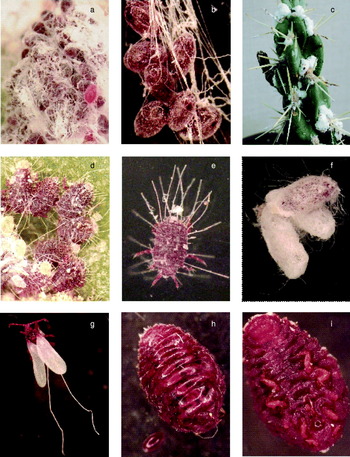
This study has examined the reproduction and development of D. tomentosus to determine whether its biology is similar, or otherwise, to other Dactylopius species. The life stages of D. tomentosus, including eggs, crawlers, male pupae, adult male and adult female, are presented in fig. 1; and a description of the unique features of these life stages is given below.
(a) eggs in a meshwork of waxy threads forming a white, spherical egg mass (mag. ~14×); (b) eggs held together by waxy threads (mag. ~36×); (c) colonies of sessile, mature females (including egg masses) covered in copious cottony wax; many females may settle close together forming clusters of colonies (mag. ~1×); (d) crawlers aggregating at a feeding spot (mag. ~30×); (e) crawler with long filaments on the posterior part of abdomen (mag. ~50×); (f) two cocoons containing developing males and a cocoon under construction (upper cocoon) (mag. ~23×); (g) male with two long, waxy filaments attached to posterior end of the abdomen (mag. ~17×); (h) dorsal view of a mature female with an egg (mag. ~19×); (i) ventral view of a mature female (mag. ~23×).

Egg biology
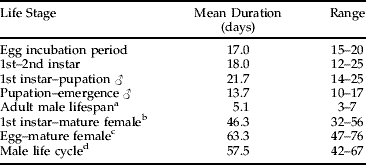
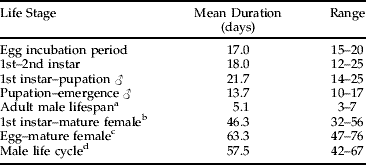
Newly laid eggs of D. tomentosus were red (crimson) in colour, had a smooth shiny texture and were oval in shape. A number of characteristics that had not been observed in eggs of other Dactylopius species were seen. Eggs were laid singly but remained held together in a ball-shaped mesh of waxy threads anchored to the posterior end of the female's abdomen. As more eggs were laid, and depending on the position of female on the cladode, the increasingly heavier egg mass sometimes sagged away from its original position but remained attached to the female by the threads. The eggs underwent a mean incubation period of 17.0 days (table 1).
Mean developmental time of each life stage of D. tomentosus.
a the time between emergence and death of male;
b the time from hatching of eggs to first egg production by a female;
c the estimated developmental time for females from egg to their first egg production;
d the estimated developmental time from egg to death.
Crawler biology
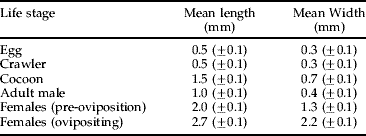
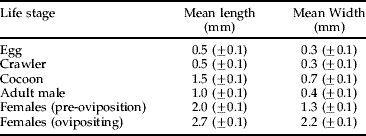
Newly hatched first-instar crawlers were small (table 2) and bright red in colour. After eclosion, the first-instar crawlers remained within the mesh of waxy threads of the egg mass for a few minutes to a few hours before becoming mobile and leaving the threads to search for suitable settling and feeding sites. Most crawlers settled at the base of spines and away from light. The mean duration of the first instar (i.e. the time between hatching and the first moult) was 18.0 days (table 1); more than 90% of crawlers moulted between 12 and 18 days and only a few individuals (<4%) had a longer developmental time. Sexual dimorphism became apparent during the second instar stage, after which the developmental cycle and morphology differed for males and females.
Mean (±SE) length and width of D. tomentosus life stages; width was measured across the widest part of the body.
Female biology
The first wax secretions produced by second-instar female crawlers initially appeared as a white dust that gradually elongated into white coils. The wax increased in quantity, forming a thick, white, cottony cushion that eventually concealed the developing female insect. The second moult took place underneath this covering, and the white exuviate was displaced to the edge of the covering. Pre-ovipositing females were smaller than gravid females (table 2), and their bodies tapered slightly towards the tip of the abdomen. The bodies of fertilized females became distended, gradually acquiring a sub-globular shape. The mean duration of the female life cycle from egg to the commencement of oviposition was 63.3 days (table 1).
Parthenogenesis
All females (n=110) in the presence of males produced eggs and offspring. No females (n=87) in the absence of males produced eggs, despite being allowed to remain on the cladodes for at least an additional 60 days after commencement of oviposition by mated females. While gravid females gradually increased in size with their bodies becoming more globular in shape, the size and shape of the non-gravid adult females remained unchanged throughout the experimental period.
Male biology
In contrast to females, which became sedentary, second-instar male crawlers frequently shifted their feeding positions before moving about in search of a favourable site for pupation. The duration of the second instar from the first moult to the commencement of pupation averaged three days. The spinning of a white cocoon commenced soon after the second instar nymph attached to a suitable substrate and was completed within 2–3 days. The pupal period lasted approximately 13 days, at the end of which emerged a red, white-winged male. The male was half the length of the mature female (table 2) and measured 1.55 (±0.02) mm from head to tip of wings, with wings at rest. The male was short-lived and died within five days of emergence. Mean male developmental time from egg to death was 57.5 days.
Male mating and reproductive potential
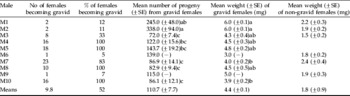
Table 3 summarizes the data on the proportion and mean fecundity of females that became gravid, as well as the mean mass of females that did not become gravid. Male mating capacity varied widely (range: 1–23 females) and the proportions of gravid and non-gravid females per male differed significantly (χ29=120.27; P<0.05). For example, for half of the males, more than 80% of the females provided were gravid, compared to 7–12% for four males.
Male mating potential of ten individual D. tomentosus males (as defined by the number of females becoming gravid), the weights of gravid and non-gravid females at maturity and the number of progeny produced by the graved females. Means within columns followed by the same letter do not differ significantly according to Tukey HSD test at P<0.05.

Male reproductive potential was high and varied between males (table 3). For this analysis (and for the analysis of female mass shown below), data for two males (M6 and M9) were excluded from the analysis of variance as only one female in each cage produced offspring. The mean reproductive potential of the other eight males that produced two or more gravid females was significantly different (F=7.42; df=7, 8; P<0.05). Mean mass of inseminated females per male also differed significantly (F=2.76, df=7, 8; P=0.01), varying from 3–6 mg. In addition, the mean mass (4.4±0.1 mg) of gravid females was significantly greater (F=108.9; df=1, 171; P<0.05) than that of non-gravid females (1.9±0.9 mg). The mean mass of the non-gravid females in each cage did not differ significantly (F=1.14; df=6, 78; P=0.35).
Pearson correlation analysis revealed a highly significant, positive relationship between mean female mass and the mean number of progeny (r=0.93; P<0.001). In addition, the relationship between the number of gravid females per male and mean mass of the gravid females was negative and significant (r=−0.79; P=0.02). There was also a negative relationship between the number of females inseminated by each male and mean number of progeny per female that just failed to be statistically significant (r=−0.68; P=0.07).
Discussion
Contrary to the widespread misconception concerning the high degree of uniformity of the biology and morphology of Dactylopius species (Karny, Reference Karny1972; De Lotto, Reference De Lotto1974; Guerra & Kosztarab, Reference Guerra and Kosztarab1992), the results of this study revealed that D. tomentosus has unique biological and morphological characteristics that differ considerably from other species. Although every developmental stage was studied, only those characteristics that are unique to this species are discussed in detail, and other features of the insect's biology are only included for comparison with its congeners where necessary.
Egg biology
The incubation period (17 days) of D. tomentosus eggs was long compared to other species in this genus. This contrasts with D. coccus whose eggs hatched within 30 min of laying (Guerra & Kosztarab, Reference Guerra and Kosztarab1992) at 25–26°C, D. austrinus where hatching took place within 67 min (Moran & Cobby, Reference Moran and Cobby1979) at 26°C, and other Dactylopius spp. where hatching occurred within 3–5 h at 26°C (Karny, Reference Karny1972; Sullivan, Reference Sullivan1990). The hatching process itself, however, was similar to that described by Karny (Reference Karny1972) and Guerra & Kosztarab (Reference Guerra and Kosztarab1992).
Another unique feature is that, although laid singly, the eggs of D. tomentosus are held together in a mesh of waxy threads for the entire incubation period. In contrast, eggs of other Dactylopius species are not enclosed in a mesh and continue to hatch as more are laid, and first instar crawlers disperse away from the female upon hatching (Karny, Reference Karny1972; Moran & Cobby, Reference Moran and Cobby1979; Guerra & Kosztarab, Reference Guerra and Kosztarab1992). The waxy mesh that encloses the eggs may play a protective role in that eggs are less accessible to natural enemies, such as predators, which could become entangled in the waxy threads; additionally, predators may not recognize the egg masses as food. Keeping eggs clustered and in close proximity to females or the colony may also protect them from desiccation during their long incubation period in the hot, dry habitat in which cactus and cochineal insects are found. The wax may also act as a means of attachment of eggs to the host plant, ensuring that the crawlers eclose on a suitable host.
Developmental biology of crawler, female and male
Developmental studies revealed that the life cycle of D. tomentosus, including the incubation period, was much longer than that of other Dactylopius species. The average developmental time for D. tomentosus crawler from egg to first moult was 35 days compared to 15, 17 and 18 days for D. ceylonicus, D. austrinus and D. opuntiae, respectively, at 26°C (Moran & Cobby, Reference Moran and Cobby1979; Sullivan, Reference Sullivan1990; Volchansky et al., Reference Volchansky, Hoffmann and Zimmermann1999). Female maturity of D. tomentosus averaged 63 days in contrast to 40–50 days for D. austrinus at 25 and 26°C (Moran & Cobby, Reference Moran and Cobby1979; Hosking, Reference Hosking1984), D. opuntiae at 26°C (Githure et al., Reference Githure, Zimmermann and Hoffmann1999; Volchansky et al., Reference Volchansky, Hoffmann and Zimmermann1999; Flores-Hernández et al., Reference Flores-Hernández, Murillo-Amador, Rueda-Puente, Salazar-Torres, García-Hernández and Troyo-Diéguez2006) and D. coccus (Guerra & Kosztarab, Reference Guerra and Kosztarab1992). The male developmental time from egg to adult emergence was 57 days compared to 43 days for D. opuntiae (Flores-Hernández et al., Reference Flores-Hernández, Murillo-Amador, Rueda-Puente, Salazar-Torres, García-Hernández and Troyo-Diéguez2006), 37.1 days for D. austrinus at 25°C (Hosking, Reference Hosking1984) and 31.3 days for D. ceylonicus (Sullivan, Reference Sullivan1990). However, developmental times for males and females of D. tomentosus, excluding the egg incubation period, fell within the ranges for D. ceylonicus (Sullivan, Reference Sullivan1990), D. opuntiae (Karny, Reference Karny1972; Flores-Hernández et al., Reference Flores-Hernández, Murillo-Amador, Rueda-Puente, Salazar-Torres, García-Hernández and Troyo-Diéguez2006) and D. austrinus (Moran & Cobby, Reference Moran and Cobby1979; Hosking, Reference Hosking1984) and, though shorter, overlapped with that of D. coccus (Guerra & Kosztarab, Reference Guerra and Kosztarab1992). Consequently, it is the prolonged egg incubation period that accounts for the difference in total developmental time. The range of developmental times of the first instar D. tomentosus crawlers (from egg hatch to first moult) was notably wide (12–25 days). Similar, wide ranges were reported for other cochineal insects, namely, D. austrinus (Moran & Cobby, Reference Moran and Cobby1979; Hosking, Reference Hosking1984), D. opuntiae (Karny, Reference Karny1972) and D. ceylonicus (Sullivan, Reference Sullivan1990) but not others, e.g. D. coccus (Guerra & Kosztarab, Reference Guerra and Kosztarab1992); the cause of this variation is unknown.
Female morphology and reproductive characteristics
The size and shape of D. tomentosus adult females differed from those recorded for other cochineals. For example, the females of D. coccus are 4–6 mm long and 3.0–4.5 mm wide (Guerra & Kosztarab, Reference Guerra and Kosztarab1992), which is twice as large as D. tomentosus females, with the latter averaging 2.72 mm long and 2.15 mm wide. In addition, the females of D. coccus are globular in shape, whereas the bodies of D. tomentosus females are tapered slightly towards the tip of the abdomen, giving them a sub-globular shape. However, D. tomentosus is similar in size to D. confusus, which measures 2.5–3.0 mm long and 1.5–2.0 mm wide. The mean mass of D. tomentosus females was much smaller (4.4 mg) than that of a number of other Dactylopius species, such as D. opuntiae (16 mg) (Githure et al., Reference Githure, Zimmermann and Hoffmann1999) and D. coccus (40–47 mg) (Guerra & Kosztarab, Reference Guerra and Kosztarab1992). The white waxy covering of D. tomentosus females is cottony and similar to D. opuntiae, but different from that of D. coccus, which is powdery and D. salmianus De Lotto, which is composed of thin, brittle threads (Guerra & Kosztarab, Reference Guerra and Kosztarab1992).
Parthenogenesis
The few males relative to the large number of females and crawlers at any given time in a colony have led to the earlier erroneous reports that all cochineal insects are parthenogenetic (Mann, Reference Mann1969). Contrary to these reports, the lack of egg production by unmated females in this study confirmed that D. tomentosus does not reproduce parthenogenetically. Lack of parthenogenesis in D. tomentosus is similar to the finding that D. austrinus (Moran & Cobby, Reference Moran and Cobby1979) and D. ceylonicus (Sullivan, Reference Sullivan1990) do not reproduce parthenogenetically. According to Moran & Cobby (Reference Moran and Cobby1979), D. austrinus females had to be mated at least once to reproduce, and this appears to be the case for D. tomentosus females. However, D. opuntiae has recently been reported to sometimes reproduce parthenogenetically, but predominantly sexually (Flores-Hernández et al., Reference Flores-Hernández, Murillo-Amador, Rueda-Puente, Salazar-Torres, García-Hernández and Troyo-Diéguez2006); therefore, the use of parthenogenesis as a means of reproduction is variable amongst Dactylopius species.
Parthenogenetic reproduction is prevalent among many insect groups and is associated with greater genetic stability (Suomalainen, Reference Suomalainen1962). Among coccoids, parthenogenesis has the advantage that sedentary females are able to reproduce without the presence of the short-lived and scarce males that may not always be available for mating (Gullan & Kosztarab, Reference Gullan and Kosztarab1997). However, as has been shown during this study, D. tomentosus males are able to fertilize many females, thus compensating for their short life span. In addition, unmated females continued to survive for up to 60 days after commencement of egg production by mated females of the same age, enabling them to overlap with the next generation. This has the advantage that if a shortage of males is experienced in one generation, unmated females can survive until maturity of males in the next generation. Given these strategies, male shortage does not appear to be a limiting factor to population growth for D. tomentosus. This may explain why D. tomentosus and other cochineal insects may not have evolved parthenogenetic reproduction.
Male mating capacity and reproductive potential
The maximum mating capacity of male D. tomentosus appears to be substantial as evidenced by the high numbers of gravid females recorded for some of the males. The current study showed that male mating capacity in D. tomentosus was approximately double that reported for D. coccus (Guerra & Kosztarab, Reference Guerra and Kosztarab1992). The results of our study may more accurately represent male mating capacity than the latter, as one male was used in each replicate in the current study, whereas in the previous study two males were used in some of the cages making it difficult to accurately determine mating capacity per male. Indeed, our study may have underestimated the mating capacity of some males as, in some cages, the males mated with all females and may have been able to mate with more had they been available. However, individual male mating capacity varied greatly in both studies; the range in the current study was larger than in the study of Guerra & Kosztarab (Reference Guerra and Kosztarab1992), range 1–23 and 3–11, respectively. The large variation between individual male mating capacity in the two studies remains unexplained. However, cochineal males have been observed to mate with the same female more than once (Karny, Reference Karny1972; Guerra & Kosztarab, Reference Guerra and Kosztarab1992); therefore, multiple matings with a single female may have obscured the actual mating capacity of an individual male. This, in turn, may be responsible for the variation in male mating capacity observed in the current and previous studies.
As with male mating capacity, male reproductive potential was also high and variable. The high reproductive potential of D. tomentosus males can counteract both their short lifespan and any paucity of males within a population of the insect; this supports our contention that numbers of males need not be a limiting factor to population growth. The variation in male reproductive potential may be due to a number of factors. Firstly, this study has shown that the weight and fecundity of gravid females is inversely related to the number that became gravid. This may be due to either fewer fertilized eggs per female or lower egg viability in cases where a high proportion of females become gravid. Secondly, the variability may also relate to selective matings, where a small number of females may have been multiply mated. Multiple-mated females tend to have higher life-time fecundity (Arnqvist & Nilsson, Reference Arnqvist and Nilsson2000). Thirdly, the variation may also be due to individual differences in female characteristics, such as weight, as this study showed that female fecundity correlated positively with female weight. Fecundity in many insect groups varies with female size (Honek, Reference Honek1993; Zanuncio et al., Reference Zanuncio, Molina-Rugama, Santos and Ramalho2002), and this phenomenon has been reported in other cochineal species (Moran & Cobby, Reference Moran and Cobby1979; Volchansky et al., Reference Volchansky, Hoffmann and Zimmermann1999). Fourthly, fecundity may also be influenced by other factors, such as egg size (Fox et al., Reference Fox, Thakar and Mousseau1997), larval developmental conditions (Tamaru et al., Reference Tamaru, Kaitaniemi and Ruohomaki1996) and food quality for adults (Leather, Reference Leather1988; Awmack & Leather, Reference Awmack and Leather2002). However, these latter factors could not have contributed to the observed relationships in this study because: (i) crawlers that were used to initiate experiments were randomly collected from females who themselves were obtained from cultures at random and were all reared under uniform laboratory conditions; (ii) as revealed by results of the current study, the eggs of D. tomentosus do not vary widely in size; and (iii) the cladodes that were used in this study were equal in size and age, making food supply uniform. Besides these factors, variation amongst males in their potential to produce offspring may also be caused by individual differences in male genetic and phenotypic characteristics, such as male size, and quantity and quality of reproductive substances transferred by males to females during mating that are known to influence fecundity (Fox & Czesak, Reference Fox and Czesak2000).
In conclusion, this paper reports on aspects of the biology of D. tomentosus and provides data that can be used for studies on the ecology of this species and for its use in biological control. This study has detailed unique life history, reproductive and morphological characteristics of D. tomentosus that differ from its congeners, implying that the biologies of Dactylopius spp. are not as similar as has been suggested. It is possible that the remaining, unstudied species may also have other unique biological features, which if studied and documented would enhance the overall understanding of this economically important group of insects.
Acknowledgements
We would like to thank staff from the Weeds Research Division of the Plant Protection Research Institute, Agricultural Research Council, Pretoria, South Africa for their help with this work and the Working for Water Programme and University of Cape Town, South Africa for financing this research. We are grateful to the Centre for Plant and Food Sciences, University of Western Sydney, Australia for financial support and provision of facilities enabling the preparation of this manuscript.