Background
The accurate clinical characterisation of mild cognitive impairment (MCI) is becoming increasingly important as treatment studies move into the prodromal stages of disease and patients present earlier in the disease process when seeking a diagnosis. Dementia with Lewy bodies (DLB) is the second most common type of neurodegenerative dementia, accounting for 7.5% of cases in secondary care (Vann Jones & O'Brien, Reference Vann Jones and O'Brien2014). Despite this, there is a relative paucity of research into the clinical and neuropsychological presentation of the MCI phase of DLB (MCI-LB). The recently revised Diagnostic Criteria for DLB (McKeith et al. Reference McKeith, Boeve, Dickson, Halliday, Taylor and Weintraub2017) list four core diagnostic features for the disease – visual hallucinations, motor parkinsonism, cognitive fluctuations and clinical rapid eye movement (REM) sleep behaviour disorder (RBD). In addition, the consensus paper also lists supportive clinical features, which are less specific than the core features but are thought to be potentially indicative of DLB, particularly where they are persistent or appear in combination. There are five neuropsychiatric symptoms in the supportive clinical features: hallucinations in non-visual modalities, systematised delusions, apathy, anxiety and depression. There is evidence suggesting the presence of core features of DLB in the prodromal phase of the disease (Donaghy et al. Reference Donaghy, O'Brien and Thomas2015). However, there has been a little investigation of other neuropsychiatric symptoms in prodromal DLB.
In addition to specific neuropsychiatric symptoms, DLB is also associated with a characteristic pattern of cognitive impairment. Compared with Alzheimer's disease (AD), DLB is associated with greater impairment in attention, executive and visuospatial function, but less severe memory impairment (Metzler-Baddeley, Reference Metzler-Baddeley2007). It has been shown that people with non-amnestic MCI are much more likely to convert to DLB than AD, whereas the reverse is true for amnestic MCI (Ferman et al. Reference Ferman, Smith, Kantarci, Boeve, Pankratz and Dickson2013). Visuospatial dysfunction was found at the first clinical presentation of the majority of patients with a post-mortem diagnosis of DLB (Tiraboschi et al. Reference Tiraboschi, Salmon, Hansen, Hofstetter, Thal and Corey-Bloom2006). There is emerging evidence that the characteristic Lewy body profile of attention, executive and visuospatial dysfunction is already present at the MCI phase of DLB (Cagnin et al. Reference Cagnin, Busse, Jelcic, Gnoato, Mitolo and Caffarra2015; Yoon et al. Reference Yoon, Kim, Moon, Yong and Hong2015; Kemp et al. Reference Kemp, Philippi, Phillipps, Demuynck, Albasser and Martin-Hunyadi2017; Sadiq et al. Reference Sadiq, Whitfield, Lee, Stevens, Costafreda and Walker2017).
Aims and hypotheses
The aim of this study was to compare the neuropsychiatric symptoms and cognitive profile of MCI-LB with MCI-AD.
The hypothesis was that MCI-LB would display a neuropsychiatric and cognitive profile similar to that seen in DLB with higher rates of non-visual hallucinations, depression, apathy, anxiety and delusions and deficits in attention, executive and visuospatial function, with relatively preserved memory function when compared with MCI-AD.
Methods
Participants
MCI subjects ⩾60 years old were recruited from memory clinics, elderly medicine clinics and neurology clinics in the North East of England and Cumbria. Potential study subjects were eligible for participation if they were reported to have at least one clinical symptom that may be associated with DLB. Such symptoms included autonomic symptoms, visual disturbances, olfactory impairment and mood changes as well as any indication of the presence of core and supportive features of DLB. Subjects were excluded if they had dementia, a Mini-Mental State Examination (MMSE) score <20, a CDR score of >0.5, parkinsonism that developed more than 1 year prior to cognitive impairment or evidence of clinical stroke or a serious neurological or medical condition that would affect their performance in study assessments.
All subjects gave their written informed consent to take part in the study. The study received ethical approval from the National Research Ethics Service Committee North East – Newcastle & North Tyneside 2 (Research Ethics Committee Identification Number 12/NE/0290).
Neuropsychological assessment
Subjects had a thorough neuropsychological assessment including the Addenbrooke's Cognitive Examination-Revised (ACE-R) (Mioshi et al. Reference Mioshi, Dawson, Mitchell, Arnold and Hodges2006), FAS Verbal Fluency (Borkowski et al. Reference Borkowski, Benton and Spreen1966), the Trail-making Test Parts A and B (Reitan, Reference Reitan1955), the Graded Naming Test (GNT) (McKenna & Warrington, Reference McKenna and Warrington2007) and the Rey Auditory Verbal Learning Test (AVLT) (Rey, Reference Rey1964). Computerised tests of simple and choice reaction time and digit vigilance (Ballard et al. Reference Ballard, O'Brien, Gray, Cormack, Ayre and Rowan2001) were used to measure attention and executive function. Variation in reaction time was measured using the coefficient of variation (standard deviation of reaction time/mean reaction time). Cognitive processing time was calculated as the difference between the choice and simple reaction times.
Computerised tasks measuring line angle discrimination (Wood et al. Reference Wood, Firbank, Mosimann, Watson, Barber and Blamire2013) and motion detection were used to measure visuospatial function. The motion detection task was based on that reported by Salmon and colleagues (Landy et al. Reference Landy, Salmon, Galasko, Filoteo, Festa and Heindel2015). Briefly, moving white dots were presented on the computer screen for 1 s. A proportion of the dots were either moving horizontally to the right or to the left (signal). The rest of the dots were moving randomly (noise). The participant had to decide if the signal dots were moving to the right or the left. The program modified difficulty based on the participant's responses; the output was a threshold of the proportion of signal dots that the participant required to correctly identify the direction of movement.
Clinical assessment
All patients were assessed by the equivalent of a Board Certified Psychiatrist (PCD), who carried out a physical and neurological examination. Blood pressure was measured lying and after standing for 3 minutes. Where one was available, a relative, friend or carer was also interviewed. Quantitative scales were used to assess neuropsychiatric symptoms (Geriatric Depression Scale (D'Ath et al. Reference D'Ath, Katona, Mullan, Evans and Katona1994), Clinician Assessment of Fluctuations (Walker et al. Reference Walker, Ayre, Cummings, Wesnes, McKeith and O'Brien2000), Dementia Cognitive Fluctuations Scale (DCFS) (Lee et al. Reference Lee, McKeith, Mosimann, Ghosh-Nodial, Grayson and Wilson2014), Neuropsychiatric Inventory (NPI) (Cummings et al. Reference Cummings, Mega, Gray, Rosenberg-Thompson, Carusi and Gornbein1994), Mayo Sleep Questionnaire (Boeve et al. Reference Boeve, Molano, Ferman, Smith, Lin and Bieniek2011)), parkinsonism (Revised Unified Parkinson's disease Rating Scale Motor Sub-scale (Goetz et al. Reference Goetz, Tilley, Shaftman, Stebbins, Fahn and Martinez-Martin2008)) and level of functional impairment (Instrumental Activities of Daily Living Scale (Lawton and Brody Reference Lawton and Brody1969)). Further clinical and neuropsychological assessments have been carried out annually and data from the first annual review were used to review the participant's diagnosis.
The presence or absence of neuropsychiatric symptoms listed as ‘supportive clinical features’ in the 2017 DLB Criteria (McKeith et al. Reference McKeith, Boeve, Dickson, Halliday, Taylor and Weintraub2017) was determined from the relevant section of the Neuropsychiatric Inventory: delusions (Section A); non-visual hallucinations (Section B1/B4/B5/B6); depression (Section D), anxiety (Section E) and apathy (Section G). An affirmative response in the relevant section indicated the presence of the symptom. The Lewy Body Neuropsychiatric Supportive Symptom Count (LBNSSC) was defined as the total number of symptoms experienced by each patient (maximum = 5).
FP-CIT SPECT
2β-Carbomethoxy-3β-(4-iodophenyl)-N-(3-fluoropropyl)-nortropane single photon emission computed tomography (FP-CIT SPECT) imaging was carried out at baseline. Three to six hours following a bolus intravenous injection of 185 MBq of 123I-FP-CIT (DaTSCAN, GE Healthcare, UK) patients were scanned using a double-headed gamma camera (Siemens Symbia S) fitted with a low energy high resolution (LEHR) parallel hole collimator. Images were reconstructed in transverse sections and classed as normal or abnormal based on visual rating (Benamer et al. Reference Benamer, Patterson, Grosset, Booij, de Bruin and Van Royen2000).
Diagnosis
An expert consensus clinical panel (AJT, PCD, JPT) reviewed all the clinical assessment data to confirm subjects met NIA-AA MCI criteria (Albert et al. Reference Albert, DeKosky, Dickson, Dubois, Feldman and Fox2011) without considering aetiology. Where the first two raters did not agree, the third made a final decision. The consensus panel also rated the presence or absence of each of the four core symptoms of DLB (cognitive fluctuations, complex visual hallucinations, clinical parkinsonism and clinical RBD). This was performed blind to FP-CIT SPECT result. These ratings and the FP-CIT SPECT result were used to classify participants as Probable MCI-LB (NIA-AA MCI plus two or more of the five diagnostic features (four core symptoms and abnormal FP-CIT SPECT)) or MCI-AD (MCI with none of the four core symptoms, evidence of decline which was characteristic of AD with no evidence for another aetiology and a normal FP-CIT scan). The ‘one year rule’ was applied so that no subjects had evidence of Parkinsonism for more than a year before the onset of their cognitive decline. Assignment to these diagnostic categories was based on information from both baseline and 1 year follow-up clinical evaluations.
The Mayo Sleep Questionnaire was completed where an informant that lived with the participant was present, as stipulated in the questionnaire. However, the classification of the presence or absence of RBD also incorporated other information e.g. where a subject or informant could reliably relay the report of a bed-partner, or the outcome of assessment at a sleep clinic.
Statistics
Demographic and clinical data were compared using t tests, Mann–Whitney U tests, Chi-squared and Fisher's Exact tests depending on the nature of the data. Cognitive performance in the MCI-LB and MCI-AD groups was compared using the general linear model and logistic regression with age, gender and years in education as covariates.
Results
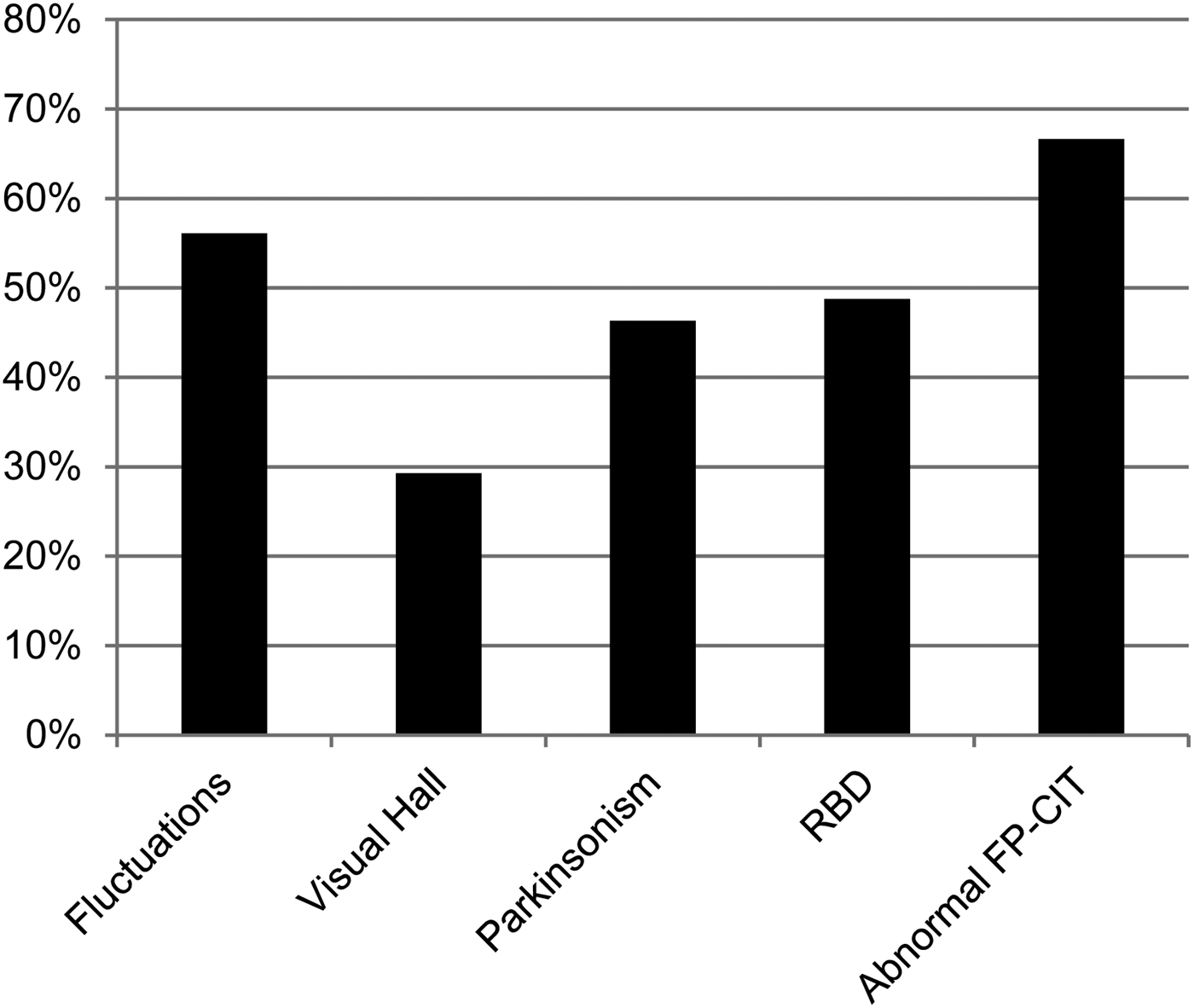
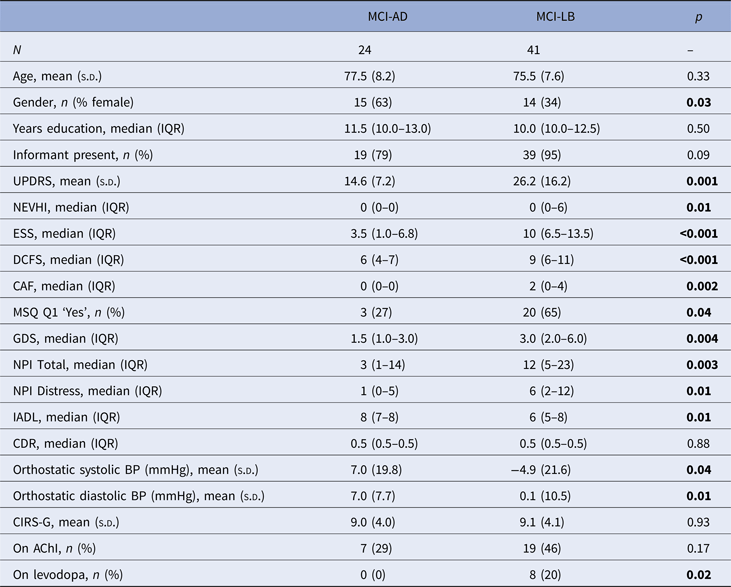
In total 77 subjects completed their baseline assessment, of which 41 were classified as MCI-LB and 24 as MCI-AD. 12 subjects had one core symptom or a positive FP-CIT SPECT scan. These subjects were considered to have possible MCI-LB. Due to the uncertainty regarding the aetiology of their cognitive impairment they were excluded from further analysis. Hereafter MCI-LB refers exclusively to probable MCI-LB. The MCI-LB group were more likely to be male (Table 1). The most common diagnostic feature in the MCI-LB group at baseline was an abnormal FP-CIT scan (67%) followed by cognitive fluctuations (56%), RBD (49%), parkinsonism (46%) and visual hallucinations (29%, Figs. 1 and 2). No participants reported a history of neuroleptic sensitivity.
Classification of subjects. Subjects with two or more diagnostic features were classified as MCI-LB. Subjects with no diagnostic features were classified as MCI-AD. Subjects with one diagnostic feature were classified as possible MCI-LB. Due to uncertainty regarding the aetiology of their MCI they were excluded from further analysis. Prob./Poss MCI-LB, Probable/Possible MCI with Lewy bodies; MCI-AD, MCI due to Alzheimer's disease.

The rate of each diagnostic feature at baseline assessment in subjects with MCI-LB. Bars represent the percentage of subjects with MCI-LB in which each diagnostic feature was present. Hall, hallucinations; RBD, REM sleep behaviour disorder.

Demographic and clinical data

UPDRS, Unified Parkinson's Disease Rating Scale (MDS Revision); NEVHI, North East Visual Hallucinations Interview; ESS, Epworth Sleepiness Scale; DCFS, Dementia Cognitive Fluctuations Scale; CAF, Clinician Assessment of Fluctuation; MSQ, Mayo Sleep Questionnaire; GDS, Geriatric Depression Scale; NPI, Neuropsychiatric Inventory; IADL, Instrumental Activities of Daily Living; CIRS-G, Cumulative Illness Rating Scale for Geriatrics; AChI, Acetylcholinesterase Inhibitor
For informant scales (DCFS, CAF, NPI, IADL) MCI-AD n = 19, MCI-LB n = 39. For MSQ MCI-AD n = 11, MCI-DLB n = 31. For BP MCI-AD n = 22, MCI-LB n = 39
Bold denotes p < 0.05.
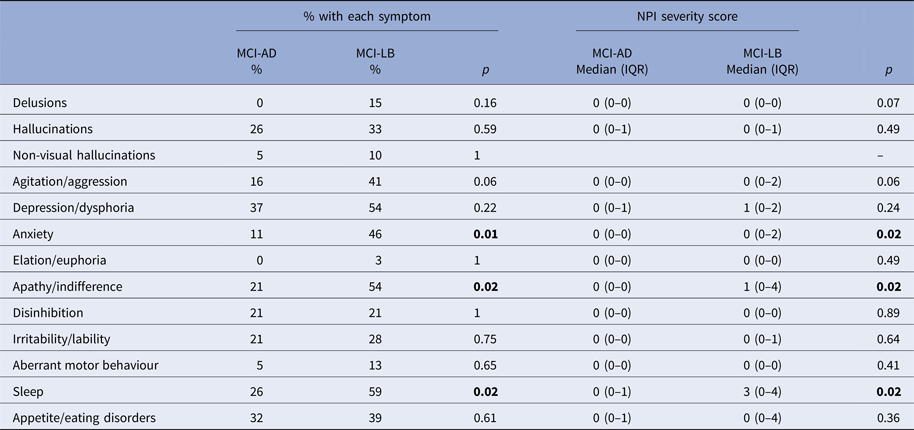
As expected, MCI-LB subjects had higher scores in scales measuring diagnostic features such as parkinsonism, visual hallucinations and fluctuations in cognition and arousal. They also had greater depressive symptoms measured by the GDS, more severe neuropsychiatric symptoms and greater carer distress measured by the NPI. The NPI domains that were significantly more commonly reported by the carers of people with MCI-LB were anxiety (46% v. 11%; p = 0.01), apathy/indifference (54% v. 21%; p = 0.02) and sleep (59% v. 26%, p = 0.02; Table 2).
Neuropsychiatric inventory results

MCI-AD n = 19, MCI-LB n = 39. Chi-squared/Fisher's Exact tests for symptom rates, Mann–Whitney U Test for severity scores
The LBNSSC was greater in MCI-LB than MCI-AD (1.8 ± 1.1 v. 0.7 ± 0.9, p = 0.001). 67% of MCI-LB had two or more of these symptoms, compared with 16% of MCI-AD (Likelihood ratio = 4.2, p < 0.001). 23% of MCI-LB cases had three or more of these symptoms compared with 5% of MCI-AD (Likelihood Ratio = 4.4, p = 0.07).
The MCI-LB group had relatively lower blood pressure on standing compared with the MCI-AD group. However, postural hypotension (defined as a 20 mmHg or greater drop in systolic BP) was not common in either group (MCI-LB 21% v. 9% MCI-AD; p = 0.31).
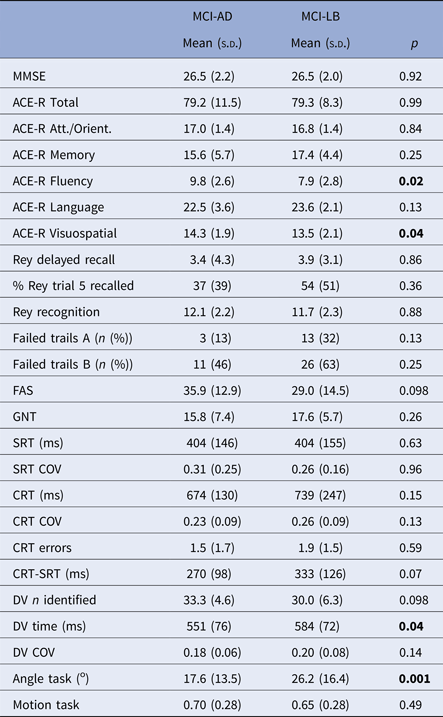
The results of cognitive tests are shown in Table 3. The overall degree of cognitive impairment was similar in both groups. Compared with MCI-AD subjects, MCI-LB was associated with poorer performance on verbal fluency (both letter and animal) on the ACE-R and a trend towards a similar finding in the FAS. Their reaction times were also slower on the digit vigilance task. There were statistical trends toward a lower number of items correctly identified on the digit vigilance task and slower cognitive processing (p < 0.10). MCI-LB participants had worse visuospatial function measured by the ACE-R and the angle discrimination task compared with MCI-AD. There were no differences between the groups on ACE-R memory, Rey delayed recall or Rey recognition. 37% of MCI-LB were >2 s.d. below the age-adjusted mean for delayed recall.
Cognitive test scores

GLM/logistic regression with age, gender and years in education as covariates
MMSE, Mini-Mental State Examination; ACE-R, Addenbrookes Cognitive Examination Revised; Rey, Rey Auditory Verbal Learning Test; Trails, Trailmaking Test; GNT, Graded Naming Test; SRT, Simple Reaction Time; COV, Coefficient of Variance; CRT, Choice Reaction Time; DV, Digit Vigilance.
Two subjects declined to complete Rey, one declined to complete DV. Computer error on SRT (n = 1), CRT (n = 2) and Angle (n = 6)
Using the four cognitive tests that demonstrated statistically significant differences (ACE-R fluency and visuospatial, digit vigilance time and angle task result) in a post-hoc discriminant analysis yielded a sensitivity of 64% and specificity of 68% for the identification of MCI-LB, with an overall accuracy of 66%.
Discussion
The recently revised consensus criteria for the diagnosis of DLB (McKeith et al. Reference McKeith, Boeve, Dickson, Halliday, Taylor and Weintraub2017) list a range of supportive clinical features in addition to the core diagnostic clinical features of visual hallucinations, spontaneous motor parkinsonism, cognitive fluctuations and clinical RBD. The supportive clinical features include five neuropsychiatric symptoms: non-visual hallucinations, delusions, anxiety, depression and apathy. Consistent with our hypothesis, MCI-LB subjects were significantly more likely to have two or more of these symptoms than MCI-AD subjects, with a likelihood ratio of 4.2. This means that subjects with MCI-LB are more than four times more likely to have two or more of these symptoms than subjects with MCI-AD. Whilst our finding requires replication, these symptoms, identified as supportive in the diagnostic criteria, do indeed appear important clinical features to ask about when assessing for the presence of LB disease in people with MCI.
Overall, MCI-LB was associated with more severe neuropsychiatric symptoms and greater resultant carer distress than MCI-AD. The NPI domains which showed the greatest difference between MCI-LB and MCI-AD were anxiety, apathy and sleep. These findings highlight the greater symptom burden experienced by people with MCI-LB and their carers in comparison with MCI-AD. As such, people with MCI-LB may be more likely to seek a diagnosis and may require more active clinical management during this phase of their disease. For patients and their carers, being able to identify the cause of these distressing neuropsychiatric symptoms may reduce levels of anxiety and interpersonal conflict related to the symptoms. The increased rate of sleep disturbance in the MCI-LB group is unsurprising, given the inclusion of RBD as a core diagnostic feature. However, the five neuropsychiatric supportive symptoms investigated (delusions, non-visual hallucinations, depression, anxiety and apathy) were not used to classify cases as MCI-LB or MCI-AD.
We hypothesised that MCI-LB would be associated with worse attention/executive and visuospatial function, and better memory than MCI-AD. We found evidence of worse attention and visuospatial function in the MCI-LB group, in keeping with the cognitive profile seen in established DLB (Metzler-Baddeley, Reference Metzler-Baddeley2007). MCI-LB cases also scored more poorly on tests of verbal fluency (both category and letter fluency). Verbal fluency performance is related to verbal ability and executive control (Shao et al. Reference Shao, Janse, Visser and Meyer2014). There was no difference in language function measured by the ACE-R or the Graded Naming Test between MCI-LB and MCI-AD, suggesting that the impairments in verbal fluency seen were due to greater executive dysfunction in the MCI-LB group.
There was no difference between the MCI-LB and MCI-AD in tests of memory. Indeed, almost 40% of the MCI-LB group scored >2 S.D. below the mean in Rey AVLT delayed recall. This is in keeping with previous reports of significant memory impairment in MCI-LB (Yoon et al. Reference Yoon, Kim, Moon, Yong and Hong2015; Kemp et al. Reference Kemp, Philippi, Phillipps, Demuynck, Albasser and Martin-Hunyadi2017). This illustrates an important clinical point. Though non-amnestic MCI has a higher chance of converting to DLB than amnestic MCI, a substantial proportion of DLB cases will have an amnestic MCI in their prodromal period, which is typically multi-domain (Ferman et al. Reference Ferman, Smith, Kantarci, Boeve, Pankratz and Dickson2013). This may be particularly true in Memory Clinic cohorts, where amnestic problems are the usual reason for referral into these services.
Three other studies have compared cognitive test scores in MCI-LB and MCI-AD (Cagnin et al. Reference Cagnin, Busse, Jelcic, Gnoato, Mitolo and Caffarra2015; Yoon et al. Reference Yoon, Kim, Moon, Yong and Hong2015; Sadiq et al. Reference Sadiq, Whitfield, Lee, Stevens, Costafreda and Walker2017). Direct comparisons between the studies are difficult as different cognitive batteries have been used. The most consistent domain that differed between MCI-LB and MCI-AD was a visuospatial function. All the studies, including this paper, also found some differences in executive function, though not necessarily on every executive function test. Findings in attention and memory domains are less consistent between the studies.
The heterogeneity of cognitive impairment observed in MCI-LB and MCI-AD was reflected in the poor discriminant ability of four cognitive tests (ACE-R fluency and visuospatial, DV mean time and angle task) to differentiate between MCI-LB and MCI-AD in a post-hoc analysis. Thus, though a pattern of prominent executive and visuospatial dysfunction is supportive of a diagnosis of MCI-LB, it is not sufficient to warrant a diagnosis of MCI-LB in isolation. This illustrates the supportive role of neuropsychological assessment in the diagnosis of MCI-LB in combination with a thorough clinical assessment for other features associated with Lewy body disease.
Strengths and limitations
This is the largest cohort of MCI-LB subjects published to date. All subjects had a thorough clinical and neuropsychological assessment. This supported the accurate clinical diagnosis, which was confirmed by a three-rater panel. The gold standard for diagnosis will always be post-mortem brain examination. As MCI-LB is an evolving concept, postmortem data will take some time to emerge. Until then, data from well characterised clinical cohorts will be the primary source of new knowledge on of the prodromal stages of DLB.
Consensus criteria for the diagnosis of MCI-LB are in development (McKeith et al. Reference McKeith, Boeve, Dickson, Halliday, Taylor and Weintraub2017). Subjects in this study were categorised as MCI-LB based on the presence of core clinical symptoms and abnormal FP-CIT SPECT imaging. The finding of a DLB pattern of cognitive impairment and associated neuropsychiatric symptoms in the MCI-LB group gives supporting evidence for this method of categorisation. FP-CIT SPECT is not yet licensed for use in MCI but has high sensitivity and specificity for DLB confirmed by autopsy (Thomas et al. Reference Thomas, Attems, Colloby, O'Brien, McKeith and Walker2017). It is reasonable to expect that the specificity would also be high in MCI-LB.
Subjects were recruited to this study on the basis of suspected symptoms of Lewy body disease. After a thorough clinical assessment, the diagnostic panel found that some participants did not have any core diagnostic symptoms of DLB and fulfilled criteria for MCI-AD. Rates of neuropsychiatric symptoms in this group were probably higher than in a non-selected MCI-AD cohort, making significant differences between the groups more difficult to detect. This increases the robustness of our findings. The somewhat atypical nature of the MCI-AD group may also explain why no differences were found in memory tests between MCI-LB and MCI-AD.
The differentiation between MCI and dementia can be a difficult one to make, particularly as functional impairment can result from both physical and cognitive problems, and untangling the two can be difficult. The NIA-AA criteria were used to make a diagnosis of MCI based on the judgement of the three clinicians that each participant had generally maintained ‘independence of function in daily life, with minimal aids or assistance’ (Albert et al. Reference Albert, DeKosky, Dickson, Dubois, Feldman and Fox2011), but the cut-off in some cases may have been made differently by other clinicians. Due to the absence of local normal data in many of the cognitive tests used, it was not possible to reliably classify our cohort into single-domain/multi-domain and amnestic/non-amnestic MCI sub-types.
There were no significant differences between the MCI-LB and MCI-AD groups in age or years in education, though MCI-LB participants were more likely to be male. To account for this, gender was included as a covariate when analysing cognitive test scores, in addition to age and years in education. Several comparisons were made between MCI-LB and MCI-AD, increasing the risk of Type 1 error. A Bonferroni correction was not applied, as it would potentially obscure clinically important differences between the two groups. As such, these findings require replication, which we are currently undertaking.
The presence or absence of neuropsychiatric symptoms was based on carer interview using the NPI. Symptoms in MCI-LB such as depression, anxiety and delusions were more likely to be reported in this context than when enquired about directly in a symptom questionnaire with both the subject and informant present, as previously reported in this cohort (Donaghy et al. Reference Donaghy, Barnett, Olsen, Taylor, McKeith and O'Brien2017). Conversely, the informant was not aware of visual hallucinations in two out of twelve volunteers that reported visual hallucinations, as the patient had not informed them of their experiences. This illustrates the value of separate patient and informant interviews to investigate such symptoms both in clinical practice and in research studies.
Conclusions
MCI-LB, identified by the presence of core diagnostic symptoms of DLB and abnormal FP-CIT SPECT, is associated with neuropsychiatric symptoms and a cognitive profile similar to established DLB. This supports the concept of identifying MCI-LB based on the presence of core diagnostic features of DLB and FP-CIT SPECT imaging.
In addition to this, the presence of two or more supportive neuropsychiatric symptoms known to be associated with DLB was helpful in differentiating between MCI-LB and MCI-AD, with a likelihood ratio of 4.2. This highlights the importance of enquiring about these symptoms in patients being assessed for cognitive complaints. MCI patients with these symptoms could be considered ‘at risk’ for later DLB, even in the absence of core symptoms of the disease. Greater problems with attention, fluency and visuospatial function were observed in MCI-LB, but deficits in these domains were not specific to MCI-LB due to the heterogeneity of cognitive impairment seen in both MCI groups. Many MCI-LB subjects also had an amnestic impairment.
Clinical evaluation to identify MCI-LB should examine neuropsychiatric symptoms associated with DLB such as non-visual hallucinations, delusions, anxiety, depression and apathy in addition to core diagnostic features. The neuropsychological profile may provide supporting evidence for a diagnosis of MCI-LB but is not in itself sufficient for diagnosis.
Acknowledgements
This Research was supported by the NIHR Newcastle Biomedical Research Unit (Grant Number BH120878). The authors are grateful to GE Healthcare who provided the FP-CIT ligand for this Investigator-led study. The authors would like to thank the staff of the NIHR Clinical Research Network North East and Cumbria for their invaluable support with participant recruitment for this study.
Conflict of interest
JPT and GP have received Honoria from GE Healthcare for educational presentations. JOB is supported by the NIHR Cambridge Biomedical Research Centre and has acted as a consultant for GE Healthcare, Avid/Lilly, Piramal, TauRx, Axon and Heptares. IM has acted as a consultant for GE Healthcare, Axovant and Takeda. AT has received support from GE Healthcare for investigator-led research including the provision of FP-CIT in this study. PCD, NB, KO, SJC and JL declare no interests.
Ethical standards
The authors assert that all procedures contributing to this work comply with the ethical standards of the relevant national and institutional committees on human experimentation and with the Helsinki Declaration of 1975, as revised in 2008.