Congenital aortic stenosis accounts for approximately 4% of all CHD. Reference Hoffman and Kaplan1 Surgical aortic valvotomy and balloon aortic valvuloplasty have been the two treatment mainstays since the 1980s. Reference Lababidi2 Since that time both techniques have been progressively modified and enhanced. In comparison to early techniques, balloon valvuloplasty now employs lower profile balloons, the option of a two-balloon technique, and right ventricular pacing or the administration of adenosine for balloon stability. Surgery has also changed significantly with more deliberate finessing of the valve leaflets including commissurotomy, leaflet edge thinning, debulking of nodular dysplasia, and leaflet extension. Reference Siddiqui, Brizard and Galati3 In light of improvements in both treatment strategies and limited contemporary data, there is now renewed debate on the relative outcome merits of the two interventions. Reference Hill, Ginde, Rios, Frommelt and Hill4
Intervention type is often dictated by local preference and skillset and therefore comparing techniques within the same centre is naturally biased towards the preferred strategy. Randomised comparison is also inherently difficult due to institutional bias and the practical challenge of distributing patients prospectively across multiple centres to obtain sufficient numbers to facilitate a meaningful statistical analysis. We therefore undertook a contemporary, propensity score matched analysis from a primary surgical centre (Royal Children’s Hospital, Melbourne) and a primary catheter-based centre (Queensland Children’s Hospital, Brisbane) to establish differences in mortality and freedom from all forms of reintervention.
Materials and methods
Between 2005 and 2016, 77 surgical aortic valvotomy patients and 65 balloon aortic valvuloplasty patients underwent primary intervention, with each patient meeting local criteria for either type of intervention. Patients were not included if they had significant associated congenital heart lesions that had the potential to impact either the type of intervention performed or its outcome. The study was approved by the Institutional Ethics Committees within each Health Service.
Pre-intervention demographic and aortic valve data were collected across both intervention groups. This included echocardiographic aortic valve leaflet morphology in the balloon aortic valvuloplasty group and aortic valve morphology under direct vision in the surgical aortic valvotomy group. Pre-intervention left ventricular systolic function, mean and peak aortic valve gradient, and degree of regurgitation were determined. The same measurements were made immediately following intervention and also at most recent follow-up or at the latest echocardiographic evaluation prior to any further intervention. The degree of aortic regurgitation was assessed independently in each centre from echocardiographic images using previously published valve dysfunction descriptors. Reference Zoghbi, Enriquez-Sarano and Foster5
Catheter technique
Catheter intervention was undertaken based on published catheter guidelines with a mean Doppler gradient used as a surrogate for peak-to-peak catheter gradient in pre-catheter assessment. Reference Feltes, Bacha and Beekman6 Catheterisation was performed using standard techniques under general anaesthesia. Haemodynamic and angiographic data were collected from cardiac catheter reports. Procedural complications were categorised utilising the IMPACT registry protocols. Reference Moore, Vincent and Beekman7 A low-profile balloon(s) with a diameter similar to the measured aortic valve annulus was inflated, aiming for resolution of balloon waist on inflation. A double balloon strategy was utilised for patients with annulus dimension on angiography greater than 12–13 mm. In the opinion of our interventional cardiologists, this technique provides theoretical benefits, including enhanced balloon stability during inflation, potential alignment with the commissures, reduced vascular trauma with reduced sheath size, and facilitates rapid inflation and deflation to allow resumption of cardiac output. Reference Mullins, Nihill and Vick8 When feasible, balloon stability was also optimised using rapid right ventricular pacing or the administration of adenosine.
Surgical technique
Surgical approach depended on each valve morphology as assessed at the time of surgery. Techniques employed across the patient cohort have been previously outlined by d’Udekem. Reference d’Udekem9 De-bulking of valve leaflets, leaflet extension, and patch resuspension of unsupported leaflets were employed to optimise valve function. Post-operative transoesophageal or epicardial echocardiography was used to evaluate valve function following weaning from cardiopulmonary bypass.
Statistical analysis
Analysis involved comparing the two management techniques for differences by several patient and clinical characteristics using non-parametric statistics to address small numbers and skewness in the distributions (Fisher exact tests for categorical predictors and Rank-sum tests for quantitative predictors). Associations between the repair techniques with any reintervention and surgical reintervention only were assessed using Kaplan–Meier curves, Log-Rank tests, and Cox regression, implemented in the R package “survival”. Reference Therneau10 Propensity scores were estimated using logistic regression, with 1:1 nearest neighbour matching without replacement using R package “MatchIt”. Reference Ho, Imai, King, Stuart and Whitworth11 The propensity score model included patient age and weight at surgery in addition to aortic valve morphology (unicuspid, bicuspid, tricuspid). Balance diagnostics were then assessed amongst the matched sample by calculating the residual bias, with values above 0.1 indicative of balance not having been achieved. The Kaplan–Meier curves, Log-Rank tests, and Cox regression were subsequently rerun on the matched sample. In addition, the association between repair technique and any reintervention was separately assessed in the neonatal group.
Results
Patient characteristics
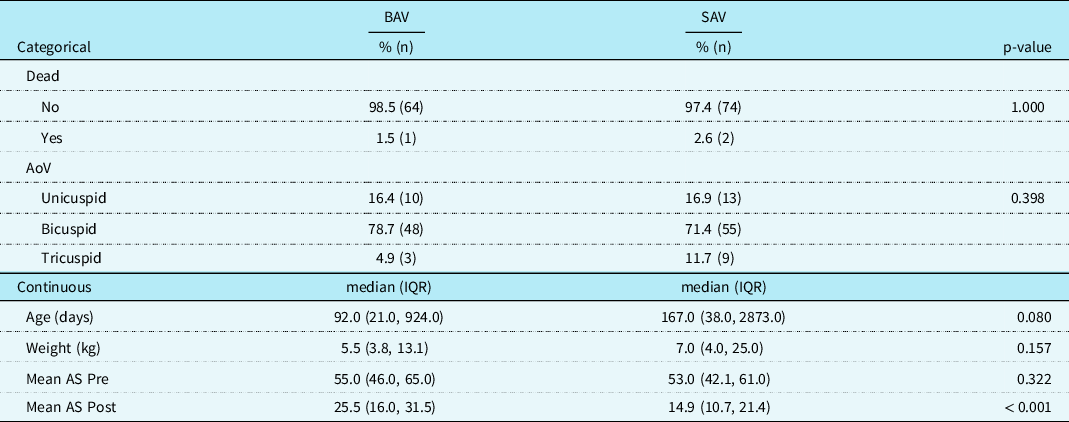
The surgical group included 17 neonates and 28 infants, while the balloon group included 18 neonates and 25 infants. Median age at balloon was 92 days (range 2 days – 18.8 years) compared to 167 days (range 0 days – 18.1 years) for surgery (Rank-sum p = 0.08). Mean length of admission was 10 days for surgical aortic valvotomy and 6 days for balloon aortic valvuloplasty (p = 0.15). Mean follow-up was 5.3 years in both groups. Table 1 shows the univariable associations between repair technique and a number of patient characteristics both just prior to and subsequent to intervention among the full sample.
Patient characteristics by repair type.

Categorical variables are presented as % (n) with Fisher exact tests, and continuous variables are presented as median (25th, 75th percentile) with rank-sum tests
Associated CHDs
In the balloon cohort eight patients had other congenital defects, including four with aortic arch lesions (three repaired prior to balloon intervention, one repaired after balloon aortic valvuloplasty). A subaortic membrane developed in two patients years following balloon aortic valvuloplasty. Two were found to have a ventricular septal defect, while one had Ebstein’s anomaly of the tricuspid valve. There was one patient each with DiGeorge syndrome, Kabuki syndrome, and heterotaxy syndrome with inferior caval vein interruption.
In the surgical group, seven patients had other congenital cardiac defects, including five with aortic arch lesions (three had intervention prior to surgical aortic valvotomy while two did not meet criteria for arch repair). Two had associated mild mitral stenosis. One patient had a diagnosis of Williams syndrome, two had DiGeorge syndrome, and one patient had an undifferentiated syndrome.
Aortic valve morphology
Valve morphology was used in propensity score matching and showed that the distribution of sub-types was similar between the two groups. Four balloon aortic valvuloplasty patients had no available images or echocardiographic report describing the pre-intervention morphology. In the balloon group, 10 valves were unicuspid, 48 bicuspid, and 3 tricuspid. This compared to 13, 55 and 9, respectively, in the surgical group.
Immediate results
Patients receiving a surgical aortic valvotomy had a lower echocardiographic mean gradient immediately after surgery (median 14.9 versus 25.5 mmHg, p < 0.001), with no correlation between mean AS pre- and post-surgery (r = 0.28, p = 0.773). Fifteen balloon patients had moderate or severe aortic regurgitation after intervention while 27 had mild aortic regurgitation. Of the surgical cohort one had moderate aortic regurgitation while 24 had mild regurgitation. All three of the balloon aortic valvuloplasty patients with severe post-intervention aortic regurgitation went on to have a Ross procedure, as did the surgical aortic valvotomy patient with moderate post-intervention valve regurgitation. Of the 12 moderate post-balloon valvuloplasty aortic regurgitation patients, four have undergone a Ross replacement with the remaining eight showing stability and have not yet met criteria for reintervention (mean follow-up 5.8 years).
Procedural complications
There were two major complications and one late death in the balloon group. One 13-year-old patient with an underlying diagnosis of Kabuki syndrome suffered severe hypotension on anaesthetic induction at the time of balloon reintervention at 7.7 years after original balloon aortic valvuloplasty. After no relief with balloon intervention, the patient underwent emergency surgical aortic valvuloplasty the same day, however, ultimately died from severe neurological injury. Additionally, a 13-month-old patient suffered a cardiac arrest after completion of the balloon procedure and developed significant neurological injury. Another patient had transient ventricular fibrillation during the procedure which resolved with DC cardioversion.
Surgical morbidity included three cases of wound infection, two cases of sepsis, two cases of emergency chest exploration for cardiac tamponade, and two cases of ventricular arrhythmia which responded to therapy. There were two early deaths; one neonate with pre-intervention endocardial fibroelastosis and left ventricular failure, and one sudden cardiac arrest at 18 days. Overall mortality was similar between the two groups (p = 1.0).
Reintervention
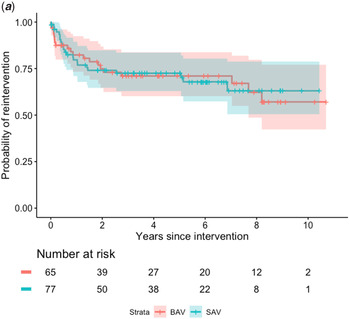
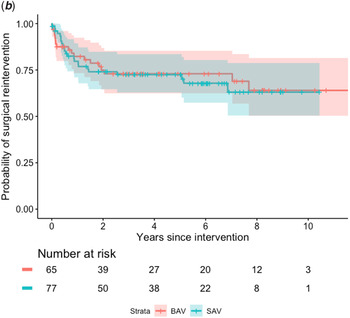
There were 20 reinterventions in the balloon aortic valvuloplasty group; 11 were for isolated aortic stenosis with a pre-reintervention mean gradient of 52.1 mmHg for those without significant associated left ventricular dysfunction. There were five re-interventions for isolated significant regurgitation with progressive left ventricular dilation and four for mixed disease. There were 23 reinterventions in the surgical aortic valvotomy group: 16 for isolated aortic stenosis (pre-reintervention mean gradient 55.3 mmHg), four for aortic regurgitation, and three for mixed disease. Freedom from any reintervention in the balloon group was 75% (95% CI = 62%, 84%), 71% (57%, 81%), and 62% (45%, 76%) at 2, 4, and 8 years, respectively. Freedom from any reintervention in the surgical valvotomy group was 74% (62%, 83%), 73% (61%, 81%), and 63% (47%, 75%) at 2, 4, and 8 years, respectively [HR = 0.99 (0.54, 1.81); p = 0.971]. The mean time to any reintervention was 1.3 years for surgical valvotomy patients and 1.9 years for balloon valvuloplasty patients. There was no significant association between the initial intervention type and any reintervention (Fig 2a) or surgical reintervention (Fig 2b).
Group matching
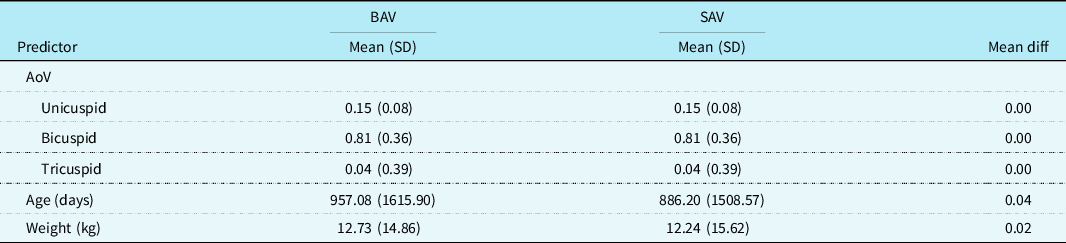
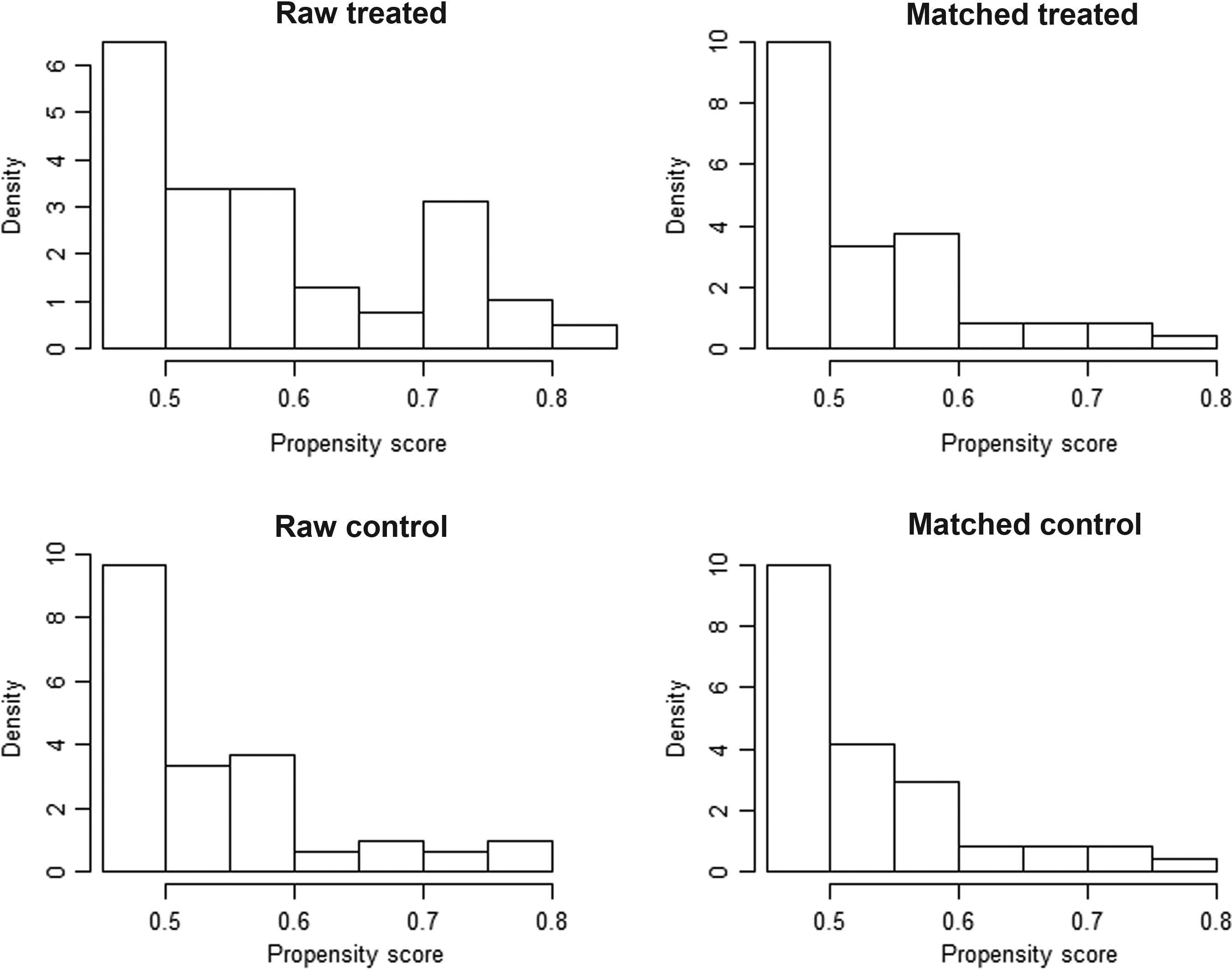
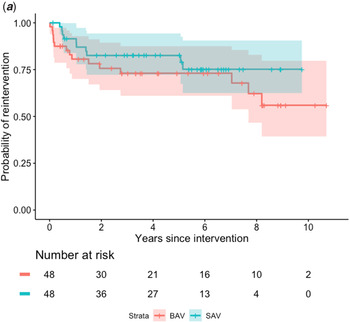
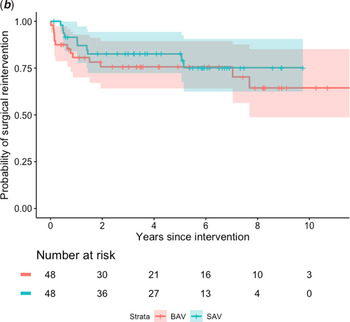
A total of 96 patients were matched (48 patients in each repair group), with all covariates having a residual bias < 0.05 and therefore balance having been achieved (Table 2). After matching, the propensity score histograms were similar across groups (Fig 1). In addition, prior to matching the two intervention techniques were not dissimilar and matches were retained from the full region of propensity scores in the unmatched data. The associations with reintervention in the matched sample were similar to those obtained in the full sample (Fig 3a and b). Freedom from valve replacement was 78% in the balloon group and 81% in the surgical group.
Balance table for matched sample.

Histograms of the propensity score separately by treatment (SAV) and control (BAV) before and after matching.

Central Illustration. Any reintervention across whole cohort. Caption: Kaplan–Meier curve of the association between repair type with reintervention among the full sample (tick marks indicate censoring). The Log-Rank test [Chi-square(1) = 0.0, p = 1.000] and Cox regression [HR = 0.98; 95% CI = (0.54, 1.80)] indicated no association.

Surgical reintervention in whole cohort. Kaplan–Meier curve of the association between repair type with surgical reintervention among the full sample (tick marks indicate censoring). The Log-Rank test [Chi-square(1) = 0.1, p = 0.8] and Cox regression [HR = 1.08; 95% CI = (0.0.58, 2.01)] indicated no association.

Any reintervention in matched sample. Kaplan–Meier curve of the association between repair type with reintervention among the matched sample (tick marks indicate censoring). The Log-Rank test [Chi-square(1) = 0.3, p = 0.6] and Cox regression [HR = 0.80; 95% CI = (0.35, 1.84)] indicated no association.

Surgical reintervention in matched sample. Kaplan–Meier curve of the association between repair type with surgical reintervention among the matched sample (tick marks indicate censoring). The Log-Rank test [Chi-square(1) = 0.0, p = 0.8] and Cox regression [HR = 0.92; 95% CI = (0.39, 2.18)] indicated no association.

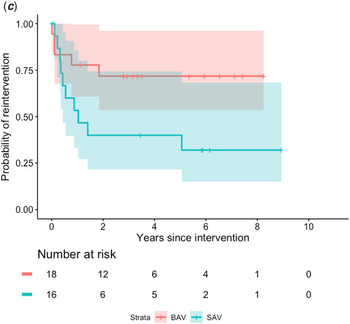
Reintervention in the neonatal group. Kaplan–Meier curve of the association between repair type with reintervention among neonates (tick marks indicate censoring). The Log-Rank test [Chi-square(1) = 3.6, p = 0.06] and Cox regression [HR = 2.73; 95% CI = (0.93, 8.04)] indicated no association.

Neonates
Freedom from any reintervention in the neonatal balloon group was 72% (45%, 87%), 72% (45%, 87%), and 72% (45%, 87%) at 2, 4, and 8 years, respectively. Freedom from any reintervention in the neonatal surgical group was 40% (16%, 63%), 40% (16%, 63%), and 32% (11%, 56%) at the same timepoints.
Despite overlapping confidence intervals, the curves are suggestive of higher reintervention in neonates undergoing a surgical intervention [HR = 2.73 (0.93, 8.04); p = 0.068] (Fig 3c).
Discussion
This contemporary study across all paediatric age groups represents the first propensity matched comparison of balloon aortic valvuloplasty and surgical aortic valvotomy between two centres which have distinct interventional preferences. The results show overall balance in both pre-intervention group characteristics and across outcomes measures. This agrees in part with the results of a number of other comparative studies over the past 20 years, although the incidence of reintervention and conclusions on the relative merit of each approach have differed. Reference Siddiqui, Brizard and Galati3,Reference Hill, Ginde, Rios, Frommelt and Hill4,Reference McCrindle, Blackstone and Williams12–Reference Loomba, Bowman and Cao15
Residual aortic valve function
A historically important comparative analysis by McCrindle et al in 2001 Reference McCrindle, Blackstone and Williams12 looked specifically at neonatal results across 18 centres, demonstrating a similar incidence of reintervention and mortality, but increased post-intervention valve regurgitation with balloon intervention and more residual stenosis with surgery. However, there was mixed experience across the 18 centres involved (between 1 and 29 patients contributed) and significant variability in balloon and surgical techniques utilised.
The surgical technique in our cohort did not include the use of trans-ventricular Hegar dilators or intraoperative balloon valvotomy. A consistent surgical approach by the same group of surgeons with considerable experience with aortic valve repair procedures, therefore, may have contributed to the improved aortic valve function post-surgical aortic valvotomy in the surgical centre represented here, compared to balloon intervention. This bares out in reports from previous eras where valve function was similar post-intervention Reference Justo, McCrindle, Benson, Williams, Freedom and Smallhorn16 compared with more recent experience with improved surgical technique and improved function. Reference Siddiqui, Brizard and Galati3,Reference Brown, Rodefeld, Ruzmetov, Eltayeb, Yurdakok and Turrentine13 Interestingly, this improved post-intervention valve function did not correlate with a lower incidence of reintervention at 5 years with the suggestion of a higher degree of valve stability over time in the balloon valvuloplasty group. This must be taken in the context of the assessment and reintervention criteria for aortic regurgitation performed by two different teams in this study. This trend towards later valve stability in the balloon group has been previously reported. Reference Brown, Rodefeld, Ruzmetov, Eltayeb, Yurdakok and Turrentine13,Reference Justo, McCrindle, Benson, Williams, Freedom and Smallhorn16
Reintervention rates
The incidence of reintervention in both the balloon and surgical groups of our study compares favourably with previous reports. Reference Hill, Ginde, Rios, Frommelt and Hill4,Reference Donald and Konstantinov17 It has been argued the overall incidence of reintervention as an outcome measure has potential confounders, such as non-uniform reintervention criteria. Our data demonstrates a reassuring safety profile (2.5% mortality for surgery and 1.5% mortality for balloon dilation). If both interventions are viewed as palliative procedures to delay valve replacement, our 10-year freedom from valve replacement of 81% and 78%, respectively, demonstrate comparable efficacy.
Neonates
Neonatal outcomes vary in the literature. Individual reports have demonstrated safety and efficacy of both techniques. Reference McCrindle, Blackstone and Williams12,Reference Auld, Carrigan, Ward, Justo, Alphonso and Anderson18 In our study, there is a higher incidence of reintervention following surgical valvotomy. Reference Siddiqui, Brizard and Galati3 Other reviews point towards significant mortality in neonates for both interventions. Reference Donald and Konstantinov17 A recent meta-analysis was underpowered to assess neonatal outcomes. Reference Hill, Ginde, Rios, Frommelt and Hill4 Our data demonstrate both balloon and surgical valvotomy can be performed safely in neonates (surgery (one early death) and balloon (no deaths)). The lower incidence of reintervention within 2 years also supports ongoing consideration of balloon valvuloplasty in the neonate with severe aortic stenosis as a means of delaying surgical intervention in this relatively high-risk population.
Limitations
This study has all the limitations of a retrospective study. An important limitation of our report was the inability to standardise reintervention criteria across the two cohorts. This could have allowed a subset of patients to meet criteria for reintervention under one treating team, while the other team would have continued to observe the patient. Any further prospective studies would require a standardised protocol of blinded echocardiographic evaluation of valve regurgitation and cross-institutional criteria for reintervention.
Future endeavours in the study of surgical and balloon valvotomy for congenital aortic stenosis will require a laying down of arms and a commitment to the clinical question of which palliative procedure benefits which patient population. While there is a call for randomised controlled trials, we believe this would be inherently flawed in a single centre, while logistically difficult across more than one centre. Importantly, a prospective study will allow standardisation of reintervention criteria.
Conclusion
A matched comparative analysis of balloon and surgical intervention using contemporary techniques shows no significant differences in mortality and incidence of reintervention in the medium term. Balloon aortic valvuloplasty continues to offer a safe and effective alternative to surgical intervention across all paediatric age groups. In experienced hands, BAV can effectively delay surgery and may be preferred particularly in the higher-risk neonatal population. Longer follow-up is required to determine if there is further significance to the finding of higher rates of valve regurgitation in the balloon group, although despite this, in the intermediate term reintervention rates were similar. Recent surgical advances continue to show gains in post-procedural valve function and with time may show a trend towards a lower incidence of reintervention overall.
Acknowledgements
The authors would like to acknowledge Janelle Johnson and Sinh Le, for their contribution to data collection and analysis.
Financial support
This research received no specific grant from any funding agency, commercial, or not-for-profit sectors.
Conflicts of interest
None.
Ethical standards
The authors assert that all procedures contributing to this work comply with the ethical standards of the relevant national guidelines on human experimentation (National Health and Medical Research Council’s (NHMRC) National Statement on Ethical Conduct in Human Research (2007)) and with the Helsinki Declaration of 1975, as revised in 2008, and has been approved by the institutional committees (Queensland Children’s Hospital #EC 00175; Royal Children’s Hospital Melbourne #EC 00238).