Introduction
Stroke is a serious condition which affects many people. Around 4.5 million people die from stroke each year. Among the survivors, a substantial proportion will have disabilities after six months.Reference Warburton, Alawneh, Clatworthy and Morris 1 The concept of stroke includes clot formation in a cerebral artery or embolic stroke from atrial fibrillation (ischemic stroke) and intracerebral hemorrhage or subarachnoid hemorrhage. Of the patients who suffer from stroke, approximately 86% have ischemic strokes and 13% have intracerebral hemorrhages. 2 Treatment with recombinant tissue plasminogen activator (rt-PA; alteplase) significantly reduces the risk of death and improves functional outcome in connection with ischemic strokes,Reference Wardlaw, Murray and Berge 3 and there are indications that rt-PA treatment can benefit patients if treatment is started during the first hours after an ischemic stroke.Reference Emberson, Lees and Lyden 4 The treatment of ischemic stroke with mechanical thrombectomy has shown even better results when compared with thrombolysis, especially in connection with a major vessel occlusion.Reference Balami, Sutherland and Edmunds 5 Thus, initial assessment and identification of symptoms and early medical treatment may be vital.
The prehospital care administered by the Emergency Medical Service (EMS) is an important link in the stroke chain, as more than 70% of patients with stroke are transported to hospital by the EMS.Reference Appelros, Jonsson and Åsberg 6 It is also crucial that, early in the prehospital care process, the prehospital personnel identify patients with possible stroke. There are several factors which influence the prehospital management of patients with suspected stroke. The dispatch center, which is the first line in the prehospital stroke chain, plays a crucial role in identifying the case as a possible stroke. When the dispatcher identifies the patient as having had a possible stroke, the patient reaches the hospital earlier and the early chain of care becomes more effective.Reference Caceres, Adil and Jadhav 7 The prehospital use of different stroke scales, such as the Face Arm Speech Time scale (FAST) and the Los Angeles Motor Scale (LAMS), has been shown to increase the prehospital recognition of patients with stroke.Reference Fassbender, Balucani, Walter, Levine, Haass and Grotta 8 A problem with these scales is that the prehospital clinician has to suspect stroke, based on other information, in order to use such scales. It is therefore important to examine the prehospital clinician’s basic assessment process in the prehospital setting, when these scales were not used, among patients with stroke. Another important aspect of the prehospital stroke chain is early notification from the ambulance to the receiving hospital. Notifications have been shown to reduce the total delay to thrombolysis and also to reduce intra-hospital delays.Reference Bae, Kim and Yoo 9 However, the screening and identification of these patients are dependent on the assessment made by the prehospital EMS clinicians. Previous studiesReference Bae, Kim and Yoo 9 - Reference Sheppard, Mellor and Greenfield 14 have investigated the EMS personnel’s ability to identify patients with stroke before arrival at hospital. To the authors’ knowledge, there is no study which has evaluated the full prehospital assessment of patients with a final diagnosis of stroke. Therefore, the aims of the present study were:
-
1. To compare the frequency of a final diagnosis of stroke with the frequency of EMS suspicion of stroke in the field; and
-
2. To explore differences in clinical signs and field assessment, and their associations with EMS suspicion of stroke, among patients with a final hospital diagnosis of stroke.
The rationale for using a neurologic examination (disability) as the primary endpoint was that this appears to be the most basic approach to patients with an acute stroke.
Methods
Design
The study had a retrospective observational design. Data were collected on prehospital and hospital medical records of patients with a final hospital diagnosis of stroke transported to hospital by the EMS during one year.
Study Setting and Population
The study population comprised all patients transported by the EMS in 2015 to a medium-sized hospital in the south-west of Sweden and had a final diagnosis of stroke. The hospital covers a population of 297,000 inhabitants. The hospital offers stroke care in the form of a stroke ward and treatment with thrombolysis, but this hospital has no facilities to perform mechanical thrombectomy in connection with stroke. The included EMS organization is part of the hospital organization and includes nine ambulance stations. Each ambulance in the organization is operated with either two ambulance nurses or one ambulance nurse and one emergency medical technician. It is always a nurse who has the main responsibility for patient care. The majority of the nurses in the organization have an additional specialist education in prehospital emergency care. Since 2005, all ambulances in Sweden have been obliged to be run by at least one registered nurse.Reference Suserud 15
During the study period, the EMS organization had a protocol-based stroke triage system. When the EMS clinicians identified a patient with stroke symptoms according to inclusion criteria, they contacted the neurologist on call who decided if the patient should bypass the emergency room and be transported directly to computer tomography (CT). If the CT could exclude a hemorrhage, the neurologist scored the severity of the stroke, and when there was a suspicion of a major vessel occlusion, the patient was transported to the central hospital for treatment with mechanical thrombectomy. If there were suspicions of a minor stroke, treatment with rt-PA was initiated at the CT lab.
Inclusion and Exclusion Criteria
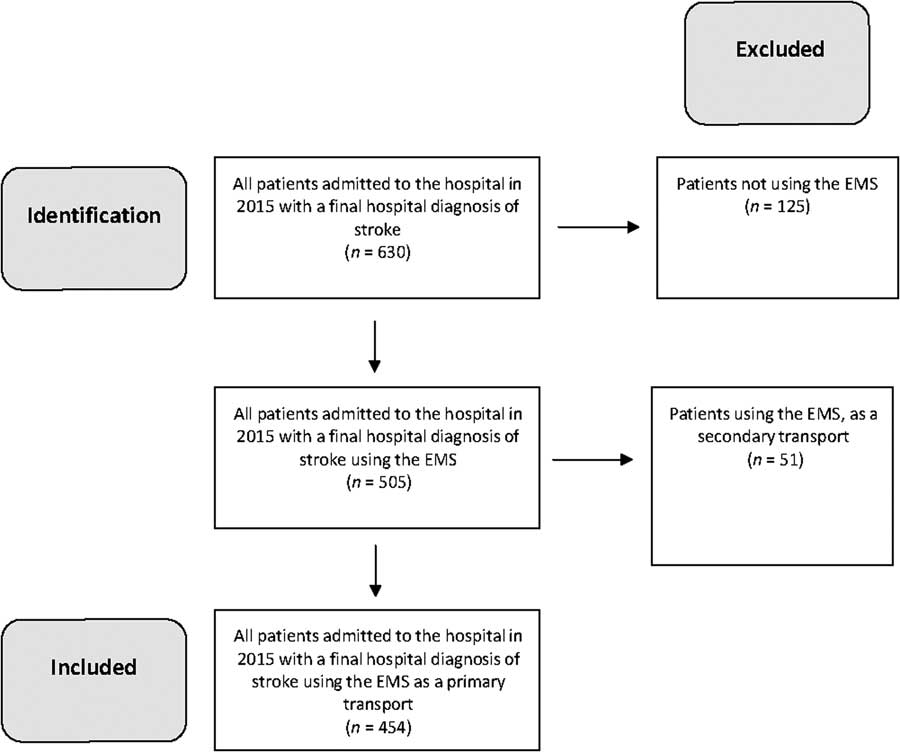
Data were handed out from prehospital and hospital medical records by two of the researchers. From a total sample of 630 patients, 454 patients were included in the study.
The inclusion criteria were:
-
1. All patients admitted to the hospital during the period of January 1 through December 31 in 2015, with the following hospital discharge diagnosis codes:
-
∙ I60 subarachnoid hemorrhage;
-
∙ I61 intracerebral hemorrhage;
-
∙ I63 cerebral infarction; or
-
∙ I64.9 stroke not specified as a hemorrhage or infarction.
-
-
2. Only admissions where patients were brought to the hospital by the EMS, and where an initial assessment was made by EMS nurses, were enrolled.
The exclusion criteria were:
-
1. Patients admitted to the hospital according to the above-stated criterion (1), but the ambulance mission was labelled as a secondary transport (eg, a transport between hospitals, a transport from a health center to hospital, a transport from hospital to home, or a transport based on a doctor’s referral).
-
2. Patients with a care event according to the above-stated criterion (1), but where the ambulance medical record that was linked to the care episode consisted of a record where the EMS clinicians only assisted another ambulance.
A map of the number of patients, included and excluded, and the reasons for exclusion are shown in a flow diagram in Figure 1.
Flow Diagram of Patients with a Final Hospital Diagnosis of Stroke, Included and Excluded, and the Reasons for Exclusion. Abbreviation: EMS, Emergency Medical Service.

Determination of the Stoke Diagnosis
Patients with a clinical presentation raising a suspicion of stroke were evaluated by a neurologist using the National Institute of Health (Rockville, Maryland USA) Stroke Scale (NIHSS). All neurologists were trained in stroke care, and all had experience in stroke diagnostic work and in the treatment of stroke. The preliminary diagnosis was then confirmed by a CT scan of the brain, and in cases of diagnostic uncertainty, by a magnetic resonance imaging (MRI) of the brain. In rare cases, especially when patients suffered from dizziness and/or imbalance, a consultation of an experienced ear, nose, and throat physician was performed.
A team consisting of a physiotherapist, occupational therapist, and speech therapist assisted in the evaluation of patients and contributed to the final diagnostic work-up.
Data Collection
Patients eligible for the study were searched for in the hospital medical record database according to directions for inclusion and exclusion criteria. When a patient who fulfilled the inclusion criteria was found, a search for that patient was made in the corresponding ambulance organization’s medical record database. If the patient had been transported by ambulance in connection with the care event, the patient was included in the study. The database search was made by two of the authors (EA, LB). A data collection protocol was developed for the study. The protocol was a modified version of a protocol used in a previous study.Reference Andersson Hagiwara, Suserud, Andersson-Gare, Sjoqvist, Henricson and Jonsson 16
The protocol included information on date of arrival at hospital, the date of discharge from hospital, and if the patient had been transported by the EMS in connection with the care event. In this part, information on gender and age was also collected.
The next part of the protocol contained information on assessments and examinations performed by the ambulance nurse. The vital parameters were collected in exact numbers, and for the history taking, according to the SOPQRSTAMPLE systemReference Dalton 17 during secondary assessment; for the assessment of symptoms, only a dichotomous response (yes or no), with yes accounting for the issue to be assessed, was collected.
The last part of the protocol comprised neurologist contact and inclusion in the stroke fast-track early chain of care. In this part of the protocol, information on the EMS nurse’s primary and secondary diagnoses and triage code according to the Rapid Emergency Triage and Treatment System (RETTS)Reference Widgren and Jourak 18 was collected.
This system divides the patients into five different colors according to time from examination until the patient must be seen by a physician. The five colors are red, orange, yellow, green, and blue, where red indicates the most urgent case and whereas blue means that the patient does not require an investigation by a physician. The colors are based on vital signs and type of symptoms. A part of the system includes a figure (emergency signs and symptoms; ESS code) which stands for type of symptom (for example, chest pain or dyspnea). A suspicion of either a transitory ischemic attack (TIA) or stroke has a unique ESS number.
During the data collection process, two of the authors (EA, LB) filled in each medical record together. One was reading the data and the other was entering the data in the study database.
Data Analysis
For demographic data, descriptive statistics were used. An independent t-test was used for continuous data and chi-square tests were used for categorical data.
Due to the large number of P values that were created, a P value of < .01 was considered significant in all statistical tests, with the exception of the primary end-point (neurological examination) where P < .05 was regarded as significant. All analyses were performed using SPSS 21.0 (SPSS, Inc; Chicago, Illinois USA).
Ethical Issues
A main ethical issue in the present study was threats to personal integrity, which means that the patient’s identity needed to be protected. Therefore, all data collected in the protocol were coded and made anonymous to patient and health care professionals. Considerations were made according to the processing of data and that people who were not involved in the study were not able to see any of the data collected from the medical records. The collected data were stored in form of paper copies which were locked in a special room at the university. The study was approved by the Regional Ethics Committee, Gothenburg, Sweden (Dnr: T017-16).
Results
Frequency of Prehospital Suspicion of Stroke
In total, 454 patients were included in this study. Among these patients, 236 (52%) had a prehospital documented suspicion of a preliminary diagnosis of stroke by the EMS clinician. Among the remaining patients, the preliminary diagnoses documented for the patients were: TIA (34; 7%), other neurology (36; 8%), vertigo (39; 9%), headache (19; 4%), and other (80; 18%).
Comparison between Patients with a Prehospital Suspicion of Stroke or Not
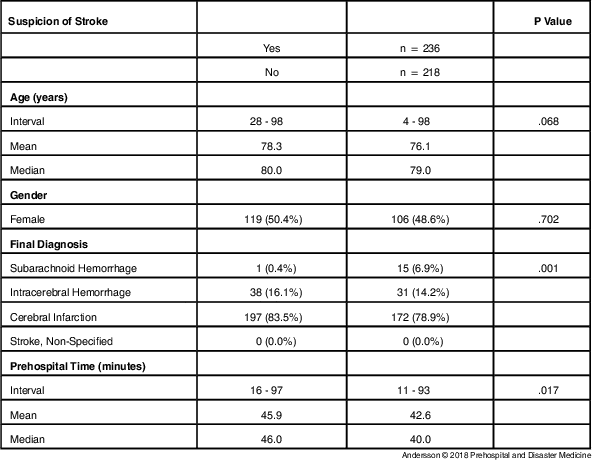
When comparing patients with a suspicion of stroke with patients with no such suspicion, there were no significant differences between the two groups regarding the distribution of patients according to age, gender, and prehospital time (Table 1). However, there was a significant difference between the groups regarding final diagnosis. Patients with a final hospital diagnosis of subarachnoid hemorrhage were more frequent in the group where EMS clinicians had no suspicion of stroke, whereas intracerebral hemorrhage and cerebral infarction were more frequent in the group with a suspicion of stroke.
Demographics for Study Stroke Victims

Overall Prehospital Assessment
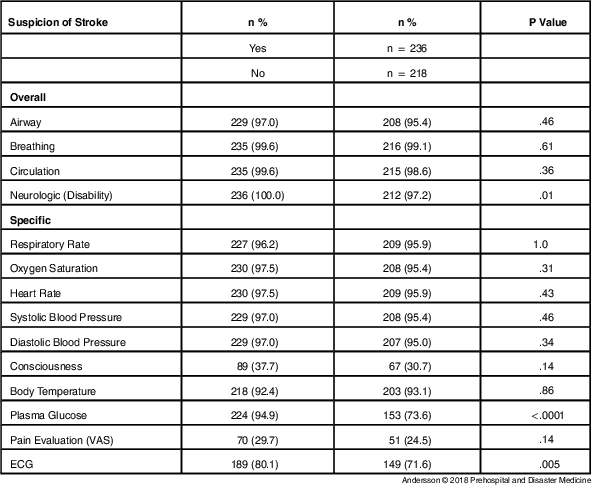
In terms of the primary assessment of vital parameters including airway, breathing, circulation, and neurology (disability), there were no differences between the two groups, with the exception of neurology (disability). Neurology (disability) was assessed in all patients with a suspicion of stroke, but only in 97% of those with no such suspicion.
As shown in Table 2, vital parameters were assessed similarly in the two groups, but an electrocardiogram (ECG) was recorded and plasma glucose was sampled more frequently among patients in whom an initial suspicion of stroke was documented.
Clinical Investigation for Study Stroke Victims

Abbreviation: ECG, electrocardiogram.
Assessment of Clinical History
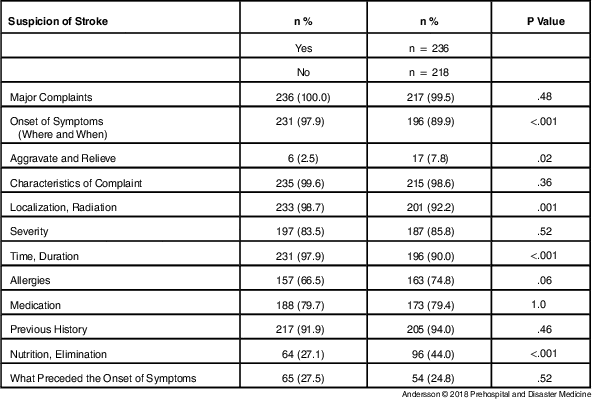
In terms of clinical history, some differences were observed. Patients with a documented suspicion of stroke were more frequently assessed for symptoms, such as time and place of onset of symptoms, localization, and radiation of symptoms, and for the duration of symptoms. On the other hand, nutrition and elimination were more frequently assessed among patients with no suspicion of stroke (Table 3).
Clinical History for Study Stroke Victims

Assessment of Symptoms
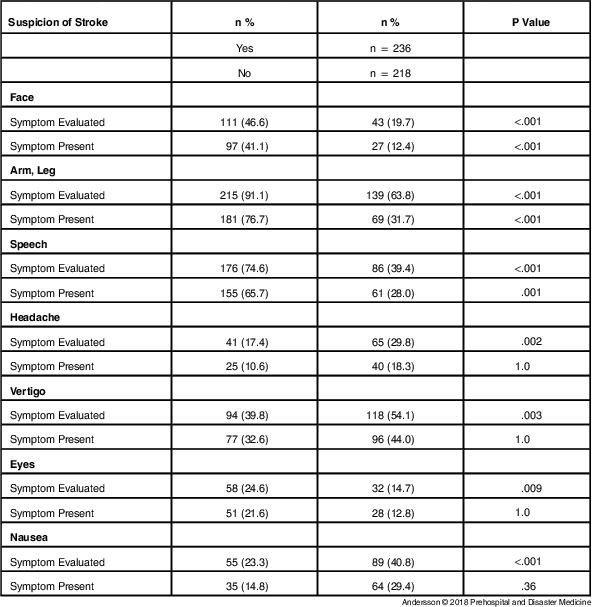
Assessments of the face, arms/legs, speech, and eyes were more prevalent among patients in whom there was a documented suspicion of stroke. On the other hand, assessments of headache, vertigo, and nausea were more frequently documented among patients in whom there was no suspicion of stroke (Table 4).
Evaluation and Incidence of Symptoms for Study Stroke Victims

Prevalence of Symptoms
Symptoms from the face, arms/legs, and speech were all more prevalent among the patients in whom there was a suspicion of stroke (Table 4).
Vital Parameters
There were no significant differences between patients in whom the EMS clinicians suspected a stroke compared with patients with no suspicion of stroke when it came to measurement of blood pressure, pulse rate, respiratory rate, temperature, plasma glucose, and Glasgow Coma Scale.
Contact with a Neurologist and Fast-Track
Among patients in whom there was a documented suspicion of stroke, a neurologist was approached by the EMS clinician in 79% of cases, and a fast-track to the hospital was applied in 70%. The corresponding figures for patients in whom there was no documented suspicion of stroke were 20% and 11%, respectively (P <.001).
Discussion
Overall Results
The findings suggest that a suspicion of stroke on the arrival of the EMS was documented in approximately one-half of the patients (52%) by the EMS clinician among the patients with a final hospital diagnosis of stroke. In addition, it is notable that of all admitted patients with a final diagnosis of stroke, 80% were transported by the EMS. However, relatively few patients among those transported by the EMS were suspected to have a stroke. This highlights a need for improvement of prehospital screening of stroke patients. These findings are in relative agreement with those in a previous report. A study in western Sweden from 2011 found that stroke was suspected by the EMS crew in 66% of all patients with final diagnose of stroke.Reference Wireklint Sundström, Herlitz, Hansson and Brink 10 Thus, the present study finding of 52% is somewhat lower than previous reporting’s from Sweden. This should, however, be related to the fact that, in a further seven percent, there was a documented suspicion of TIA, and in a further 10%, contact was established with a neurologist by the EMS clinician. Thus, in around 70% of cases, the initial judgement by the EMS clinician was in relative agreement with the final outcome.
Why Was a Stroke Not Suspected in a Large Percentage of the Patients?
A number of possible reasons can be addressed. The first is the question of symptoms. It was obvious that the patients without any initial suspicion of stroke less frequently had documented typical symptoms of stroke. There were also trends indicating that less typical symptoms such as vertigo, headache, and nausea tended to be more frequently observed in this subset of patients. These findings are in agreement with those in a previous report.Reference Moreira, Correia, Magalhães and Silva 19 Another important factor is the assessment made by the EMS clinician at the scene. Here it was found that a neurological examination (primary endpoint) was more frequently performed among patients in whom there was a suspicion of stroke.
These results suggested that, among patients in whom there was no initial suspicion of stroke, the initial assessment made by the EMS clinician was less detailed. This was found not only with regard to the presence of typical symptoms, but also with regard to the characteristics of the symptoms that were present. It is difficult to estimate the relationship between the cause and the effect of this finding. Questions remain on whether a less-detailed prehospital assessment may result in a lower detection rate of stroke, or whether patients without a documented suspicion may be more difficult to detect due to a lower frequency of a traditional symptom onset of stroke. Still, a more detailed assessment of patients with no suspicion of stroke is important, in particular patients with symptoms such as headache, vertigo, and nausea might benefit by an extended prehospital neurological examination.
Another interesting observation was that measurements of plasma glucose and recordings of an ECG were less frequent if there was no notification of an initial suspicion of stroke. It is possible to speculate that a suspicion of stroke increases the likelihood of making these analyses.
Is it Possible to Improve Screening and Early Identification of Stroke?
The early identification of stroke is based on clinical history and clinical signs. There is still no scope for biochemical markers or electrical changes in the brain or any other similar investigation. An early diagnosis based on an analysis of the transmission of microwaves in the brain has been suggested, but this is still in the research phase.Reference Persson, Fhager and Trefn 20 So a careful evaluation of the clinical history and a careful clinical examination remain as the cornerstone in the early diagnostic work-up.
Relatively frequently documented symptoms among patients with no suspicion of stroke were vertigo and headache. These are non-specific symptoms of stroke. More about whether the characteristics of vertigo and headache differ between patients with stroke and other causes of these symptoms needs to be known. The implementation of stroke training programs for both prehospital personnel and personnel working in the emergency room have become a positive strategy both for improving the identification and the management of acute stroke patients.Reference De Luca, Toni and Lauria 13 More research is required to evaluate the potential for further improvement of the diagnostic accuracy by health care providers already in the prehospital setting among patients with stroke.
Strengths and Limitations
The strength of the present study is the investigation of the prehospital assessment in relation to patients with a final diagnosis of stroke. The results can be used to improve clinical practices and educational programs in connection with prehospital stroke care.
A limitation of the study is the use of medical records. Problems with the use of medical records have previously been reported, related to, for example, that data are abstracted several steps away from the patient.Reference Kaji, Schriger and Green 21 The problem may even be potentially greater when it comes to prehospital journals, as the medical records are commonly completed several hours after the first patient contact.Reference Bledsoe, Wasden and Johnson 22 However, the present study has been guided by the paper of Kaji et al,Reference Bledsoe, Wasden and Johnson 22 with the aim of reducing bias in medical record reviews. Moreover, the study is limited to a specific region of Sweden at a middle-sized hospital, which may be a limitation. However, these findings include valuable knowledge on the prehospital assessment of patients with a final diagnosis of stroke, an area in need for further improvements.
Conclusion
This study points to a need for improvement of prehospital screening and identification of patients with stroke. Among the 454 patients with a final diagnosis of stroke transported by the EMS, there was no documented suspicion of stroke by the EMS clinician in around one-half of the cases. These patients differed from those with a suspicion of stroke in terms of less frequently being assessed for different neurological symptoms.
The assessment and identification of stroke may be a challenge as symptoms vary between patients. Still, patients with less traditional symptoms need to be carefully considered and assessed in order to further improve the identification and care of patients with stroke.