The International Energy Agency (IEA) is arguably the world's most advanced multilateral energy institution. Established in the wake of the first oil shock, the IEA now deals with energy policy writ large, and it is hardly surprising that when the G8 countries and their emerging partners decided to launch a new International Partnership on Energy Efficiency Cooperation (IPEEC) in 2008, they turned to the IEA to host it. Yet a few months later, Germany and some other IEA member states successfully pushed for the creation of the International Renewable Energy Agency (IRENA) outside the IEA as a new, stand-alone organization.
These events present two puzzles. First, why did those states not simply use the IEA to promote renewable energy? This would have been a natural choice, given that the IEA had for decades developed competencies for renewable energy. Secondly, why did those states create IRENA in spite of tremendous uncertainty about the fledgling organization's ability to survive in the shadow of the hostile IEA? According to conventional co-operation theory, such uncertainty should be a strong deterrent against institutional creation.
The creation of a new institution on terrain already occupied by an existing institution is a worthwile phenomenon to explore. It is empirically frequent and, from a conventional functionalist perspective, theoretically puzzling. The number of international institutions has increased rapidly over time.Footnote 1 As they proliferate, international institutions ‘inevitably bump against one another’,Footnote 2 and overlaps can be expected to become more common.Footnote 3 The creation of new institutions is at the heart of institutionalist co-operation theory.Footnote 4 While previous theories provide powerful explanations of the functional utility and ‘stickiness’ of institutions, they provide less leverage for understanding why states create new institutions even where suitable and sticky alternatives exist.
We propose a bargaining approach to explain why states create new institutions instead of relying on the existing seasoned ones that perform similar functions. In the model, the creation of an overlapping institution is considered a form of bargaining failure. A ‘challenger’ state is dissatisfied with a currently focal institution and threatens to create a new institution. A ‘defender’ state can propose to reform the currently focal institution in order to prevent the challenger from creating the new institution. Or, in Hirschman'sFootnote 5 terms, the defender gives more ‘voice’ to the challenger to avert his ‘exit’.
We do not expect bargaining difficulties to be the only reason why states create overlapping international institutions, nor do we expect bargaining difficulties to always result in overlapping international institutions. Instead, we have a more modest goal: a theoretically parsimonious and empirically relevant account of when and how bargaining can be expected to produce overlap. The fundamentals of the model are institutional capture, domestic political pressure and the expectation that a new institution will succeed. By institutional capture, we refer to the possibility that the currently focal institution is controlled by interests that hold a distributive bias against the challenger. Domestic political pressure increases the challenger's willingness to pay for changing the status quo. The expectation of success is conceptualized as the probability that the new institution will garner support among other states.
According to the model, de novo institutional creation is likely when the challenger insists on reform but the defender's cost of conceding those reforms is high. This outcome can be expected when institutional capture has occurred and domestic political pressure is intense. Similar to deterrence models,Footnote 6 the expectation of success is irrelevant. If the expectation of success is high, the defender offers to reform and therefore the new institution is often not created. If it is low, the defender refuses to reform, but the challenger does not dare to create a new institution because it will probably fail.
This theory can explain the puzzling case of IRENA. As shown below, the combination of institutional capture of the IEA and intense domestic political pressure led Germany to champion a new institution despite uncertain expectations about its success. In contrast, the IEA was not captured with regard to energy efficiency, nor was there much domestic political pressure in the case of the IPEEC. Below, we offer a systematic test of our model by examining de novo institutional creation in the issue areas of energy, whaling and intellectual property (IP) rights.
This article offers three broad contributions to the study of international politics. First, it explains why states resort to the costly and difficult strategy of de novo institutional creation in dense institutional environments. Secondly, it demonstrates the value of incorporating distributional conflict and power politics into the canon of co-operation theory. The cases reveal the limitations of functionalist approaches such as rational design.Footnote 7 Finally, it helps scholars understand the profusion of international institutions in a conflictual environment.
OVERLAPPING INTERNATIONAL INSTITUTIONS
International institutions are ‘explicit arrangements, negotiated among international actors, that prescribe, proscribe, and/or authorize behavior’.Footnote 8 They facilitate co-operation by enforcing behavior, pooling resources, providing information and facilitating bargaining.Footnote 9 Overlapping international institutions hold similar mandates and have an intersecting target membership.Footnote 10 Mandates can be considered similar if the functional scope of one institution protrudes into the functional scope of the other.Footnote 11 Membership must intersect, except if they regulate common pool resources. In such cases, given the nature of such goods, parallel institutions can overlap even if their membership does not intersect. The Kyoto Protocol and the Asia-Pacific Partnership on Clean Development and Climate (APP) are examples of overlapping institutions because both regulate the climate policies of countries that are members to both treaties. If any of the three conditions fails, there is no overlap. For example, the simultaneous existence of African and East Asian trade agreements is not defined as overlapping because these agreements focus on different regions and do not constitute common pool resources.
There are different forms of overlapping insitutions, and overlaps may exist between two or more institutions. Some overlaps may arise unwittingly, though most are created self-consciously.Footnote 12 The goals and activities of overlapping institutions can exhibit different degrees of compatibility. For example, despite occasional political quarrels, European security institutions share similar goals with NATO, and their respective forces co-operate closely ‘on the ground’.Footnote 13 The APP, by contrast, is widely interpreted as a rival to the Kyoto Protocol.Footnote 14 Finally, there is variation in the degree of membership overlap. On all these dimensions, overlap has to be understood as a matter of degree rather than an absolute binary variable.
According to classical co-operation theory, overlap increases transaction costs. Scholars of international relations have argued that the establishment of international institutions is costly.Footnote 15 Designing effective rules and standards to govern state behavior and then implementing them is difficult. As Keohane famously puts it, ‘international regimes are easier to maintain than to construct’.Footnote 16 Yet despite compelling functional reasons for avoiding redundant overlap, empirical examples of overlap abound, and pervade many issue areas of world politics. If an extant international institution can govern state behavior in an issue area, why would states not capitalize on it? Why would they not rely on a single focal institution to exploit economies of scale?
Studies of ‘regime interaction’ and ‘regime complexes’ offer analytical typologies of how regimes interact,Footnote 17 but they do not develop precise causal models of overlap. Raustiala and VictorFootnote 18 come close by proposing that states sometimes strategically create inconsistent rules in one regime to influence another, but this proposition applies more to regime shifting or forum shopping than to the creation of new institutions. Keohane and VictorFootnote 19 propose that the climate regime is fragmented because organizing a comprehensive regime would be difficult and members of specific ‘clubs’ in the issue area prefer to exclude others from their benefits, but they do not describe a situation in which a focal institution was explicitly challenged by a competing one. Johnson and UrpelainenFootnote 20 show that states may keep regimes separate if there are negative spillovers between two issue areas, but they assume that the regimes do not have overlapping mandates and do not consider competition.
YoungFootnote 21 claims that choices of arenas for regime formation are products of organizational imperatives, on the one hand, and actor interest calculations, on the other, yet he does not operationalize these concepts or explain how they interact. Jupille and Snidal argue that states will reach beyond focal institutions if these fail to provide ‘a relatively efficient and uncontested means for handling the issue without raising distributive questions’,Footnote 22 but they do not characterize a situation in which such distributive questions would arise. MansfieldFootnote 23 argues that states may circumvent existing international institutions if they believe that ‘institutional capture’ has occurred and these international institutions have become dysfunctional. However, he does not develop a causal account of such institutional capture.
A partial exception to this pattern is Cottrell,Footnote 24 who emphasizes the possibility that an existing institution may lose its legitimacy. It is equally plausible that state preferences could remain unchanged while institutions change due to ‘agency slippage’ and other factors internal to the institution.Footnote 25 The general thrust of our argument is similar, but we expand the argument by considering the possibility that satisfied and dissatisfied states engage in bargaining.
Studies of ‘forum shopping’ have recognized the possibility that states strategically choose among existing international institutions.Footnote 26 These studies argue that powerful states may use alternative institutional fora to advance their strategic aims.Footnote 27 For example, HelferFootnote 28 argues that domestic interest group pressure is an important cause of ‘regime shifting’ in international relations. However, this literature does not consider the possibility that dissatisfied states opt to create a new international institution.
THE STRATEGIC ORIGINS OF OVERLAP
We examine a situation in which a dissatisfied state, labelled challenger (A), considers the possibility of creating a new institution. For example, India could be the challenger in trade co-operation if it believes that World Trade Organization (WTO) rules are biased against it. Creating a new institution is costly, and the enterprise may fail if other states refuse to join it. The model also includes another state, labeled defender (B). Since this state prefers an existing focal institution, it wants to avoid overlap. In the WTO, the United States or the EU could be the defender because current trade rules produce considerable benefits for them. The defender may offer to change the rules and practices of the existing institution to appease the challenger, and thus avoid overlap. For example, the United States or the EU could offer to liberalize agriculture to appease developing countries.
We assume states are unitary actors, with the expection that they are subjected to exogenous domestic political pressure. As to scope conditions, the following three factors should be present.Footnote 29 First, the challenger must be willing to create a new international institution unless the extant institution changes. Secondly, the issue must be such that a new institution could potentially increase the challenger's pay-off. For example, the new institution could influence the extant institution or directly solve the international co-operation problem at hand. Finally, the challenger must possess the capacity to create a new institution.
The key independent variables are Institutional Capture and Domestic Political Pressure. Institutional capture refers to a situation in which the challenger believes that the defender dominates agenda setting within the extant international institution and is capable of influencing distributional outcomes to such an extent that the status quo carries a high cost to the challenger. For example, Japan could worry that the International Whaling Commission (IWC) is captured by anti-whaling countries.Footnote 30
Institutional capture is difficult to measure because it has both objective and subjective elements. The objective elements are distributional conflict and asymmetry of influence. First, institutional capture is not possible unless states are in distributional conflict. A challenger and a defender with diverging preferences must exist for our theory to apply. Secondly, institutional capture requires that some states systematically find themselves on the losing side. The asymmetry of influence must be such that the defender's material capabilities are disproportional to its influence in the international institution. The final element is the challenger's perception of a systematic bias against its interests.
Domestic political pressure refers to interest group demands in the challenger state for the creation of a new international institution. The government of the challenger state has its own preferences for an international institution, and these may be amplified by demands from influential interest groups. For example, pharmaceutical companies in the United States could demand that the federal government do more to force other countries to protect their IP rights. While the identity of the relevant interest groups depends on the context, most governments are sensitive to domestic political pressure. Both in autocracies and democracies, the government depends on constituency support for political survival.Footnote 31 For any particular empirical application, it is important to identify the relevant interest groups and verify that they have political clout.
The challenger's resolve is subject to some uncertainty. The challenger may be resolute, and thus willing to create a new institution at a high cost, or it may be irresolute, and thus willing to accept even modest reform offers. This assumption is standard in bargaining models.Footnote 32 The defender cannot be sure that the challenger would really pay the high cost of creating a new institution unless the defender offers to reform. For example, if developing countries demand a reform of the multilateral trade regime, such as a reduction of agricultural subsidies in Europe and North America, the EU and the United States may suspect that the developing countries are not really willing to create alternative trade institutions to challenge the WTO.
Formal Model
Without institutional capture, the challenger and defender can easily resolve their policy disputes. But if the defender has captured the institution, a bargaining analysis is needed. Unless the defender offers to reform the institution, institutional capture prevents it from credibly committing to policy changes that would appease the defender. For this analysis, we need a formal model. The game is played by the challenger, the defender and a third party that decides whether to join the new institution. The sequence of moves is the following:
-
1. Nature draws the challenger's type and the third party's type;
-
2. Defender offers a reform concession, x ∈ [0,1];
-
3. Challenger accepts or rejects, D(x) ∈ {0,1};
-
4. If challenger accepts, the game ends. If challenger rejects, a new organization is created and the third party decides whether to join J ∈ {0, 1}.
The game has two uncertain parameters. First, uncertainty surrounds the challenger's cost of establishing an organization (Bayesian type). Let
c
be this cost with probability p
low
, so that the challenger is ‘resolute’. Let the cost be
 $$$ \bar{c} $$$
with probability p
high
= 1 − p
low
, so that the challenger is ‘irresolute’. Suppose
 $$$ \bar{c}\, \gt \,\underline{c} $$$
. This payoff is the challenger's private information. Secondly, uncertainty surrounds the third party's preferences (Bayesian type). With probability λ
join
, the third party's pay-off from joining the organization is 1. With probability 1 − λ
join
, it is instead −1. This pay-off is the third party's private information.
If no organization is created, the challenger's pay-off is x. Note that it increases with the defender's concession offer. If a new organization is created, the challenger's expected pay-off is:
 $${{\lambda }^{join}} \,{\rm{ - }}\,c\, + \,d.$$
In this expression, λ
join
is the expected probability that the third party will join. If it does so, the challenger obtains a bonus of 1. Note that this is also the upper bound of the defender's reform offer. The cost
 $$$ c\, \in \,\{ \underline{c}, \overline{c} \} $$$
represents the cost of creating a new organization.
The final variable, d > 0, represents domestic political pressure for the creation of a new organization. We assume that as domestic political pressure increases, d increases, regardless of the challenger's type. This plausible assumption states that, regardless of the challenger's intrinsic preferences, it reacts to domestic political pressure. We do not endogenize domestic political pressure here, as our focus is on the consequences thereof. One could extend the model by assuming that there is a lobby that can mobilize efforts to influence its own government's preferences. Such an extension could yield interesting insights into domestic bargaining over new international organizations. We leave this potentially complicated extension for future research.
The defender's pay-off is 1 − x if the challenger accepts the offer. It is 1 − λ join if the challenger rejects, thus creating a new organization. The idea is that if the new organization fails, as is expected to happen with probability 1 − λ join , the defender obtains a bonus of 1. This is equivalent to no reform offer. Otherwise the defender obtains nothing. Let c − d > 0, so that under complete information, bargaining failure is impossible. For a full solution of the model, see the Appendix.
Dependent Variables
We have two dependent variables: Reform Offer and the creation of a New International Institution.
Reform Offer
Reform offers are a form of appeasement that the defender can rely on, should it believe that the challenger's threat to create a new institution is credible. The most important reform offer is to change the institutional rules of the focal institution. These changes would mitigate the challenger's concerns about institutional capture and the adverse distributive bias in the focal institution.
New International Institution
Given the defender's reform offer – or lack thereof – the challenger must next decide whether to create a new institution. Thus de novo institutional creation is coded as a positive observation and all other outcomes (status quo, reform, nesting and regime shifting) are coded as negative observations.
Independent Variables
The three key independent variables are institutional capture, domestic political pressure and the expectation that a new institution will successfully attract support from other states. While the introduction of any of these variables is itself not novel, their interactions are potentially complex.
Institutional Capture
Institutional capture is why the challenger considers creating a new international institution. In the absence of institutional capture, the challenger and defender can easily resolve any conflictual issues within the confines of the extant institution. Since the challenger understands that the defender's promises of policy change are credible, the defender can relatively easily accommodate the challenger. For example, if the United States and China believe that each is adequately represented in the WTO, they can use the WTO to resolve trade disputes. Neither party has a real incentive to threaten the other with the creation of a competing trade institution.
Under institutional capture, the situation becomes more difficult. To accommodate the challenger, the defender must reform the extant institution. Without institutional reform, promises of policy change ring hollow, because the defender cannot credibly commit to them. For example, if China grows increasingly powerful in the realm of international finance, the United States may have to promise to revise the voting rules of the International Monetary Fund. Otherwise, China will believe that the United States cannot credibly promise to accommodate China's demands.Footnote 33
In this situation, the defender faces a choice between reform and the status quo. The status quo is ideal if the challenger's threat to create a new institution seems incredible, or if the new institution is expected to fail. In each case, the extant institution prevails and the defender continues to benefit from institutional capture. The defender may also offer substantial reforms, but this is costly because the defender loses control of the extant institution. However, this strategy has the benefit of reducing the probability of a new institution. If the defender makes a reform offer, the challenger will accept if it believes the reform would mitigate institutional capture.
Domestic Political Pressure
Domestic Political Pressure comprises different domestic interest groups’ efforts to induce the government to combat the distributive bias in the focal institution. While we reject Truman's pluralistic notionFootnote 34 that governments have no policy preferences of their own, we also maintain that domestic politics is important. All else constant, domestic political pressure to break away from the status quo changes the government's calculus in regard to the creation of overlapping institutions.
Under low domestic political pressure, the challenger's incentive to create a new institution is limited to the government's foreign policy and ideological preferences. Since the defender understands this, it also understands that the reforms required to prevent the challenger from creating a new institution are not as costly as in the presence of domestic political pressure. For example, if advocates of improved energy efficiency do not mobilize to demand the creation of a new institution for energy efficiency, then potential challengers face less pressure to create a new institution than otherwise.
Under high domestic political pressure, the challenger has a strong incentive to create a new institution. Doing so both generates material benefits for the domestic supporters of such an institution and is a form of symbolic politics. Given that the defender understands that the offer required to ensure that the challenger does not create a new institution is costly, the defender has incentives to ‘gamble’ by making a modest offer and hoping the challenger will accept it. For example, if major pharmaceutical and chemical companies in the United States lobby aggressively for the federal government to combat lax protection of IP rights in existing organizations such as the World Intellectual Property Organization (WIPO), developing countries that oppose stringent IP rights understand that the US government is willing to play hardball unless concessions are made.
Expectation of Success
The final independent variable that we consider is the expectation that a new institution will succeed. In the model, success is defined in terms of the new institution's ability to garner the support of a ‘critical mass’ of third parties.Footnote 35 This support allows the new institution to produce meaningful effects on governance in the relevant issue area. Since expectations of success are subjective, measuring the expected probability of success is empirically challenging and requires a careful evaluation of key actors’ beliefs.Footnote 36
If the expectation of success is high (low), the challenger's incentive to create a new institution is also high (low), ceteris paribus. However, this variable does not have unambiguous effects on the probability of de novo creation. If the expectation of success is high, the challenger's threat is credible, and so the defender makes a substantial offer. If the expectation of success is low, however, the challenger's threat is not credible, and so the defender makes a modest offer. Overall, then, the probability of de novo creation remains unchanged.
Hypotheses
In the absence of institutional capture, bargaining within the confines of an extant institution is efficient. But if institutional capture has occurred, the defender's promises to reform require deeper changes in institutional rules and structures. In such circumstances, our model indicates that the probability of institutional creation is non-negligible due to a problem of credible commitment.Footnote 37 Given institutional capture, the defender cannot credibly commit to policy changes that would appease the challenger, and so deeper institutional reforms are needed.
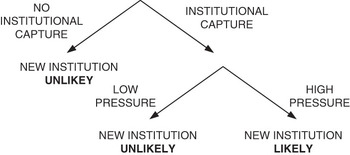
Our central empirical predictions are illustrated in Figure 1. In the absence of institutional capture, the probability of a new institution is low. In this circumstance, the challenger and defender can easily resolve their policy disputes within the focal institution. In the presence of institutional capture, however, the probability depends on domestic political pressure. If domestic political pressure is low, the challenger cannot credibly threaten the defender with creating a new institution, because the defender understands that the challenger is not really under heavy pressure to act. The defender can easily accommodate the challenger's demands, even with a relatively meagre reform offer. If domestic political pressure is high, however, the challenger has an incentive to gamble by creating the institution. Although the defender understands this, it also realizes that preventing the challenger from acting is very costly due to domestic political pressure. Therefore the defender may offer a meager reform package as a rational gamble. These hypotheses can be stated as follows:
A graphical illustration of testable hypotheses

Hypothesis 1: (Institutional Capture): All else constant, institutional capture increases the probability that a new institution will be created.
Hypothesis 2: (Domestic Political Pressure): If institutional capture has occurred, all else constant, domestic political pressure increases the probability that a new institution will be created.
The expectation of success should not have a systematic effect on the probability that a new international institution will be created. If the expectation is high, the defender understands that a substantial reform offer is required. If the expectation is low, the defender does not offer to implement substantial reforms. These effects go in opposite directions, so the combined effect of increasing the expectation of success is unclear:
Hypothesis 3: (Domestic Political Pressure): If institutional capture has occurred, the expectation that a new institution will succeed has no effect on the probability that it will be created.
In the Appendix, we also consider the possibility that the challenger and defender disagree on the expectation of success, λ join . In this case, changes in the subjective expectations of success, as estimated by one of the players, may change the likelihood of de novo creation. Even then, however, the overall effects may be ambiguous, as they depend on the correlation between the subjective expectations.
Finally, our model generates hypotheses for reform offers. The primary implication of the model can be summarized as follows:
Hypothesis 4: (Reform Offers): If institutional capture has occurred and domestic political pressure exists, a substantial reform offer that reduces institutional capture reduces the likelihood of institutional creation.
Suppose institutional capture does not result in overlap. In the presence of domestic political pressure, this avoidance of overlap should be associated with reforms that reduce institutional capture. These reforms are needed to appease the challenger that is facing pressure, and thus overlap should be difficult to avoid without such reforms. In the absence of domestic political pressure, it is much more likely that the challenger will fail to engage in de novo institutional creation without a reform offer.
RESEARCH DESIGN
To scrutinize our theory, we analyze six cases. We take as a case any strategic situation in which a group of states negotiated about the design of international institutions. In some such cases, de novo institutional creation followed. In others, it did not. But in all cases, the possibility of a new institution was not completely negligible ex ante, so we are comparing across strategically similar situations.Footnote 38
The key scope condition for our analysis is that some states (challengers) must be in a position to create a new institution unless others (defenders) agree to reform the extant focal institution. Thus we selected cases in which potentially dissatisfied states were not completely unable to engage in institutional creation. We also selected recent (post-Cold War) cases to reduce variation in systemic factors. In each case, there was an existing focal institution.Footnote 39
We selected one pair of cases from three different issue areas. In each pair, one case is a positive observation that resulted in a new institution, and the other case is a negative observation that did not. By comparing positive and negative outcomes within the same issue area, we avoid comparing apples to oranges. Following Mill's method of difference, we examine whether the positive and negative outcomes can be explained with reference to our key independent variables, while controlling for other factors.
The method of difference is ideal because we are interested in explaining the puzzle of overlapping international institutions. An alternative approach would be to maximize variation in the value of our key independent variables. However, this approach is neither theoretically defensible nor practical. Since our goal is to explain the emergence of overlap, we must have many cases of overlap. An approach based on variation in the independent variables might fail to meet this criterion. From a practical perspective, it would be difficult to sample on independent variables without any regard to the dependent variable. By using the method of difference, we can easily isolate positive observations and then ensure variation by choosing matching observations that for some reason produced negative outcomes. As King and ZengFootnote 40 argue, such balancing of positive and negative observations is a highly useful method for the study of relatively ‘rare events’.
By selecting pairs from three very different issue areas, we also enhance the generality of our empirical results. By exploring variation within an issue area and conducting this analysis across three issue areas, we conduct comparative analyses without sacrificing the generality of the results. Therefore our qualitative research design is both broad and deep.
The first structured comparison pertains to energy policy. Our positive observation here is the creation of IRENA in 2009. In this case, a bloc of relatively ‘green’ countries led by Germany established IRENA despite the existence of the IEA. Our negative observation is IPEEC, which was established in 2008. Instead of creating a new organization for energy efficiency, interested European states chose to nest this partnership inside the IEA.
The second structured comparison focuses on whaling. Our positive observation is the creation of the North Atlantic Marine Mammal Commission (NAMMCO) in 1992. Dissatisfied with the IWC's activism against commercial whaling, Iceland and Norway led efforts to create NAMMCO as an alternative organization for managing whale populations. Our negative observation is Japan's failure to create a whaling organization. As the leading whaling nation, Japan has repeatedly complained about the IWC's ‘bias’ against commercial whaling, yet it has not walked out of it.
The third structured comparison examines the politics of IP rights. The positive observation is the creation of the Anti-Counterfeiting Trade Agreement (ACTA) in 2010, an effort led by the United States and the European Union (EU). The negative observation is the nesting of the Agreement on the Trade-Related Intellectual Property Rights (TRIPS) within the WTO. While the United States and the EU were dissatisfied with the WIPO, they chose to rely on the WTO instead of engaging in de novo institutional creation.
Our research design warrants two cautionary notes. First, while our structured comparison of six important cases allows us to illustrate the causal logic of our argument, the approach fails to meet the standards of full-fledged testing. Secondly, we have chosen low politics issue areas for the cases. The model would have to be applied to a much larger set of cases – and to issue areas of high politics – before more conclusive claims can be made.
Dependent Variables
We explain variation in institutional creation and reform offers. First, how can we measure Institutional Creation? Our primary criterion is the establishment of a new and independent institution. A case is coded as featuring institutional creation if and only if some group of states formally accepts a treaty text that imposes a new set of obligations on member states without subordinating these obligations to an existing treaty, and these obligations regulate behavior on issues that the existing institution already sought to regulate. Thus the creation of a new department within the United Nations Environment Program would not count as institutional creation. In contrast, the creation of a completely new World Environmental Organization would.
This should not be conflated with ‘regime shifting’ or ‘forum shopping’.Footnote 41 If states create a new set of rules within an existing institution, this does not count as de novo institutional creation. De novo institutionalization differs from regime shifting because it entails far higher costs, including both transaction and bargaining costs, and carries higher risks and uncertainty.Footnote 42 In the case studies below, we take note of regime shifting and forum shopping, but we do not equate these strategies with institutional creation.
Our second dependent variable is the Reform Offer. The defender can offer reforms that mitigate institutional capture and thus reduce the probability of institutional creation. To measure reform offers, we first examine the status quo ante. We code the existing institutional rules and record the concerns of the challenger state, especially in view of institutional capture. We then examine the bargaining process between the challenger and defender. We search for evidence of the defender agreeing to modify the rules and policies of the focal institution. We code substantial programmatic and/or organizational reforms, explicitly aimed to appease the challenger, as evidence of a generous reform offer. Vague promises, inertia and minor reforms that are visibly insufficient to recalibrate the distributional bias against the challenger are coded as a modest reform offer.
In cases featuring regime shifting or ‘nesting’ a new initiative under the extant institution, we examine the bargaining interactions that resulted in these decisions. We code them as reform offers if and only if they produced benefits for the challenger, so that they were not cases of pure coercion.
Independent Variables
We have three independent variables: Institutional Capture, the challenger's Domestic Political Pressure and the Expectation of Success. To measure Institutional Capture, we need to identify strategic settings with an institutionalized, distributive bias against the challenger's interests. First, we identify potential challengers and defenders. Next, we examine the recent history of the institution in focus and search for traces of bias. The case is coded as featuring institutional capture if the following three criteria are met. First, there must be a salient disagreement among member states, with a challenger demanding policy change and a defender opposing this policy change. Secondly, the disagreement must be deep enough to require changes in the rules and standards that underpin the institution. Finally, the requisite changes in the rules must be such that they attenuate the distributive bias against the challenger. Examples include voting rules, criteria for staff appointment and the establishment of new departments.
Suppose we compare two cases, one featuring institutional capture and the other not. Both feature some disagreement and scope for bargaining. Without institutional capture, the conflict can be resolved within the institution. Neither the defender nor the challenger seriously considers adopting a very tough bargaining stance. The possibility of de novo institutional creation is never raised, and negotiations are conducted under the rules of the focal institution. With institutional capture, the challenger instead demands fundamental changes in the way the focal institution operates. The challenger threatens to leave the institution unless its demands are met, but the defender may accuse the challenger of bluffing.
As for Domestic Political Pressure, we measure the extent to which domestic lobby groups demand that their government act to correct the bias in the extant focal institution. We first examine the domestic political landscape in the challenger state. We identify potentially influential lobby groups by looking comprehensively at organizations active in the issue area, and examine their preferences for or against the policies of the extant focal institution. If they oppose the focal institution, we examine whether they actually mobilized to influence their government's position. We consider both legislative lobbying and public campaigns. We look for evidence of mobilization based on the secondary literature and media reports. We then code a case as featuring domestic political pressure whenever the domestic lobbies or policy entrepreneurs actively try to induce their government to reject the status quo. The domestic lobbies may either denounce the existing focal institution or explicitly demand the creation of a new institution. We acknowledge that one limitation of this approach is that we cannot take hidden lobbying into account.
Finally, consider the Expectation of Success. This independent variable has two possible values: low and high. A case is coded as ‘low’ if the available evidence clearly shows that past efforts to create a new institution had consistently failed. In this case, there is every reason to believe that the expectation of success is low. A case is coded as ‘high’ if past experiences and precedents suggest that third parties would have very strong incentives to join it. If there is no precedent whatsoever, as a secondary measure, we look at other clear indications of interest by third parties. In such instances, we code conservatively by only considering success to be likely if the evidence for interest by third parties is overwhelming.
THE CASES
We now discuss our three pairs of cases, hypothesizing that the likelihood of overlap increases with institutional capture and strong domestic political pressure. However, the expectation of success should not influence the probability that will be established. After analyzing the cases, we consider alternative explanations.
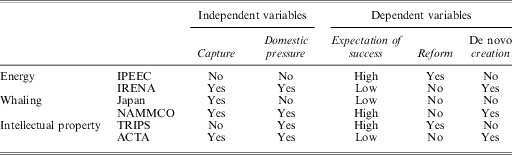
Table 1 gives an overview of the key variables and outcomes across the six cases: cases that combine institutional capture with strong domestic political pressure (IRENA, NAMMCO, ACTA) indeed resulted in de novo creation. In contrast, the expectation of success is not correlated with the value of the dependent variable.
Summary of Empirical Results

Note: de novo institutional creation does not include regime shifting (for example, TRIPS) or nesting of a new initiative within the extant focal institution (for example, IPEEC), which we code as reform offers. The combination of institutional capture and domestic political pressure induces de novo institutional creation, while the expectation of success does not vary with de novo institutional creation.
Energy
The IEA has long been the focal multilateral organization for energy issues. When the G8 countries and their emerging partners decided in 2009 to create a new agency for energy efficiency, they naturally turned to the IEA to host it. The IPEEC was therefore nested within the IEA. In stark contrast with IPEEC, IRENA was established without any formal link to the IEA. Given the IEA's expertise on energy policy, including on renewables, the de novo creation of IRENA is puzzling. It is even more startling because the leading states behind IRENA's creation – Germany, Denmark and Spain – are all IEA founding members.
IRENA's creation can be explained as a strategic move by a set of countries led by Germany to offset the IEA's perceived bias in favor of the fossil fuel and nuclear industries. Domestic politics played a critical role in pushing this initiative forward.Footnote 43 IPEEC, by contrast, was not the object of fierce domestic political debates, but rather of a technocratic consensus.
IRENA
De novo creation. IRENA was established in January 2009 by seventy-five countries in Bonn, Germany. Currently, more than 100 countries have ratified it.Footnote 44 In April 2011, the Assembly held its first meeting in Abu Dhabi.
Top IEA officials were not pleased when some member states created another international organization on the IEA's turf. The IEA had already set up a Working Party on Renewable Energy Technologies in 1982. Moreover, the agency operates Implementing Agreements on specific renewable energy technologies. William Ramsay, the IEA's deputy executive director from 1998 to 2008, called IRENA ‘a distraction that is going to cost a lot of staff time’, claiming that ‘the IEA has pushed back IRENA two or three times before it was actually established’.Footnote 45 Claude Mandil, former director of the IEA, concurred: ‘we are very opposed, not to renewables, but to this new agency’.Footnote 46
Reform Offer . Since the late 1990s, there have been intermittent calls within the IEA to focus more on renewables. In response, the IEA created a Renewable Energy Unit in 1999 to support the Working Party on Renewable Energy Technologies. Since 2004, the agency has also maintained a ‘policies and measures’ database on renewable energy. Yet many proposals to ramp up the agency's activities have been defeated. When the IEA Secretariat tabled such an initiative in October 2001, the Governing Board reacted with skepticism and requested further analytical work.Footnote 47
These minor programmatic and organizational modifications did not satisfy the challenger. The German government strongly believed that renewables needed an additional push. Berlin was convinced that the IEA's mandate was too broad to provide visionary leadership on renewables.Footnote 48 Germany's view was shared by Spain and Denmark.Footnote 49
Institutional Capture . The Germans were dissatisfied with the IEA because, in their eyes, the agency was captured by specific interests. In an official document, the German government lamented the fact that the IEA analyzes its member countries’ energy policies ‘without fully reflecting the potential of renewable energy’.Footnote 50 The Energy Watch Group, a transnational coalition of parliamentarians and scientists, published a report in December 2008 accusing the IEA of blocking a global switch to renewables. To Rudolf Rechsteiner, a member of the Swiss Parliament and author of the report, these projections evidenced that the IEA was ‘delaying the change to a renewable world [by] touting nuclear and carbon capture and storage, classical central solutions, instead of a more neutral approach, which would favor new solutions’. He accused the IEA of suffering from ‘institutional blindness’ on renewable energy.Footnote 51 His opinion was shared by Hermann Scheer, the German Social Democrat who pioneered the idea of IRENA, and who claimed that the IEA ‘leaves no stone unturned when it comes to emphasizing the long-term indispensability of nuclear and fossil energy’.Footnote 52
This case features institutional capture. Germany, supported by Spain and Denmark, demanded a radical change in the IEA's policies toward renewables. These challengers wanted to alter the IEA's internal governance structures so that renewable energy would figure more prominently in its analyses. Other members of the IEA, notably the United States, were satisfied with the IEA's work and did not want the agency to change in a drastic way. The challengers voiced their criticism and tried to reform the IEA from the inside but, despite these efforts, the distributional conflict could not be resolved.
Domestic Political Pressure . This transnational coalition merely amplified the message that Scheer had been advocating for years in German domestic politics. Scheer orchestrated a campaign in the early 1990s to promote the creation of IRENA. When his political party, the SPD, formed a coalition government with the Green Party (Bndnis 90/Die Grnen) in 1998, Scheer acquired a high-level platform to sell his idea. He was one of the main proponents of the Johannesburg Renewable Energy Coalition, the 2004 Renewables conference in Bonn, and the German diplomatic campaign that eventually led to IRENA.
Expectation of Success . Although IRENA is now a functioning agency, only a few years ago this possibility was in great doubt. Past experience with similar efforts testifies to the tremendous difficulty of the effort, so this case can be coded as having a low expectation of success.
In the early 1990s, Scheer tried to sell his original idea for an international solar energy agency by approaching the United Nations Secretary-General, the United States Senate and the European Commission, but his efforts were in vain. In 2000, the G8 set up a Renewable Energy Task Force only to completely discard its recommendations at the next annual summit. German hopes for a strong resolution on renewable energy at the 2001 World Summit on Sustainable Development quickly proved idle, the Johannesburg Renewable Energy Coalition that was set up afterwards did not lead to any breakthroughs, and the final declaration of the 2004 Bonn conference did not mention IRENA even once.
When IRENA was created in January 2009, it initially failed to muster broad support among the world's leading and emerging powers. Conspicuously absent from the seventy-five original signatories were G8 countries Canada, Japan, Russia, the United Kingdom and the United States; and global South leaders such as Brazil, China, India, Mexico and South Africa.Footnote 53 Germany and its allies risked saddling up with a flock of developing countries that were mainly interested in funds and technology transfer.
The case of IRENA supports our hypotheses. The perceived capture of the IEA and domestic political pressure in Germany paved the way for IRENA. The IEA had proven so resistant to demands for change that a reform of the IEA was no longer considered by the challenger.Footnote 54 The expectation of success was low, yet IRENA was created.
IPEEC
De novo creation. The idea for a new global initiative around energy efficiency originated from the European Commission. In 2006, the Commission proposed an international framework agreement on energy efficiency with specific targets and timetables.Footnote 55 It did not specify whether this agreement would be embedded within an existing institutional framework. The Commission's proposal appeared in the German draft of the G8 leaders’ declaration in the run-up to the 2007 Heiligendamm summit. Yet it was scrapped due to opposition from the United States and the big emerging economies.Footnote 56 A weakened version received the backing of the G8 countries plus China, India, South Korea and the EU, which had gathered at the meeting of G8 energy ministers in Aomori, Japan (June 2008). IPEEC would be created, but not as a stand-alone agreement.Footnote 57
Reform Offer . When the signing ceremony for IPEEC was held during the G8 energy ministerial in May 2009 in Rome, it was formally decided to nest the Partnership within the IEA. To that end, the ministers of the fourteen founding countries of IPEEC also signed a memorandum asking the IEA to host the IPEEC Secretariat. Even though IPEEC has a separate budget and carries out an independent work program, the embedding of its Secretariat within the IEA structure creates a novel way for the IEA to reach out to non-member countries beyond the Implementing Agreements. This constitutes a reform of the IEA.
Institutional Capture . The conflictual issues concerning energy efficiency could be resolved within the confines of the extant, focal organization. One underlying reason is that no key member state found the IEA captured in regard to energy efficiency.
Domestic Political Pressure . While IRENA clearly served identifiable domestic constituencies in Germany and elsewhere, there was virtually no domestic political pressure to create IPEEC. Indeed, the very idea of IPEEC did not originate from an individual country, but from an international organization, the European Commission.Footnote 58
Expectation of Success . At the Heiligendamm summit, the IPEEC proposal failed to mobilize sufficient support among the G8 members. Germany, holding the EU presidency at the time, took the proposal to the fifteenth session of the United Nations Commission on Sustainable Development (May 2007, New York), but no agreement was reached.Footnote 59 When the proposal was watered down to a voluntary partnership at the 2008 G8 energy minister's meeting, resistance faltered. Henceforth, the proposal received firm support from Japan and the United States.Footnote 60 Therefore, the IPEEC proposal is coded as a high expectation of success.
What sets IPEEC apart from IRENA is the absence of a strong energy efficiency industry, the lack of a well-organized political lobby and the low probability of getting domestic political rewards from establishing a new organization in this field. The European Commission's advocacy of IPEEC was less resolute than Scheer's passionate plea for IRENA. Moreover, IPEEC was cast less in conflictual terms than IRENA.
Whaling
Since 1946, the IWC has been the primary global organization designated to manage whaling. Its original mandate was to promote the sustainable hunt of whales. During the 1970s and 1980s, the regime's management policies came under pressure due to the influx of non-whaling nations and the cessation of commercial whaling in many of the original members. These shifts transformed the whale conservationist club into a whale preservationist club that was preoccupied with the protection of whales. In 1982, a three-fourths majority within the IWC approved a complete moratorium on whaling beginning in 1986. The moratorium was intended to last for five years, but it has been extended to date.
Pro-whaling nations are very dissatisfied with the continued anti-whaling stance of the IWC. Yet their reactions to the situation differ. While Iceland and Norway took the initiative to set up a competing organization, the North Atlantic Marine Mammal Commission (NAMMCO), another highly dissatisfied state, Japan, has refrained from either joining NAMMCO or creating a regional whaling organization of its own.
NAMMCO
De novo creation. The extension of the IWC's five-year moratorium for each year after 1990 has greatly frustrated the pro-whaling nations. In response, Iceland and Norway decided in April 1992 to create NAMMCO. Disgruntled with the IWC, Iceland even left the Commission in 1992. Norway, for its part, resumed commercial whaling in 1993 under the IWC's objection procedure, but it remained highly discontent. StoettFootnote 61 even suggests that the only reason Norway did not leave the IWC is that it wanted to leave open the policy option of joining the EU. Over the same period, other strong pro-whaling nations threatened to withdraw from the IWC and create regional management groups similar to NAMMCO. For many observers, the international whaling regime was in danger of disintegration.Footnote 62
Reform Offer . The trigger for the creation of a competing institution by Iceland and Norway was the failure to reform the IWC's zero-whaling regulations. In the early 1990s, the IWC's Scientific Committee had stated that, due to the recovery of whale stocks, about 2,000 minke whales could be harvested each year without endangering the population. Consequently, the IWC adopted a computerized formula, the Revised Management Procedure, in 1994 determine allowable catches of some whale species. But while accepting the formula, the IWC voted to maintain the blanket moratorium on whaling.Footnote 63 States favoring the restoration of whaling were completely rebuffed in all of their requests within the IWC: not only did the Commission refuse to lift the moratorium, it also blocked efforts to impose quotas on small nearshore whaling off the coast of Japan, whaling in the North Atlantic or the Arctic, and minke whaling in the Southern Ocean.
Institutional Capture . The failure to reverse the IWC's moratorium policy has fed the pro-whaler's perception that the IWC is ‘hijacked’ by the environmental lobby.Footnote 64 The pro-whaling states complain that the IWC is ‘prone to political bias’.Footnote 65 As FriedheimFootnote 66 puts it, ‘the anti-whaling forces have captured the delegations of the major states’. Over time, the whaling states have become increasingly convinced that future IWC policy would remain unresponsive to scientific discourse.Footnote 67 DeSombreFootnote 68 attributes the longevity of the moratorium to a successful strategy of ‘bribing’ and ‘bullying’ states into the IWC.
In short, the salient disagreement between the pro- and anti-whaling states could not be resolved. Due to the IWC's changing membership demographics, the pro-whalers were simply outnumbered by the defenders of the status quo. In this context, they could not expect the three-fourths majority required to reverse the moratorium anytime soon. The case thus features all the elements of institutional capture: distributional conflict, asymmetry of influence and the perception by the challengers (the pro-whaling states) of a systematic bias against them.
Domestic Political Pressure . Domestic political forces played a critical role in the creation of NAMMCO. In Norway, Prime Minister Gro Harlem Brundtland orchestrated a unified political strategy in favor of tougher action from the pro-whaling nations. The prime minister's office wanted to follow the advice of the scientific community, which provided support for the continuation of whaling. They were also receptive to the arguments of the whalers, who were lobbying the government actively and effectively for the resumption of whaling. Moreover, the whalers got support from the fisheries sector at large. ‘Generally, this group saw the IWC as fundamentally flawed; they were tired of being harassed at the yearly IWC sessions and wanted Norway to leave the IWC and instead try to set up some alternative management body.’Footnote 69
Similarly, in Iceland, a majority of domestic actors was willing to take some risks in order to resume whaling and supported the creation of NAMMCO in 1992. However, as Norway demonstrated from 1993 that even an IWC member can conduct commercial whaling, the need and credibility of the threat to exit was reduced. In Iceland, the actors that feared the negative economic consequences of more assertive actions by the pro-whaling nations gradually came to outvote the forces in favor of unilaterally resumed whaling.Footnote 70 This shift in the domestic game enabled Iceland's re-entry to the IWC in 2002.
Expectation of Success . When Norway and Iceland set out to create NAMMCO, ‘there was hope that NAMMCO would attract more members and thereby provide a broader political base and represent a more realistic alternative to IWC’.Footnote 71 This hope was based on the fact that seven pro-whaling nations had come together each year since 1988, including Japan, Canada and the Soviet Union. So, the case is coded as high expectation of success.
NAMMCO is a clear case of dissatisfaction due to institutional capture and domestic political pressure causing challengers to create a countervailing institution. When they set up NAMMCO, Norway and Iceland hoped that other pro-whaling states would join although none has.
The non-creation of a Pacific Whaling Commission
De novo creation. Frustrated with IWC developments, Japan has repeatedly stated its intention to create a regional whaling body in the Pacific Rim.Footnote 72 The latest such announcement came in 2009, when it backed a proposal by a pro-whaling nongovernmental organization for a new international treaty to manage the world's whale stocks.Footnote 73 Despite all these threats, Japan has not left the IWC.
What is more, among the main pro-whaling countries, Japan has been the most loyal: it has withdrawn its objection to the moratorium, conducted only scientific whaling and remained within the IWC.Footnote 74 Given that large powers are especially adept at forum shifting,Footnote 75 one would expect Japan to create a countervailing institution sooner than Iceland and Norway.
Reform Offer . Japan pressed for reform within the IWC in the early 1990s, but it has suffered one diplomatic blow after another. First, Japan tried to win recognition of a special exception for small-type coastal whaling, but its arguments fell on deaf ears. Then it developed a new action plan for community-based whaling, but this proposal was also rejected. When the Southern Ocean Sanctuary was discussed, Japan, Norway and several Caribbean states unsuccessfully tried to get an exception for hunting minke whales. Worse, when the sanctuary was finally put to the vote, Japan was the only state to vote against it; even Norway abandoned Japan by abstaining.Footnote 76 Japan has also tried to use the Convention on International Trade in Endangered Species as an alternative international forum for regulating whaling, though without success.Footnote 77 Thus the strategy of regime shifting did not produce a generous reform offer.
Institutional Capture . In the previous section, we provided evidence that ‘an anti-whaling coalition was able to “capture” the IWC’.Footnote 78 Two factors make capture even more pronounced in the case of Japan. First, no other whaling state has been under such vehement criticism. According to Friedheim,Footnote 79 the 1994 Southern Ocean Sanctuary ‘was obviously directed at one member state who wished to resume commercial harvests in the Southern Ocean – Japan’.
Secondly, the IWC's moratorium is sealed by the willingness of the United States to act unilaterally against states that violate the moratorium. As the whaling regime policeman, the United States has introduced a ‘double standard’ in the IWC, distinguishing between permissible whaling conducted by Norway, Iceland and aboriginals and impermissible whaling conducted by Japan.Footnote 80 The United States has adopted a much tougher stance toward Japan than toward any other whaling nation.Footnote 81
Domestic Political Pressure . Domestic constraints prevent Japan from walking out of the IWC and setting up a Pacific Whaling Commission. While restoring Japan's right to whaling receives broad support among the Japanese public, there is dissent regarding how far Japan should go to achieve this goal.Footnote 82 Overall, the hardliners who favor an exit from the IWC are outnumbered by those favoring a cautious diplomatic approach.
Japan's behavior results from a rational cost-benefit calculation: the whaling issue is not important enough related to wider Japanese interests. To be sure, whaling is a truly marginal industry in Japan compared to other whaling countries. Given the US double standards approach, however, Japan faces much higher risks and costs of retaliation if it creates a new institution than Norway and Iceland. The fear of negative economic consequences from trade sanctions and reputational damage is therefore greater in Japan than in other countries, and far outweighs its wish to resume whaling.Footnote 83 Moreover, contrary to Norway, where the whaling issue was framed (including by the prime minister) as a matter of resource management principles and as involving (marine) fisheries at large, no similar development took place in Japan.
A related reason why Japan has not walked out is its ability to secure desired outcomes within the IWC, despite the whaling moratorium. Since 1987, Japan has continued to conduct permissible ‘scientific whaling’. The aim of scientific whaling is to show that a return to regulated commercial whaling is feasible.Footnote 84 However, Japan seems quite satisfied with this status quo.Footnote 85 This view is supported by Japan's diplomatic campaign to use aid money to buy votes in the IWC.Footnote 86 If Japan thought that exit was worth the cost, why would it still invest in buying votes within the IWC?
Expectation of Success. The expected success of a Japanese regional counterregime to the IWC is low. To be sure, Japan is a large power capable of creating new regional institutions, and China and South Korea have expressed interest in joining a Pacific Whaling Commission.Footnote 87 Yet possible US retaliation could jeopardize the whole enterprise by stirring domestic opposition and dissuading other states from joining Japan's organization. The precedent of NAMMCO also illustrates the risk that such a whalers’ club will not receive firm backing, even from whaling states.
There is clear evidence of institutional capture of the IWC. However, the lack of strong domestic political forces in Japan demanding the creation of a new regime has prevented the creation of a Pacific Whaling Commission. Our model predicts that such a Commission is likely only if the IWC reform processes remain stagnant and the political forces in Japan begin to support de novo institutional creation.
IP Rights
In 1974, WIPO was established as the cornerstone of the international IP regime. Dissatisfied with what they perceived as the permissive nature of the WIPO regime, developed countries successfully introduced a discussion on IP rules in the Uruguay Round of multilateral trade negotiations in the 1980s. Those negotiations led in 1994 to the creation of the WTO and the adoption of TRIPS. As a result of this regime shift, the WTO has arguably replaced WIPO as the single most important organization for IP regulation.Footnote 88
The same set of countries is now pushing for even more stringent IP protection rules through ACTA. First proposed in 2007, the negotiations were successfully concluded in November 2010. The treaty is now open for ratification. ACTA is a new plurilateral agreement that promulgates a maximalist IP agenda. Strikingly, it is being developed outside the existing institutional structures, most notably WIPO and the WTO, even though ACTA builds to a large extent on the norms and rules that are propagated in the WTO-TRIPS agreement. But why was the TRIPS agreement nested within the WTO, instead of the hitherto focal WIPO? And why was the ACTA treaty not nested within the WTO, even though it built on TRIPS rules?
TRIPS
De novo creation. In April 1994, the Uruguay Round was concluded. The TRIPS agreement was not signed as a stand-alone treaty but nested within the established GATT/WTO structures. This regime shifting was consequential because it not only elevated IP protection standards, but also made them legally binding under the WTO dispute settlement mechanism, thus permitting the use of trade sanctions to enforce IP standards.Footnote 89
Even if the original introduction of IP to the trade regime resulted in the creation of a countervailing institution to WIPO, it did not involve de novo creation. While the WTO was a new organization, it replaced (and further expanded) the same basic rules that had governed the GATT. So, the WTO-TRIPS agreement was normatively and institutionally nested within the extant trade regime.
Reform Offer . Since its creation in 1974, WIPO has had great difficulties in establishing minimum international standards of IP protection. With the growing economic significance of IP, the largest IP producers have become increasingly dissatisfied with the WIPO's ineffectiveness. At the same time, developing countries have sought adjustments to the international copyright and patent regimes.Footnote 90 Attempts to reconcile the interests of industrialized and developing countries within WIPO failed, and the revision of the Paris Convention that began in 1980 was never completed. This stalemate induced the United States to consider GATT as an alternative forum.
In a sense, the shift from WIPO to GATT was a reform compromise based on issue linkage. The industrialized countries had their way with regard to IP. For developing countries, increased market access under the WTO promised substantial benefits.
Institutional Capture . The United States was displeased with the lack of progress on IP protection under WIPO. The United States could always expect to be outvoted by developing countries in the ‘one-country, one-vote’ WIPO and other relevant United Nations bodies.Footnote 91 With the negotiations on the reform of the Paris Convention in deadlock, no parties in this North-South conflict were particularly satisfied with the status quo.Footnote 92 Developing countries also began to push for changes to the old rules, while the United States and the European Community wanted to ratchet up those rules. No single group was able to command sufficient support to rig the rules of global IP regulation in its favor. So a negotiation gridlock was present, but institutional capture was not.
Domestic Political Pressure . Domestic forces, particularly in the United States, have been central to the establishment of TRIPS within the WTO. For example, consider the Advisory Committee for Trade Negotiations (ACTN) was designed to provide direct business sector input into US trade policy. The ACTN established a Task Force on Intellectual Property, the recommendations of which were fundamental to the development of an American strategy for IP.Footnote 93 In 1986, twelve US business leaders organized themselves in an Intellectual Property Committee and were able to forge a transnational consensus among the business communities of the developed nations that IP rightly belonged in the GATT.Footnote 94
These groups were keen to shift IP from WIPO to GATT, and their influence in the hegemonic United States was extraordinary. According to Sell,Footnote 95 ‘twelve corporations made public law for the world’. These corporations ‘appealed to both legislative and executive branches in their quest for globalizing IP protection’.Footnote 96 Their work was greatly facilitated by public concern about the US trade deficit: ‘Conscious that the US government was increasingly worried about its burgeoning trade deficit and its ability to effectively compete internationally, the IP lobby astutely packaged its demands as a solution to America's trade woes.’Footnote 97
Expectation of Success . TRIPS is an unambiguous case of a high expectation of success, because the industrialized countries had demonstrated their willingness to apply trade sanctions against recalcitrant developing countries. The existence of a clear precedent meant that industrialized countries’ threat to apply sanctions against developing countries that failed to comply with the rules promulgated by a new IP institution was credible and effective in expectation.
At first, the developing countries had boycotted the negotiation on TRIPS within the Uruguay round on the basis that WIPO was the proper forum for IP discussions.Footnote 98 Nevertheless, the larger developing countries eventually acquiesced to the decision to include IP in the Uruguay Round under the threat of sanctions by the United States, acting under the notorious Section 301 of its domestic Trade Act of 1974, or because they hoped it would get them concessions elsewhere, notably in agriculture.Footnote 99 As soon as a transnational business coalition had forged a consensus among the ‘quad’ (the United States, European Community, Japan and Canada) on the usefulness of including IP in the multilateral trade talks, TRIPS was bound to succeed.
TRIPS is an unusual case. Despite widespread dissatisfaction with the WIPO, institutional capture was not present because neither side benefited from the WIPO negotiation gridlock. The Uruguay Round allowed industrialized countries to use TRIPS to promote their aims, while the developing countries accepted TRIPS in exchange for WTO membership. Thus the most conflictual outcome of de novo institutional creation was avoided.
ACTA
De novo creation. ACTA is a new plurilateral agreement on IP that was negotiated between 2008 and 2010. Since May 2011, the treaty has been open for ratification by the negotiating parties and other WTO members. In contrast to TRIPS, the creators of ACTA deliberately decided to create a new agreement.
Reform Offer . Industrialized countries with domestic industries that benefit from strong IP rights have sought to build on TRIPS by further expanding those rights. Yet, particularly in the aftermath of the ‘Battle of Seattle’, these efforts have made little progress. Developing countries have increasingly stood up to the rich countries on this issue, both within the WTO and by grafting IP protection onto the agenda of other international organizations more favorable to their interests.Footnote 100
Institutional Capture . The primary motivation to create ACTA as a stand-alone organization, rather than as a nested regime within the WTO, was that in recent years the proponents of an ‘IP maximalist’ agenda have been increasingly rebuffed by developing countries.Footnote 101 The WTO structure has become unreceptive to an expansionist IP agenda because the developing world has become more vocal in its opposition. The fact that the WTO named its latest round of multilateral trade talks the ‘Doha Development Agenda’ is emblematic of this shift. Developing countries successfully pushed through the adoption of acts like the Doha Declaration on TRIPS and Public Health, which takes their interests more into account.
Within WIPO, similarly, a coalition of developing countries pushed for the adoption of the ‘Development Agenda’ in 2004, which ‘aims to overhaul WIPO's mandate to reframe IP as a tool for development, rather than as an end in itself’.Footnote 102 It is no coincidence that the ACTA initiative was first proposed by the United States, Japan and the European Commission just two weeks after WIPO's formal adoption of the Development Agenda. Developing countries also successfully rebuffed American and European efforts to pursue a TRIPS-plus Substantive Patent Law Treaty at WIPO. Since the WTO and WIPO came to adopt declarations that were at odds with American and European policy preferences, and since their attempts to reverse this course were stymied by the increased activism of the developing countries, the developed countries decided to negotiate a plurilateral anti-counterfeiting treaty.
The salient disagreement between the challengers (IP maximalist industrialized countries, notably the EU and the United States) and the defenders (developing countries) did not result in a strengthening of the IP rules and standards within the WTO or WIPO, despite loud calls for such changes. This fed the IP maximalists’ perception that those institutions were captured by opposed interests, which were able to install and maintain a distributive bias against them. In other words, those institutions were captured in a way that made them impermeable to demands for changes that could attenuate the institutions’ perceived bias against a maximalist IP agenda.
Domestic Political Pressure . ACTA is part of a relentless quest by a group of actors for stronger, global IP protection rules. The primary actors behind this move are the most economically advanced countries, which perceive IP protection as part of their vital national interests. The domestic lobbying coalition consists mainly of the globally oriented entertainment and high-technology industries in the United States, the EU, Switzerland and Japan.Footnote 103 According to Sell,Footnote 104 the recent push for ACTA emerged in 2004 at the first annual Global Congress on Combating Counterfeiting, sponsored by the Global Business Leaders’ Alliance Against Counterfeiting.Footnote 105
Expectation of Success . Most observers expect the major industrialized countries to promote ACTA by making its ratification a condition for the formation of preferential trade agreements. Contemporary research on these agreements suggests that their proliferation can result in costly trade and investment diversion for developing countries that are unfortunate enough to remain outsiders.Footnote 106 Given these costs, industrialized countries could promote ACTA by simply threatening to refuse preferential trade co-operation in the absence of an ACTA commitment. However, this strategy only works toward countries that are eager to obtain trade benefits from the United States or the EU. Emerging countries such as China and India have shown no desire to join ACTA.Footnote 107 Moreover, the recent US strategy of creating a more stringent patent protection system than the one stipulated in TRIPS by concluding bilateral agreements has not succeeded in inducing major trading partners or major counterfeiters to adopt higher IP enforcement standards.Footnote 108 Therefore, we code Expectation of Success as low.
ACTA resulted from domestic pressure in industrialized countries to raise global IP standards. These countries have become dissatisfied with the WTO and WIPO as sites for global IP governance because those institutions have been captured by developing countries. ACTA has a low expectation of success of becoming the ‘global standard’, given past experience with bilateral treaties and the apparent opposition from leading developing countries.Footnote 109
Alternative and Complementary Explanations
Our model can shed light on the six cases, but how well does it perform in comparison with existing theories? Functionalist approachesFootnote 110 cannot explain variation in our cases, because a focal institution was present in all of them. Therefore, if states had collectively minimized their transaction costs, de novo institutional creation should not have occurred.
Jupille and SnidalFootnote 111 have modified this approach to allow for bounded rationality and alternative institutional strategies. They lay out a repertoire of institutional choice including use, selection, change and creation. They find that variation in institutional choice responds to the nature of the co-operation problem, on the one hand, and the institutional status quo, on the other. In particular, they emphasize that the expectation of successful institutional creation should, in conjunction with the absence of a clear focal institution, prove conducive to de novo institutional creation.Footnote 112 We find, however, that the expectation of success is irrelevant and that de novo creation occurs even where there is a focal institution.
Power-based explanations offer more leverage on our case studies. DreznerFootnote 113 argues that distributional conflict between major powers can be expected to result in the creation of incompatible rules and standards. Thus distributional conflict between relatively symmetric powers should maximize the probability of de novo institutional creation. In asymmetric circumstances, such creation is not necessary because the more powerful state can use existing institutions. At first sight, this sits uneasily with the whaling case in which two small countries, Iceland and Norway, were willing to take bold steps to set up a rival institution, whereas a regional power, Japan, was not. However, given the role of the United States as the whaling regime ‘policeman’ (which in turn reverberated in domestic politics) and its double standards approach, the outcomes are in fact quite consistent with power-based insights.
Finally, world society and legitimacy-based approaches may also be more complementary than alternative approaches, even though they do not shed light on variation in bargaining dynamics. As CottrellFootnote 114 notes, a low legitimacy of an existing institution could also cause de novo institutional creation. World society scholars argue that state policies are driven by normative pressure emanating from the international community.Footnote 115 This might help increase our understanding of why more states did not join Iceland and Norway in NAMMCO, and of why IRENA has been very successful in enticing IEA members to join.
CONCLUSION
The world is full of international institutions. Why do some overlap? We have proposed a bargaining approach. We have shown that institutional capture and domestic political pressure increase the probability of de novo institutional creation, whereas the expectation that a fledgling institution will succeed is irrelevant. These findings can explain important and puzzling cases in the issue areas of energy, whaling and IP rights.
The creation of new, stand-alone institutions that overlap with existing ones is associated with the capture of the focal institution and domestic pressure. The model and empirical findings suggest that, if neither condition is met, de novo creation will not occur. Moreover, neither condition seems to be sufficient in and of itself. It is the combination of the two conditions that is sufficient to explain de novo creation. At the same time, we acknowledge that they are clearly not necessary, and that other pathways to de novo creation offer exciting opportunities for future research in international relations.
Ours is the first strategic model of the origins of overlap. Previous studies have examined the choice between extant and new organizations, the practice of regime shifting and the functionalist logic of international institution design. However, they have not managed to incorporate bargaining dynamics into state interactions. Given the importance of distributional conflict and power politics in international relations, this omission is both theoretically and empirically troubling. We have proposed a solution and conducted a plausibility probe with evidence from six cases.
Our contributions to international relations theory are threefold. First, by offering a bargaining account of power politics in institutionalist co-operation theory, we add to the line of enquiry on distributional conflict in international co-operation advanced previously by KrasnerFootnote 116 and others. Secondly, we provide new insight into the patterns of growth in the number of international institutions, especially since the end of the Second World War.Footnote 117 Finally, the findings are particularly important in the present situation characterized by emerging powers, such as China and India. These powers hold revisionist preferences on many issues, which alters the bargaining situation and makes our bargaining approach particularly relevant. We suggest that institutional capture, perceptions of such capture and the presence of intense domestic political pressure are key factors in shaping bargains that generate new institutional initiatives and institutional reform.