At the beginning of the Panathenaic festival in 514 bc, two kinsmen of the genos Gephyraioi, Aristogeiton and Harmodios, assassinated Hipparchos, the brother of the reigning tyrant in Athens. Harmodios was killed on the spot by Hipparchos’ guards; Aristogeiton was executed later after torture. Four years later, Hippias was removed from power through the efforts of the Spartans and the aristocratic Alcmaeonids. Some three years after that, the reforms of Kleisthenes were instituted, which led to the Athenian democracy. Though Athenians knew well that the overthrow of Hippias was a result of Spartan intervention,Footnote 1 many early on seem to have celebrated Harmodios and Aristogeiton as the originators of the movement that ultimately led to the democracy. As one scholar has suggested, ‘the Tyrannicides started a revolution which in four years swept away the tyranny’.Footnote 2
We have two types of ancient sources that refer to these events: textual and visual. Our earliest textual sources are by the fifth-century historians Herodotus and Thucydides.Footnote 3 Our visual sources, for which we have only Roman copies and depictions mainly on Attic vases, are bronze statues in honour of Harmodios and Aristogeiton by Kritios and Nesiotes set up in the Athenian Agora in 477 bc.Footnote 4 Scholars have tended to rely on the texts to interpret the sculpture, and this reliance – cross-pollination – may have blinded us to the original meanings of the sculpture. What follows is an attempt to separate the textual from the visual and to look anew at the famous sculpture by Kritios and Nesiotes.
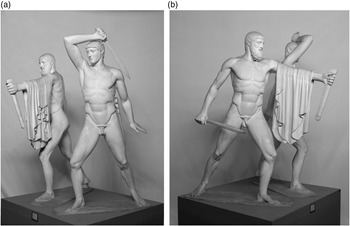
The bronze statues in honour of the Tyrannicides, Harmodios and Aristogeiton, by the sculptors Kritios and Nesiotes (figure 1) stood in a prominent place in the Agora for several centuries and were without any doubt among the best-known sculptures in Athens throughout the classical and Hellenistic periods. They were set up in the Agora in 477 bc as replacements for an earlier version by Antenor, which had been taken to Susa by the Persians after their sack of Athens in 480 bc. These were the earliest and only such memorials for mortals to be allowed in the Agora until the 390s bc; even in the Hellenistic period, edicts prohibited the placing of sculpture near the Tyrannicides.Footnote 5
The Tyrannicide group (reconstruction), Plaster-cast copies (Museo dei Gessi, University of Rome; Photos: H. Schwanke, D-DAI-ROM 84.3301, 84.3303)

We know nothing about the form of Antenor's group,Footnote 6 and our knowledge of the appearance of the group by Kritios and Nesiotes, as already noted, comes largely from Roman copies in marble and images mainly on some fifth-century Attic vases.Footnote 7 An epigram carved on the base of the original monument included the names of Aristogeiton and Harmodios.Footnote 8 One figure, a mature bearded male, holds out a scabbard with his left hand, a cloak draped over that arm, while a sword is at the ready in his right hand. The other figure, a beardless young adult, swings a sword with his right hand back over his head, about to strike.Footnote 9 The older figure is traditionally referred to as Aristogeiton, the younger as Harmodios. Both figures are naked and stride forward – the older leading with his left foot, the younger with his right.
Thucydides, in his discussion of the Tyrannicides’ motive for assassinating Hipparchos asserts that Harmodios and Aristogeiton were lovers in the tradition of erastes–eromenos, where an older male takes a younger male as a lover. Art historians have tended to focus on the nature of their relationship in interpreting the sculpture. One art historian has recently written of it, ‘the Tyrannicides’ similar poses and physiques yet obvious disparity in age, clearly hinted at their relationship…these bronzes now actively invited [the eroticized glance] by vigorously promoting the homosexual relationship that sustained it’.Footnote 10 Another scholar has referred to Harmodios as ‘the very image of ephebic desirability’.Footnote 11 I suggest that these comments project recent sensibilities that distort a careful reading of the meaning of the sculptures in their original context. The easy adoption of Thucydides’ text defining the relationship of the Tyrannicides has blocked other modern interpretations of the sculpture. But, as we will see, the visual will always trump the power of the word to embody a common vision.
My contention here is that the statues were not intended as likenesses and need not have referred at all to the physical beings of Harmodios and Aristogeiton. Rather, for their figures, the sculptors drew on contemporary depictions of the Gigantomachy, that final great challenge to the authority of the Olympian gods, and specifically on Apollo in the Gigantomachy for the pose of Harmodios. Thus, through a visual allusion to myth, the sculptors created figures that were emblematic of something more than an assassination, a perspective emphasized by the absence of a victim.Footnote 12
Significant honours were accorded to Harmodios and Aristogeiton by the Athenians as early as 510/509 bc when Antenor's bronze statues were set up in the Agora.Footnote 13 After Xerxes absconded with Antenor's group in 480 bc, the new statues by Kritios and Nesiotes were in place within three years.Footnote 14 Other extraordinary honours were awarded to them and their heirs: ‘a share in libations at sacrifices in every shrine and a public funeral cult in perpetuity’.Footnote 15 In addition, their descendants were granted the right to dine at state expense at the Prytaneion.Footnote 16
However, both Herodotus and Thucydides, our earliest sources for the assassination of Hipparchos, raise objections to Athenian celebration of the Tyrannicides. Herodotus writes that the Alcmaeonides ‘were far more liberators of Athens than were Harmodios and Aristogeiton who, by killing Hipparchos, did not put an end to the tyranny but only drove the surviving Peisistratids to savagery’ (6.123).Footnote 17 Thucydides is considerably harsher in his criticism. In Book 1, he uses the assassination of Hipparchos as an example of the way that people accept traditions as they receive them without applying a critical test. His point here is that people think Hipparchos was tyrant when he was killed while, in fact, Hippias was the tyrant. In describing his methodology, he emphasizes the importance of supporting information from an oral tradition with other evidence.Footnote 18
Then in Book 6, while discussing the role of Alcibiades and the Sicilian expedition, Thucydides returns to his theme of people accepting false facts and launches into a substantial digression, claiming that the murder of Hipparchos was a result of nothing more than a love affair. According to Thucydides, Harmodios and Aristogeiton were lovers in a traditional erastes–eromenos relationship and Hipparchos had twice made unsuccessful attempts to seduce the young Harmodios. Enraged by this behaviour and by an insult to Harmodios’ sister, the two hatched a plan with friends to overthrow the tyrants. Thus, according to Thucydides, the principal motive for the attack was personal revenge by angry lovers, not a desire to end the tyranny.
It should be noted here that Herodotus never mentions the erotic element in the assassination, nor does Thucydides in his account of the deed in Book 1, nor is the relationship alluded to in the skolia (songs sung in the context of the symposion) nor does Aristophanes hint at it.Footnote 19 Furthermore, as Sture Brunnsåker noted, ‘Thucydides does not think it necessary to adduce the evidence for this part of his account.’Footnote 20 However, Thucydides’ insistence that the Tyrannicides’ motive was love and not politics seems to be the principal source for later accounts that involve an erotic element and has been, I contend, the source of misinterpretations of the sculpture.
In the Aristotelian Athenian Constitution, written a century after Thucydides and clearly influenced by his account, some details are changed.Footnote 21 There it is Hippias’ half-brother Thettalus, not Hipparchos, who propositioned Harmodios and led to the plot to overturn the tyranny. In the (pseudo-)Platonic Hipparchus, Hipparchos, not Hippias, was the ruling tyrant; Harmodios was the eromenos of Aristogeiton, but at the same time Harmodios was in love with another well-born youth who admired both Harmodios and Aristogeiton. Afterwards, when this youth became associated with Hipparchos, he turned on his former friends, which led Harmodios and Aristogeiton to kill Hipparchos. It would seem that there were several versions of the story afloat in fourth-century Athens, and they all appear to refer back to Thucydides. My point here is not to deal with the relationship between Harmodios and Aristogeiton but to demonstrate how Thucydides’ account has led to a misreading of the famous sculpture.
Neither the argument by Herodotus nor the attack by Thucydides in what D. M. Lewis calls the historian's ‘most combative mood’ seems to have had any effect on the behaviour of most Athenians toward the Tyrannicides.Footnote 22 The bronze group by Kritios and Nesiotes remained in the Agora as the only memorial to mortals allowed there for another four decades, until a sculpture of Konon joined them in 394 bc, and their descendants continued to be honoured.
Returning now to the sculpted pair by Kritios and Nesiotes, there are no surviving references to the group itself until Aristophanes’ Lysistrata in 411 bc.Footnote 23 Thus we have no direct evidence how Athenians understood the sculpture, but we know that it stood in a prominent place in the Agora for several centuries;Footnote 24 it would thus have been well known to the local people, including Thucydides, who was born in the deme of Halimous, about five kilometres from the Athenian Acropolis, some twenty years after the new statues of the Tyrannicides were installed. Though Thucydides never mentions the group in his writing, he is likely to have passed by it hundreds of times in the three decades before he was exiled from Athens in 424 bc; he must have known well the inscription on the base telling that Aristogeiton and Harmodios killed Hipparchos. The fact that the assassination happened more than two generations before Thucydides was born might suggest that his vivid description of Harmodios ‘in the flower of youthful beauty’ and his insistence that they were lovers was at least in part inspired by the sculpture. As James Davidson has suggested, Thucydides’ description of the Tyrannicides might depend on the statues and could be seen as ‘disguised ekphrasis’.Footnote 25
One further point might colour our understanding eof the sculpture and perhaps of Thucydides’ account. As I mentioned earlier, we know that descendants of the Tyrannicides were given special privileges by the Athenians. For Harmodios to have had legal descendants, he would have had to be married and to have produced offspring, in which case, given what we know about Attic marriages, he could well have been in his thirties – certainly not a beardless youth. Prosopographical evidence seems to support this point.Footnote 26 This raises a question as to why he was depicted as a young adult. A likely answer is that the model for Harmodios was Apollo, who is always depicted in this way.
The Gigantomachy, the last great challenge to the authority of the Olympian gods, clearly had special meaning for Athenians.Footnote 27 While there are few fifth-century texts that refer to the battle, the many depictions of it on Attic vases from the middle of the sixth century on through the fifth, along with sixth-century pedimental reliefs from the Acropolis, emphasize its significance. Moreover, it was the subject woven into the Panathenaic peplos and of metopes on the east frieze of the Parthenon, and it was depicted on the inside of the shield held by Phidias’ chryselephantine statue of Athena in the Parthenon itself.
In black-figure depictions of the Gigantomachy from the sixth century, Apollo is a regular participant in large battle scenes, usually accompanied by his sister Artemis, where both of them are shown with drawn bows. The focus of the scenes changes with the advent of red-figure in the late sixth century, where duels tend to replace the larger battle scenes. New elements of imagery are added by early red-figure painters. Giants wearing feline skins often replace the traditional hoplite giants of black-figure, and they are given a new weapon, a single-edged slashing sword, probably called a machaira. Apollo is separated from his sister and given a new pose and weapon, and for the first time he is depicted in duels. In those new scenes, Apollo uses a sword as his weapon instead of his traditional bow, and it is only in depictions of him fighting giants that he uses the sword. He fights a giant on thirteen extant red-figure vases; on all but one of them he uses a sword and in nine of those he adopts the slashing pose with his right foot forward.Footnote 28 No other identifiable figure in surviving Attic imagery is consistently given this pose and weapon. The new Apollo appears nearly a quarter of a century before the statues by Kritios and Nesiotes were created, the earliest being on a fragment of a cup by Euthymides from the Acropolis c. 500 bc.Footnote 29
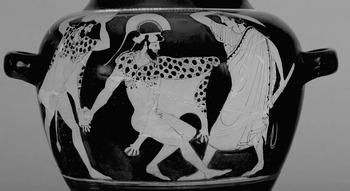
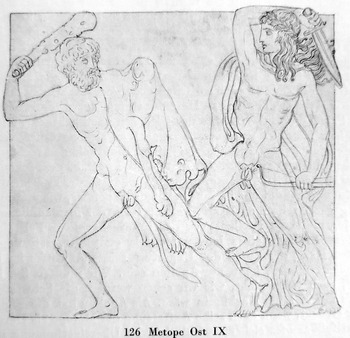
The new Apollo in the Gigantomachy is illustrated well on two vases from c. 475 bc (figure 2).Footnote 30 On both, with his sword swung back over his shoulder ready to strike, he attacks a giant wearing a leopard skin. In both he holds the scabbard in his left hand. The group is essentially the same as the one used nearly half a century later for Apollo fighting a giant on metope IX on the east side of the Parthenon (figure 3). Though that relief is badly damaged, Apollo's pose and orientation can be seen as the same, and it is clear that the giant wears a feline skin.Footnote 31 On both the Parthenon metope and on a late red-figure cup signed by an Aristophanes as painter, Apollo is nude in his fight with the giant.Footnote 32
Attic red-figure stamnos, showing Apollo fighting a giant (British Museum, London, E 443; © Trustees of the British Museum)

Athens, Parthenon metope East IX, showing Apollo fighting a giant (Drawing from C. Praschniker, Parthenonstudien [Vienna, 1928], 210, fig. 126)

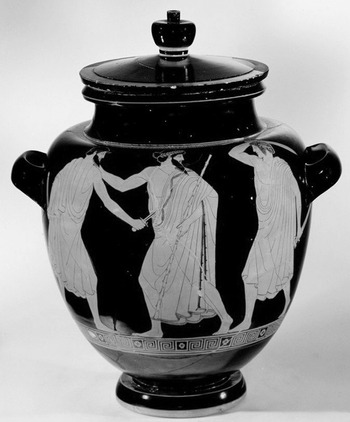
On a red-figure stamnos from c. 475, where Harmodios and Aristogeiton are depicted attacking Hipparchos, the figure of Harmodios is indistinguishable from these depictions of Apollo (figure 4).Footnote 33 Where Apollo's sword seems to be associated with one specific narrative, Harmodios’ sword is associated with another. The sword is a visual key to the connection between them.
Attic red-figure stamnos, showing Harmodios and Aristogeiton attacking Hipparchos (Martin von Wagner Museum, Würzburg, 515)

The sword used by both Apollo and Harmodios is usually a single-edged slashing sword that swells toward the tip, which was probably called a machaira or kopis, distinctly different from the usual sword carried by heroes and warriors on black- and red-figure vases, which has a straight, double-edged blade. In the accounts of the assassination in both Thucydides and the Aristotelian Athenian Constitution, daggers are the weapons carried by the Tyrannicides and their companions. Thus this slashing sword makes little sense in the context of the Agora during the Panathenaic procession; rather the sculptors chose it because of its association with Apollo in a specific context.
Giants comprise the largest single group to use the machaira, and Apollo's employment of it coincides with its adoption as a standard weapon for giants. He uses it only in fights with giants, and no other deity in Attic imagery ever uses it. There must have been a narrative that explained Apollo's unique employment of the sword instead of his bow. While we cannot know the specific source of that narrative, based on the imagery we can guess at its content. Surprised by the attack of the giants, Apollo picked up one of the enemy weapons and used it against them. Supporting this hypothesis is the fact that on the vases he usually holds a scabbard in his left hand with the strap hanging loose, while the giants wear their scabbards attached to baldrics slung over their shoulders.
Whether or not people had seen these images of Apollo with a sword on vases, they would certainly have seen him in precisely that pose on the metope on the east side of the Parthenon, where each of the metopes, carved between 447 and 438 bc, depicts a deity in combat with a giant or giants. Its appearance on a public building commissioned by the demos half a century after its first appearance on vases implies the existence of a well-known visual model in Attica. Elsewhere I have suggested that the model for the new Apollo pose may have come from the Panathenaic peplos, the subject of which was always the Gigantomachy, that final challenge to the authority of the Olympian gods.Footnote 34 Plato in his Euthyphro implies that the images of the Gigantomachy on the peplos were ‘sacred representations’, and thus would have embodied the type of authority that might influence other forms.Footnote 35
Whatever the model for Apollo in the Gigantomachy may have been, by using the well-known image for their depiction of Harmodios, Kritios and Nesiotes intentionally employed the language of myth and so made the image multivalent. As such, the figure of Aristogeiton could be imagined as any one of the senior Olympians involved in the battle with the giants. A depiction of nude Zeus pursuing a giant on a calyx krater from Attica by the Copenhagen painter provides a good parallel (figure 5).Footnote 36 Through a visual allusion to this myth, the sculptors created figures that were symbolic of something more than the assassination. As the gods struggled to maintain/establish their authority in the Gigantomachy, so the Tyrannicides would have come to symbolize the struggle against destructive powers that threatened Athens. By 477 bc, when Kritios and Nesiotes were commissioned by the demos to replace the sculpture by Antenor, Athenians had triumphed in the face of huge threats: they had defeated the Persians at Marathon in 490 bc, and, after the sack of Athens in 480 bc, they had defeated the Persian fleet at Salamis.Footnote 37 The year before the erection of the sculpture, in 478 bc, they had been instrumental in the creation of the Delian League as a defence against future attacks from Persia.
Attic red-figure calyx krater, showing Zeus pursuing a giant (Akademisches Kunstmuseum, Bonn, 71; Photo: Akademisches Kunstmuseum Bonn)

The attitude toward tyranny came to be conflated with the attitude toward Persia.Footnote 38 There is ample literary evidence to show that Greeks associated Apollo's slashing sword (machaira) with Persians and their allies. Whenever a Persian is shown with a sword on an Attic vase, starting early in the fifth century, it is just such a weapon. Aeschylus calls the assembled Persian troops machairophoron, Herodotus associates it with various Persian allies, and Xenophon calls it a Persian cavalry sword.Footnote 39 It seems likely that the new group created by Kritios and Nesiotes was intended to reflect these other triumphs and, as such, was probably very different from Antenor's original group.
The statues in the Agora honouring the Tyrannicides were the first of their kind – dedicated to specific mortals for their contributions to the polis. They have also been called the first political monuments.Footnote 40 There were no precedents for the sculptors to follow. Kritios and Nesiotes chose to honour Harmodios and Aristogeiton by creating images charged with symbolism, drawing parallels between their actions and the actions of the gods as they fought the giants. The two figures represented the protagonists, but they were not intended to depict Aristogeiton and Harmodios any more than the Anavysos kouros was intended to depict Kroisos.Footnote 41 The sculpture captured the deed but transcended it through the language of myth. As Attic tragedians used myth as a means to explore contemporary issues and anxieties, Kritios and Nesiotes did the same with their sculpture. A literal reading of the statues of the Tyrannicides of Kritios and Nesiotes based on Thucydides’ text misses the breadth of meanings that the statues must have held for Athenians. And, as time passed, the sculpture could take on yet new meanings, which is part of the power of an image like this where each generation can read it anew.